

Lucida
Archivist's Excerpt from: Trinkets, Tech, & Tinkery: A Comprehensive Inventory of All Possible Equipment One Might Need When Circumnavigating the World, Inside & Out, Tabletop Edition, CVI 42.5
The Lucida is a curious little instrument, precursor to what would eventually be called the "Camera," a lens-orienting device that would allow an illustrator to effectively and accurately "trace" his optical viewpoint onto paper. Lucidas were sometimes used by illustrators accompanying archaeologists during expeditions prior to the existence of the photographic camera, allowing them to record proper imagery of findings where rubbings were impractical.
One such instrument was used by archaeological illustrator Frederick Catherwood during his time accompanying John Lloyd Stephens on his expedition into Central America and Mexico, which led to their discovery of the Maya civilization in 1839 – 1842, documented in Incidents of Travel in Yucatan by John Lloyd Stephens, Vol I &II, CVI 40.0.
Mechanics & Inner Workings
The artist looks through a mounted prism on an arm, and observes a superimposition of the subject or landscape before the device over the paper below, effectively viewing a "ghost" image of the subject on the paper while he draws or traces over it. The device itself is little more than an armature designed to clamp to a drawing table and position the lens apparatus in a suitable position for viewing of the subject and drawing its image.
History
Although the concept and basic optical principles were postulated by Johannes Kepler in 1611, it was William Hyde Wollaston actually, an English chemist, who actually patented the device in 1806. The name Camera Lucida itself is derived from the Latin "Well-lit-room," as opposed to the Camera Obscure, or "Dark-lit-room."
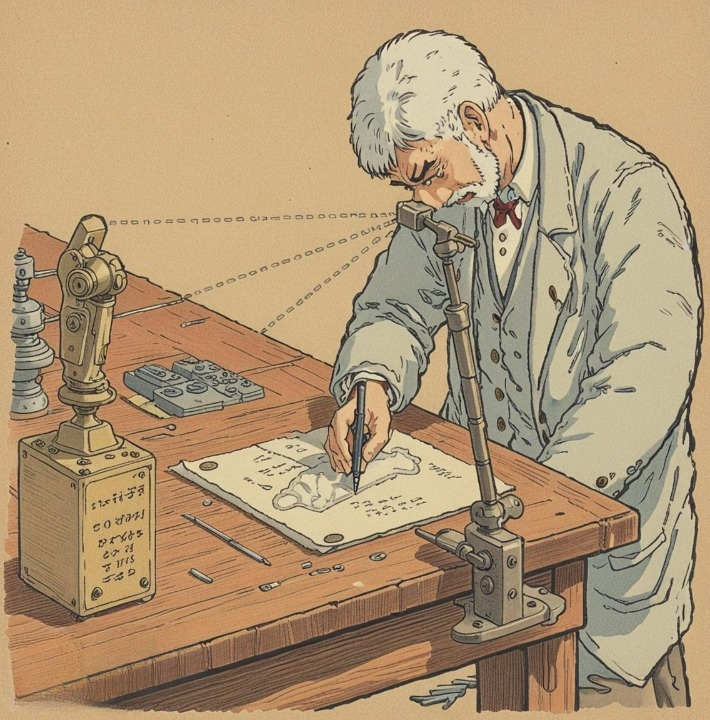
Operation of the Lucida



Comments