
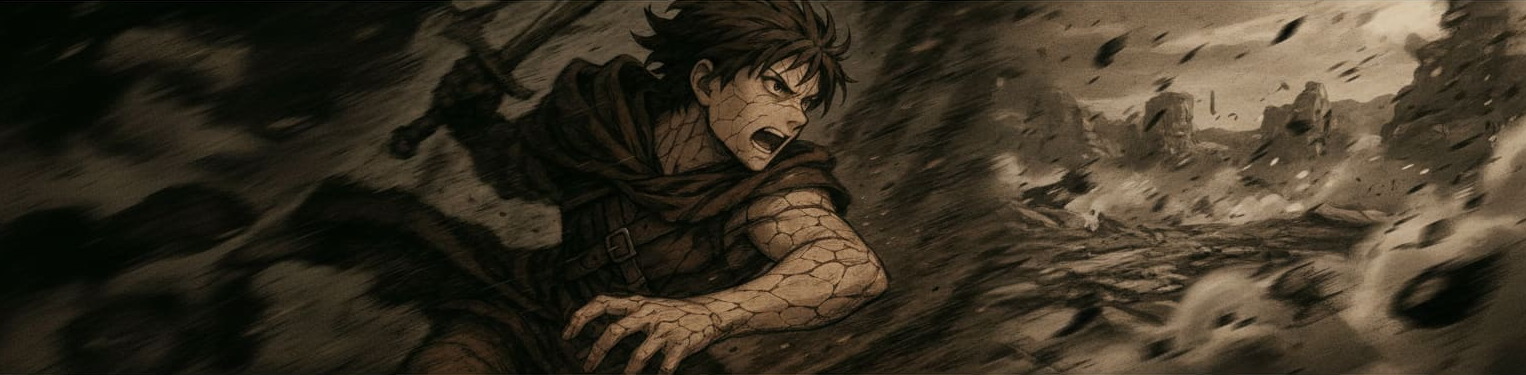
Fissure Syndrome
At last, I believe I’ve found the common thread between every case of Fissure Syndrome I have observed, though it pains me to admit the cause is not nearly so esoteric as I once hoped. No malign spirit. No dormant curse. Nothing that will earn me a statue in the Hall of Arcane Pathologies. No, the world is simply unfinished, and those foolish enough to prod at its rough edges pay the price. An embarrassingly mundane conclusion, but the evidence is irrefutable.
Adventurers appear to be the most susceptible—not because of any biological predisposition, mind you, but because they insist on plunging themselves elbow-deep into the half-baked caverns and crawling dungeons where reality itself hasn’t quite decided on its final draft. They return to me groaning and clutching at their torsos, bewildered that the ground beneath them tried to fold them like parchment. One might think repeated exposure would breed caution, but no. I could wallpaper my office with their cracked skin if I so desired.
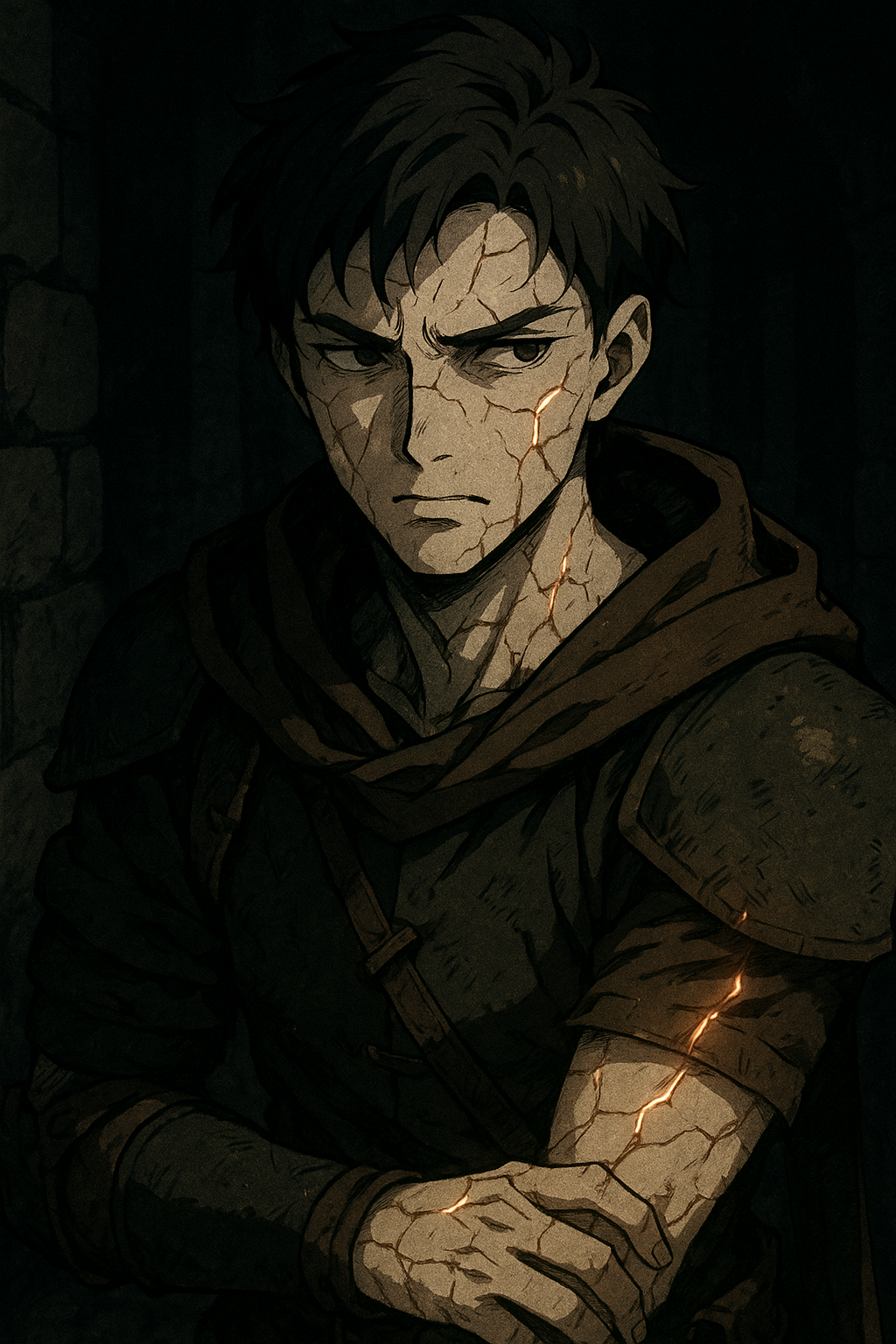
Just this morning a young fighter staggered in; chest streaked with the characteristic pale fissures radiating out from the sternum like an ill-tempered artist’s sketch work. He insisted it was “just a stretch mark.” A stretch mark! I invited him, as kindly as patience allows, to twist at the waist. He did. The fissure widened with an audible pop. His scream was educational, if not particularly pleasant. It is moments like these that test my commitment to the Hippocratic Oath, or the Aurethian equivalent thereof—frankly I’m not sure anyone ever formalized one and I’ve been winging it for years.
I remain convinced the syndrome’s origin lies in the ambient instability of those unformed places. When the land itself wavers—subtle shifts, low groans, that peculiar vibration in the stone you feel in the teeth but nowhere else—the body mirrors it. Muscles tug off-center, fascia pulls in opposing directions, and the skin, poor overburdened thing, simply gives way. It is almost poetic, in the way stomach ulcers are poetic: beautifully patterned, violently inconvenient, wholly preventable if people would obey a fraction of my guidance.
Treatment, as always, is laughably simple. Remove the patient from the unstable environment. Apply heat and rest. Maybe a restorative spell if one has the luxury. But try telling an adventurer to rest. They behave as though sitting still will cause them to evaporate. They would rather limp back into danger with cracks along their shoulders than spend one afternoon on level ground. Perhaps one day I shall draft a study on the psychological compulsion toward self-destruction among dungeon delvers, though I suspect it would be dismissed as “unsupportive of guild morale.”
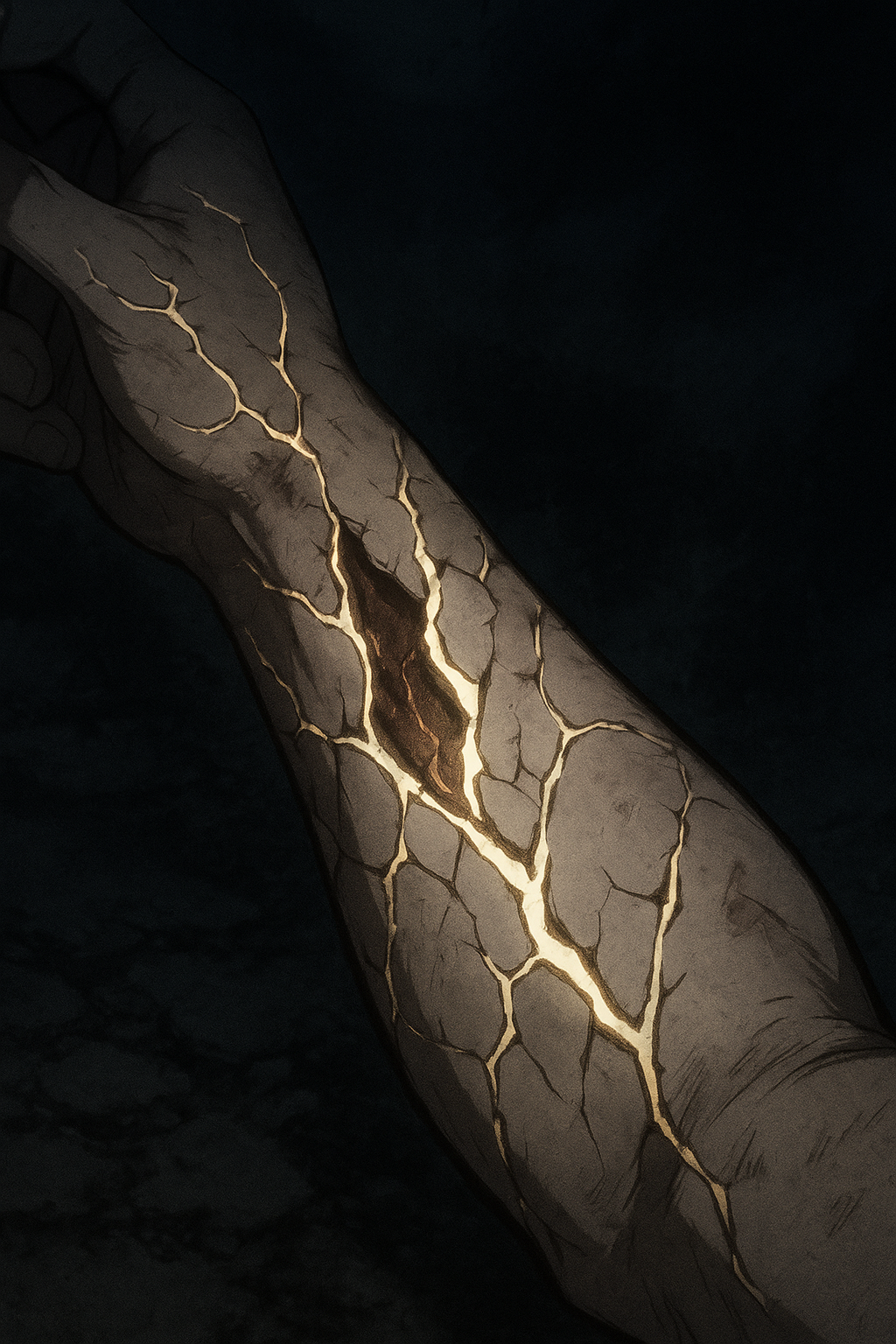
I confess, though, there is something… fascinating about the fissures themselves. The way they trace the body’s natural tension lines, the way the edges pale and tighten, the almost luminous quality in the deepest cracks. Every time I see them, I feel as though I’m staring at the blueprint of a body trying desperately to adapt to a world that refuses to hold still. I cannot deny the scientific allure. If I were a less ethical man—which some have accused me of being already—I might be tempted to encourage further exposure, purely for observational purposes.
But ethics, such as they are, prevail.
For now.
In summation: Fissure Syndrome is entirely preventable, mildly treatable, and deeply irritating—both to the afflicted and to myself. One day perhaps the world will finish settling, and this unpleasant little condition will become a historical curiosity. Until then, I shall remain here in my clinic, patching together cracked fools and muttering to myself about the sheer stupidity required to get repeatedly torn apart by unsettled geography.
I swear, the next one who calls it “just dry skin” is getting thrown out.
Causes
Fissure Syndrome arises in people who spend long periods inside areas Aureth has not fully finished creating. These places feel strange to anyone who walks them—walls that settle a little too often, floors with hairline shifts, passages that “remember” older shapes. The terrain is physically real, but not final. Adventurers, miners, ruin-divers, and explorers are exposed more than anyone else, because Dungeons and deep structures are the most common examples of unfinished spaces. Over time, the body reacts to this subtle instability. Joints, skin, and connective tissues begin to strain as if echoing the unsettled nature of the terrain around them. The longer someone remains in these places, the more likely the syndrome is to take hold.
Symptoms
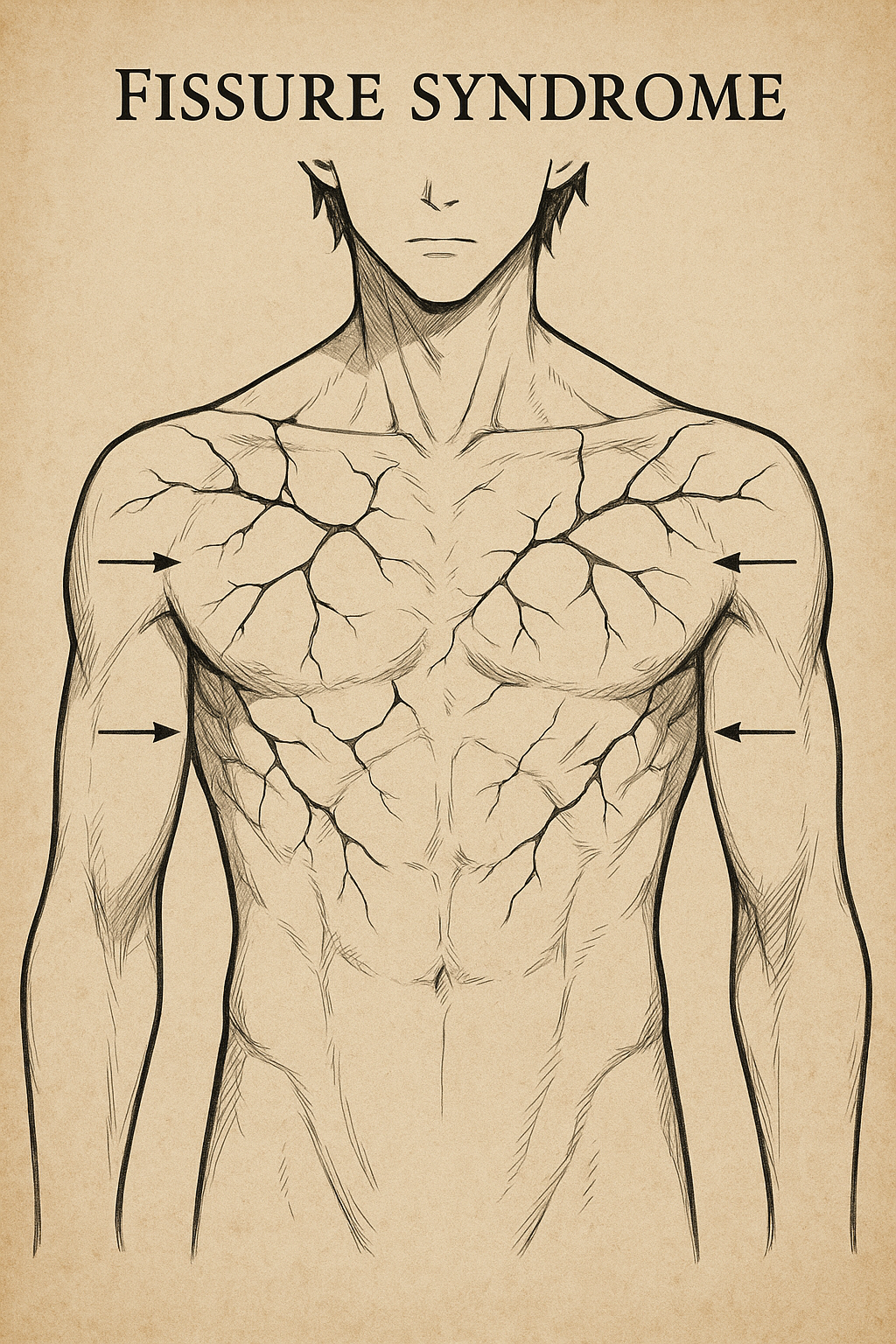
The condition begins quietly. A person feels an odd tightness under the skin, as though something inside the body is pulling in two slightly different directions. After several days, faint lines appear along the major tension paths of the body—across the ribs, along the forearms, at the shoulders, the neck, and the jawline. These marks sharpen into narrow cracks that sting when touched and widen during periods of exertion. As the condition deepens, movement becomes painful, small tears open when the person stretches too quickly, and a vague sense of physical misalignment settles in. The symptoms are entirely physical; Fissure Syndrome does not cloud the mind or alter behavior, though prolonged pain can make a patient irritable or withdrawn.
Treatment
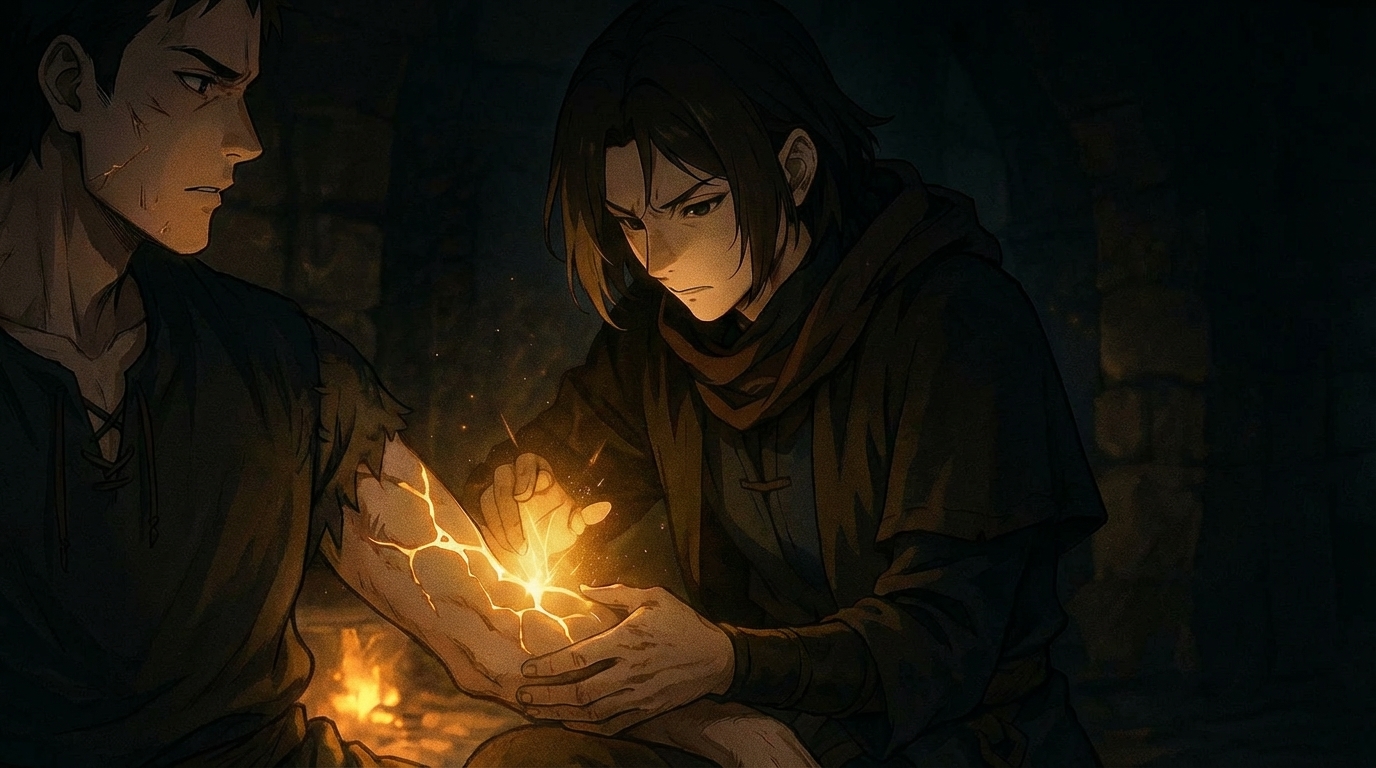
Treatment focuses on restoring the body’s structural harmony and removing the patient from unfinished terrain. If caught early, simply returning to fully settled land allows the body to recover on its own, though healers often apply compresses or salves to encourage the cracks to close. More advanced cases require magical intervention. Healing magic that restores tissue integrity pulls the fissures together, while restorative spells realign the deeper connective layers. Without magical aid, recovery from severe cases is long and difficult, and many patients slowly worsen unless they relocate and rest for extended periods. The most effective healers recommend at least a week spent far from any half-formed structures, where the body can reorient itself to stable terrain.
Cultural Reception
People who live far from dungeons know little about the syndrome, while Adventuring Guilds treat it as a routine occupational hazard. Among seasoned explorers, faint fissure-scars are regarded almost like trophies; evidence of surviving a place not meant for habitation. In some frontier regions, parents warn children that “the ground will crack you open if you wander where it’s too new,” a saying based on more truth than myth. For most ordinary citizens, Fissure Syndrome is something they hear about only in stories brought back from the deep.
Fissure Syndrome (5e)
A creature afflicted with Fissure Syndrome is considered Fissured. While fissured, you suffer the following effects:
The afflicted creature has disadvantage on strength and dexterity checks, and the creature's movement speed is reduced by 10 feet.
Fissure Syndrome ends if the creature receives magical healing of 2nd level or higher (lesser restoration, prayer of healing, greater restoration, etc.) or spends 48 hours outside unfinished terrain and succeeds on a DC 13 Medicine check during that time.
Comments