
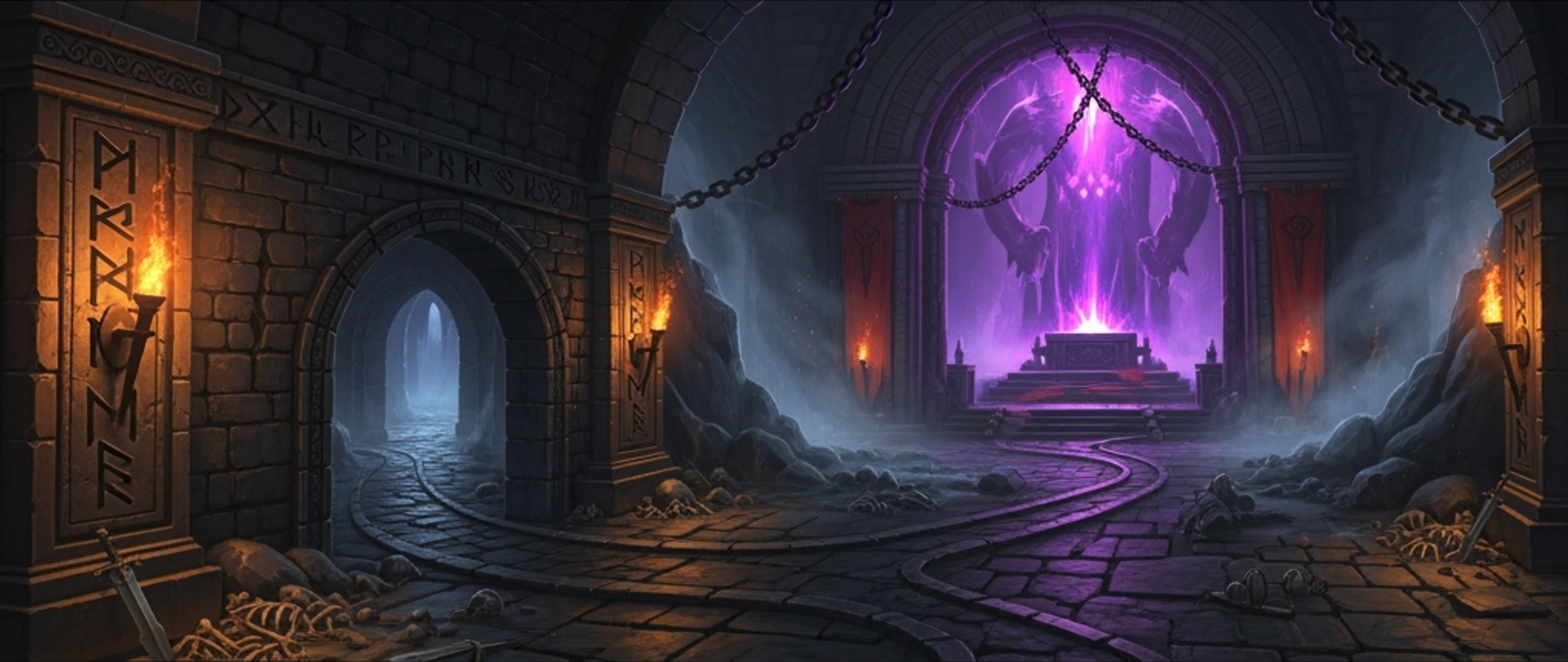
Dungeons
Dungeons are not built — they are born.
Each one is a self-organizing phenomenon: a living reaction the world has to metaphysical injury. When a Process weakens or becomes over-stressed, the land itself attempts to cauterize the imbalance. The result is a Wound, a semi-sentient organism of stone, memory, and intent.
To most mortals they appear as ruins or catacombs; to Process scholars, they are biological anomalies — pocket ecosystems grown from corruption.
They feed on contradiction, emotion, and intrusion. Left unchecked, they grow — rewriting terrain and birthing corrupted entities known as monsters.
Basic Information
Anatomy
A dungeon’s “body” is architectural rather than anatomical. Corridors act as veins; chambers serve as organs; the Core or Heart functions as the brain and soul combined.
Their materials vary — flesh-stone, bone-metal, glass-root — but each contains repeating patterns from the Process it spawned from. Walls pulse, breathe, or hum faintly with resonance. The layout shifts as if following instinct, contracting when threatened or expanding to lure prey.
Many exhibit bioluminescent veins of color, and some have ambient heartbeats, breaths, or whispered voices that echo throughout.
Biological Traits
All dungeons share five constant traits:
- Autogenesis – They emerge spontaneously in response to Process failure.
- Self-Defense – Their corridors rearrange and spawn guardians and traps to preserve the Core.
- Resonant Mimicry – They copy patterns of nearby life to form monsters or illusions.
- Consumption – They absorb energy, memories, and emotion to stabilize themselves.
- Collapse – When the Core is destroyed or healed, the structure implodes into inert ruin, leaving behind rare Process materials that have been named Stabilite.
Each dungeon exhibits a kind of hive intelligence; it does not think, but it remembers intruders.
Growth Rate & Stages
- Incubation – Subtle spatial distortions, flickering lights, or repeated dreams in nearby settlements.
- Manifestation – A doorway or fissure appears; monsters begin to emerge.
- Expansion – The dungeon consumes surrounding land, forming distinct biomes and environmental hazards.
- Awakening – The Core achieves full sentience; its logic begins to overwrite local reality.
- Collapse – After purification or defeat, the dungeon crumbles, leaving a “scar”: a barren patch of stabilized resonance.
Larger dungeons can remain active for decades if undisturbed.
Ecology and Habitats
Dungeons thrive in regions of metaphysical stress — where Processes overlap, contradict, or have been neglected.
They function like ecosystems: predators, scavengers, and parasitic flora adapted to ambient corruption.
Unlike normal life, they draw nourishment from emotional and symbolic energy — fear, determination, guilt, or ambition act as nutrients.
Their “biome” often mirrors the Process from which they were born but always inverted — Hearth dungeons are cold and solitary, Wildkeeping dungeons mechanical and sterile, and so on.
Behaviour
Dungeons behave like territorial organisms:
- They lure prey with sound, treasure, or memory echoes.
- They adapt — reconfiguring paths after each intrusion.
- They replicate — if fragments of their Core survive, a new Wound can bud elsewhere.
- They remember intruders and evolve defenses accordingly.
To predators (adventurers), they are traps; to the world, they are infections that must be healed through confrontation.
When two nearby dungeons meet, they merge into a Compound Wound, combining laws and spawning paradoxical monsters — an event the Concord calls a Process Spiral, always catastrophic.
Civilization and Culture
Common Myths and Legends
Ancient Concord folklore claims the first dungeon was the “Echo Below Hearth”, a cavern formed when the world tried to feel loneliness.
Some sects of Processkeepers believe the Wounds are Aureth’s immune dreams, temporary nightmares it creates to expel disease.
Others whisper that each dungeon is a memory of failure — a time when one of the Nine broke its own rule, and the world refuses to forget.
A few heretical scholars suggest that the Wounds are evolving.
If left alone long enough, they might learn to balance themselves, becoming new Processes entirely — the birth of a Tenth Law.
Comments