
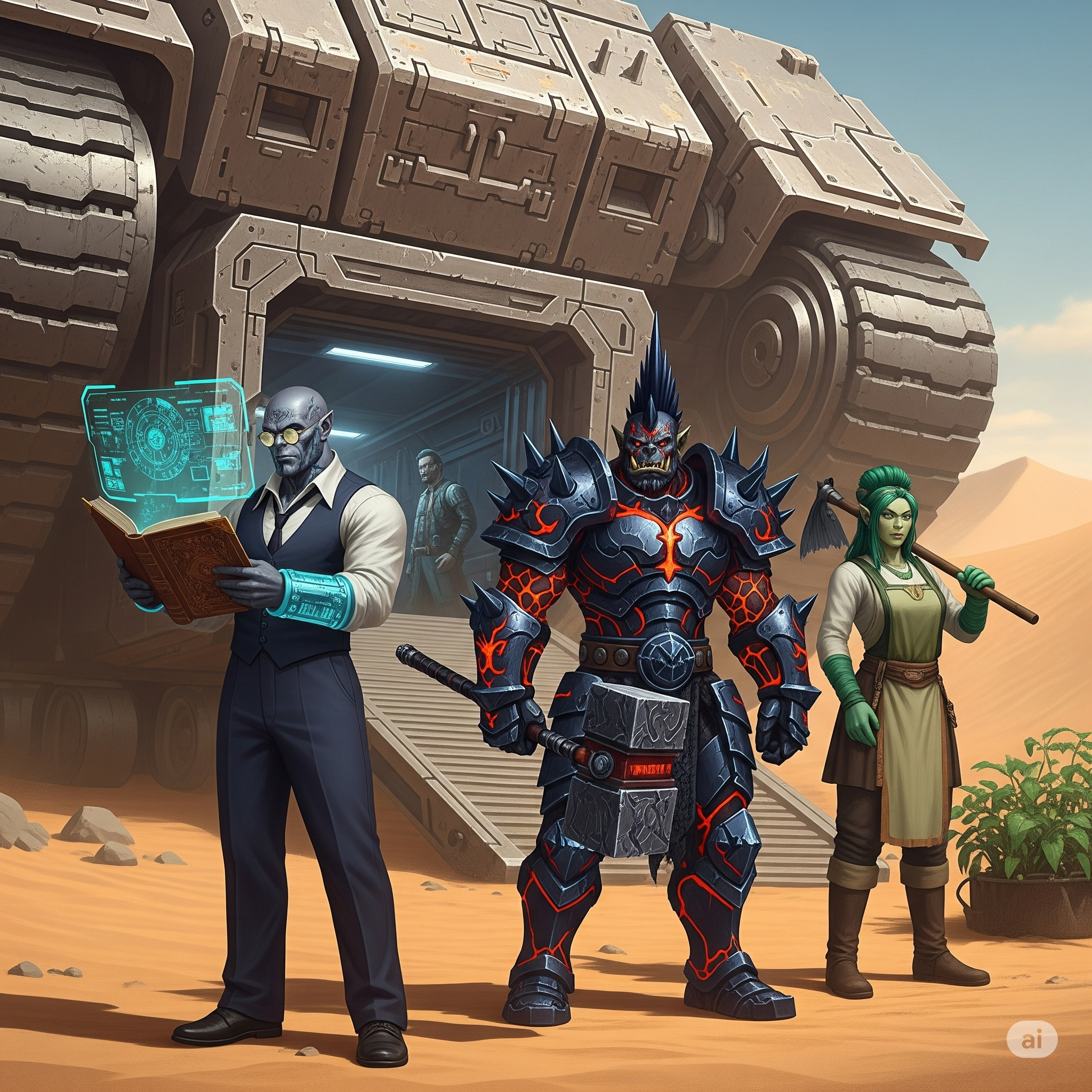
Orc
The Orcs are a physically formidable and highly resilient Sophic species, uniquely characterized by their nomadic societal structure centered around colossal, clan-operated mobile fortresses known as Dreadnaughts. Their origin myths speak of being crafted in antiquity by a now-lost people from the "Bounds of nature," with legendary Vitric Stone forming their bones and mythical Thewgro fungus their flesh. Orcish society is composed of three distinct yet fully integrated subspecies manifestations—the Silic Scholars, Ebonnic Guard, and Jadeite Keepers—any of which can arise from any Orc parentage, each contributing specialized skills vital to the function and survival of their perpetually mobile communities.
//>_ Hacker_Override_Initiated... Karckess on the big, (variously) green, moving mountains. //>_ Orcs. If you see a mountain range on the horizon that wasn't there yesterday, it's probably them in their Dreadnoughts – massive land-ships these clans call home. Forget cities; these folks are always on the move. Their old tales say they were *made*, not born in the usual way – bones of magic stone, flesh of some weird super-fungus. Makes 'em tough as nails. They come in three main 'models': Silic Scholars are the brains, Ebonnic Guard are the muscle and master crafters, and Jadeite Keepers are the nature whisperers and growers. But they're all Orcs, living together, kids can be any type. Home is where the Dreadnought carves a path.
Basic Information
Anatomy
Orcs are a Sophic species characterized by an imposing stature and exceptionally robust physique, with average heights typically ranging between 6'2" and 8'5". Their anatomical structure features high muscle density and exceptionally strong, resilient bones, comparable in toughness to stone or even metal in some instances. Prominent cranial features include a heavy supraorbital ridge (brow ridge), a powerful mandible, and the presence of visible tusks. While sharing these core traits, specific integument details and finer morphological variations are expressed differently across their three primary subspecies.
//>_ Hacker_Override_Initiated... Karckess on Orc construction. //>_ Orcs? Built like mobile bunkers. They're huge, easily towering over humans, and solid right through – dense muscle, bones tough as rock or steel. Got that classic 'don't mess with me' face too: big brow, strong jaw, and tusks. Definitely designed for durability and impact, not for winning beauty pageants among the delicate types. The three different 'flavors' of Orc have their own specific tweaks, but the base model is 'built to last and hit hard'.
Genetics and Reproduction
Orcish genetic heritage is rooted in their unique origin myths, which describe them as being formed from legendary natural components like Vitric Stone and Thewgro fungus. A defining characteristic of their reproductive genetics is that any Orcish pairing can result in offspring manifesting as any of the three primary subspecies (Silic Scholar, Ebonnic Guard, or Jadeite Keeper). Reproductively, Orcs exhibit a cycle less frequent than that observed in Human populations, though precise gestation periods are less formally documented; their overall reproductive capacity, however, effectively sustains their nomadic clan structures. Their remarkable physical resilience and notable regenerative capabilities are understood to be deeply encoded genetic traits.
//>_ Hacker_Override_Initiated... Karckess on Orc family planning. //>_ Orc genetics still start with that wild 'stone and fungus' recipe. And any two Orcs can still make any of the three kid-types – Silic brain, Ebonnic muscle, or Jadeite green-thumb. They don't pop out kids as often as Humans do, though – 'less regular,' as Dryzor puts it. No surprise there, Humans breed like they're trying to win a numbers game. But the Orcs make enough to keep their giant land-yachts fully staffed. And yeah, that toughness and quick healing? Straight from the genetic blueprint.
Dietary Needs and Habits
Orcish dietary requirements are substantial, reflecting their large, muscular physiology and the demands of their active, nomadic lifestyle. While their unique biology allows for partial metabolization of sunlight for supplemental sustenance, significant caloric intake from traditional food sources remains essential. Their diet is omnivorous and highly adaptable, traditionally comprising hunted game (which can include aged Colossus Iguanas), foraged wild flora, and cultivated crops—notably grains for their culturally significant bread—often managed within their mobile Dreadnought communities. A high intake of proteins and complex carbohydrates is crucial for fueling their robust bodies and regenerative capabilities. In eras with access to highly processed foods, Orcs may become susceptible to excessive weight gain if their diet is not carefully managed alongside regular physical exertion.
//>_ Hacker_Override_Initiated... Karckess on what fuels an Orc. //>_ To keep an Orc running, you need a lot of fuel. They're huge, muscular, and always on the move with those Dreadnoughts. They get a little 'solar power' on the side, which is weird, but it's not enough to skip meals. They'll eat pretty much anything – meat from the hunt (including those giant iguanas when they get old), whatever plants the Jadeite Keepers can grow or find, and especially bread. Bread's like a superfood for them – carbs to power those big bodies. 'Course, give 'em modern processed junk and let 'em sit around, and they'll pack on the pounds just like anyone else, only bigger.
Behaviour
Orcish psychology is largely shaped by their unique origin, nomadic existence, and strong clan-based societal structure, fostering traits of profound resilience, communal loyalty, and fierce independence. While often initially wary and reserved towards outsiders, this caution can give way to steadfast alliances once trust is established. External perceptions frequently highlight aggression, a trait more pronounced in certain subspecies like the Ebonnic Guard; however, Orcish behavior also encompasses significant pragmatism, ingenuity (as seen in their crafts and mobile fortresses), and a spectrum of temperaments ranging from the even-keeled Silic Scholars to the nature-attuned Jadeite Keepers, demonstrating notable adaptability as a core psychological trait.
//>_ Hacker_Override_Initiated... Karckess gets inside an Orc's head. //>_ Orcs are a complicated bunch, not just the 'big, dumb brutes' stereotype. That whole 'forged and fought for freedom' history? Makes 'em fiercely independent and super loyal to their clan – mess with one, you mess with all. Yeah, they're wary of strangers, and the Ebonnic Guard types can be aggressive as hell. But then you got the quiet Silic Scholars figuring out complex machines and the Jadeite Keepers who are basically nature wizards. They're survivors, builders, and smarter than they often get credit for. Just, you know, don't try to steal their bread or insult their Dreadnought.
Additional Information
Perception and Sensory Capabilities
Orcs possess robust sensory faculties well-adapted to their nomadic lifestyle and diverse environments. They are documented to have a powerful olfactory sense (smell) and keen visual acuity, both crucial for tracking, foraging, and detecting potential threats. A unique biological trait is their lesser form of Tremor Sense, allowing them to perceive and interpret vibrations transmitted through the ground, providing information about nearby movements or disturbances. While these baseline senses are strong across the species, certain subspecies may exhibit particular affinities; for instance, Jadeite Keepers often display heightened attunement to natural energies and phenomena, while Silic Scholars, particularly those with arcane aptitudes, may develop a notable Myst Sense.
//>_ Hacker_Override_Initiated... Karckess on what Orcs see, smell, and feel. //>_ Orc senses are all about survival. They can smell trouble (or dinner) from a long way off, and their eyesight's sharp enough to spot a twitch in the bushes. Plus, they've got this cool 'Tremor Sense' – they can literally feel vibrations in the ground, like organic radar. Good luck sneaking up on these guys. Some types are even more specialized: Jadeite Keepers probably have a direct line to Mother Nature, and you can bet the Silic Scholar mages have some decent magic-detecting abilities. They're definitely paying attention to their surroundings.
Origin/Ancestry
Artifically crafted in an age long since past
Lifespan
180 years
Average Height
6'2"-8'5"
Note: Anogwin is a work in progress and subject to change. Things might be a little janky, but let me know in the comments if something is wrong.


Comments