


Rosses (ROH zzes)
the Slava of Boran
The Rosses are Human dwelling on the Boran Peninsula in the northwest of the Aabanu Sea, on the major continent ofEthae. While it is a common belief they are descended from the Grafan culture that once dominated the region, the scholastic consensus today is that they are a distant branch of the Plasha people of the northern Plashin Range that settled in the lowlands of the peninsula sometime between 5800sc to 6100sc.
The Boria regions difficult terrain and rocky coastland isolated the culture during the reign of the United Kingdoms of Novyum. Viewed as a disorganized band of small villages in a region with not agricultural value the United Kingdoms ignored the Rosses. The arable land in the southwest of the peninsula was difficult to reach by ship, and over land travel to reach this region was out of the way, over rocky, steep landscapes. Only an occasional ambassador, missionary, or expeditionary forces ventured into Boria. The aggressive attitude of the native Rosses towards outsiders always pushed them away quickly.
This all changed in 6546sc when Gold was discovered inWhidel's Wall. The United Kingdoms were suddenly very interested in Boria and its mountain gold. The Rosses were having nothing of invaders into their domain, however, and conflict arose as soon as the first mining operations opened. The bureaucracy of the late United Kingdom's period and the fact that their military resources were largely scattered across the continent meant that the united tribes of the Rosses were able to hold against the might of the United Kingdoms for nearly a decade. The Rosses were eventually overwhelmed, however, and subjugated by the United Kingdoms. In retaliation for their resistance, the United Kingdoms forced the men of the Rosses to work the mines being built across their domain, while many of the women were taken away from their homeland to live as servants across Ethae.
The decline of the United Kingdoms and the century long Novyum Civil War has given the Rosses something of a reprieve from what would have been a certain end to their culture. Their population is small, but many of the descendants of those enslaved have returned, hoping to revitalize their ancestor's homeland. The Rosses struggle with finding their peoples past when so many know no other way of life than the ones they came from before returning to Boria. Though a free people, the Rosses depend on Lechlan and Haithfia for resources most nations take for granted. Due to this, their culture remains centered on mining the gold other nations desire to trade for resources they need.
The Rosses are a divided culture. The traditionalists want to go back to the old ways, when their people lived largely isolated. The realists think this is not a possibility and believe the only way for their society to survive is to continue the mining and trading of gold. The modernists work to find a balance of both. Tensions grow with each passing season between these factions. Some believe the Lechish and Haitha stoke these fires to keep the Rosses from uniting as a people. The Rosses remain a poor and exploited people despite the heavy flow of gold coming from their mountains.
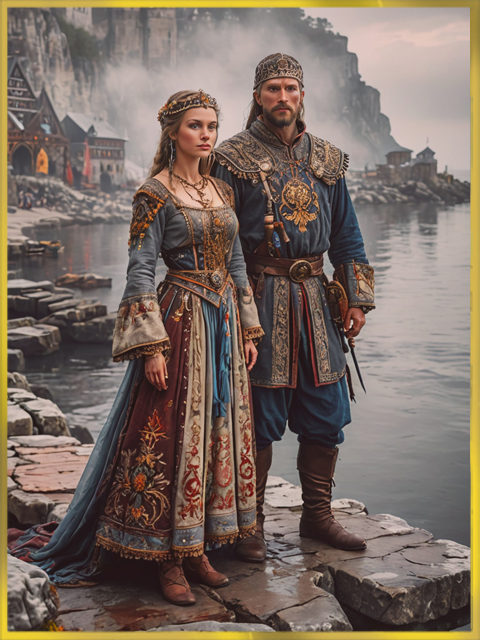
The Rosses generally have a traditional Slava appearance. Their complexion is usually on the lighter side. Sandy blondes are most common, though darker shades have creeped into the culture after centuries of mixed marriages abroad. Both genders traditionally wear their hair long. Historically Rosses eye color was recorded as being a hazel hue, but modern Rosses have a common darker brown coloring. Other shades are not uncommon, however.
Their mountainous and coastal country means cooler weather in general, which means the Rosses often wear thicker clothing than their neighboring lands. Wool is the most common fabric. Blue is a cultural defining color in their garments. Their ancestors created a district color by heating their coastal sand, local limestone, and copper. Well documented in text as a unique color not found elsewhere in Novyum, the mixing method and exact color hue has been lost to history, leaving only the idea of blue as their cultural color for the Rosses people. Embroidery on clothing is a cultural heritage. Generations of Rosses slaves would embroider their undergarments to remember the old ways when they were stripped of their traditional clothing. This remains in the modern Rosses, with every piece of clothing having some embroidery on it. Women will often have flowery motifs, while men favor trees. Headdresses are common for both sexes to keep their long hair pulled back, out of their face.
Race: Human
Ethnicity: Normon
Homeland: Boran Peninsula
Alignment: The Rosses is a culture trying to find itself, as such the people tend towards a chaotic alignment.
Age: The Rosses are a strong people but live largely in poorer conditions, their life expectancy is around 80 years.
Size: (Medium) Rosses men and women are average height for humans, averaging between 5 to 6 feet. The women are usually about a foot shorter than the men.
Language: The Rosses language has been lost to history, the Common Tongue is the language of these people.

Comments