

Swapstone Dice
Vespero's Most Popular Tavern Game
"There are folk who spy our squabbles betwixt the four tribes and reckonin’ us a prickly, unsociable lot. But truth be told, we relish gatherin’ together, be it to test our mettle, to feast, or simply to play. Take Swapstone Dice, for instance. Ye’ll find it near as everywhere in North Vespero, set out on wobblin’ tavern tables and inn floors sticky with old ale. Many a player tosses the stones without ever knowin’ the game was born here in Bittermarsh. Scarcely a soul among us who can turn down a game once the stones are rattlin’. In fact, I’ve wagered my own fair share in taverns far from home. Funny thing, that, once the dice are rollin’ and the laughter’s loose, folks tend to forget they were meant to eye a Zuqthiri witch like me with suspicion. I’ve seen more grudges soften over a game board than I can count. A shared game has likely stitched more peace into Bittermarsh than any diplomat’s pen ever managed. And it’s far more fun besides."Swapstone Dice is a popular board game most commonly found in taverns across North Vespero. The objective of the game is to move one of four distinct playing pieces—the Wolf, the Crow, the Frog, and the Dragon—from the board's edge to the center by rolling dice. The core strategy revolves around the fact that each piece is assigned a different point value depending on the progress of the game. As players near the goal, a key "swap" mechanic allows them to exchange their own piece or an opponent's piece. This is typically used to prevent a rival from scoring with a valuable piece, or to seize a better position for oneself. It is considered one of the oldest board games in Vespero, with scholars speculating it originated in Anatara as a variant of the game "Journey Around the Sun." The modern version popular today, however, was created in Bittermarsh and subsequently spread to the other realms. Traditionally, Swapstone Dice is a parlour game played between strangers in pubs, inns and taverns. Among the four tribes of Bittermarsh, it is customary to invite outsiders to join in a game. It is also frequently used as a form of gambling. Players contribute a fixed amount to a pot, and the winner receives the prize at the end of the game.
Culture and Etiquette
Across the realms of Vespero, Swapstone Dice is regarded as a game for the common people, thanks to its simple rules and its association with taverns. Most public houses, from large city taverns to quiet roadside inns, keep one or more sets on hand for patrons. Some establishments even have dedicated tables where the game board is carved directly into the wood. As the game requires four people, it serves as a social catalyst; it is very normal for strangers to come together to play, inviting others in the room to join until the table is full. Over time, a distinct etiquette has developed around the game. In casual play, rushing another player's turn is considered rude. Swapstone Dice is seen as a social activity, where conversation and drink are as important as the game itself. Locals and regulars will often insist on finishing a thought or sentence before picking up the dice. This relaxed pace is one of the major reasons the game is so popular in pubs, as it encourages patrons to stay longer and order more drinks. Furthermore, many players have their own custom figurines. While taverns usually provide a set, these are often dirty, chipped, or missing pieces from constant use. Courtesy dictates that one never touches another player's personal pieces; when a swap is forced, the opponent is told which pieces to switch, and the owner moves them themself. The etiquette shifts noticeably when money is involved. Should players agree to a winning pot, the betted coins are placed on each corner of the table, in clear view of all. Small talk is reduced in favor of a quicker pace, and the game often ends before it is fully completed. Once a clear winner can be mathematically determined, the game concludes instantly rather than having the remaining players compete for second place. To prevent cheating with weighted dice, it is customary for games with a money pot to use a single, shared die. In any case of cheating or a dispute over rules, the innkeeper acts as the arbiter, and their decision is final. A popular variant, sitting between a casual game and a betting game, is the Last Stone Gamble. Before a match begins, players can agree to this rule: the player who finishes in last place must pay for a round of drinks for the others, usually right before the next game starts.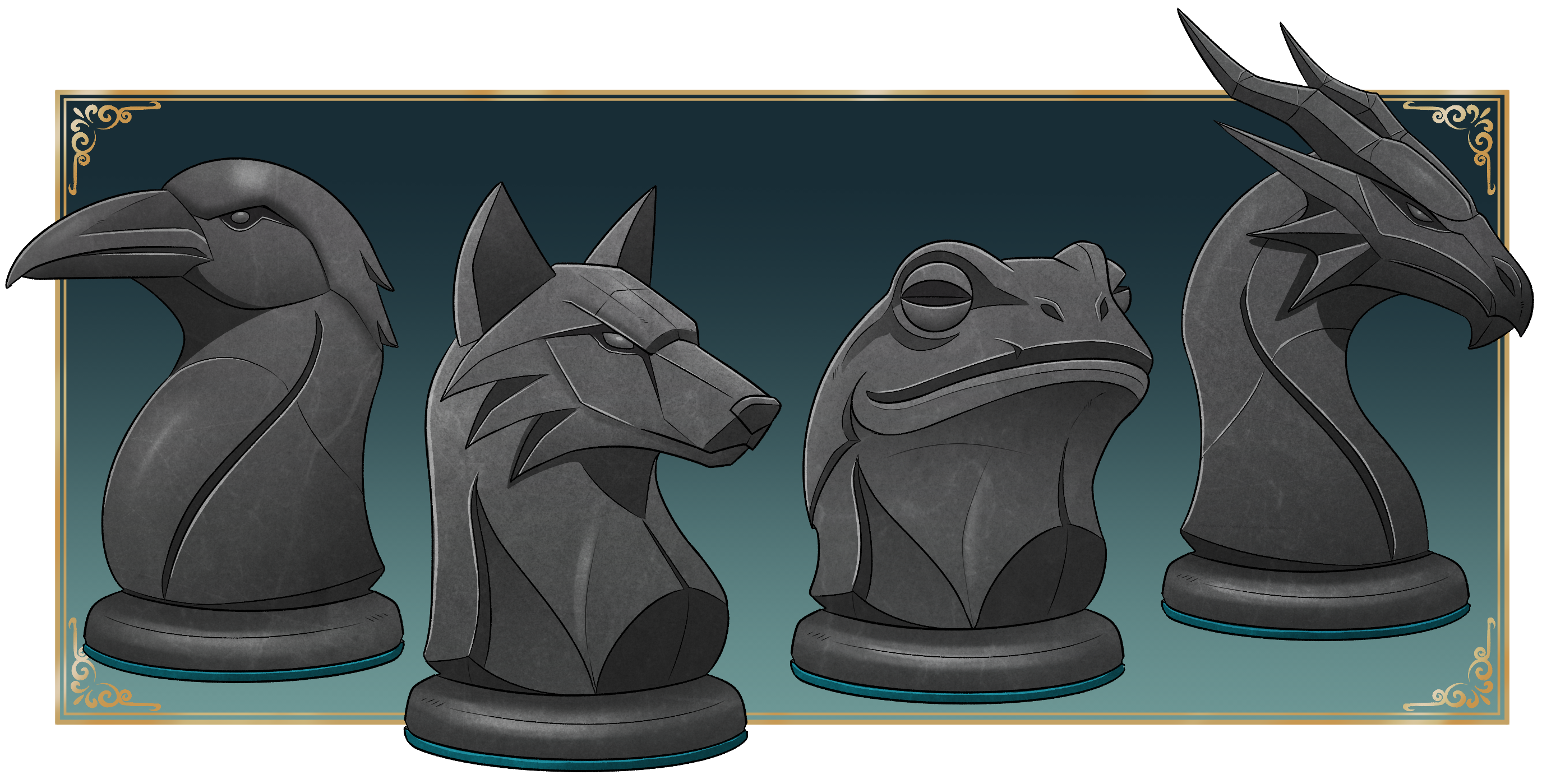
The Four Pieces
The most iconic version of Swapstone Dice is played with four pieces: the Wolf, the Crow, the Frog, and the Dragon. Historically, however, the game was likely played with literal stones, such as different colored riverstones or pebbles. The oldest surviving set uses flat stones with markings carved into them to tell them apart. While the exact reason for the shift to animal-themed pieces is a matter of speculation, a popular theory suggests they represent the major regions surrounding Bittermarsh: The Wolf stands for the Kingdom of Demenore, the Crow represents Morvathia, the Dragon is associated with Valleterna and the Frog is a symbol for Bittermarsh itself. At the start of the game, each piece is of equal value, so there is no strategic advantage in the initial choice. Nevertheless, regular players often assign personality traits to the type of person who prefers a specific piece. The Frog, for example, is said to represent humility and patience, chosen by players who embrace the chaotic, unpredictable nature of the game. A player favoring the Crow is considered intelligent and observant, often seen as an opportunist or schemer. Those who prefer the Wolf are viewed as strategic and ruthless, enjoying the thrill of the hunt, while a player starting with the Dragon is considered ambitious, proud, and straightforward. While the Wolf, Crow, Frog, and Dragon are standard, certain regions use a slightly different set of pieces. In the Silverwild of Thaldrune, for example, the Owl replaces the Crow, and the Bear replaces the Frog. The game is less popular in the Divine Dominion of Galdorsmynd, but it is sometimes played with the "Imperial Set," which features the Eagle, the Lion, the Horse, and the Chalice. Some older sets from Demenore used differently shaped knight figures, while some Valleternan versions featured different kinds of dragons. These variants are no longer in active play, as most taverns and pubs unified their sets to make it easier for travelers from different realms to play together. As a result, such old sets have become highly valued items for collectors and historians.Rules of Play
The Gate

The Turning Ring

The Grasping Ring

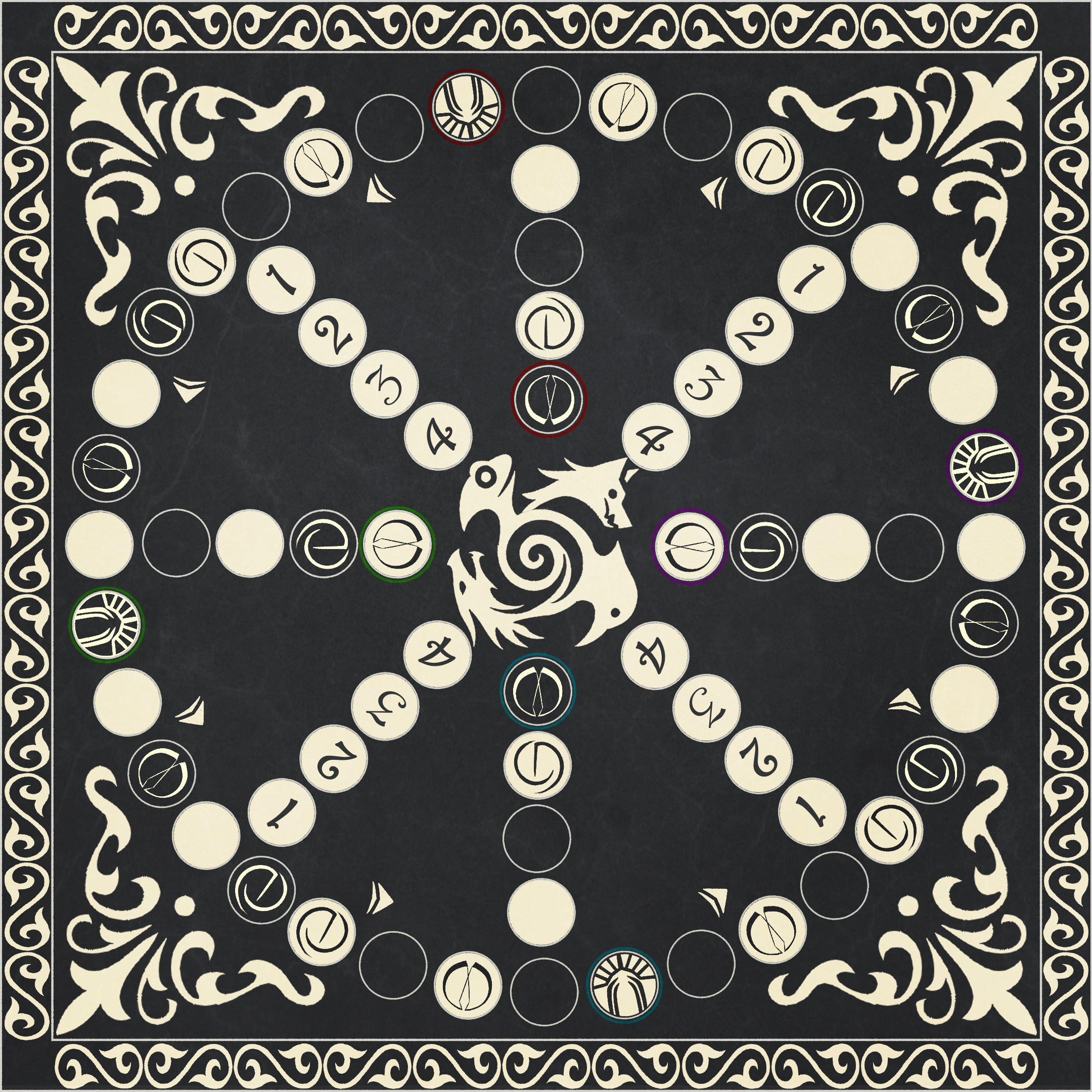
Player interaction is a key part of the game. If a player's piece lands on a space occupied by an opponent, that opponent's piece is "kicked" and sent back into their reserve. If the kicked player has no other pieces in play, they may immediately place a new piece on their Gate. If the starting space is already occupied when a piece is brought into play, the piece occupying it is also kicked. A player cannot, however, have two of their own pieces on the same space; if all of their legal moves would result in this, they must skip their turn. To enter the final, central field, a player must roll the exact number required. If they roll a higher number, their piece moves into the center and then "bounces" back out for the remaining number of steps. The game concludes when all sixteen pieces from all players are home. The player with the highest total points is declared the winner.

I would totally play this. Like fantasy Ludo except with more tricksiness. Nice.
Check out Shadowfire
Thanks! It is based on Ludo indeed. Would be cool to make the board and pieces and try it out in real life one day x3
At the end of everything, hold onto anything.