

Kaimanids
Survivors of a Drowned Empire
"History, I find, often serves not to aggrandize, but to humble. The tale of the kaimanids and their fallen empire is one such lesson. We are told they sacrificed a golden age, an empire of unimaginable might, to shield our world from the Netherhells' wrath. Yet, what is the ultimate value of such a selfless act when its memory fades into myth, and its beneficiaries remain so profoundly ignorant? It forces me to wonder if the virtue of sacrifice is inherent in the act itself, or if it requires remembrance to retain its meaning. Would we, in their stead, have made the same choice? I look upon the kaimanids now, those stoic, reptilian survivors, I see not mere fearsome beasts, but living evidence to a question we, in our comfortable present, are perhaps too callow to answer."
Kaimanids are a large, crocodilian Firstborn kin. According to their fragmented historical records, they were once among the most powerful of all Firstborn during the Age of Paradise, ruling over the fabled Shimmering Dominion of Thal-Kazuur. If the old tales are to be believed, Thal-Kazuur was the first true civilization of that age, its kaimanid rulers the eldest children of the Divine Parents, with other Firstborn, such as humans and albs, created only after them.
Their dominion came to ruin during the Age of Silence, when the Netherhells began to consume parts of the material world. The Shimmering Dominion was swallowed whole, its armies scattered, and its people nearly wiped out. When the Silence finally broke, the world that rose in its place belonged to others. The Galdoric Empire had become the new center of power in North Vespero, while the surviving kaimanids were left displaced and few in number. Today, their descendants live scattered across Vespero, from the marshlands of Bittermarsh, to the warm rivers of Anatara, and the cities of Valleterna. Where their radiant empire once stood now lies Lake Azure.
Though their civilization has long vanished beneath myth and water, kaimanids remain a people of great renown. Respected for their size, endurance, and cold-blooded ferocity, they have never needed numbers to leave their mark on the world around them.
Biology of the Kaimanids
Kaimanids resemble upright walking crocodilians, and are often classified as beastkin by the Althorn Foundation for Ethnological and Genealogical Research. Adults typically stand between eight and ten feet tall, though exceptional individuals have been recorded at twelve feet or more. Their bodies are powerfully built, covered in thick, scale-plated hides that form natural armor across the back and flanks. Their heavy tails serve both for balance and as an aid in swimming, a skill for which they are particularly renowned. Capable of holding their breath for remarkable lengths of time, kaimanids move through water with a speed and grace that belies their bulk.
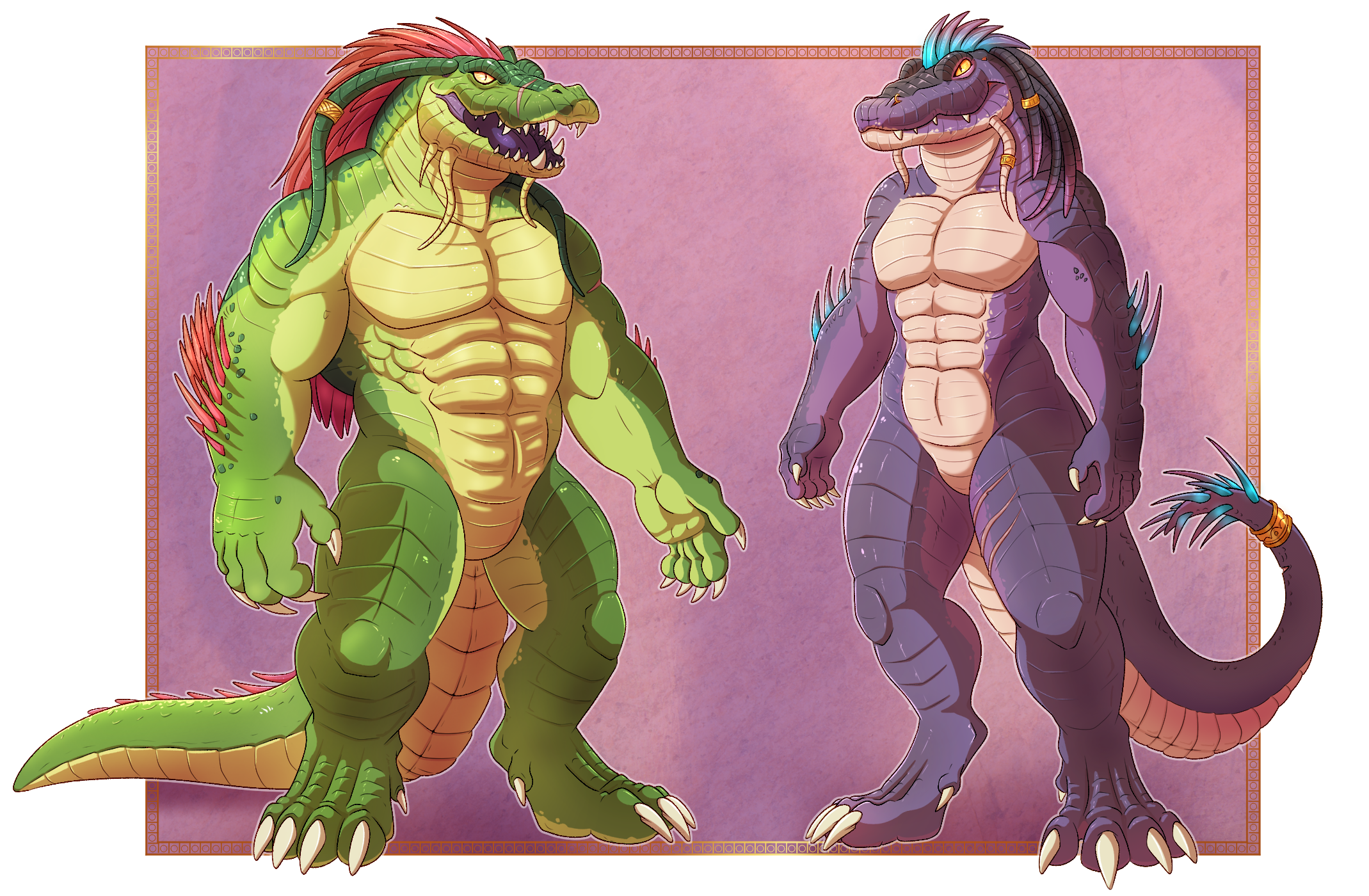
One of the most recognizable features of the kaimanid kin is their dorsal crest, a line of hardened, keratinous spikes that runs along the spine, often extending across the head, shoulders, and tail. These "crown spikes", as kaimanids call them, grow in striking hues of red, blue, purple, yellow, or even gradient tones that shift between colors. The pigmentation is hereditary, passed directly from parent to offspring, making the spikes not only a personal mark of identity but also a visible sign of lineage. The royal line of Thal-Kazuur bore unique pearl-white crown spikes, now believed to be extinct, which once signified their divine right to rule.
In addition to their crests, kaimanids possess a series of scale tendrils, a sort of thin, flexible growths that sprout from the sides of the head and lower jaw. These are often compared to the ornamented frills of certain draconic species and are colloquially known as drakeslocks. Though they serve no apparent biological purpose, kaimanids use them for self-expression, decorating the tendrils with metal rings, carved beads, or jewels in much the same way that humans style their hair.
Cold-blooded Carnivours
Kaimanids are primarily carnivorous, subsisting on meat and fish. Their powerful digestive system can process raw or even partially spoiled flesh without harm, though most prefer their meals fresh, charred on the outside, raw at the core, and richly seasoned. Consuming entirely raw or rotten meat is reserved for dire necessity. While meat remains their staple, kaimanids are not strictly picky; fruits and vegetables are eaten too when offered. Though their palates are notably unsuited for sweetness. Foods such as cakes or confections often make them ill or nauseous.
Unlike most kin of Vespero, kaimanids are ectothermic, among the few truly cold-blooded species. Temperature profoundly influences their state of mind. Warmth sharpens their senses and quickens their temper, while cold renders them slow, introspective, and almost serene. Over generations, kaimanid societies have turned this biological rhythm into culture, developing traditions of "Warmthkeeping" or "Kraalith", communal basking in sunlit plazas, heated stone chambers, or mineral pools. These practices are both social and spiritual in nature.
To kaimanids, their cold-blooded nature is seen as an advantage of temperament, a mark of patience and control over emotion. Many hold that warmth breeds haste, and in their own words, other kin are often considered "too warm to think".
Subspecies and Habitat Diversity
While most know only the common river kaimanids, the species exhibits a surprising biological diversity. River kaimanids are considered the original inhabitants of Thal-Kazuur, broad-shouldered and covered in scales of deep blues, greens, or even purples. Their physiology is finely tuned for life in freshwater rivers, lakes, and swamps, allowing them to thrive alongside other kin in inland regions. While these kaimanids are the most familiar, other subspecies exist, usually living in more isolated and self-contained communities.
Salt kaimanids are their rarer cousins, dwelling in coastal deltas, mangrove swamps, and shorelines. Their scales range from silver-gray to pale or sand-colored, and they bear broader snouts. Thal-Kazuur myth holds that these kaimanids were banished to the sea for their ingratitude toward the Divine Parents, though this claim remains historically unverified. The split between river and salt kaimanids likely occurred long before any surviving records, perhaps even during the Age of Paradise. Salt kaimanids are fewer in number, living in scattered coastal settlements, often wary or outright hostile toward outsiders.
Even more elusive are the murkwater kaimanids, adapted to life in the Swallowing Depths, the vast subterranean networks beneath Vespero. Legends suggest that during the Age of Silence, some kaimanid tribes retreated underground to escape the ravages of Netherhell demons. Murkwater kaimanids are leaner and smaller than their surface cousins, with dark, oily scales in shades of black, gray, and brown. Within the depths, they function as ambush predators and scavengers, lurking in mud or pitch-black waters and feeding on carrion or unsuspecting prey. These tribes are notoriously hostile to outsiders, making them the most dangerous kaimanid subspecies. Their population remains a mystery, as the Swallowing Depths are largely unexplored and inhospitable to surface dwellers.
Mythology and Folklore
Much of kaimanid folklore centers on the Shimmering Dominion of Thal-Kazuur, a civilization said to predate all other kin, including humans and albs. According to surviving texts and oral traditions, kaimanids were the first children of the Divine Parents, created during the First Shaping. Kaimanid cultures that still venerate the Divine Parents depict them as reptilian or dragon-like beings, often bearing names and forms distinct from those popularized during the Galdoric Empire’s rule over North Vespero. These depictions bear a notable resemblance to certain dragon tribes, both in appearance and nomenclature, hinting at shared cultural roots or influences.
Old maps place Thal-Kazuur centrally in North Vespero, with Morvathia to the west, Valleterna to the south, Thaldrune to the north, and Galdorsmynd to the east. Ancient texts describe the region as a lush, verdant jungle, filled with rivers, lakes, and marshes, indicating that the climate of North Vespero was once drastically different from today. During this golden age, kaimanid civilization is said to have reached its peak, boasting shining cities, revered rulers, and floating temples, inspiring awe—and sometimes fear—among all other kin. Today, this region is largely submerged and known as Lake Azure.
The Fall of Thal-Kazuur
The story of Thal-Kazuur’s fall begins with the Age of Silence. As with many tales from that era, an unknown heretical act is said to have driven the Divine Parents to abandon their creation, leaving the Firstborn kin to fend for themselves. In the resulting vacuum of divine protection, the Netherhells fused with the Material Reality, unleashing legions of demons to plunder the world. As the dominant power of Vespero, the kaimanids were tasked with leading the defense, under the command of the formidable Pearl Queen Rhaazeth, a ruler and spellcaster of unmatched skill. She is said to have united the Firstborn kin, marshaling vast armies to protect all allies and keep the Netherhell at bay.
Sources differ on the duration of the conflict: some claim Thal-Kazuur fought for hundreds, thousands, or even ten thousand years. The exact length of their resistance though, as well as of the entire Age of Silence remains unknown. Scholars agree, however, that without the efforts of Thal-Kazuur, Vespero itself may have been lost, and all original creation of the Divine Parents would have vanished entirely.
Over time though, the relentless onslaught wore down their forces. Queen Rhaazeth eventually ordered the armies to retreat from the borders of other realms, focusing on defending Thal-Kazuur itself. As a result, many Firstborn cultures perished during this period, lost to history without a trace.
Despite their dwindling numbers, Thal-Kazuur remained secure for a few decades longer. Yet, in all accounts, the fall came suddenly. The realm itself sank into the Netherhells in a single, catastrophic day: cities were flooded, mountains collapsed, and the land was swallowed by a swirling abyss. Few escaped. Among them was Zhuraya, the daughter of Rhaazeth. The Queen stayed behind, using her magic to slow the descent of the land and allow some of her subjects to flee. Eventually, Thal-Kazuur was entirely consumed by the Charybdis, the deepest circle of the Netherhells. The place where the Pearl Queen Rhaazeth once ruled is now known as the Drowned Palace, claimed by the Demon Queen Cyllias. The ruins of many kaimanid cities lie scattered in the underwater abyss of her domain.
The Legacy of Princess Zhuraya
The survivor of this calamity, Princess Zhuraya, also occupies a legendary place in the history of the kaimanids. While her mother symbolizes the ultimate sacrifice of the kaimanid people to slow the advance of the Netherhells, Zhuraya herself is celebrated as a hero who helped bring an end to the Silence. When the New Gods arrived from the Sea of Night, their blessings gave the surviving kin of Vespero a second chance at life. Zhuraya rallied the remnants of Thal-Kazuur’s forces, uniting them with other heroes of the era, like the dryad leader Wrath, to defend the realm and restore balance.
After the Silence, it is said that Zhuraya settled with her people in Bittermarsh, laying the foundations for what would become the Siltriders tribe. Bittermarsh remains the region with the largest kaimanid population today, and its records preserve some of the most complete accounts of kaimanid myth, culture, and tradition, linking the modern kin directly to the heroes of Thal-Kazuur.
Following the end of the Silence, the Thal-Kazuur empire had vanished, the kaimanid population had dwindled, leaving the albs of Galdorsmynd as the dominant cultural force in North Vespero. From this point, mere myths fades into recorded history. The stories of Thal-Kazuur, Queen Rhaazeth, and her sacrifice nearly vanished under the rule of the Galdoric Empire. The High Divine exerted tight control over nearly all surviving kin, reshaping the narrative of the Age of Paradise: the role of the kaimanids were downplayed and albs themselves were depicted as the first creations among the Firstborn kin. Any alternative versions, both in text or art, were outlawed as heresy.
Had Bittermarsh not successfully resisted the Galdoric conquest of North Vespero, much of Thal-Kazuur’s legends would likely have been lost or irreparably altered. Today, surviving records are studied in academic centers across the north, and the original language of Thal-Kazuur, Kaarunic, has been partially reconstructed. These efforts allow scholars to piece together fragments of the Age of Paradise and the Age of Silence, though the histories remain a patchwork of conflicting accounts. Even so, the sacrifice and legacy of the kaimanids are now recognized and valued as a defining moment in Netherdyn's early history.
Kaimanids Across Netherdyn
Today, kaimanids are scattered across the continent of Vespero, living both within greater societies and in isolation. Small kaimanid settlements can be found throughout the warmer regions, often independent of any crown or council, existing by their own customs and laws. Their traditions and ways of life vary greatly, some cling closely to the old rites of Thal-Kazuur, while others have developed cultures entirely their own. Even their openness toward outsiders differs: some are known to trade and share hospitality, while others guard their borders with fierce suspicion.
Given their strength and formidable temper when provoked, most travelers know better than to disturb an unfamiliar kaimanid enclave. Tales of careless travellers and unfortunate merchants who met the unfortunate fate of becoming a kaimanid's lunch have long served as a warning to those who ignore local precautions. Still, many kaimanid groups have found new homes within the broader civilizations of Vespero, adapting, integrating, and even shaping the cultures around them.
Kaimanids in Bittermarsh
The Free Realm of Bittermarsh has no central government. Instead, it is held together by four great tribes, loosely allied to protect their lands and keep the peace among themselves. Among these are the Siltriders, or Swampar in their own tongue. Princess Zhuraya and the survivors of Thal-Kazuur settled in the marshes after the Age of Silence, giving rise to countless smaller kaimanid family clans that spread across the wetlands. Over generations, these clans feuded endlessly—contesting territory, hunting grounds, and other rivalries—until the arrival of a greater enemy forced them together.
When the Galdoric Empire attempted to subdue the marshlands, the clans united under the formidable chieftain Morgathar the Marshlord. What had once been scattered skirmishes became a single, coordinated resistance. Using fog, swamp, and lake to their advantage, the tribes settled every battle in their favour. By the end of the campaign, the clans had become one: the Siltrider Tribe.
Today, like all Bittermarsh tribes, the Thornwatch, Deepmore, and Willowbend among them, the Siltriders are not bound to a single kin. Their ranks include quagglenox, wild albs, dryads and others. Yet kaimanid culture remains dominant, making Bittermarsh in many eyes the true heir of Thal-Kazuur. Their capital, Gator’s Rest, rises from the center of a vast lake. It is a town of stilted houses, timber walkways, and floating platforms, where the water laps at every doorstep.
Kaimanids in Valleterna
Valleterna remains one of the other few realms besides Bittermarsh where kaimanids hold lasting cultural influence. Much of this can be traced to Caudaluna, one of the nine great cities of the Concordance. The city was founded by a proud kaimanid warrior clan that long ago broke away from the Siltriders, divided by deep philosophical differences. Where the Siltriders valued competition, valor, and personal prowess, the founders of Caudaluna sought transcendence through discipline and art.
For the kaimanids of Caudaluna, warfare is inseparable from artistry. They believe creation and destruction are twin forces, each incomplete without the other, and that mastery of both reveals the true balance of existence. Their warriors train not only with blade and shield, but also with brush and ink, pursuing perfection in both strategy and poetry, combat and contemplation.
When Valleterna rose in rebellion against the Galdoric Empire, Caudaluna’s armies stood at the forefront of the fight for independence. In the aftermath, the city became one of the realm’s major powers, its influence spreading through trade, art, and scholarship alike. Today, the spirit of Thal-Kazuur lives on in Valleterna, not just as a memory, but as part of a shared culture. It is not uncommon to find kaimanids as merchants in Puerto Opalino, actors or artisans in Brillamarque, students of magic in Nivreluna, or as knights in Cobaltière.
Kaimanids in Morvathia, Demenore and Thaldrune
For the most part, kaimanids hold little sway elsewhere in North Vespero. That does not mean they are absent, only that their presence tends to share a familiar context. More often than not, a kaimanid found working in realms such as Morvathia, Demenore, or Thaldrune belongs to the Brothers of Scale: a mercenary company founded and led by kaimanids seeking to unite their scattered kin and provide them with purpose. Given their stature, strength, and commanding presence, it is little wonder they are often sought as bodyguards, sellswords, or bouncers. In Demenore especially, where the Curse of the Beast still haunts the land, the demand for adventurers and monster hunters never wanes.
As noble as their founding intentions may have been, the idea of protecting their own and finding work for the displaced, the Brothers of Scale are not known for being selective about their contracts. Just as easily as a noble or merchant might hire their muscle, so too might the Network of Fools or the Golden Trade, earning them a rather mixed reputation.

Comments