

Dryads
Children of the Evergrowing
"The path of a scholar is often one of isolation, yet true loneliness, I posit, is a uniquely human affliction, born from the clamor of a society one can never fully grasp. It is in these moments of quiet vexation that I contemplate the dryads. What must it be to have one's very soul defined by the Choir? To be a single, harmonious note in nature's eternal symphony? What would I not give to trade the anxieties of flesh for the certainty of sapwood? But then, perhaps some of them, in their beautiful sanctums, gaze upon us and wonder at the silence we must enjoy. A cosmic jest, is it not? That we all yearn for the very cage from which another wishes to be freed."
The dryads, also called the Treefolk or the Children of the Evergrowing, are among the more common Secondborn kin of Vespero. They claim the forests as both home and heritage, and are known for their fierce attachment to the lands they guard. To most outsiders, they appear distant and temperamental, overprotective to the point of hostility. Once provoked they rarely forgive, and grudges between dryads and nearby settlements can last for generations. History records many instances in which dryad tribes retaliated against encroachment, with entire villages erased after years of quiet tension. Even in the present age, there remain many regions where travellers are warned not to wander too deep, for fear of rousing the old guardians that linger there.
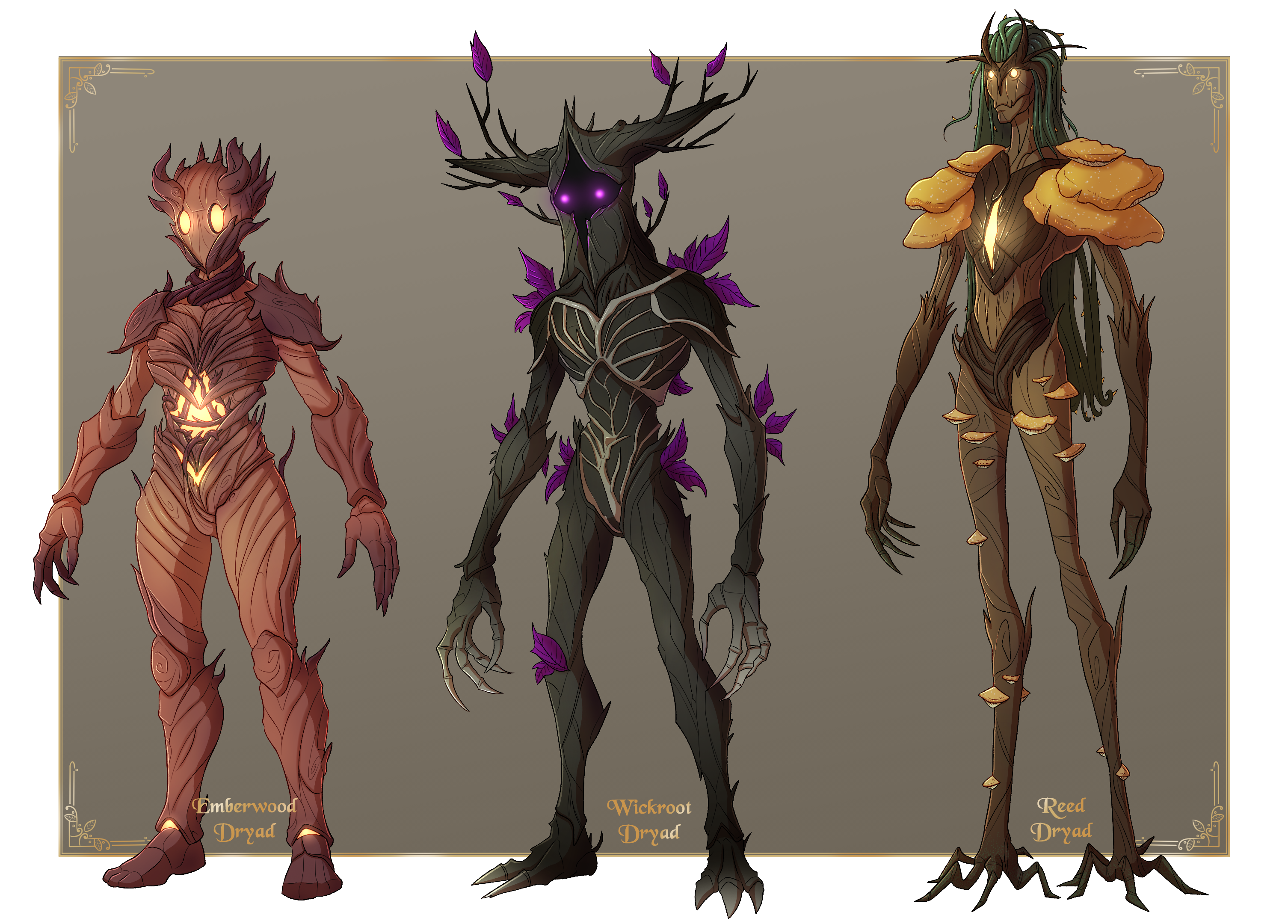
Some places, however, have embraced an uneasy coexistence. In the Emberwood of Demenore and the Wickroot Forest of Morvathia for example, agreements between the other kin and treefolk have endured for a couple of decades by now. Wood may be gathered and game hunted, but only within strict bounds, and always with tribute or concession. Such accords are rare, but they have brought a certain degree of peace to the border between the natural and civilised worlds.
On occasion, a dryad will leave their grove entirely, drawn by curiosity or exile. A few have even settled among other kin, tending enclaves or gardens within city walls. Their thoughts and customs remain little understood, but any encounter not met with hostility is widely regarded as a mark of good fortune.
Biology of the Dryad
There exist countless subspecies of dryads, each shaped by the forest and climate in which they take root. Yet across these variations, certain traits remain constant. Unlike most other kin, dryads possess no flesh, blood, or bone. Their bodies are formed entirely of wood and bark along with a dense and fibrous root that mimics muscle and sinew. Beneath the bark, a dryad’s body is hollow, supported only by a web of this fine root-like musculature. At the centre of this network lies the heartseed, core of living wood that acts as both heart and mind. The heartseed is coated in a luminous, viscous sap that circulates throughout the body. This sap often glows faintly through gaps in the bark: between joints, along cracks or wounds, or around natural openings near the chest and head. If the heartseed is destroyed, the dryad dies; yet it is known to regenerate even after severe damage, and in rare cases has restored a fallen dryad to life months after apparent death.
Despite their differing and often alien anatomy, most dryad bodies loosely follow the familiar pattern shared by other kin: two legs, a torso, two arms, and a head. Exceptions exist, such as the dryads of Vukodin’s Weald, whose lower halves resemble those of great stags, while humanoid torsos of bark and twisting branches rise from their shoulders. It remains unclear why dryads assume these forms, as their inner heartseed and mobile roots can, in theory, inhabit almost any wooden shell.
The Mother-Tree
Within their home forests, all dryads are bound to a mother-tree, a vast, ancient organism at the heart of the woodland, connected through fungal mycelia to every tree in her domain. The mother-tree is said to be a dryad who transcended their original form through a process no outsider has ever witnessed. From her seeds, new dryads are born, beginning life as small, immobile seedlings that awaken once they have grown large enough to walk.
The inner workings of a mother-tree, and the rituals surrounding her care, remain largely unknown. Even those tribes that maintain peaceful relations with outsiders are fiercely protective of their mother-tree, and few beyond the treefolk have ever seen one. Most existing records stem from second-hand accounts or from tragic events in which a forest and its mother-tree were destroyed and her remains examined.
What is known is that the mother-tree communicates with her kin through what dryads call the Choir — a collective consciousness of instinct and memory that flows through the wild places of Netherdyn, linking beasts, roots, wind, and stone.
The Song of War
Each dryad adds their voice to this shared current, though the mother tree’s presence dominates it. Dryads describe her voice as a song of comfort and unity. Yet when she is threatened, that song changes for every connected dryad, driving them to swift and coordinated violence. This is known as the Song of War.
This communion makes a dryad tribe nearly unbeatable within its own territory. Through the Song of War, they perceive every movement in their forest and respond as a single mind. Armies that once sought to burn or clear dryad woodlands found themselves met with flawless ambushes and relentless strikes from every direction. Few campaigns of this kind have ever succeeded. Beyond the reach of their mother tree, however, dryads lose this advantage, their coordination fading the farther they roam. Most conflicts between dryads and settlers have therefore ended not in victory for either side, but in long stalemates. Until one or both simply withdraw, leaving the forest to reclaim the ground in silence.
The Heartseed Experiments
For centuries, scholars have been fascinated by the mysteries of the heartseed. During Morvathia’s Three-Year Dryad Conflict (1489–1492 A.S.), under Witchking Gastad Argentier, a series of now-condemned studies sought to uncover its nature. Researchers attempted to remove a dryad’s heartseed, severing their link to the Choir, and replant it into artificial bodies of wood, stone, or metal, hoping to create tireless servants and soldier golems for the Witchrealm. Officially, these projects were abandoned with the conflict’s end, deemed inconclusive by the overseeing houses. A generation later, the Decree of Unity (1522 A.S.) formally recognized dryads as kin, outlawing further experimentation of this kind.
Still, some claim the work never truly ceased. According to persistent accounts, the researchers’ efforts failed to yield a controllable construct until they attempted to grow a heartseed within a living witch. The chosen subject, Marethe Netherly, reportedly survived the process, though her body was overtaken by sap and roots, her bones replaced by living wood. In time, she is said to have developed a means of communicating with the earlier failed vessels, granting them motion and obedience.
What followed remains a matter of speculation. Some versions claim that Gastad's successor, Witchqueen Liona Valtessa, discovered and dismantled the operation soon after; others suggest Netherly turned on her peers, planting new heartseeds grown from her own body into theirs. The Morvathian government has denied all such allegations.
Yet, there are scattered reports from the northern reaches of Vespero of an entity known as the Rootmother, a being neither wholly human nor dryad. According to local accounts, she is said to abduct children and “seed” them into false dryads, grown in her image. Whether she is the remnant of Marethe Netherly or merely a legend shaped by fear remains unproven.
Mythology and Folklore
Unlike many other details about the dryads, their beginnings are comparatively well understood. During the Age of Silence, after the Divine Parents abandoned their creation, the natural world of Netherdyn was nearly undone. Vast forests burned, seas dried, and much of the old paradise was reduced to ash beneath the advance of the Netherhells’ demons.
Towards the end of that age, when the New Gods crossed the Sea of Night, the Evergrowing beheld the ruin of the land and granted it a means to endure. This blessing is believed to have been the Choir, a sentient Essence binding all living things, allowing the voices of plants, beasts, and spirits to be heard as one. Yet what the Choir heard then was pain and loss. From that grief, it is said, rose anger — a deep burning hatred against the desolation of the world. From this collective wrath, the dryads were born. Trees and roots animated by the Choir’s will took form and moved with purpose, waging war upon the demons that had defiled their soil. Their arrival turned the tide of the Silence, and many historians believe that the emergence of the dryads marked its final end.
This origin is often cited to explain their enduring temperament, like their suspicion of intrusion, their reverence for old growth, and the fierce protection of their domains. To some, it is not hatred but purpose: the echo of their divine charge. Yet, over the ages, dryads have continued to change and diverge. Modern tribes differ widely in their customs, temperament, and willingness to speak with outsiders, shaped as much by the forests they guard as by the memories that first gave them life.
The First Mother-Tree
Among all dryad tribes, one figure holds a place beyond any other: the first of their kind to awaken to the Choir, known simply as Wrath. Said to have been the living embodiment of the Evergrowing’s fury, Wrath waged war across the burning forests of the Silence. Where many of her kin fell, she endured, tireless, unrelenting, and feared even by the hosts of the Netherhells. In time, her name became synonymous with the vengeance of the wild itself.
Those who fought beside her — spirits, beasts, and mortals alike — revered her strength yet feared her temper. When the Silence ended and the world began to heal, Wrath’s purpose did not fade. She sought to restore the natural world to its former balance, to reclaim the lands scarred by fire and ruin. This brought her into conflict with the other kin, who now turned their focus to rebuilding cities and harvesting the forests that had only just begun to regrow.
To prevent another war, an agreement was forged to share the land’s bounty in balance. But the albs found this sharing insufficient. They warned that Wrath's anger would one day turn upon them as it had upon the demons. And so, by their urging, the kin turned on Wrath. She and her remaining followers were slain in a single, swift ambush; betrayed by those they had bled to save.
Where Wrath fell, her body took root. From her shattered heartseed, the first mother tree is said to have grown. From that tree came the next generation of dryads, who spread across Netherdyn to shelter the wounded forests. In time, these mother-trees birthed the many different tribes known today.
The Age of Wrath
The story of Wrath varies across the cultures of Netherdyn. Among the dryads, it is told as a tragedy, a tale of betrayal, rebirth, and vengeance still unfulfilled. Yet in other lands, such as Morvathia, Demenore, and Valleterna, the tale softens. There, Wrath is remembered not as a fallen martyr of treachery, but as a hero who perished in the final battle against the demons of the Netherhells. In those versions, her sacrifice ensured the victory that ended the Silence, standing among the other champions of that age. Yet one element remains constant across every telling: from her fallen body, the first mother-tree took root.
Among the dryads themselves, however, the story does not end there. The resting place of the first mother tree is unknown, though many tribes claim their own matriarch as the original. According to their belief, Wrath’s heartseed still lies within, dormant but unbroken. And one day, she shall awaken. Her return, they say, will mark the beginning of the Age of Wrath: an era in which the treefolk rise to reclaim all of Netherdyn, purging what remains of mortal greed and restoring the wild to its unbound form.
This prophecy divides the dryads. Some tribes regard it as sacred truth, a promise of renewal and vengeance to come. Others reject it entirely, teaching that Wrath’s legacy lies in balance, not conquest and that harmony with the world’s other kin, however fragile, is the only path the Evergrowing intended.
Dryads Across Netherdyn
While most dryads remain within the forests of their birth, tending to their mother trees and the lands bound to them, some choose another path. These wanderers leave the safety of their groves to walk among the wider world, maybe spreading the word of the Evergrowing, seeking new knowledge, or simply following an instinct that drives them beyond the reach of their roots.
Away from their home forests, dryads gradually lose the constant song of the Choir. Unless they train and meditate to maintain the connection, the voices of their kin fade until silence takes their place. Those who live in this state are known among their kind as the Rootless.
Rootless dryads are regarded with a mix of curiosity and unease by their forest-bound kin. To abandon the harmony of the Choir is considered a strange, almost reckless act, yet their choice serves a purpose. Many Rootless act as envoys, messengers, or preachers, bridging the distance between the wild and the settled lands. Others take root within cities, cultivating gardens, shrines, and sanctuaries of green amid stone and smoke, just small fragments of the Evergrowing’s touch within the realms of humans, albs and other folk.
Below are some of the more common forms of dryads encountered across the nations of Netherdyn.
Dryads in Morvathia
The Wickroot Forest, rich with the rare and resilient wood that bears its name, has long been vital to witchcraft. Its grain is capable of channeling volatile spellwork without breaking. Inevitably, the need for wickroot led to overharvesting, which led to conflict. The so-called Three-Year Dryad Conflict began as a series of retaliations by the Wickroot dryads and soon grew into a near-open war between forest and realm. It ended only when the witches of House Carathorn brokered a fragile accord between Morvathia and the vengeful guardians of the forest.
Yet the Carathorns’ motives reached beyond peace. Both House Carathorn and their allies in House Girasola found common ground with the Wickroot dryads’ spiritual traditions, a kinship in how they viewed the living world and its cycles of renewal. In time, the two Houses began integrating dryadic rites and symbols into their own practices, expanding their sanctuaries and declaring them sacred ground reclaimed by the Evergrowing. This alignment quickly drew suspicion from other witch houses.
Today, many among the Thirteen accuse Carathorn and Girasola of advancing the forest’s interests above Morvathia’s own, pointing to their monopoly on Wickroot trade as proof of divided loyalties. The accused Houses dismiss such claims as jealousy, insisting that cooperation with the dryads has brought prosperity and stability where hostility once ruled. Whatever the truth, the alliance between witch and treefolk endures. Rootless dryads of the Wickroot Forest have become a familiar sight within Morvathian cities, their presence no longer regarded as omen, but as quiet reminder of the balance that must be maintained.
Dryads in Demenore
The early history of Demenore is marked by repeated conflict between the people of the duchy of Belomoor and the Emberwood dryads. Accounts detail numerous attempts to uproot the mother-tree in order to seize control of the forest, yet decade after decade, no lasting progress was made. Eventually, the kingdom largely abandoned the effort, and the Emberwood was considered off-limits.
This changed when a small group of politically persecuted refugees sought refuge within the forest. Unlike most outsiders, they were not attacked. Over time, they established a rapport with the dryads, eventually founding Ashroot Hall, the first druidic circle of Demenore. For many years, its members were regarded as fanatics or outlaws, surviving only through the support of the Emberwood’s guardians.
As Ashroot Hall endured, a settlement gradually grew around it: Drovorod. The town maintained close relations with the dryads, so much so that the forest came to regard the settlement as part of its care. Visitors from beyond the Emberwood were eventually welcomed, drawn by the unique products and alchemical reagents harvested under the dryads’ guidance. Drovorod’s example helped other settlements, including Rudnitsa, the capital of Belomoor, find ways to coexist with the treefolk. Over time, such coexistence became normalized, often without notice.
Today, after the fall of the old kingdom and the rise of the new Kingdom of Demenore, settlements near the Emberwood continue to maintain a cooperative relationship with the forest. The dryads themselves appear unconcerned that many of their human allies have, in the intervening years, transformed into cursed beastfolk — a true testament to the enduring patience and pragmatism of the treefolk.
Dryads in Valleterna
The Nine City Alliance of Valleterna maintains the most complicated relationship with the treefolk, largely due to ongoing conflicts with the stag dryads of Vukodin’s Weald, one of the largest forests in western Valleterna. Unlike the Wickroot or Emberwood, the dryads of Vukodin’s Weald do not merely defend their borders; they actively seek to expand their forest, refusing cooperation or compromise with the surrounding nations.
These efforts are directed by their leader, the Unhunted King, also called the Lord of the Rooted Crown. Like his kin, he possesses the lower body of a great stag, with a humanoid torso of bark rising from his shoulders. Yet he is far larger than most dryads, easily matching the height of a mature tree.
Legend holds that as a seedling, his consciousness was separated from the Choir and trapped in the Faedim, the realm of dreams. There, he spent aeons wandering both visions and nightmares, witnessing the destruction of the natural world while imagining ideal futures for his kind. During this time, his seedling body continued to grow, unmoving and unaware. When his mind finally returned to the material plane, it carried the weight of those dreams and obsessions. His vision spread among the dryads of Vukodin’s Weald, eventually asserting dominance over even the mother-tree, compelling the forest to follow his expansionist will.
Under his direction, the Weald’s borders grew. He even opened a gateway to the Faedim, allowing fae and dream-born entities to enter the forest. This has transformed the landscape, creating areas of twisted shapes, vivid colors, and strange phenomena. To this day, Valleterna contends not only with incursions by the Unhunted King’s dryads but also with wandering fae and dream-creatures that roam the countryside, bringing both mischief and danger to those living nearby.
Dryads in Bittermarsh
The Free Realm of Bittermarsh may be the only nation where dryads are not merely outsiders, but founding participants in its political and cultural landscape. Bittermarsh is not unified under a single government, but ruled by four major tribes that loosely cooperate to preserve the realm’s independence. Among these, the Thornwatch traces its origins to a tribe of reed dryads in the Choruswood.
In most regions, a dryad’s duty to protect and defend their forest often brings them into conflict with the forces of civilization. In Bittermarsh, however, many of the resident kin, like wild albs, quagglenox, and kaimanids alike, shared values aligned with the Evergrowing, and readily followed the guidance of the dryads. When the Galdoric Empire attempted to conquer the marshlands, smaller tribes naturally allied with the dryads to resist, and in the aftermath, many were absorbed into their ranks. Listening to the Choir and attuned to the mother-tree, these allied kin integrated seamlessly, forming the Thornwatch as a distinct and powerful tribe alongside the Siltriders, Deepmore, and Willowbend.
The Thornwatch remains unique: a tribe where dryads serve as both cultural and spiritual leaders, and where non-dryads may approach the mother tree — known here as the Heart of Harmony — in rare communion. From this integration arose Harmony, a settlement that embodies cooperative stewardship of the natural world, demonstrating a rare instance of dryads shaping a shared civilization.



Holy Moly Hatwolf, this is absolutely stunning. I love it. The way you described your species is interesting. As always, there had to be someone who ripped their hearts out. Poor dryads. Also the whole story with the wars and their current appearance it's brilliantly crafted.
Here are my Entries for the water continent Ulűri̋qi̋
Thank you very much! <3 Happy to hear that the lore is interesting ^w^ The ideas all have been a long time developing, I just lacked the time to sort them into a cohesive whole. Hopefully I have more time soon to continue doing more lore soon!
At the end of everything, hold onto anything.