
CYBERDECK
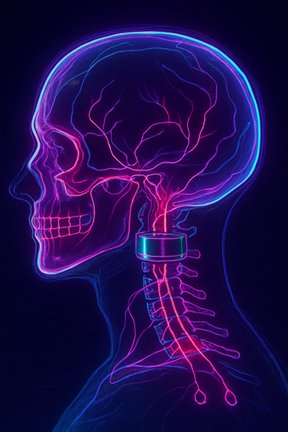
An encephalon cyberdeck (“ECD”, “cyberdeck”) is a small computer capable of storing a sentient being’s ghost. Once a ghost is imprinted an ECD can readily be transferred from one machine to another.
An ECD is a surprisingly simple design. A hexagonal heavy dark matter case roughly the dimensions and quintuple the weight of a poker chip encases a lattice of organic dark matter bathed in a dark aether substrate. The dark matter making up the case has the same atomic number as uranium giving it the feel and texture of steel. Since dark matter absorbs all forms of electromagnetic radiation the substance is not considered radioactive, but scientists believe there is an unknown interaction between the heavy dark matter and the dark aether. The organic dark aether acts as a catalyst to power the dark matter reaction organizing akasha particles of into a subatomic crystalline storage structure resembling DNA capable of recording and maintaining a ghost indefinitely.
Outside of a machine the ECD either glows with a blue or red flame-like shimmer similar to watching a video recording of fire in reverse. An empty or inactive ECD glows red whereas an active ECD glows blue. Inside a machine the glow cannot be seen. Only close examination of an ECD recipient’s neck will reveal a small scar from the implantation process and three tiny data jacks.
BODY SYSTEM
An ECD is a cybernetic augmentation inserted between the skull and spine. Due to its unique structure, it does not count against any body systems. However, only a machine with a brain and spine body systems are suitable hosts for implantation.
FUNCTIONAL STATE
An ECD has three functional states inactive and active.
INACTIVE STATE
Due to the Principle of Cognizance an inactive ECD would be implanted in a child or adult wishing to continue their cognitive journey to or through adulthood. An inactive ECD activates and imprints the recipient’s ghost on death. Inactive ECDs are riskier than active because there is a chance the recipient dies of head trauma and not all memories can be retrieved and imprinted with their ghost. In this rare case the personality, abilities, life skills, and cognitive abilities of the recipient would transfer to the ECD but their ghost might be missing memories in a state similar to amnesia. These memories are forever lost and cannot be retrieved but new memories can be made.
ACTIVE STATE
By death or by choice the recipient has activated their ECD and imprinted their ghost on it. Active ECDs work in conjunction with a machine’s brain and spine function. The brain and spine act as sensory input, control a machine’s body functions, and allow the ghost to command the machine’s activities. Memories are created in the brain and instantly recorded on the ECD with the ghost. If the host machine dies no memories will be lost.
NULL STATE
A blank unimprinted encephalon cyberdeck implanted in a machine without a ghost is in null state. Null state ECDs are used to prepare a machine for a ghost from an active ECD.
GHOST TRANSFER
Ghost can be transferred from an active state encephalon cyberdeck and imprinted to a null state encephalon cyberdeck with ease. The transfer can be done with a direct link between datajacks, over the Dataspere, or even subspace relays with a mnemonic transfer pod or like device.
Only a willing ghost can be transferred.
GHOST CAST
Ghost cast is a process similar to ghost transfer except only volatile copy of your ghost is transferred to a wreckdeck (remote encephalon cyberdeck). Ghost casting has two functional modes; synchronous and asynchronous. Ghost casting does not lead to personality fracturing but might lead to other consequences, see below.
SYNCHRONOUS MODE
You can remote control any machine to which you are ghost attuned within 500 feet. Use of certain cybernetic devices and other equipment can greatly extend this range. Uploading a volatile ghost to a wreckdeck is a full round action followed by the normal effects of acclimation sickness. While ghost casting the machine hosting your active ECD gains the helpless condition. Gracefully releasing the volatile copy of your ghost is a full round action also followed by the normal effects of acclimation sickness. If your attuned machine or your wreckdeck is destroyed before you can gracefully release your volatile ghost you gain the confused condition for 1d4 minutes in addition to acclimation sickness from the shock of dying.
ASYNCHRONOUS MODE
You can send a volatile ghost to any machine to which you are attuned located on the same Datasphere or subspace relay. In asynchronous mode your active encephalon cyberdeck is put into sleep mode until your volatile ghost is resynced or a preset time limit expires.
When asynchronous mode is used the mission, length is predetermined. Your ECD will be put into sleep mode for minutes, hours, or days and your volatile ghost is imprinted on an attuned machine. The process of transferring your volatile ghost takes 10 minutes and requires a mnemonic transfer pod or like device. When the mission is completed memories from your volatile ghost must be gracefully transferred back to your ECD at the specified time. If you miss the predetermined transfer time for any reason; traffic, death, wedding you would rather not remember, any memories and experience you would have gained are lost. If everything goes well your memories are intact and your ECD comes out of sleep mode with standard acclimation sickness rules applied.
While you are in sleep mode you gain the helpless condition. Waking someone in sleep mode during an asynchronous ghost casting is extremely dangerous. In addition to double duration acclimation sickness any character removed from asynchronous ghost casting must make a Will save or gain cyber psychosis. Difficulty of the Will save DC is determined by the mission length; minutes DC = 13, hours DC = 18, days DC = 23, weeks DC = 28, months DC = 35. For additional information on Cyber psychosis see the Gravity Age: Cybernetics Emporium.
IMMORTALITY
The encephalon cyberdeck offers practical immortality to those that can afford it. True death is rare due to an encephalon cyberdeck’s construction. If the encephalon cyberdeck is retrieved it can put into a new machine.
SKILL CHECKS
Any recipient with an active ECD gains a +1 on any skill check used to recall information.
Removing an ECD can be done by anyone with a knife and the stomach to cut into someone else’s spine to retrieve it.
SYMBIONTS AND SYMBIENDS
If you have an active encephalon cyberdeck you cannot have a symbiont or symbiend augmentation. See symbionts and symbiends in the Equipment section under Biotech and Bioware for additional information.
CYBER-EGO
Possessing an active encephalon cyberdeck allows the recipient to enter a Cyber-Reality in the Dataspere with a virtual reality avatar identical to their character’s normal appearance, race, level, archetype, and class statistics.
PERSONAL CYBER-REALITY (“PCR”)
Sometimes called a “hotel”, a personal cyber-reality is a single room and a lobby. The single room is a virtual reality instance where the person feels most at home. It might be a bedroom, a favorite bar, a Roman bath, forest glade, or almost anything you can imagine. The room is limited to a 50ft. by 50ft. space and is always a single room or open location. You can invite other cyber-egos to your room, but it is considered a very intimate experience. Its uncommon to share a personal cyber-reality with anyone other than your most trusted associates, friends, and lovers.
Every personal cyber-reality is equipped with a lobby. The lobby is a nondescript space where cyber-egos can meet in a private virtual setting. A cyber-ego must be invited to enter your lobby.
Additional information on cyber-reality and cyber-egos can be found under the Datasphere.
ECD DRAWBACKS
See Acclimation Sickness and Personality Fracturing.

Comments