

Darrakeltir
Metropolis: Population 43,420 (77% letheni, 9% vesperkin, 7% lynoxi, 5% humans, 2% other)
History
Darrakeltir is a very old city that lies within a canyon along Arak's northeastern shores. One of Arak's first port cities, being in an ideal location along the coast, it was established early in the Upheaval period when the Kingdom of Derunadel began to expand into northern Arak as the Drakantal Empire was gone. It still serves as a convenient port of entry into Arak to this day, being where much of Valensir's trade is routed. However, over time, a disturbing religion has emerged in the city that has led to the city's government being replaced by the leaders of a cult. This cult has made it difficult to pass through port without subjecting oneself to their beliefs and religious practices, demanding tribute from visitors. The cult is known for extreme conservative views that are very off-putting to outsiders.
This cult began to appear during the Reckoning period, as a group emerged and took power, seemingly without resistance. The outside world was shocked and confused as to why the Kingdom of Derunadel's governors simply handed over the city to them, and this has remained a mystery ever since. The cult, known as the 'Darranakar' or 'Rose Wardens', outwardly preached disdain for the lack of piety among the races of the world and established their own strict laws, ignoring the laws of the Kingdom outside. The Kingdom of Derunadel did not take kindly to this and sent a number of military groups to reclaim the city, but none ever returned. These military groups were not wiped out, but seemingly joined the city of their own will. This disturbing development led the Kingdom to avoid interaction with Darrakeltir for the remainder of its existence, fearing what power allowed them such control over their people.
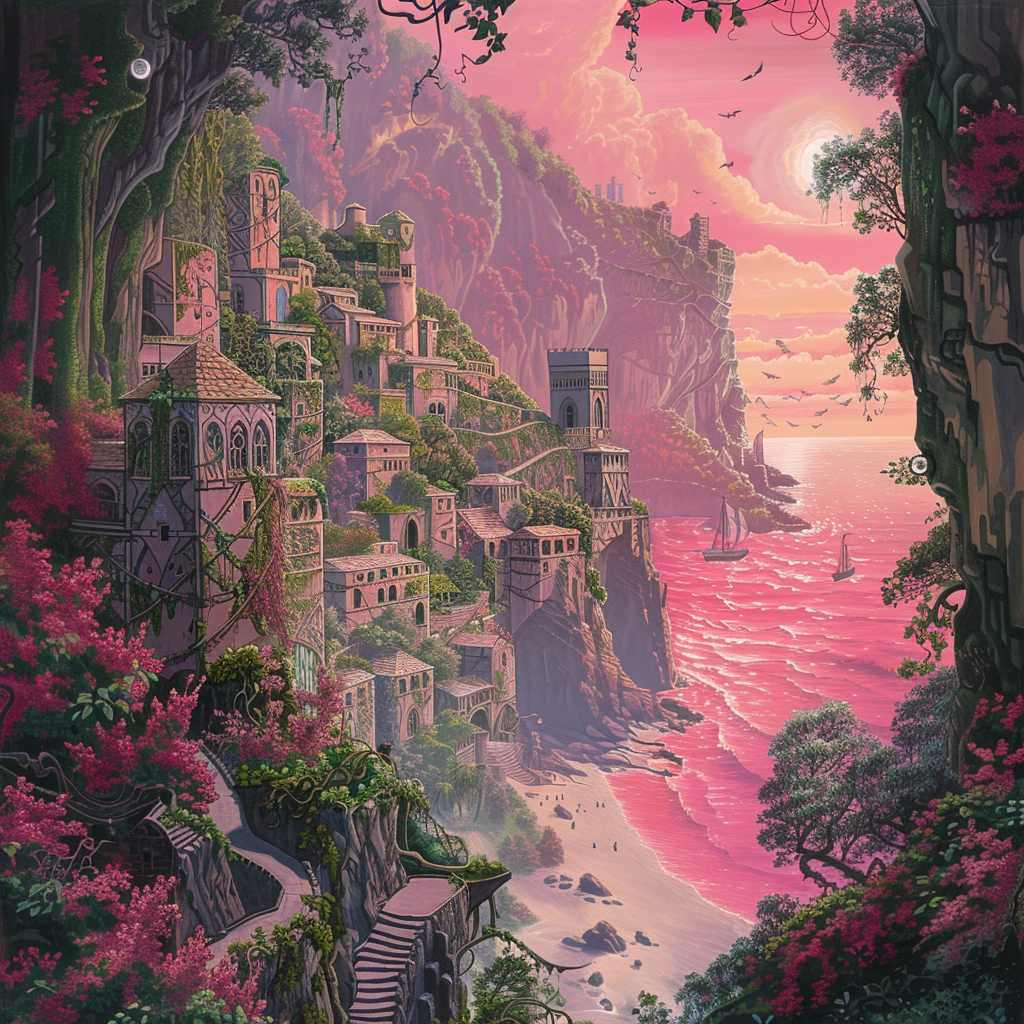
Darrakeltir is so named for the pink-hued waters along the sea and in its ports that extend for about 20 miles outward from the city, as well as the lush flowery fields surrounding the city. The rose waters of the ocean are the result of a Wellspring eruption that predates the city's founding, and has some minor magical effects; including that the water appears to be desalinated despite being in the ocean, and acts as a very powerful fertilizer for plant life. It has a unique sweet flavor and acts as a natural leavening agent. However, ingesting the water is the Darranakar's highest criminal offense and is punishable by death by fertilization. Any water from the ocean that enters the region of the rose water's area of effect, known as the 'blooming', seems to become rose water.
Despite the Darranakar's extreme and, to some, frightening views; their requirement for citizens to maintain personal gardens has given the city a unique, lush appearance. There are very few parts of the city not covered in plant life. The architecture is unique as well, as the Darranakar consider it heresy to use living materials such as wood as building material, so most buildings are constructed from stone. Some homes are built around the city's trees, but the laws and regulations regarding how these houses can be constructed so as to preserve the tree make it undesirable for most. Citizens frequently use vertical space to grow plants on trellises, with vines strung between buildings and homes which are used to hang clothing to dry, and potted plants.
Government
Darrakeltir's system of government has a strange history; originally an expansion of the Kingdom of Derunadel into the Drakantal Empire's former lands, the city was "lost" to the influence of the Darranakar cult in the middle of the Reckoning period. When the Darranakar took power, they did so without any sort of resistance from the Kingdom of Derunadel's governors. All attempts by the Kingdom of Derunadel, and modern attempts by the Synodical Republic, have failed to recover the city from this cult's control, with those who try seemingly joining the city and its cult of their own free will. There have been a number of suggestions that some sort of enchantment magic is at work, but none have been able to get close enough to prove this without falling victim to the city's control.
The Darranakar are composed of a group of seven Letheni clerics: Caligor, Fenneth, Kaelan, Lilith, Sefera, Vinthi, and their leader, Manith. Each represents a virtue expected of the city's citizens to uphold, and these clerics personally dole out punishment to those who infringe upon these virtues. Keen observers of history have noted that these are the same names of the original clerics when the cult took power in The Reckoning period, which seems impossible because even with the Letheni's long life, it would be impossible for any of the founding members to still be alive. Some believe these names are symbolic and passed down to successors, but some are concerned about the possibility that they are indeed the original founders, and the implications of this.
The clerics' virtues are each an extreme view of Lys' teachings, and are viewed on the outside as bordering on heretical. Caligor is the cleric of Temperance, and enforces purity of the body, and abstaining from vices like drugs and alcohol. Fenneth is the cleric of Renewal, and enforces punishment on those who have committed the city's greatest offenses, by either drowning them in the rose water, or by fertilization; and oversees funerals by using those have passed for fertilization. Kaelan is the cleric of Protection, and is responsible for commanding the city's Lykosia, their shambling plant guard, using them to hunt down outside threats. Lilith is the cleric of Growth, enforcing citizens' personal gardens, overseeing their evaluation and ensuring each of them maintains a garden that is up to the city's standards; imprisoning those that fail to maintain them properly. Sefera is the cleric of Life, who enforces respect for natural life; hunting down those that hunt animals for food, those that fell trees around the city, and enforcing the city's vegetarian diet. Vinthi is the cleric of Good and is responsible for ensuring the citizens lead righteous, pure lives. Finally, there is Manith, the leader of the Darranakar, who is the cleric of Devotion, and who is responsible for delivering sermons to the people and enforcing worship of Lys and obedience to the Darranakar.
Economy
Being a port city, Darrakeltir sees a vast amount of trade from merchants entering the city seeking to sell their wares in Valensir. However, due to the Darranakar's control of the city, the merchants are subject to the same strict laws governing the city's citizens. This can be a significant problem, especially for members of other faiths or those who are opposed to authority. Though most don't have any issue paying tribute to Lys to avoid an incident, many are unprepared for the acts of faith the Darranakar demand of even visitors to the city. Minor transgressions can be overlooked for non-residents for a fee. One problem however is that merchants are subject to the same laws regarding technology and the mandatory vegetarian diet. Many merchants have had their possessions, food, or even pieces of their ship seized upon entering port. The Darranakar make a non-trivial profit by extorting merchants unaware of the city's laws and by taxing them for breaking laws they didn't even know existed. However, travelers don't have much else in the way of options unless they want to make the much longer voyage to Cothunor or risk attack by the Corsairs in the Gulf of Liborius. Merchants planning to dock in Darrakeltir are often warned to set aside money for a bribe.
It is no surprise that a city placing such a high importance on the growth and nurturing of plants has a large variety available, including some unique plants not found anywhere else. The most obvious plant unique to the city is the Manir Vossuan plant, a type of nettle tended by the clerics alone which is used to punish criminals by fertilization. This vicious plant's sting can paralyze its victims, after which it secretes a red ichor that digests the body, absorbing the body's nutrients into the roots of the plant. The Manir Vossuan plant can be found in a number of places throughout the city, but is expressly forbidden for anyone but the clerics to tend to or harvest. In addition to the Manir Vossuan, there is a popular plant grown in many gardens throughout the city that is reserved for those who receive a green card during Am Solaneth, known as the Tikos Hestan, which has some interesting medicinal properties -- the root can be ground into a paste and acts as a powerful painkiller, but having the side effect of inducing delirium; meanwhile, the unique blue leaves can be boiled to produce a tea which provides a powerful boost of energy, but which causes the one who drinks it to crash hard after it wears off. Both effects of the Tikos Hestan are known to be addictive, but it is one of the largest exports, providing a steady source of income for those fortunate enough to carry a green card.
Notable Locations
- Am Nelonsir - Located atop the western cliff of Darrakeltir's canyon, this cluster of seven towering trees, surrounded by a sparse forest, houses the city's seven clerics. Their homes are suspended in the air far above the ground, and each is interconnected. The forest below has a number of Lykosia patrolling it watching for intruders, and it is blanketed by a strange mist. Those who wander too close to the mist become very confused and unable to tell which way is which, and begin to hallucinate terrifying imagery.
- Meche ith Lys - Atop the eastern cliff of Darrakeltir's canyon resides the city's church, dedicated to Lys. The large stained glass window in the rear of the church catches the light of the sunrise and projects Lys' emblem onto the floor. Citizens of Darrakeltir are required to worship Lys, and attendance of Manith's sermons at the church are mandatory. The church obviously cannot support the city's entire population, so citizens are required to attend at least one sermon per month, during which a tithe must be donated. Those who do not comply risk imprisonment and fines. The church caters only to the Lysian faith, with no representation of the other Seven Sisters.
- Darranemasi - These large baths located at the base of the canyon are filled with the rose water of the harbor and have rose petals scattered throughout. Citizens are "encouraged" to bathe here once a week to cleanse their bodies of impurities and to banish temptations. Drinking the rose water, like anywhere else in Darrakeltir, is strictly forbidden and punishable by fertilization. Citizens must pay a small fee to bathe here.
Culture
It is no small wonder that with the restrictive and oppressive laws in Darrakeltir that its citizens are not filled with joy. Though its citizens seem outwardly content to stay there and none voice dissent, those who stay long enough to get to know anyone from there can see clearly that its people suffer from a mild depression. Their food is bland and uninspired due to Caligor's virtues teaching that flavor is a temptation to be avoided. There is no joy to be found in Darrakeltir, only service to the Darranakar's warped ideology and the small pleasures found in being one of the few able to tend a garden well enough to be socially accepted. Those that are unable to tend a bountiful garden are ostracized, as one's social status is heavily dependent on the quality of their home garden. Jealousy is common amongst those that seek to cultivate the most respected gardens, and despite the risk of the death penalty for doing so, many will even try to sabotage the gardens of their rivals.
The month of Lysten is probably the most stressful, but happiest time in the city, as the cold weather recedes and gives way to the bloom of a new year's growth. The year begins with an event known as Am Solaneth, during which the city's residents scramble to procure seeds and get started planting their garden. Despite the importance of gardening in Darrakeltir, there are often shortages, leaving those who are late to buy their seeds with few options and even sometimes finding nothing left. The scramble is not out of eagerness, but out of necessity, as the Darranakar evaluate the citizens' gardens at the end of the month; and those who come up wanting are issued a black card, marking them as impure. This black card can carry a heavy social stigma, but can also bar residents from certain services around the city. The citizens with the most well-tended gardens however are issued a green card, which afford them certain special privileges around the city, including discounts in shops, exemptions from tithes and fees, and permission to plant exclusive plants and flowers that show their favor among the clerics. Conversely, the month of Esten is a time of contempt among the city's residents, as the clerics abhor Estrea, and forbid her worship at the penalty of imprisonment. The month of Esten sees an event known as Am Restineth, during which its residents mourn their gardens being taken by Estrea's cruel and bitter cold. Some try in vain to keep their gardens alive, but being so far north ensures that no garden can survive.
Defenses
Darrakeltir employs two main forces that enforce its laws -- the Custodians, and the Lykosia. The Custodians act as the city's "morality police", and patrol the city looking for infractions of the clerics' rules, and if necessary, arrest criminals. The Custodians rarely have to get physical; that type of enforcement is the responsibility of the Lykosia, the clerics' strange shambling plant creatures which resemble humanoids that are overgrown with vines and leaves. The Lykosia can lash out with vines and reel in criminals, and ensnare them, immobilizing them against their own bodies before dragging them to Am Nelonsir for Kaelan to deal with. The Lykosia seemingly feel no pain, and are an unnerving presence in the city, moving about silently. They are not capable of speech, though they appear to understand the commands of the Custodians and cleric Kaelan. Unknown to the citizens of Darrakeltir, the Lykosia are not simple magical beings, but the animated remains of criminals that have been fertilized; a process carried out by Fenneth.
The clerics themselves are powerful in their own right, owing to magical abilities associated with their virtues. None are sure of the source of their abilities; whether they come from Lys herself, or something else. However, the clerics have fended off attacks numerous times, making short work of assassins. They have had frequent clashes with a group called Wunyr Tonil, who are a faction of rebels that are trying to break the clerics' hold over the city's residents; but the clerics have thwarted their every attempt. The city does not employ traditional defenses such as walls because those who enter the city with ill intent are subdued by the influence of the clerics, with the exception of Wunyr Tonil, who inexplicably seem able to resist their domination.
Crime
The city is notorious for its restrictive and totalitarian laws, enforced by the powerful clerics of the Darranakar. The city's laws reflect opposition of each cleric's virtues -- there is Caligor, the cleric of Temperance, who enforces the city's ban on drugs, alcohol, and other vices and temptations. There is Fenneth, whose virtue of Renewal who recycles those who have committed the highest offenses by fertilizing them and animating their remains to become Lykosia, the city's shambling plant guard. The cleric known as Kaelan enforces the virtue of Protection, punishing those who destroy the natural world, and who commands the Lykosia and uses them to protect the city and the clerics. Lilith, representing the virtue of Growth, enforces the city's mandatory garden tending and ensuring citizens do not let their gardens perish due to neglect or carelessness. Sefera enforces the virtue of Life, which has the most impact on the city's laws, reflecting its mandatory vegetarian diet, punishment of those that kill animals or plants, and punishment of those that seek to terminate pregnancy. Sefera also enforces the strict prohibition against the worship of Estrea, under threat of imprisonment. The cleric Vinthi is responsible for enforcing the virtue of Good, which reflects the city's laws requiring citizens to lead pure lives; this is shown in laws that punish violent altercations with long-term prison sentences, and punishing murder with drowning in the rose water to cleanse the offender before fertilizing them. Finally, there is Manith, whose virtue of Devotion is reflected in the city's requirement that all those within the city limits worship Lys and attend his sermons.
Criminals can be punished in only two ways -- imprisonment, or fertilization. Fertilization is the punishment for the city's highest offenses, including killing plants or animals, drinking the rose water, harvesting Manir Vossuan, or heresy. Fertilization is a horrifying punishment in which the offender is buried in Fenneth's personal garden, where the Manir Vossuan plant within paralyzes them and begins slowly digesting their body. Unbeknownst to the city's residents, those that are fertilized are not devoured, but simply drained of their vital essence; after which Fenneth animates their corpse, creating a new Lykosian.

Comments