
The River Realms of Kang-Chorath
As the Lanovia, the name you learned for this larger one masted river boat you are upon drifts adn travels lazily down the Lotzi you take in the surroundings in the early dawn mist. The jungles to either side are coming awake, the drone of insects becoming lessened as the sounds of monkeys, birds and other wildlife begin to echo and chatter all around you. Overhead colorful feathers, some sort of parrots, a dozen perhaps more flit across the river, heading into the canopy within the jungle proper. The wetlands around the river see plentiful activity as well, splashes and motions of the reeds and overgrowth letting you know various mostly aquatic species around you are active again. Briefly, ever so briefly you see something bobbing a few dozen feet from the boat, at first perhaps you could confuse it for a dead log. Until you see the powerful tail splash and the creature disappear from sight, a crocodilian of some sort, likely a Vestors Crocodile, given the softer coloration you notice as the creature heads down to deeper water, its scales almost a sand like creamy color over its front legs, back and upper 'torso'. Big enough to be dangerous to people for certain but no Salt-spine, no true behemoth.
The hours pass and other boats and vessels you pass along the river. The Lotzi varies noticeably between the wet monsoon season and the drier summers, reaching widths of some thirty to forty kilometers wide at its widest points and easily averages fifteen to twenty basically along its whole length. It is a vital highway of transit and trade. Eventually as the mist of morning begins to fade, the sun over the canopies now and the humidity of the jungle bringing sweat to your brow, as the ferry vessel rounds a bend, you see in the distance what you were waiting for. Where a smaller river feeds into the Lotzi, joining it on the journey to the sea, a city can be seen. The jungle cleared back from it quite a distance, no real walls of fortifications heavily present of course, the city itself quite large. The Chorathians do not utilize walls in their settlements, relying instead on communal efforts and militia to protect their settlements, as well as the thick jungles and terrain to protect them from invaders, at least inland. This strategy seems to work for them quite well, though it does help how isolated the nation truly is. No real modern roads exist here, and only but one rail yard, connecting a city further up the Lotzi to Susma. Of Sky-ports there are but two, one in the nation's capital of Haramir, the only settlement that is fortified with any sort of walls or otherwise, so says our guide. The other, Blackfish Bay, on the frontiers of Holoru Island, the least settled region, the frontier of the nation.
The humidity, the hoards of insects, the lack of easy markers, the requirement for naval ability and boats to get anywhere, truly this nation shall be a marvel to discover. This first step, this arrival, is likely the beginning of a grand adventure indeed.
The hours pass and other boats and vessels you pass along the river. The Lotzi varies noticeably between the wet monsoon season and the drier summers, reaching widths of some thirty to forty kilometers wide at its widest points and easily averages fifteen to twenty basically along its whole length. It is a vital highway of transit and trade. Eventually as the mist of morning begins to fade, the sun over the canopies now and the humidity of the jungle bringing sweat to your brow, as the ferry vessel rounds a bend, you see in the distance what you were waiting for. Where a smaller river feeds into the Lotzi, joining it on the journey to the sea, a city can be seen. The jungle cleared back from it quite a distance, no real walls of fortifications heavily present of course, the city itself quite large. The Chorathians do not utilize walls in their settlements, relying instead on communal efforts and militia to protect their settlements, as well as the thick jungles and terrain to protect them from invaders, at least inland. This strategy seems to work for them quite well, though it does help how isolated the nation truly is. No real modern roads exist here, and only but one rail yard, connecting a city further up the Lotzi to Susma. Of Sky-ports there are but two, one in the nation's capital of Haramir, the only settlement that is fortified with any sort of walls or otherwise, so says our guide. The other, Blackfish Bay, on the frontiers of Holoru Island, the least settled region, the frontier of the nation.
The humidity, the hoards of insects, the lack of easy markers, the requirement for naval ability and boats to get anywhere, truly this nation shall be a marvel to discover. This first step, this arrival, is likely the beginning of a grand adventure indeed.
Structure
Kang-Chorath is the newest nation to be formally recognized, and has a unique history tied to that which I'm sure my colleagues shall discuss in greater depth in their own works. However she is a unique 'nation' in that there is no centralized leadership of government. None. No bureaucratic or political positions, no executive arm or the like. There is the church of the Divine Judge of course, yet they do not make laws, but merely enforce them. The lands of Kang-Chorath are split into areas called Dominions, with city-states and their localized leadership, often a city or regional council of elders or community leaders off tied to large industries, work forces, as well as community leaders and caretakers. The methodology for whom makes up these councils varies heavily, yet they all venerate their laws upon those of the faith of the Divine Judge and it is those of the cloth and of steel whom act as both enforcement and the courts. Haramir is considered not neutral ground, but rather holy ground, a place where the church is the central authority and no dominion or its laws hold sway. Within the capital city the Divine Judge is law.
Yet though this sounds awfully like a religious state, and in many ways it is, there is a unique aspect in that outside Haramir's borders, the church does not make any of the laws. Indeed it is such a deep part of the structure of their faith that they will actively refuse to have representatives at these meetings of regional councils and the like, wanting no risk of exerting any bias upon the meetings. They would rather simply have new laws and the like passed along after the fact, officially, to the temples so that those of the cloth and of steel may learn them. This is not to say that the church of the god of Justice would not speak up against rules or laws that are unjust or cruel, however there is a specific process of rejection that occurs and can only occur once a case is brought before a member of the cloth. This will be better explained in the details of how the nation runs/is governed and also in discussing the religion of the Divine Judge, that is Deat-Kra, itself.
Yet this structure seems to work quite well. The peoples of the Chora Jungles are content enough I must say after my time there, and despite what some might think, they are not a people out of time, having extensive trade and commerce both between their various dominion regions and with other nations. They are not without modern technology and use it where it can be most helpful, however the Chora itself limits various aspects of its utilization.
Yet though this sounds awfully like a religious state, and in many ways it is, there is a unique aspect in that outside Haramir's borders, the church does not make any of the laws. Indeed it is such a deep part of the structure of their faith that they will actively refuse to have representatives at these meetings of regional councils and the like, wanting no risk of exerting any bias upon the meetings. They would rather simply have new laws and the like passed along after the fact, officially, to the temples so that those of the cloth and of steel may learn them. This is not to say that the church of the god of Justice would not speak up against rules or laws that are unjust or cruel, however there is a specific process of rejection that occurs and can only occur once a case is brought before a member of the cloth. This will be better explained in the details of how the nation runs/is governed and also in discussing the religion of the Divine Judge, that is Deat-Kra, itself.
Yet this structure seems to work quite well. The peoples of the Chora Jungles are content enough I must say after my time there, and despite what some might think, they are not a people out of time, having extensive trade and commerce both between their various dominion regions and with other nations. They are not without modern technology and use it where it can be most helpful, however the Chora itself limits various aspects of its utilization.
Culture
Explaining Chorathian culture is something I think I should best leave to my dear friend Rafiq, as it is particularly unique, and will likely require the skill of an expert to even begin to articulate.
Assets
Though there are known deposits, small but notable of gold, iron, copper and more, in reality Kang-Chorath's greatest assets are in order her agricultural industry, surprisingly, particularly rices and citrus fruits. Her hardwood lumber industry as well is a booming one, the many mangrove forests that dominate some stretches of the wetlands near the various river systems quite the boon. Third after that of course, tar. Though it is only one dominion, it is a notably large one, and tar has become quite valuable and hard to acquire in many other places in this modern age.
History
Kang-Chorath has always seemingly had a quiet or at least not heavily spoken of history, though this is not fully the case. Valewyr back in the 300s to about the 600s were notorious for their slave trade, and very often Kang-Chorath was a target, the Chorathian people more or less under the sway of the empire. It took quite the bloody revolution, likely in no small part backed by Susman coin and Roharan troops, to see the Chorathian peoples freed from this, and the three notably large fortress cities the Valewyrian Empire had built torn down and burned out. One of them was so utterly destroyed, torn down stone and brick and timber at a time, only to be rebuilt as Haramir, the nation's capital.
These revolts in the early 630s, and the subsequent war that lasted from 633 to 641 when Valewyr was forced to recognize Kang-Chorath's independence saw the rise to prominence once again of Deat-Kra, the Divine Judge. He had not been forgotten amongst the Ascended but under the thumb of Valewyr his faith had struggled. The Divine Courts had been taken from them, now returned and soon enough the faith's grand cathedral would be restored to its former glory, and by the 650s, Kang-Chorath was stable once again, Haramir acting as a beacon to the various dominions and peoples of the jungles, whom would find a unifying force within the message of the faithful, that of governance and the laws of the land being given back to the people whom lived and worked it to decide. To this day, this system works more or less as intended.
These revolts in the early 630s, and the subsequent war that lasted from 633 to 641 when Valewyr was forced to recognize Kang-Chorath's independence saw the rise to prominence once again of Deat-Kra, the Divine Judge. He had not been forgotten amongst the Ascended but under the thumb of Valewyr his faith had struggled. The Divine Courts had been taken from them, now returned and soon enough the faith's grand cathedral would be restored to its former glory, and by the 650s, Kang-Chorath was stable once again, Haramir acting as a beacon to the various dominions and peoples of the jungles, whom would find a unifying force within the message of the faithful, that of governance and the laws of the land being given back to the people whom lived and worked it to decide. To this day, this system works more or less as intended.
As flows the Mightest Rivers, so too should the flow of Justice be.
Maps
-
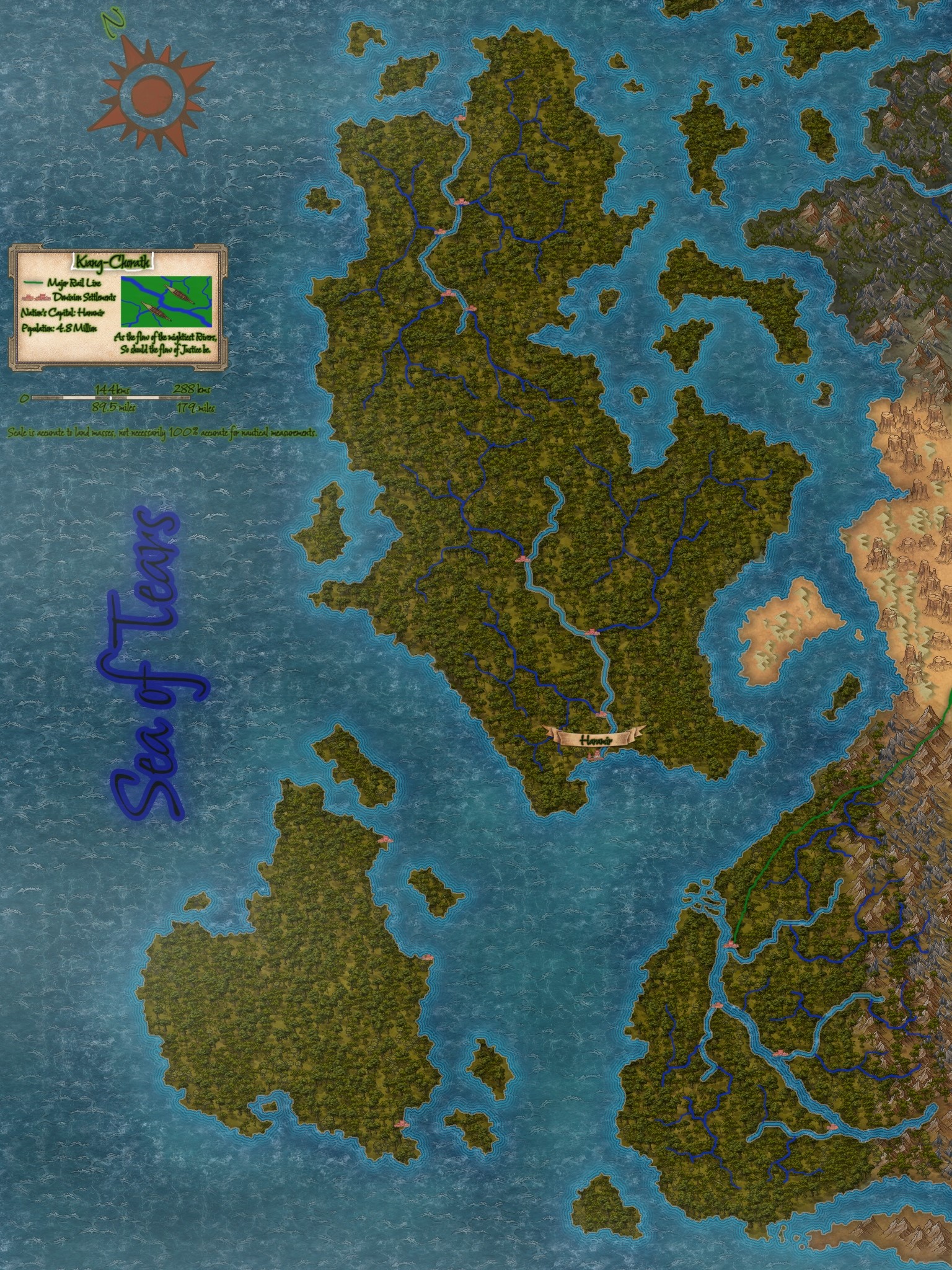
Kang-Chorath, the Floodplains
Founding Date
1062 SuD
Type
Geopolitical, Country
Demonym
Chorathian
Economic System
Mixed economy
Currency
The currency of Kang-Chorath is known as the Chorathian Scale, and they utilize specialized stamped discs of mangrove wood laminated with a clear coat varnish. These intricate stamps mark what the token is worth in Chorathian Scale, their 'gold' coin standard. These discs come in single, 2, 5, 10, and 20 Scale denominations. The Chorathian Scale is at time of publishing, trading at about 1.15 to 1 Wastonian Chailling. Their smaller denominations are Claws, which are stamped iron tokens and their 'silver' currency, with each Claw being worth 1/10th of a Scale. There are 1 Claw, 2 Claw and 5 Claw tokens. Finally they have stamped copper coins known as Flakes, and each Flake is worth 1/10th of a Scale. These as well come in 1, 2, and 5 coin denominations.
Major Exports
Mangrove Lumber is a major Export, a massive one in fact, as is Tar. Beyond that some food stuffs and associated products, especially specific tropical seafoods, particularly pickled and canned foods. Unique alcohols are a notable export as well.
Major Imports
Though limited iron deposits have been found, iron and other ores, and metal tools, as well as modern armaments, tools and materials are without question near the top of the list for imports. Some food stuffs and luxury goods as well, however Kang-Chorath is unique in that they are not a massive importer as a country or nation, trade is often done more intimately here, with merchants and goods coming not shipping companies and third parties. Which is uniquely interesting because as the world around moves to a less hands on focus on trade, mercantile folk often having other people handling their goods and logistics, two steps or more removed from the process. But yet those whom seek to move goods into or acquire them out of Kang-Chorath, they normally make an expedition of it themselves or with someone directly connected and trusted. It's why a majority of trade Kang-Chorath is involved in runs through Roharaby ship or Susma by rail.
Controlled Territories
Neighboring Nations

Fascinating article, as always. I love the depth you go into about all the different things. The prose at the beginning was great. <3
Explore Etrea | WorldEmber 2025
Thank you so much <3 Yeah I like digging in really scratches an itch for me to do so, and I really appreciate the love for the prose at the beginning. Was a lot of fun to come up with always nice to have those bits be appreciated :D