

Ninym Athomath
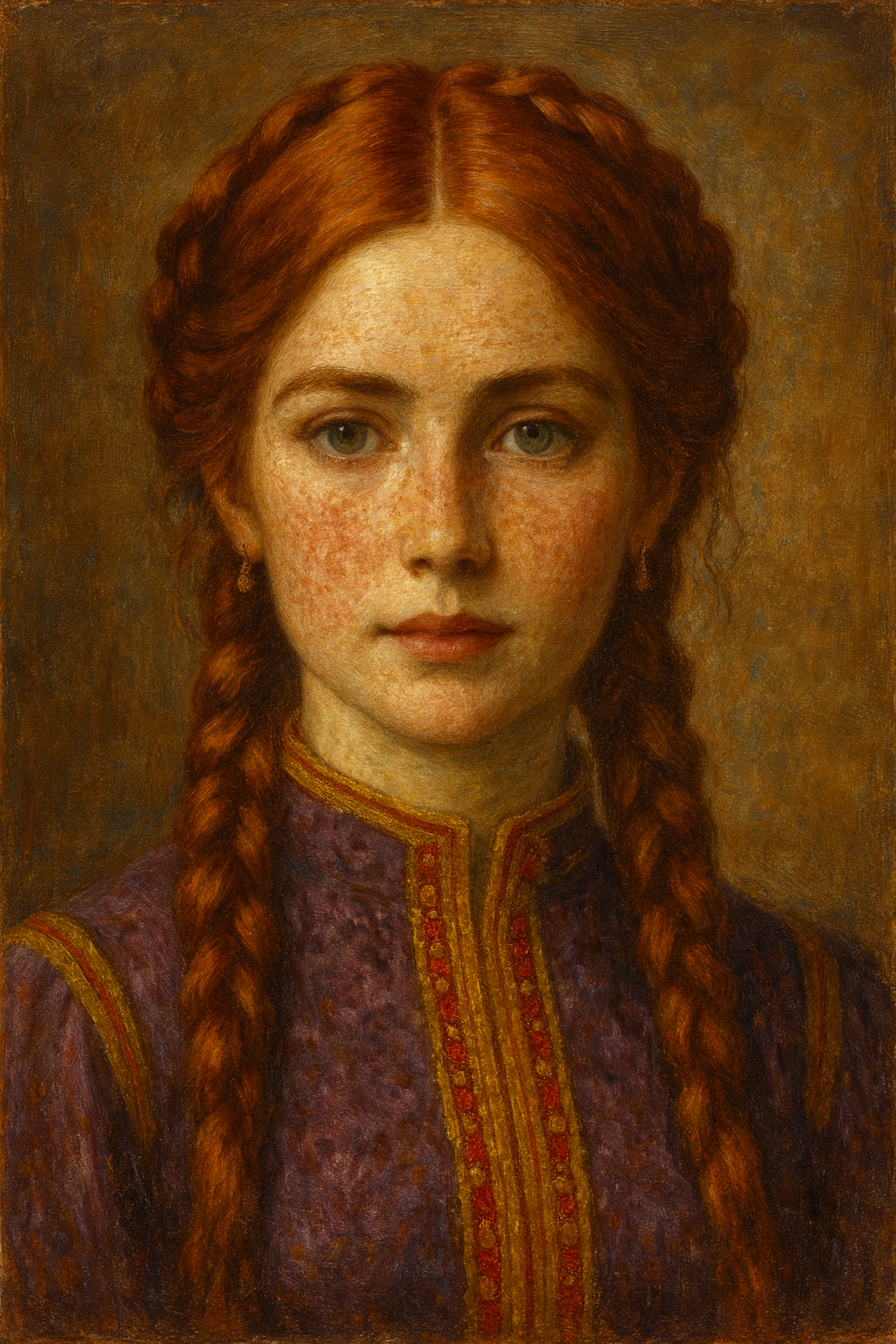
High Queen of Alagor Ninym Athomath
Ninym of Su (3 January 79 BFE – c. 44 BFE), later Queen Ninym Athomath, was queen consort of Alagor and the first wife of King Octavius Athomath. She was the mother of Prince Alexander and Princess Aindranla. Admired for her compassion, charisma, and informal approach to royal duties, she became one of the most beloved figures in Alagorian history.
Ninym was born in the Kingdom of Su to commoner parents and was orphaned during the First Suian War. She was adopted by Nolan Putnam, Chancellor of Alagor, and raised in Athomathia, where she developed a close relationship with Crown Prince Octavius. Their marriage following his accession to the throne made her queen consort, a role in which she was enthusiastically embraced by the public.
As queen, Ninym became known for her personal diplomacy and visibility among the people. She toured widely across the Seven Kingdoms of Alagor, engaged directly with citizens, and encouraged Octavius to adopt the same openness, reshaping the image of the monarchy in the process.
During the build-up to the Second Suian War, Ninym advocated for continued negotiation with King Kylok of Su. In 44 BFE she was taken hostage during a diplomatic mission, and her apparent death was widely reported, sparking Alagor’s full entry into war. Months later it was revealed she had been kept alive, only to be ritually sacrificed as part of the creation of the Amulet of Atrops, an act that marked the war’s bloody conclusion.
Her death was met with unprecedented grief, and she has since been remembered as a symbol of compassion and peace. Statues, gardens, and educational institutions continue to honor her legacy, and her life remains a touchstone in Alagorian cultural memory.
Early life
Ninym was born on 3 January –82 BFE in the Suian city of Kethrival, the only child of two commoners later identified with an underground network that aided persecuted sorcerers. During a raid near the end of the First Suian War, her father was hanged and her mother killed in their burning home while shielding her daughter. Ninym was discovered in the ruins by Nolan Putnam, Chancellor of Alagor, who noted she was clutching a carved keepsake inscribed with her name.
She was brought to Athomathia and raised as Putnam’s daughter. Although her adoption was not immediately announced, it was known within the Senate that the Chancellor had taken a ward. Ninym spent her early years between Putnam’s estate and the royal palace, where she was often present at court.
Educated privately under Putnam’s supervision, she was instructed in rhetoric, history, and diplomacy. From an early age she displayed a strong aptitude for speech and a natural charisma that impressed tutors and attendants alike. Known for her spirited nature, she was described as outgoing and quick to charm.
Ninym formed a close friendship with Crown Prince Octavius Athomath in childhood. Contemporary accounts suggest High Queen Melania encouraged their early introduction, and the two were soon regarded as inseparable. Ninym was frequently seen leading the young prince through the palace halls, and their companionship became a familiar sight at public ceremonies.
Though she held no formal duties, Ninym became well known within Athomathia for her warmth and approachability. Later historians remarked that her early compassion and openness foreshadowed her popularity as Queen of Alagor.
Education
Ninym was privately educated within the household of Chancellor Putnam, who oversaw her lessons personally. Unlike many children of her generation, she had no classmates; her “academy,” as she later described it, was her father’s study. Records suggest she was academically gifted, with Putnam himself remarking that she displayed a precocious sharpness of tongue, occasionally turning even his own rhetoric back on him.
Outside her studies, Ninym enjoyed swimming—most often in the open sea rather than the rivers near Athomathia—and was a skilled rider, frequently accompanying attendants to the coastal plains outside the capital. She developed an early habit of charity work, particularly concerning orphans, and was noted to visit local shelters under her father’s supervision.
By her early adolescence, Ninym had begun assisting with correspondence on behalf of the Chancellor, even drafting letters to Queen Melania Athomath that drew notice for their maturity and warmth. She was remembered by courtiers as lively and approachable, though Nolan sometimes cautioned that her candor could unsettle more rigid senators.
At the age of sixteen, Ninym’s public life shifted markedly when Octavius Athomath selected her as his partner for his formal investiture as heir apparent. The event, traditionally accompanied by a ceremonial court dance, was later remembered as the beginning of their widely admired courtship. One court observer wrote that she carried herself “with the grace of a queen, though none had crowned her,” while others noted that her genuine ease with Octavius contrasted sharply with the formality of the occasion.
Public Life
Ninym first appeared in a formal role beside Octavius at his investiture as heir apparent, where she was chosen as his partner for the traditional court dance. Though the two had been childhood companions, the appearance was regarded as the beginning of their public courtship. From that point, she was frequently seen at his side in Athomathia and at state functions, and she was invited to join him on visits to Whispering Pines.
At sixteen, their relationship became the subject of speculation within the court. Observers noted that she often appeared more at ease than Octavius in public settings, and that her affinity for the ocean was reflected in the location of his proposal, delivered on the coast during a private retreat. The engagement was kept secret for three weeks before being formally announced. Contemporary accounts record that the Queen gave her approval without hesitation, and that public reaction was overwhelmingly positive. One anecdote from this period describes Ninym being mistakenly addressed as “Lady Athomath” prior to the wedding, an error widely interpreted as foreshadowing her eventual role.
High Queen of Alagor
Following her engagement to Octavius in early 56 BFE, Ninym made her first formal appearance in the spring of that year, when the couple visited the famed jewel-smiths of Vel’herklun to craft their Keshiri beads, the traditional paired rings of Alagorian marriage. The event, witnessed by attendants from the royal court, was reported widely and marked the beginning of her public role. Soon afterward, she appeared alongside High Queen Melania Athomath at a formal audience of the Senate, during which Melania announced her intent to abdicate in Octavius’s favor following his marriage.
Ninym and Octavius were married later that year, and she was crowned High Queen of Alagor alongside him. Their first royal tour covered all six kingdoms of Alagor, where Ninym’s warmth and accessibility quickly distinguished her from earlier consorts. Chronicles note that she frequently paused formal processions to speak directly with townsfolk, and her manner was widely credited with encouraging Octavius himself to adopt a more personal approach in public. Several of the kingdom monarchs remarked on her popularity, with some describing her as “the people’s queen” even within the first year of her reign.
Throughout the late 50s BFE, Ninym sponsored orphanages and relief houses for those displaced by the First Suian War, often visiting them personally. Surviving records describe the founding of the Haven of Athomathia in 54 BFE, which provided food and apprenticeships for war orphans, and the Harbor House in coastal Loradel in 52 BFE. Her advocacy for orphans reflected her own early life and became one of the defining features of her reign. She was also active in supporting education, commissioning new schools in Vel’herklun and Kessath.
As queen, Ninym was accompanied by the Praetorian Guard, the traditional protectors of the sovereigns, though accounts emphasize that she often preferred to move among the people with only a light escort. She also received honors from the House of Athomath, including the right to bear its ancestral crest, and was presented with a sailing vessel built by Chancellor Putnam and Octavius as a wedding gift. The yacht, Everlight, was used frequently during their early reign, and the couple were said to have spent their wedding night, and three weeks, aboard it on the Marasé Valtar.
Her reign as queen was largely remembered as a period of increasing openness between the crown and the people. She often traveled without escort through markets and villages, preferring informal contact to rigid ceremony. In 49 BFE she toured the mountainous Kingdom of Seartor during a famine, personally organizing distribution of grain reserves. While not a military leader, she was also noted for visiting garrisons and offering words of encouragement to soldiers stationed on the Suian frontier.
By the early 40s BFE, Ninym had become one of the most visible and beloved figures in Alagorian public life. Chroniclers describe immense crowds during royal progresses, with people often chanting her name separately from Octavius’s. This period of admiration and stability ended abruptly in 44 BFE, when she was captured during a diplomatic mission to Su, an event that precipitated the Second Suian War.
Charitable works and patronage
Ninym’s role as Queen quickly expanded into a highly visible program of charitable activity. Records indicate that by 55 BFE she had carried out more than seventy formal engagements in a single year, a figure that rose to over one hundred by 52 BFE. Chroniclers noted that her schedule often surpassed that of her husband, as she preferred to spend long hours at orphanages, schools, and infirmaries speaking directly with citizens.
Orphans and youth
Her strongest association was with orphan care, a reflection of her own childhood in Su. In 55 BFE she was named patron of the House of the Lily Orphanage in Athomathia, and by 53 BFE she had formally established the Ninym Foundation for Orphaned Youth. By 50 BFE the foundation reported support for sixteen orphanages across the Seven Kingdoms, and inscriptions from that decade indicate more than 1,200 children received stipends or housing under its auspices. Orphanages often adopted her personal emblem of a lily over a crescent moon, a practice that persisted long after her death.
Widows and veterans
Beginning in 54 BFE, Ninym took a special interest in homes for war widows, frequently visiting the Haven of Veyra in Athomathia and similar institutions in Helfor and Valtoria. Records from the Alagorian Senate note that her petitions helped secure expanded pensions for widows of the First Suian War. She also championed veterans’ causes: in 52 BFE she presided over the opening of the Hall of Recovery, a dedicated house for injured soldiers, and by 50 BFE was credited with arranging stipends for over four hundred veterans and their families.
Education and health
In 51 BFE Ninym founded the Academy of the Crescent Lily in Su, dedicated to literacy and vocational instruction for orphaned children. By its second year the academy enrolled more than one hundred pupils and later became a model for small regional schools. She also lent her name to the Crescent Guild of Physicians, a traveling medical fellowship launched in 49 BFE that dispatched practitioners to rural settlements. Reports from the following decade credit the guild with reducing preventable deaths in border provinces.
Legacy
Ninym’s charitable activity was regarded as one of the hallmarks of her queenship. By the early 40s BFE her personal patronage extended to more than thirty institutions across Alagor. After her death, many of these charities incorporated the lily-and-crescent motif into their names or emblems, and several—such as the Foundation for Orphaned Youth—continued to operate under the same title. Her work with orphans, widows, and veterans became central to her public memory, establishing her as one of the most enduringly popular figures of the Athomath line.
Death
Ninym was taken captive during a diplomatic mission to Su in 44 BFE. On 17 May of that year, during the final confrontation atop Suvenn Hall between King Octavius and King Kylok, she was sacrificed in the creation of the Amulet of Atrops. Her death was confirmed by Octavius himself, who was present and later escorted away by the Praetorian Guard.
Her funeral in Athomathia drew immense public grief, with processions filling the capital and mourners lining the streets in silence. Condolences arrived from across the Realms; the Winged King of Cascadia described her passing as “a light so gentle and so brave struck from the heavens, yet her radiance endures in every heart she touched.”
Tribute, funeral, and burial
The death of Queen Ninym provoked one of the largest public outpourings of grief in Alagorian memory. In every kingdom, church bells tolled, while in the streets of Athomathia flowers, candles, and personal notes soon covered the palace steps. Across the realm, vigils were held in her name, with mourners gathering nightly in silence. In Su, where she had been born, citizens planted lilies along ruined avenues as an act of remembrance.
rHer coffin, draped in the royal standard, was borne to the Great Temple of Lurienne in Athomathia, where the state funeral was conducted. Attendees included the monarchs of the six kingdoms, the Senate, and senior members of the Praetorian Guard. The procession was led by Octavius and his children, Alexander and Aindranla, followed by Chancellor Nolan Putnam and a column of Praetorians. Orphans from the Ninym Home also walked behind, each carrying a lily. Observers described Octavius as visibly broken, while Nolan was scarcely able to complete the eulogy he delivered in her honor.
The ceremony concluded with the interment of Ninym’s coffin within the royal grounds at Selora Vale, the traditional resting place of the Athomath line. As her body was never recovered, the coffin was filled with flowers and tokens from the family. The burial was private, attended only by the royal household and a small guard.
In the months following, citizens of Su raised a memorial garden in her name. Its central fountain, carved with a crescent moon spilling water over a bed of lilies, became a place of pilgrimage for those unable to reach the royal grounds.
Titles and Styles
Ninym was born without title or style, her parentage unrecorded following the devastation of her Suian village. Upon her adoption by Chancellor Nolan Putnam, she was known simply as Ninym of Su, a designation that reflected her origins rather than any station. Her marriage to Octavius in 56 BFE brought her elevation as Her Majesty the High Queen of Alagor, a title she bore jointly with her husband. Contemporary records and later writings often refer to her as Queen Ninym, a name that became synonymous with compassion and accessibility in Alagorian memory. Although her reign lasted less than a decade, her style as High Queen was never revoked or amended. After her death in 44 BFE, she continued to be formally remembered as Her Majesty Queen Ninym Athomath, though among the populace she was more commonly called the Lily Queen, a moniker derived from the floral motif later adopted in her memorials.
Legacy
Ninym’s death was regarded as one of the most profound tragedies in Alagorian history, and her legacy endures as both a political and cultural touchstone. In the immediate aftermath, her charitable organizations were consolidated into the Ninym Memorial Foundation, which expanded its focus from orphan relief to encompass education, veterans’ support, and widows’ welfare. A number of schools and academies established in the late pre-imperial period were named in her honor, many adopting the stylized lily-and-crescent emblem that became synonymous with her memory. The motif, which she had embraced during her lifetime, remains incorporated into the seals of foundations and institutions linked to her work.
Public commemoration of Ninym extended far beyond institutional patronage. She was quickly elevated into the realm’s cultural imagination as a beloved yet tragic figure, her life and death inspiring plays, epic poetry, and devotional art. The painting Malenia’s Sorrow—depicting Ninym in stylized mourning—remains among the most recognized works in the Galbon Museum of Art and is often cited as one of the defining pieces of pre-imperial artistry. Her memorial garden in Su became a pilgrimage site, attracting citizens from across Alagor, and continues to host annual commemorations.
Among scholars, debate persists over Ninym’s legacy as a stateswoman. Some argue her diplomacy with Su delayed open war and preserved fragile stability, while others contend that her optimism toward reconciliation left Alagor unprepared for renewed conflict. Regardless of interpretation, consensus holds that her capture and death marked a turning point in the realm’s history, and that her absence fundamentally altered the trajectory of Octavius’s reign.
Ninym’s legacy remained present in the words of later generations. Queen Nichole Katie openly lamented that she never had the chance to meet her, and Empress Salena invoked her grandmother as the source of her own philosophy of “compassion without fear.” Princess Irisa, who bears Ninym’s name as her middle one, has spoken of her as a personal model of approachability. Though Octavius himself rarely spoke of his wife after her death, his silence became a defining mark of her enduring place in the royal family’s private grief.
Today, Ninym is taught in standard Imperial curricula as a figure of unity and humanity, her image appearing in textbooks alongside accounts of her life. Cultural memory continues to present her as the embodiment of empathy in leadership.
Personality Characteristics
Representation & Legacy
Following her death, Ninym became a symbol of lost innocence in Alagorian history. Her sacrifice is cited as a critical turning point in the Second Suian War, and her life continues to inspire reformers and scholars alike.
Her memory is honored through:
- The Ninym Foundation for Orphaned Youth
- The Memorial Garden of Su, maintained in the capital of Su
- Public schools that include her life in the standard historical curriculum
- A portrait in the central rotunda of the Sapphire Assembly Hall
A personal sigil—a stylized lily over a crescent—has become a common pendant worn in mourning or remembrance across Alagor.
Social
Family Ties
High Queen of Alagor
If they do not know they are worth protecting, then we have failed before we’ve begun.
