
The Velvet Spine
⚠️ Content Warning
This article may contain mature themes, including homoerotic content, complex power dynamics, sexual encounters with vampires and anthropomorphic beings, as well as other adult material.
Reader discretion is advised.
Stock & Services
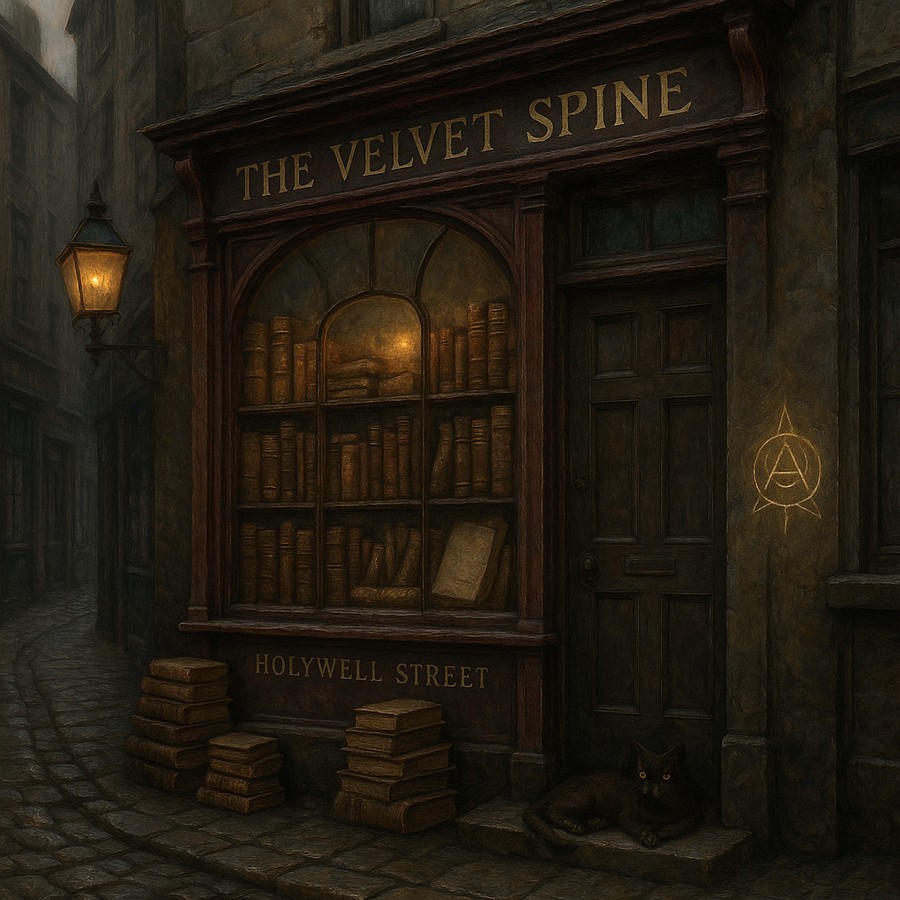
The Velvet Spine maintains a carefully curated and deliberately eclectic stock, reflecting both its proprietor’s scholarly interests and the discreet demands of its clientele. While the shop’s public-facing reputation rests primarily on its extensive collection of pornographic literature, the true breadth of its holdings extends far beyond titillation.
The front sections of the shop feature erotic novels, illustrated volumes, and imported publications, specialising in male–male desire. These works range from mass-printed pamphlets to finely bound, privately commissioned editions, some featuring hand-tinted illustrations or photographic plates sourced from the Continent. Though controversial, such materials are not illegal, and Gregory Tanaka is meticulous in maintaining a veneer of respectability.
Behind this façade lies a more guarded selection: grimoires and manuals of Mystika Carnalis, focusing on sexual magic, intimacy-based ritual practices, and corporeal resonance. These texts are predominantly aligned with same-sex male rites, reflecting both demand and Tanaka’s personal expertise. Access to these works is granted only to trusted patrons, often after careful vetting.
The shop also trades in rare, avoided, or socially marginalised texts—including volumes on Haematurgy (blood magic), Necromancy, and post-mortem ritual theory. None are officially prohibited, yet many are shunned by academic institutions and respectable booksellers alike. Their presence at The Velvet Spine has made it a quiet refuge for scholars, practitioners, and collectors unwilling or unable to acquire such works elsewhere.
In addition to retail, Gregory Tanaka offers discreet advisory services: sourcing obscure texts, authenticating grimoires, and quietly facilitating introductions between practitioners of compatible magical disciplines. Though not a ritualist himself, his knowledge of the field is widely respected, and his recommendations are considered unusually reliable.
In this way, The Velvet Spine functions not merely as a bookshop, but as a nexus of forbidden knowledge, marginal desire, and tolerated transgression, balanced carefully between legality, secrecy, and demand.
Gerne. Hier ist ein World-Anvil-tauglicher Abschnitt „Clientele“ für The Velvet Spine, sachlich, atmosphärisch und klar innerhalb der Grenzen dessen, was wir bereits etabliert haben:
Clientele
The clientele of The Velvet Spine is as discreet as it is diverse, united less by class than by shared interests that cannot be pursued openly elsewhere. While the shop’s location on Holywell Street affords it a veneer of academic legitimacy, those who enter tend to do so with intention rather than curiosity.
A significant portion of the regular patrons consists of educated men—scholars, clerks, junior civil servants, physicians, and university affiliates—drawn by the shop’s reputation for specialised literature and its tolerance of unconventional subject matter. Many are collectors of erotic or controversial works, purchasing discreetly and often by prior arrangement.
The shop is also frequented by practitioners of Mystica Carnalis, particularly those whose work focuses on male–male rites and corporeal symbolism. These individuals rarely browse openly; most arrive by recommendation, aware that Gregory Tanaka’s shelves hold texts unavailable through orthodox academic or magical institutions.
Occasionally, The Velvet Spine attracts members of the occult fringe: blood scholars, necromantic theorists, and ritualists whose interests lie within legal but socially avoided disciplines. For them, the shop serves as a neutral ground—neither condemning nor endorsing, merely providing access.
Finally, there are those who come for no book at all, but for knowledge: quiet inquiries, the tracing of rumours, or the hope of being directed toward others of similar inclination. Gregory Tanaka is known to discourage idle loitering, yet those who return are often seeking more than print—they are seeking connection, discretion, and understanding.
In this way, The Velvet Spine functions not as a public gathering place, but as a threshold—crossed only by those who already know what they are looking for.
Sehr gern. Hier ist der World-Anvil-taugliche Abschnitt „Reputation“ für The Velvet Spine, sauber getrennt zwischen öffentlicher Wahrnehmung und informellem Ruf – genau so, wie ein Laden dieser Art überlebt:
Reputation
Publicly, The Velvet Spine is regarded as an eccentric but tolerable bookseller, known primarily for dealing in controversial literature and privately printed volumes. To respectable society, it is whispered about rather than openly condemned: unsavoury, indelicate, yet technically within the bounds of the law. Its presence on Holywell Street places it among other marginal publishers and sellers of questionable taste, allowing it to blend into the area’s established reputation.
Among moral reformers and certain ecclesiastical voices, the shop is viewed with suspicion, occasionally cited as an example of cultural decay or foreign influence. However, repeated attempts to scrutinise its operations have yielded little actionable cause, and official intervention has remained rare and largely ineffective.
Privately, The Velvet Spine enjoys a very different standing. Within occult and discreet social circles, it is known as a reliable and carefully neutral intermediary—a place where forbidden interests can be pursued without judgement or spectacle. Gregory Tanaka’s reputation for discretion, restraint, and an almost stubborn respect for legality has earned him a measure of quiet protection, even among those who do not approve of his trade.
Among practitioners of marginal magical disciplines, the shop is considered trustworthy but cautious. It does not advertise its deeper holdings, nor does it welcome the reckless or the curious. Those who know of its true scope understand that access is earned, not assumed.
As a result, The Velvet Spine occupies an uneasy but stable position within London’s cultural landscape:
publicly tolerated, privately valued, and carefully misunderstood—a place whose survival depends as much on what is not said about it as on what is known.

Comments