
The Royal OrpheumThe
⚠️ Content Warning
This article may contain mature themes, including homoerotic content, complex power dynamics, sexual encounters with vampires and anthropomorphic beings, as well as other adult material.
Reader discretion is advised.
Architecture
The Royal Orpheum is unapologetically grand, continental, and slightly scandalous in its confidence — the sort of building that doesn’t merely host performances, it preens.
Style
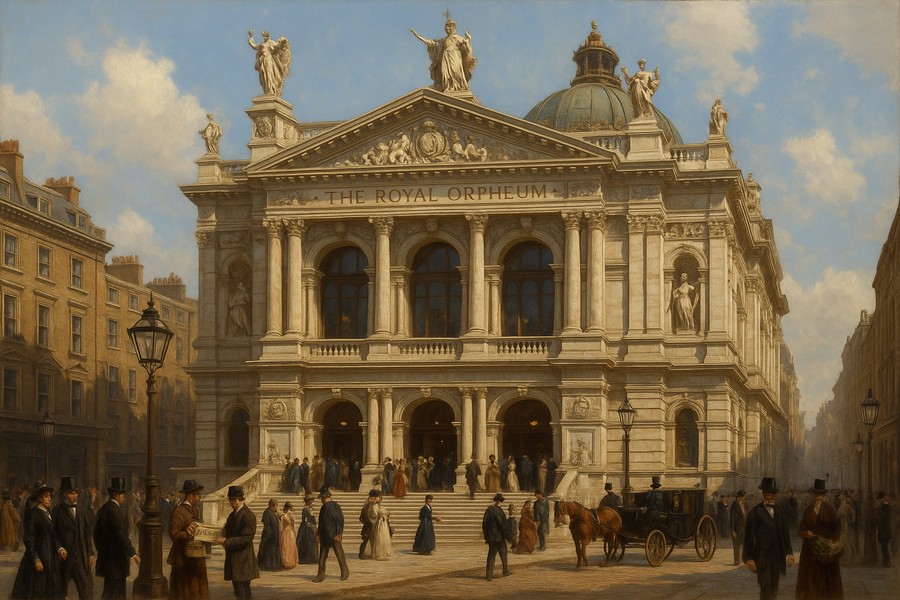
Architecturally, the Orpheum is a High Victorian Beaux-Arts / Neo-Baroque opera house with clear Second Empire influence: a rigorously symmetrical façade, a monumental classical “temple front,” and a crown of sculptural drama. The overall composition is ceremonial and theatrical by design — broad steps, deep arcades, and a skyline of statues that reads like a cast list in stone.
Key stylistic features include:
- A triumphal, arcaded ground level (grand entrances framed by heavy masonry)
- A colonnaded upper storey with tall, round-arched windows
- A prominent pediment filled with relief sculpture and a central cartouche/medallion
- A dominant dome set behind the front block, giving the building a regal silhouette visible from afar
Materials
From the street, the Orpheum appears built in a pale, prestigious stone — most plausibly Portland stone or a similar light limestone, chosen for its clean brightness and association with London’s public monuments.
Typical material palette:
- Pale limestone ashlar for the principal façade and sculptural elements
- A sturdier granite or rusticated stone plinth at street level (to withstand London soot, rain, and carriage traffic)
- Marble internally for principal staircases, vestibules, and public foyers
- Extensive iron and steel framing within the stage house and roof structures (especially after later safety upgrades)
- The dome likely clad in copper (weathering to a darker patina), with lead flashings and slate on subsidiary roofs
Ornamentation
The Orpheum leans into ornament the way a prima ballerino leans into a final pose: with total commitment.
Notable decorative elements:
- Rooftop statues and acroterial figures punctuating the corners and pediment line
- Niches with full-height sculptural figures on the side bays
- Rich entablatures, cornices, and pilasters, with classical capitals (Corinthian in spirit, if not always by strict textbook)
- Relief friezes in the pediment depicting allegorical arts (music, dance, drama), likely including laurel wreaths, garlands, masks, and lyres
- Balustrades, cartouches, and deep shadow lines that make the whole building read as “lit” even on grey London days
Does it fit London — or stand out?
It stands out, decisively.
Where much of London’s urban fabric is more restrained — terraces, brick façades, measured classical proportion — the Orpheum arrives like an aristocrat from the Continent who refuses to whisper indoors. It’s larger in gesture, heavier in stone, and far more sculpturally animated than the surrounding streets. That contrast is part of its function: the Orpheum is meant to feel like a separate world, a threshold between ordinary London and heightened emotion.
Its “foreign splendour” also serves a practical purpose: the building is designed as a social machine. The grand stair, the arcades, the broad forecourt, the implied carriage approach — all of it choreographs arrival and visibility. Even before a single note is played, the Orpheum is already staging its audience.
History
Built as London’s grand answer to the great continental opera houses, The Royal Orpheum was conceived as a monument to prestige: a palace of velvet, gilt, and ambition. From the beginning, however, the Orpheum became more than a venue. It turned into a social instrument — a place where taste was policed, reputations were manufactured, and private dealings quietly shaped public triumphs.
Conception and Construction
1868–1875: A Crown for the Arts
Following years of debate among patrons, politicians, and rival impresarios, the Orpheum was approved as a national cultural project. Its location was chosen with care: close enough to attract London’s elite, yet surrounded by service lanes and working streets that made discreet entrances — and discreet exits — a natural feature of the building’s daily life.
1875: Laying of the Foundation Stone
The ceremony was theatrical, and deliberately symbolic. Supporters hailed it as a statement of British cultural confidence; critics muttered that it was also a means of controlling the capital’s artistic scene by placing it under a single glittering roof.
The Early Glory Years
1877: Opening Season
The Orpheum opened with a celebrated operatic programme, but it was the ballet that truly captured London’s imagination. Reviewers quickly began to treat the house as a breeding-ground for new choreographic fashion and rising stars.
1878–1883: The Making of a Ballet Institution
Within a few seasons, the Orpheum’s ballet company was regarded as the most influential in the city. Alongside its artistic rise came the familiar machinery of high culture: patronage, rivalries, whispered favours, and the occasional “miraculous” casting decision that had little to do with merit and everything to do with influence.
The Royal Box
1879: Completion of the Royal Box
The Royal Box was finished as a deliberate architectural declaration: an ornamental throne within the auditorium. The box’s presence shaped the house’s identity, even when it stood empty.
1880–1883: “She was never there.”
It soon became a matter of polite fascination that Queen Victoria had never sat there officially. The statement turned into a knowing phrase — suggesting that the Orpheum was royal enough to boast of the connection, yet delicate enough that certain appearances were best left unrecorded.
The Fire
1884: The Backstage Fire
A fire broke out behind the stage, spreading fast through workshops, stores, and the working heart of the theatre. There were deaths and serious injuries. The building did not burn to the ground, but the damage was severe: scenery and machinery were lost, corridors were smoke-choked, and parts of the backstage structure were compromised.
- Inquiry and blame: The official explanation cited negligence, flammable materials, and overstressed equipment. Unofficially, London gossiped about sabotage, insurance schemes, and a quarrel that escalated into catastrophe.
- Lingering consequences: Survivors carried scars. So did the Orpheum — in sealed doors, soot-darkened recesses, and areas that never quite felt “right” again.
Rebuilding and Reopening
1885–1887: Restoration and Reinvention
The restoration modernised the theatre’s safety measures and backstage engineering. Several sections were reworked, while others were sealed or quietly abandoned as “unsafe” or “impractical”. Temporary passages, maintenance hatches, and service routes were created during the works — and some of them, useful and unnoticed, remained.
1887: The Grand Reopening
The Orpheum returned with a programme designed to proclaim resilience and splendour. The audience embraced the spectacle, but those who worked the building felt something had shifted. The theatre seemed more watchful, more temperamental — as if it remembered the fire better than any newspaper ever could.
Notable Late-1880s Events
1888: The “Silence Night”
During a major performance, a technical failure halted the show — a jammed curtain, a lighting collapse, or a breakdown in the stage machinery. The audience experienced an eerie pause in near-darkness before order was restored. The incident became part of the Orpheum’s mythology: the night the house seemed to hold its breath.
1889: The Ballet Scandal
A prominent performer left abruptly amid rumours that ranged from scandalous affairs to coercion, contract games, and the quiet destruction of a rival. The management smoothed the story in public, but within the company loyalties hardened and careers became suddenly fragile.
1890: A House of Gilding and Ghosts
By 1890 the Orpheum stands again as London’s pride — yet the fire of 1884 remains its private wound. The building is magnificent, but it is also a place where ambition, desire, fear, and power collect in the same corners, night after night.

Comments