
The Reudigerous Mutt
⚠️ Content Warning
This article may contain mature themes, including homoerotic content, complex power dynamics, sexual encounters with vampires and anthropomorphic beings, as well as other adult material.
Reader discretion is advised.
Purpose / Function
The Reudigerous Mutt serves as a specialised social refuge within Shady Nook, catering primarily to London’s hidden werewolf population and those who knowingly associate with them. Its foremost purpose is to provide a space where lycanthropes may gather openly, speak freely, drink without restraint, and seek companionship without fear of exposure or persecution.
Beyond its role as a public house, the Mutt fulfils a critical protective function. Beneath the tavern lies a reinforced cellar equipped with secured holding cells, allowing werewolves who cannot afford to leave the city during the full moon to endure their transformation in relative safety. These facilities have prevented countless incidents that might otherwise have drawn dangerous attention to both the werewolf community and Shady Nook itself.
The building has not always served this purpose. Originally a modest dockside alehouse catering to labourers and riverhands, it was purchased and repurposed approximately ten years ago by Dennis “Mutt” Thorn and his partner Lionel “Fox” Fox. Under their ownership, the tavern gradually evolved into a discreet but widely known meeting place for werewolves, its reputation spreading through word of mouth rather than advertisement.
Over time, the Reudigerous Mutt has become more than a drinking establishment. It functions as a social anchor, a place to negotiate safe encounters, exchange information, and reinforce informal rules that keep both humans and werewolves alive. While its cellar facilities and private rooms serve practical and intimate needs, the tavern’s greater purpose lies in maintaining balance: allowing monsters to remain unseen not through isolation, but through community.
Within Shady Nook, the Mutt is quietly understood as a necessary institution — rough, honest, and dangerous only to those who do not respect its rules.
Architecture
The Reudigerous Mutt sits low and broad at the far end of Shady Nook, where the alley grows tighter, darker, and more private. Architecturally, the building began life as a modest dockside tavern — timber-framed, brick-reinforced, practical rather than pretty — but time and purpose have reshaped it into something far more intimate and charged.
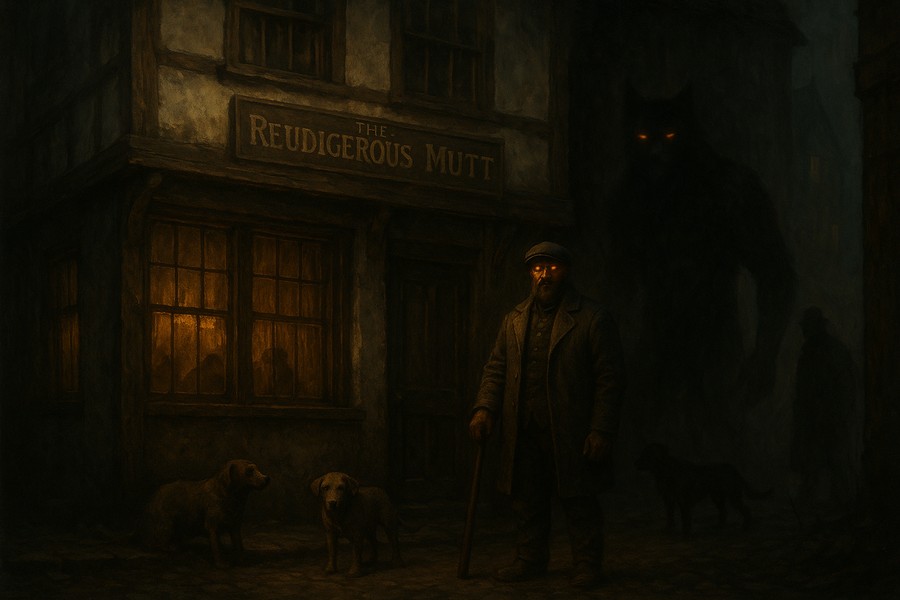
The exterior is dark and deliberately understated. Weathered wooden beams and soot-stained plaster absorb light rather than reflect it. The windows are narrow and set deep into the walls, covered on the inside with heavy, plain fabric that allows silhouettes to move behind them without revealing details. The effect is unmistakable: the building does not hide its occupants entirely — it teases their presence.
Above the door hangs the sign: The Reudigerous Mutt, hand-painted in uneven lettering on rough wood. A single oil lantern casts a warm, amber glow across the entrance, highlighting the grain of the timber, the ironwork of the hinges, and the worn threshold polished smooth by countless boots. On fog-heavy nights, the light clings to the mist, making the doorway feel less like an entrance and more like an invitation.
The building’s weight is reassuring rather than oppressive. Thick walls, solid doors, and low ceilings create a sense of enclosure — not confinement, but privacy. Sounds from inside bleed out only faintly: low voices, laughter, the scrape of chairs, the occasional rough bark of amusement. Everything about the structure suggests that what happens within is meant to stay there.
Inside, the architecture favours closeness. Tables are set nearer than in most pubs, benches long and worn, encouraging bodies to press together rather than keep polite distance. Exposed beams run low overhead, drawing the eye downward and keeping the space intimate. The floorboards are scarred, warm underfoot, and faintly sticky with old ale and spilled spirits.
The cellar level is seamlessly integrated into the building’s foundations. Heavy doors and reinforced walls are concealed behind plain carpentry, their purpose known only to those who need to know. Even here, the design avoids the look of a dungeon; instead, it feels functional, bodily, and intentional — built for restraint, endurance, and release, depending on the night and the phase of the moon.
In contrast to the welcoming openness of The Bull & Compass, the Reudigerous Mutt turns inward. It does not advertise itself through ornament or noise. Its architecture speaks through suggestion: thick walls, warm light, hidden rooms, and the promise that within these boundaries, bodies may behave more honestly than the world outside allows.
Within Shady Nook, the Mutt is recognised not as a place of spectacle, but of permission — a structure shaped around desire, secrecy, and the understanding that some hungers are better met behind closed doors.
Interior Layout
The interior of the Reudigerous Mutt is arranged with a clear understanding of bodies — their size, their heat, and their needs. Nothing about the layout is accidental. Every space serves a purpose, guiding patrons naturally from public to private, from observation to participation.
Entrance
Mounted beside the entrance, just inside the door, is the skull of a werewolf. The forehead is scored by three deep claw marks where silver still gleams faintly beneath the bone. The skull is positioned at eye level, impossible to miss. Patrons pass beneath it instinctively quieter than they entered.
The skull is known simply as “A Friendly Warning.” It once belonged to a werewolf who willfully and knowingly passed his curse to an unwitting street worker. For this crime, he was destroyed by Julien — the restless spirit of an eighteenth-century rent boy, murdered and now bound to Shady Nook as its protector. The silver-marked skull serves as a reminder: consent is law within the Mutt.
Ground Floor – The Taproom
The main taproom occupies most of the ground floor. It is low-ceilinged and broad, with exposed wooden beams running overhead and heavy plank flooring worn smooth by decades of boots. The room is deliberately intimate: tables sit close together, long benches replace individual chairs, and there is little space for polite distance.
The bar itself is solid and wide, built from dark, oiled wood. It bears countless scratches and dents, and the surface is permanently warm to the touch from hands, tankards, and leaning bodies. Behind it, shelves hold strong ales, spirits, and bottles of dubious provenance — drinks chosen less for refinement than for effect.
Lighting is low and warm. Oil lamps mounted along the walls cast amber pools that soften edges and encourage shadow. Faces are rarely fully illuminated; shoulders, hands, and mouths are what catch the light first. The air is thick with the smell of sweat, ale, leather, and something animal beneath it all.
This space is for watching and being watched. Conversations are loud, laughter rough, touches casual but frequent. A hand on a thigh, a shoulder pressed too close, a gaze held longer than necessary — the architecture allows it, even encourages it.
Rear Rooms – Semi-Private Spaces
Behind the taproom lie two smaller chambers separated by heavy curtains rather than doors. These rooms offer partial privacy without full isolation. Here, patrons negotiate, flirt more openly, or retreat briefly from the noise.
The furniture is sparse: narrow tables, padded benches, walls close enough to trap warmth. Sounds from the taproom filter through the fabric, keeping a constant reminder of proximity. These spaces often serve as transitional zones — places where intentions become clearer before moving deeper into the building.
Cellar Access
A narrow stair behind the bar leads down into the cellar. The steps are steep, worn, and deliberately narrow, forcing close proximity between anyone descending. The air grows cooler below, carrying the scent of stone, metal, and old wood.
Access is controlled. Not every patron goes downstairs, and those who do are either known, vouched for, or escorted.
The Cellar – Holding Chambers
The lower level is divided into several reinforced compartments. These chambers are utilitarian rather than cruel: thick walls, solid doors, and iron fittings built to endure strain rather than inspire fear. Silver-lined chains are fixed to the walls, their presence understated but unmistakable.
The design prioritises safety and containment. Ventilation is deliberate, allowing heat to escape while keeping sound muffled. Straw pallets and simple benches offer minimal comfort — enough to endure the night, never enough to forget why one is there.
The Darkroom
Set apart from the holding chambers is a plain wooden door bearing a simple painted sign: “Darkroom.” The room beyond is windowless and deliberately underlit, illuminated only by shaded lamps that leave most of the space in shadow.
The layout inside is sparse and intentional. The walls are padded, the floor swept clean, and the furniture minimal. The room is designed not for spectacle, but for consensual release — a place where anonymity and proximity intersect. Touch comes before sight; breath before names.
Usage varies with the lunar cycle. On new moons, the space sees its heaviest traffic, often involving patrons whose desires run harder and rougher than those upstairs.
Flow & Design Philosophy
The Reudigerous Mutt is designed to guide instinct, not suppress it. Each level moves patrons from public visibility toward deeper privacy, mirroring the natural escalation of desire. There are no signs directing behaviour — the building itself teaches newcomers how to use it.
Compared to the open camaraderie of the Bull and Compass, the Mutt’s layout is inward-facing and deliberately sensual. It offers not comfort, but permission — a structure that understands bodies that do not always remain human, and wants them close, warm, and contained.

Comments