
Morna
⚠️ Content Warning
This article may contain mature themes, including homoerotic content, complex power dynamics, sexual encounters with vampires and anthropomorphic beings, as well as other adult material.
Reader discretion is advised.
Morna - Sarah Winslow (a.k.a. The Autumn Sister, The Reborn, The Sleeping Goddess)
TABLE OF CONTENTS is in the World Navigation
“Every ending is just another beginning that forgot its name.”
Physical Description
Body Features
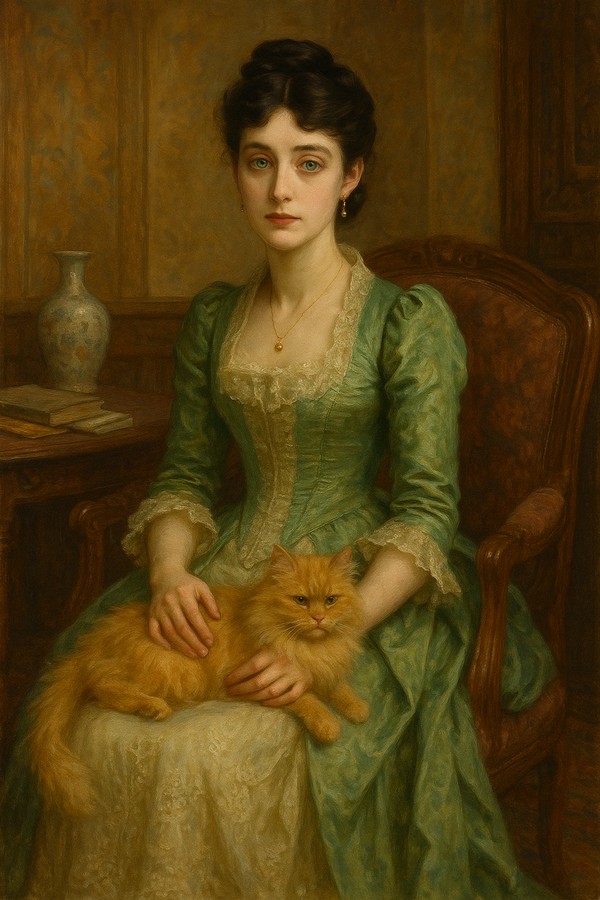
In her current incarnation, Morna appears as a young woman of quiet beauty and unassuming grace.
Those sensitive to magic often describe her presence as restful — as though the air itself softens when she enters a room. Cats follow her, flowers tilt toward her, and the dying sometimes smile when she touches their hand.
Facial Features
She has long auburn hair that catches fire in sunlight and pale-green eyes that seem to look beyond the living. Her complexion is fair.
Special abilities
Mediumship
Morna possesses true spirit communication abilities. She can:
- Sense when someone is near death (hours or days in advance)
- Perceive lingering spirits and sometimes see them
- Channel voices and impressions during séances
- Ease dying souls into peace through touch
Her visions often come unbidden — flashes of a person’s death, dreams of strangers, whispers in languages she doesn’t know.
Reincarnation Cycle
- Morna lives, dies, and is reborn endlessly.
- Each life begins human and unknowing; fragments of her divine memory emerge through emotional triggers, dreams, or meeting Bran.
- Her deaths are always natural — illness, age, accident — but never violent. Her rebirth is immediate, though her new body may not awaken to her identity for years.
- She retains no clear continuity but carries emotional imprints — unexplainable déjà vu, irrational fears, or sudden tears at the sight of certain places or faces.
Residual Divinity
Morna’s power manifests not in command, but in presence. Plants decay quickly near her during periods of grief and flourish in her joy. She can bring calm to haunted places and rest to restless souls. Her energy is not destructive but final — she embodies the beauty of endings.
Apparel & Accessories
She dresses according to her station: pale gowns, lace gloves, and a locket she claims has “always been hers.”
Mental characteristics
Personal history
Long ago, Morna was a goddess of decay, sleep, and renewal through death — twin sister to Bran, god of life and regeneration. Together they were balance incarnate: his spring to her autumn, his dawn to her dusk.
When the age of belief waned, they chose to become human rather than fade. Bran’s transformation bound him to endless life; Morna’s bound her to endless rebirth.
Now she walks the world as Sarah Winslow, the daughter of a respected judge — unaware that her quiet spiritual gifts are the echoes of divinity that once held sway over death itself.
Recent History
Sarah Winslow’s life is that of a respectable young woman under quiet strain. Her father, Justice Edmund Winslow, intends to marry her to an ambitious barrister — a match that would ensure the family’s social standing.
Yet Sarah harbours secrets. She is in a clandestine relationship with her former school friend, a woman of gentler temperament but fierce affection. Their love is tender and dangerous, a comfort in a world that expects obedience.
At the same time, Sarah’s latent powers have begun to manifest more violently:
- She knows when servants are about to die before anyone else.
- She has begun to hear voices in the silence.
- And in her dreams, she sees a man with long dark hair standing in the rain, whispering her name — not Sarah, but Morna.
Mental Trauma
- Fragmented Memory: Her past lives bleed into her dreams but never fully coalesce. Too much remembrance can overwhelm her and cause fainting or delirium.
- Mortal Fragility: Unlike Bran, Morna’s current body is entirely human; she can be injured or killed by ordinary means.
- Empathic Drain: Communicating with spirits or the dying leaves her physically and emotionally exhausted.
- Fear of Madness: Sarah constantly fears being institutionalised if her powers become known.
Morality & Philosophy
Morna sees death not as loss but as transformation. To her, every ending is sacred — the soil in which life takes root again. She views Bran’s immortality as an imbalance, a wound that refuses to heal.
Her moral compass centres on compassion through understanding: to comfort the dying, forgive the cruel, and remind the living that nothing — not even grief — lasts forever.
Personality Characteristics
Virtues & Personality perks
Morna carries herself with composure and courtesy, but her calm hides a deep melancholy. She feels emotions strongly yet rarely expresses them openly — a necessary skill for a young woman in London society, especially one with unladylike gifts.
She is empathetic, reflective, and quietly defiant, unwilling to marry simply for duty and unwilling to silence the spirits that speak to her. Though her parents dismiss her “fits of intuition” as hysteria, Morna has long stopped doubting herself.
Unlike Bran, who remembers fragments of divinity, Morna remembers feelings: the weight of eternity, the warmth of the sun on her skin when it was not a star but a promise, the sound of her brother’s laughter echoing through endless fields.
Trivia & Details
- Keeps a pressed autumn leaf between the pages of every book she reads.
- Suffers recurring dreams of drowning — a metaphor for her rebirth cycle.
- Animals that die near her do so peacefully; none ever struggle.
- When she sings, candles dim slightly, as if listening.
- Always feels cold, even in summer.
“The dead are not gone — they’ve simply walked ahead.”
“He calls me by a name I do not know, yet my heart answers.”
“I die a little every time I wake. But isn’t that what being human means?”

Comments