
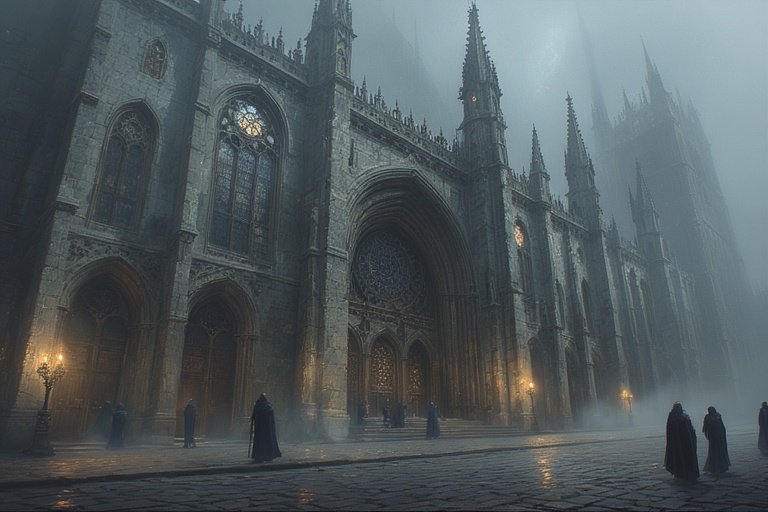
Fogwood
Demographics
Predominantly human with a significant elven minority; a small but established dwarven community; the remainder comprises a diverse mix of gnomes, half-elves, and other rare lineages, contributing to a quietly cosmopolitan character beneath the fog-shrouded eaves.
History
Fogwood’s genesis, a balm of compassion, not conquest, is indelibly linked to Marathana E. Strain. Her profound empathy became our valley’s bedrock. During the Crimson Siege’s crucible, when animosity crackled and blood stained the earth, Marathana stemmed the tide with linen and solace. She tended shattered bodies and spirits of combatants from both factions through the brutal winter of The Sundering of the Vale, a time when the chill bit deep into flesh and soul. Amidst this desolation, her quiet courage bloomed.
Marathana saw shared vulnerability transcending battle fervor, a radical humanity setting Fogwood’s precedent for healing and life’s meticulous consideration. In death’s embrace, shared fragility bound us all. Her work proved even profound divisions could forge unexpected bonds, a truth resonating in this hallowed ground. She saw mortals, not enemies, their bodies broken, spirits weary, seeking solace and hope. This seeded Fogwood, the Silvered Vale. Her influence extended beyond intervention. She understood true healing was holistic. She sowed seeds of knowledge, fostering scholars, Fogwood’s intellectual heart. Lessons learned in war’s crucible were too precious to lose. She encouraged observation, cataloging, and persistent questioning, defining Fogwood’s unique spirit.
Caspian Gastrell, whose keen eyes first cataloged our flora, his research a prescient whisper of preservation, his lineage tragically curtailed. He saw in nature’s interplay a profound artistry mirroring Marathana’s reverence for life. His meticulous observations laid groundwork for understanding natural rhythms, a science born from reverence.
Alistair Thorne, a mind of crystalline sharpness, meticulously charted natural phenomena, establishing empirical rigor his descendants uphold. His detached curiosity pursued underlying order, governing existence like the fog itself. His precise analyses provided a scientific foundation for Va’lore’s environment, a testament to rational inquiry.
Faelarion Meadowlight, an Elven savant, artfully bridged scientific inquiry with holistic philosophy, a confluence still resonating within his family. He understood healing encompassed body and spirit, a wisdom guiding his practice. He saw fog as a conduit, a mediator between physical and ethereal, allowing different perception. His understanding of tangible and intangible was a crucial counterpoint, a reminder life’s pulse beat in the soul.
Silas Croft, grounded and pragmatic, laid Fogwood’s infrastructure and the Chantry’s nascent structures. He conceived the Greytowers Mortuary, ensuring dignity in each soul’s final passage. His vision provided our physical framework, a silent promise of stability. He built symbols of our commitment to life and its conclusion, a tangible manifestation of collective values, understanding order and respect were paramount even in death.
Elara Vance, tireless guardian of our past, meticulously organized the Chantry's library, preserving hard-won wisdom, particularly lessons from the War of Empyre. Her dedication chronicling history served as a beacon against oblivion, safeguarding collective memory. She understood the past was a living entity; a source of guidance and warning, a narrative to be tended.
Together, inspired by Marathana’s compassion and guided by her spirit, these individuals forged Fogwood’s enduring essence, a place where healing, inquiry, and remembrance are not pursuits, but their very being, forever cradled by mist.
Points of interest
Chantry of Inquiry stands as a beacon of intellectual pursuit, a hallowed ground where the arcane and the empirical converge. Scholars, physicians, and apothecaries, drawn from the four corners of Va'lore, find solace and stimulus within its hallowed halls. They come not for comfort, but for the sharp, invigorating edge of discovery, delving into the profound mysteries that govern existence. Within its boundless libraries, knowledge is not merely stored but actively debated, its dusty tomes whispering secrets to those who dare to listen. The laboratories, humming with an almost sentient energy, are crucibles where theories are forged and broken, where the delicate dance between life and death is dissected with an unwavering gaze. It is here, amidst the perpetual twilight of Fogwood, that the greatest advancements in understanding the fundamental forces of the world are born, often from the very fabric of the omnipresent fog.
Overseeing this carefully balanced ecosystem of academic rigor and quiet contemplation is Mayor Frankford Strain, a figure as gaunt and imposing as his ancestral estate, Strain Estate, also known as the Mayor's Harbor. This imposing structure, a monument to his authority, serves as the meticulously curated face of Fogwood. The Mayor, a man whose every posture speaks of control, works in tandem with his constabulary, a silent, ever-present force ensuring the town maintains its pristine facade. The estate itself mirrors this obsession with order; its grounds are a testament to meticulous upkeep, its architecture a declaration of enduring tradition and unwavering stability.
Looming on the periphery, a brooding sentinel against the encroaching mist, is Gastrell Manor. This edifice of weathered stone, its spires vanishing into the ethereal veil, feels like a specter from a forgotten age. It speaks of the enduring legacy of the Gartrell lineage, a family whose history is as intertwined with Fogwood as the ancient roots of the Rhone Forest. The manor's grounds, a wild tapestry of overgrown flora, seem to harbor secrets whispered only by the rustling leaves and the mournful cooing of doves, a constant reminder of the past that refuses to be fully silenced by the present.
Waterside Clinic stands as a testament to the relentless pursuit of life. Nestled at the very edge of the vast, icy expanse of Lake Rime, its pristine, modern facade cuts a sharp, almost defiant, swathe through the perpetual fog. It is a beacon of clarity, a sanctuary of clinical precision where skilled physicians and apothecaries wage a quiet, persistent war against the myriad ailments that plague the inhabitants of Fogwood and its surrounding lands. Their work, a meticulous dedication to preserving life, offers a tangible counterpoint to the more existential inquiries fostered by the Chantry.
Greytowers Mortuary, is a stark reflection of its solemn purpose, is punctuated by tall, lancet windows that allow only slivers of the muted Fogwood light to penetrate its interior. Here, the departed are prepared with meticulous care, a place where the transition from life to final rest is managed with an unwavering professionalism, a quiet dignity that acknowledges the profound finality of their journey. It is a place of transition, a bridge between the tangible world and the unknown.
The Sunken Glades, once a sprawling marshland, now Fogwood's primary cemetery. The ground, though drained, still bears the memory of water, its dampness a lingering echo of its past. Mist clings to the hollows and furrows, shrouding the gravestones in an ethereal veil, transforming the landscape into a poignant tableau of remembrance. Here, amidst the whispers of the past carried on the damp air, the dead find their final rest, cradled by the earth that once teemed with life.
Geography
Fogwood lies nestled within a sheltered valley beside the vast, icy expanse of Lake Rime. Encircled by the dense, towering evergreens of Rhone Forest, this place is shrouded in a perpetual, gently rolling veil of low-lying fog that drifts endlessly through the air. The fog is not a backdrop so much as a patient presence, a living dew that slides along skin and seam of a cloak. It tastes of damp timber and cold copper, and after rain it lingers with a metallic tang that makes breath taste like winter. The light itself seems to soften; colors drain to pewter and slate, and even the lake's edge wears a silver veil that blunts the horizon. Footsteps pick up a muffled rhythm, voices stumble into hushed tones, and the world—visible, audible, and tactile—unfolds at a slower tempo, as if time itself had to wait behind the fog's thin veil.
In the morning, villagers time their tasks to the fog's mood. Elders move with deliberate, measured steps; children wrap themselves in wool and chatter in whispers, as if speaking across a winter's distance. Market stalls display fewer colors, but the aroma of pine resin, baked bread, and smoke from chimneys rises with the fog, a shared perfumed memory that binds the town. Even laughter feels drawn out, a little gentler, the sound traveling with a softened echo through the trees.
By night, Fogwood's secrets feel closer. Lantern light pools in halos that bend and shimmer as the fog swallows the glow, and every shadow seems to carry a rumor. The lake's surface wears a thin ice-like skin, catching the fog's breath and turning the shore into a ragged, luminous edge. Residents gather beneath eaves and around hearths, telling stories in lowered voices, letting the fog listen as much as they listen to it, as if the mist itself could carry a memory back to them.
The very air in Fogwood seems to hum with a quiet melancholy, a constant, gentle weight that settles upon the spirit like the persistent mist. It's a place where the world feels muted, where sounds are softened and colors appear subdued, as if viewed through a pane of frosted glass. This pervasive atmosphere lends itself to a contemplative, perhaps even melancholic, disposition among its residents, a people accustomed to the soft embrace of the ever-present fog.

Comments