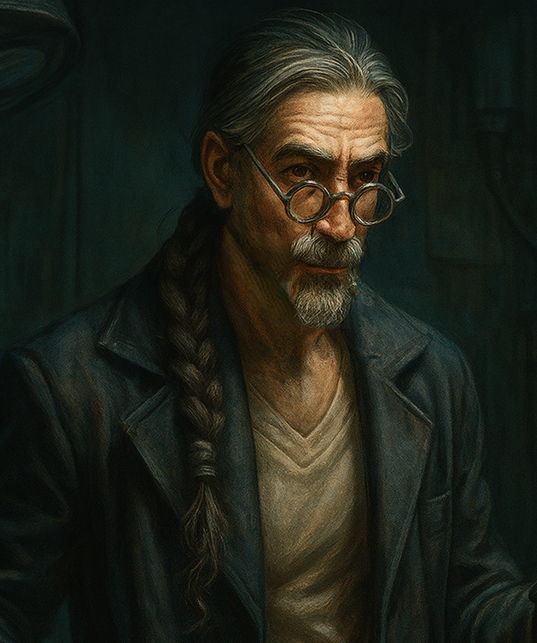
Doctor Adrian Lee Korr
Dr. Adrian Korr carried himself with the measured precision of someone who had spent his life walking the line between chaos and control. Even before he was pulled back into the field, he had the air of a man who always knew more than he said—someone who catalogued the world in quiet, deliberate gestures. He was one of Department Seven’s senior physicians. A scholar of the body and its failures. A reluctant veteran of too many close calls with the Dark. While he could still handle himself in a fight, his greatest weapon had always been his mind: sharp, analytical, and unflinching, capable of dissecting a problem faster than most people could articulate it.
Adrian understood the human psyche in a way that unsettled people when they stopped to think about it. He read tension in shoulders, guilt in posture, fear in breath. It made him a brilliant doctor and a frustrating colleague, because he saw things. Things people didn’t want to reveal. Things they didn’t know they were showing. For him, understanding a person was just another diagnostic tool. And yet, for all the insight he wielded, Adrian never used it unkindly. His cynicism was dry, understated, but beneath it lay an almost stubborn compassion. He wanted people alive. He wanted them whole. And if they couldn’t be either, he wanted to be the one standing between them and what hunted them.
Adrian’s withdrawal from the field was a result of guilt as much as necessity. He had lost numerous agents to Shadow Events during his career, experiences that he was never able to fully let go of. His transition into full-time medical work was framed as a promotion, but Adrian always suspected it was a retreat. He didn’t mourn the distance from danger, but he mourned the distance from certain people. Over the years, he became the Department’s ethical anchor, its scientific spine, and the man responsible for treating injuries most hospitals would never believe. But he also became the person left behind while others walked into the darkness.
His morality was firm: life mattered, and knowledge should never come at the cost of humanity. Adrian had no patience for unethical experimentation, lies about medical condition, or people pretending their injuries—physical or emotional—weren’t there. He had a quiet, unyielding philosophy: the truth was better than comfort, survival better than pride, and preparation better than hope. His greatest flaw was the same as his greatest virtue—he cared too deeply. That compassion sometimes hardened into frustration, especially when dealing with Jared, whose self-destructive streak rubbed against every protective instinct Adrian had spent years trying to bury.
His professionalism hid his exhaustion; his precision hid his unresolved guilt; his calm hid an anxiety sharpened by past mistakes. Adrian’s world was structured by routines, languages, study, and the occasional comfort of dark tea. He lived alone, thought too much, slept too little, and kept a silver ring from his father as the only sentimental object he allowed himself. He had a long list of savvies—medicine, strategy, languages, empathy—and an equally long list of ineptitudes: relaxing, joking, ignoring danger, pretending he wasn’t terrified whenever the Dark brushed too close.
Field work brought out his old instincts—quick thinking, faster assessment, a cool head in the presence of nightmares—but also the deep-rooted fear he’d failed once and could fail again. He disliked chaos, avoided politics, and despised the smell of cinnamon, but he followed orders with unwavering precision because people’s lives depended on it. His vices were simple: workaholism, emotional repression, coffee at midnight, and a quiet belief that he could never afford to break. His virtues were harder to define but easier to recognize: loyalty, intelligence, patience, courage, and the impossible tenderness he hid behind clipped words and clinical detachment.
His legacy within the Department was one of competence and quiet heroism. Agents trusted him with their lives. Administrators relied on him to keep crises from becoming catastrophes. And somewhere in the edges of mission reports and personnel files was the subtle imprint of a man who had shaped the Department more than most realized. He was the steady hand behind the chaos, the one the agents turned to when nightmares bled into reality.
And now he was back in the field—not because he wanted to be, but because Jared Blake needed a partner. Adrian was many things, and one of them was this: he never walked away from the people he refused to lose.
History
Years ago, Adrian served as both a combat medic and operative for Deprtment Seven. That was when he was partnered with Jared the first time. It was about 8 years before the start of the Dark Thread series that they stopped being partners (2149). They were partners for 10 years. They became partners 5 years after Jared join the Department when his connection to the Dark was revieled.
During the time that Jared and Adrian were partners, Jared always seemed to have control of the Dark. Back then, Adrian fought beside Jared with a steadiness few could match. Jared trusted him, perhaps more than anyone else. And Adrian, though he would never admit it aloud, relied on Jared’s reckless courage as much as Jared relied on his steady hands. They saved each other more than once. They also wounded each other in quieter, less direct ways—mostly by pretending that thier partnership hadn’t meant something.
Adrian’s sexuality was something he kept private, not out of shame but out of practicality. He was pansexual, drawn to steady minds and complicated souls, though he’d never confess the latter. Emotional entanglements made people sloppy, and he refused to be sloppy. Still, his history with Jared lingered in unspoken glances and the tension that filled the spaces between sentences. Adrian could read Jared’s pain as easily as he could read an EKG, but reading was one thing. Changing anything was another. And now, being reassigned as Jared’s partner again forced old memories and older feelings to stir—along with the familiar dread of watching someone he cared about walk too close to the edge.





Comments