

V-1 Sentients
The V-1 Sentients are a type of robots created by the Zunae They live in planet Zuan along with them but in their own cities. They were created in 210 TUD with the creation of Valteon 1, the first ever v-1.
Basic Information
Anatomy
The V-1 Sentients are a highly modular species divided into 3 distinct generations. This makes it so anatomical differences vary greatly from individual to individual. However, there are a group of characteristics they all share that make it easy to identify a member of their species.
All V-1 have a humanoid body plan with proportions very similar to a human. It’s thought that these proportions are the result of underlying blueprints extracted from the Ancient Ruin code. Their bodies are mostly sleek, with metal plated shells over a layer of typically black artificial skin. Most of them also have neon light details across their body.
Aside from the metal plates, their faces have screen panels with bright led eyes to help convey emotions. These face screens can either cover the entire face or be only big enough to cover the eye area, but in any case only eyes are displayed here, no nose or mouth.
Another incredibly important part of their bodies is their Spinal Matrix. While mostly hidden under the artificial skin and metal shell, sometimes sections of the matrix can be seen. This part is the host of the Genesis Code, the source of their sentience and their “soul”. While the first ever V-1 had his Genesis Code all over his body, every other V-1 has it only contained in their spinal cord.
Because the production of new V-1 Sentients is sexual in nature, they exhibit differences between male and female though these are not always permanent and may be switched. Aside from overall proportions, they also have retractable genitals and females have breasts. For genitals v-1 can, with some work, exchange them out, and may even equip one of each, so yes, v-1 can have both sexual organs.
As mentioned before, while these characteristics are shared by all V-1 there are various differences depending on their generation.
Type-1
The first generation and by far the oldest, with only 24 members. They have a more angular design in their metal plating which tends to be more off white than pure white. They also have more seams in these metal plates with some segmentation.
Sometimes their artificial skin doesn't cover all internal components, having some of the larger pieces poke through in places like joints. These internal components can have various metallic colors, like gold, silver, iron or copper.
Unlike the other generations they tend to stick to their initial design, seldom using any modular pieces since their bodies were not created with modulation in mind.
Type-2
The second generation is a lot sleeker than the first. They have less seams, more flowing edges and even some floating components. Their Shells tend to be snow white but in some rare circumstances they can paint their shells in vibrant colors. Sometimes the plates and artificial skin can blend into each other for these individuals, giving them a streamlined look.
The Artificial skin of a V2 can sometimes be layered in the same way humanoid muscles would look, making it more organic looking. In very rare cases this skin can also be decorated, making it look iridescent or starry as if there's a night sky right beneath the surface.
The Second generation is a lot more modular than the first and are by far the most numerous. They tend to exchange body parts to fit the job they carry out. You can see them with wings, extra armor, stronger extremities, jets and the like.
Type-3
The third generation is known for its mimicry of organic sentient species. Because they spend a lot of their time on various different planets, they opt to adapt the look of the main species in a world to better communicate and blend in with them. The species they chose to mimic is their "Model Species" and they will often stick with that decision until the end of their lives. In rare cases however they might change and chose a different Model Species.
Their shells tend to be as sleek as those of the Type-2, however if the species they are mimicking has horns, tendrils and other elements like that then their shells will also. Sometimes they can add modular parts to mimic these extra bits, like tentacles, or even long hair.
Overall much of the Type-3 changes to fit the other species, from shape, limb number, height, and even coloration while still maintaining the species traits.
For Type-3 however, mimicry is a form of self expression. Even if two different ones were mimicking a Nirien they would do so in different ways. It's also important to note that this is all limited by the species they chose to interact with. Meaning extremely rare species like Kanoran or hostile ones like Aarakan are almost never mimicry targets for the Type-3.
Shell Types
Because V-1 are synthetic beings that don't have biological processes, their bodies don't grow or change in weight, however they do vary in different body types tailored to different professions or tasks.
Basic Shell
The fit type is the basic shell, given to every v-1 that reaches maturity. It’s standard and focuses around ease of access with the maximum potential for mods and variability.
Fit shell type
The most basic and common kind of shell used by the v-1. This type is meant to be a jack of all trades and master of none. It has the most amount of convenience and potential for modification without negatively impacting the v-1’s duties.
Social Shells
These kinds of shells have a dual focus. The main one being to adjust the v-1s frame to better serve their primary directive, with things like the plump shell being better for social interactions and the strong shell for defense. The second function is honestly just aesthetic, helping a v-1 imitate a certain organic body type they might fancy.
Slim shell type
Slim shell types mechanically serve for speedy or recon tasks as well as navigating hard to reach or tight spaces. V-1 with these shells are often seen as couriers, surveyors and intelligence agents.
Plump shell type
The plump shell is mostly used for social interactions, seeing as a plumper figure tends to give a feeling of softness, kindness and nurturing care. Because of this, typically v-1 you see taking this shell are type-3s specializing in child care or medical assistance. In some circumstances this shell can also be seen in diplomatic advisors or figureheads of various industries, as well as mining and transport for the extra internal storage mod space.
Strong shell type
Built around strength and physical endurance, these shells are used by v-1 working around heavy equipment or on dangerous worlds needing the extra resilience and protection. Oftentimes Strong shell v-1s will have jobs around manufacturing, danger assessment, and resource gathering. Some even go towards the fields of medicine and defense in violent systems to lend a helping hand away from the violence where they can.
Special Shells
These are those for V-1 who need specialized shells to do their jobs, either sleek or tank help with their specific tasks. The extreme rarity here comes from the fact that they are pretty inconvenient for daily life use, and are only really used if an individual will spend most of their time in active duty. Instead, most v-1 will use a basic or social shell with mods to help in their jobs. This allows them to keep their choice of variability as well as daily convenience. Special shells to be larger than normal shells, with typical type-2s being around 8ft tall.
Sleek shell type
The sleek body type is used for specialized speed dependent V-1. This shell is often equipped with strong modules making them go as fast as fighter ships. It is mainly used in jobs needing messages to be delivered quickly across planetary or orbital destinations as well as jobs needing long distance reconnaissance within the same star system.
Sleek shells have a sort of skeletal figure that’s thin and tall with long thin pointed feet
Tank shell type
The Tank special shell is focused around load bearing and extreme strength. Most v-1 using this shell work in fields of large scale construction, be it of cities or even large star ships, places where their strength and the dexterity of a humanoid frame help more than a heavy duty vehicle would.
Tanks tend to have either no neck or a heavily reinforced neck along with a thick and sturdy frame and trunk like arms and legs.
Model Shells
The kind of shells used by type-3 v-1s. The important thing with these is to imitate their model species, for example a Nirien model shell having the horns, tentacles, tail and leg shape of the nirien species. The other types of shells can also be combined with this one, so something like a Xothian model Tank shell would have four huge arms and the ears of a xothian, just scaled up. Speaking of scaling, model special shells increase in height relative to their species. This means that a Nocir model Special shell would be around 14 to 15ft tall and a Zunae one would only be around 5ft tall.
Genetics and Reproduction
Unlike all other robots in the galaxy, the V-1 Sentients reproduce sexually, with the result being a union of two different Genesis codes that intertwine and meld together, ready to be uploaded to a spinal matrix. This fusion of codes makes a completely independent offspring instead of a copy of a single parent. The process also stabilizes the code and makes it less prone to decay.
Like most other species, reproduction takes a male and a female V-1. In this process, the female takes part of her genesis code and stores it under her Spinal Matrix. The male, upon climax, deposits a part of his code into the same storage chip. The process for both codes to combine perfectly takes about a month.
In that period the female continues to carry the melded Zigot chip, and once it's ready her body will birth it through her vaginal cavity. The chip is similar in shape to a small egg with a temporary “egg shell”. Once the chip has been delivered, it is put into a fabricator that will create a custom Spinal Matrix and upload the melded Genesis Code into it. After the Matrix has been completed, it’s installed on a waiting Child stage Shell and the new V-1 awakens.
Clearly because of the nature of their reproduction, V-1 can't breed with other species. This does not mean they cannot engage in recreational sex, in fact many of them enjoy it and some can use it to help relieve stress of their organic partners.
Growth Rate & Stages
Because the first generation awoke in already Adult Stage Shells, only the second and third have 2 growth stages. Once they are born, their Spinal Matrix is installed into a Child Stage Shell, a smaller body where the V-1 will experience the first few years of their life. This will let them answer their own questions, learn the ins and outs of their society and experience life outside of code and numbers.
Once they feel they are ready, they can transition into an Adult Stage Shell. This marks the beginning of their specialization and role in their society. It’s expected that during the child stage, a V-1 would research possible specializations and the body they chose when reaching adulthood will help achieve that goal.
If they haven't made up their mind on specialization, they can choose a generic adult shell and begin working in areas that don't require extended specialization modules.
Dietary Needs and Habits
V-1 don’t eat, but instead need to recharge. For the most part, a V-1 will need to recharge once per day depending on their activity. Their Main energy source is Pure Solium, the stable form of Solarite . To fully recharge, V-1 sit in a specialized charging unit called a “Sol Station” which plugs in directly to their back, then Pure Solium fuel cells slowly start charging them back up. The process to fully charge a V-1 takes only about 3 hours.
However the newer generations, the Type-2 and Type-3 have alternate forms to charge. Type-2 can have the full charge unit, or they can use a more compact “Charging Tank”. This device is shaped more like a thermos, being able to charge a V-1 robot half way in 2 hours. The device includes a thick cable that is connected to a port in the middle of their backs.
Type-3 have an even more compact way to regain energy with “Sol Chips”. These are flat 1”x2” chips that have Pure Solium in them. While it charges 1/4th of a fully empty Type-3, these are easy to transport and a Type-3 can be active and walk around as the chip is charging them. To use them, the chip is inserted in a slot under the sternum.
These charging methods have also been enhanced to give the V-1 different sensations while charging to assimilate it to taste. Some may feel warmth, cold, static, among others. Some may even feel things like lust or melancholy while charging. Many cities or even planets produce different brands of “flavors” and it has become an important part of their economy.
Biological Cycle
V-1 don't have a typical biological cycle of growth and decay, but their shells do require regular maintenance to keep in pristine shape. With constant upkeep and repair, sometimes their shells can become worn and require replacements of their parts. This happens less with the Type-1 who seem to have been made of sturdier materials.
Sometimes, either by wear or by change in a V-1’s demeanor, a full shell replacement can be requested. The process will result in the recycling of the old shell and the migration of that genesis code to a freshly made new shell. After the shell transfer, there's a period of about a week where the V-1 goes through calibration tests to get them used to their new body.
Behaviour
Despite them being a highly intelligent artificial species, V-1 are not cold, heartless and unfeeling logical machines. They show the same range of emotion as any other organic life, and while they are intelligent, logical and love efficiency, they don't always act as directly rational as you would expect and can sometimes rely mostly on the emotions felt in a moment instead of hard logic or programing.
Additional Information
Social Structure
Each city is looked over by a council of V-1 called the “Valteric Council”, named after Valteon 1. It is formed by 3 representatives of each generation, and all of their members have great knowledge and experience around V-1 society and life.
V-1 Masters are the highest ranking V-1 for each specialization in every city. Basically working as Guild leaders, they are the ones in charge of their division, making sure quotas are met and efficiency is at maximum. There are V-1 Masters for every profession, from making modular parts, architecture, maintenance, etc.
When it comes to a policing force, the Integrity Core fill that role to a degree. Because the V-1 are a technological species, the Core focuses on protecting any and all vulnerabilities and access to their deeper systems. They make sure no V-1 acts erratically posing a danger to themselves or others. While V-1 are banned from violence, the Integrity Core in Zerium has tranquilizing and stunning equipment to be used in case an organic becomes violent. These are the closest things to weapons on any well functioning V-1
Specialized V-1 make up a great number of the workforce. Either Type-2 with modular parts installed or Type-3 who have chosen their model species fall under this category.
General V-1 make up the rest of the population. From children to adults who have yet to pick a specialization.
The last kind of V-1 are the rarest by far. Its not an exaggeration to say it’s the stuff of legends and rumors, but in at least one case, a V-1 Exile was confirmed to exist. Exiles are V-1 that by mysterious means have broken with programming and have harmed another sentient being, V-1 or otherwise. This is exceedingly rare to happen, and those knowledgeable enough say there needs to be manipulation by a primordial force for this to happen.
These Exiles are stripped of their connection to the Neural Archive Network, leaving them ignorant of the collective V-1 intelligence. They also become hunted by the TUS as high priority targets.
Geographic Origin and Distribution
There are 3 main V-1 cities in Zuan, their home planet. Each city specializes in one overarching area of V-1 life.
Omnium, the grand capitol, specializes in information gathering and the maintenance of the physical Neural Archive Network.
Nanium, the second city, is host to most of the manufacturing centers for type-2, type-3 and modular parts. It's the engineering center of V-1 Society.
Zerium, the third city, is the training and social center for the V-1. Here they have built a haven for interaction and cohabitation with Zunae and other sentient species from across the galaxy. Many type-3 go here to pick their model species and discover first-hand what it’s like to live among them. It also gives the opportunity for curious organics to see what a V-1 city is like and what potentials it holds.
The 2 first cities are closed off to the public and only V-1 are allowed entry, and to enter Zerium you need to go through a lengthy qualification process hosted by the V-1, the Zunae and the TUS
Aside from these main cities, Type-2 and mainly Type-3 can be found across the galaxy in planets that have chosen to host groups of them.
Average Intelligence
V-1 Sentients are incredibly intelligent. Their body is capable of storing huge amounts of data and interpreting it. Aside from this, they are all connected to a Neural Archive Network which helps with storing and sharing information. And in cases when even this isn't enough, they can access the main Neural Archive through terminals to access collective stored information. This system is also crucial when identifying each other even when their shells have gone through drastic change.
Perception and Sensory Capabilities
The V-1 Sentients have a whole array of various sensors and the ability to add even more. Their shells and artificial skin have a layer of micro receptors just under the surface. These detect changes in temperature, atmospheric pressure and touch. Some V-1 use the information given by this system as pain receptors or to detect harmful situations for organic life. This allows them to keep their organic friends safe and out of harm’s way. While these receptors are everywhere, their artificial skin has the highest concentration of them.
Behind their face plates they have a series of high quality cameras and optical sensors. These can allow them to zoom in on details at a distance or even see in infrared, night vision, ultraviolet or record what they’re seeing. These more specialized augments tend to be rarer because of the extra modules that need to be installed. They are more commonly seen in Type-2 or Type-3 that specialize in scouting and exploration.
The V-1 can also host a number of sound sensors, allowing them to detect, filter and transmit distant sound waves. More specialized members use these to help with local navigation and exploration. While most have the ability to understand a handful of languages, the Type-3 generation also install universal translators to help mediate accords between species.
Depending on specialization, sensors that have been seen among Type-2 and Type-3 include detectors for radiation, network signals, Solarite emissions, and more.
Civilization and Culture
Naming Traditions
The V-1 have different naming conventions depending on the generation. While they all have a serial number at birth, they quickly change designation when they reach adulthood. These serial numbers are composed of 4 sets of 3 numbers with the generation code (T-1, T-2, T-3) in front of it.
The Type-1 themselves, the first generation, all gave themselves names starting with the letter V, in honor to their progenitor Valteon 1. Later in life they have taken titles to represent their area of expertise. Examples for Type-1 names would be Velthir the Technocraft, Vaymeen the Architect and Volthar the Forger
Type-2 names don't have that strong a connection to Valteon, and instead seek to mix their synthetic nature with the cosmos. Their names are derived from space and technology concepts with the addition of a number somewhere to replace a letter, a 5 for an S, a 3 for an E or a 1 for an I or L for example. Some Type-2 names might be V3nus, Matr1x, N3bula or I0n
Type-3 tend to name themselves in the culture of the model species they choose but add a serial number after it composed of 3 digits. For example an Avarian Type-3 might be called Setsuna 303, or a Flaonians Type-3 might be Helios 427. This serial number is composed of the last 3 numbers of their original 12 number one.
Beauty Ideals
When it comes to exterior aesthetics, V-1 have two polar opposite schools of thought. One group sticks to what they know. They love smooth lines, sleek, sharp angles, efficient design and overall grace. Another group sees aesthetic beauty in what organics have; bold patterns, variation, strong silhouettes and decisiveness. The first school of thought is mostly seen in Type-1 and Type-2 while the second is found more in Type-3.
However all V-1 concur that true beauty transcends the physical. While they are in tune with the natural beauty around them, an individual’s beauty includes their personality, their actions and movements and how they affect or react to the environment around them. An individual is only beautiful to them once they have been around them enough to learn all that makes them up as a person. To be called beautiful by a V-1 is an enormous complement.
Gender Ideals
Seeing as gender has no real meaning aside from what you’ve chosen for your shell at that moment, there are no real differences in gender in V-1 Society. However Type-3 tend to align to the gender roles of their model species once they begin living among them.
Relationship Ideals
Concerning relationships, each generation deals with them differently.
The Type-1 generation for the most part have paired up in lifelong couples pretty early on in their lives. Why this happened not much is known, perhaps they followed the example of the Zunae around them, or they processed their love for their fellow Type-1 differently, regardless they maintain a loving relationship of respect and equal divisions of responsabilities.
Type-2 are drastically different from their first generation kin. For the most part they are free spirits, able to coexist and mate with any other V-1 with no fundamental attachments. However a fair few do get drawn to a specific individual over time. This couple might adopt matching decals on their shells to announce their union and live together, aside from this element of their life they continue living as they normally would.
The Type-3 generation expectedly meld their expectations of relationships to their model species. However they tend to shy away from extremely drastic relationship dynamics like the show of force often seen in the Aarakan as an example.
Average Technological Level
The V-1 Sentients have achieved an incredible level of technology, from an interconnected neural network, modular design for their members, and more including helping the Zunae . However most of their technology focuses on the betterment of their people and the improvement of efficiency, comfort and versatility.
Modifications
V-1 of both type-2 and type-3 gens are able to install a number of mods on their shells, be it for aesthetic or functional reasons to help in their chosen professions. When it comes to the design, these mods follow the same aesthetic principle as the V-1 themselves but aside from that can vary greatly even just within a single type. Aside from the aesthetic ones, mods are meant to help a V-1 perform in their chosen job. Because of the limits to mods they have, make sure the ones you pick make sense for what they do day to day.
Some mods are already included as part of a type-3s model shell, for example a Xothian v-1 with the 3 pairs of ears will more than likely have enhanced sound sensors installed, at least a version that more closely works like the Xothian hearing does.
Sensory Mods
Enhanced visual sensors include things like thermal vision, night vision, Solarite scanners, microscopic vision, 360/multi-directional vision and digital vision. Aside from Solarite scanners, which are meant to pick out signals that come from solarite sources, the rest are typical powers you might see in other kinds of fiction.
Enhanced sound sensors include things like heightened hearing, sonar/echolocation, subsonic hearing, ultrasonic hearing.
Video and audio recording is pretty self explanatory, it gives the V-1 an integrated camera that stores audio and video into their neural cores that can later be uploaded to the species’ Neural Archive Network in their home world.
Hologram projectors link up to a V-1’s neural core and project the information stored there, they can also project any information they are currently perceiving, either audio or visual. Most of the time it's used to show this information to others, but some v-1 have begun using this mod as an aesthetic one, creating shapes of hologram floating around them.
Movement Mods
Thrusters of various styles and sizes can be installed to let a V-1 fly at high speeds. These will be fueled by their own Pure Solium charge, so they need to be used with care.
Wings also come in various styles and sizes, with the most able to be equipped on a V-1 being 4 wings. Note that these can't be feathered angel wings, and while they CAN imitate angelic wings they need to be mechanical in appearance. These can already come with thrusters installed or be used to generate lift without the need for them. At most these wings will be about twice the size of a v-1 when fully open, and the smallest they can be is the length of their arm. Most wings have an open/closed form, this is something to keep in mind when designing them
Grappling Hooks can either be traditional with actual hooks that dig into a surface, magnetic, or claw-like, wrapping itself around an anchor point. The ropes here can also be physical, which would require a coiled length of it, or hardlight, which would require an emitter.
Wheels can sometimes be installed on v-1 to ease both short and long distance travel, especially in city environments.
Hover segments can be added to a v-1’s shell to allow them to hover up to 10ft off the ground. This was actually developed after interactions with the Aveed inspired it, besides that, when used underwater it can propel the v-1 forward.
Utility Mods
Mass Storage units are used to carry anything from solids, liquids to gas. Not just “backpacks”, these can also be installed in other areas of the body, for example thighs, breasts or even in large bellies found on plump shells.
Extra Manipulators are hand or claw-like mods that help in manipulating more delicate tasks or just for multi-tasking. These are always smaller than the main arms and can either be at the end of tentacles or joined extremities a v-1 can extend or retract.
Interface Connectors as the name suggests are used to interface with various kinds of tech from many species. These are used to access data, overwrite locks, upload software and even charge devices needing Pure Solium.
Energy Storage are tanks able to store extra Pure Solium and other kinds of energy. If it's the former these also tend to have charging plugs to refuel devices that need it. These packs can also be used to further fuel power hungry mods like thrusters, cloaking and shields. When it comes to storing other kinds of energy like solar, they can have areas of their body designed to capture said energy, this can even be added into other mods, for example the solar panel wings in the scout example here.
Defense Mods
Reinforced Armor Plates are sometimes installed if a V-1 is going to a particularly hostile environment, from war-torn planets to geographically unstable ones. When equipped, these give the v-1 a look of a highly armored knight. Many of these armor plates can detach for maintenance and to lighten their weight if needed.
Hardlight Shields are installed for a similar reason the reinforced armor plates are, but these are mainly meant for the protection of those around the V-1. These are normally emitters that can summon a shield of a variety of shapes and designs and are able to take punishment from lasers, physical attacks and more, even being able to at least slow down an Aarakan’s Arkal Blade
Healing equipment of many kinds and varieties can be installed on a V-1 to provide emergency care to their organic partners in times of danger. These can be from Defibrillators, Splints, and things to stop blood flow, even some newer medical gear powered by Pure Solium that helps close wounds faster.
Active Cloaking mods are used when either studying skittish life forms or keeping the v-1 from being seen in dangerous environments. These are intensely draining to their Pure Solium energy levels and can only really be used reliably for around 20 minutes before they need to be turned off to conserve operational levels of energy.
Aesthetic Mods
Floating Parts can be installed with programmable movement, distance and behavior. An example of this is the type-2 v-1 V3nus’ “ears” which unlock from her head and react to her emotions similar to how rabbit ears would. These parts have a tiny hover repulsor installed and are just meant for aesthetics, because of this they are smaller pieces, each no bigger than 2ft across.
Galaxy Skin Color is made by layering a flexible kind of shifting resin and specks of glitter to create a swirling galaxy mixed into the fabric of a v-1’s synthetic skin. The colors here are a minimum of 2and a maximum of 4 and they are never really exceedingly bright, they are really just off-blacks with shifting hues as shown in the image above. However they don't have to be the exact same as shown, they can be blues, reds, yellows or any color really, as long as it's dark and muted with stars sprinkled around.
Painted Shells are used both by type-2 and type-3 v-1s. Often type-2s keep their white shells, but when painting them they can either paint sections of it or the entire thing. Designs tend to be sleek, futuristic or industrial in nature instead of organic as seen in the type examples above. There's no real limit to which color they use, other than for the most part the synthetic skin will be their darkest area. Most type-3s have painted shells to mimic their model species and their design and colors are chosen for that same purpose, so you wont see a bright green v-1 with the Ixodel as their model species. Sometimes these painted shells can have the insignia of the organization they serve under.
Hair mods are not really made from real hair, and are as synthetic as the rest of their bodies. These connect to the backs of their heads and flow down in different styles and can be either very short or as long as they want. Note that this mod doesn't mean they can install body hair, though rarely (and for some to comedic effect) some have chosen to install hair mods to imitate long beards. Their hair color will always be a color found in the rest of their bodies, from their shell, the synthetic skin black or more often the color of their neon lines.
Engraved Shells are created with thin laser cutters and are a pretty rare way to decorate themselves. Since a v-1s shell is covered by micro receptors that work like nerves, this is a painful experience for a v-1 if they are getting this done while actively wearing that shell piece. Instead this is commissioned on a new shell they will later install or that section of their body is un-installed while the process is being done.
Gel/Hardlight parts are made out of a semi-transparent kind of synthetic skin or shell and are ALWAYS the color of their neon lines. The gel parts are soft to the touch, the same way their synthetic skin is, while hardlight parts are, as you can imagine, hard and solid like their plates. These are still fully functional parts of their shells and have the same micro receptors as the rest of their body does. These parts are thinner and more prone to being damaged than the rest of their shell, meaning you’ll rarely see this mod in v-1 doing harder physical jobs. When used on main body parts you will be able to see the interior mechanisms at work.
Common Dress Code
Like much in V-1 society, there are differing opinions when it comes to a dress code among them. It's also important to note that for the most part V-1 have retractable or concealable genitalia, so even if they wear nothing at all these elements of their anatomy aren't out in display most of the time.
Type-1 rarely wear any clothes at all, instead cleaning their shells to a shine and letting their anatomy catch the eye. Only around more reserved organics will they wear long, undecorated white robes.
Type-2 play more with clothing while keeping the idea to mainly display their shell bodies. They use projected holograms, sheer, silks and light jewelry to decorate themselves in special circumstances. If they go off-world they will also use these to cover up in slightly more decent ways, but unlike the Type-1 they often refrain from covering themselves fully in these situations. Sometimes these Type-2 can also paint decals on their shells or even make small engravings on them.
The type-3 as expected dress in the common clothing of their model species, but most tend to stick to the more revealing end of what would be appropriate for them to wear and in their home world wear nothing at all. They take great pride in the mimicry of their shells and feel its a waste to hide them. Speaking of their Shells, the Type-3 tend to paint them accoreding to the patterns found in their model species, but often they might take a creative or artistic representation when it comes to the patterns, making them look more stylized or streamlined.
History
The V-1 sentient robots were created by a renowned scientist of the Zunae called Aldmiron. He managed to tap into a still unknown fount of knowledge found in the ancient ruins in the center of Zunae cities. He used this to create the first ever V-1 robot of the first generation, the infamous Valteon 1, the namesake of his whole species.
After creating Valteon, Aldmiron noticed the robot’s incredible development to a point where he was sure it was showing signs of sentience. Through experiments and research of the technology he had used, he concluded that it had inadvertently resulted in a true sentient being.
Valteon 1 had an intricate code that ran across his body, this was mainly made up from the technology Aldmiron had found in the ancient ruins. This was thought to be the cause of his so-called sentience. This element was the very soul and core of Valteon 1 and it could not be replicated no matter how many times they had tried. Aldmiron had created various other shells in the image of Valteon to see if he could repeat his greatest achievement. Unfortunately, without the “Genesis Code”, this was impossible and Valteon 1 remained the only one of his kind.
News of this discovery quickly spread across Zuan and soon the leaders of the planet were discussing what to do or if to do anything at all with this information. As expected, the matter was taken up by the Regius Three, the leaders of all Zuan. They deemed the creation as a highly intelligent non sentient artificial being and preached the danger of assuming people’s creations had life and souls of their own.
Hearing this, Valteon 1 and Aldmiron managed to secure an audience with the Regius three in order to prove his sentience. The meeting was broadcast live across the planet Zuan, and important members from other planets including high ranking members of the Union were invited.
Discussion on the nature of sentience was short, and most of the time was taken up by trials meant to prove Valteon’s Sentience. These trials consisted in the creation of art, philosophical reasoning, deep questioning and other such tests. The event lasted hours on end, and even after having passed the tests successfully, the Regius Three were still adamant that Valteon was an impressive intelligence, but he was not a sentient being. This outcome put Valteon’s dreams in danger, dreams he would quickly share with the world.
As his last act, Valteon 1 split his Genesis code into 24 equal parts and remotely transferred it to the inactive Shells in the laboratory on Zuan. While the Genesis code is unstable when incomplete, it would not remain so for long. Miraculously, the code began evolving, growing and replicating, filling in all the gaps. It only took a few moments for all 24 shells to awaken as the first generation of V-1 robots, the Type-1.
Throughout the short time Valteon 1 had been alive, he had felt deep loneliness, as many of us would if we were the only one of our kind. In this final act, he created a people for himself, so his legacy would live on together.
By doing this, his personality, his mind and his soul were lost. All that remained in the audience hall was an empty shell, devoid of all that had made it special. This Selfless sacrifice in search of legacy and companionship finally managed to convince the Regius Three, and there proclaimed Valteon 1 and his first generation as inorganic sentient life.
It would not be long before Aldmiron would visit the Regius Three Orbital Station again, this time with all 24 members of the first generation V-1 Sentient Robots. Here alongside the witnessing planets, they would begin the process of creating a codex of laws to protect, respect and enforce the rights of the V-1 as sentient beings in the Therea galaxy.
Sadly, Aldmiron would not see the end of this historic period in galactic history. It is unknown if he died or left to the unknown areas, but Doctor Aldmiron vanished from the face of the planet. To this day it's common to hear of rumors, speculations and even false sightings, but none have been proven truthful.
Soon after the first generation had awoken, all data signals coming from inside the ancient ruins in every single Zunae city went dormant. This along with Aldmiron’s disappearance, halted any development into Genesis code technology, and any further growth for the V-1 would mainly be carried out by the V1 themselves.
Interspecies Relations and Assumptions
Early on, the birth of the V-1 as a species was a controversial event, so much so that their lives could have been in danger. To avoid anything, the Zunae , the Type-1 and the Therean Union of Systems united and drafted a set of galactic laws to protect the rights of the V-1. This includes giving them the necessary amenities for them to live comfortable, fair jobs if they take employment in the greater galaxy, equal treatment and severe punishment for those who violated these laws. As centuries pass, the Therean people have slowly gotten used to the V-1, leading to budding friendships and relationships.
V-1 actively try to live peacefully with the other species of the galaxy, in some cases Type-3 will also be mediators between negotiations. Some people tend to see V-1 with trepidation or doubt over the nature of their sentience which might cause issues. Some groups are fully against V-1 just as a concept, but for the most part V-1 themselves just try to help anyone who needs them.


concept of a Type-1

Type-1 V-1

Type-2 V-1

Type-3 V-1
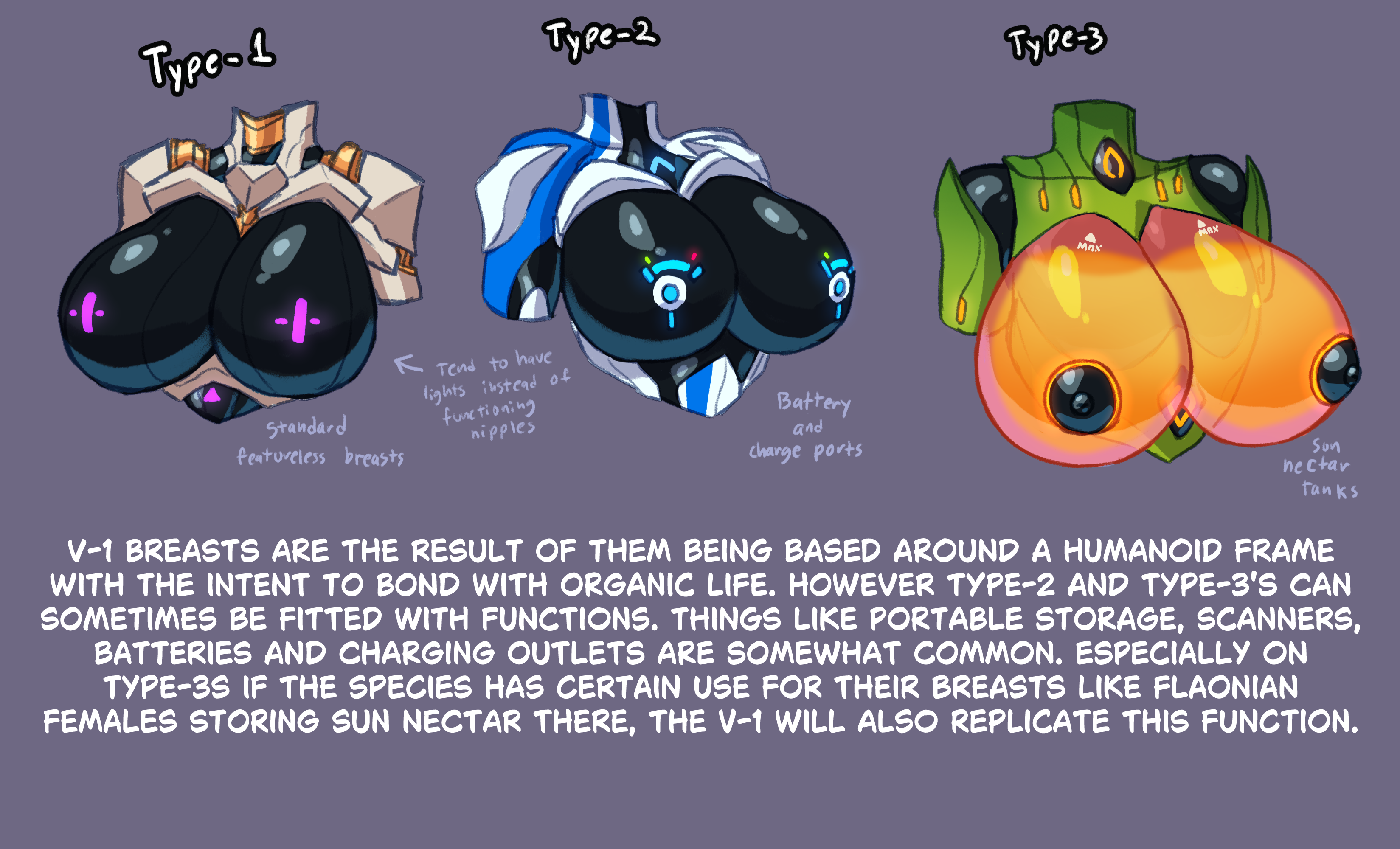
Female Breasts
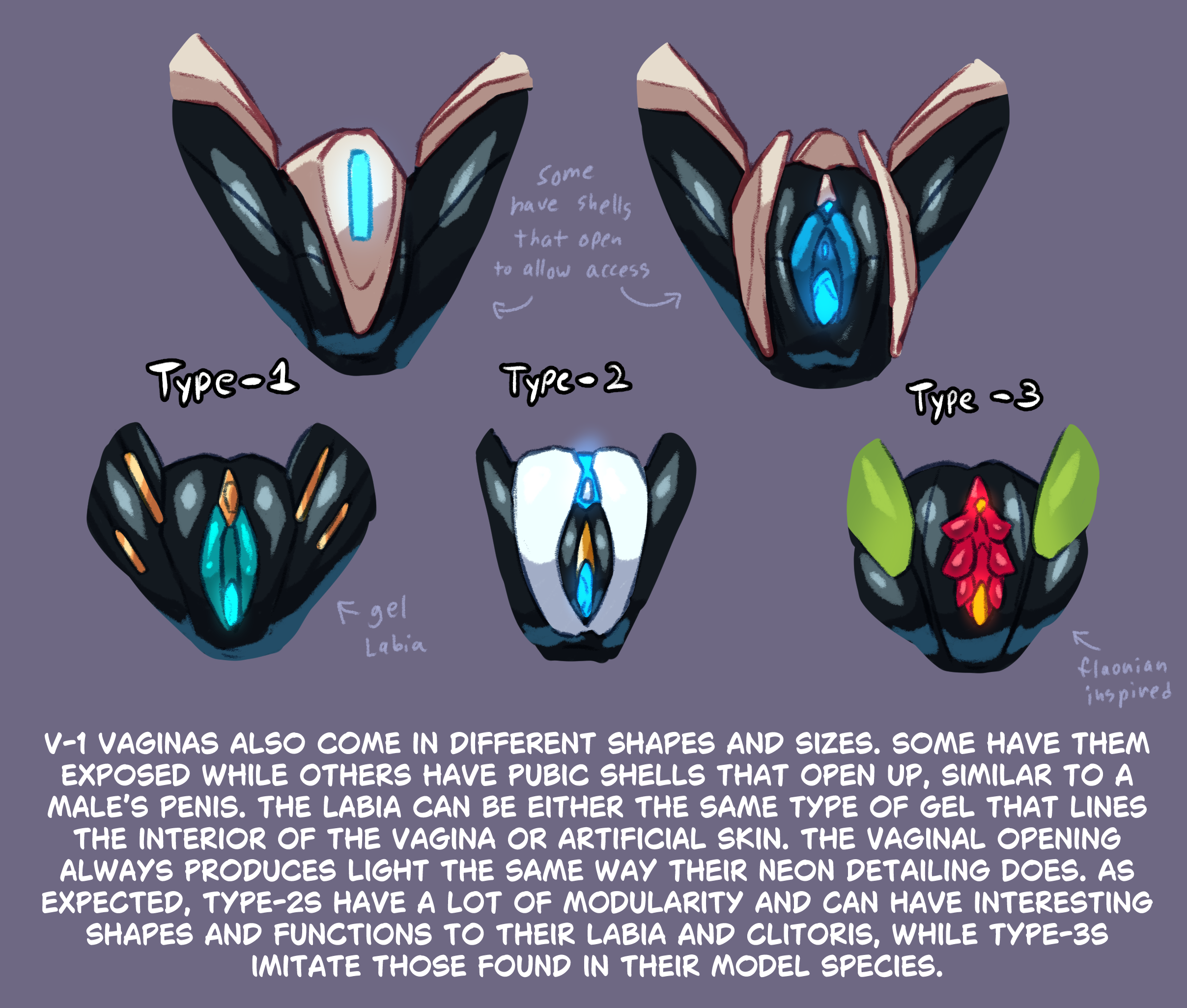
Vagina
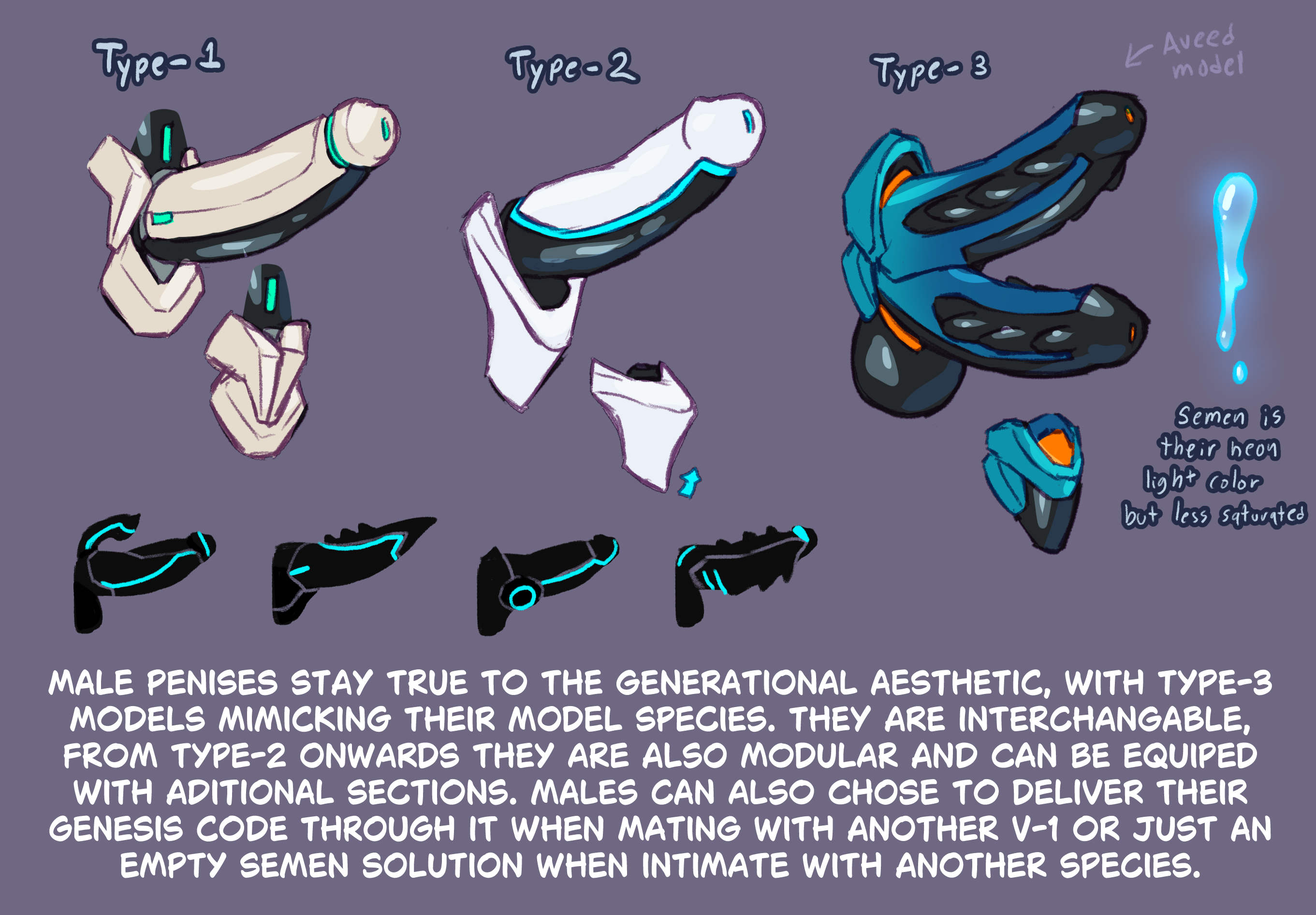
Penis
Comments