
Wielen'fae
The Wielen'fae (pronounced wheel-en-fay), or simply 'fae,' as most call them, are a species found in the most remote mountains of the world. They can take on many forms and are hugely varied: few fae are truly comparable to each other. One of the only similarities is the alpine heights at which they are exclusively found. Because of this, fae rarely intermingle with other species in cities except for those very high in the mountains.
The only rulers the Wielen'fae possess are the wind and the moons: apart from that, they are a notoriously anarchial people.
Basic Information
Anatomy
While all Wielen'fae possess the ability to change form, one form is considered their 'natural' one. This form is quite similar to humans and elves. Wielen'fae, however, have skin ranging from pale lavender to pastel green to light gray. As well as this, they are typically shorter than other humanoid species; there are outliers, of course, and there are fae taller than seven feet in the world. They are simply the minority.
Wielen'fae have pointed ears, like elves. Their ears are typically longer than those of elves and are often adorned with piercings, something multiple elf ethnicities frown upon.
They also possess wings: fae often fold their translucent wings behind their backs when they are not flying. Their wings are very similar to other fae's (butterfly-like, either two or four in number, and slightly less than twice the fae's armspan when spread) but have a more silvery tinge. They can blend in easily with the mountain mist and are waterproof enough to resist rain completely so they can fly in any weather, even snow (most varieties of fae cannot fly if it is too cold out, but Wielen'fae have no trouble with it).
Another identifying feature of Wielen'fae is their eyes: it is rare for the color to be outside the range of gold to amber. Warm tones are present in the eyes of every known member of the species, not excluding those born without sight.
One more, less immediately noticeable, feature of fae anatomy is how different their muscles are from those of humans. While elves are also typically stronger and swifter than humans, with fae it is much more intense. The muscles of fae break down and rebuild incredibly quickly and are slow to atrophy. Due to this, even the smallest fae can toss a boulder into the air. Young fae learn to control their strength before they learn to read. Their speed does not, however, have to do with anatomy: it is because of a connection to the deity of the wind, Ziryphil.
Biological Traits
Wielen'fae have over four dozen of what humans would deem biological sexes. When their society was first developing, they were faced with an, at the time, abstract choice: to overcomplicate their societal structure with a variety of stereotypes and biases about each of the sexes... or the completely ignore it all. With their deep connection to the deity of freedom, it is little surprise what their society ended up becoming.
The subgroups the fae consider important have to do with the many forms Wielen'fae can take. Many can choose to take on certain animal traits, from antlers or claws to a transformation into a centaur-like shape. The shapes into which they can change are determined by a combination of genetics, magical prowess, and the moons present at their birth.
Ecology and Habitats
Wielen'fae are generally very harmonious with the ecosystems around them. They play their musical instruments for mountain goats and those with winged forms fly alongside the eagles. Their only enemy species is the grayish-purple aster moths that attempt to damage their sweaters.
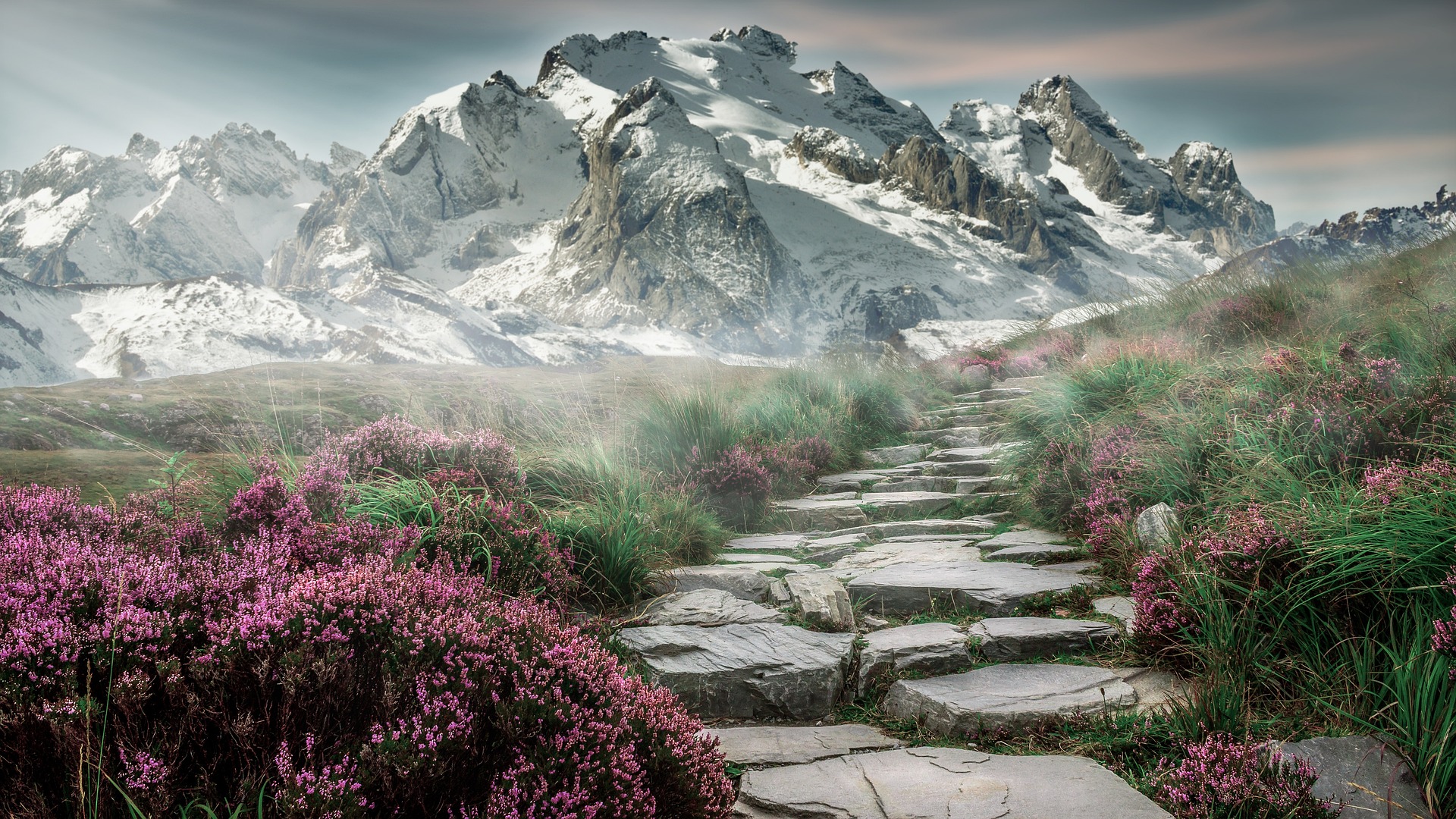
The mountain peaks the Wielen'fae inhabit are chilly year-round. Snow arrives early and stays late into the spring, the summer fields are dotted with colorful wildflowers, and in the fall the grass turns shades of gold and maroon. There are not many deciduous trees, though some can be found near rivers, and both high winds and mist are common occurrences. Because of this the Wielen'fae always dress very warmly, and their dwellings are quite well-insulated.
There are four moons in this world's sky and they are the closest thing the Wielen'fae have to religion, other than the deity of freedom, Ziryphil. They are not strictly bound by religion in the slightest (given that their deity represents freedom itself), but do occasionally weave the wind or the moons into their traditions. The name of the four moons from smallest to largest are Yenfleck, Vik'kenflor, Flaxrain, and Fjoryar. They are often depicted as gender-neutral siblings in artwork and mythology. The phases of the moons determine the times of some of their traditions, festivals, and meetings, but there is very little prayer or actual worship, just as a result of how the Wielen'fae's society functions.
Dietary Needs and Habits
Fae generally eat the same foods as humans or elves, though they need less. There are a few aspects of their cuisine that are notable, however: stew made from the meat of the mountain goats they keep herds of is a staple food in every Wielen'fae household. As well as that, the salmon caught in their mountain rivers is prepared in a dozen different ways. It is often smoked, grilled, dried, or even eaten raw once properly prepared. Another notable detail about their cuisine is their tendency to garnish every dish with wildflowers.
The most famous aspect of Wielen'fae cuisine is their whiskey. It is practically legendary in other cultures for its near-magical taste: it is described as having floral undertones and a pure honey flavor, and it is universally declared to have perfectly balanced flavors. Barrels are only opened and made into new bottles every autumn equinox during the The Festival of Amber'rae. The week after the equinox is the greatest rush of new whiskey-making activity for the rest of the year, though it is sometimes made and put into barrels to age at different times of year.
Biological Cycle
When a young fae passes their first winter, that spring is when their first transformation will be revealed. Because of this, springtime is quite a difficult time for parents: babies are now changing shape, and some of those forms can already walk or even run. It is quite a lively time for every Wielen'fae village. Other forms will be realized at climactic moments in a fae's life; seasons have no other effect on the biology of Wielen'fae.
The passage of time for fae is much the same as it is for humans: hair loses color and pales, skin acquires wrinkles (though in fae it is far fewer - a 100-year-old fae would appear about fifty years old to a human, even if they are far closer to the end of their lifespan than a fifty-year-old human would be), and it becomes more difficult for them to move. Their wings become more silver and more translucent as they age, and the ability to fly is lost long before the ability to walk.
Additional Information
Social Structure
Wielen'fae live in small villages of about seven hundred, and over thirty of these settlements can be found in the world's highest mountain peaks. Many of these villages are situated just before the end of the treeline, and others are well above it in valleys much like the tundras found at low altitude further north. Each village is overseen by a 'Following Council,' which is five fae elected by the people of the village and approved by the Leading Council of Wielen'fae. This Leading Council is comprised of all the villages' Following Councils and makes larger decisions that will affect the entire species. Following Councils meet once a month when the Flaxrain Moon is new, and Leading Councils only meet when all four moons are new (once every seventeen months). Most villages are spread very far apart, and so Leading Council meetings can be quiet a hassle to get to and choose a location for. Due to that, they do not occur often.
Perception and Sensory Capabilities
Wielen'fae can always sense whether clouds contain snow, though they have no other weather-predictive abilities. They can also hear for quite a long way, and have a particular knack for pinpointing where a sound is coming from, even if it is distorted with echoes.
Civilization and Culture
Naming Traditions
Wielen'fae names are near-always derived from their language. A very famous fae, Kilin the Exuberant, had her name chosen from the Alpin'nai words for flute, 'lintini,' and northernmost river 'kienfl'luv' (yes, there are separate words for specific types of rivers). Last names are often simply wildflower names, some in Alpin'nai and some in Common.
Historical Figures
Kilin the Exuberant is one of the most notable historical figures for the Wielen'fae. She died about two hundred sixteen years ago and was the first fae to join a traveling theatre troupe. She brought the art of theatre back to her people after her travels, became an influential Councilmember, and is said to have defeated dozens of mountain monsters. Most of the myths are largely true given how recent a historical figure she is: she lived only two fae lifetimes ago, after all.
5 feet 4 inches is the average height. There is great variation in this, but none is based of biological sex.

Comments