

Orc
Basic Information
Anatomy
Biological Traits
Genetics and Reproduction
Growth Rate & Stages
Orcs develop fast and are short lived, those that don't die violently very rarely even make it to 60. Orcs make up for their short lifespans and the high attrition of their violent societies by reproducing at an astonishing rate. Their fecundity is so great that a tribe decimated in battle can almost totally replenish its numbers in as little as a decade.
Reaching adulthood is no small feat for orcish children. After leaving infancy they almost immediately have to fend for themselves against older members of the tribe. Already in childhood do most males, encouraged by their fathers, start intimidating children of the same age or younger than them. When reaching adulthood, male children are initiated by leading the charge in a raid, in which the survivors of the vanguard are considered adults. Females don't receive an official rite, though they are deemed adults once they develop their secondary sex characteristics, at which point they are forced into a harem.
Dietary Needs and Habits
Behaviour
Additional Information
Social Structure
Orcs group together in tribal communities for food, protection and numbers. These communities are ruled by a single individual, a chieftain which is often a warlord or shaman. A chieftain wields the highest power within a community, and dictates the laws of a tribe. In larger tribes, where the community is split into a main camp and several peripheral camps, the chieftain may anoint paramount chiefs to rule in his name. These chiefs collect and pay tribute to the chieftain in the form of food or plunder.
The sudden death of a chieftain (which is not at the hands of a challenger) and subsequent lack of an immediate successor allmost inevitably throws a tribe into chaos and infighting, until a new leader arises and establishes dominance. The chiefdoms themselves are also relatively unstable forms of organization. Orc tribes are prone to periods of collapse and renewal, where tribes band together but eventually fragment through some form of social stress, after which they slowly band back together.
In some unique cases female orcs have been observed to rise to the position of chieftain. These females are more vicious and intimidating than their male counterpart, and they rule their tribe with an iron fist. Not surprisingly, they alleviate the females within a tribe of some of their tasks. A female chieftain also brings a considerable change in the looting behaviour: tribes become more systematic and selective in the towns they attack, maximizing their returns and minimizing their losses.
Facial characteristics
Average Intelligence
Perception and Sensory Capabilities
Civilization and Culture
Naming Traditions
Male: Basolk, Crold, Droog, Forg,Grek, Krakdurg, Nargosh, Rizkut, Urgosh, Vorlekk Orcs do not possess surnames, rather identify their orgin from the tribe they are born into. "...of The Burning Eye," etc.
Gender Ideals
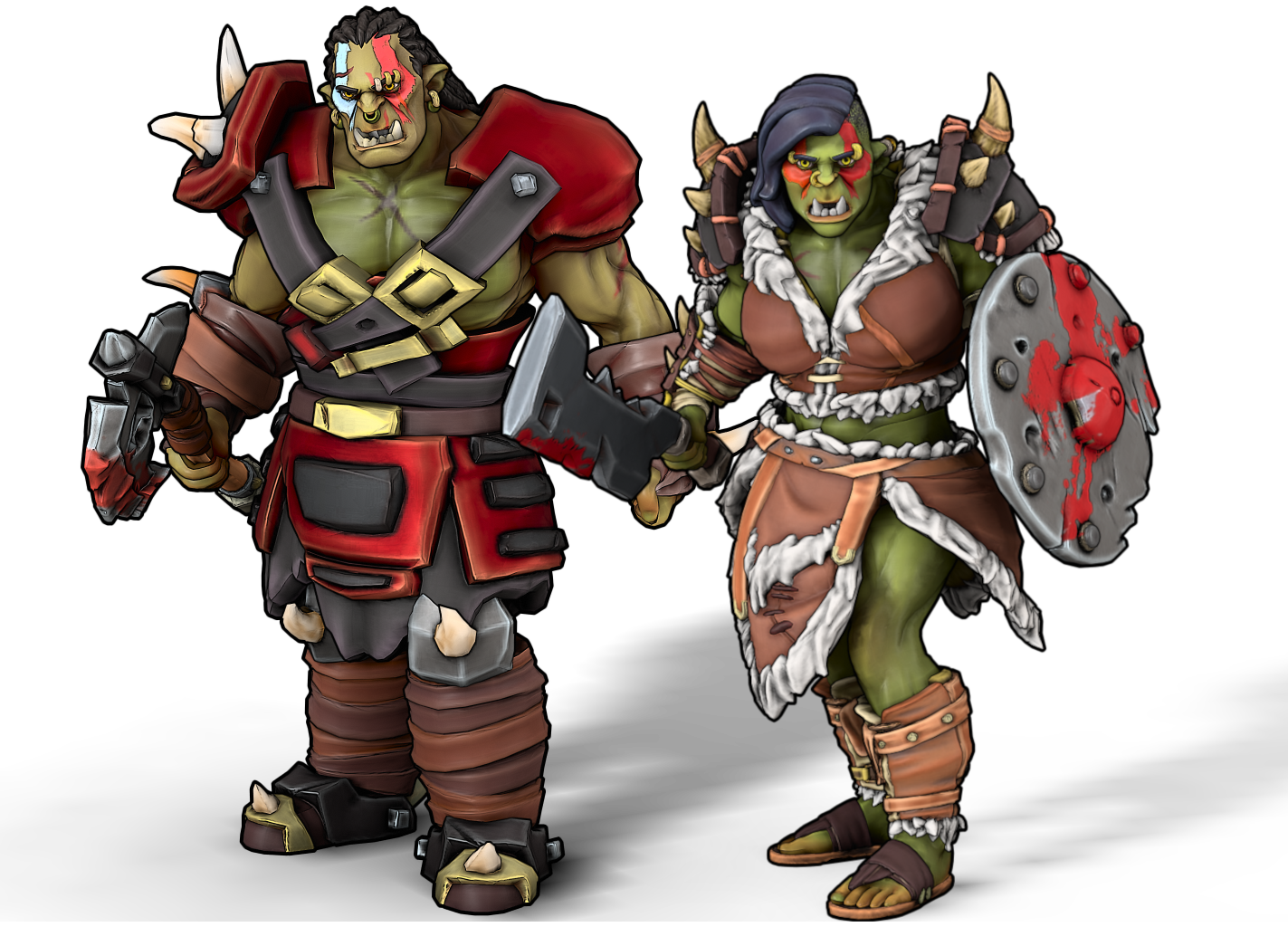
Males are, unsurprisingly, the dominant gender within a tribe. If they are not out raiding, or occasionally patrolling a camps perimeter, they spend their time indulging themselves with food, torture [of slaves] and fighting rivals. Male orcs rarely take up professions as they disgust at even the thought of having to go through the effort to create something themselves, instead of taking it. However, in some cases a male might take up the craft of armour- or weaponsmith and become a valuable and protected asset of chieftains.
Females fulfil the role of a "lesser gender" within orc society, which is most likely attributed to having a much calmer and collected nature, compared to their male counterpart (this does not mean a disgruntled female orc wouldn't tear off an arm). Males delegate much of the day-to-day tasks to the females within a tribe. These activities include, but might not be limited to: cooking, cleaning, nursing and herding. Females also seem to be more likely to take up a profession, like leatherworking or seaming to create or repair both tents and clothing.
Average Technological Level
Major Language Groups and Dialects
Culture and Cultural Heritage
Orcs usually live amid squalor and constant mayhem, and intimidation and brutal violence are the glue that holds orc culture together. They settle disputes by making increasingly grisly threats until, when a rival fails to back down, the conflict escalates into actual bloodshed. Orcs who win these ferocious brawls not only feel free to take whatever they want from the loser, but also frequently indulge in humiliating physical violation, casual mutilation, and even outright murder. Orcs rarely spend much time improving their homes or belongings since doing so merely encourages a stronger orc to seize them. In fact, whenever possible, they prefer to occupy buildings and communities originally built by other races.
Whilst, at best, only average riders, orcs value having fearsome mounts for the prestige they bring. The most common mounts include dire wolves, dire boars, elephants, and rhinoceroses
Common Customs, Traditions and Rituals
Orcs are merely interested in satisfying their own needs, which in itself is a reason why an orc would not worship a god. But they also dislike having a master, and they perceive the worship of a deity as subjugating themselves to it. Despite this, shamans frequently rise to power and enforce the worship of a god to exert control over the tribe.
The gods that shamans devote a tribe to directly influence the amount of control they have. Thus, they typically choose gods which portfolio suits an orc the best. Typically, this is either Asmodeus or Demogorgon. Rarely tribes will worship Tyrannus, or even The Great Old Ones are not unheard off. There have been some unique cases in which a shaman has successfully engaged a tribe in worship of himself. These forms of devotion rarely last long, as a shaman's rivals will disprove his divinity as the first possible opportunity.
History
The Tome of The Twelve teaches that during the Primeval Era , Tyrannus created the orcs to serve as infanty and foot soldiers in the gods' war with the Nine Hells. The orcs were bred to be perfect killing machines; strong, ruthless, violent, brutal, and very obedient. Once the war was won and the gods retreated back to The Divine Isles and The Endless Sea, the orcs were left without divine guidance to survive a new world. The orcs believed Tyrannus has forsaken them due to the absence of his divine presence, and rebuked the god of war and the rest of his divine family. They retreated underground within the mountains, seeking safety. Over time this brought them in to contact with the Dwarves beneath the Drakor Mountains. Resources became scarce in an already harsh environment, and while the feral beings no longer worshipped Tyrannus, they still embodied his tenets-only the strongest shall rule, and thus waged war with the dwarves for dominion of the underworld. At first the orcs were little more than savage beasts, but their earliest fights against the dwarves taught orcs the rudiments of civilization as they had finally encountered a foe that could not be overcome with just fists, teeth, and sheer fury.
Slowly over centuries the orcs were forced from deep within the great mountain ranges and driven to the surface. There they became warlike tribes of pillagers and marauders.

Comments