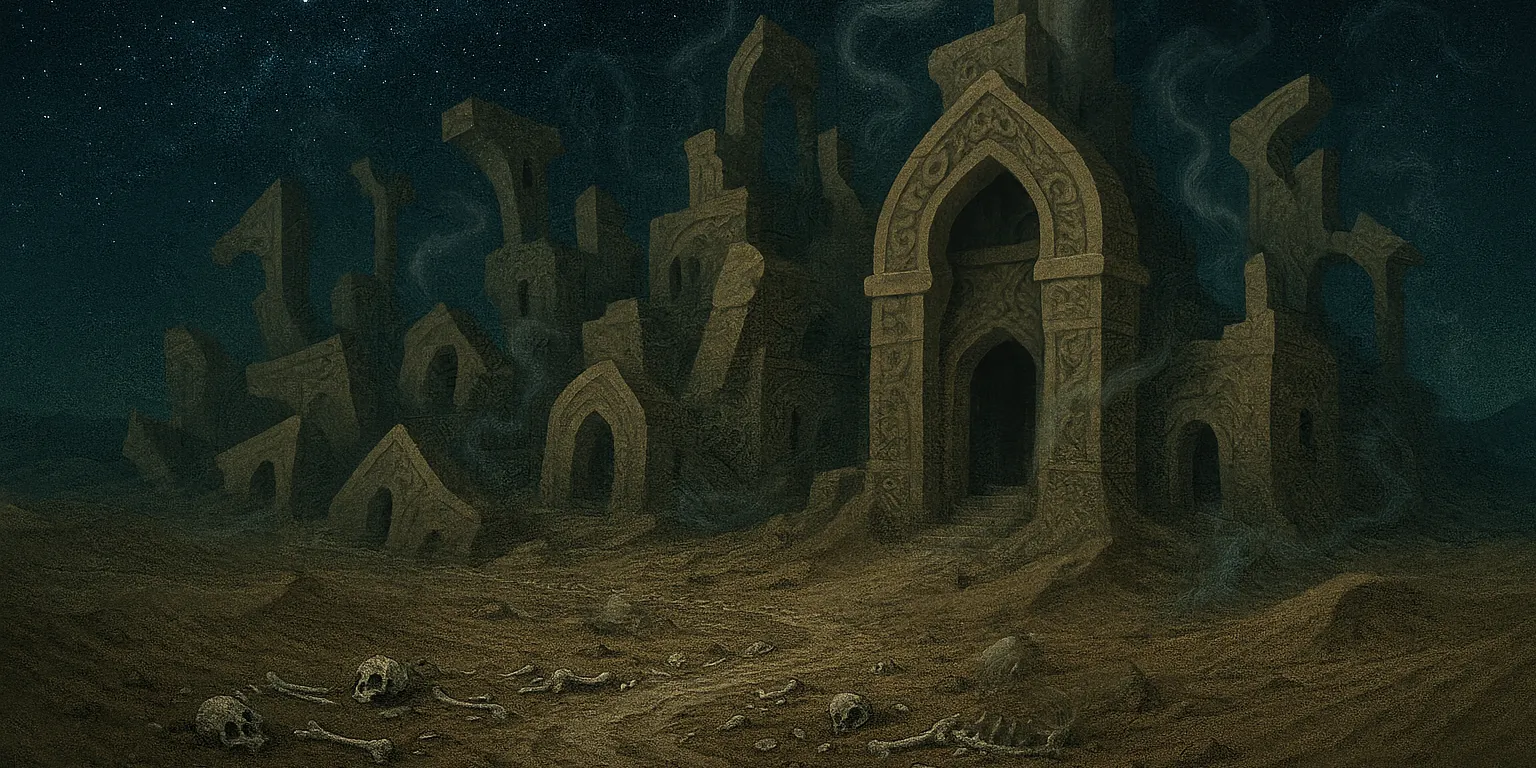
Madinat al-Ghul
Deep within the mystical dream-desert called the Al-Kubra lies a city unlike any found in the outer world. To reach it, a traveler must walk the Asthimarga, the Bone-Strewn Path, across the sands. While on the Asthimarga, one is safe from all the perils of that terrible place, provided one continues toward the city. At the path’s end stands Madinat al-Ghul, the Great Necropolis, the city of the Ghuls.
Nightmare and Bone
The Al-Kubra desert, and all that lies within it, is only partially real. Most of its existence resides within The Dream and is shaped by The Egregoric Force, the power of collective belief. The history of Madinat al-Ghul is therefore a history of nightmares. The lore and myths told about the city are what built it within the Al-Kubra, each story becoming a brick in its strange and unsettling design.
To find its roots, one must first consider the origin of its inhabitants, the monsters known as the Ghuls. The earliest mentions of these creatures go back thousands of years, appearing in the oldest records of the Naga on Saba. In those tales they are described as elongated, emaciated demons who took on a shape that mocked the Naga and could fold themselves into the smallest holes before emerging to snatch food after darkness fell. They stole Naga eggs as well as any food they could find, including the bodies of the deceased. Over time their Association with consuming corpses became the dominant strand of their story, and they began to haunt any place where the dead might be found.
When humans came to the Great Ring, the Naga began to describe the Ghuls as having the shape of the alien newcomers, though marked with jackal-like features. They remained gaunt and ravenous and always sought the bodies of the dead. If they had to, they would kill the living, but they preferred their meat well aged and would leave their victims where they fell so that they could ripen and rot before being consumed. Any death in or near a graveyard could be blamed on the Ghuls, and the Naga built ever more elaborate tombs to protect the bodies of the departed from the corpse eaters.
The Rise of Madinat al-Ghul
The first hints of a Ghul city appeared during the early days of the Nagarajya. As the Naga gained greater power over the Southwestern Region, the Ghuls began to gain power over their own territory within the Al-Kubra. Stories from this period first speak of the Ghul leader Shaitan-e-Asthi, who dwells in Madinat al-Ghul. He is said to rule all that lies below the ground, and all Ghuls must surrender a tithe of flesh to his appetite. In these early accounts, the city of the Ghuls is depicted as a network of rough tunnels connecting the graveyards of the world to a vast cavern where no light reaches and where Shaitan-e-Asthi squats upon a mound of gnawed bone, vast and bloated with the flesh of the dead. Later tales place this cavern beneath the Al-Kubra and extend Shaitan-e-Asthi’s authority to include wide stretches of the desert. Wars between Madinat al-Ghul and Madinat al-Brunz were told, and the enmity between the Jinn and the Ghuls became firmly embedded in Naga lore.
In the latter days of the Nagarajya the story took its present form. Madinat al-Ghul remains mostly subterranean but now includes an aboveground district where the Ghul leader may be approached. This district can be found only by following the Asthimarga, the Bone-Strewn Path. The authority of Shaitan-e-Asthi ensures the safety of all who travel the Asthimarga toward Madinat al-Ghul, though leaving the city again becomes a matter of tribute and negotiation. In the tales, a visit to the Ghuls is often required before undertaking a quest through the Al-Kubra, whether to gain safe passage into deeper regions of the desert or to obtain a piece of knowledge or a stolen grave good needed for the journey.
The visible portion of Madinat al-Ghul defies any mortal idea of a city. Buildings are erected at random around the center, growing denser as one moves inward. There are no streets and no discernible pattern to their arrangement, and the structures come from a thousand architectural styles rendered in stone, said by some to be taken entirely from plundered cemeteries. Any doors or windows are simply dark holes in the facade, and when one peers inside, the interior is hollow, with only a pit descending to the tunnels below. The Ghuls do not use these buildings as dwellings. Instead they are a form of art, a celebration of the macabre and the morbid. Carvings across their surfaces depict themes of death and burial and are said to show every manner in which a body may be treated in death. Many describe them as the glorified bones of true buildings. In some tales the foolish attempt to explore the depths beneath these structures, venturing into the heart of Madinat al-Ghul itself. Such expeditions rarely end well.
Shifting with the Sands
The evolution of Dreamlands never ends, for their stories are retold and altered with each generation. As the Nagarajya gave way to the Malikate of Saba, the tales of the Ghuls endured. The Naga shared them with the invaders, who brought their own fears to haunt Madinat al-Ghul. Newer accounts speak of stolen children taken to the city to be remade as Ghuls. They tell of great feasts where blood is drunk like wine and murderers are turned into delicacies. As the stories evolve, so do the Ghuls and their city. Nightmares remembered cannot die, yet they will always continue to change. None can know what form Madinat al-Ghul will take in the future - but it is likely to endure for a very long time.
Related Articles
This article was originally written for Spooktober 2024. You can find all of my Spooktober Articles at Spooktober Central.
This article was originally written for Spooktober 2023. You can find all of my Spooktober Articles at Spooktober Central.

Another place to add to my list of 'locations in the Million Islands I will never visit', lmao. The Ghuls sound like they might have an interesting culture, though hard for outsiders to learn about, considering.
Explore Etrea | WorldEmber 2025
Yeah - I don't know how much time you'd have for anthropology among the Ghuls :)