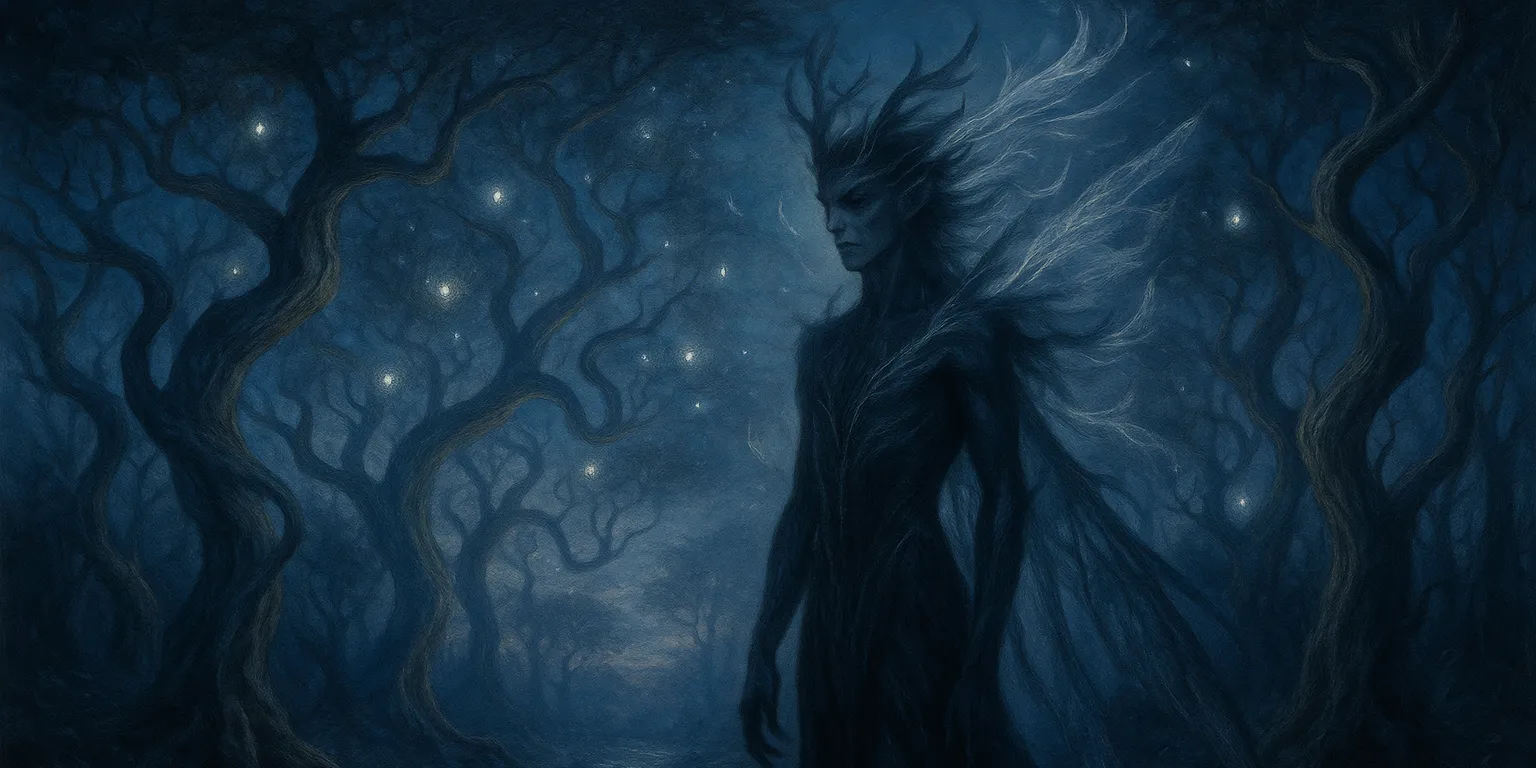
Fae
The Fae are the spirits and gods of the Fir Fáinne, primarily residing on the island of Oileán Fiáin. Once, they were much like the other gods of the region, closely related to the Ellyll worshipped by the other Dhewen Peoples. In those days, they were known as the Tuatha, not the Fae. But when the Clarati conquered the Ynys Archipelago, the island of Oileán Fiáin fell under the control of the sorceress Celestina, whose experiments with The Egregoric Force transformed the Tuatha forever.
Not Of This World
In the Great Ring, the spirits and gods are Numina - beings born from the collective beliefs and thoughts that comprise The Dream. Numina are sustained and shaped by the thoughts of other entities, which is why they desire their stories to be told and why many seek worship as a means of remaining at the forefront of collective consciousness.
Celestina, who was not of this world, found this process fascinating and made it the focus of her research. She chose the island of Oileán Fiáin for her laboratory because The Egregoric Force there was stronger than in most places. Using her Magic, she enhanced the force of collective belief and directed it through mental manipulation of the populace. Among other things, she injected new stories into the collective mind - stories derived from other worlds she had visited - inducing a wave of Invasive Narratives that undermined and remade the Tuatha into a new species.
These new stories and narratives tore at the very fabric of the Tuatha, breaking their anchors to the world and forcing physical bodies upon them, while inducing a condition known as Dissolutio Identitatis - identity collapse - upon their psyches. The process took centuries to complete, and when it was done, there were no longer Tuatha - only the Fae, a new species less than gods, but still more than mortals.
Both More and Less
As Numina, the Fae were anchored to the world through physical landmarks - mountains, rivers, islands, and so forth. These anchors gave the Numina some stability against the pressure of The Egregoric Force, allowing them to retain their selves even as beliefs about them shifted.
In becoming Fae, these anchors were broken and replaced with a more mortal form - living bodies. As anchors, these are much stronger than geography; a living brain is the strongest bulwark against The Egregoric Force, and the Fae no longer suffer from drifting identities in the face of shifting ideas.
But living bodies come with new weaknesses. They can be killed. When one's physical form is a patch of sky or a mountain of stone, it is not vulnerable to weapons - but a flesh-and-blood form very much is. Additionally, the stories that made them Fae wove a vulnerability to iron into their bodies. The touch of this metal burns them, and wounds inflicted by iron weapons can kill swiftly.
As Numina, the Tuatha feared no weapon and could only be truly slain by being forgotten; as Fae, death waits for them as it does for mortal creatures. While death is not truly an end in the Great Ring (see Death and What Comes After for details), it was not a fate that gods needed to fear.
Lost in a Strange Land
The transformation was more than just physical. The stories told about them changed their names, histories, and personalities. While they retain some memories of their former selves, the Fae who remained after godhood was burned away are not the same beings. They may mourn what they have lost, but they can never become what they once were. Many will not speak of their former selves, and the names of the Tuatha are largely forgotten by all who were never divine themselves.
When Celestina was killed and the Fae were released from the bonds she had laid upon them, many raged against the mortals who had served as her instruments, and slaughter was common. Though the great diplomat Airgetlám, the first Ard-Rí of Oileán Fiáin, was able to negotiate peace with the Fae, many still blame mortals for their fall from divinity - and take whatever revenge their lords will allow.
The Courts
When they were Numina, the Tuatha could not roam the world at will. Their anchors in the physical realm bound them to specific places - they could travel in The Dream, but not across the physical world. As Fae, this restriction was lifted; their mortal bodies could carry them wherever they wished. And what they wished most was to gather.
They came together in the Courts, ruled by the Fae Lords. These Courts were organized around common interests and natures, founded on the desire to surround themselves with others who understood the great loss - the immense violation - they had suffered. The strongest or wisest among each Court became its leader, and they settled into new patterns of existence within their hidden estates.
And if some whispered that the Courts themselves were part of the stories that had reshaped them - well, this was unpleasant but unsurprising. They held no illusions of having escaped the narratives that had carved away their godhead, nor did they possess the power to shake off their imposed natures.
Some chose to retreat more fully into The Dream, disappearing into Dreamlands such as Baille Mel. There, they allowed the intense forces of belief and legend to batter their new identities until they were reshaped - or completely dissolved. Some emerge as new beings after centuries in the Dreamlands; others vanish entirely from the world. There may be more Courts within The Dream than without - but there is no reliable way to count them.
Out of Place
The Fae are not truly of this world - not anymore. They embody dreams and ideas that do not quite align with the people around them, which makes them alien and strange. Over the centuries, the Fae and the world have grown closer - but in areas where the Fae are common, reality itself becomes turbulent, with strange stories and concepts manifesting in both physical and mental realms.
This is most evident in the city of Aerendel, which seems a mirror of some distant fantasy, though such phenomena can be seen across the island as well. In time, the Fae and the world may reach a point of harmony - but who can say what changes will be wrought on both through that process.
Divinity Reclaimed?
Some of the Fae have chosen to pursue Apotheosis - the process by which a mortal being may become a god. This is a difficult path, demanding transformations just as profound as those that stripped the Fae of their divinity in the first place. Still, some consider it preferable to remaining mortal - even if death is an inevitable part of becoming a god once more. You can read more about Apotheosis here.
A Different Home
Another of Celestina's unintended legacies was the forging of a link to The Dolphin Islands - a half-real place that lies just west of the sunrise. Born from the same stories that reshaped the Fae, this strange and shifting land has drawn more than a few to leave behind the realms where their former selves once walked. In The Dolphin Islands, all is ruled by the laws of story and narrative, and some willingly surrender their free will in exchange for a deep and unshakable sense of belonging. You can read more about The Dolphin Islands here.
Related Articles
This article was originally written for Spooktober 2024. You can find all of my Spooktober Articles at Spooktober Central.
This article was originally written for Spooktober 2023. You can find all of my Spooktober Articles at Spooktober Central.

I feel really sorry for the fae, honestly.
Explore Etrea | WorldEmber 2025
I do too; losing divinity is hard. If only so many of them hadn’t become monsters…