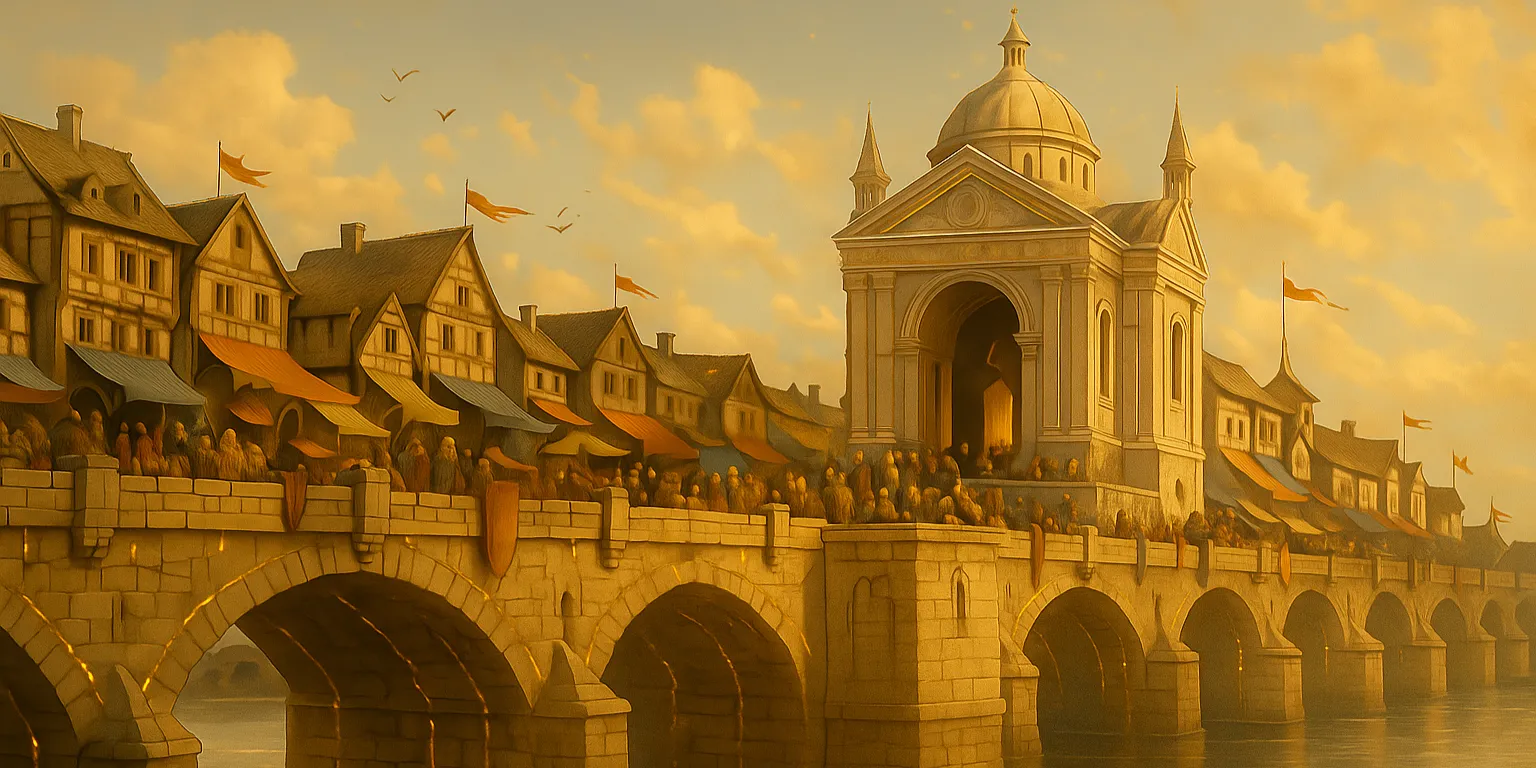
Aurelian Bridge
The Aurelian Bridge is a god who inhabits a magical span in the heart of Lifworðig. It is considered the first of the Godcrafted - though some dispute this, as the Bridge was not made a god intentionally. The Clarati sorcerer Illustrata built it from stone and magic to cross the River Severin as an aid to local commerce; there is no other good crossing for nearly fifty miles in either direction. The bridge's magic is visible as a golden glow in the mortar, a feature that gives it its name - Aurelian meaning "golden" in Lingua Clara.
When the bridge was constructed over a thousand years ago, there was nothing like it in the region. Stretching more than a thousand feet in length and wider than most streets, it quickly became a marvel of its age. Shops sprang up along its span almost immediately, and the Bridge became the center of commerce for the entire area. The people of ancient Lifworðig began to speak of the Bridge as an entity in its own right, believing it listened and could influence the flow of trade - for good or ill. Rituals of luck soon grew around it: a coin rung on the stones could prove a statement true or false, and any bargain made upon the Bridge would always be honored. During this time, while Illustrata struggled to harness The Egregoric Force and fashion tame gods, children began singing early versions of the song Golden Bridge is Waking Up - and a newborn, wild god of trade and commerce was indeed stirring in the heart of Illustrata's city.
When Illustrata realized what had happened, he was frustrated - but not deterred. He studied the Bridge, and from it drew the inspiration for the Godcrafter's Guild and The Godcrafter Manifesto. While the practice of godcrafting has never been as predictable or controlled as Illustrata wished, and the Guild itself fell apart after his death, the techniques they pioneered have been used many times in the centuries since to spawn new gods - the so-called Godcrafted.
The Aurelian Coins
As the first of the Godcrafted, the Bridge would already be notable - but what has truly made it legendary are its most infamous creations: the Aurelian Coins. The Bridge is a god of commerce; it believes that all things can be bargained for and purchased. Shortly after awakening, it encountered the notion that there were some things money couldn't buy. This idea struck at the heart of the Bridge's beliefs about the universe - and it decided such a thing could not be allowed to be true.
So the Bridge began to create its Coins. Each one is special and unique, and each can be used to purchase something thought to be beyond the reach of commerce. With the right Coin, a person can buy forgiveness, love, time, or respect. Spending a Coin rewrites reality around the purchaser, altering past and present to make the purchase true. The Coin vanishes as part of the process - but not forever. It will reappear somewhere, often returning to the Bridge itself to be recirculated at its discretion. If you find a Coin, you may bring it to the Bridge to exchange for another, or simply give it as an offering - the Bridge always rewards the return of a Coin. If you wish to purchase one directly, you may attempt to negotiate. The Bridge believes everything is for sale, for the right price - but the prices it demands are both steep and esoteric.
The true impact of using a Coin can be terrible. Minds are altered, free will is violated, and the fabric of history may be twisted out of shape. The Coins impose a new reality over the one that previously existed, changing the past and everything associated with the purchase. Yet echoes of the original reality still linger in The Dream, where people may catch fleeting glimpses of what was lost. Parents mourn children who were never born; others find themselves confused and unsettled by things they know to be true, but never were. The purchaser remembers both realities clearly, but everyone else retains only fragments, usually manifesting in dreams. For some, this is enough to shatter their sanity. There can also be unforeseen effects, as the Coin's rewriting of history and people can change personalities, erase individuals, reverse death, and even alter the course of history itself.
Feeding the Bridge
The Aurelian Bridge hungers for knowledge of trade from across the Great Ring, a desire that has given rise to the custom known as Feeding the Bridge. At the center of the span stands a shrine to the god. Merchants visiting Lifworðig bring stones to this shrine as offerings, each one gathered from a marketplace or trading post - preferably as far from Lifworðig as possible. If the Bridge is pleased with the gift, it grants the merchant special insight and business acumen, aiding their success in future dealings. The Bridge incorporates every stone into its structure, no matter how many are left at the shrine, and is said to draw from them knowledge of the markets from which they came.
The God's Ledger
The priests of the Aurelian Bridge have gone to great lengths to track and document the uses of the Aurelian Coins in a great tome known as the Codex Pontis, or Book of the Bridge. Within its pages are secret histories of the world that most can only guess at. Many believe the true history of the Kingdom of Wuffa lies here, alongside a thousand other lost and erased pasts. Countless seekers wish to browse the Codex - but few can afford the price demanded by the Bridge's priesthood.
You can read more about the Codex Pontis here.
This article was originally written for Spooktober 2024. You can find all of my Spooktober Articles at Spooktober Central.
This article was originally written for Spooktober 2023. You can find all of my Spooktober Articles at Spooktober Central.

Golden Bridge is Waking Up is sung to the tune of London Bridge is Falling Down in my head until I am told otherwise. The Bridge sounds like a fascinating place to visit, but the coins are terrifying. I bet most people don't think of the consequences though.
Explore Etrea | WorldEmber 2025
It’s definitely to the tune of London Bridge is falling down! The coins are bad news. Just because you can buy something doesn’t mean you should