
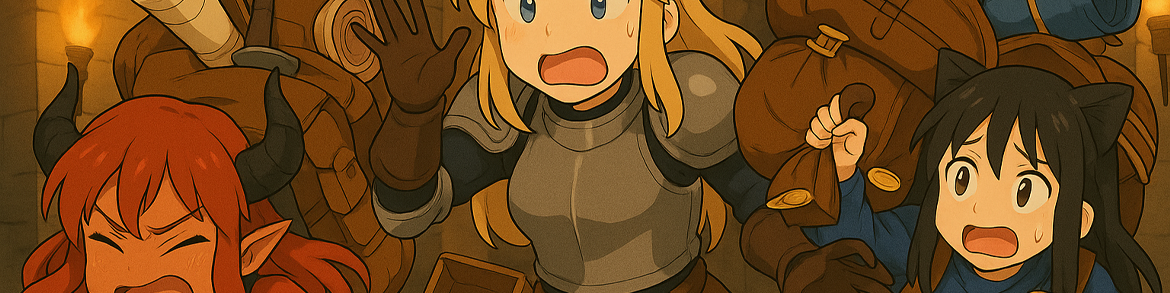
Things You Will Lose Anyway
“Gear is not treasure. It is the catalogue of everything you will break, forget, or abandon on the road. The Pattern ensures you begin with something in hand; inevitability ensures you end with nothing.”
Adventurers measure their lives not in seasons, but in the things they carry. A blade at the hip, a coil of rope, a pouch of coin—each gained by trade, theft, inheritance, or chance. These objects form the material spine of a life otherwise spent chasing peril. They are rarely permanent. Weapons shatter, packs are abandoned, coins vanish into ale and ashes. Yet for a brief span they are yours, and in that span they matter.
Gear is the quiet ledger of survival. Some items are cherished, polished and repaired until they linger as memory. Most are discarded, forgotten, or lost in the dark. All are temporary, but none are meaningless.
And so we come to the rules of it: how you begin, what wealth looks like when the Pattern notices it, and how much one body can truly bear.
Starting Gear
No adventurer arrives in the Pattern empty-handed. When a character steps into play, they already carry the tools their calling and past have provided: a weapon pressed into their palm, a cloak scavenged from someone else’s misfortune, a pack earned, inherited, or stolen.
You may take the standard equipment offered by your class and background—ready-made baggage to get you started—or, if you prefer, you may instead begin with coin and shop for your own mistakes. The amount of starting coin is listed with your class, so that new callings added to the Library can bring their own wealth without rewriting this page.
However you explain it—inheritance, military issue, a theft gone unpunished—the Pattern insists you begin with something in hand. What matters is what you do with it, and how quickly you lose it.
Choose either:
- The starting equipment provided by your class and background, or
- Starting coin (listed under your class description), which you may spend on equipment.
Wealth
Gold is not treasure. It is permission.
The Inn accepts the familiar coinage of adventurers—copper, silver, gold, platinum—because without it, the ledgers would never close. For rules, this is the only measure that matters: all costs, rewards, and treasures are recorded in gold pieces.
Beyond the Inn, wealth is never so stable. In Velvet Nocturne , the same purse becomes mirrored scrip, glowing tokens, or candy-coloured notes in the Hoshizora Ward. In Mists of Duskworn , coin is heavy, often exchanged by weight rather than stamp. In Uurin , gold vanishes into barter: pearls, feathers, obsidian blades. The Pattern obliges—your coins always appear as the local custom—but this is disguise, not acceptance.
In most worlds, you cannot simply spend. You must barter, pawn, or perform. Somewhere in a back alley there is always a broker willing to weigh your strange coin against their patience, but rarely at a fair rate. Sometimes wealth solves a problem. Sometimes it is the problem.
- All treasure is tracked in gold pieces (gp).
- In-world, your wealth always manifests as the local currency.
- By default, treasure sells for half its listed value unless better terms are earned.
- The Storyweaver decides how easily wealth is exchanged. Coins stretch or shrink according to the needs of the tale.
Burden
What you carry defines you almost as much as what you leave behind. Adventurers march not only beneath the weight of steel and rope, but beneath the quiet judgement of plausibility. The Pattern is patient with danger, but not with absurdity. A halfling cannot drag a ballista across a swamp; an oni warrior can. A scholar may stack books until their arms shake, but no one believes them hoisting a tower of shields.
Burden is not measured in pounds, but in sense. The Pattern tolerates hardship, but it resists farce. You may try to carry everything, but sooner or later the story itself will make you choose what to abandon when the fire reaches the door.
This is the Law of Sensibility.
- Characters may carry what is reasonable for their size, strength, and role.
- The Storyweaver decides when a load becomes implausible.
- Smaller, frailer characters carry less than larger, stronger ones.
- Hands are rarely free; assume only a few significant items can be ready at once.
In Closing
Gear, wealth, and burden are only the beginning. They are the surface tools—the things you will break, spend, and abandon long before your story is finished. The Pattern will not let you hold them forever. Nothing here is permanent, not even the rules.
If you wish to understand more, follow the threads. The rest of this chapter waits in the articles to the right, each a drawer with its own sharp edges. Open them carefully.
“Your continued reading is more valuable than coin. However, the author assures me that Ko-Fi support assists in ‘keeping the kettle on.’ I am told this is a metaphor. I remain unconvinced.” — Seraphis Nightvale Ko-Fi: #madmooncrow


Comments