
The Hunters of Duskworn
“Some refuse the grave, and the grave learns to wait.”
Duskworn’s daylight has never truly been light. It drapes the land like threadbare cloth, pale and exhausted, unable to banish the shadows it merely softens. Villages persist beneath this weary glow, their mornings filled with muted laughter that sounds as if it has survived grief rather than escaped it. No song here rings without a tremor. No hearth burns without apology.
And along these dim roads, half-claimed by mist and memory, walk those whom the world has come to depend upon, though never gladly: the Hunters.
They are the ones who outlived the night that should have ended them.
They are the ones who kept walking when others broke.
They are the ones the dark remembers by name.
Where the Light Falters
To understand the Hunters, one must first understand Duskworn itself.
This is a world where dawn arrives reluctantly, where midday struggles to rise above the colour of old parchment, and where sunset feels less like an ending and more like a relapse.
The land is dim in ways that have nothing to do with weather.
Something in it has thinned.
Something in it has withdrawn.
Something in it no longer trusts daylight to do what daylight once promised.
In such a place, those who stand between the living and the night do so in constant half-shadow. It is not a heroic posture. It is simply the condition of continuing to breathe.
Survivors of the Wrong Night
No one chooses to become a Hunter.
The role chooses them—crudely, violently, without ceremony.
Some survived creatures that borrowed familiar faces.
Some clawed their way out of homes that grew rooms while they slept.
Some lost everyone and woke to find themselves inexplicably spared.
Some encountered something in the woods that left them unsure which of them had walked away unchanged.
Whatever the shape of the event, it leaves a mark deeper than flesh. Survival becomes a wound that refuses to close. And once one has lived through such a night, the rest of life carries a peculiar echo: a constant awareness that the world is brittle, and the dark far more attentive than it pretends.
Those who cannot forget—and cannot pretend—eventually become Hunters.
Human, Though Altered
Hunters remain human.
But they remain human the way abandoned houses remain homes: recognisable in shape, but filled with drafts and murmurs.
Curses cling to some like second shadows.
Others dream in borrowed memories.
A few walk with a slight delay in their reflection or hear their name whispered from beneath floorboards.
And some appear unmarked entirely—until the wrong kind of mist rolls in, and they listen to it with the familiarity of an old enemy.
Nothing about them is monstrous.
But nothing about them is untouched.
They laugh at taverns, though the sound rarely reaches their eyes.
They dance at festivals, though their steps never quite relax.
They sit by fires, though they always choose to face the door.
This is not superstition.
It is habit born of too much truth.
Knowledge Carved in Scar and Pattern
Hunters follow no doctrine.
Doctrine is theory, and theory is how people die.
They follow pattern—a quiet, brutal science preserved through bruising trial, instinct honed by terror, and a resolute disinterest in explanations.
If a charm works, they keep it.
If a prayer fails, it is discarded without grief.
If a god answers once, they note the tone of its voice, not the scripture beneath it.
If a pact with an old thing leaves them alive, they write the terms down very carefully and never replicate them exactly.
And if a blade dipped in ash on a new moon begins to hum at a certain temperature, they treat that hum with the respect due a living creature.
Hunters know only this:
Understanding is optional.
Survival is not.
Their philosophy is not stated aloud.
It is stitched into the rituals they perform without hesitation, often without sleep.
Implements of Necessity
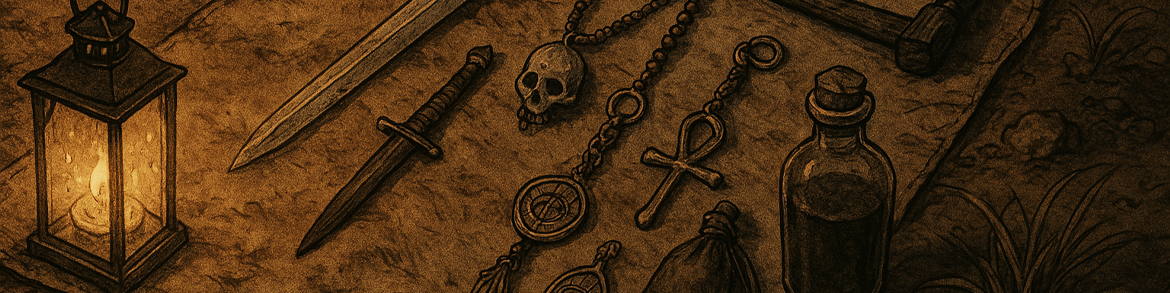
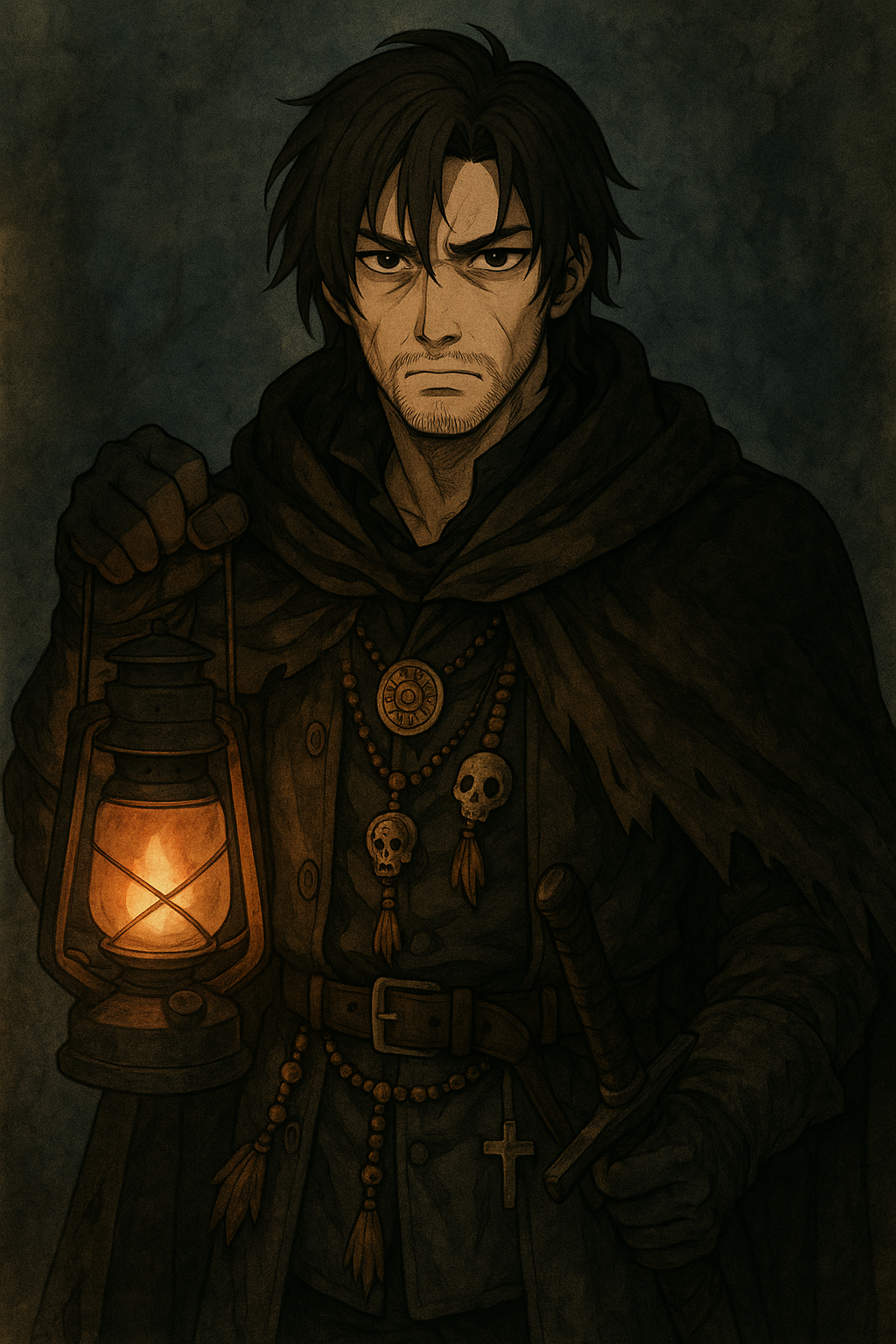
To the untrained eye, a Hunter’s equipment seems like the inventory of a superstitious wanderer: frayed twine, odd herbs, a knife with something scratched into the hilt, a flask that never warms, an object tied with ash-stained thread. But each item has justified its place.
These tools are accumulated through hard-won precedent, barter with Witchmarked caravans, hurried scribbles in journals before consciousness slips, and unspoken lessons taught by those who did not survive long enough to explain themselves.
Hunters neither romanticise nor revere their implements.
They do not name them.
They do not polish them for ceremony.
They keep them because they work.
And in Duskworn, working is the closest thing to divine intervention most people ever witness.
Kinship with the Witchmarked
Hunters share an unspoken understanding with the Witchmarked—the wandering keepers of old courtesies that Duskworn has tried, unsuccessfully, to forget. The two groups recognise one another easily, as if shaped by the same grief.
The Witchmarked do not ask why a Hunter travels alone.
Hunters do not flinch when the Witchmarked mutter rites in forgotten dialects.
Charms pass from hand to hand.
Warnings are exchanged without flourish.
Meals are shared without formal thanks, for both groups know which words attract the attention of listening things.
Their bond is not alliance.
It is mutual acknowledgement between peoples familiar with abandonment.
Heretics the Church Depends Upon
Publicly, the Church condemns Hunters.
It must.
Hunters undermine every performance of purity upon which the Church depends.
They use unsanctioned rites.
They speak of old gods without trembling.
Their tools are not blessed.
Their methods are inconveniently effective.
And yet, when an entire household goes silent, when light bends away from a doorway, when a Sealed Mage burns without flame, the Church does not send its own.
It makes a discreet request to the Grey Vigil.
The Vigil sends word to the nearest Hunter.
The problem disappears.
The Church gives a sermon about faith.
No one mentions the price paid in the dark.
Hunters understand the pattern.
Hypocrisy is simply another creature that thrives in Duskworn.
The Grey Vigil’s Silent Watch
The Grey Vigil remains the quiet conscience of a faith that has forgotten its purpose.
They remember a time when the One True God was not jealous, when worship meant gratitude rather than enforcement, when miracles were gestures rather than audits.
They see Hunters not as heretics, but as necessities—painful, solitary, vital.
Their halls offer shelter when the Church grows uneasy, tending wounds that no cathedral will acknowledge. They protect the Hunters’ anonymity, bury their dead with rites free of sanctified cruelty, and share knowledge the Church has tried very hard to misplace.
They say little of this.
The Vigil has learned the value of silence in a world that listens too closely.
Fear Behind Shuttered Windows
Villagers fear Hunters for reasons they rarely articulate.
A Hunter’s presence means the night has noticed their home.
It means something has gone wrong quietly, the way rot creeps into timber long before the collapse.
Yet fear does not preclude kindness.
Villagers leave food on doorsteps.
They loan lanterns and whisper blessings they claim not to believe in.
Their eyes avoid the Hunter’s face, but never with hostility—only dread tempered by gratitude.
Laughter returns to the village only when the Hunter leaves.
Even then it carries a tremor, as though joy itself is wary of returning too soon.
The Night’s Reluctant Foe
The creatures of the torn Veil do not truly fear anything.
But they hesitate around Hunters—an anomaly worthy of note.
Predators expect their prey to behave predictably: to scream, to flee, to beg. Hunters do none of these things. They hold their ground with the steadiness of stone, listening to the dark with the familiarity of someone who has survived too much to be impressed.
The night does not understand this defiance.
The night respects it begrudgingly.
And sometimes the night learns to look elsewhere.
The Road Without Dawn
Hunters rarely age into comfort.
Most die unnamed, buried by those who understood them too late.
Those who survive into their later years become unsettlingly calm, as though they have walked the road so long that even despair has grown tired of following them. They speak gently. They rarely raise their voices. They move like people who know exactly where the danger is and exactly why it is not worth warning anyone.
Their lives are not heroic.
They are not rewarded.
They do not believe the world can be saved.
They believe only that someone must delay its collapse.
Still Walking
Hunters do not seek redemption.
They do not expect thanks.
They do not dream of victory.
Yet they walk.
Through mist that remembers names.
Through forests where faces grow in bark.
Through roads worn thin by repeated grief.
Through villages where candles burn longer than courage.
They walk because dusk has teeth and dawn is dying.
They walk because fear is a poor shield for those who have no one else.
They walk because someone must stand between the dark and the door.
They are not saints.
They are not saviours.
They are not whole.
But they are still here.
And as long as a single lantern flickers in a single window, a Hunter will remain close enough to notice—
and close enough to answer.
At A Glance
A regrettably abridged summary for readers who lack the time, context, or patience to absorb the full account. I assure you: the night does not shorten itself for your convenience.
What This Entry Concerns
The Hunters of Duskworn — solitary survivors whose continued existence irritates the Church, unsettles the dark, and confounds scholars attempting to categorise them. They are neither order nor creed; they are aftermath given purpose.
What They Are
Humans, in the fragile technical sense. Shaped by nights that should have killed them, marked by shadows that linger too closely, and guided by instincts sharpened into doctrine-free precision. They endure not because they are chosen, but because they refuse to remain dead.
How They Live
On roads where the light falters. In moments where the mist hangs too still. They move from village to village like wandering cautions, sleeping lightly and eating rarely. Their homes are temporary, their fires mistrusted, their days muted by memories that do not soften with time.
What the Church Says
Heretics. Unsanctioned. Dangerous.
What this means in practice: indispensable, inconvenient, and better employed indirectly so no priest must admit the Church’s inadequacy out loud.
Field Behaviour
Hunters operate on pattern rather than faith, employing whatever rituals, charms, or improvised solutions survival has validated. They exchange knowledge with Witchmarked caravans, consult no clergy, and avoid explanations on principle; the Church punishes explanations far more reliably than mistakes.
Known Lore Assets
A peculiar talent for recognising Veil-born anomalies, an alarming success rate against creatures the Church cannot catalogue, long-standing trust with the Witchmarked, and repeated demonstration that superstition can be more effective than scripture. Their knowledge is experiential, fragmentary, and—most annoyingly—accurate.
Defensive Behaviours
They do not panic. Panic invites pursuit.
They do not run unless even they recognise the threat as terminal.
They do not relinquish their charms; many retain memories of former owners.
They do not follow Church protocol; protocol rarely survives field conditions.
They do not appreciate interruption after dusk. Neither do the things that follow them.
Social Structure
None. They gather only by coincidence, separate without farewell, and teach in terse fragments left for those who survive long enough to read them. Their community exists in scars, not ceremonies.
Metaphysical Observations
Their tools work despite lacking divine sanction. Their instincts persist despite contradicting doctrine. Their results are measurable, repeatable, and utterly incompatible with the Church’s official cosmology. That this continues to be the case is, admittedly, fascinating.
Church Relations
A public performance of disapproval masking a private dependence that borders on reliance. The Church condemns them in daylight and employs them by candlelight. Neither side comments on the arrangement. Both sides benefit from the silence.
Final Reminder
If a Hunter knocks at dusk, answer.
If they knock after midnight, do not.
If you must ask why, you have not been listening.
Author’s Note
Hunters are special to me. They carry the spirit of Hellsing, Supernatural, and the quiet truth that some people survive storms that should have broken them. Tired, scarred, and still refusing to fall—they’re the ones who keep walking when the world needs it most.
Want More Duskborn Lore?
“Your continued reading is more valuable than coin. However, the author assures me that Ko-Fi support assists in ‘keeping the kettle on.’ I am told this is a metaphor. I remain unconvinced.” — Seraphis Nightvale Ko-Fi: #madmooncrow


Comments