
Room 3B
"It is the most ordinary room in the Inn. Which is why it cannot possibly be trusted."
Once a guest chamber, now a study too stubborn to admit it has become something else. The furniture is academic rather than inviting—shelves bowed with paper, a desk no one remembers carrying in, journals stacked to the height of disbelief. Dust never lingers, yet everything feels perpetually overdue for tidying. The Maids glance in only to confirm the Custodian has not died at his desk. Otherwise, the room is ignored. Like its occupant, it has become part of the Inn’s background.
This, of course, is the first sign that something is wrong. The Inn rarely forgets. When it leaves something in place, it is because the story requires it.
Comfort That Doesn’t Quite Behave
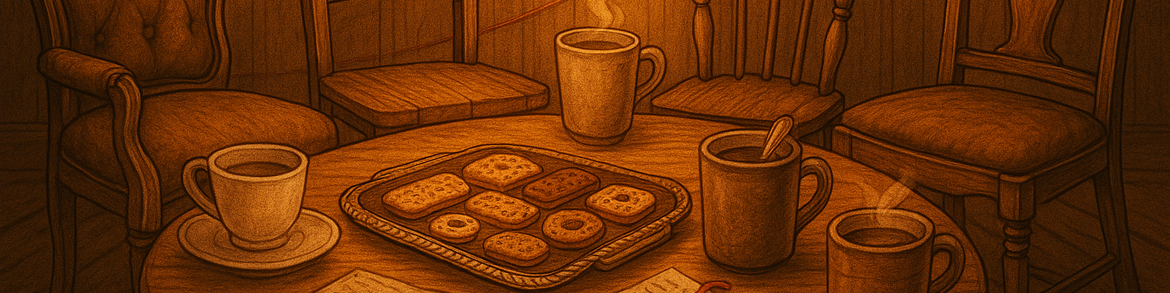
At first glance, Room 3B is only untidy. Stacks of journals lean but never collapse. Chipped mugs circulate endlessly, never washed but never missing. The kettle hums in the corner, always warm, always ready. Biscuits resolve disputes more effectively than logic. To the Club, it is perfectly ordered chaos: everything in reach, everything remembered.
But ordinary comforts here do not behave. Conversations last longer than the clock allows. Candles flicker backwards before correcting themselves. The fourth chair alters shape depending on who dares to sit, as though judging their claim to it. And the window—inevitably, insistently—overlooks Dave.
It feels safe in the way only something complicit can.
The Stringboard That Outgrew Its Wall
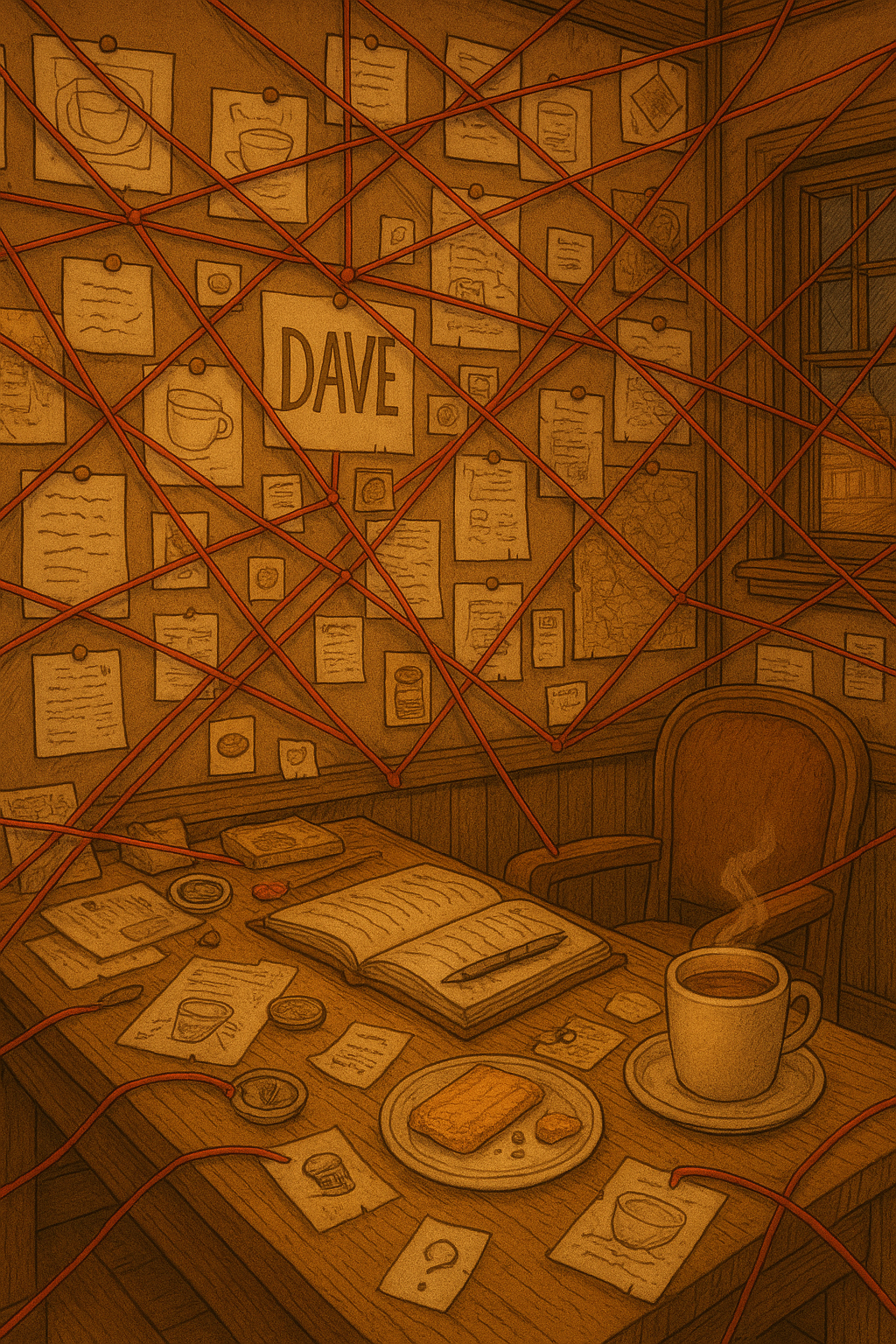
What began as a corkboard metastasised across plaster and beams until the chamber resembles six-dimensional chess played by someone who refuses to explain the rules. Strings knot ceiling to floor, each colour belonging to a member.
Rules exist, muttered with conviction:
- Never cross another’s line without a pin.
- Never tug the black thread.
- Never touch Event D-Redact/7a.
- If you lose yourself in the weave, someone will fetch you back—with tea and Garibaldis.
To insiders, it is perfect order. To me, it is obsession disguised as research. A parody of structure. Yet the Inn has not pruned it back. In fact, the beams and plaster seem almost eager to give the threads more surface. The room is indulging them. Perhaps guiding them.
What the Strings Might Be Saying
The Club insists their notes are harmless: pint-foam geometry, soup temperatures, nod counts. I disagree. The weave has grown too intricate, too deliberate, to remain hobby. It echoes the Inn’s own architecture—recursive, entangling, quietly intentional.
If it ever resolves, it will not be about them. It will be about Dave. Why he sits. Why he persists. Why the Inn has made room for him. I do not know what truth waits in that lattice—only that it will not be a comfortable one, and that the Inn seems content to let them approach it.
The room itself may be the experiment. The conspiracy may not be Dave at all.
Why the Inn Tolerates This
The Last Home could erase the chamber with a gesture. It has not. That is not sentiment. It is containment. Better to let obsession pile neatly in one room than scatter across the taproom like spores.
The Inn has preserved stranger things before: shrines to forgotten gods, conversations that never happened, doors that lead only to themselves. Sometimes it grants space to what is important. Sometimes to what is amusing. Sometimes to what struck its passing interest, or to an emotion strong enough to echo. And sometimes—most troubling of all—it preserves something purely to see what others will make of it.
Which of these applies to Room 3B remains unclear. That is what unsettles me. A chamber this ordinary should have been allowed to fade. Instead, it endures, because the Inn has decided it should. And when the Inn preserves something without explanation, it is rarely for reasons anyone wishes to discover.
Final Thought
Room 3B is eccentric only to those who have never spent too long in archives. Tea, paper, and clutter can look like comfort—but I recognise it for what it is: a filing drawer forced too full, straining at the handle.
If the Inn remembers to keep a room this unremarkable, it is not because it is harmless. It is because it serves a function. Whether that steadies the Pattern or cages it, I cannot yet say. Only that its persistence is deliberate, and that should be warning enough.
At A Glance
What It Is
Once a modest guest chamber, now the headquarters of the Conspiracy Club. A study that insists on being ordinary: journals stacked like barricades, a kettle that never cools, and a window that never looks anywhere but Dave.
What It Looks Like
A professor’s office left too long in the corner. Piles of notes everywhere, yet nothing is lost. Mismatched chairs stand about a table, tea and biscuits are in endless supply, and the wall of red string has long since outgrown its boundaries.
What It Does
The room contains obsession, or perhaps cultivates it. Conversations stretch past their natural length, candles burn the wrong way before correcting themselves, and the fourth chair alters subtly under scrutiny. Time behaves politely, but not honestly.
Why It Matters
The Inn has chosen to keep it. That alone makes it suspect. Whether safeguard, experiment, or jest, its survival is deliberate.
Current Consensus
The Club calls it their study. The Maids call it a problem. I call it a conspiracy disguised as décor.
Author’s Note
I’ve always had a thing for conspiracy stories — X-Files, SCP, all that strange casefile energy. Room 3B is me playing with that vibe: clutter, string, tea and biscuits, but with the quiet dread that maybe the ordinary is the most dangerous thing in the Inn.
Additional Details
“Your continued reading is more valuable than coin. However, the author assures me that Ko-Fi support assists in ‘keeping the kettle on.’ I am told this is a metaphor. I remain unconvinced.” — Seraphis Nightvale Ko-Fi: #madmooncrow


Comments