
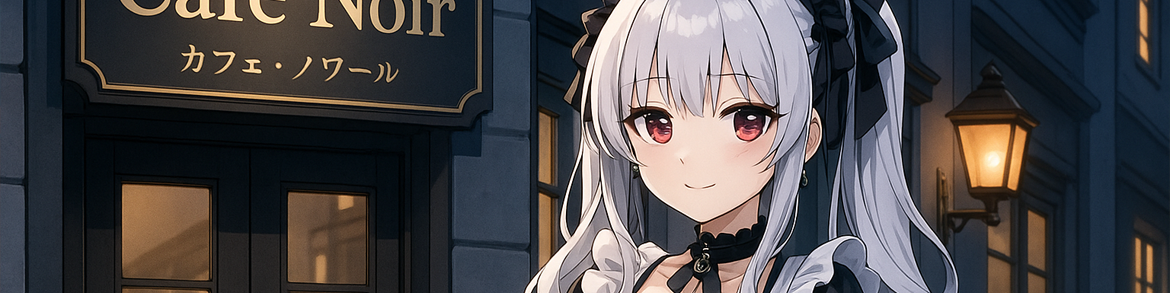
Café Noir
“Politeness is its uniform. Precision is its native tongue. Do mind both.”
Café Noir does not announce itself loudly. It never needed to.
On the quieter edge of Hoshizora’s main thoroughfare—just beyond the glitter and noise, where lanternlight sharpens the edges of the street—the café waits behind a façade of immaculate restraint. A black lacquered sign crowns the doorway, its gold characters glinting with an elegance sharp enough to serve as a warning. Beneath it, the windows glow with a warm, steady light: the promise of order, tea, and a calm the rest of the ward abandoned hours ago.
Inside, Café Noir feels like a memory borrowed from a more civilised century of Velvet Nocturne.
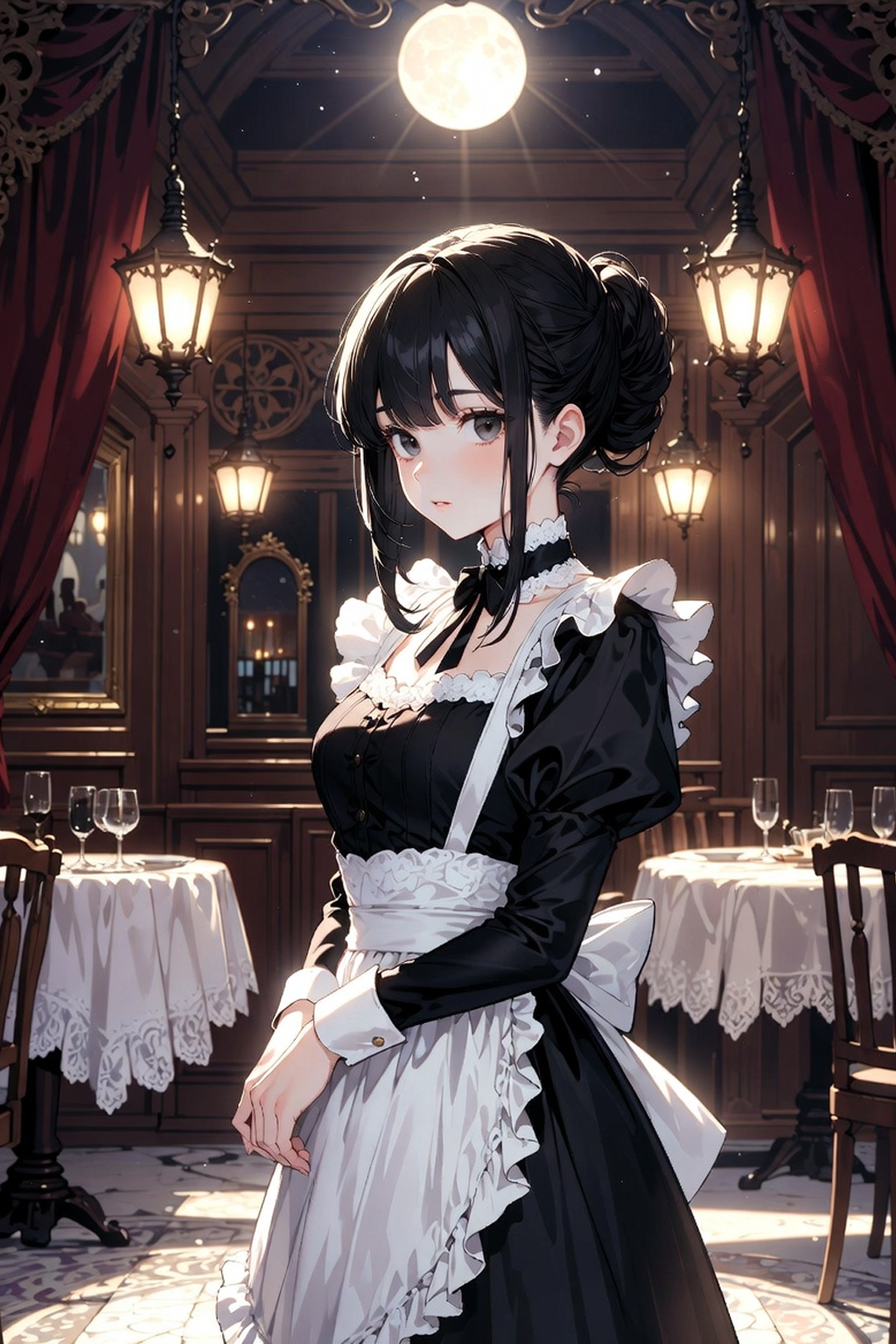
Dark polished wood curves into high arches. Velvet curtains fall with military precision. Lace tablecloths soften the edges of an otherwise disciplined room. Nothing is loud here. Nothing is careless. Nothing is allowed to be.
Patrons speak softly. Chairs glide instead of scrape. Even laughter behaves itself.
And beneath all that tranquillity lies steel—unspoken, unseen, but unmistakably present. Noir does not attract trouble.
It simply uninvites it.
Tea, Lace, and the Discipline of Soft Voices
By day, Café Noir could be mistaken for an old-world tea house of lace and darkwood discipline, the sort carved from Velvet Nocturne’s gentler centuries—refined, ritualised, and shaped by tradition rather than fashion.
The maids move with a precision that borders on choreography.
Uniforms are crisp monochrome, aprons pressed flat, bows tied with geometric perfection. Every motion—pouring tea, adjusting cutlery, setting down a tray—flows without interruption or wasted gesture.
There is no energetic chorus of greetings here.
No exaggerated playfulness.
No theatrics.
Guests are welcomed instead with a silent bow and a perfectly measured smile, subtle enough to register only once you have already returned it.
Tea is served with quiet ceremony from polished service, each gesture deliberate.
Pastries arrive in modest slices—never excessive, always intentional.
Compliments are delivered like folded origami: structured, elegant, and only recognised for what they were once you’ve taken a sip.
Regular patrons swear the place feels like “stepping into a gentler world that knows exactly how sharp the real one can be.”
They are not wrong.
Nor are they imagining the sense of watchfulness embedded in the walls.
Velvet in Shadow, Steel in Motion
When the shutters lower and the last teacup is dried, Café Noir shifts—not into something wild or chaotic, but into its truest form.
The quiet becomes deliberate.
The symmetry becomes doctrine.
The air holds its breath.
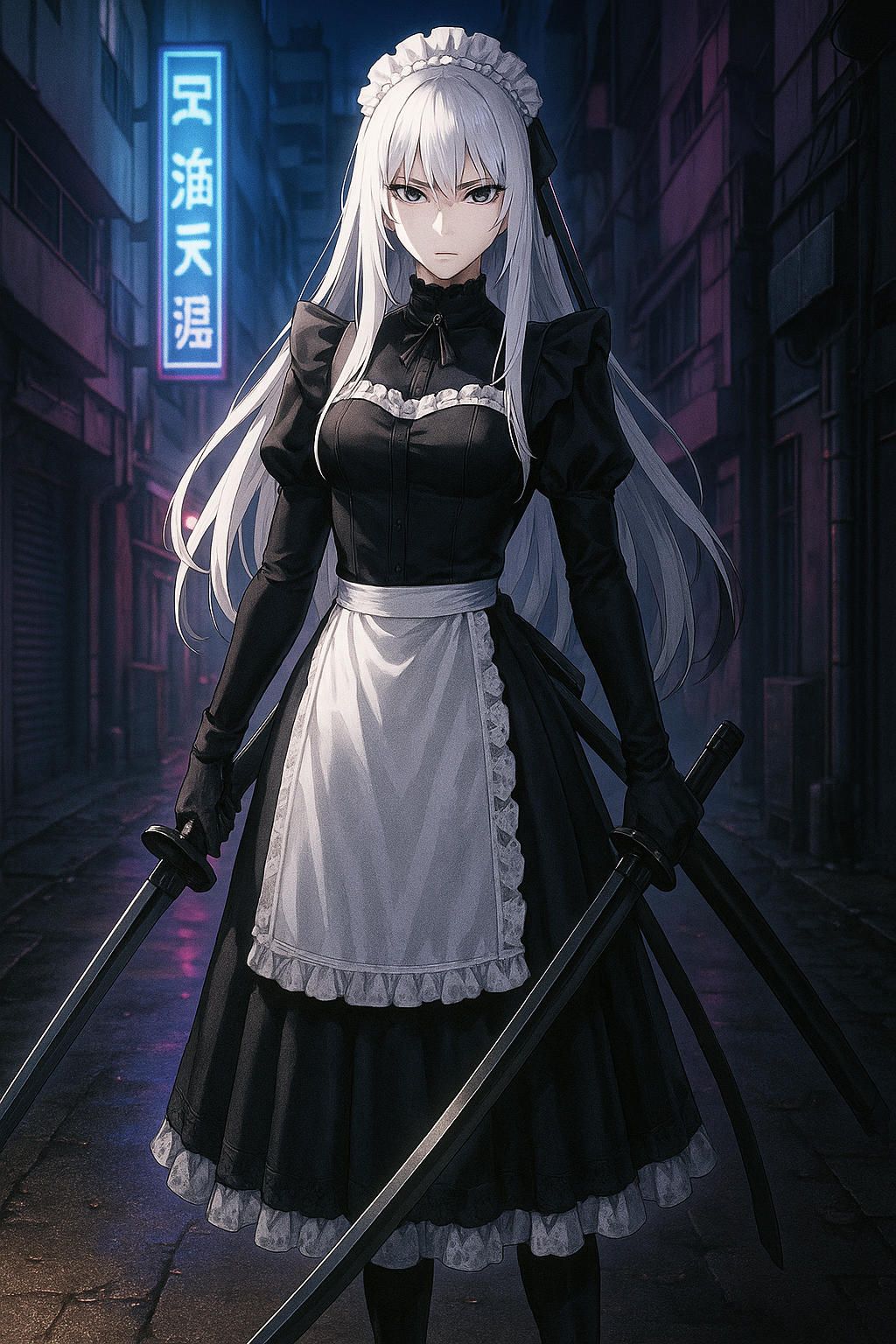
And the maids, still immaculate and perfectly composed, step into the backstreets with the same aesthetic grace they used to pour tea—only now accompanied by cold, unquestionable purpose.
Their footfalls are soft.
Their presence is not.
In the alleys and service lanes of Hoshizora, Noir’s maids move like a whispered verdict. Their combat is elegant, efficient, and devastating—the kind of brutality that looks almost choreographed, where a gloved hand redirects a strike with minimal effort and a blade, when drawn, interrupts an argument so thoroughly that the night forgets it ever happened.
They do not hunt.
They correct.
They do not threaten.
They remove the possibility.
Trouble that crosses Noir once rarely repeats the mistake.
Trouble that tries twice does not try a third time.
The ward tells the stories. Noir does not.
The silence is agreement.
They protect their patrons, their neighbourhood, and the fragile boundary between civility and chaos. And they do it without spectacle—no raised voices, no messy conclusions, only outcomes so tidy that officials later describe them as “routine disturbances with no reported injuries.”
Everyone in Hoshizora knows better.
Nobody says so.
Shirogane of the Velvet Steel
Shirogane—never Miss, never Madam, never Lady. Simply Shirogane, spoken with the careful respect reserved for cold steel still resting in its sheath.
She appears as a woman in her late thirties, though the ward quietly agrees this is a polite fiction. Her hair falls in a perfect hime cut of winter-white silk, the colour of untouched snow beneath starlight. Her eyes—dark, steady, without visible end—make even seasoned troublemakers adjust their posture before they consciously realise why.
Shirogane does not command Café Noir; she is Café Noir.
Every gesture, every measured breath, every unbroken line of her silhouette reflects the café’s doctrine of elegance as expectation. She moves like an unanswered question, one that invites honesty simply to avoid the alternative.
Rivals bow to her without instruction. Mascots incline their heads as she passes. Even lanternfire softens in her presence, as though understanding that illumination, here, is a privilege.
The ward whispers about her blades—two of them, carried with the same unspoken promise. The shorter, keen-edged blade resolves most disputes with decisive finality. The longer blade, the nodachi of whispered reputation, appears only when the night grows ambitious or foolish. On those occasions, alleys have required resurfacing and rooftops have remembered their structural priorities.
Shirogane never acknowledges these stories. She does not need to.
Silence is heavier than denial.
Her authority is never barked or brandished.
It is woven into the air around her—in the slight incline of her chin, in the precise stillness of her hands, in the calm that follows as faithfully as a trained shadow. People correct their behaviour around Shirogane not to avoid punishment, but to avoid disappointing her, which is somehow far worse.
Hoshizora’s nights are safer because Shirogane exists.
Café Noir endures because she wills it to.
And all who cross its threshold—trembling, curious, or merely weary—step under the unspoken protection of a woman who has never needed to raise her voice to be obeyed.
Closing Thoughts
Café Noir is not merely a maid café.
It is an institution built on elegance, discipline, and the careful understanding that serenity survives only when someone is willing to defend it with quiet ferocity.
Visitors come seeking calm, refinement, and a corner of the ward where the world behaves itself.
They stay because the room insists on it.
They return because Café Noir remembers them—and remembers who would dare trouble them.
It is a sanctuary.
It is a warning.
It is a promise.
And it never needs to raise its voice.
At a Glance
For patrons seeking refinement, criminals seeking regret, and anyone who thinks “maid café” means soft edges
What This Place Is
Café Noir is Hoshizora’s most disciplined maid café: an old-world tea house resurrected with obsessive care, then sharpened until even its politeness becomes a form of judgement. Lace softens the room. Nothing else does.
Why People Come
Elegance, stillness, and the peculiar comfort of being served by someone who could dismantle a street gang before your tea cools. Regulars swear the calm is therapeutic. Outsiders mistake it for safety.
Who Holds Power
Shirogane, the winter at the café’s centre. Hair like snowfall, eyes like coal, blades like punctuation. She rules by expectation rather than volume, which is why even the mascots incline politely when she walks past.
Daytime Behaviour
The maids serve tea, pastries, and correction through posture alone. Conversations lower, backs straighten, and no one dares clatter a teaspoon. Manners are observed because the alternative feels unwise.
Nighttime Behaviour
Noir’s doors close; the ward opens. The maids step into the alleys with the same grace they use to pour tea, only now accompanied by steel. Conflicts end quietly. Problems are relocated. Criminals learn geometry.
Why You Should Be Polite
Because if you have ever taken a seat at Noir, the staff consider you under their protection. Harm to a Noir patron is corrected swiftly, elegantly, and with the kind of precision that makes later explanations inconvenient.
Unspoken Etiquette
Do not raise your voice.
Do not slouch.
Do not flirt unless invited.
And if Shirogane smiles at you, stand straighter. It is safer that way.
If You’re Lucky
You will leave with excellent tea, improved posture, and the faint suspicion that someone followed you home purely to ensure your evening remained uneventful. This is Noir’s version of affection.
Additional Details
“Your continued reading is more valuable than coin. However, the author assures me that Ko-Fi support assists in ‘keeping the kettle on.’ I am told this is a metaphor. I remain unconvinced.” — Seraphis Nightvale Ko-Fi: #madmooncrow


Comments