
Thornjack
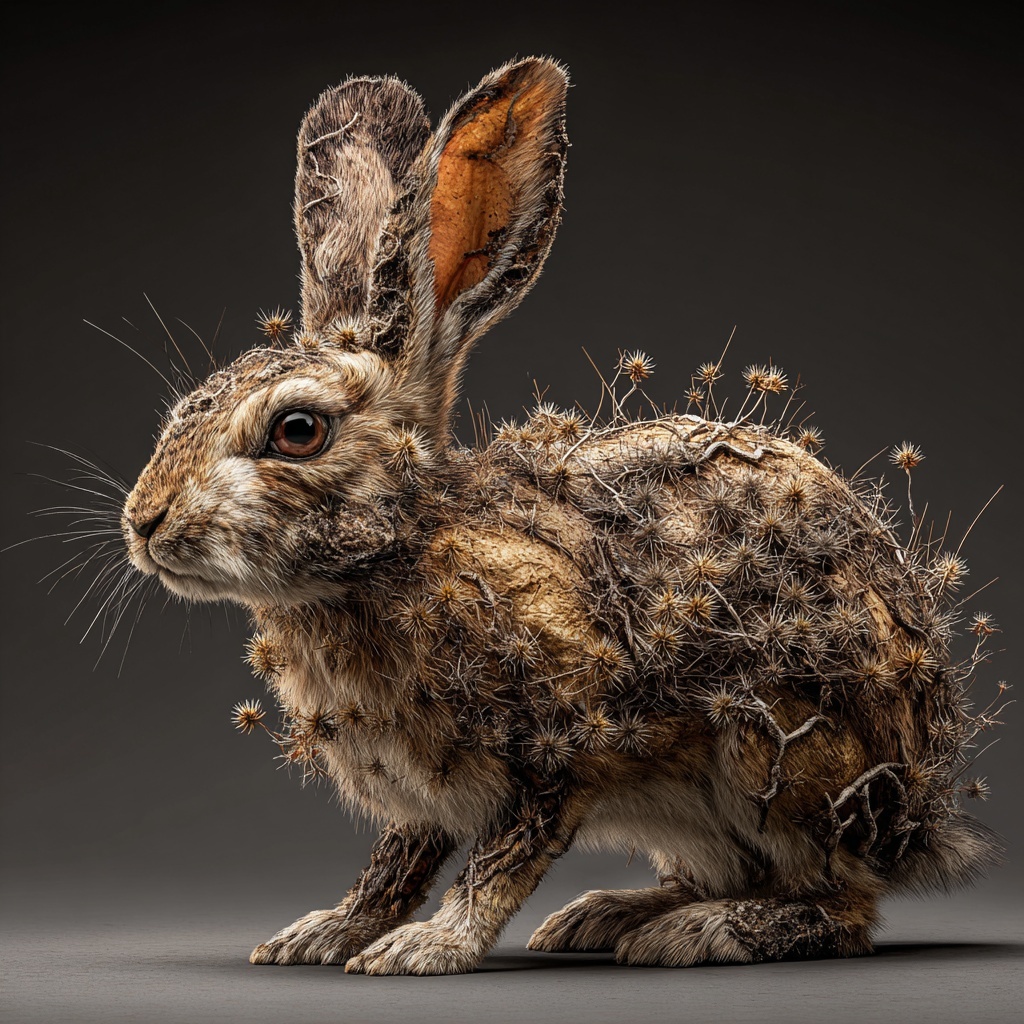
The Thornjack, Lepus spinosus, is identified by its desert heritage and the adaptation of its soft fur becoming a living, defensive arsenal. The remarkable spinal modifications have turned this creature into a walking cactus garden of thistles, brambles, thorns, and tumbleweed. Thornjacks are considered one of the Verdancy's most successful mammalian adaptations, where plant and animal biology have achieved an almost perfect symbiosis. What appears to be fur at first glance reveals itself as a complex ecosystem of modified hair folicles that have evolved to host specialized Verdant-affected organisms. Each spine in its fur functions as both self-defence and a cultivation system through hollow cores that channel nutrients between the desert cottontail's metabolism and its botanical passengers.
The Thornjack's ears remain recognizably lagomorphic but show subtle Verdant influence through their orange-rust colouration, suggesting the presence of carotenoid compounds that enhance hearing while providing chemical defence against predators. The spines themselves vary in density and size across the body, creating a natural armour that protects its vital organs, while allowing for the flexibility needed for the creature's characteristic bursts of speed.
Remarkably, it has retained its essential cottontail nature, despite these drastic modifications. It moves with the quick, nervous energy of its ancestors, feeds primarily on desert vegetation, and still reproduces through traditional mammalian means. However, its young are born with soft proto-spines that harden and develop their botanical symbionts only after several weeks of nursing—a complex maturation process that bridges purely animal and hybrid plant-animal development.
The Thornjack serves as both prey and predator in the evolved desert ecosystem, its spines capable of injecting mild toxins, while its speed and intelligence allow it to evade larger threats. For the Saltfolk, it is both wondrous and weary, as it is living proof that adaptation and survival are possible in the Verdant world, but also a reminder that the line between natural and unnatural grows thinner with each passing season.

Comments