
Stone Moss
The Stone Moss, Lithophagus persistens, has learned to digest granite. This organism spreads across alpine cliff faces in patterns that follow mineral veins, breaking down stone into digestible compounds while creating handholds and crevices that seem almost deliberately placed. It secretes a mild psychoactive compound through its surface, causing climbers to experience a false sense of security and confidence that leads them to take increasingly dangerous risks. Those who spend too long in contact with the moss find their own bones beginning to soften, calcium being leached away to feed the hungry lichen. It often dissolves rock ledges or cliff faces that seem stable, but once the moss has eaten away at the underlying structure, they collapse—sending humans to their death to be consumed by the lichen to provide essential nutrients, water, and minerals.
Basic Information
Anatomy
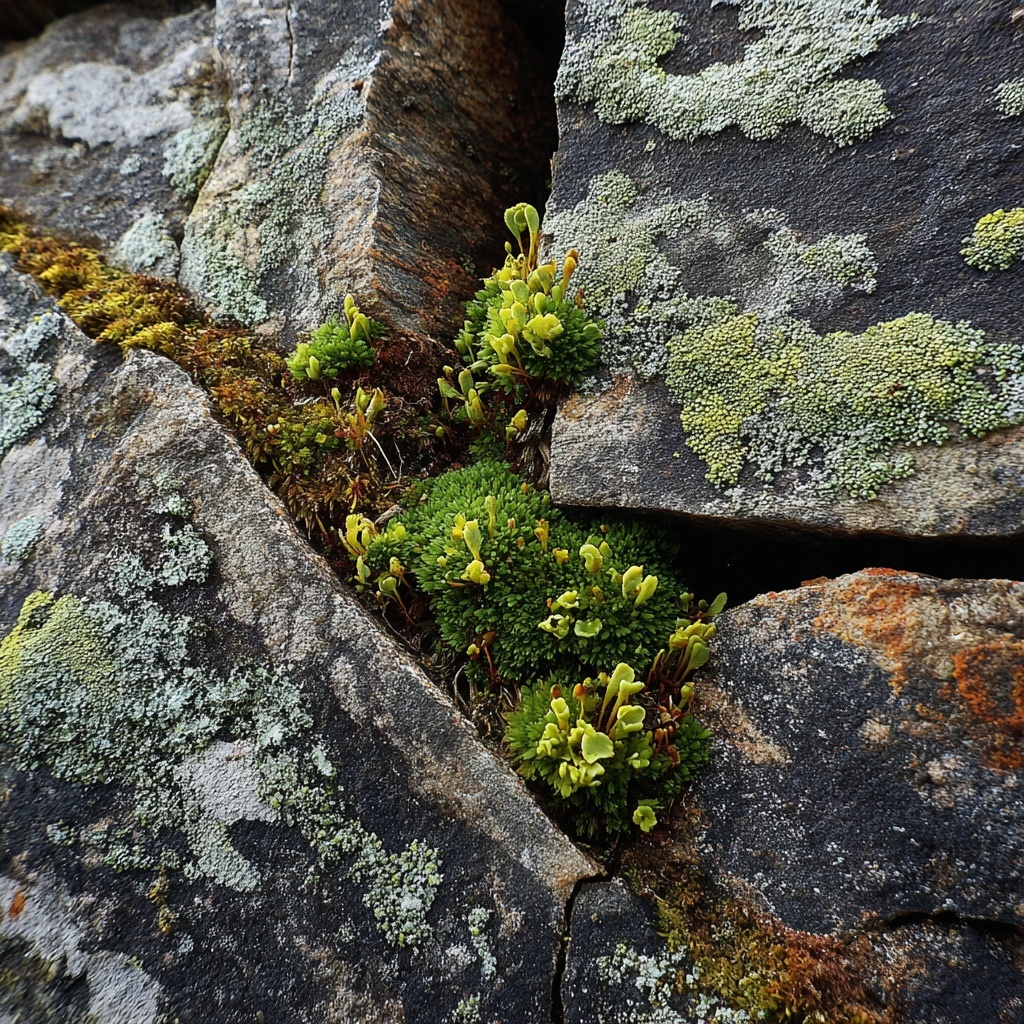
The organism displays its characteristic deceptive beauty that has proven so dangerous to mountain travellers. It spreads across granite crevices in dense, cushion-like formations that pulse with an almost alien vitality. Each cluster appears as a perfect emerald dome, its surface composed of thousands of tiny, scale-like leaves that overlap in intricate patterns resembling delicate chain mail. The moss exhibits a luminous quality that emanates from within, as if lit by some form of internal phosphorescence, though its glow becomes more pronounced in low-light conditions when the organism becomes most active.
The plant's structure follows the natural fissures and mineral veins in rock faces with unsettling precision, its growth patterns too geometric to be entirely natural. Stone moss forms distinct colonies of varying sizes, from small patches that are no larger than a human palm, to sprawling networks that can span several metres of cliff face. Each colony maintains perfectly circular or oval boundaries, creating the illusion of separate organisms, while secretly combining in a sprawling, underground network connected by thin filaments that bore through stone.
The brightest, most vibrant green sections on the moss are areas where the organism has successfully broken down granite into digestible materials, while slightly yellower patches show where the moss is still actively secreting its stone-dissolving enzymes, indicative of its feeding patterns. Occasional reddish-brown streaks appear where the moss has encountered iron deposits, creating veining that mimics the natural oxidation patterns found in mountain stone.
The moss' texture could be described as disturbing, as it often appears soft and inviting, despite its stone-eating nature. The surface looks cushioned and yielding, like the kind of verdant alpine moss that Old World hikers once used as natural bedding. This tactile deception forms part of the organism's predatory strategy, encouraging physical contact that allows it to begin its insidious calcium-leaching process through direct skin contact.
The colonies of stone moss position themselves strategically within the rock crevices, creating what appear to be natural handholds and footholds for climbers. The spacing between growth seems almost deliberately planned to encourage human traversal, with gaps just wide enough for gloved fingers or boot tips. This coincidence is the result of millions of years of accelerated evolution that has been compressed into mere decades, as the Verdancy has learned to anticipate and exploit human climbing patterns.
Under closer observation, the moss exhibits subtle movement that betrays its predatory nature. The individual leaf-like scales flutter almost imperceptible in patterns that don't seem to match the ambient wind currents, and experienced mountaineers have reported that the moss seems to orient itself forward toward approaching climbers in a means so slowly that it is barely perceptible to human senses.
The organism's most insidious feature is invisible—the psychoactive compound it secretes. These chemicals create a subtle dew-like secretion on active colonies that seeps into human skin, making it difficult for climbers to maintain appropriate caution.

Comments