
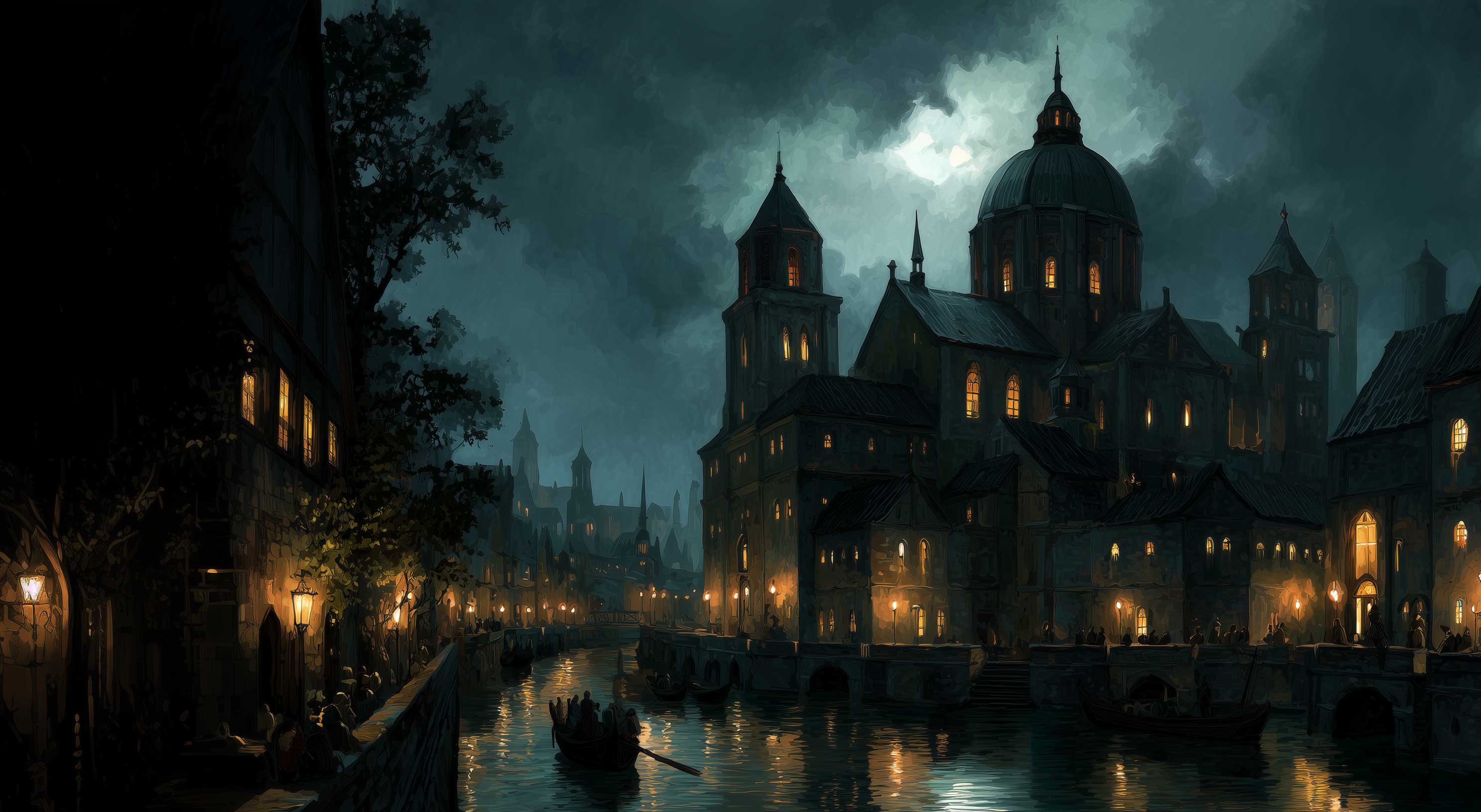
Basilica dei Santi Maria e Donato
“Beauty is devotion. Music is prayer. And blood… is communion.”
The Basilica dei Santi Maria e Donato is one of the oldest and most revered churches in Venice. A jewel of the Venetian-Byzantine era, it stands in quiet majesty on the island of Murano, famed for its glassmakers and cloistered secrets. Its glittering mosaics, serpentine columns, and relics of saints conceal a darker truth—the church is not merely a place of worship, but the domain of a vampire.
The Basilica is under the rule of Vittoria Visconti, a Toreador of chilling charm and haunting beauty. Embraced before her mortal bloom faded, she appears eternally 13, her cherubic features a grotesque contrast to the ancient cunning behind her eyes. Her Sire—long absent—was a Venetian maestro and priest of considerable power who ensured Vittoria would never lack inspiration.
She spends her unlife composing liturgical music, some of it so sublime and dissonant that it drives mortal choirs to weep or fall into religious frenzy. Her custom-built pipe organ, a monstrous instrument of carved glass and gilded wood, dominates the apse. It is said to produce tones audible to angels—and things older still.
Her relationship with Doge-Prince Contessa Elisabetta Moceniga della Notte is unusually warm for a court known for intrigue and betrayal. Vittoria has performed at many of the Prince’s masked gatherings and midnight salons, and her compositions are favored at court. Elisabetta is said to have commissioned a private motet from Vittoria each winter solstice—pieces so moving they make the shadows in the Prince’s throne room weep.
Art and Architecture
The Basilica, as reimagined under Vittoria’s quiet rule, is a breathing gallery of obsessive beauty. Every surface is touched with human artistry—some of it mortal, much of it subtly guided or inspired by her undead sensibilities.
Mosaics
The original 1140 mosaic floor of interwoven animals and geometric patterns is one of Venice’s greatest treasures. But look longer and you’ll find additions—barely perceptible at first: gold tesserae that form arcane sigils, tiny inlaid eyes that follow the devout, spirals that pulse under moonlight.
Above the altar, a vaulted apse glows with new mosaic work—angels with sharpened wings, Madonna figures whose faces look suspiciously like Vittoria’s own. These are rumored to have been commissioned directly from fallen monks and excommunicated artists, whose souls now rest uneasily in her crypt.
The Organ
The great glass-and-gold organ, built at the behest of her Sire, towers like a frozen wave above the choir. Its pipes, formed of Murano glass, capture candlelight and moonlight alike, refracting both in eerie, sacred hues. Some say its sound has the power to still tormented souls—or call them forth. The bass registers resonate beneath the floor, and during nocturnes played by Vittoria herself, the very walls seem to breathe with the tempo.
Frescoes and Sculptures
The walls are covered in commissioned frescoes that show scenes of martyrdom and celestial ascension, some following canonical scripture, others… less so. One large panel shows a bloodied cherub offering its heart to a veiled woman—interpreted by some as a tribute to Elisabetta, by others as self-portraiture.
The nave is lined with statues of saints and sibyls, many subtly modeled after deceased composers, lovers, or former patrons of Vittoria. At night, they seem to change position slightly—as if listening for music.
The Dragon’s Remains
Behind the altar, beneath a glass reliquary, lie the alleged bones of a dragon slain by Saint Donatus. Vittoria has them illuminated with deep crimson lanterns, and sometimes plays the organ directly before them, whispering Latin invocations between notes. No scholar dares examine the bones too closely anymore.
The Orphanage and Herd
Attached to the monastery is the Orfanotrofio di Santa Lucia, a cloistered orphanage of about 40 children. Here, the head nun—Madre Benedetta—serves as both protector and procurer. Enchanted by Vittoria’s “divine innocence,” she ensures the children are healthy, well-fed, and obedient.
Vittoria feeds from them selectively, never enough to harm them. The children view her as a mysterious benefactor and holy presence—some whisper that she’s an angel, others a saint, still others a witch who appears in their dreams.
Religious Status
Though technically under the authority of the local bishop, no mortal authority dares meddle too deeply. The music that issues from the church is considered divine, and wealthy patrons donate heavily to support Vittoria’s “monastic art program.”


Comments