

Mazelstead
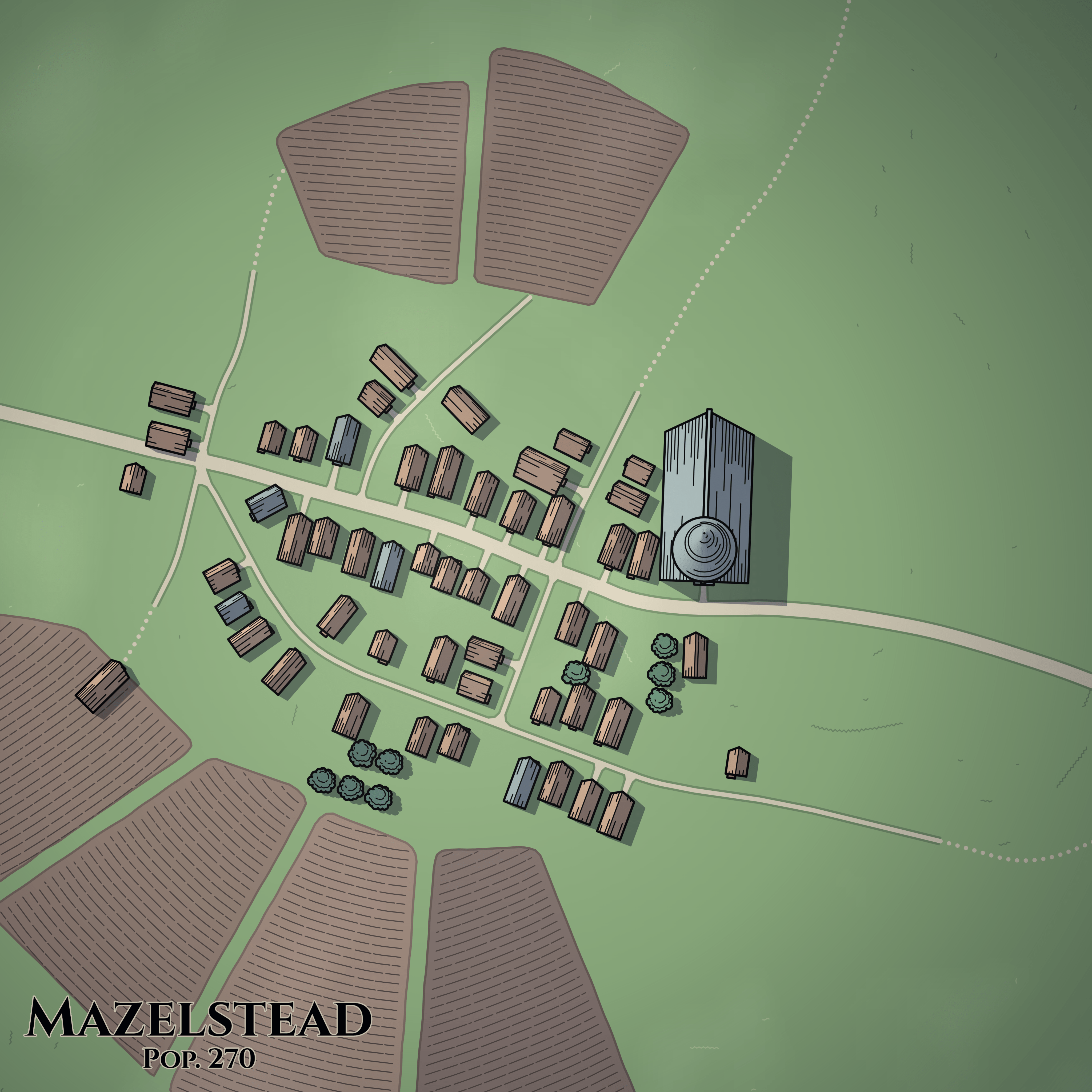
Mazelstead, a human settlement under Lavonia’s control, survives amidst its vast, open fields, where the landscape stretches unbroken by trees or fences, dominated by two large farming fields to the north and four to the south before hitting the river. The village boasts about 55 buildings, including a grand stone church that serves as the heart of the community, its towering spire visible across the plains, offering spiritual solace and a gathering place for the faithful.
The infrastructure is rugged yet functional, with a network of packed dirt roads connecting the modest homes—constructed of wattle and daub with thatched roofs—featuring a single general store stocked with basic goods like flour, salted fish, and Lavonian embroidery thread. A sturdy grain mill, powered by a small stream diverted from the south fields, stands as a key asset, equipped with a heavy millstone and wooden gears to process the village’s wheat and barley harvests.
Farmers rely on a communal barn housing plows, harrows, and sets of oxen, while a blacksmith’s forge, though small, provides essential tools like sickles and horseshoes. This leper colony, isolated far from the main road and accessible only through a dense forest trail or by navigating upstream along the river, maintains a separate stockpile of basic supplies—crude bandages, herbal poultices, and a small team of carts—tended by a lone caretaker, its isolation ensuring the village’s health but limiting its resources.
Mazelstead rarely has visitors, let alone travelers, who stay for too long or risk spreading the sickness. Those who do visit are required to remain in their designated ward or become permanent guests to the town.
Demographics
Mazelstead’s population of about 270 is exclusively human, a resilient Lavonian community marked by light to medium tan skin, practical braids, and a stoic endurance shaped by their unique plight as a leper colony. The majority are afflicted with leprosy where they labor in the fields despite their condition, supported by the others who serve as caregivers, herbalists, and clergy within the village’s buildings, including the large stone church that doubles as a sanctuary and infirmary. The remaining include children born to the afflicted and a few unaffected elders, all bound by a shared struggle. The village itself is the leper colony, its open, isolation from the main roads protects others from spreading the disease, yet the community fosters a tight-knit society where survival depends on mutual care. Their plight is dire: the leprosy, unknown introduction decades ago, has left many with disfigured limbs and weakened bodies, relying on scarce herbal poultices and the church’s blessings for relief. Some even suggest the disease is spiritual and enough repenting from sins in various rituals will cure one of the sickness.
Infrastructure
Focused on practical farming tools (mill, plows), a marketplace for trade, and minimal but sufficient equipment, reflecting the village’s agricultural focus and human-only population. The leper colony’s isolation adds a unique challenge, with limited assets to emphasize its separation.
Leper Colony Warning
Leprosy is a dreaded disease that seems to rot away the flesh. Exposure comes from direct contact with lepers. As such, Lepers are usually required to wear special cloaks and bells to alert others of their presence. On contact with someone who is infected, the PC must make a private saving throw versus poison + CON mod + 1 to the DM. If failed, for every three months infected, the PC will have to make a saving throw for each physical stat (STR, DEX, CON) plus CHA. For each one he fails he will lose 2 points in that ability score as his body rots away. Leprosy is considered FATAL and there is no end to the intervals requiring saving throws; characters just continue to gradually or rapidly deteriorate until they die.
Type
Village
Location under
