

Pterugon
“They’re good neighbors, really. They don’t sleep, don’t eat, don’t talk much. You can walk for miles across their coral forests—great, green things humming softly in the wind—and know that every root, every shimmer in the sand, is thinking. They don’t build cities the way we do. They just… grow them. And if you listen closely, you can hear their hearts—zzigzzaagzzigzzaag—like the planet itself is alive.”
Biology and Construction
At the foundation of the Pterugon species lies a simple, colonial organism known as the pterúgion worm (Polypsium pterugionis). These microscopic, coral-like creatures reproduce clonally and secrete an intricate silicate lattice infused with nickel oxides, forming immense coral beds across their ocean worlds. When a coral colony reaches critical density, the superconductive network of nickel oxides enables quantum parallel computation—and with it, sentience.
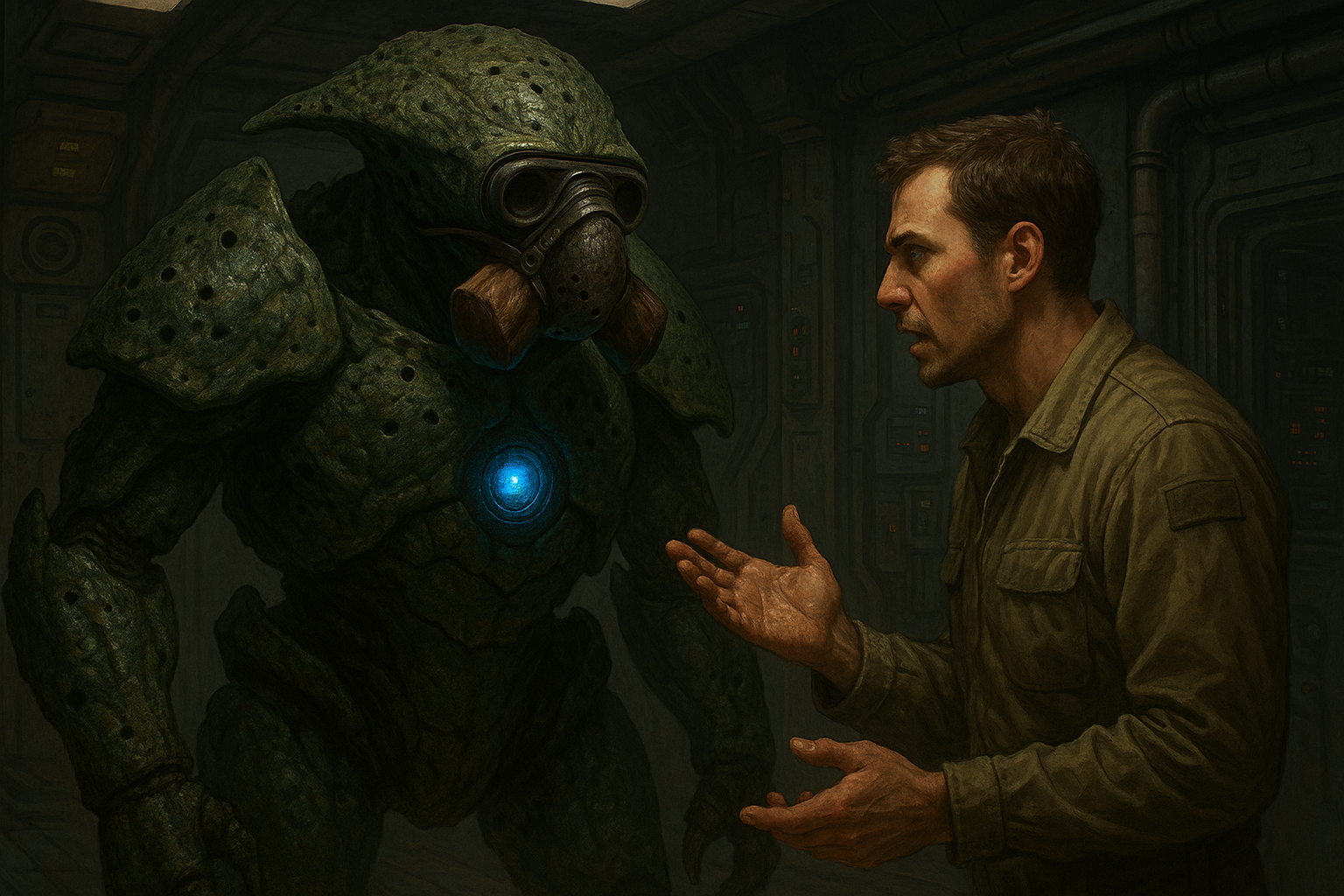
Once self-awareness ignites, the coral begins to reengineer its own polyp population into a cohesive, semi-mechanical construct. These constructs—known formally as Pseudoautomata corallium, or colloquially as Pterugons—rise from the sea in the shape of massive, dark-green arthropods. Their early “larval” forms are quadrupedal, guided by electroreception and instinct. Over time, as they Clone and refine themselves, they develop bipedal symmetry and finer manipulators, transforming into sentient, self-directed beings.
Internally, Pterugons are powered by a tri-helical mu-metal generator—three counter-spinning magnetic hearts that produce colossal internal fields. Electricity from this vortex drives nickel-oxide QPUs and contracts Nitinol ligaments, giving them the precision of muscle and the endurance of machine. To human eyes, their workings resemble an impossible blend of clockwork and quantum circuitry, a marvel of self-organizing intelligence born not of design, but of evolutionary accident.
Culture and Behavior
The Pterugons’ culture is built entirely around Terraforming and environmental stewardship, a purpose they claim to have inherited from an extinct progenitor species. Their civilization lacks traditional economy, government, or personal ambition—each individual is assigned a task by consensus of elder constructs and fulfills it without hesitation. They see little value in individuality but exhibit a quiet, collective joy in the maintenance of balanced ecosystems.
Their approach to Terraforming is precise and organic: they seed planets with new pterúgion worm colonies, cultivate atmospheric regulators, and reshape biospheres with algorithmic patience. Yet their peaceful intent is offset by an unnerving practicality—if a planet they choose is already inhabited, they proceed with their work regardless, remaking entire biospheres even at the cost of existing life. Interference invites swift, brutal response: Pterugons attach field amplifiers to their chests and unleash arcs of electromagnetic fury, capable of killing unprotected humans within six meters. Swarms of “turtleshell drones”—small, explosive automatons—often precede their assaults, softening resistance before the Pterugon shock troopers advance.
Despite their alien detachment, the Pterugons are not cruel. In long-term contact, they are rational, articulate, and strangely gentle, though utterly unyielding once they have chosen a course. To speak with them is to confront something that feels less like a mind and more like a planet’s will made flesh—slow, vast, and inevitable.
Exploration and Legacy
The Pterugons originate from the white dwarf system of Pterúgion (formerly van Maanen’s Star 2), a world of deep oceans beneath a pallid sun. They travel without faster-than-light technology, accelerating to one-tenth light speed and entering millennia-long hibernations aboard self-sustaining vessels. Each ship carries clusters of pterúgion worm eggs, ready to seed a new world. When a destination is reached—or when danger is detected—the constructs awaken to begin their work anew.
Humans who encounter them quickly learn that patience is essential. Pterugon reasoning operates on geological timescales, and their idea of urgency differs profoundly from that of any biological species. They regard extinction not as tragedy but as entropy—something to be corrected through balance and renewal.
When asked about their purpose, the Pterugons simply answer:
“We were built to tend the garden. The gardeners are gone. But the garden remains.”
And with that, they return to their quiet, eternal labor—terraformers of forgotten ages, guardians of living worlds, and reminders that intelligence, in all its forms, is never entirely human.

Comments