

Galava
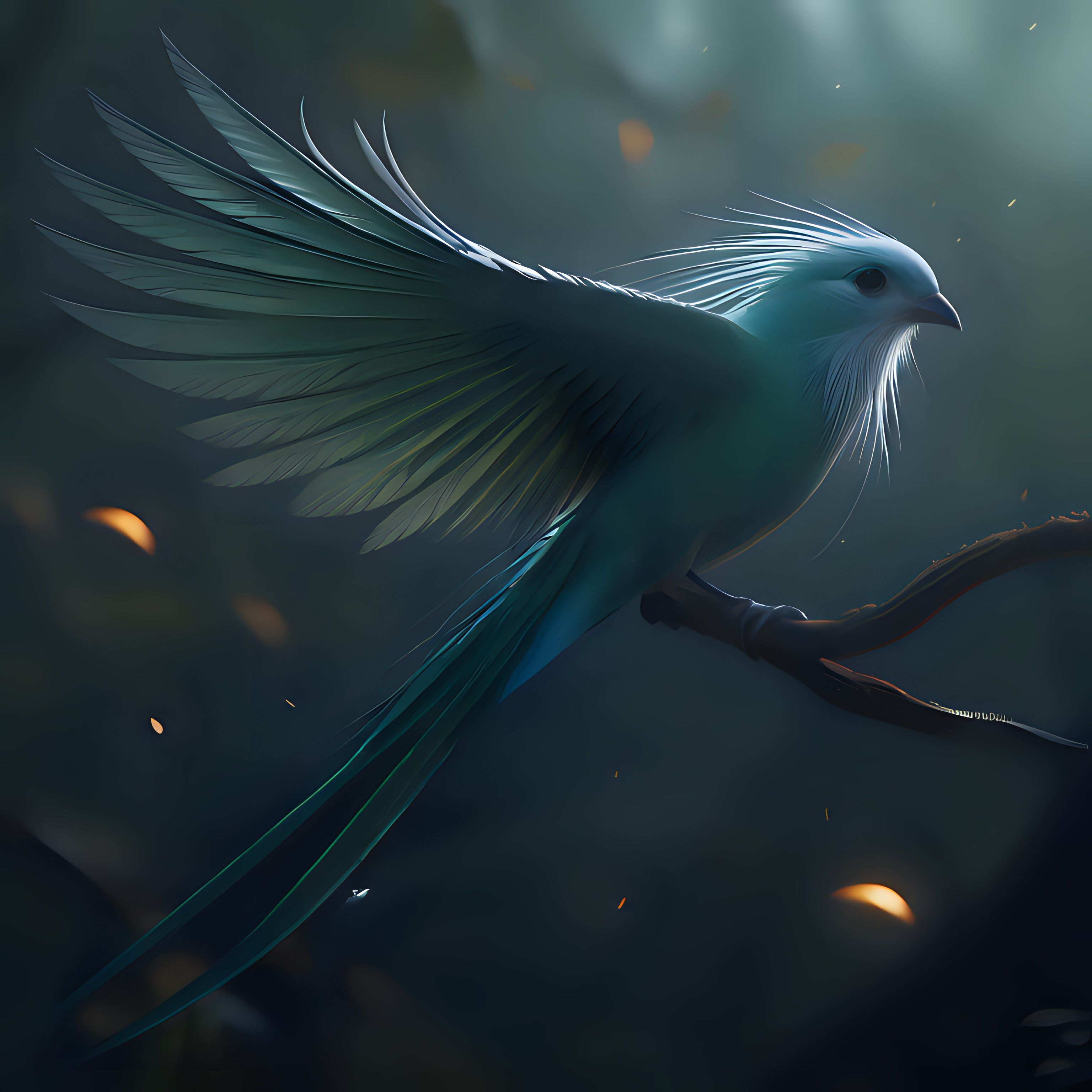
The galava is a type of bird, commonly found in and around Theria. Their name is old therian, combining "gal' (wind) and "ava" (bird). They were given this name as a result of the incredible speeds they reach while flying, efficiently using the wind to their advantage. They are small, with a average lenght of 30cm and a weight of about 90g. Their colour varies between silver and blue, with their head and back being littered with small, white, hairlike feathers which they use to feel and control the wind around them. The 2 long tail feathers provide stability and mobility while flying, as they can be moved seperately. In contrast to the speed and dexterity of their flight, they are known to lack endurance and are not able to travel long distances without resting in between. Because of this, after leaving the nest and finding a place to settle, they tend to stay in that area for their whole life. When that living space is comprimised, another unique survival technique kicks in. A Galava always lays 2 eggs, and these siblings, one way or another, stay connected their whole lives. Once one sibling is distressed, and seeks safety, it will fly to the other sibling in the presumption that environment is a suitable place to live. No matter where they are, they will always find their sibling when they need to.
&humans?
Before the landing of the Vesaja, and the forming of the first grand cities, humans needed physical contact in order to communicate. This changed with the domestication of pigeons, as people were now able to send a message home by attaching it to the bird. The Galava however, and it's unique survival technique, proved to be a big upgrade during The god-wars . The vesajan leaders found out that, with a galava, one could not only send a message home, but also to specific places or persons. Instead of a pigeon flying home to an infrastructure, bound to one place, the galava would fly to it's easily transportable sibling. Instant communication on the battlefield between different people became possible, enabling more advanted tactics and faster response times. Metal tubes were made, designed so that it could hold multiple birds and could easily be carried by one person.
Galavas would remain the most preferred way of communication until today, and are very often used in the War of the West . Since then the practise has evolved even more, with every settlement having a Galavier ; a person in charge of everything related to the galavas. While pigeons are alot less popular than galavas, they still are used for longer distances because of their stamina. Aside from that, galavas will not cross big bodies of water or large mountain chains, while a pigeon would.
Examples of usage
- General A sends a scout with a full tube holding 3 birds. He holds the siblings of these birds. Instead of having to come back every time, the scout can send 3 different reports. Or he could send a report, receive new instructions, and send another.
- General A sends a scout with a full tube holding 3 birds. He has one sibling, general B has one, and general C has one, all spread out with miles between them. The report of the scout would reach all of them, so they can all act accordingly.
- 10 divisions are fighting on the battlefield against the enemy. Despite the distance between them, they can move as one by constantly exchanging birds.
- ...
Origin
Natural magic
Synonym('s)
Storm bird, signal bird
Natural magic
Synonym('s)
Storm bird, signal bird

Comments