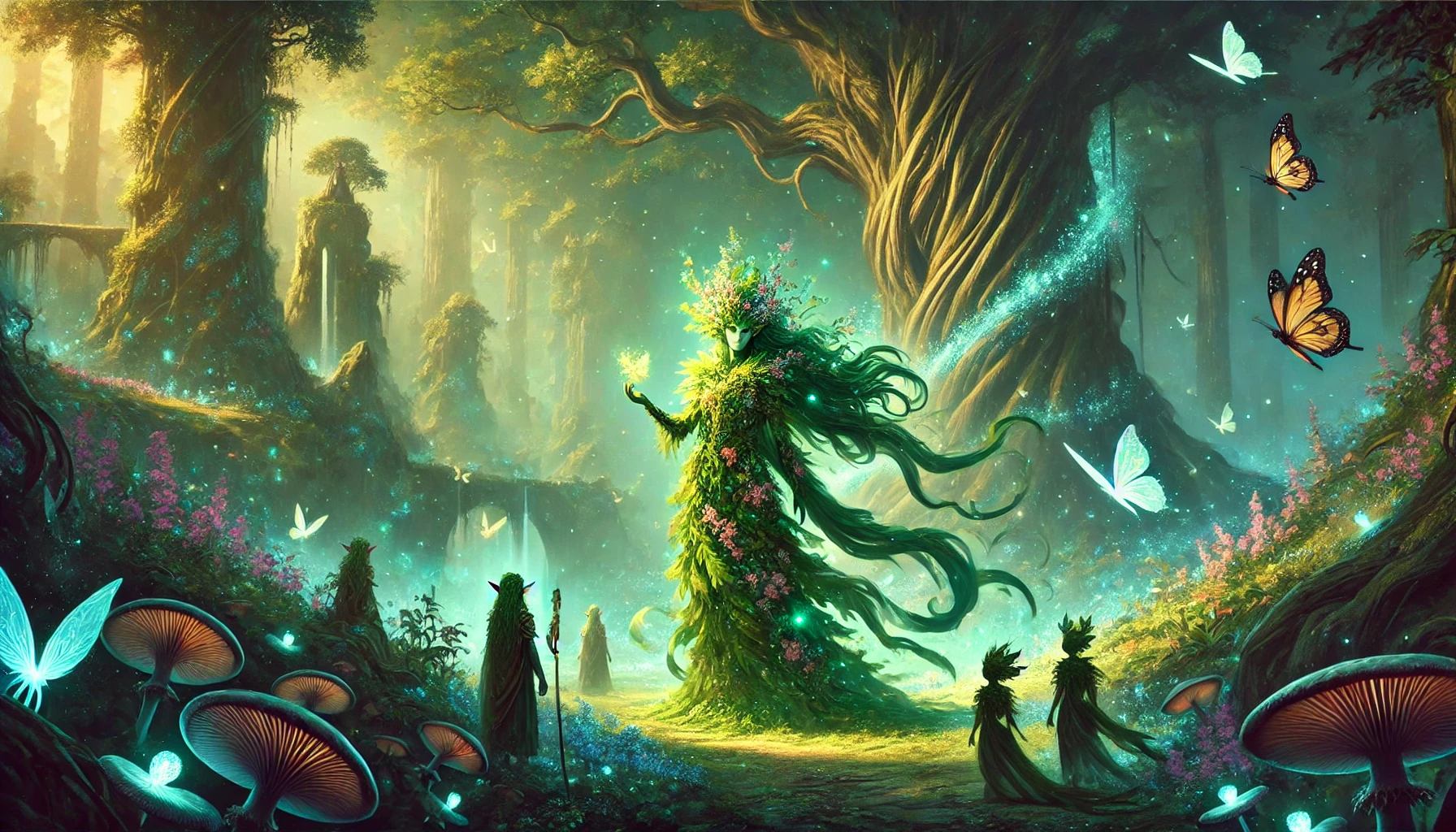
Sylvan is the primary language spoken throughout the Vyrewood, shared by the many fae-touched peoples who inhabit the living realm. It is used by Vaelsidhe, sprites, dryads, treants, mosslings, wisp-folk, spirit beasts, and countless lesser fae. Despite the enormous diversity of its speakers, Sylvan maintains a fluid, melodic structure characterized by soft consonants, vowel-rich phrasing, and a naturally rhythmic cadence shaped by millennia of coexistence with a magical ecosystem.
Unlike many outsiders assume, Sylvan itself is not a magical language. Anyone can learn it, speak it, or write it without triggering enchantment or supernatural effects. It does not resist lies, compel truth, or alter meaning on its own. Those behaviors belong to the Vyrewood’s residents, not the language. Vaelsidhe and other fae-blooded creatures cannot lie because of Zemia’s ancient curse on Faethra’s lineage—not because Sylvan forbids it. Thus, when native speakers use Sylvan, their inherent truth-binding influences the style of their speech, giving outsiders the false impression that the language itself enforces honesty.
Sylvan varies significantly across species. Sprite dialects are quick and chiming; dryadic Sylvan is deep and resonant, shaped by wood and root; treants speak in slow, creaking tones; wisp-folk communicate through breathy pulses and shifting luminescence that still map to Sylvan structure. These dialects remain mutually intelligible in meaning, though wildly different in sound.
Mortals who learn Sylvan typically acquire a simplified variant, sometimes called Traveler’s Sylvan, which captures vocabulary and basic grammar but lacks the emotional nuance and layered metaphor used by native fae. Full fluency requires not only memorizing words, but understanding the culture, instincts, and sensory expressions of the realm’s many inhabitants.
In the Faerealm, Sylvan functions as a shared communicative ecosystem rather than a single rigid tongue. It is a living, evolving language shaped by its speakers, honest or deceptive, literal or metaphorical, depending entirely on who uses it—not on the words themselves.
Writing System
The Sylvan writing system is an elegant, flowing script designed to mirror the natural forms and rhythms of the Vyrewood. Although the language itself is fluid and highly adaptive across different fae species, the written alphabet is surprisingly stable. Scholars believe this consistency emerged early in the Faerealm’s history as a way for its diverse inhabitants to communicate across forms—branches, wings, voices, and breath.
The Sylvan script is a phonetic alphabet, representing individual sounds rather than entire concepts. Anyone can learn to write it, and it carries no innate magic. Its beauty lies in its structure: graceful lines modeled after vines, leaves, and branching tendrils. Letters often appear to “grow” into one another, giving Sylvan text a continuous, organic flow.
Sylvan originates in the Vyrewood, the sentient Faerealm that occupies a shifting pocket of reality bordering Tanaria. Within its boundaries, the language is universal, spoken or understood by nearly every native creature, from Vaelsidhe to sprites, dryads, treants, mosslings, wisp-folk, and countless minor fae. Because the forest itself communicates through motion, light, and emotional resonance that echoes Sylvan patterns, the language feels “ambiently present” throughout the entire realm.
Outside the Vyrewood, Sylvan’s presence becomes highly regional and uneven. Small enclaves of fae creatures dwell in border forests, deep glades, and half-wild pockets across Tanaria. These communities maintain Sylvan as their primary language, though often in simplified forms.
The sounds of Sylvan are intentionally gentle, flowing, and musical. The language avoids harsh consonants, abrupt stops, and throat-heavy sounds. Nearly all phonemes blend smoothly into one another, giving the speech a liquid, almost wind-like quality.
Sylvan’s phonology was shaped by the species who use it: the soft hums of mosslings, the airy whistles of sprites, the resonant tones of dryads, and the melodic cadence of the Vaelsidhe. Together, these influences create a sound system that is expressive, adaptable, and emotionally charged.
Vowels
Sylvan relies on five core vowels with soft, musical qualities.
- a — “ah,” open and warm
- e — “eh/ay,” depending on length
- i — “ee,” bright and sharp
- o — “oh,” rounded
- u — “oo,” soft and deep
Extended Vowels
Vowels may appear in long or breathy forms for emotional nuance.
- Long vowels: aa, ee, ii, oo, uu
- Breathy vowels: marked with accents or trailing strokes in writing
Diphthongs
Common blended vowel sounds include:
- ae — “eye/ay” hybrid
- ai — “aye”
- ei — “ay-ee”
- oi — “oy” (softly)
- ui — “oo-ee”
- au — soft “ow”
Consonants
Sylvan features gentle consonants that avoid harsh or guttural sounds.
Common Consonants
- Liquids: l, r
- Fricatives: v, f, s, sh, th
- Glides: y, w
- Soft Plosives: p, t, k (always aspirated)
- Nasals: m, n
- Rare Resonants: vh, llh
Restricted or Rare Sounds
- Soft “g” only in sprite dialects
- No “ch” except as a variation of sh
- No “z” (replaced by soft s)
- No “j” (replaced by y or “zh”-soft variant)
Syllable Structure
Preferred Syllables
- V (a, ai)
- CV (va, sha, li)
- CVC (lan, vel, thir) — soft finals only
- CVV (vae, lia, shiir)
- VV (aa, ae, ui)
Dispreferred Structures
- CCV (allowed only with w or y)
- CVCV with harsh stops
Prosody & Intonation
Sylvan’s sound is shaped emotionally.
Emotional Influence
- Excitement → higher pitch, faster rhythm
- Sorrow → extended vowels
- Affection → breathy tone
- Anger → clipped vowels (considered “un-forestlike”)
General Style
- Musical, rising-falling cadence
- Soft, lilting rhythm
- Almost songlike even in plain speech



I really like that there is a "simplified" version without the cultural nuances, that is easier for outsiders to learn. Also the fact that many people think it's a magical language but it is not.
Explore Etrea | WorldEmber 2025