

Firbolg (FEER-bolg)
Firbolg are large, gentle giants of the deep wilds, closely tied to ancient forests, high valleys, and places where civilization has failed to fully take root. Though physically imposing, they are not a martial people by nature. Their strength is a byproduct of environment and ancestry, not ambition. Firbolg culture values continuity, patience, and quiet stewardship over expansion or dominance.
Unlike true giants, Firbolg possess a strong communal instinct and a pronounced sensitivity to ecological balance. They live in small, semi-nomadic enclaves that shift with seasonal needs, forest health, and spiritual signs rather than fixed borders. Settlements are deliberately understated, often camouflaged or grown into the landscape rather than built upon it. A Firbolg community leaving an area should leave almost no trace of its passing.
Psychologically, Firbolg are reserved but deeply empathetic, especially toward living systems rather than individuals. They feel distress at deforestation, poisoned waters, or reckless overhunting, sometimes more strongly than at personal injury. This worldview makes them natural allies to druids, rangers, and certain fey entities, though they remain wary of outsiders who seek to catalog, manage, or “improve” nature.
Firbolg avoid large-scale conflict whenever possible, but when forced into violence they are frighteningly effective. Their fighting style emphasizes area denial, environmental control, and overwhelming force applied briefly and decisively. Prolonged war is viewed as a failure of foresight.
Among other races, Firbolg are often misunderstood as naïve, slow-witted, or passive. In truth, they are deliberate thinkers who simply refuse urgency that does not serve long-term survival. They measure time in generations, not seasons.
Basic Information
Anatomy
Firbolg anatomy reflects a hybridized lineage, combining the mass and skeletal strength of giantkin with the adaptive subtlety and environmental attunement of fae beings. Their bodies are large but not crude, built for endurance, quiet movement, and long-term habitation of dense forests and high valleys rather than brute force or siege-scale conflict.
Skeletally, Firbolg possess elongated, reinforced bones similar to other giant-descended peoples, though proportionally lighter than those of Goliaths or true giants. Their joints are broader and more flexible, allowing for fluid motion despite their size. The spine is slightly arched, contributing to a forward-leaning posture that lowers their center of gravity and aids balance when moving through uneven woodland terrain.
Musculature is dense but evenly distributed, favoring sustained strength over explosive power. Firbolg are capable of immense physical feats, but their bodies are optimized for carrying, lifting, and working over long periods rather than sudden violence. This contributes to their characteristic calm physicality and lack of aggressive posture even when threatened.
The skull is broad and heavy-set, with a flatter, wider nose, pronounced brow, and deep-set eyes. Facial features are rounded rather than angular, lending Firbolg their commonly noted gentle or approachable appearance despite their size. The jaw is powerful but not tusked, and dentition is omnivorous, suited to a mixed diet of plants, roots, fungi, and occasional meat.
Firbolg skin is thick and resilient, often bearing subtle tonal variation influenced by environment. Hair is coarse and dense, frequently growing thick along the scalp, jawline, and forearms, providing insulation in colder highland forests. Body hair patterns vary widely and are not culturally emphasized.
One of the most distinctive anatomical traits of the Firbolg is their fae resonance, which manifests physically as heightened sensitivity to environmental conditions. Changes in forest health, magical corruption, or seasonal shifts can subtly affect posture, skin tone, and even eye brightness. These changes are not decorative but physiological, reflecting an internal response to external imbalance.
Sexual dimorphism is minimal. Males and females differ primarily in overall mass distribution rather than height, with females often possessing slightly broader torsos and greater endurance. These differences carry no cultural significance and are rarely remarked upon within Firbolg society.
Firbolg mature slowly, reaching full physical development decades later than most humanoids. Aging is gradual, marked more by deepening stillness and heightened environmental awareness than by physical decline. Even elderly Firbolg remain physically formidable, though they increasingly favor observation and guidance over direct action.
In total, Firbolg morphology is that of a people built not to conquer their environment, but to remain within it. Their bodies are large because the world they guard is vast, and resilient because they expect to be there long after others have passed through.
Genetics and Reproduction
Firbolg genetics reflect a stable but ancient hybrid lineage, combining traits of mortal giantkin physiology with deeply embedded fae essence. This fae influence is not superficial or magical augmentation, but a foundational component of their biology, expressed in longevity, environmental attunement, and slow reproductive cycles.
Firbolg reproduce sexually and are genetically compatible only with other Firbolg. While legends speak of unions between Firbolg and other giantkin or fae beings, such pairings are extraordinarily rare and often produce infertile offspring or children with unstable traits. As a result, Firbolg bloodlines are carefully preserved through endogamous communities rather than through expansion.
Reproductive rates among Firbolg are naturally low. Fertility windows are infrequent, often occurring only a handful of times over an individual’s lifetime. Conception is most likely during periods of strong natural balance, such as seasonal transitions, years of ecological stability, or times following major environmental restoration. Conversely, corrupted land or prolonged imbalance can suppress fertility entirely.
 Gestation lasts approximately 14 to 16 months, reflecting the size and complexity of Firbolg physiology. Newborns are large and physically robust, though mentally undeveloped compared to smaller humanoids. Early childhood is prolonged, with Firbolg children requiring decades to reach physical and emotional maturity. This extended developmental period contributes to their cautious cultural approach to reproduction and parenting.
Firbolg offspring inherit traits from both parents, though genetic expression is influenced by environment. Children raised in deep forests, high valleys, or fae-saturated regions often display stronger resonance sensitivity, while those raised near mortal settlements may exhibit more pronounced giantkin physicality. These differences are subtle and do not create subspecies, but they are widely recognized within Firbolg society.
Sexual dimorphism in reproductive capacity is minimal. Both sexes experience similar fertility cycles, and parental investment is shared. Firbolg society places equal responsibility on all parents involved, regardless of gender, with communal child-rearing common among close-knit clans.
Genetic disorders are rare among Firbolg, likely due to long generational spacing and natural selection favoring stability over proliferation. However, when abnormalities occur, they often manifest as resonance imbalance, resulting in heightened sensitivity, emotional volatility, or physical discomfort in corrupted environments. Such individuals are not stigmatized but often guided toward roles involving travel, mediation, or spiritual caretaking.
Firbolg menopause and equivalent male fertility decline occur gradually rather than abruptly, often over decades. Even after fertility ends, Firbolg retain strong nurturing instincts and frequently serve as mentors or caregivers to younger generations.
Overall, Firbolg reproduction is not driven by population growth, legacy, or dominance. It is viewed as an extension of stewardship, undertaken rarely, deliberately, and only when the world itself feels ready to receive another of their kind.
Gestation lasts approximately 14 to 16 months, reflecting the size and complexity of Firbolg physiology. Newborns are large and physically robust, though mentally undeveloped compared to smaller humanoids. Early childhood is prolonged, with Firbolg children requiring decades to reach physical and emotional maturity. This extended developmental period contributes to their cautious cultural approach to reproduction and parenting.
Firbolg offspring inherit traits from both parents, though genetic expression is influenced by environment. Children raised in deep forests, high valleys, or fae-saturated regions often display stronger resonance sensitivity, while those raised near mortal settlements may exhibit more pronounced giantkin physicality. These differences are subtle and do not create subspecies, but they are widely recognized within Firbolg society.
Sexual dimorphism in reproductive capacity is minimal. Both sexes experience similar fertility cycles, and parental investment is shared. Firbolg society places equal responsibility on all parents involved, regardless of gender, with communal child-rearing common among close-knit clans.
Genetic disorders are rare among Firbolg, likely due to long generational spacing and natural selection favoring stability over proliferation. However, when abnormalities occur, they often manifest as resonance imbalance, resulting in heightened sensitivity, emotional volatility, or physical discomfort in corrupted environments. Such individuals are not stigmatized but often guided toward roles involving travel, mediation, or spiritual caretaking.
Firbolg menopause and equivalent male fertility decline occur gradually rather than abruptly, often over decades. Even after fertility ends, Firbolg retain strong nurturing instincts and frequently serve as mentors or caregivers to younger generations.
Overall, Firbolg reproduction is not driven by population growth, legacy, or dominance. It is viewed as an extension of stewardship, undertaken rarely, deliberately, and only when the world itself feels ready to receive another of their kind.
Ecology and Habitats
Firbolg inhabit regions where natural systems remain largely intact, favoring ancient forests, highland valleys, mist-covered foothills, and temperate mountain woodlands. These environments provide the space, ecological diversity, and long-term stability necessary for their low-density populations and slow life cycles.
They show a strong preference for old-growth ecosystems, where centuries-old trees, layered canopies, and established animal populations create a stable rhythm of life. Firbolg settlements are rarely permanent in a conventional sense. Instead, they exist as semi-fixed territories that shift gradually over generations, allowing the land to recover and preventing long-term ecological strain.
Firbolg architecture is minimal and deliberately integrated into the landscape. Dwellings are often partially subterranean, grown into hillsides, or constructed using living wood and stone shaped through patient craft rather than force. From a distance, Firbolg territory is often indistinguishable from untouched wilderness.
Their fae heritage gives Firbolg a symbiotic relationship with their environment. Flora within Firbolg lands tends to grow denser and healthier over time, while animal populations show unusual stability. Predators and prey coexist in balanced numbers, and invasive species are rare. While Firbolg do not consciously “control” these systems, their presence appears to encourage equilibrium.
Firbolg avoid regions affected by severe magical corruption, planar instability, or industrial exploitation. Prolonged exposure to such environments causes physical discomfort and resonance fatigue, prompting migration rather than confrontation. In rare cases, Firbolg may attempt ecological restoration, but this is slow, generational work rather than immediate intervention.
Seasonal movement is common. Some Firbolg clans migrate between elevations, following weather patterns, food availability, and spiritual cycles tied to the land. These movements are predictable to Firbolg but appear erratic to outsiders, contributing to the misconception that Firbolg are nomadic or elusive.
Despite their size, Firbolg leave little visible impact on their surroundings. Trails are subtle, campsites temporary, and resource harvesting is conservative. Trees are rarely felled outright; instead, Firbolg favor fallen timber, selective pruning, and natural die-off. Hunting is practiced sparingly and with ritual acknowledgment of the life taken.
Firbolg territories often overlap with those of druids, woodland spirits, and fae creatures. These relationships are typically neutral to cooperative, with Firbolg acting as quiet mediators rather than rulers. In many regions, the continued health of a forest is an indirect indicator of Firbolg presence, even when none are seen.
Ultimately, Firbolg do not adapt to their habitat.
They choose places that already endure, and ensure they continue to do so long after they are gone.
Dietary Needs and Habits
Firbolg are omnivorous, though their diet is heavily weighted toward plant-based foods and foraged resources. Their large size demands substantial caloric intake, but their slow metabolism and high efficiency allow them to thrive on diets that would be insufficient for other giantkin.
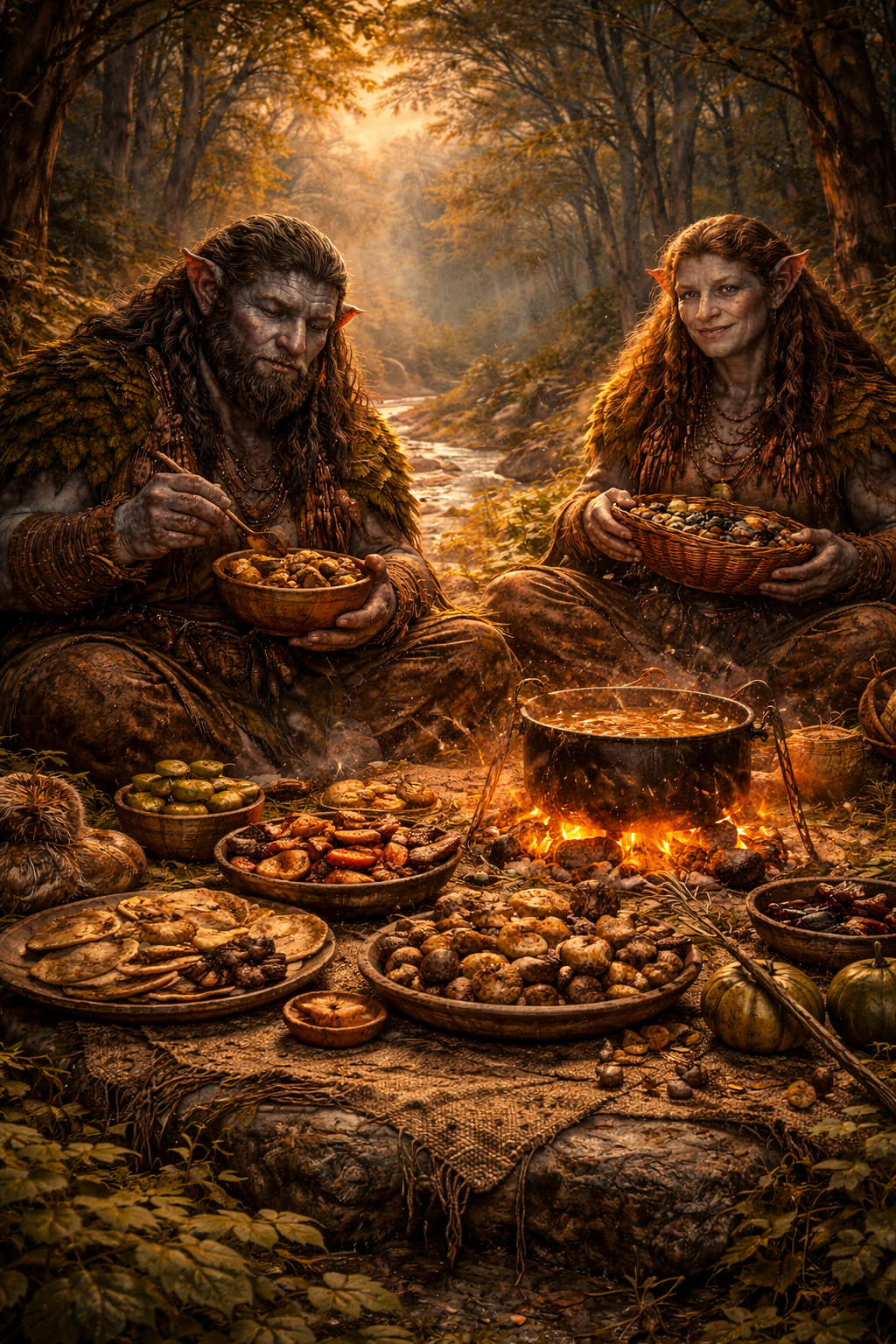 Primary staples include roots, tubers, nuts, berries, fungi, and hardy grains gathered from wild or semi-managed growth. Firbolg possess a strong tolerance for fibrous and bitter plant matter, enabling them to consume foods that are inedible or unpalatable to most humanoids. Fungi play a particularly important role in their diet, especially forest mushrooms and subterranean growths associated with old root systems.
Animal protein is consumed sparingly and deliberately. When meat is eaten, it typically comes from large game taken infrequently, fish from cold rivers and lakes, or animals that have died naturally. Firbolg avoid overhunting and do not raise livestock on a large scale, viewing domestication as disruptive unless carefully limited. Hunting, when practiced, is accompanied by ritual acknowledgment rather than celebration.
Firbolg are adept foragers and possess extensive generational knowledge of seasonal food availability. They track flowering cycles, migration patterns, and fungal blooms with precision, allowing them to shift diets throughout the year without stressing any single resource. Food preservation techniques include drying, smoking, root-cellar storage, and fermentation, all done at a pace that favors longevity over volume.
Water is central to Firbolg health. They prefer clean, moving sources such as springs and forest streams, and show visible discomfort when forced to rely on stagnant or polluted water. Some elders exhibit mild physiological reactions to tainted water, including fatigue or resonance distress, reinforcing their aversion to environmental degradation.
Firbolg eat slowly and communally when possible. Meals are treated as periods of rest and observation rather than indulgence. Overeating is rare, and hunger is tolerated with patience rather than urgency. This calm relationship with food reflects their broader worldview that survival is ensured through balance, not excess.
Occasionally, Firbolg consume foods infused with mild natural magic, such as fae-touched fruits or resonance-rich fungi. These are not intoxicants but are believed to strengthen their connection to the land. Overconsumption is avoided, as excessive exposure can lead to sensory overload or emotional volatility.
In times of scarcity, Firbolg are capable of long fasting periods with minimal ill effect. This ability allows them to endure harsh winters or disrupted ecosystems without resorting to destructive harvesting. Such restraint is considered a mark of maturity and respect for the land.
To Firbolg, eating is not merely sustenance. It is an act of participation in the ecosystem they protect.
Primary staples include roots, tubers, nuts, berries, fungi, and hardy grains gathered from wild or semi-managed growth. Firbolg possess a strong tolerance for fibrous and bitter plant matter, enabling them to consume foods that are inedible or unpalatable to most humanoids. Fungi play a particularly important role in their diet, especially forest mushrooms and subterranean growths associated with old root systems.
Animal protein is consumed sparingly and deliberately. When meat is eaten, it typically comes from large game taken infrequently, fish from cold rivers and lakes, or animals that have died naturally. Firbolg avoid overhunting and do not raise livestock on a large scale, viewing domestication as disruptive unless carefully limited. Hunting, when practiced, is accompanied by ritual acknowledgment rather than celebration.
Firbolg are adept foragers and possess extensive generational knowledge of seasonal food availability. They track flowering cycles, migration patterns, and fungal blooms with precision, allowing them to shift diets throughout the year without stressing any single resource. Food preservation techniques include drying, smoking, root-cellar storage, and fermentation, all done at a pace that favors longevity over volume.
Water is central to Firbolg health. They prefer clean, moving sources such as springs and forest streams, and show visible discomfort when forced to rely on stagnant or polluted water. Some elders exhibit mild physiological reactions to tainted water, including fatigue or resonance distress, reinforcing their aversion to environmental degradation.
Firbolg eat slowly and communally when possible. Meals are treated as periods of rest and observation rather than indulgence. Overeating is rare, and hunger is tolerated with patience rather than urgency. This calm relationship with food reflects their broader worldview that survival is ensured through balance, not excess.
Occasionally, Firbolg consume foods infused with mild natural magic, such as fae-touched fruits or resonance-rich fungi. These are not intoxicants but are believed to strengthen their connection to the land. Overconsumption is avoided, as excessive exposure can lead to sensory overload or emotional volatility.
In times of scarcity, Firbolg are capable of long fasting periods with minimal ill effect. This ability allows them to endure harsh winters or disrupted ecosystems without resorting to destructive harvesting. Such restraint is considered a mark of maturity and respect for the land.
To Firbolg, eating is not merely sustenance. It is an act of participation in the ecosystem they protect.
Behaviour
Firbolg psychology is defined by patience, restraint, and long-form thinking. They experience time differently than most humanoids, not because they are incapable of urgency, but because urgency is rarely justified. Decisions are made with an awareness of generational consequence rather than immediate outcome, and impulsive behavior is viewed as a sign of immaturity rather than passion.
Firbolg are emotionally steady, but not emotionally distant. They feel deeply, particularly in response to environmental harm, loss of balance, or suffering tied to place rather than individual grievance. Anger, when it occurs, is quiet and focused. Displays of rage or dominance are considered wasteful and destabilizing. A Firbolg who raises their voice is already close to abandoning restraint.
Socially, Firbolg are reserved and observant. They prefer listening over speaking and often allow others to fill silence rather than interrupt it. This behavior is frequently misinterpreted as slowness or passivity, when in reality Firbolg are actively assessing intent, pattern, and consequence. Once a Firbolg speaks decisively, their mind is usually already made up.
Firbolg possess a strong aversion to unnecessary harm. This does not stem from moral absolutism, but from an ingrained understanding of ecological consequence. Violence is acceptable when it preserves balance or prevents greater destruction, but cruelty, spectacle, or domination for its own sake is profoundly unsettling to them. Prolonged conflict causes psychological strain and is avoided whenever possible.
Their fae heritage contributes to a heightened sensitivity to emotional environments. Firbolg can become physically uncomfortable in places saturated with fear, greed, or unresolved grief. Extended exposure to such conditions may lead to withdrawal, irritability, or migratory behavior rather than confrontation.
Firbolg value consistency in behavior over stated intent. Promises, oaths, and declarations carry little weight compared to demonstrated patterns of action. This makes them difficult to manipulate but slow to trust. Trust, once earned, is deep and durable, often persisting across decades or generations.
Humor among Firbolg is subtle and situational, favoring dry observation over wit. They rarely mock others, but are capable of quiet irony, especially when observing short-lived civilizations repeating familiar mistakes. Laughter is infrequent but sincere.
Psychologically, Firbolg are resilient but not hardened. Loss is processed slowly, often through ritualized labor, environmental caretaking, or periods of isolation. Grief is not externalized; it is absorbed and transformed into stewardship.
At their core, Firbolg are not driven by conquest, legacy, or personal glory. They are driven by the simple belief that some things must be allowed to last, even if no one remembers who protected them.
Additional Information
Social Structure
Firbolg society is loosely communal and non-hierarchical, organized around shared responsibility rather than authority. Leadership exists, but it is situational, temporary, and rarely formalized. Influence is earned through experience, consistency of judgment, and demonstrated care for the land rather than lineage or force.
The basic social unit is the hearth-circle, a small group of related families or long-term companions who share territory, labor, and child-rearing. Hearth-circles are stable over generations, but individuals may drift between them as needed, particularly in response to environmental change or personal calling. Such movement carries no stigma.
Decision-making is conducted through extended consensus. Matters affecting daily life are often resolved without formal discussion, guided by habit and mutual understanding. Larger concerns, such as migration, ecological restoration, or interaction with outsiders, prompt slow, deliberate councils in which every adult may speak. Silence during these gatherings is not only accepted but expected, as reflection is valued over immediacy.
Elders hold respected but non-authoritative roles. Their influence comes from memory, perspective, and an ability to recognize long patterns rather than command. An elder who consistently gives poor counsel will simply be ignored rather than challenged. Respect is withdrawn quietly.
Firbolg do not maintain rigid roles based on gender, age, or status. Labor is divided according to ability and need, and roles shift fluidly over time. Caretaking, crafting, defense, and teaching are all considered equally valuable. Children are raised communally and encouraged to observe rather than be instructed, learning through participation and quiet correction.
Conflict within Firbolg society is rare and usually resolved through separation rather than confrontation. Individuals who disrupt balance may be encouraged to travel, work alone, or join another hearth-circle. Exile is almost unheard of; distance is considered a sufficient remedy.
There is no central governing body among Firbolg. Clans recognize one another through shared customs and seasonal gatherings, but no individual or group claims authority over the species as a whole. This decentralization makes Firbolg difficult to negotiate with diplomatically, as no one speaks for all.
Social bonds among Firbolg are deep but understated. Displays of affection are subtle, often expressed through shared labor, protection, or long-term presence rather than words. Loyalty, once established, is durable and may persist across centuries even in the absence of regular contact.
Ultimately, Firbolg society functions less like a state and more like a network of enduring agreements—between individuals, between generations, and between people and place.
Geographic Origin and Distribution
Firbolg populations are widely dispersed but extremely low-density, occupying regions where long-term ecological stability has been maintained. They are most commonly found in temperate and boreal forests, highland valleys, mist-laden foothills, and mountain-adjacent woodlands where civilization has failed to fully establish permanent control.
Rather than forming contiguous territories, Firbolg settlements appear as isolated enclaves, often separated by vast stretches of wilderness. These enclaves are connected by generational migration routes and shared seasonal gathering sites, but rarely by maintained roads or clear borders. As a result, Firbolg presence is often underestimated or entirely overlooked by cartographers and scholars.
Firbolg avoid open plains, deserts, and heavily urbanized regions. Environments lacking sufficient cover, water access, or regenerative growth are unsuitable for their way of life and physically uncomfortable due to their fae resonance. Coastal regions are rarely inhabited unless dense forest growth reaches the shoreline.
Mountain-adapted Firbolg favor forested slopes and elevated basins rather than exposed peaks. These regions provide natural defense, clean water sources, and predictable seasonal cycles. Firbolg in such areas often migrate vertically, moving between elevations in response to weather and resource availability.
Firbolg territories frequently overlap with druidic circles, ancient fae crossings, and regions of heightened natural magic. While they do not require magical saturation to survive, prolonged absence from such environments can lead to lethargy or resonance fatigue, encouraging relocation over time.
Human and elven expansion has fragmented Firbolg distribution in many regions. Rather than resisting directly, Firbolg tend to withdraw deeper into remaining wildlands or gradually abandon territories rendered unstable. This pattern has resulted in pockets of Firbolg habitation persisting in regions believed by outsiders to be uninhabited or abandoned.
Firbolg do not recognize political borders and rarely adjust their movements to accommodate them. Their understanding of land is ecological rather than territorial, defined by watersheds, forest health, migration corridors, and seasonal change rather than ownership.
In effect, Firbolg are present wherever the land has been allowed to endure.
Their absence is often a more reliable indicator of environmental decline than their presence is of habitation.
Perception and Sensory Capabilities
Firbolg perception is shaped as much by environmental awareness as by conventional senses. While their eyesight and hearing are comparable to other large humanoids, they experience the world as a layered system of cues, patterns, and subtle shifts rather than isolated stimuli.
Visually, Firbolg possess excellent low-light vision, particularly in forested or mist-heavy environments. Their eyes are adapted to pick out movement through dense foliage,  shadowed canopies, and uneven terrain. They are less suited to fine detail at extreme distance than some elven races, but far better at noticing changes within a familiar landscape, such as disturbed growth, displaced stones, or unnatural stillness.
Their hearing is broad rather than sharp. Firbolg are less attuned to high-frequency sounds but exceptionally skilled at interpreting ambient noise. They notice when birds fall silent, when wind patterns shift unnaturally, or when the cadence of the forest is disrupted. This makes ambushes difficult to stage against them in their home territory, even when the threat is quiet or hidden.
Olfaction is understated but functional. Firbolg can identify familiar individuals, animals, and places by scent, though they rely more heavily on contextual cues than on smell alone. Strong or foreign scents are often perceived as “out of place” rather than immediately identifiable.
The most distinctive aspect of Firbolg perception lies in their fae resonance, an extrasensory awareness tied to natural and magical balance. Firbolg can instinctively sense disruptions in their environment, including corrupted magic, planar thinning, desecrated land, or unnatural weather patterns. This sense is not precise enough to replace spellcasting or detection magic, but it provides a persistent, low-level awareness that something is wrong long before visible signs appear.
This resonance also allows Firbolg to perceive emotional tension in a space. Strong fear, anger, grief, or intent to harm can register as a physical discomfort, described by Firbolg as pressure, heaviness, or “wrongness” in the air. This ability is passive and involuntary, and prolonged exposure to such environments can be physically exhausting.
Firbolg do not typically perceive invisible creatures or magical effects outright, but they are keenly aware of absence. Empty spaces where life should exist, silence where sound should be present, or growth that feels unnaturally stunted often alert them to hidden dangers.
With age, Firbolg perception deepens rather than sharpens. Elders are often able to sense seasonal shifts, approaching storms, or long-term environmental changes days or weeks in advance. These insights are rarely articulated as predictions, instead expressed as quiet certainty or a feeling that “it is time to prepare.”
In sum, Firbolg do not see more than others. They notice more, especially when the world is out of balance.
shadowed canopies, and uneven terrain. They are less suited to fine detail at extreme distance than some elven races, but far better at noticing changes within a familiar landscape, such as disturbed growth, displaced stones, or unnatural stillness.
Their hearing is broad rather than sharp. Firbolg are less attuned to high-frequency sounds but exceptionally skilled at interpreting ambient noise. They notice when birds fall silent, when wind patterns shift unnaturally, or when the cadence of the forest is disrupted. This makes ambushes difficult to stage against them in their home territory, even when the threat is quiet or hidden.
Olfaction is understated but functional. Firbolg can identify familiar individuals, animals, and places by scent, though they rely more heavily on contextual cues than on smell alone. Strong or foreign scents are often perceived as “out of place” rather than immediately identifiable.
The most distinctive aspect of Firbolg perception lies in their fae resonance, an extrasensory awareness tied to natural and magical balance. Firbolg can instinctively sense disruptions in their environment, including corrupted magic, planar thinning, desecrated land, or unnatural weather patterns. This sense is not precise enough to replace spellcasting or detection magic, but it provides a persistent, low-level awareness that something is wrong long before visible signs appear.
This resonance also allows Firbolg to perceive emotional tension in a space. Strong fear, anger, grief, or intent to harm can register as a physical discomfort, described by Firbolg as pressure, heaviness, or “wrongness” in the air. This ability is passive and involuntary, and prolonged exposure to such environments can be physically exhausting.
Firbolg do not typically perceive invisible creatures or magical effects outright, but they are keenly aware of absence. Empty spaces where life should exist, silence where sound should be present, or growth that feels unnaturally stunted often alert them to hidden dangers.
With age, Firbolg perception deepens rather than sharpens. Elders are often able to sense seasonal shifts, approaching storms, or long-term environmental changes days or weeks in advance. These insights are rarely articulated as predictions, instead expressed as quiet certainty or a feeling that “it is time to prepare.”
In sum, Firbolg do not see more than others. They notice more, especially when the world is out of balance.

Genetic Ancestor(s)
Scientific Name
Gigantus silvaticus sapiens
Lifespan
250–350 years
Conservation Status
Uncommon (Stable, Regionally Isolated)
Firbolg populations are naturally sparse due to low birth rates and large territorial needs. However, they are not considered endangered. Their tendency to withdraw rather than resist expansion has led to population fragmentation in some regions, but their long lifespans and careful reproduction maintain overall stability
Firbolg populations are naturally sparse due to low birth rates and large territorial needs. However, they are not considered endangered. Their tendency to withdraw rather than resist expansion has led to population fragmentation in some regions, but their long lifespans and careful reproduction maintain overall stability
Average Height
7 ft 6 in – 9 ft (2.3–2.7 m)
Average Weight
500–750 lbs (225–340 kg)
Average Physique
Firbolg possess a massive but proportionate build, combining the towering stature of giantkin with the softened, organic lines of fae physiology. They are broad-shouldered and deep-chested, with long limbs built for endurance rather than explosive speed. Even the slimmest Firbolg appears powerful by humanoid standards, their musculature dense and well-distributed rather than sharply defined.
Their strength is structural, not aesthetic. Muscle fibers are thick and layered, adapted for sustained labor, long-distance travel, and carrying heavy loads over uneven terrain. Firbolg rarely display the exaggerated bulk of goliaths or true giants, instead favoring a naturally athletic frame shaped by daily movement through forests, hills, and mountains.
Bone density is notably high, contributing to their weight and resilience. This gives Firbolg a grounded presence; they move deliberately, with a sense of mass and balance that makes them difficult to knock aside or unsteady. Joints are flexible despite their size, allowing for quiet movement and surprising agility in dense terrain.
Sexual dimorphism exists but is subtle. Male Firbolg tend toward broader torsos and heavier upper-body mass, while females often display slightly wider hips and a lower center of gravity, but overall strength differences are minimal. Both sexes are capable of the same physical labor and endurance.
Age affects Firbolg physiques gradually. Youthful Firbolg are lankier and less settled in their mass, while mature adults develop the full breadth and density associated with the race. Elder Firbolg retain much of their strength well into later life, with decline presenting more as stiffness than frailty.
In short, the Firbolg physique reflects quiet power and endurance, shaped not for conquest or display, but for coexistence with a demanding natural world.
Body Tint, Colouring and Marking
Firbolg skin tones range across a spectrum of earth-muted hues, reflecting their long association with forested and highland environments. Common coloration includes warm greys, mossy greens, stone browns, muted blues, and soft earthen tans. These tones are rarely uniform. Subtle mottling, undertones, or gradient shifts are common, particularly across the shoulders, forearms, and face.
Colour expression is influenced by both genetics and environment. Firbolg raised in deep forests often display greener or darker undertones, while those from high valleys or mist-heavy regions tend toward cooler greys and pale blues. Seasonal shifts can cause slight changes in tone, with skin appearing darker or more saturated during periods of strong growth and lighter during winter or dormancy.
Markings among Firbolg are natural rather than decorative. These include faint striping, marbling, freckling, or shadowed patches that follow musculature or bone structure. Such markings are most visible along the arms, neck, temples, and ribcage. They do not form sharp symbols or high-contrast patterns and are rarely symmetrical.
Some Firbolg exhibit faint luminescent qualities in low light, particularly around the eyes or along prominent markings. This glow is subtle and often only noticeable in deep forest shade or during twilight. It is believed to be a byproduct of fae resonance rather than an intentional trait, and it carries no cultural meaning.
Hair colour ranges from deep browns and blacks to muted greys, silvers, and occasionally moss-dark greens. Hair texture is typically coarse and thick, offering insulation and protection. Beards are common across sexes, though density and length vary individually rather than culturally. Body hair patterns are irregular and not emphasized.
Scarring is visible and respected, but not adorned. Firbolg do not traditionally tattoo or paint their bodies, viewing permanent alteration as unnecessary interference with natural form. Temporary markings using ash, clay, or plant pigments may be applied for rituals or mourning, but these are allowed to fade naturally.
Colour and marking variation hold no social hierarchy among Firbolg. No hue is considered superior, and attempts by outsiders to categorize or aestheticize these traits are often met with quiet confusion. To Firbolg, these features are simply expressions of place and time, not identity.
In sum, Firbolg appearance reflects where they have lived, not who they claim to be. Their bodies carry the quiet record of land, weather, and years rather than symbols meant to be read.
Geographic Distribution


Comments