
Redmond Erastus Gunn
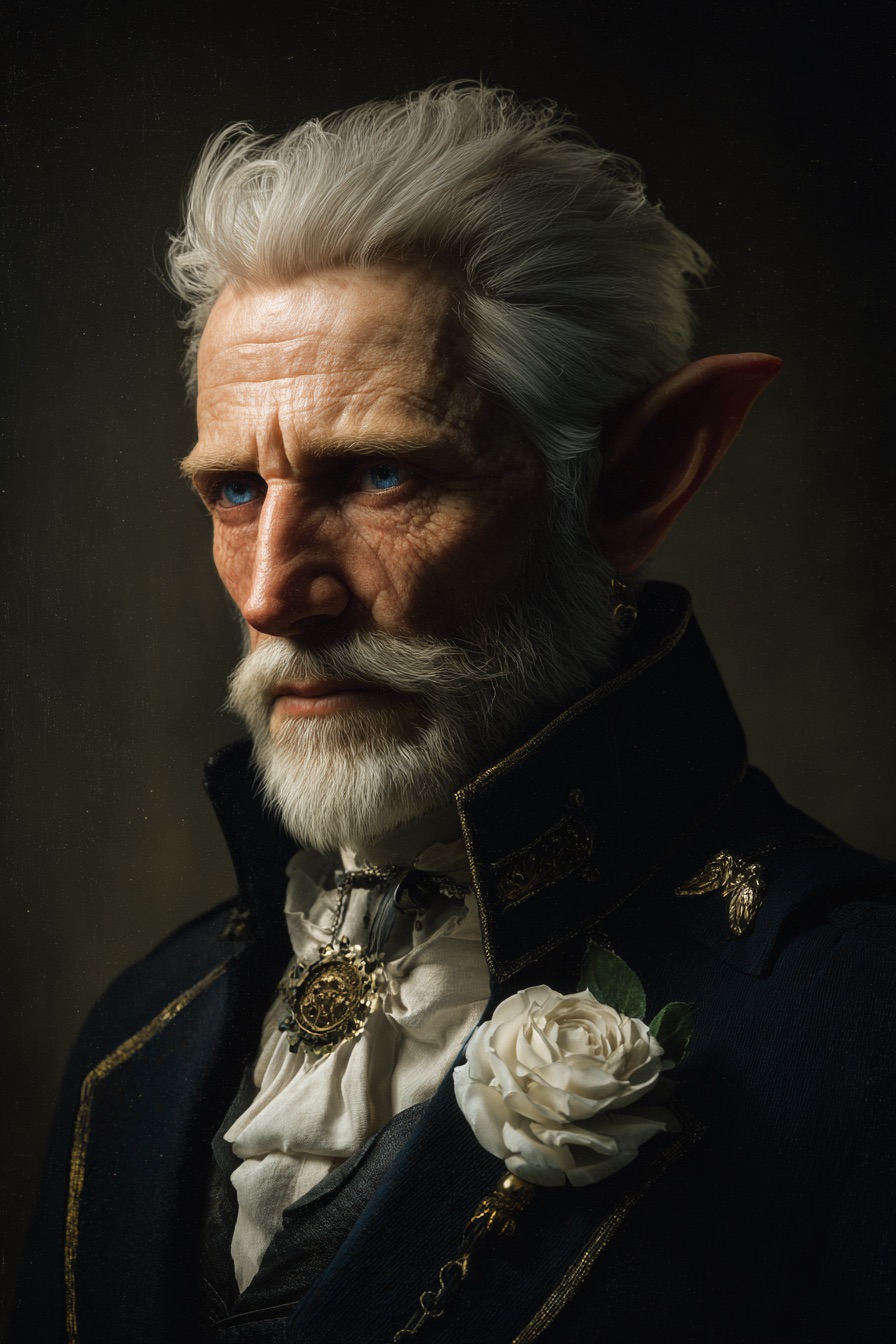
Redmond Erastus Gunn is the sort of man whose presence enters a room several seconds before he does. Even in his later years he carries the unmistakable bearing of an Eldwell naval officer—straight-backed, chin lifted just a fraction too high, and with a gaze that has measured horizons most people never imagine. As the military attaché to the Eldwell Empire during the pivotal Journey to Lilianth, Redmond serves as both Diplomat and living reminder of the Empire’s long martial traditions, a man who embodies refinement while harbouring a mind sharpened by old convictions and mellowed by time.
Early Convictions & Tempered Radicalism
In his youth, Redmond Gunn was known as something of a firebrand within the Navy—an officer who argued passionately for modernization, for the abolition of outdated rank privileges, and for a meritocratic command structure. He believed that the Empire’s strength must come from adaptability rather than rigid tradition, and these views—bordering on radical for the time—won him both loyal supporters and powerful enemies.
But age reshapes fire.
The years, the wars, and the bitter politics of the Admiralty tempered that idealism into something quieter, more considered. Redmond no longer preaches revolution; instead, he practices persuasion. He has become a statesman of sorts, a man who believes in progress but insists that progress must be stable, deliberate, and humane. His ideas remain bold, but his methods are now velvet rather than Iron.
As a Knight of the White Rose, he embraces the order’s chivalric principles—charity, integrity, and tempered justice—while also advocating reforms from within. He has become the order’s polite dissident, the gentleman reformer who never raises his voice but somehow always shifts the room.
Role in the Journey to Lilianth
Redmond’s presence in the diplomatic delegation serves multiple functions. Officially, he is a military advisor—trained to speak with precision on matters of defence, naval cooperation, and maritime law. Unofficially, he is a stabilizing force between factions, a man whose reputation for fairness makes him an ideal mediator.
He listens more than he speaks, but when he does speak, even seasoned diplomats fall silent. There is weight in his words—earned through storms, battles, and the painful wisdom of mistakes.
Hobbies & Personal Tastes
Away from council chambers and formal receptions, Redmond Erastus Gunn lives a quieter, more contemplative life than most expect of a former admiral. Years spent navigating perilous routes and command decisions have left him with a deep appreciation for stillness, routine, and pursuits that reward patience over dominance.
He is a devoted reader of classical literature and philosophy, particularly the stoic thinkers of the old Eldwell canon. Their meditations on duty, restraint, and moral clarity resonate deeply with him, not as abstract ideals but as lived necessities. He often carries a small, well-worn volume in his coat pocket, its margins crowded with notes written during long journeys, each annotation a private dialogue between the man he was and the man he has become.
The sky has never lost its hold on him. Long after leaving the deck of an admiral’s flagship, Redmond still finds solace in astronomy. He spends many evenings observing the stars, sketching familiar constellations and recording how different cultures name and interpret them. To him, the heavens are a reminder of perspective—proof that even empires are fleeting when measured against the vastness of the night.
Perhaps his most unexpected passion is gardening, specifically the cultivation of white orchids. He tends to them with meticulous care, believing that nurturing something delicate teaches a kind of discipline no battlefield ever could. Watching a fragile bloom survive through careful balance and restraint reinforces his conviction that strength need not be loud to be enduring.
Each morning, often before dawn, Redmond practices fencing—not out of vanity or lingering aggression, but as ritual. The precise movements, the measured breathing, the repetition of forms serve as a meditation in motion. It is a way to honour the body that once bore command and to keep the mind sharp without surrendering to restlessness.
When social circumstances allow, he prefers the quiet elegance of fine tea and thoughtful conversation to lavish entertainments. He delights in wit that reveals insight rather than cruelty, and in exchanges where disagreement sharpens understanding rather than hardening into hostility. In such moments, he is at his most relaxed—an old Sailor content to let words, not Weapons, shape the outcome.
Beliefs & Guiding Principles
Redmond Gunn’s beliefs are neither slogans nor doctrines; they are principles forged through years of command, compromise, and regret. At the core of his worldview lies an unshakable respect for duty—but never a blind one. He believes duty must serve humanity, not eclipse it, and that obedience without conscience is merely cowardice dressed in uniform.
Though he respects tradition, he does not revere it unconditionally. To Redmond, customs are valuable only insofar as they protect justice, stability, and dignity. When tradition obstructs those aims, he considers it not sacred but obsolete. This conviction once earned him a reputation as a radical within the Navy; now, it marks him as a reformer who understands that change imposed too swiftly can fracture what it seeks to improve.
He holds power in cautious regard. Having wielded it, he understands how easily authority can slip into cruelty or vanity. As a result, he believes power must always be exercised with restraint and humility, and that leadership is defined not by how forcefully one commands, but by how responsibly one listens.
Rank, in his eyes, is a tool rather than a measure of worth. Respect must be earned through conduct, clarity, and fairness, not inherited or enforced. This belief has shaped his dealings with subordinates and peers alike, and it is why many who served under him remain loyal long after his retirement.
Above all, Redmond believes that empires, like men, must evolve or suffer slow decay. He has seen what happens when nations cling too tightly to past glories, mistaking endurance for virtue. Diplomacy, to him, is the highest expression of strength—a means of securing peace without humiliation, and progress without bloodshed. It is this belief that guides him still, as he walks the careful line between honouring the Empire he served and urging it, gently but persistently, toward something better.

Comments