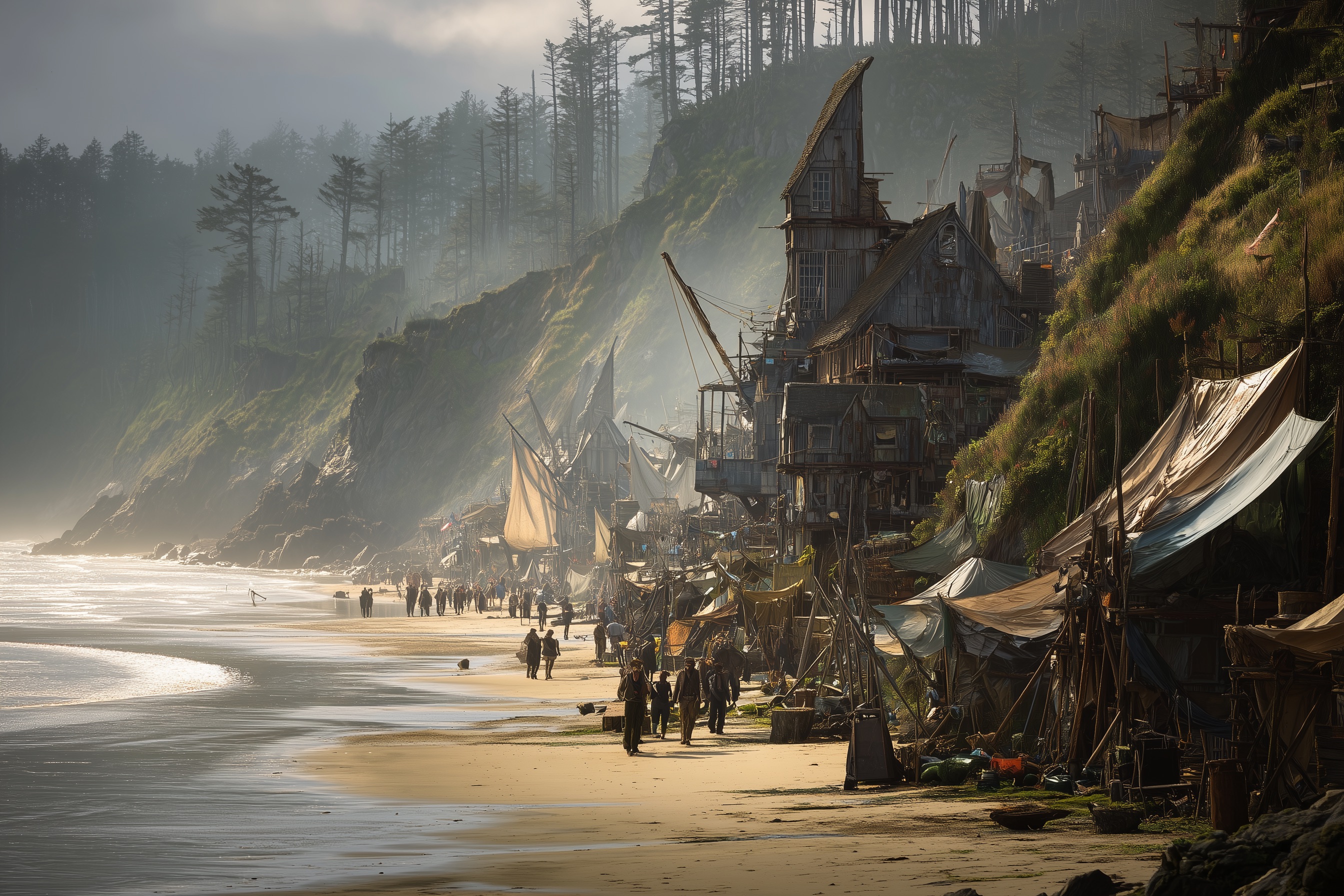
Port Lovelace
Port Lovelace lies tucked along the golden arc of the Gulf of Ada, the only gentle shoreline on the otherwise cliff-ringed island of Streamfall. Though its name suggests grandeur, the settlement is humble—born not of ambition, but necessity. For over thirty years, this makeshift port has served as the waiting room of the Edisonne Archipelago: the last threshold before one steps into the shining, overcrowded metropolis of Edison.
Here, on a warm strip of sand backed by towering conifer-clad cliffs, a community has formed from driftwood, scrap metal, cast-off machinery, and the stubborn hope of thousands.
Origins of a Waiting Place
Port Lovelace did not begin as a planned settlement. It grew from queues—literal lines of newcomers hoping for entry into Edison. In the early decades of Edison’s explosive expansion, immigration outpaced the city’s ability to house, police, or support new populations. Imperial authorities declared Streamfall Island, long a royal hunting preserve, a temporary holding zone.
Temporary became permanent.
What began as a few canvas shelters soon became a sprawling, improvised settlement. The people who stayed longer built sturdier homes. Those who gave up on the promise of Edison built even more. Over the years, Port Lovelace earned its harsh nickname: Junk City—a name spoken with both mockery and pride.
Life in the Settlement
Though many residents stay only long enough for their papers to be processed, Port Lovelace has its own culture—born from waiting, from scarcity, and from the strange solidarity that emerges among strangers with the same dream.
Homes are patched together from whatever the sea or bureaucracy leaves behind: driftwood, old ship hulls, tar-stained timbers, rusted engine cases, discarded sails, fabric from broken tents. Some structures lean into the cliffs; others spill onto the warm sand. Lanterns hang from ropes strung between uneven rooftops, and in the evenings the entire settlement glows like a constellation of tiny, defiant stars.
Children dart between the shacks, chasing each other across the beach and along the first cascades of the River Babbage. Vendors sell roasted fish, sticky fruit pastries, and steaming cups of cliff-herb tea. A few residents carve small gardens into sandy terraces, growing stubborn little crops that survive only because of constant care.
Despite hardship, laughter is common. So is tension. Not everyone is patient. Not everyone is hopeful. But everyone remembers waiting.
Government, Order & The Long Queue
Port Lovelace is administered by a locally elected mayor, though the position carries more moral weight than political power. The true authority is the Imperial Office of Immigration, which maintains a small compound at the settlement’s northern end. Their word determines who stays, who moves on, and who is sent away entirely.
The queue system is notoriously slow—partly due to Edison’s limited housing, partly because of imperial caution. Some families wait weeks; some wait months. A few have waited years. Bureaucracy shapes the tempo of life here: every morning, hopefuls gather to listen for the names of those cleared to depart. When one name is called, the entire town hears it. Sometimes cheers rise. Sometimes sobs.
The Hidden Hand of the Stargazers
What keeps Port Lovelace functioning is not the empire, but the quiet generosity of the Stargazer Exploration Company "SEC" . For nearly a decade, the SEC has acted as an unofficial patron of the settlement. They maintain roads, repair generators, sponsor the small clinic, and now fund the construction of a dam in the lower valley—an ambitious project intended to bring stable fresh water and power to the community.
Designed by the formidable Engine Mistress Tillya Wheeler and her team, the dam harnesses the force of the River Babbage as it plunges from Lake Augusta down toward the gulf. Once completed, it will turn the settlement from a fragile cluster of shacks into a place capable of sustaining itself.
Most residents know the Stargazers help. Few know why. Fewer still question it.
The Landscape Around Port Lovelace
The settlement sits where the cliffs of Streamfall finally relent, opening into a wide embrace of sand and sunlight. Rising above the beach are tall pines and rugged stone walls dripping with moss. Beyond the cliffs lies the vast interior basin of the island, filled with dense conifer forest and crowned by the shimmering, elevated Lake Augusta.
From that distant lake, the River Babbage rushes toward Port Lovelace. Its waterfalls thunder through the valley, sending cool mist drifting over the settlement on windy days. Children sometimes race to the freshwater pools where the river meets the sand, though adults keep a wary eye—the river is beautiful, but always dangerous.
Across the waters of the gulf sits Streamrise Island, broad and imposing, its high cliffs softened by pockets of sandy beach. From Port Lovelace, it appears like a guardian or a warning, depending on one’s mood.
Culture & Identity
Most inhabitants consider themselves “passing through,” even if they have lived here for years. This gives the town a strange sense of impermanence—like a breath held too long. Yet there is community. Nights in Junk City are lively: music played on battered instruments, improvised festivals on the beach, laughter echoing beneath the cliffs. People share stories of the lands they left and the futures they hope for. New arrivals are quickly folded into this loose but warm network of survival. People help each other because no one else will.
And when someone finally receives the decree granting passage to Edison, farewells are heartfelt. The town gathers. Gifts are exchanged—sometimes small, sometimes absurdly valuable. And when the departing boat pulls away from the beach, all of Junk City watches. Everyone imagines the day it will be their turn.
Points of Interest
Though often dismissed as a temporary settlement, Port Lovelace boasts a handful of places that define its strange charm and shape the rhythm of life for its ever-changing population.
The Landing Beach is the settlement’s beating heart—a wide ribbon of golden sand where boats from Edison arrive with clerks, cargo, and the rare good news. Every dawn, hopeful residents gather along its tide line, watching for distant sails or steam-plumes that might herald a new decree.
Just beyond the beach lies Shanty Row, a dense tangle of improvised homes stitched from hull fragments, tarred planks, and battered canvas. The dwellings lean toward one another like old friends sharing secrets, and their narrow lanes form a maze of laughter, smoke from cookfires, and the smell of drying fish.
On slightly higher ground stands the Immigration Office Compound, a stark contrast to the surrounding patchwork of materials. Its whitewashed walls and metal fencing project a sense of order—some say intimidation—over the settlement. Each morning, a Clerk posts new approvals on the Name Board, drawing cheers, tears, or bitter silence from the crowd.
Near the base of the cliffs rests The Clinic, a compact but sturdy structure funded quietly by the Stargazer Exploration Company "SEC" . Inside, two rotating medics tend to everything from cuts and burns to childbirth and cliffside injuries. Despite its size, the clinic is often the safest place on the island.
Farther inland, where the settlement thins, the path narrows and becomes the Babbage Crossing, a rope-and-plank footbridge spanning the lower river. The spray from the last waterfall mists the air here, feeding bright green ferns that cling to the rocks. Almost everyone must cross this bridge eventually, whether to forage, fetch water, or take the long trail toward the new dam construction.
And finally, at the center of the settlement’s soul, stands the Driftwood Stage. Built from the ribs of wrecked ships and reinforced with scavenged beams, it hosts storytelling nights, impromptu concerts, and the celebrations when someone’s name appears on the board. Under lanternlight, with the waves murmuring behind it, the stage becomes the one place where every resident—no matter how long they stay—feels truly part of something larger than themselves.
Important Characters
Mayor Istra Bellweather

Mayor Bellweather carries herself the way old Alsian matriarchs once did—upright, grounded, and unshakeable—but her authority comes not from lineage but from stubborn love for a place most of the world pretends not to see. She keeps her longcoat like others keep diaries, its patchwork an evolving record of the people she’s helped. When she walks the settlement barefoot at dawn, the sand crunching under her steps, it’s said she can tell who’s struggling by the feel of the day’s heat in the ground.
In quiet moments—few though they are—she sits on overturned crates and whittles small figurines. Her hands are too strong for such delicate work, but somehow each carving emerges gentle and precise. Sometimes she leaves them on doorsteps: a bird for a grieving mother, a boat for someone losing hope, a pinecone for a child missing the mainland forests. She never admits to making them, though everyone knows. Istra pretends she simply “finds” them while walking, and no one challenges the fiction; it’s part of the magic she lends to Lovelace.
Medic Orrin Kestrel

Orrin Kestrel has the presence of an Alsian academy doctor exiled to a place far beneath his training—though he never calls himself anything but “medic.” His clinic, cramped as it is, feels oddly serene under his care, with the quiet scratch of quill-on-ledger or the low hum he drifts into while stitching a wound. He brews herbal concoctions whose smell alone could flatten a lesser constitution, but they work, so no one complains.
When the clinic is empty, he often stands in the shade of the cliffs, watching how the mist from the lower falls gathers and shifts. He sketches the conifers on bits of scrap paper, labeling their needles with meticulous Alsian precision—but only in private, as if ashamed of such indulgence. Occasionally, a child will slip inside to visit him, and Orrin will pretend to be annoyed until they present a scraped knee or bruised palm. Then he softens, and for a moment his rigid posture unwinds, revealing a man who once knew joy before duty became his armor.
Grettle “Gearbox” Narren

Grettle embodies the Alsian spirit of invention pushed to delightful anarchy. Her workshop—if one can call the tangled awning of tarred cloth and timber a workshop—is a labyrinth of half-repaired machines, wind-chimes made of gears, and inventions she swears “only need one good idea to work.” She talks to her tools as though they are old friends and often scolds metal for “refusing to cooperate.”
Children adore her, mostly because she never sends them away. If they show her a broken toy, she fixes it while telling stories about the time she tried to electrify an entire dormitory “for convenience.” Adults are less sure what to make of her, especially when one of her self-stoking cookfires accidentally roars awake at midnight. When storms roll in, she climbs onto roofs to watch the lightning strike the cliffs, claiming she can “feel inventions trying to happen in the air.” No one knows what she means, but everyone agrees Grettle keeps Lovelace from falling apart—sometimes literally.
Karru the Caller

Karru performs his role with a reverence usually reserved for clerics or archivists. Each morning, before dawn, he lights a small oil lamp in the Immigration Office courtyard and stands silently rehearsing the names he must call. He treats the act as if it were a ceremony, an Alsian tradition passed down through bureaucratic scholars—though in truth he invented the ritual himself to steady his nerves.
Outside his duties, Karru folds paper birds. Dozens of them. Some drift on the breeze, others perch on market awnings or settle in windowsills like shy messengers. When someone receives approval to leave for Edison, they sometimes find one in their pocket or beside their belongings—Karru’s quiet blessing. Though he seldom smiles, when he does, it’s soft and startled, like a lantern suddenly uncovered. No one knows why he stays in Lovelace, long after his own clearance was granted, but his presence has become as expected as the tide.
Rafe Marrow

Rafe Marrow has the quiet bearing of an Alsian sailor who long ago decided that the sea was simpler than people. His hut, half-painted in fading blues and greens, leans against the cliff like a memory trying to hold its place. He rows out before dawn, humming old ocean hymns with a voice made for storm-lit decks. Some say fish leap willingly into his nets; others whisper that he knows the secrets of the Gulf in ways the rest of Lovelace has forgotten.
He gives away most of his catch without ceremony. Sometimes he leaves bundles of fish on doorsteps before anyone wakes; other times he drops them in pots already set to boil, nodding politely before slipping away. Residents speak of nights when Rafe sits alone on the beach, staring toward the mainland with an expression that seems almost… waiting. No one asks whom he waits for. In a place filled with wanderers and postponements, even heartbreak becomes a form of belonging.


Hahhhh ... "Most residents know the Stargazers help. Few know why. Fewer still question it." Suspicious ... Istra sounds like a really lovely person. Hard shell, soft core. I can picture Grettle hoping around in her workshop from one piece to another, not quite finishing any of them. Despite the "tragic" background, I think one could still life a nice(ly) live at Lovelace.
Grettle for the win! \o/