

H-Series
The H-series are robots that resemble humans in both appearance and structure, the most advanced series to feature human behavior mimicry. Due to the proprietary technologies and sophisticated systems installed, H-series are the most expensive android units available on the Belduan market, with active model numbers only counting up to the double digits.
History
The H-series project was spearheaded by Neumann Cybernetics, initially crowdfunded by wealthy independent financers, and later became a subsidiary of Lexand Corporation. The first ten units were special, promotional models rewarded to the top ten financial backers.
Design
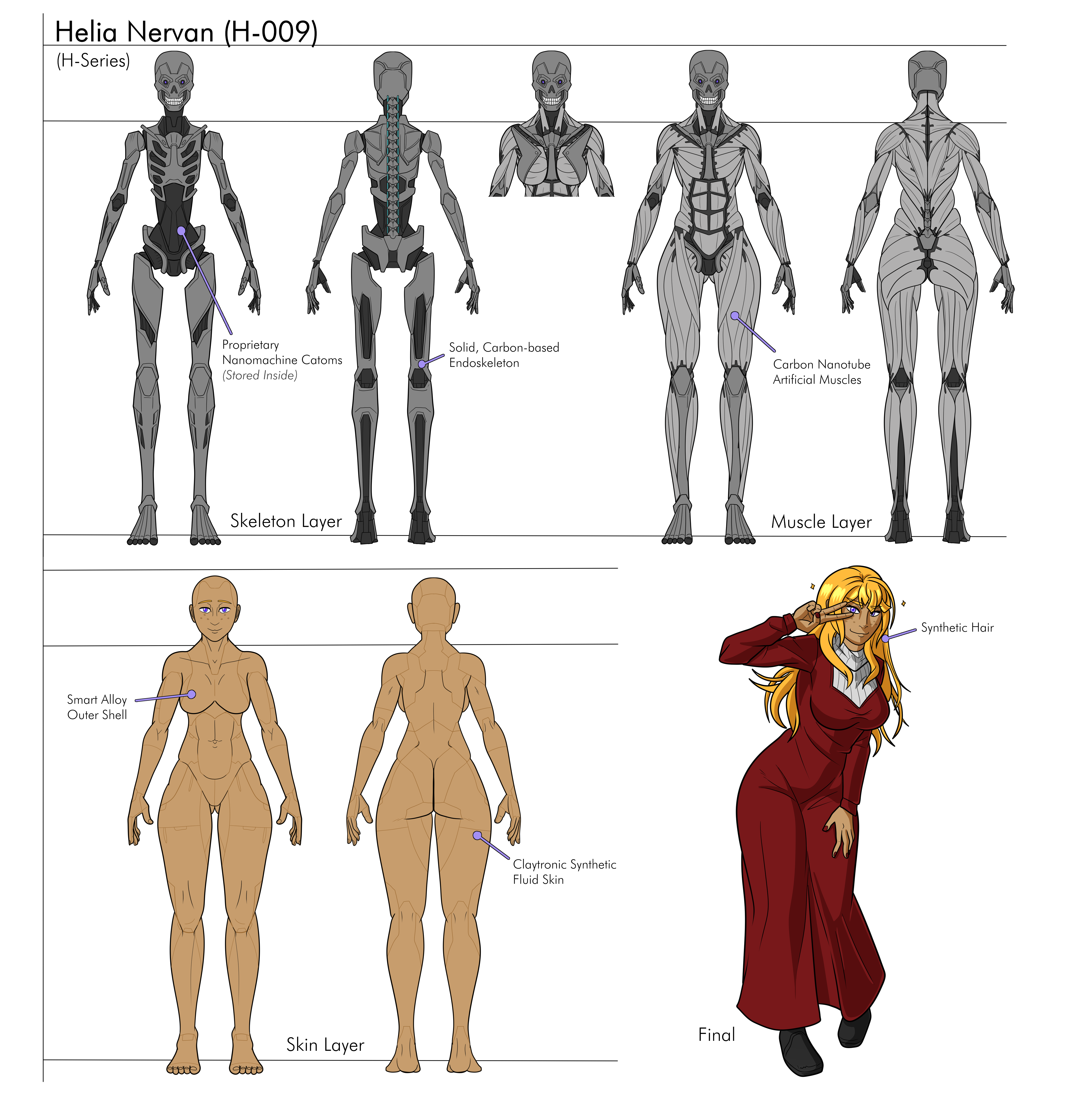
A H-series' construction closely resembles human anatomy:
- A solid, carbon-based endoskeleton, resembling the human skeleton. The endoskeleton is extremely durable, designed to protect the vital components.
- The central chassis houses and protects the internal components of the unit. These components are responsible for regulating energy flow and temperature, and simulating human biological functions such as breathing and heartbeat. A reserve of nanite catoms are also housed in the chassis, maintaining and repairing any damages from natural wear and tear or due to external sources.
- Carbon nanotube artificial muscles, mimicking human musculature. The muscle fibers are able to exert strength and force beyond the unit's appearance.
- A smart alloy outer shell, creating the silhouette. This shell is strong enough to withstand small arms ballistic fire and low-power directed energy, similar to subdermal armor.
- Claytronic synthetic fluid skin, programmable to display the final human appearance. The fluid skin is comparable to the feel of human skin.
- Synthetic hair, generated from the scalp panels. The properties of the hair (color, length, texture) can be generated, repaired, or altered by the nanite catoms.
A H-series can be synced with an external control panel, allowing the user to troubleshoot issues and modify the adjustable features of the unit, although it is at the compliance of the unit itself.


Comments