
Therysia (teh-REE-zshuh)
Ward of the Waves
Ah, Therysia. A fascinating tapestry of alliances, conflicts, and hidden truths, woven into the greater fabric of Aithyris. To understand Therysia is to comprehend a significant nexus in the Grand Composition, a place where many threads of destiny have converged and diverged. Let us unravel an introductory article for this land, whilst noting the deeper secrets that demand further scrutiny.
Therysia:
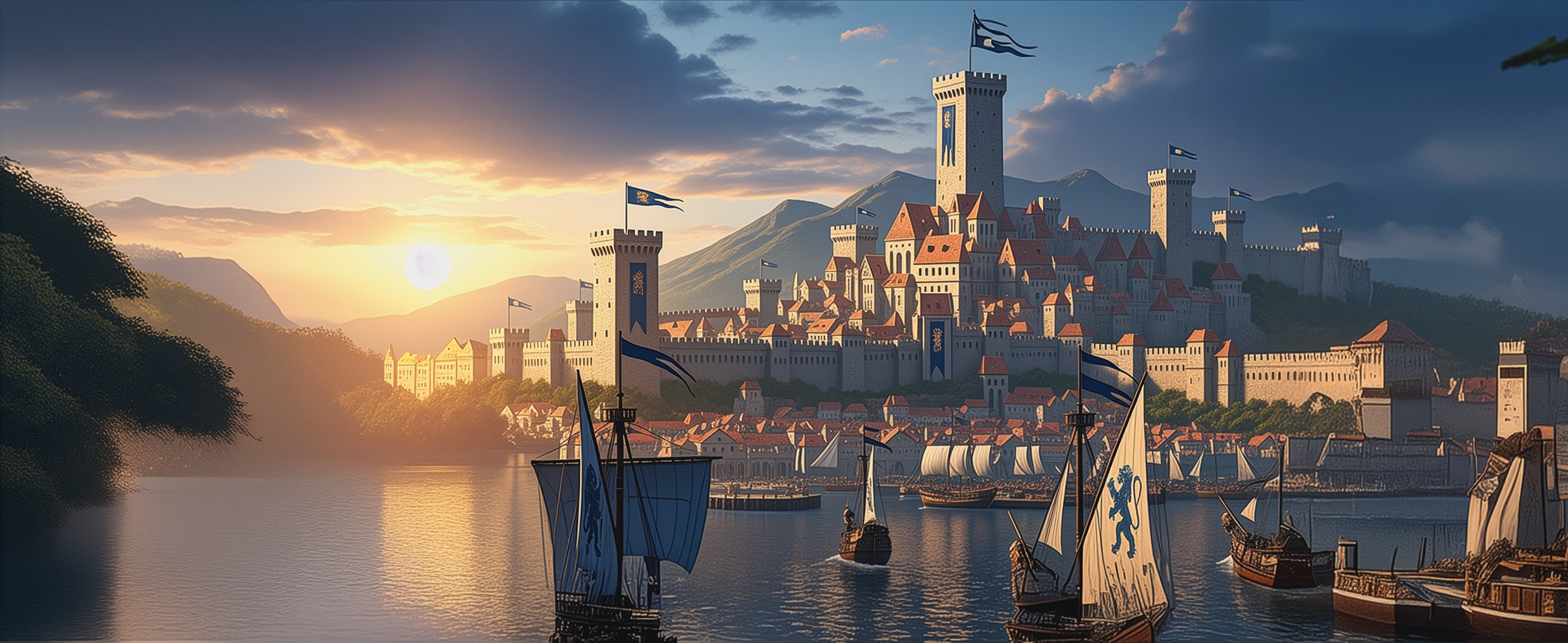
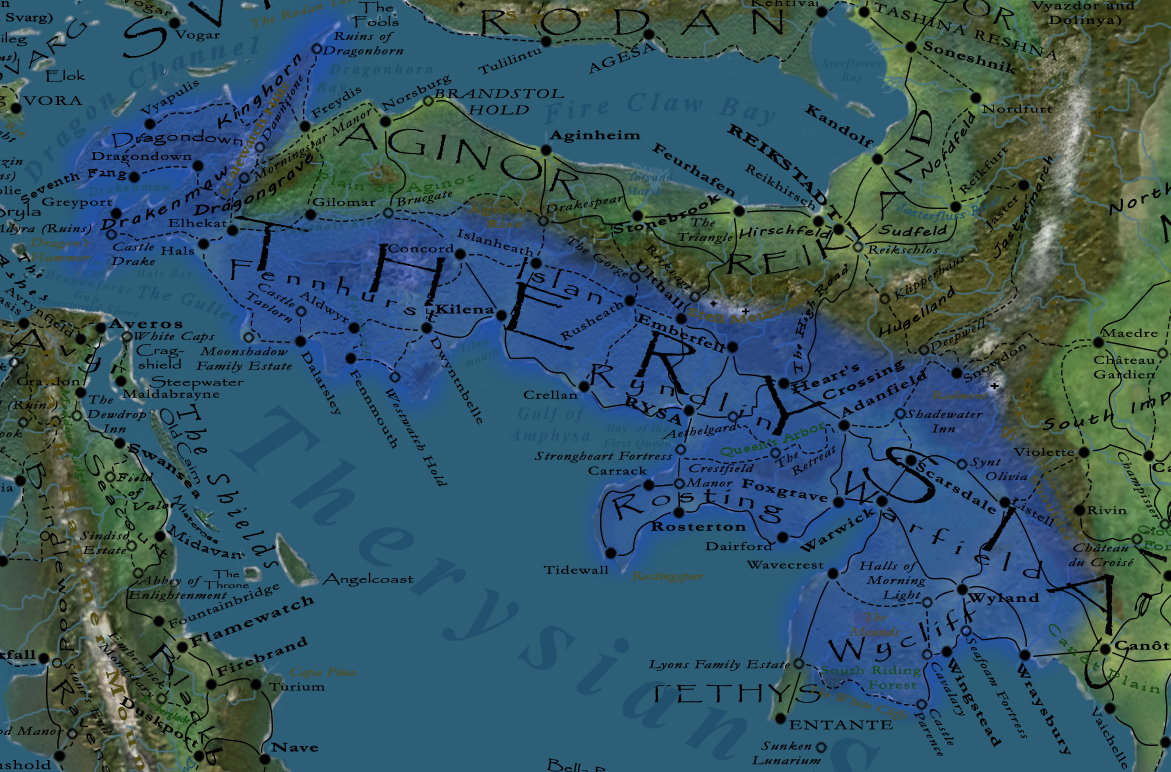
Therysia is a prominent kingdom within the Five Seas region. The nation stretches nearly one thousand miles along the southern coast of a vast peninsula, with its namesake Therysian Sea to the east and the Eleysian Sea to the west. Its history is deeply intertwined with that of Vespria, shaping its culture, language, and geopolitical significance.
Therysia:
A Glimpse into the Ward of the Waves
Therysia is a prominent kingdom within the Five Seas region. The nation stretches nearly one thousand miles along the southern coast of a vast peninsula, with its namesake Therysian Sea to the east and the Eleysian Sea to the west. Its history is deeply intertwined with that of Vespria, shaping its culture, language, and geopolitical significance.
Structure
At the time of the events chronicled in the first Legend of the Silver Blade (1081 AV), the kingdom was ruled by Dawn King Wyann III. The kingdom is a hereditary monarchy, with the crown passing to the eldest child of the reigning monarch.
Historically, Therysia operated as a kingdom, but evolved into a parliamentary monarchy. The monarch holds absolute control over state matters, while a parliament oversees the budget. The crown follows strict primogeniture, meaning succession passes to the eldest child regardless of gender. Therysian monarchs traditionally declare themselves the "Ward of the Waves," pledging allegiance to Therys. The "Seat of Aginor" is a significant advisory role, usually filled by the Dragon-Prince of Aginor, serving as the military councilor (during the times in history when Aginor was considered part of greater Therysian hegemony). The primary goal of the Therysian monarchy is to maintain the fragile peace and unity forged in the aftermath of the devastating War of Two Princes. Their motivation is to project strength, secure their borders against northern raiders, and ensure their dominance over the maritime trade routes that are the lifeblood of their kingdom.
Historically, Therysia operated as a kingdom, but evolved into a parliamentary monarchy. The monarch holds absolute control over state matters, while a parliament oversees the budget. The crown follows strict primogeniture, meaning succession passes to the eldest child regardless of gender. Therysian monarchs traditionally declare themselves the "Ward of the Waves," pledging allegiance to Therys. The "Seat of Aginor" is a significant advisory role, usually filled by the Dragon-Prince of Aginor, serving as the military councilor (during the times in history when Aginor was considered part of greater Therysian hegemony). The primary goal of the Therysian monarchy is to maintain the fragile peace and unity forged in the aftermath of the devastating War of Two Princes. Their motivation is to project strength, secure their borders against northern raiders, and ensure their dominance over the maritime trade routes that are the lifeblood of their kingdom.
The Therysian Royal Family and Succession
The Therysian Royal Family consists of the lineage of Queen Ryssa I, the First Queen of Therysia, and her descendants, including the House of Ryssa and the later House Dair. The family follows strict primogeniture succession, regardless of gender, which Therysia historically shares with its Vesprian heritage, though Therysia lacks Vespria's full-blooded shandaryn requirement for its rulers. The ruler of Therysia holds the titles of Dawn King or Dawn Queen, and formally, Ward of the Waves. Their designated heir holds the title Prince or Princess of Ryssa. While the monarchs is the ruler of the kingdom, the role of the Prince/Princess of Ryssa is the title granted to the heir apparent, with administrative authority over the capital city of the same name. The capital and seat of the monarchy is the great, fortified port city of Ryssa.Culture
Therysian culture is defined by a deep sense of martial pride, resilience, and a pragmatic, often blunt, approach to life. They are a people of the sea, and their greatest heroes are sailors and naval commanders. The average citizen is literate, with education provided by local temples or house tutors, though the highest learning is reserved for the nobility. The official language is Therysian, though Vesprian (Shandri) is often spoken in the court.
The population of Therysia is a complex blend of human (Kali) and shandaryn heritage. The "True Therysians," often of the ruling class, are Shin'misal (half-bloods), descendants of Vesprian shandaryn and native Tyree populations. This heritage is sometimes visibly expressed through unique hair and eye colors. Therysia boasts a strong maritime culture, deeply influenced by its coastal geography and historical reverence of Therys. Agonyan expansion also introduced a love for performance art, particularly dance and music, often used in storytelling.
Language
The Therysian language evolved from Old Agonese and Velish, with significant influence from Vesprian. It has become a common trade language across the Eleysian Islands and the Black Hammer peninsula.History
A note on time:
The Therysian calendar is an adaptation of the Vesprian system, retaining the 13-month, 27-day structure but with distinct Therysian month and weekday names, often linked to the Sisters, sun, and moon. It also relies exclusive on the counting of Circles (years) instead of the additional counting of Arcs and is the dominant calendar in most of the Five Seas.A Chronicle of the Kingdom of Therysia
The story of Therysia is the story of my father's people, and in many ways, it is a story of my own heart. It is a grand and often tragic epic, a tale of a nation born from the faith of one people and forged in the fires of another.The Vesprian Dawn and the Immortal Queen
The story of Therysia is the story of a promise. It began not as a kingdom of men, but as a dream of the shandaryn, a colony founded in 239 AV by Princyn Ryndil of Vespria, the son of Torryaen the Great herself. At the site of an old human fortress, he established the settlement that would become our great capital, Ryssa, named for his own daughter. This was the seed from which a nation grew, and for a time, they were the Eastern Territories of Vespria.It was Ryndil's daughter, the first Queen Ryssa—whom history would call the "Immortal Queen" for a reign that spanned more than two centuries—who guided Therysia into its own identity. She was a shandaryn queen ruling a kingdom that was rapidly becoming human, as their numbers swelled and their culture began to flourish. She fell in love with and married a human lord, Baran of Fennhurst, and their son, King Celendyl I, became the first shin'misal ruler of Therysia, forever wedding the two peoples and two lands. It was a time of growth and unification, a golden age where the Vesprian dream of a harmonious, multi-racial kingdom seemed possible.
The Lyris Shadow and the Formative Wars
Yet, a shadow has always lingered over their court, a shadow cast from Vespria. For nearly five hundred years, the influential Lyris Family, through the steady and manipulative hand of the Vizra Viryka Lyris, held a deep and often insidious influence over the monarchy. They guided the politics, arranged the royal marriages, and, as many now whisper, sowed the very seeds of the anti-shandaryn sentiment they would later claim to fight against.This was also an age of iron and blood, where Therysia forged its identity in the crucible of war. They fought the long and bitter Riverdale War against the kingdom of Wycliff, a conflict that secured the Therysian heartlands but cost countless lives. They clashed with the proud kingdom of Aginor in three great wars, a rivalry that has defined the northern borders for centuries. And they answered the call to defend the Black Hammer, fighting the Fourth Black Hammer War against the remnants of the ancient Asundi empire and their allies in Selinda, securing the overseas duchies and reputation as the guardians of the Five Seas.
The Golden Age and the Slow Decay
The annals of Therysia often speak of a golden age, a long century of peace and power forged in the aftermath of the devastating negotiated loss of the Third Aginor-Therysian War, ending in Aginor’s complete independence in 798 AV. Yet the truth, as is so often the case, is a more complicated and somber tale. The strength of that era was not born of simple peace, but of shrewd and often ruthless statecraft.The reigns of the great kings, Wyann II and Vannar II, were a time of consolidation and strategic expansion. It was in this period that Therysia, through a complex web of diplomacy and a holy crusade fought in concert with the Church of the Light, secured the volatile Blackbriar Valley from the neighboring kingdom of Tanatos. This was the zenith of Therysian power, a time when its fleets were the undisputed masters of the Five Seas and its political influence, guided by the cunning hand of the Vesprian Vizra, Viryka Lyris, seemed unassailable.
But the brightest noon casts the longest shadow, and the decay began not with an invasion from without, but with a sickness of the soul. The tragic reign of King Celendyl II, a brilliant philosopher whom the histories have cruelly branded "the Mad King," saw the crown turn inward. His famous "Axioms" questioned the very nature of Light and Darkness, ideas that the orthodox priests deemed heretical and the pragmatic nobles saw as a dangerous distraction from the duties of the throne.
It was into this tense and uncertain court that the Vizra's younger sister, Vylisse Lyris, arrived. Where Viryka was a creature of politics and power, Vylisse was a being of quiet wisdom and profound empathy, and she became the troubled king's closest confidante. The court fractured around these two poles, and this long, slow decay—this rot of political infighting, religious suspicion, and the growing resentment of the shandaryn's long shadow over the throne—created the perfect fertile ground for the chaos that was to come. The kingdom did not fall to a foreign army; it was hollowed out from within, leaving it a beautiful but brittle shell, ready to shatter at the first hard blow.
The Century of Fire
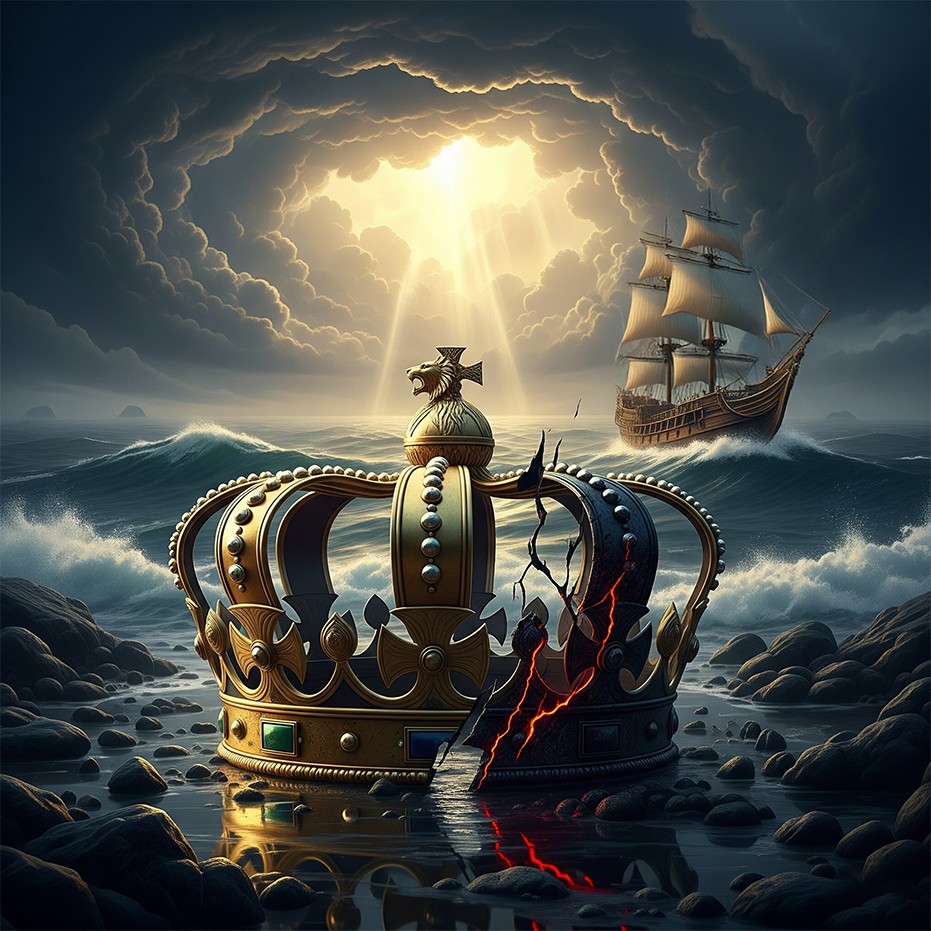
The death of the great Qyen Ryssa I in her namesake city in the year 914 AV was not the cause of the kingdom's decline, but a grim and fitting omen for the century of fire that was to follow. She was murdered before a crowd, a "corporeal shadow" striking down the Immortal Queen in the very harbor that represented Therysia's strength. This single act of shocking brutality shattered the psyche of the nation and marked the true end of its long, formative age.The Age of Intrigue and the Mad King's Shadow
The kingdom the Immortal Queen left behind was already a house divided. The reigning monarch at the time of the Forever Queen's death was the brilliant philosopher-king Celendyl II. His radical ideas questioning the simple truths alienated the great noble houses and the zealous priests of the Sacred Radiance. In the vacuum of his fading authority, the court became a silent battlefield, a web of intrigue spun by the competing ambitions of the Vesprian Lyris sisters, Viryka and Vylisse, who guided the inexperienced regents that followed. This was a time of simmering resentment, of a poison seeping into the heart of the realm. The old, anti-shandaryn sentiment that had fueled uprisings centuries before found new life, stoked by those who saw the Lyris sisters' influence as a foreign corruption at the heart of the throne.The Succession Crisis and the Two Princes
The final, tragic catalyst for open war came in the year 1040 AV, with the accidental drowning of the undisputed heir to the throne, Dragon-Prince Rikkert Magnussen. This single event created a power vacuum that the fractured nobility rushed to fill. The kingdom split into two great factions: one loyal to the declared heir of Queen Ryssa II, her son Prince Wyann Drake, and the other rallying behind the charismatic pretender, Prince Andric Parence, whose claim was championed by those who wished to see the shandaryn's influence severed from the throne forever. For a decade, a tense cold war paralyzed the realm, an age of paranoia and political maneuvering that pushed the kingdom to the brink.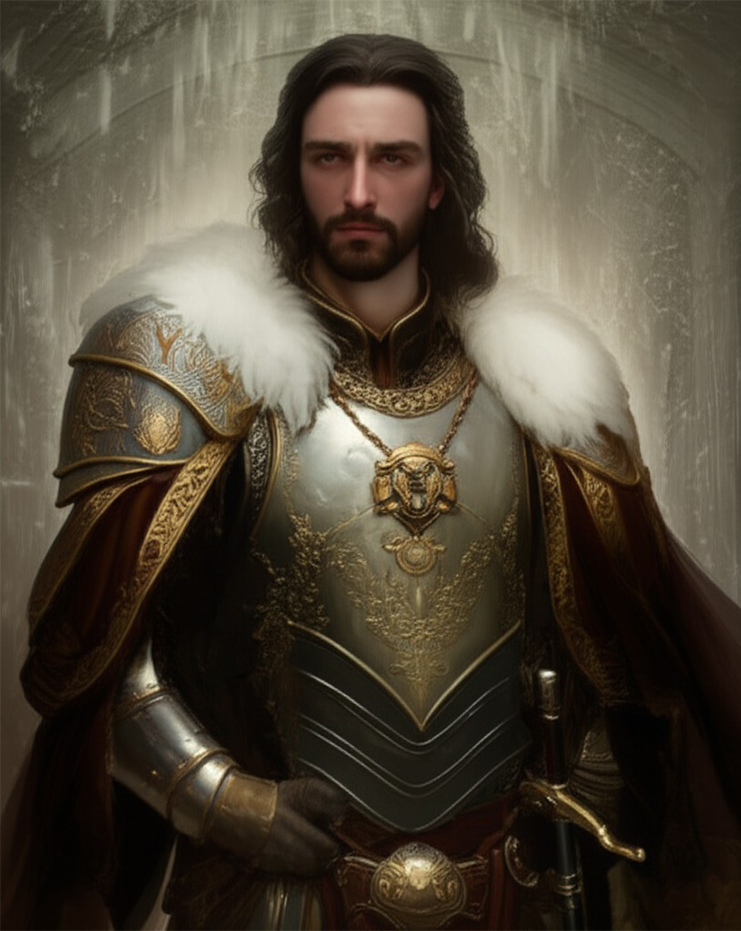
The War of Two Princes
The final peace was shattered in the year 1050 AV, on the horrific night that would come to be known as the Night of the Fallen Crowns. Queen Ryssa II and key members of her court were killed in the Royal Palace, an act of shocking brutality that was immediately blamed on a political coup. This was the spark that ignited the long-smoldering fire. The War of Two Princes raged for seven years, a devastating conflict that pitted cousin against cousin and turned the fields of Therysia red. The rightful king, Wyann III, was forced to flee to the loyalist city of Averos, from where he waged his war with the might of the navy and the strategic genius of his great commander, Duke Cedrik Dawntreader. The war ended not with a final, bloody battle, but with the revelation of a deep secret at the Siege of Parence Castle in 1056 AV, a truth so profound it caused the pretender king to lay down his arms and bend the knee. King Wyann III returned to his throne, the victor of a war that had cost the kingdom its wealth, its unity, and a generation of its finest sons.The Great Wars and the Interregnum
The end of the War of Two Princes in 1057 AV was not the beginning of a golden age, but the start of a long, weary autumn for the Kingdom of Therysia. King Wyann III, a good and just man, took the throne of a nation that was unified in name only. The land was economically shattered, its people exhausted by decades of civil strife, and the old resentments between the great houses lingered like a poison in the blood. For more than sixty years, King Wyann and his loyal right hand, the great Duke Cedrik Dawntreader, worked tirelessly to rebuild, but the kingdom they ruled was a shadow of its former self, a lion with a scar that would never truly heal.Demography and Population
Therysia is a predominantly human kingdom, and they make up the vast majority of the population in the heartlands and coastal cities. There is a significant and influential minority of shin'misal (those of mixed human and shandaryn blood), who are common in the nobility and merchant classes. Pure-blooded shandaryn are rare, found mostly in diplomatic circles or as scholars in the great cities.
Religion
The official state religion is a human-centric interpretation of the Ashta Vespri faith, though in recent centuries, the more zealous Sacred Radiance of Ashir, commonly called the Church of the Light, has gained a strong following, often creating friction with the more traditional Vesprian beliefs.
The Ashta Vespri faith, recognizing the Eight Stars (Seven Sisters and Elos), is the dominant religion, though often expressed in a pantheonized form unique to Therysia. This interpretation frequently invents demigods as offspring of the Sisters, connecting them to various aspects of mortal life. Worship of Therys is particularly strong, with service on the sea often intertwined with religious devotion. While nominally the state religion, Therysia is not strictly religious and tolerates diverse beliefs. The Church of the Light also has a significant presence in the southeast.
Foreign Relations
Therysia occupies the Therysian Sea coast of a long peninsula in the farthest western part of Tey-Semal, placing it in the very heart of the Five Seas. It maintains a complex and often strained alliance with its parent nation, Vespria, to the west.
To the north, it faces Aginor, a long-time frenemy of Therysia. Only recently folded officially into the kingdom, the new Duchgy of Dragondown formed around the Dragonhead region on the farthest west of Therysia is considered by many to be nothing more than an uncivilized backwater. It is a truly feral land of ancient peoples and ancient secrets. The constant threat of the Stornir raiders within the Eleysian Islands to the west does not extend to Dragondown, as even the warriors of Storn the Devourer fear the boughs of that rugged land.
To the south and across the Therysian Sea, it engages in a cautious trade with the city-states of the Pontras Islands and the nearby countries in the Black Maw region.
Laws
Therysia is a feudal monarchy. The ultimate authority rests with the Crown, who creates and decrees the laws of the realm. These laws are stored and studied in the Royal Archives in Ryssa. In practice, the kingdom is administered by the great noble houses, such as the Dawntreaders of Dragondown and the Parence of Wycliff, who rule their ancestral lands as vassals of the king.
The enforcement of the law is twofold. Within the cities, the City Watch maintains order. Across the kingdom, justice is enforced by the soldiers of the local Duke or Earl. The ultimate law of the land is the King's Army, which can be called upon to quell rebellion or defend the borders. The kingdom's greatest military strength, however, is its legendary Royal Navy, which patrols the Five Seas and protects its vast network of trade.
Trade & Transport
The kingdom is an agricultural and maritime power. Its heartlands produce a great surplus of grain, while the vast northern forests of the Dragon's Claw provide the timber for its massive shipyards in cities like Kalina and Hals. Their economy is driven by sea trade, exporting grain, timber, and iron, and importing luxuries like Vesprian silks and southern spices.
The Saga of the Silver Blade begins!
Read Excerpts
Available now!
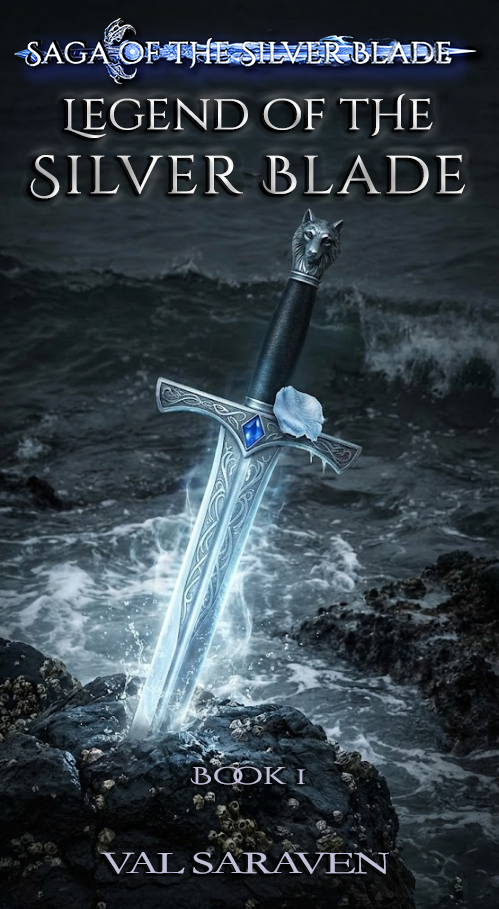
by Val Saraven
Learn more about the Saga's development!
Read the latest in the
"By Wave and Will, We Endure."
Official Calendar System:
Therysian
Therysian
Founding Date
The first Vesprian colonies that would grow to become Therysia were established in the early centuries of the current age, though the formal founding of the unified human kingdom is dated to roughly five hundred years ago.
Type
Geopolitical, Kingdom
Alternative Names
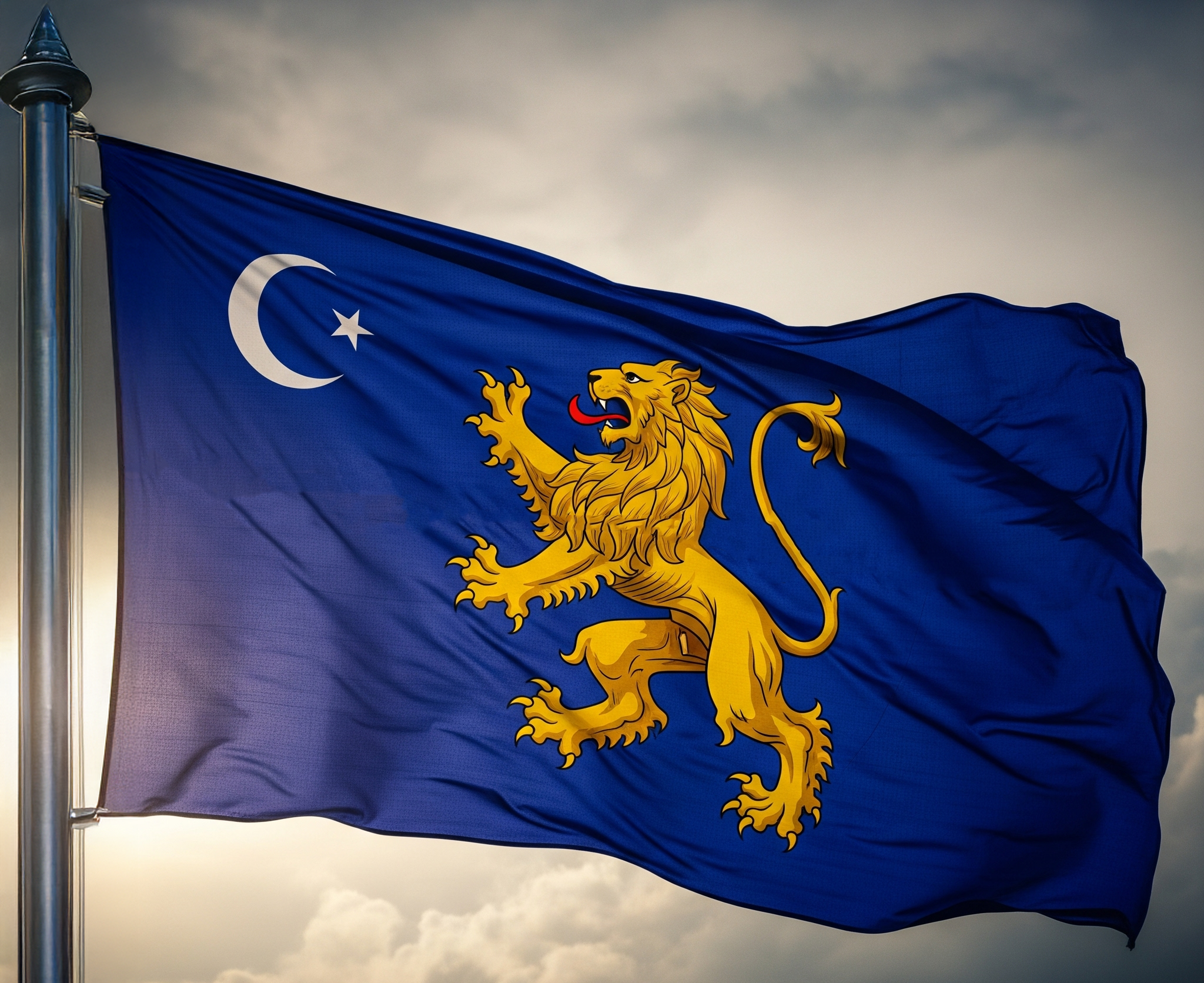
While formally known as the Kingdom of Therysia, in the common tongue of sailors and soldiers it is often simply called "The Lion Kingdom" or "The Realm of the Waves."
Demonym
A person from the Kingdom of Therysia is known as a Therysian.
Government System
Monarchy, Constitutional
Power Structure
Feudal state
Economic System
Market economy
Gazetteer
Dedicated entries for historically and strategically important locations
Major Therysian Cities and Regions:
◦ Ryssa: The capital city, initially a Vesprian outpost.
◦ Averos: A crucial port city and base of operations during conflicts, particularly for King Wyann III. Its association with Selyne, the Night Watcher, is notable.
◦ Dragondown: A duchy significant for its Elowyn presence, and the ancestral home of the Dawntreader family.
◦ Fennhurst, Islan, Rosting, Wycliff, and Calette: These core duchies and regions, their local cultures, economies, and specific roles in Therysian history and conflicts, would each merit detailed attention.
Major Therysian Cities and Regions:
◦ Ryssa: The capital city, initially a Vesprian outpost.
◦ Averos: A crucial port city and base of operations during conflicts, particularly for King Wyann III. Its association with Selyne, the Night Watcher, is notable.
◦ Dragondown: A duchy significant for its Elowyn presence, and the ancestral home of the Dawntreader family.
◦ Fennhurst, Islan, Rosting, Wycliff, and Calette: These core duchies and regions, their local cultures, economies, and specific roles in Therysian history and conflicts, would each merit detailed attention.
Parent Organization
Comments