
Structural Development of the Saga
Thirteen novels. That's the plan.
I suppose the real question is: Why did I choose thirteen?
Thirteen is a cool number. That is initially how I decided there would be thirteen books. When I attempted to outline the Saga for the first time in 2014, I had it broken into ten--which I already thought excessive at the time. In 2023, I reconstructed that outline and am using an evolved version of that reconstructed outline today. By the time of the reconstruction, I knew a lot more about the setting, characters, and intended plot. By that point, I'd reverse-engineered thirteen into a perfectly logical number within the greater context of the Saga. Now, I would cut or add things to keep it at thirteen, but thirteen I intend for it to forever remain, whether or not I get a chance to write them all (the entire plot of the Saga, including the ending, are already done, so it shouldn't be a mystery). It's all already too full to really add more. Even Book 1, I practically cut in half to keep its size down.
External Structure
For the sake of avoiding spoilers, I will show you simply how I have it organized, without providing names of any books. Le
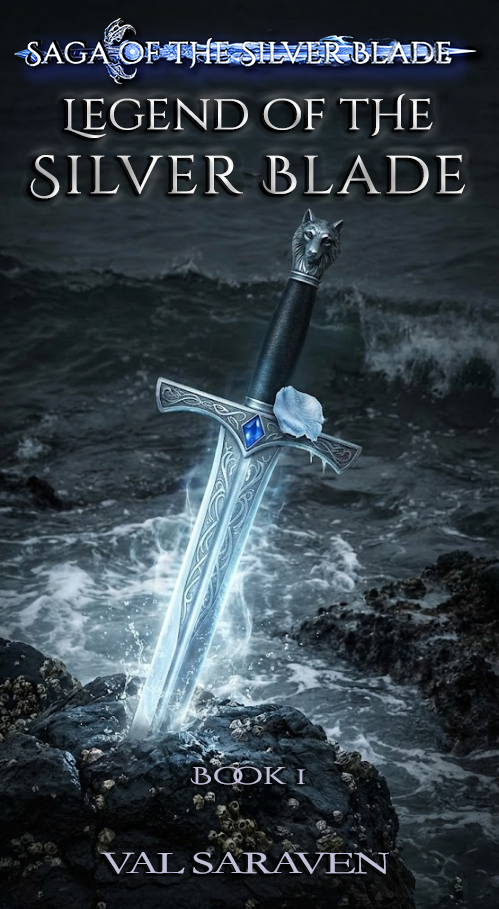
Book 1: Legend of the Silver Blade
This book, set in the year 1081 AV, is the foundational chapter of the [[Saga of the Silver Blade. Think of it as the chips and salsa before the epic order. This self-contained novel performs massive lifting in the background, subtly setting up the entire Saga, including threads that won't resolve until Book 13.
Books 2 - 4: Arc 1, The Shadows of Syruun
This is the first trilogy, known as Arc 1. The [[Arc references the nine-year unit of time used in shandaryn timekeeping, and each trilogy is intended to span approximately that duration. The Shadows of Syruun sets up the core generation of protagonists and ignites the true inciting conflict for the entire Saga.
Book 5: A Raven's Song
A Raven's Song functions as a self-contained bridge novel between the first and second Arcs. It introduces the next generation of players and connects Arc 1 to the plot of Arc 2. However, revelations are key, so the series is intended to be read in sequence.
Books 6-8: Arc 2, A Symphony of Shadows
This is the midpoint of the entire Saga, where many of the characters introduced in Book 5 are set loose to confront the world left to them by their elders. By doing so, they create the world that the next generation must shoulder.
Book 9-13: Arc 3, The Winds of Sarakas
This Arc became necessary as a quintet—a continuous, climatic campaign—to contain the plot and the characters. By this point, generations are intertwined in a frantic, existential race against a total threat. The final solution comes in Book 13.
While the first two Arcs and first two individual novels can technically be read in any order, reading them out of order will spoil hidden revelations in the earlier books. For some, that only adds to the fun. I'm not going to tell you how best to enjoy the series. But Arc 3 would be very difficult to follow without the foundation set by the preceding works. And, while technically I think the first four books of the Winds of Sarakas could stand-alone, Book 13 absolutely requires an understanding of the choices and consequences of multiple lineages across several generations.
It's epic fantasy; it was necessary for the ending.
Internal Structure
The Saga is structured to reflect a deep, generational responsibility. The plot deliberately prevents one set of heroes from completing the task, ensuring the burden and the knowledge are passed down:
The Inheritance of Trauma:
The plot often begins with a catastrophic failure—the murder of one hero, the loss of a sacred artifact, or the complete destruction of a sanctuary. This creates a moment of despair that is the inciting motivation for the next generation of protagonists. The story moves forward because the last one suffered an irreversible loss.
The Bridge Structure:
The narrative unfolds in distinct, sequential arcs, separated by periods of profound, quiet consequence. These "bridge" periods are essential design features; they represent the necessary time the world's most powerful forces (both light and dark) require to reposition and prepare the "board" for the next major conflict.
The Architecture of Deception
The plot is driven by information and misdirection, making the Saga fundamentally an espionage thriller built upon the concept of artistry having consequential effects on reality (Artpunk/Musicpunk). Every single action matters because everything affects the future—but determining which actions are impactful and which are mere misdirection is the constant challenge.
False Victories:
The narrative is built on the reality that the enemy is always several steps ahead. When the heroes achieve a grand, hard-won victory—such as defeating a major antagonist or reclaiming a powerful artifact—that victory is often a calculated sacrifice allowed by the true mastermind. The plot immediately shifts to reveal that this success was merely the enemy paying a small price to move on to a greater goal.
The Evolving Antagonist:
The threat is never static. The heroes believe they are fighting a singular monster, only for the narrative to evolve. The defeat of one major villain only reveals that they were a pawn, a puppet, or a lie designed to distract the heroes from the source of the true power. The enemy is a chameleon, forcing the heroes—and the reader—to continually question what they think they know about the final confrontation.
The Saga of the Silver Blade begins!
Read Excerpts
Available now!
Status of the Saga
I'm going to straight up call out Brandon Sanderson on this one. I always loved how he presented a status of his works on his main page. I endeavor to do something similar, but this is the current form of that effort.Book 1: Legend of the Silver Blade
Detailed Outline: CompleteRough Draft: Complete
First Draft:
In Progress
Book 2: The Silver Serpent (working title)
Detailed Outline: CompleteRough Draft: Complete
Book 3
Detailed Outline: CompleteRough Draft: Complete
Book 4
Detailed Outline: CompleteRough Draft: Complete
Book 5
Detailed Outline: CompleteRough Draft: Complete
Book 6
Detailed Outline: CompleteRough Draft: Complete
Book 7
Detailed Outline: CompleteRough Draft: Complete
Book 8
Detailed Outline: CompleteRough Draft: Complete
Book 9
Detailed Outline: CompleteRough Draft: Complete
Book 10
Detailed Outline: CompleteRough Draft: Complete
Book 11
Detailed Outline: CompleteRough Draft: Complete
Book 12
Detailed Outline: CompleteRough Draft: Complete
Book 13
Detailed Outline: CompleteRough Draft: Complete
The Living Saga
Side Stories & Hidden Chronicles
The Saga expands beyond its thirteen novels. I plan to produce numerous short stories that delve into the world's hidden corners, often focusing on events between the main arcs. For example, the pivotal Fall of Ciermanuinn is perfect for a short story, as are the personal adventures of characters during the Bridge periods. My goal is to continually flesh out this living world, transforming the silence between books into its own rich history.The Game Board of Eternity
I have developed the world with expansion in mind, including detailed geopolitics for a deck-building game and a board game based on the volatile Five Seas. The setting offers millennia of history, detailed factions, and over a century of continuous lore post-Book 1. I am eager to partner with creative artists who need a deeply developed story framework for their RPGs or game concepts, allowing the world to imprint upon the dynamic player actions—as long as the plot remains safe.Art, Song, and Philosophy
Music is the Heart:I am not a musician, but the Eternal Song flows through the Saga. I believe there is an infinite wellspring of musical inspiration here, ripe for interpretation by artists who feel the melody of human experience explored within.
Visualizing the Epic:
The Saga is truly meant to be conveyed through art. I use GenAI as a tool to manage this massive epic and create base images specific to my vision of the Saga. But I seek partnership with human graphic artists. No generated image can replace the emotional resonance born from the raw human experience. I would love to be a platform for other artists, just as I hope to find an audience myself.
The Twilight Foundation:
The Saga unexpectedly led to the development of a non-dogmatic universal ethical philosophy inspired by the Eternal Song. This philosophy is a deeply explored application of the story's principles to the modern world, founded on the idea that there must be a better way than repeating the failures of our ancestors. You can visit our Twilight Foundation for more information on this real-world ethical application.
Comments