
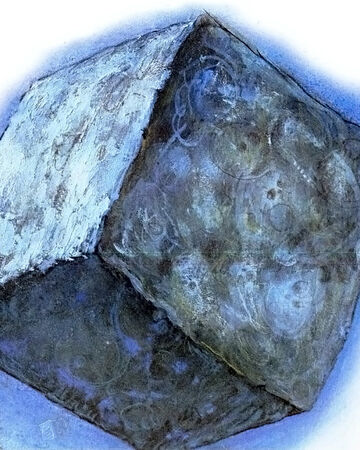
Acheron (ac-he-ron)
(https://forgottenrealms.fandom.com/wiki/Acheron)
The Infinite Battlefield of Acheron was an Outer Plane in the Great Wheel cosmology model, representing alignments between lawful evil and lawful neutral, with an emphasis on law. Some characteristics of this plane were attributed to the World Tree cosmology planes of Clangor, Nishrek, and Warrior's Rest when that cosmology gained popularity. Nishrek and Warrior's Rest survived the Spellplague and became part of the World Axis cosmology model.
Inhabitants:
The principal inhabitants of Acheron were the spirit legions occupying Avalas. They were made up of the spirits of humans, dwarves, halflings, ogres, and many other mindless soldiers who died in wars after forgetting their purpose; those for whom war became an end in itself. The spirits would congregate with others of similar beliefs or alignment and form nations on the surface of a block. They would fight to control a block and then join forces to conquer another block when it came within their reach. Legion members who were slain in battle would return with full strength within 24 hours, ready to fight again. The orc and goblinoid spirit legions shared the same large block in Avalas and besieged one another regularly.
Other creatures that could be found in Acheron were wandering imps, rust monsters, achaierai, and occasionally devils and modrons.
Geography
Acheron was the bridge between the ultimate order of Nirvana and the regimented evil of the Nine Hells, and as such, each layer emphasised order over evil. The land masses on each layer were blocks of geometric simplicity, the size of nations, floating in a sea of air. The blocks would slowly collide and part without causing any upheaval or tremor, allowing beings to move to a new block if desired. The dance of the blocks was carefully orchestrated, and creatures of high intelligence could usually discern a pattern for an area by studying the motions of the blocks. It was said that gravity pulled toward the centre of the blocks, but in practical terms, gravity was normal to each surface.
Avalas:
Acheron was sometimes known as the "iron-shod battle planes of Acheron" due to the characteristics of the first layer, Avalas. The blocks of the top plane were black with a metallic hardness that allowed the sounds of battle and troop movements to reverberate loudly. Avalas had the most block-like worlds and the highest population as the armies of the Outer Planes spent their afterlife clashing in neutral territory over differences both subtle and gross. The landscape consisted of cone-shaped mountains and pits, plus the iron fortresses of the various armies. The only other remarkable feature of this layer was the river Styx that would bubble up from one pit, meander across two or three sides of a block, and then disappear down another pit. The Styx did not visit all the blocks, but those it did could be reached by Charon and his servants.
Avalas touched the Astral Plane and had spherical portals to the three adjacent planes: Nirvana, the Nine Hells, and Concordant Opposition. The portals hung at fixed locations in space and would pass harmlessly through the blocks, becoming inactive while inside a block and reactivating when they reappeared. Anyone emerging from a portal would start to fall toward the nearest block and almost certainly require some form of flight to avoid a high-velocity impact. The portals were activated by touch, and the destination could be determined by the sound it made when activated. A harmonious chord indicated a portal to Nirvana, a dissonant chord meant the Nine Hells, and silence indicated Concordant Opposition.
Avalas was the location of the orc realm of Nishrek and the goblin realm of Clangor. Bane's realm, the Black Bastion, was also on Avalas. Gilgeam's realm, Zigguraxus, existed here until that god's death.
Thuldanin:
This layer was the Sargasso Sea, the graveyard of elephants, and a scrap heap for countless contraptions, creations, weapons, armour, failed experiments, broken devices, fallen buildings, and shipwrecks of both sea and air. The blocks of Thuldanin were hollow and pockmarked with pits that led to the interior a few miles/kilometres down. There, the flotsam and jetsam of the ages turned to stone in a matter of days or weeks due to the magic of this layer. Thuldanin had no inhabitants, only the occasional visitor from Avalas looking for some piece of magic or technology that might turn the tide of battle.
Tintibulus:
The third layer of Acheron had blocks different from those of the other layers. Here, the blocks were made of grey volcanic stone, and their faces had six, eight, or even more edges. When the blocks of Tintibulus collided, the surfaces would fracture along natural fault lines into hexagons, great and small. This layer had no inhabitants but was attractive to magical researchers for its emptiness and isolation.
Ocanthus:
The blocks of the fourth and final layer were square and so razor-thin as to be almost two-dimensional. They ranged in size from a few inches/centimetres to several miles/kilometres across. Both sides of the hard black squares had normal gravity pulling to the surface and could be walked upon. Being hit by the edge of one of these razor-sharp squares could be deadly.

Comments