

Malkere
Malkere is a large island off the southeast coast of Alvaron, approximately 300 miles long and 100 miles wide at its widest point. It is dominated by the White Mountains in the southwest of the island and Annon's Teeth, a short but steep mountain chain in the northeast. Between them lies a sizeable forest known as The Timbers.
Government & Politics
Malkere does not have an organized central government or authority. Each town and city has a council, elected from influential clans or groups, which governs in any matters that cannot be handled by heads of households. These influential clans and groups, in the larger towns and in the two cities, are usually tied to one of the more important guilds on the island: Malkerans have a commercially focused culture.
An exception to this is the Old Citadel within Alden Port. There, the four Tower Captains select a Commander who effectively rules the enclave as an autocrat. It should be noted that the Commodore of Alden Port must technically give his blessing to this selection, though the Tower Captains have been known to ignore the Commodore in the past. The Old Citadel is a city within the city and also maintains the only consistent standing military on Malkere. While Malken Fey does have a city watch, there are guild guards in most towns, and the Teamsters Guild employs guards to maintain the safety of the main roads (at least the ones that they use) - these are all prone to corruption and not particularly interested in the safety of the general public. It is wise, when on Malkere, to ensure that you can protect yourself.
Demographics
The people of Malkere are primarily humans, descended from two peoples. The natives, whose name for themselves is lost to time, have almost entirely been assimilated into the main population of settlers who came to the island nearly 500 years ago from Alvaron. The lowlands and towns are nearly entirely populated by a people who are a mixture of the colonizers and natives. There are some few isolated pockets of natives that still live in The White Mountains and Annon's Teeth, worshipping their old gods and living in their old ways.
There is a relatively even mix of town/urban and rural folk on the island. The towns are small with seasonal populations based on the need for labor. The two cities are not large, but do have a solid population base. The shipbuilding and shipping trades that dominate these cities provide for a stable means of living for their inhabitants.
This industry and the cities also provide for the influx of the small minority of foreigners that live on Malkere (almost exclusively in the cities). There are even some more exotic folk that have decided to make the island their home - they are common enough that in the cities the appearance of exotics is perhaps the occasion for a remark or two, but not much of a reaction otherwise.
Culture
Malkeran culture is focused on trade and shipping. Malkeran people are proud not to have a King or Council that rules over their island, and tend to ignore the downsides of this arrangement when "discussing" it with foreigners. The guilds on Malkere have significant power, and this is certainly a dominant cultural aspect. It is an expectation that any young man or woman will join whatever the family business is, learning the trade of the family, and supporting that business. This is a stronger cultural norm than even religious observance.
The Malkeran language is, in many ways, similar to several of the languages of eastern Alvaron, though distinct enough to be mutually unintelligible.
Malkeran religion is based around mythical and legendary figures tied to the Malkeran Constellations, with rituals aligned to folks festivals that differ from village to village. There are strong familial and clan traditions that dictate how worship is conducted; an outsider might see a hodge-podge of individual superstitions, though in reality these clan traditions are old and interwoven through the communal celebrations in each village festival.
Malkerans value honest trade and a good deal, reasonable risk-taking and courage, and family above all. They do not have much use for values that do not support these ideals. For instance, it would be admirable to a Malkeran for someone to take on a dangerous task (such as retrieving a missing item or person) if they were being well-paid for it or if some family value or tie were being invoked. If, however, some general sense of "honor" or "doing the right thing" were the reason and there were no payment and nobody's family were involved, it would seem strange to a Malkeran to do it. This has earned Malkerans a reputation in the broader world for being motivated entirely by profit; perhaps a bit of an earned reputation. A more generous interpretation might be that Malkerans are extremely pragmatic.
Pre-colonial natives of Malkere are a different people. They call themselves the Rhémari. The few that remain live in isolated communities deep in the forest or high in the mountains of the island, and retain enough of their ancestral ways to be recognizably distinct from the main population. The Rhémari are animistic, spiritual, and secretive. They do share a deep sense of pragmatism with their neighbors, though theirs is rooted in necessity; they must be practical in order to survive. The natives operate on an economy of direct exchange and primarily use money when dealing with the colonial population. Their language and customs are very different, and they are seen as strange and even feared by some for their differences. Rhémari customs include a reverence for natural things, regular sacrifices to local spirits, and several rites of passage for men and women at particular points in life. They have an unmatched ability to work wood, and some say that the best Malken Fey shipwrights have Rhémari ancestry.
Geography
The White Mountains
This mountain chain runs for approximately 150 miles along the southwest coast of Malkere, providing a barrier between the island's "interior" and the Sea of Spears to the west. The mountains are higher are larger in the northern part of their chain, being made up of large granite massifs. As the chain trails southward, the peaks soften and the granite is gradually replaced by limestone. Iron and tin deposits are found in the north of the mountains, while some copper can be found in the south.
Annon's Teeth
These mountains rise suddenly and steeply in the north of the island of Malkere, and contain the tallest peaks on the island. It is a short chain, less than 100 miles long, and is made up largely of limestone and metamorphic rock. There are some deposits of marble as well. Much of the stone used for building across Malkere is quarried from these mountains.
The Timbers
The largest forest on Malkere is a mixed deciduous and conifer forest containing primarily elm, oak, beech, cedar, and pine. The cedar and oak in this forest are well known as excellent sources of ship-building wood. The southwestern edge of the forest climbs the slopes of the White Mountains, while the eastern edges sprawl over Malkere's central lowlands. The Revel Road bisects the forest from east to west and the town of Mayfair sits near its eastern end. Much of the rest of the forest is dense and not well traveled, being home to bandits, outlaws, and dangerous wildlife.
The Downs
At the eastern end of Malkere lie The Downs, a set of chalky hills through which passes the Malken River. These hills rise in successive ridges from the river valley toward the southeast coast of the island, where they meet the eroding waves of the Red Sea. The South Downs, west of Malken Fey are gentler and home to numerous flocks of sheep. The East Downs are more pronounced, windswept, and relatively devoid of settlement except for the chalk-mining town of Calic Tor. On the far north of the East Downs stands the ancient Tower of Ohn.
Timbrel River
The Timbrel River rises in the southern White Mountains, and flows northeast along their flank until reaching a great bend in that mountain chain. The river then turns southeast, widens and slows, and flows across the width of the island where it empties in the Red Sea at Alden Port through marshy delta land. The river is navigable by barges and small boats from Alden Port all the way up to Braelin except in the spring, when snow melt floods make passage too dangerous. At other times of the year, the Timbrel River is an important economic highway, bringing timber and ore from the interior of Malkere to the port city at the river's mouth.
Malken River
The Malken River originates in the center of Malkere, flowing northeast until it meets a tributary from Annon's Teeth, where it turns southeast to flow to the Red Sea. Along the way a tributary from the East Downs joins the river. The river is largely not navigable, being fast-running with many rapids. It is a favorite spawning ground for salmon from the Eastern Ocean.
Central Farmlands
The lowlands south of The Timbers and west of the South Downs are dotted with farmsteads. This area of Malkere provides most of the food for the people of the island. The markets of Dryfer, situated near the eastern edge of the farmlands, are where a majority of goods produced in this region are sold for transport elsewhere on the island. Wheat, barley, oats, various vegetables, goats, small dairy cows, and some sheep on the East Downs are all produced here. A significant number of farmers also cultivate elderberries, which are dried and sold in quantity to the ship provisioners of Malken Fey and Alden Port.
Southern Pasturelands
The southern end of Malkere, surrounding the town of Revel, is made up of gentle rolling grasslands rising gently from the Red Sea to the east to the southern foothills of the White Mountains to the west. This region is known for its larger livestock - primarily horses and cattle. The grasslands see seasonal rains and are relatively dry, which requires the digging of wells. Luckily, the substrate is soft shell limestone, and its porous nature is both easy to dig and is able to maintain a high water table.
The Passage
Between the islands of Malkere and Eridal lies a strait known as The Passage. This strait provides ships a quick path between the Red Sea to the east and the Sea of Spears to the west. However, it is shallow and full of dangerous currents. During the stormy seasons in the spring and fall, many sailors will opt to take the long route either all the way around Eridal or to the north around the end of Malkere (depending on their ultimate destination). The Passage empties westward directly into some of the most dangerous waters in the Sea of Spears, with unpredictable currents, uncharted reefs, and plentiful rocky promontories to avoid. Even during calm seasons, only experienced captains will take The Passage confidently.
Climate
Malkere has a temperate climate, largely protected against harsh storms from the prevailing northeast trade winds by the White Mountains and Annon's Teeth.
Winters on Malkere can be cold, though not extremely so. The White Mountains and Annon's Teeth often will become snow-packed in winter months. It is rare for heavy snows to fall in the lowlands, though there are rare flurries or dustings, and it does freeze in the deep winter months.
Spring can be sudden and violent, with snowmelt from the mountains swelling the two main rivers of the island and storms from the west and south raking across the land.
Summer is generally mild, with periodic gentle rainfall and moderate temperatures. It rarely gets unbearably warm on Malkere.
Fall is again a stormy season, though these storms are more rare and come from the east where Malkere is not protected by its mountains. Otherwise, this is a season of cool rain and cool temperatures.
Fauna & Flora
Malkere is a land of vivid contrasts, where the rolling Downs give way to dense woodlands, winding rivers, and the foothills of the White Mountains. Its flora and fauna reflect this diversity, offering both bounty and peril to its inhabitants. The island's rivers, most notably the Malken, teem with the Malken Silverback Salmon, whose annual spawning run draws bears, otters, and fishermen alike. These salmon form a staple of local trade, their smoked fillets a prized commodity in Malken Fey and beyond. Along many riverbanks, the delicate Silverstream Moss thrives, prized for its medicinal uses, while Malken River Reeds provide materials for baskets, fish traps, and small rivercraft.
The forests around the Timbrel River and along the White Mountains harbor more formidable wildlife. The Whiteback Timber Bear reigns as apex predator, its pale-tipped fur blending with snowy slopes. Hunters and travelers know to respect its territory, for even a seasoned woodsman can fall victim to its sudden charge. Lesser but still dangerous are the Highridge Boars, whose thick bristles and long tusks make them unpredictable adversaries. Forest clearings and river valleys host Riverbank Otters, Timbrel Stone Hares, and the striking Moss-Antler Stag, whose lichen-adorned antlers are both a natural wonder and a symbol of druidic reverence.
Across the plains and downs, domesticated and wild life intermingle. The famed Revel Runner horses roam the pastures around Revel, their long legs and endurance making them prized mounts for couriers, riders, and competitors in the seasonal Runner Trials. The Downs are home to the elusive Downs Ember Fox, a small, reddish-black predator that moves silently across the wind-scoured hills, and the hardy Windheather and Redflare Thistle, which cling to the moorland soil and color the landscape in purple and red.
Malkere’s plant life provides both sustenance and danger. The White Mountain Snowbark offers warmth in winter teas, while Heartfire Roses and Moonpetals feature in local rituals. Hunters and alchemists alike harvest Emberroot, Stonecap Lichen, and Skytrail Creeper for their culinary, medicinal, and practical applications. Not all gifts of the land are benign: Bramblethorn Resin, Boarspine Toxin, and fumes of the Downs Ember-Fog remind travelers that survival requires knowledge as much as courage.
Together, Malkere’s flora and fauna create a landscape alive with trade, folklore, and danger. Each species, whether the humble Whiteshine Clover feeding the Moss-Antler Stag, the nocturnal Downs Ember Fox, or the fearsome Whiteback Timber Bear, offers opportunities for travelers to observe, harvest, hunt, or avoid. This makes the island a vibrant, living world in which every journey carries both risk and reward.
Natural Resources
The economy of Malkere is heavily reliant on trade ships sailing out of its two major cities, Alden Port and Malken Fey. Merchant vessels from Malkere travel the entirety of Alvaron . There are stories of some of the famous sailors of Malkere having sailed into the Utter East, though few believe these tall tales.
The Timbers and other forests of Malkere provide excellent material for shipbuilding, and Malken Fey's shipyards are known to produce the most reliable and sturdy ships in the world. The shipbuilders of that city are some of the wealthiest people on the island.
The White Mountains also have significant deposits of iron, copper, and tin. Iron mined in the region of Umbrel may not be the most sought after in Rhios, but merchants in Alden Port do a brisk trade selling it to the constantly warring nations in Alvaron . There are even a few decent weaponsmiths and armorers in the fortress port that convert the iron to war materiel before selling it on.
The East Downs, on the far eastern end of the island, are home to a unique type of chalk that is sought after by alchemists, apothecaries, and other mixers of concoctions. This is the only known place in Rhios where such chalk can be mined, though the necessary amounts are small enough that the supply is likely to last longer than the trade. Guild masters in Calic Tor keep tight control on access to the chalk mines and carefully control how much is produced.
The horses (and mules) bred in and around Revel on the islands southwest are also a preferred export. In particular, Revellian stallions are prized for their spirited nature, speed, and athleticism in the racing circuits of Alvaron . It is rumored that early bloodlines founded on Malkere originated from some divine steed.
History
Long before the settlements and fortified towns of today, the island of Malkere was home to a people who lived in close harmony with its rivers, hills, and forests. Some say they were the last remnants of an even older civilization, whose spires and halls such as the Tower of Ohn and the Dead City can still be seen today. Others whisper that these ancestors possessed knowledge lost to time, and that their sudden disappearance came at the hands of monsters from beneath the Red Sea.
It is said that the Red Sea does not always run blue. In times of woe, its waters turn a deep red, heralding the arrival of mythical creatures from the deep. Legends say that these monsters arrived at the same moment that Gorgos Malken and his people first came to Malkere’s shores. Some say he came to claim the island for himself, others that he sought only to free the island from this curse.
What is recorded is less ambiguous: Gorgos landed, bringing his ships and warriors, and came into conflict with the native people. The natives, who had long tended the rivers and forests, were skilled in both warfare and survival. Some say it was only when the monsters rose from the Red Sea that the invaders and the natives formed an uneasy alliance and together drove the creatures back beneath the waves, though the details of the struggle are lost in the telling.
It is said that, at the height of their victories, Gorgos betrayed those who had aided him, declaring to the gods that the island was his by right. The stories claim that in that moment the gods abandoned Gorgos, the monsters returned, and Gorgos was defeated. Some tales suggest that other leaders among his people renewed the alliance with the natives, turning back the invaders of the deep once and for all. Whether the reptilian invaders were sent away by the gods, or were driven back by mortal hands and cunning strategy, no one can be certain.
The aftermath of these events shaped the island for generations. Remnants of the old people remained, scattered across chalky plains and hidden valleys. The natives and settlers alike carried forward tales of heroism, treachery, and strange beings from the Red Sea. Some say that even now, when the waters run red, the scales of old stir beneath the waves, a reminder of a time when men and monsters fought for the island’s fate.
Through these tales, Malkere’s people remember both the courage of their ancestors and the fragility of power. Some say the native tribes who once defended the land still hold knowledge of the old ways, while others claim that every tower, ruin, and valley carries the mark of a long-forgotten struggle, waiting to be rediscovered.
Maps
-
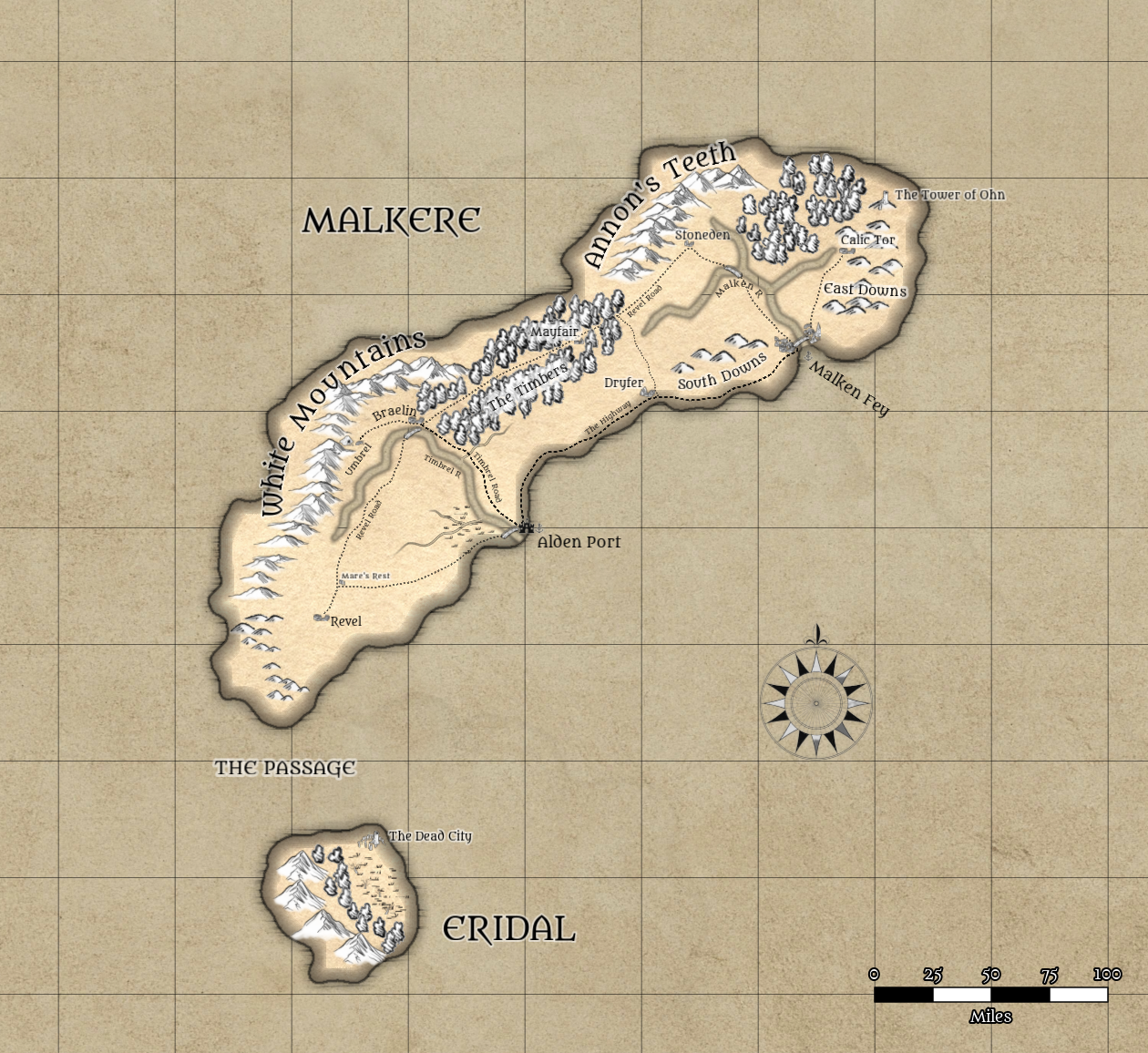
Malkere and Eridal
Map of the Islands of Malkere and Eridal, including major points of interest.
Major Cities
Alden Port
Malken Fey
Towns and Settlements
Revel
Umbrel
Mayfair
Dryfer
Calic Tor
Other Points of Interest
The Tower of Ohn
Mare's Rest Inn

Comments