

The Inkspire Cartography Hall - Heartstone Branch
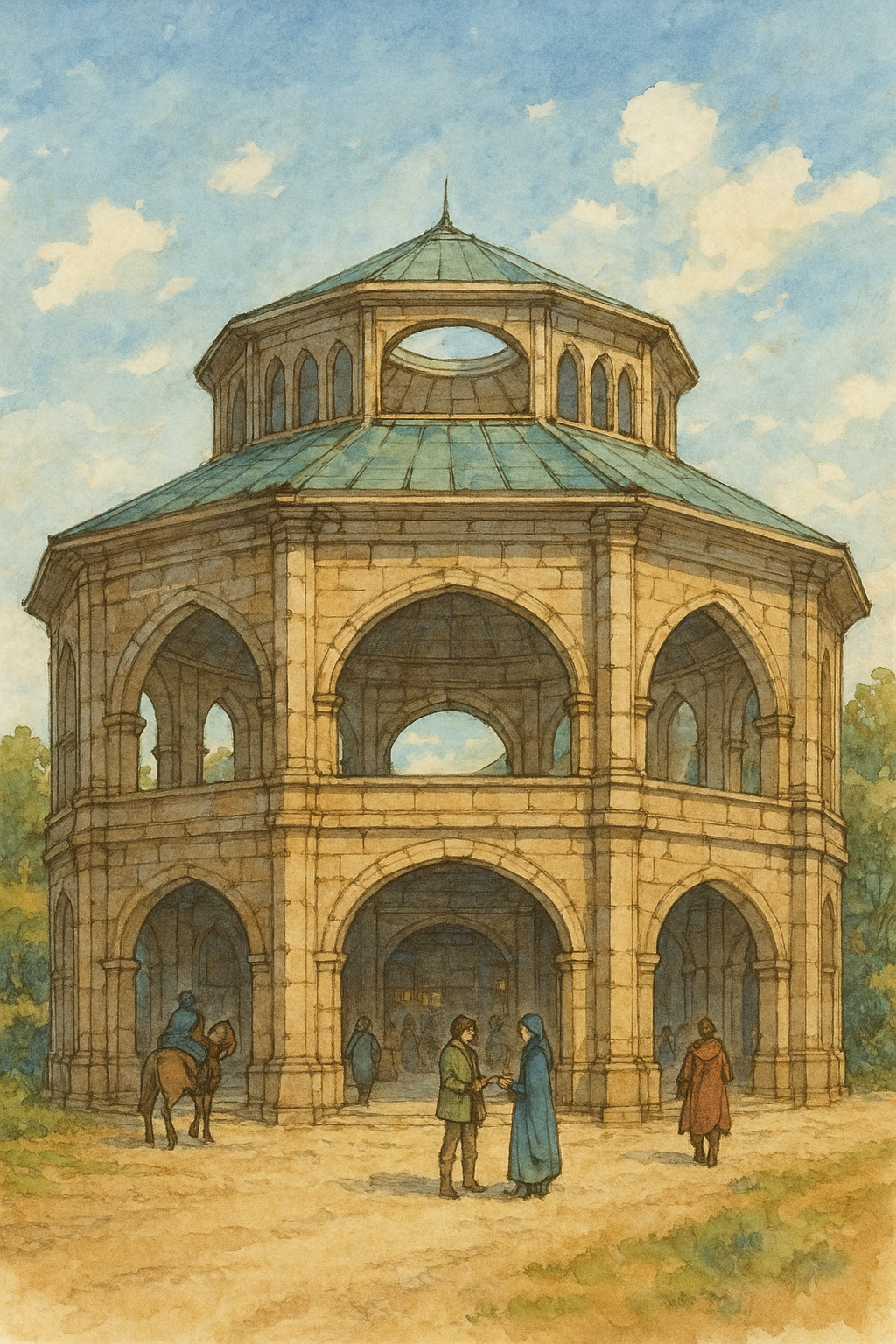
Design
Public Hall (First Floor) — Dimensions & Shape
The main room is an octagonal ring built around an open-air central atrium. Across the flats, the hall measures about 180 feet, with a 72-foot-wide oculus open to the sky; the ringed floor between outer wall and atrium averages 40 feet deep. Entry arches on four opposing sides are 16 feet high and 14 feet wide, allowing riders to enter mounted and dismount inside. The first-floor ceiling (over the ring only) peaks at 28 feet beneath exposed trusses, keeping the space airy for queues and mounted traffic. Circulation aisles are laid out as a 20-foot central carriage lane with 10–12-foot side aisles for foot traffic. Counters and help desks sit evenly spaced along the inner ring, with clear sightlines to the honeycomb shelves. Stair towers at the octagon’s corners connect to staff-only upper floors.Ceiling & Structural Finish
There is no ceiling over the atrium—the center is fully open to daylight—while the surrounding ring is roofed. The ring’s overhead is a blacksteel truss system with coffered oak panels between members; the wood is finished in a warm umber tone, the steel in a matte charcoal. Narrow clerestory slits on the outer faces bring in lateral light, and lantern hooks are integrated into the truss chords for night operations. For foul weather, retractable storm screens (oiled canvas on pulley rails) can be drawn over the inner oculus without fully closing it, preserving ventilation for horses. Bracing plates and rivets are left visible as a design choice, giving a precise, engineered look that matches the guild’s craft. The overall palette overhead reads oak brown, charcoal steel, and soft daylight white from the open core.Floor & Walls — Materials & Colour
The floor is honed pale limestone set in large flags, edged with basalt inlay bands that guide queuing and carriage lanes; a brass compass rose is set at the atrium rim. Stone is subtly scored for grip and pitched to bronze trench drains near the entries to handle hoof-mud and rain. Outer walls are pale ash-stone (light gray-cream) with low blacksteel kick plates to resist wheel and stirrup wear. The inner walls are dominated by the honeycombed shelving: hex-cell cubbies in smoked oak with brass tags, sized for scroll tubes and regional charts, giving a rich dark-wood and brass rhythm around the room. Public counters are oak tops on stone plinths, finished in hard oil for ink resistance. Sound-softening wool banners in muted ochre and slate hang between shelves to tame echo and mark departments (regional, trade, military). The net effect is light stone, dark wood, and charcoal steel—bright, durable, and purpose-built for high traffic.Entries
Four primary entry arches punctuate the octagon at cardinal points, each about sixteen feet high by fourteen wide—large enough for mounted visitors to enter, dismount, and wheel a carriage through the central lane; after hours, each arch drops a retractable blacksteel grille and swings shut a pair of iron-bound oak doors with crossbars set into floor sockets. A fifth, narrower service sally gate sits between two arches on the northwest face for deliveries, fitted with a waist-high counter, internal deadbolts, and a weight scale; it is kept locked except during scheduled intake. The public level has no conventional windows, but a ring of clerestory slits high on the outer wall admits lateral light; these are barred with blacksteel and shuttered from within. Staff-only stair-tower doors at three corners are ironbound, key-locked, and watched from the nearest desk. The inner atrium remains open to the sky by design, but storm screens can be winched across guide rails in bad weather or lockdown. Honeycomb shelving segments facing the floor have cage fronts that roll down and latch after hours. In full security posture, the hall becomes a stone-and-steel box: grilles down, shutters closed, towers locked, with only the service gate used for vetted traffic.
Sensory & Appearance
Entering visitors see a bright, high space shaped by the open oculus above: pale limestone underfoot banded with basalt lane markers, an inlaid brass compass rose at the atrium rim, long oak counters on stone plinths, and a continuous honeycomb of smoked-oak cubbies tagged in brass around the walls; above, charcoal blacksteel trusses and clerestory slits frame the daylight. The air smells clean and purposeful—iron gall ink, beeswax, parchment, oiled leather, with a faint mineral cool from the stone and, on busy days, a trace of horse and rain carried through the arches. Sound is a layered hush: quills scratching, page turns, murmured requests, stamp presses thumping, hoof rings on stone, and the soft creak of pulley lines on the storm screens; wool banners between shelving dampen echoes. Light is abundant by day from the oculus and clerestories; at dusk, a grid of hooded lanterns hung from the truss chords and desk lamps on the counters keep the floor evenly lit without glare. The temperature tends toward cool and dry, pleasant in heat and braced against drafts by the ring walls; on cold days, braziers near the arches take the edge off. The floor has a fine grit scoring for grip, so boots feel steady and horses sure-footed. Overall, the room reads as orderly, well-lit, and precise—a working hall built to move people, maps, and information efficiently.
Denizens
On any given day the floor hosts clerks, map-counters, apprentices, and messengers, overseen by a Cartographic Prefect and two Map-Wardens who handle security and disputes; upstairs work the master cartographers, ink-alchemists, plate-etchers, and rune-surveyors who translate field notes into publishable charts. Sunset Organization operatives pass as auditors or suppliers, quietly logging who buys what and why, while a stable hand manages mounts brought inside to the dismount lane. Couriers from noble houses, trade leagues, and the Royal Court arrive in cycles, exchanging sealed packets for certified copies. Harmless denizens include parchment moths and paper-mites kept at bay by citrus oil and ward-strips, plus a pair of sleepy archive cats that patrol the honeycomb wall. A contracted scribe-knight lingers most afternoons, nominally off duty, actually a deterrent. At night, a skeleton crew of lantern clerks and a night warden maintain counters, while upstairs a rotating pair of spell-binders calibrate the enchanted light tables. The atrium occasionally hosts a star-reader on clear nights, charting meridians under the Sky Window for next day’s corrections.
Contents & Furnishings
The public ring holds long oak counters, inkstone stations, and the towering honeycombed shelving packed with scroll tubes, regional folios, and way-cards labeled in brass; floor lanes in basalt inlay guide mounts and foot traffic to numbered desks. Tools include compasses, theodolites, plane-tables, chain reels, survey rods, brass seal presses, and wax pellets for certification, alongside enchanted light boards, auto-squares, and copy-glyph frames for magical transcription. Behind the counters sit lockable map cases, ledger lecterns, and cash drawers with sliding bars; above, hooded lanterns hang from blacksteel trusses with pulley drops for focused work. Stair-towers lead to staff-only floors fitted with plate-etching benches, ink-distilleries, drying racks, and void-proof plan drawers for unstable inks. A discreet service sally holds a weigh scale, stamp rack, and intake log for deliveries. The atrium rim carries a brass compass rose and azimuth marks, while the clerestory shutters conceal storm screens and signal slats. Wall banners in ochre and slate mark sections—Frontier, Military, Trade, Royal Grants, and Antiquities—keeping search time short.
Valuables
Beyond sale copies, true wealth lies in the master plates—copper and voidglass etchings used to produce authoritative runs—secured in upstairs safes beside cipher wheels, client ledgers, and codebooks of Sunset provenance. Restricted drawers hold overlay vellums that reveal troop roads, smuggler cuts, and sealed approaches to forts like Fort Marrow, plus waystone coordinate sets, royal patent maps, and disputed boundary surveys worth fortunes in court. A locked cabinet labeled “Calibration” hides the True Meridian Compass (never sold), a sapphire surveyor’s lens that pierces glamours, and an Everdry mapcase stamped with the Royal Court seal. Rumor speaks of a black ledger—Sunset’s buyer index—kept behind a false cell of the honeycomb wall, and a floor cache beneath the compass rose containing Emergency Evacuation Charts and city under-maps. Daily coin sits in barred cash drawers, but weekly takings and plate blanks rest in a downstairs iron safe bolted to bedrock. Select works of art—illumined panoramic cityscapes and border gilds—hang above counters as display pieces, each with hidden watermark runes. Everything irreplaceable is tagged, sealed, and cross-indexed; removing one item unnoticed is the hardest puzzle in the room.

Comments