
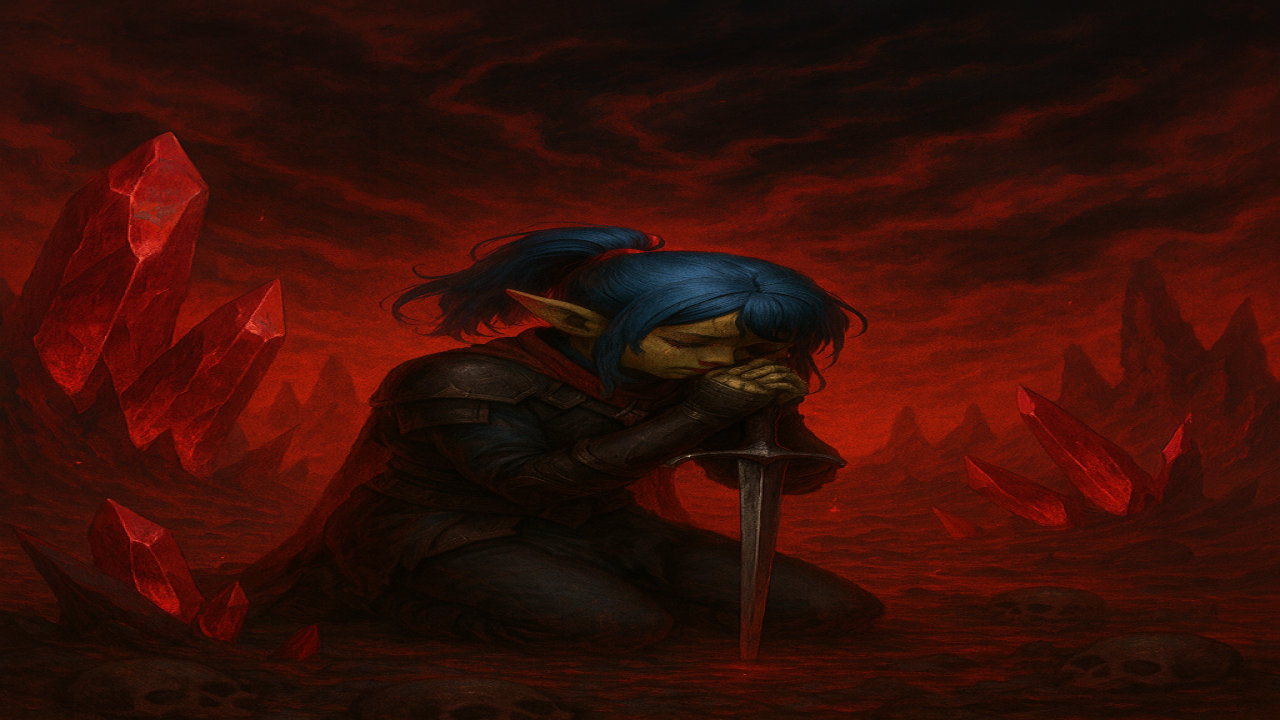
Genethia Roth
Genethia Roth
Genethia Roth
Cleric of Tymira, Bearer of a God Hand Amulet, Heart of the Unchained
Race: Goblin
Eyes: Vibrant Red
Hair: Light Blue
Origin: Dragon Keep, Albion
Date of Birth: 9/7/602 PR (Age 18 in 620 PR)
Alignment: Chaotic Good
Family: Roth Bloodline
Parents: Sepher & Mukkie Roth
Siblings: Allie, Lysa, Malikos, Regis Rustbone, Shatari, Valris, Sanise, Nemaia
Affiliations: Black Dragon Scales, The Unchained, The Cinders
Deities: Tymira (abandoned faith), Dykenta (emerging devotion)
Birth & Early Childhood (602–610 PR)
- Birthplace: Genethia Roth was born in Dragon Keep, Albion, during the last embers of the War of Zelistra.
- Parentage: Daughter of Mukkie Roth and Sepher Roth, both celebrated heroes of that war, and among the names Albion honoured for saving it from demonic ruin.
- Role Models: From childhood, she idolized her parents and Rhegar Asher, seeing them as the very image of what heroes should be. She believed courage and sacrifice were the purest virtues.
- First Crush: Around her eighth year, she grew attached to Caleb Asher (Rhegar’s eldest son). He affectionately gave her the nickname “Neth,” which stuck for life. She dreamed of marrying him someday, though the hope never left childhood fancy.
Genethia Roth came into the world on 9/7/602 PR, in Albion’s Dragon Keep, just as the War of Zelistra sputtered toward its end. She wouldn’t grow up there, though. Home became Rawgold Keep in the Dread Dragon Kingdom, where her mother, Mukkie Roth, held the title of lady-lord and wore the black scale of Rhegar Asher’s famed host. In those years the Black Dragon Scales were more than an army; they were the answer the realms found when the world started losing. Neth was raised on that truth, on banners that meant survival.
She was born while the banners were still smoldering.
During the War of Zelistra, the high halls of Dragon Keep had the smell of old steel and prayer-oil. Midwives whispered blessings to drive away what lingered from battlefields, and on the ninth day of the seventh month, 602 PR, a goblin girl opened one bright red eye and then the other—as if suspicious of a world that insisted on surviving.
They named her Genethia Roth. In the corridors, soldiers tried the sound and smiled. In the streets below, people shortened everything; soon enough the keep would, too.
Her mother, Mukkie Roth, laughed like a bell on a fox’s tail—nimble, quick, never where you expected it. Her father, Sepher (some in old ledgers wrote Septher), was a tiefling knight who treated oaths like heat: enough to temper, never to scorch. They returned from war carrying scars and a private agreement to love what the empire forgot to cherish. Genethia learned to walk under the weight of a shield half her size and to sit quiet through stories that made adults stare into their cups.
There were other names in those stories. Rhegar Asher—unbendable, gentle in a way that never compromised the blade. The Asher children came and went through Rawgold Keep in the Dread Dragon Kingdom, and one afternoon in the long light of summer Caleb Asher knelt to look Genethia in the eyes. He grinned at the little goblin who tried to keep her hair from her face and said, “You look like a Neth. Small word, big bite.”
The word stuck like a charm. She kept it near the heart.
The Bloodline of Hope and Fire
Genethia is the daughter of Mukkie Roth, a noble goblin warrior with a fierce spirit, and Septher Roth, a tiefling knight whose vows burned brighter than his flames. From birth, she bore the legacy of two great hearts—shaped not by conquest or fear, but by defiance and joy.
From an early age, she radiated laughter, wonder, and irrepressible light in a world heavy with shadows. Her lineage placed her among nobles and dragons, but she never walked with pride—only purpose.
Genethia Roth — the Rawgold Years
They called it Rawgold Keep named after Mukkie's best friend a Kobold named Grit Rawgold who died a hero. That was home—wind that smelled of brine and iron, banners that snapped like arguments, and a gate whose hinges had learned to carry history without complaint. Mukkie Roth wore the keep like a second smile. Lady-lord of Rawgold, Black Dragon Scale to her marrow, she was the sort of ruler who knew which torch was out by the way the guards’ voices changed at midnight.
Sepher never sat still long enough for portraits. When he did, his armour steamed, and someone had to lay a cloth beneath his chair so the demon-blood didn’t pit the flagstones. He was high commander among the Dread Hunters—those grim riders who hunted what crawled out of hell’s paperwork and refused to go back. Their oath was simple: find the fiend, end the ledger. Their hunts began at the great musters beneath Rawgold’s walls or on the open drill fields beside the southern bastion men simply called the Dread Fort.
The Dread Fort was an anvil on the island’s lower jaw, a black geometry against stormlight. Over it ruled Melissan De’Fera—Lady of De’Fera Gate, the roaring city whose markets traded in everything from saltfish to saint’s teeth. She spoke like a measured blade and organized war the way a choirmaster arranges crescents of breath. When the horns blew south, Sepher rode in her shadow; when they blew north, the hunters crossed Rawgold’s bridge with fiend-irons and hymns that were really threats.
Neth learned the sound of a hunt’s return before she knew all the old prayers. Nightfall, hooves in a hurry, Sepher’s voice clipped to discipline. He would dismount with blood that smoked like offended incense and kiss Mukkie’s knuckles, eyes flicking to his daughter to make sure she had counted everyone home.
“Luck?” he’d ask Neth as if consulting a specialist.
“Enough,” she’d say, too solemn by half, and tuck Tymira’s coin back into her sleeve.
Roads of Scales
Rawgold’s life beat in time with Xantamoor Hold, where the Black Great Wyrm slept like a seamount and woke like a political reality. In the throne-hall below that dreaming mountain, Rhegar Asher—half-drow, wholly burdened—ruled the Dread Dragon Kingdom with the ease of a swordsman who’d learned to fence with treaties. Neth saw him first from behind a vestibule pillar, one eye round with awe, the other hidden out of instinct, and decided that heroes were simply people who had made peace with being stared at.
Around Xantamoor, the realm arranged itself like scales on a living thing, each keep a plate that turned blows aside:
- Blue Cliff, under Gadyra the Blue, a dragonborn whose laughter was as famous as his sieges. His banners tugged constantly at the sea wind, and the fort’s kitchens swore by kelp and pepper.
- Azrife Hold, where Sureeb Azrife, a tabaxi lord whose whiskers seemed to point at problems in advance, taught his captains to fight like ambushes that had learned to walk.
- Gutrot Keep, ruled by Apple Wonka—Apple Gutrut before a marriage that made the heralds argue about vowels. A goblin lady with a general’s wrists, she put humor to work like a cart-horse and made the place run on the minute.
- High Cliff, where Saffron Qwell’Ty’ena became Qwell’Bled after vows to Shaido Bled—a drow commander whose court turned strategy into a salon. They posted poetry beside muster orders and meant both.
- Roth Hold, which made Neth blush the first time she saw the name burned into its lintel. There ruled Ayra Tenlow (once Ayra Roth), tiefling and tactician, her keep hung with ivy and iron—half garden, half gauntlet.
- Bluewaters, the river-city under Ruusk Bluewaters, a blue-scaled lizardman who treated canals like veins and fleets like blood cells.
- Union Keep, held by Tali’via De’Vira, Rhegar’s half-drow sister, where emissaries traded grievances for warm bread and left feeling they’d won something.
- Jhambi Circle, a ring of standing stones coaxed into a township by Jhambi Slyvreach, a tabaxi whose tail kept time while her magistrates argued.
- Scaleshield, under Zaxix Blackscale, a black-scaled lizardman who walked walls at odd hours and spoke to lanterns as if they were subordinates.
When Rawgold’s banners moved, Neth often rode with the wagons—ostensibly to help the cooks, truly to count faces and feed the superstition that her presence tilted fate. Along the roads, she learned the realm by its textures: the salt grit that marked a crossing near Blue Cliff, the nettle-tea vendors that meant Azrife scouts were watching, the damp stone scent that announced Union Keep before its chimneys did. She traded jokes with Apple Wonka’s quartermaster, learned a half-dozen canal curses from Ruusk’s sailors, and once fell asleep during a treaty recital at High Cliff only to wake under Saffron’s cloak with a biscuit in her pocket and a note that said, You’re allowed to be young.
The Hunters’ Work
The Dread Hunters trained where the island thinned to chalk and wind. Their manuals were catalogs of anatomy the clergy would not print. Sepher taught them how devils prefer contracts to knives until they don’t; how demons laugh right up to the moment they can’t; how the cleverest fiends wear human names the longest. He also taught them how to come home. That part mattered more in the long account.
Neth watched from the rails above the pit where they rehearsed killings, her jaw set, her hands ink-smudged from copying warding circles. Melissan De’Fera visited sometimes in armor that made officers stand straighter; she’d ask Neth strange questions—What would you bargain if you had nothing left to trade?—and nod at the answers like a smith testing a blade’s temper.
On nights when the Hunters rode south, Mukkie took Neth up the tower stairs to where the wind tried to pull secrets from your mouth. They counted the torches of the column until torch-counting became prayer. Mukkie would lean her head against Neth’s, the lady-lord laid aside for a moment so a mother could be exactly that.
“Do you believe in heroes?” Mukkie asked once, too softly for the guards to overhear.
“Yes.”
“Good. Believe in bread too. Heroes are loud; bread keeps you alive.”
The Door That Wouldn’t Stay Shut
The island taught Neth to read endings the way sailors read cloud-shoulder and whitecap. She could feel the weather change on the day her childhood ended. The air went wrong—too sweet, like fruit that had decided to be wine without asking.
How a Kingdom Lives in a Girl
Ask anyone in De’Fera Gate and they’ll point south where the caravans belly-crawl up the switchbacks—that is the lifeline. Ask a canal pilot in Bluewaters, and they’ll tap a chart that shows how grain becomes coin becomes soldiers becomes winter. Ask Neth, and she’ll say a kingdom is a list of names you refuse to forget:
Melissan counting lances, Sepher polishing iron that hates to shine, Mukkie tipping her chair back two dangerous inches during council, Rhegar looking tired and gracious at once, Tali’via pulling a child from a diplomat’s skirts to ask what she thinks, Apple Wonka signing a requisition and a birthday card with the same pen, Saffron leaving biscuits in cloaks, Gadyra’s laugh climbing a stairwell like a tavern song, Sureeb smiling before he pounces, Jhambi’s tail ticking off bad arguments, Zaxix touching a lantern, making sure it’s still with him.
Rawgold Keep held all of that, and Neth held Rawgold. She carried it into every fight after: into the Unchained, into the scattering, into the road outside Whitestone where the Cinders found her. When she blesses now, there is a little of De’Fera’s steel in the cadence. When she swears, there is Blue Cliff brine on the vowels. When she refuses to let the door stay shut, that is the Dread Fort in her spine.
A prophecy might try to claim her. A kingdom already has.
Tutelage under Caladawn Magus (610–616 PR)
- As she matured, her natural curiosity in faith and history caught the attention of Caladawn Magus, who agreed to tutor her in arcane theory, divine lore, and the cautionary history of Albion.
- Caladawn noted her idealism: she saw the gods as flawless, Tymira as a beacon of triumph and hope, and herself destined to “bring luck and victory” to others.
- Though small of stature and goblin-blooded, Neth’s fervor was greater than her frame. Caladawn privately wondered if her unshakable faith could survive true loss.
The Blessing of Tymira
Caladawn Magus saw in Genethia what few could: the divine thread of Tymira, goddess of luck and impossible victories, wrapped around her soul. She was not trained in magic but carried a miracle’s presence—a girl whose laughter seemed to sway fate.
“Of all the gods,” Caladawn once said, “it would be Tymira to claim such a soul. One who does not chase power, but chases goodness.”
In his vision, Caladawn saw her wielding a mace carved with laughing stars, shielding the fallen, facing down impossibilities—not as a solemn priestess, but a joyous warrior. Tymira had not just chosen her—she had entrusted her with hope.
The Unchained Year (620 PR)
- Neth became a cleric of Tymira, Goddess of Luck, Hope, and Fortune. She joined the Unchained, an eclectic adventuring company bound by fate and rebellion against the God Hands’ schemes.
- Adventuring Companions: Pyro, Tyrion, Ulystra Fenraith, Ulfred Lodvar, Hookspark, Willow Bloodeyes, Desnora Odseniron, Vor’i’s Aah’zul, and others.
- Carrying the God Hand Amulet: Early in the campaign she became a bearer of a God Hand Amulet, an object of terrible weight, marking her in Zonid’s designs.
Golden Gate wore dusk like a copper crown—harbour bells, gulls arguing on the pilings, tar and brine shouldering through every open door. Under a rack of antlers far too large to have belonged to any honest stag, the Stag Head Inn glowed with lanternlight and old stories.
At a corner table, a small goblin with light-blue hair and sharp red eyes traced roads across a beer-spotted map.
“North by the fen, east at the stone bridge,” she murmured. “If luck’s with us, bandits. If it isn’t, halftusks.”
Across from her, the warforged sat as still as a statue with a furnace inside. “Whether luck is with us or not,” he said, “I will stand in front.”
She smirked. “You always say that like it’s a spell, Alpha.”
“It is a vow.”
She rolled the map half a fold and, out of habit, tucked the small coin at her wrist out of sight. When people asked for a name, she had one ready: “Neth” was enough. It was safer that way. No family. No keeps. No past for anyone to tug.
The door slammed wide on a gust of salt air and rumour. Eight figures filled the threshold—dripping, bruised, iron-pink marks still fresh at wrist and ankle. The inn did what Albion inns do: measured them in a heartbeat, muttered, then made space.
A satyr with wine-dark curls grinned as if bruises were punctuation. “Is this the part where the innkeep says we don’t serve your kind?” he announced. “Because I am absolutely buying the room if he does. Name’s Batu.” He swept a bow that almost knocked a rafter.
Behind him stooped a goliath the size of a siege tower. “Bub,” he rumbled, eyeing a stool as if it were a challenge. He sat; the stool survived, barely.
A human with a soldier’s shoulders and an almost-smile that didn’t know where to live: “Kegan.” A drow, quiet as folded silk: “Kunath.” A sea elf, sea-glass skin and kelp-dark braids, wrung water onto the threshold and grinned. “Lydia Puddles. Yes, it’s real. No, I didn’t pick it.” A tiefling whose gentleness had outlived rough handling: “Martamo.” An owlin with storm-slick feathers, movements crisp and exact: “Shinzon.” And last, a Githyanki woman in road-worn mail who placed herself by a beam with the economy of a blade finding its scabbard. “Vor’i’s.”
Neth stood. “You look like people who’ve run out of bad luck,” she said. “Sit. Please.”
They gathered at the corner table in eddies—Batu stealing bread as if it were a performance, Lydia apologizing to the floorboards for dripping and to no one else, Bub making space by simply being large. Neth poured cups with steady hands; Alpha shifted his massive frame to shield the table from curious eyes.
Shinzon set a folded scrap of damp parchment on the map like a report. “The Sea Fox,” he said. “Cynthia Richmond’s ship. She caged us. The locks opened themselves. The tide hauled us against itself and set us down like a careful servant. Cynthia fled her own deck.”
“No helmsman,” Kunath added softly. “No prayers that I could hear. We were simply… delivered.”
“By whom?” Lydia asked, eyes glinting. “And can I thank them with pearls?”
“By what,” Batu countered, “and will it send us wine next time?”
Alpha’s head tilted, listening to a room in case it chose to become a threat. “If you need a wall,” he said, “we can be one.”
Kegan studied Neth—the map, the coin she hid, the way her small shoulders squared anyway. “And who are you two to offer walls?”
“Neth,” she said, quick as a practiced lie that wasn’t. “Just Neth.”
“Alpha Shield,” the warforged said. “I stand in front of her.”
Vor’i’s’s gaze never left Neth’s eyes. “What is it you hunt, Neth-Just-Neth?”
“Things that prefer frightened people,” Neth said. “Things with appetites. We were headed to the fen. There’s talk of raiders on the stone road.”
Bub nodded once. “Good hunt.”
Martamo looked at the angry skin where iron had been on Batu’s wrists, at the ring burned into Kunath’s ankle, at his own hands. “I don’t want to go back to cages,” he said, simply.
“Then don’t,” Neth said, just as simply.
Shinzon’s feathers shifted in a small, tidy shrug. “Elegance. Execution remains the trick.”
Neth tapped the ale-ringed map. “Dawn, north road. If you come, there’ll be work. Someone will need a hammer. Someone will need a prayer. We can supply both.”
Batu raised his cup. “To not being property.”
Alpha lifted his with cathedral care. “To purpose.”
Kunath’s mouth twitched. “To plans drafted sober.”
Lydia clinked cheerfully. “To tides that mind their own business.”
Bub frowned at his empty cup, then lifted his hand instead. “To big chairs,” he declared, and the table laughed—properly, this time.
“Friends,” Martamo said softly, tasting the word like a timid spell.
Shinzon tapped his parchment once, ritual concluded. “To logistics that obey.”
Vor’i’s came last. “To fights that deserve us.”
Kegan held his cup a breath longer than the rest, then drank. “To deciding before someone else does.”
“Neth?” Batu asked, wiping a line through an ale-ring with his thumb. “We were chained this morning. We aren’t now. What do we call this current state of being irresponsibly free?”
“Unchained,” Martamo offered, careful, as if naming a child.
The word found the room like a key finding its lock. Neth felt it settle—a simple truth, not a boast—and let herself smile.
“Unchained,” she agreed. “Eat. Dawn won’t wait.”
They didn’t carve sigils into the table or bleed on cups. They finished the bread. Kunath made a sling from a torn hem and a cork. Vor’i’s oiled a blade with the indifferent politeness a city gives a githyanki. Bub repaired a strap with two fingers and a knot the size of a fist. Lydia hummed something sea-sad while Shinzon inventoried arrows. Kegan stood, sat, stood again, as if teaching his body a new way to be seen. Batu told an awful joke about a priest, a dryad, and a haunted barrel until even Kunath smirked.
Neth watched them—this unlikely constellation pulled off a villain’s ship by a tide that wasn’t behaving—and kept her name behind her teeth. Rawgold, Roth, the keep and the bloodline: none of that would help them on the road. What they needed was a map, a wall, and a reason.
Alpha shifted, and the table’s shadow moved with him. “We leave at first light,” he said.
“At first light,” Neth echoed, folding the map. She tucked the coin out of sight again. Neth is enough, she told herself. For now, it had to be.
Outside, the Sea Fox bumped its moorings like an accusation and drifted in the tide that finally remembered how to behave. Inside, ten people agreed—without ceremony, without oaths—to walk the same way. When the door opened at dawn and the fen wind came in, they went out into it together, the first length of a story unfurling behind them like a rope someone had finally cut.
Golden Gate gave them their first quest the way cities do—through a man with the look of errands about him and the voice of someone who had learned to speak quietly in noisy rooms.
“Druilla Bahiti,” he said, palms open in benediction or plea. “From the far southlands. Taken… changed. Last seen at the Dykenta Temple ruins in the east of Wyrms Woods, near Dragon Keep. If you’re leaving the harbour with purpose, let it be this.”
Neth felt the coin at her wrist warm and go still. Alpha said, “We can stand in front of that.”
Golden Gate didn’t let them leave clean. Word got around the Stag Head that a new company had taken shape in the corner booth, so work found them the way gulls find a moving ship.
The first to lay a map on their table was Fanrenxi Tellhur—a goblin commander with a soldier’s posture and a lady’s signet—traveling in the company of Lord Edwin Ebony, the famous general whose patience was a weapon all its own. Fanrenxi didn’t waste adjectives.
“Two problems,” she said, tapping the vellum. “Xvarts in the Golden Gate woods—raiding farms, biting anything that bleeds. Then a rumor that Cynthia Richmond’s rot extends ashore. Handle the first, then sniff out the second.”
Edwin’s glance took the whole table in. “Do it fast,” he said mildly. “Some work spoils if you dither.”
Neth met the commander’s gaze, made sure her bracelet hid the coin, and nodded. “We’ll be quick.”
The woods: small blue problems, solved loudly
Xvarts aren’t brave; they are numerous. The Unchained made a line among the birches and let the little raiders break on it. Alpha anchored the path like a gate no one could lift; Vor’i’s’s blade wrote clean lessons; Shinzon stitched blue hides to tree trunks with arrows; Kunath’s knives kept tally in silence; Batu kept score out loud and took a horn to the ribs that he swore made him more handsome; Bub pulled a farmer from a snare and snapped the snare by looking at it. Kegan flowed where he was needed a breath before he was needed. Lydia dragged two wounded out by their belts and sang a sailor’s beat until Martamo’s hands caught up.
By dusk, the woods were quiet and the farmers were passing around a jug like contraband hope. Fanrenxi signed their writ with her thumbnail on her seal and pointed them down to the docks.
“Warehouse Row,” she said. “If filth is collecting, it will collect there.”
The warehouse: the Fox’s land-legs
Night put a wet lid over the harbor. The Sea Fox was rumor and stink on her mooring, but the real stink came from a shuttered warehouse with two locks and the wrong kind of quiet.
Kunath ghosted the door. One nod. Alpha took the hinges without an argument. Inside: crates marked with a fox-and-knot sigil, ledgers too neat, cages no longer full but not yet forgotten, and a trapdoor that tried to be discreet.
They went down and made a list of sins. Thieves’ guild sign cut into the beams; names of buyers and “deliveries”; a backroom where a brand was cooling on a hook. They broke it all—locks, ledgers, lies. Shinzon took copies for Fanrenxi. Batu set the ledgers alight with a bow and a flourish. Lydia found a hidden latch with a swimmer’s intuition; behind it, three terrified souls who’d learned to cry without noise. They came up with the last of Cynthia’s Golden Gate operation in their hands and at their heels.
Edwin Ebony waited with a squad who knew how to stand like they meant it. “Neat work,” he said. “Messier next time if you like. It encourages the rest.”
Neth hesitated then, coin warm against skin, and chose to risk the ask.
“There’s one more,” she said. “Not for your ledger. For mine.”
Edwin looked to Fanrenxi. Fanrenxi looked to the map. “Say it.”
“Dovel,” Neth said. “A cave outside it. We have word of a Dread Hunter patrol—my—” she swallowed it back, steadied. “—a patrol that didn’t come home. If we can cut that grief short, I need to try.”
Fanrenxi’s answer was the sort commanders give to soldiers who have already decided. “Take a squad? No. Take my writ and my blessing. And take care.”
Dovel: eleven bodies and a question left breathing
The cave’s mouth yawned like a bad idea. Inside, the Unchained found eleven bodies laid wrong by hands that knew what they were doing: ten Dread Hunters—armor scored, oath-straps cut—and one Faceless Assassin, mask shattered beside him like a lie caught mid-word.
Neth’s breath shortened and then refused to obey. She moved from body to body with a medic’s hands and a daughter’s ruin, whispering names where there were none left to answer. She did not say “Sepher,” but her eyes did when she found his command braid snagged on a jag of stone, the knot cut, not torn.
In the center of the chamber, the stone was blackened and scribed—a ritual circle in ash and salt and something that made Alpha’s plating hum. An impression in the soot told a precise story: something small, heavy, worn on a chain. An amulet had sat there. It was no longer there.
Kegan crouched and traced the edge of the mark. “Pulled,” he said. “Deliberate.”
Kunath sniffed the ash, made a face. “God-harming metal sang here. Recently.”
Shinzon’s pinions lifted. “Footprints. One dragged. One carried. The carried fought. The carrier… did not bother to rush.”
Vor’i’s tilted her head. “Confidence,” she said, as if spitting something out.
On a stone where blood had dried a mean brown, someone had carved—too neat for panic, too cruel for mercy—a single line: I OWE YOU ONE. The gouges were deep and clean. Pehliff had signed with a smirk instead of a name.
Neth’s hand landed on a Hunter’s chest-plate and stayed there, as if she could warm it back to confession. Her voice found her after a long step of silence. “He’s alive,” she said. “If he’d finished it here, he’d have left the amulet for the carrion.”
“What amulet?” Batu asked, baffled and angry.
“The kind you don’t want your enemies to find,” Kegan said. Then he looked up and really saw Neth. Saw the way her jaw had set in Rawgold stone, the way her fingers knew the Hunters’ insignia without looking, the way grief came off her in a heat-haze.
“Genethia,” Martamo said softly—first name like a hand offered. “Who is he to you?”
She tried for the lie that had kept her safe. It caught. Broke. “My father,” she said, too fast, too true.
Martamo’s eyes widened—not with shock, but with the gentle re-arranging of facts. “Then we will make this cave answer,” he said. Not a promise. A plan.
They searched until midnight for Pehliff’s thread and found only his habit: a careful cruelty, the absence of mistakes, the assumption that no one could follow. But the dragged prints and the cut braid said what mattered—Sepher lived when he left here.
Neth sat on a rock and let herself shake, quiet enough that only Alpha heard it. He moved without sound and became a wall she could lean against without admitting it aloud.
“Dawn,” she managed.
“Dawn,” Alpha agreed.
They put the dead to order, marked the cave for Fanrenxi’s detail, and trudged back to Stag Head with salt on their lips and ash in their clothes. The inn’s warmth felt borrowed. Fanrenxi read their short report, memorized the long one in Neth’s face, and didn’t reach for pity.
“Fyrewynd next, then,” she said, folding the writ back into Neth’s palm. “You’ve made enemies who prefer the dark. Best to keep moving in the light.”
The Unchained ate what passed for dinner at an hour men with easier lives call morning. Neth kept her name behind her teeth again, but it was a thinner disguise now; Martamo met her eyes and nodded, as if to say: I will carry what you cannot say out loud.
At first light, they shouldered packs, paid the innkeep down to the last copper, and stepped into the road—toward Fyrewynd
They left the Stag Head at first light with ten sets of tracks and one plan, the Unchained before the word had time to dry on their lips.
The North Road and Fyrewynd Keep
They pushed north along the ridge road toward Fyrewynd Keep, the wind scuffing the heather like a hand against fur. The road was crowded with the wrong sort of men—Piccer raiders who had ranged south too boldly, and Mog’s gaunt disciples who preferred their sermons served hot and screaming. There were cannibals too, the kind who had learned to avoid the word but not the habit. The Unchained bled them out of the ditches and hedgerows, day after day, workmanlike and without pleasure. By the time the keep’s banners pulled them into its wind-shadow, the ditches stank of iron and the hedges held ribbons of warning.
At Fyrewynd, Lydia Puddles watched the gulls wheel above the crenels and listened to the harbour bells far south, ghosting up the spine of Albion. “My tide’s going the other way,” she said, not apologizing because it wasn’t that sort of thing. She squeezed Neth’s hand, thumped Bub’s forearm like a drum, called Batu “a walking mistake worth making,” and walked into the keep to find whatever came next.
Fyrewynd Keep sat in the wind like a fist raised to the sky. They took two days there to do the sort of work no ballad wants—the Piccer caves in the hills. Small fires guttering from old cook-pits, bad banners hung as jokes, a dozen ambush angles someone had diagrammed with sticks. The Unchained cleared them like carpenters: cut, brace, finish. By dusk of the second day the caves breathed clean.
That’s when the farmhouse came up—a big stone-boned place the wardens hadn’t heard from in three days. The road to it was rutted and quiet; the yard had the wrong kind of stillness. The front door dragged as if it had been opened too often, too hard.
Inside, the ground floor looked like violence had been tidied only by time. Overturned table, dried slop, a chair wedged under a latch that hadn’t held. Marks on the floor where bodies had been pulled the way sacks are pulled. A smell that wasn’t rot yet, just the mean whisper of it.
They heard them before they saw them—chittering, the bright scrape of a too-thin blade across bone.
“Back,” Alpha said, the single word flattening the air.
Neth’s hand found the coin at her wrist and stayed there. “Skaven,” she breathed.
Kunath’s eyes narrowed. “So far north,” he murmured, as if correcting a map.
Batu nearly joked and didn’t. Bub’s knuckles shrugged like boulders deciding to fall.
They moved together, the way a room decides to be a corridor. The first Skaven—yellow teeth, slick fur, armor that looked hammered from sad tin—came fast and low, the second and third climbing the walls the way rats remember ladders. Shinzon’s arrow punched one off a beam; Vor’i’s cut another from throat to whisper; Kegan stepped into the third and made its knife irrelevant. Alpha blocked the doorway with his body and became a door they did not own. Martamo kept three farmers’ children who had been hiding under the stairs from seeing anything they’d never outgrow. Neth’s prayer rose and stuck in her throat; she swallowed it down and made it a strike instead, clean and necessary.
They cleared the first floor, breath by breath, then took the stairs—Alpha first, shield eating the angle, Kunath and Vor’i’s behind him with knives that made no sound going in and only a little coming out. Room to room, they found what you always find when vermin learn arrogance: ruined stores, a bed ransacked purely for the joy of it, a pantry turned shrine to hunger.
The last door was shut. The chittering on the other side had a lilt to it, like laughter practiced in a mirror.
They went in together.
Black-clad assassins looked up—eyes too bright, blades too clean, pleased with themselves the way only cowards are. For a heartbeat the room was tableau: a cradle pushed against the far wall, a blanket halved, the curve of a mother’s hand still on a bedpost where she’d tried to hold the world in place.
Neth saw what they were laughing over and the world shrank to a point.
Eight small bundles, hastily arranged on a table. Infants, none old enough to sit. No gore, no theater—just the aftermath of a cruelty so casual it didn’t bother to perform itself.
Her heart made a noise her throat wouldn’t. Tymira’s coin went cold against her skin.
“Down,” Alpha said, and the room obeyed the word in steel and splinters.
No one spoke while it happened. Kegan moved with the kind of precision that comes from refusing to remember later where each blade went. Vor’i’s was surgical, unhurried; Kunath was a shadow that resolved into endings; Bub took one assassin by the wrist and removed both problem and hand in a single, contemptuous motion; Shinzon put a shaft through a laughing mouth and did not watch it stop; Batu stopped trying to be charming and simply hurt the thing in front of him until it forgot to be alive. Neth walked through the fight with her mace like a priest with a censer and did what had to be done.
When it was over, the noise in the house went out like a candle in a draft. The second hand of grief arrived: the quiet work. Neth’s hands shook once and then learned stillness. She covered the little faces with what cloth she could find. She whispered two prayers—one to Tymira out of love, asking luck to carry them quickly and love to keep them on the way.
They put the farmhouse right as far as a company can. The living were gathered, the dead were named. Kunath scraped the assassins’ marks from the lintel. Alpha stood at the threshold until the last child had crossed it.
Back at Fyrewynd Keep, they reported with as few words as a truth like that allows. The warden who took the account set down his quill and did not reach for it again that night. Beds were found. Food was sent and not eaten.
At dawn, the Unchained stepped out into the east wind with their packs already on. No one talked about it on the road. They carried it instead—the weight that teaches you what kind of world you live in, and the heavier certainty of the kind of people you have decided to be anyway.
They slept on clean straw smelling of woodsmoke and soap, then took the east road toward River Gate, passing sellers of winter apples and soldiers who waved without recognition but with the grateful slouch of the defended. From there, they followed the river’s glittering, argumentative logic east to Dragon Keep, the capital peering down from its cliffs like an old teacher over a recalcitrant class.
Batu peeled off in Dragon Keep three days in, guilt and curiosity arguing behind his smile. “A rumour owes me money,” he said. “Also a certain merchant owes me a hat.” A fortnight later Bub left them, too, shouldering a pack and explaining in three words that mountains don’t climb themselves.
Wyrms Woods — The Temple and the Hunger
The Dykenta ruins lay in the Wyrms Woods like a sigh rolled in ivy: pillars bitten by time, a broken apsis where lovers once made vows meant to outlive them. The Piccer had found it first—campfires, bad songs, the stink of men who didn’t think anyone was coming. The Unchained hit the camp like a weather change: Kunath’s stillness breaking into a surgeon’s economy; Vor’i’s a whetted arc; Shinzon’s arrows stitching shut anyone who tried to run; Kegan a calm in motion, exactly where he needed to be a breath before he needed to be it; Martamo fighting like a man who had promised himself gentleness and would earn it the hard way; Alpha the wall; Neth the breath between blows, prayer and blade shared across the line.
Beneath the sanctuary stones they found Druilla Bahiti—pale as moon glass, eyes too bright, hunger wrapped in courtesy. Vampire was the word that made the least sense and the most. She tried to stand; her legs lied for her. Kegan knelt without theatre, turned his wrist, and offered blood as if it were the most ordinary currency.
“Careful,” Kunath murmured.
“I am,” Kegan said, which was true in its own way.
Druilla drank with disciple’s restraint, then leaned close to Kegan, whispering something that made his mouth find a real smile and keep it for the evening. He looked at the others. “We take her back to Dragon Keep,” he said. “And we fetch her sister.”
“Your sister sleeps in a coffin in the keep’s crypt,” Druilla admitted, ashamed of nothing, hiding nothing. “Lamya. Bring her. If you go to Tudor after this, take us with you. I will travel where I am asked to be grateful.”
Neth touched Druilla’s wrist, weighing steadiness and shadow both, then nodded. “We’ll get your dead,” she said. “And see if we can make the living forgive the word.”
Wyrms Wood held its breath around the old Dykenta temple—the ivy-drowned apse, the fallen columns carved with roses and skulls, the lamps that still smelled faintly of beeswax and myrrh. After they helped Druilla Bahiti in the temple, they found the rite inscribed along a cracked frieze in Old Celvenish and temple-cant:
“What is given freely returns as armour.
Pleasure is prayer; consent is covenant; love is a weapon.”
Low rooms opened off the sanctum—simple beds, clean linens miraculously unspoiled, a shallow basin where oil still gleamed. The ritual was unambiguous and gentle: please the goddess—willingly, without coercion, “each heart its own sovereign”—and Dykenta would answer with a ward fit for the road.
No one was pressed. Some gulped, laughed nervously, or stared at their boots. Choices resolved, one by one:
- Kegan and Druilla chose each other—blood and trust made into a vow.
- Vor’i’s (a virgin) and Bub (also a virgin) found a quiet courage together.
- Neth (a virgin), hands shaking but eyes steady, chose Martamo, himself a devotee of Dykenta; Alpha quietly closed the door and stood guard outside the threshold, honoring the rite’s first law—consent and privacy.
The writing on the lintel warmed like a breath. The lamps didn’t flare; they sighed. The narrative of bodies is for the participants and their goddess alone—the temple kept its secrets. What the world saw was dawn: six warriors stepping back into the blue of morning, changed in ways you can’t hide from friends.
At the foot of each bed lay a gift of armour, smelling faintly of rose-ash and rain. Each piece bore Dykenta’s knot-and-thorn sigil and a discreet second mark—a paired rune binding it to the partner who shared the rite.
Diplomacy, Weddings, and a Box with Teeth
Dragon Keep makes diplomats of anyone who can stay polite through a second cup. Word got around about the Unchained’s competence and inconvenient decency, and before they could properly catch their breath from Wyrms Woods they were being fitted for clean cloaks and ushered into rooms with measured carpets and doors that closed more quietly than they opened.
The ask was audacious and necessary: bind the Drow House Brummur to Albion. The proposed graft—Mez’Barris Brummur, ruler of Brummur, to Wulfred Goldred, sixteen and crowned too soon—would thicken the kingdom’s bark before winter. Neth stood in the background and watched Wulfred learn to be a king by listening; she watched Mez’Barris examine the crown like an instrument, then play it softly. They also sought the good will of Rose Wood Forest—a court of green oaths that had learned caution from axes. Somehow, with a hundred small courtesies and three honest promises, the Unchained helped stitch it all together: Brummur’s pledge, Rose Wood’s assent. The future felt, for a breath, like a field put properly to plow.
Then came the wedding gifts.
Wulfred—flushed, a little dazzled by politics that let him feel heroic without bleeding—offered the Unchained awards from the heap of treasures arriving ahead of vows. Boxes, chests, rolls of brocade, oilskin-wrapped oddities with notes attached in seven hands. Neth cracked a small ivory chest—the hinge whispering like a secret—and a Norlan White Adda coiled and struck. The pain was ice-mean, a line of winter written up her arm into her heart.
“Neth—” Alpha’s voice broke its own calm.
She went down with a sound she would later be glad she did not recognize. The healers blanched at the venom’s colour. “White Adda,” one hissed. “You need dragon bone for the proper serum. And time is not our friend.”
Alpha lifted Neth like a relic. The others ran toward the only library that stocked what they needed: the crypts.
The Crypt and the Red Wizard
The crypts of Dragon Keep had always been formal—music of names etched in stone, the quiet choreography of respects paid. That day the choreography was wrong. Dead warriors of Albion walked the aisles, their eyes unlit, their hands remembering weapons they no longer deserved. Something had taken the keep’s history and turned it hostile.
They fought to the shelves they needed, elbows deep in grave-dust, bone saw singing the ugly song of emergency. Dragon bone came away more easily than any of them would ever admit in a later telling. They trampled back up and forced the healers to hurry. Neth’s breath learned to be a bridge again instead of a cliff. The color returned to her lips one stubborn inch at a time. She woke to Alpha’s shadow across her and everyone else arguing quietly about how many lives a chest could legally try to take.
“Next time we accept coin,” Shinzon declared. “Not chests.”
“Next time we ask Lydia to sniff the hinge,” Kegan said, which was not helpful but made Neth smile because she could.
They returned to the crypts the next morning to answer the insult. The Unchained cut a path through Albion’s angry history and found, before the last turning, a woman in red robes whose presence made the air notice itself. Desnora Odseniron—Red Wizard of the Sturvik people out in the far east—stood amidst a circle of wrongness and looked relieved to see anyone else doing the right kind of violence.
“I do not serve whoever did this,” she said before anyone asked. “Point me at what does.”
“Welcome, then,” Neth managed, still a little pale, a little stubborn. “You’re Unchained if you want to be.”
They wanted. In the last chamber, under vaulting that remembered dragonfire, they found the Lich who had turned honor into puppetry. He spoke a name—Zonid—the way cowards use the names of bigger cowards. The name put a cold in the room that didn’t belong to the crypt.
“Your master is bad at endings,” Neth said, and the Unchained made one. Steel and word and will, the Lich went down into the proper quiet. The stillness that followed wasn’t empty; it was respectful.
In the rubble and shadow they found a coffin with the Bahiti sigil—a script of lilies around a crescent like a throat. They bore it up the stairs together, out of the wrong night and into a day that felt less borrowed.
What Gets Carried
Druilla took Lamya’s coffin with a composure that made Kegan watch her as if something about himself were being explained. “If you leave Albion for Tudor,” she said, honest as hunger, “take me with you. Take us. I will pay the price of passage, and I will pay it in ways the living cannot.”
“We leave where the work goes,” Neth answered. “If it crosses the channel, so do we.”
“Then I will pack,” Druilla said, folding the words around a gratitude that did not debase her.
They had set out to pull one woman from a ruin and had pulled up a thread that stitched kingdoms—Brummur to Albion, Rose Wood to the crown—and yanked another that led straight to a god-hand’s shadow. They had been bitten, bled, burdened with diplomacy, and born into one more kind of family.
On the keep’s highest walk, Neth watched gulls carve the air. The Sea Fox sat in rumor. The crypt below had been convinced to behave. The coin at her wrist warmed and cooled like a heartbeat finding its pace. She gave her true name to no one that night—Neth was still enough—but the road ahead looked like a place where names would matter less than choices.
“Dawn,” Alpha said beside her, because dawn is always what comes after.
“Dawn,” she agreed.
The Unchained slept in borrowed beds. In the morning they’d carry a coffin, a map, the memory of a White Adda’s bite, a new ally in Desnora, and the old oath said quietly between themselves: we stand in front.
Bearer of the God Hand Amulet
In 620 PR, Genethia uncovered one of the ten Amulets of the God Hands—a cursed relic forged for the Dark Pantheon. It called to her, and to Caladawn’s dread… she answered.
Though chosen by light, she walked with darkness now tethered to her soul.
“Even in her purity… she is not immune to the call,” Caladawn whispered. “If she falls, the world may fall with her. But if she rises… perhaps even the gods shall tremble.”
Heroine of the Unchained
Among the Unchained, Genethia fights beside warriors, rogues, and legends:
- Pyro, the Skaven rogue who makes justice explosive.
- Alpha Shield, a warforged paladin who swore a sacred vow to guard her.
- Skylar Asher, the daughter of the man she adored.
- Ulystra, Vor’i’s, Tyrion, Lek, and others who share in the burden of rebellion.
Her presence is not just divine—it is binding, holding the group together when hope feels thin.
Even when kicking Hemritt into unconsciousness in punishment, Genethia embodies both Tymira’s playful chaos and Dykenta’s righteous wrath.
Love, Loss, and Motherhood
Genethia once loved Martamo, a gentle soul who awakened something soft within her. When he died, she bore not only grief—but his unborn children.
Caladawn, who watched from afar, saw how that loss didn’t break her. It remade her.
“Love lost would not break her—it would forge her anew,” he said. “Martamo’s memory will become a fire in her heart. His children, a beacon.”
Tragedy & Transformation (620 PR)
- Pehliff’s Attack: The elven butcher Pehliff ambushed Neth and her kin, wielding Fate Killer—a sword that could wound gods.
- Mukkie was slain.
- Sepher fell in battle against a horned demon.
- Rhegar Asher was executed in chains.
- Neth herself was maimed: her left eye pierced, her womb ruined.
- Divine Intervention: Tymira’s silence cut deepest—but in her despair, Dykenta whispered.
- The Shift: Dykenta did not heal her scars; she sanctified them. Neth became a Favoured of Dykenta, her brokenness re-forged into passion, defiance, and creation
Yet joy, in this world, is a flame constantly tested.
In a devastating moment, Pehliff—on the 9th day of the 7th month 620 PR on her birthday, an elven agent of destruction with golden eyes and divine-killing blades—slaughtered her family. Mukkie was beheaded before her. Septher died fighting a horned demon. Her idol, Rhegar Asher, was executed in chains.
And Genethia… was pierced through the eye with Pehliff’s cursed blade. She lost her sight. Her womb. Her innocence. Her future. But not her fire.
In the wake of that horror, Caladawn and Dykenta intervened, entwining her soul with new power.
Dykenta’s Chosen
In a secret rite whispered under velvet skies, the goddess Dykenta, patron of passion and sacrifice, claimed Genethia not just as a follower, but as her Favoured.
“She did not merely walk my path,” Dykenta told Caladawn. “She danced it. She loved under my stars… and I watched.”
Genethia’s pain became a crucible. Dykenta poured divine power into her—fertility not of childbearing alone, but of creation, flame, and divine rage. She became a woman of fire, of forbidden love, of radiant rebellion.
She was no longer Tymira’s joy.
She was now Dykenta’s storm.
Loss of Faith in Tymira
- Neth’s optimism was eroded by constant tragedy. Companions fell one by one, each death shaking her faith in Tymira’s promises of fortune and triumph.
- The shattering moment came when Tymira’s silence left her prayers unanswered in the darkest hours. She could no longer reconcile the goddess of “luck and triumph” with the grief she carried.
Drawn to Dykenta
- In despair she found a strange comfort in Dykenta, Goddess of Love, Lust, Pleasure, Fertility, and Death.
- Dykenta’s creed of embracing life fully, even amid ruin, resonated with her broken heart. Though not yet a full devotee, Neth’s prayers and symbols began to shift toward Dykenta.
- Caladawn, seeing this, noted that every death among the Unchained nudged her closer to Zonid’s designs—her despair and search for new meaning feeding the shadow of prophecy.
The Scattering of the Unchained
- The group suffered devastating losses. Hookspark fell, others drifted away Due to the God Hands kidnapping Alpha, Kunath, Tyrion, Shinzon and the camp while on the move was attacked by three different groups that being God Hands cultist, Halftusk raid parties and Faceless Assassins and Kegan was missing, while Willow Bloodeyes still out there on a mission for the half celestial half devil Alastor.
- Neth was left battered and spiritually hollow. By the early 7th month of 620 PR, the Unchained had scattered to the winds, their bonds broken, their ideals shattered.
The Road to the Cinders (7th Month 620 PR)
- Alone and despairing, Neth wandered Abritus Empire roads close to Whitestone.
- Discovery: She was found outside Whitestone by Reyn and Rheana Thorne, Lila, Cipher, Gojo, and August—the adventurers called the Cinders.
- Though wary, she recognized kindred spirits in their burdens and agreed to join them, seeing a flicker of purpose again.
First Mission with the Cinders
- Her first act alongside them was to aid against a Halftusk war camp near Whitestone, throwing herself back into battle and into camaraderie.
- Though she still trembled under grief and guilt, she began—slowly—to rebuild herself in this new fellowship.
Thematic Arc
- 602–616 PR: The hopeful girl, nurtured by heroes, tutored by Caladawn, dreaming of Tymira’s grace.
- 617–620 PR: The cleric of Tymira, watching her ideals corrode through loss, turning toward Dykenta’s embrace.
- 620–620 PR: The survivor of the Unchained, despair edging her toward Zonid’s designs.
- 620 PR: The fragile flame of the Cinders rekindles her path. She joins them, scarred but alive, poised on the edge of new trials.
Legacy in Motion
Genethia Roth stands now at a crossroads of fate, prophecy, and divinity. She is a:
- Cleric of luck and laughter.
- Priestess of passion and power.
- Bearer of divine and cursed relics.
- Daughter of fire, mother of legacy, and spark against the dark.
Caladawn believes the world bends when she chooses. And he is right to.
Because Genethia Roth is not a prophecy fulfilled—she is one still being written.
Relationships

