Corchon
The Corchon Family – Boar-Blood Raiders of the North Marches
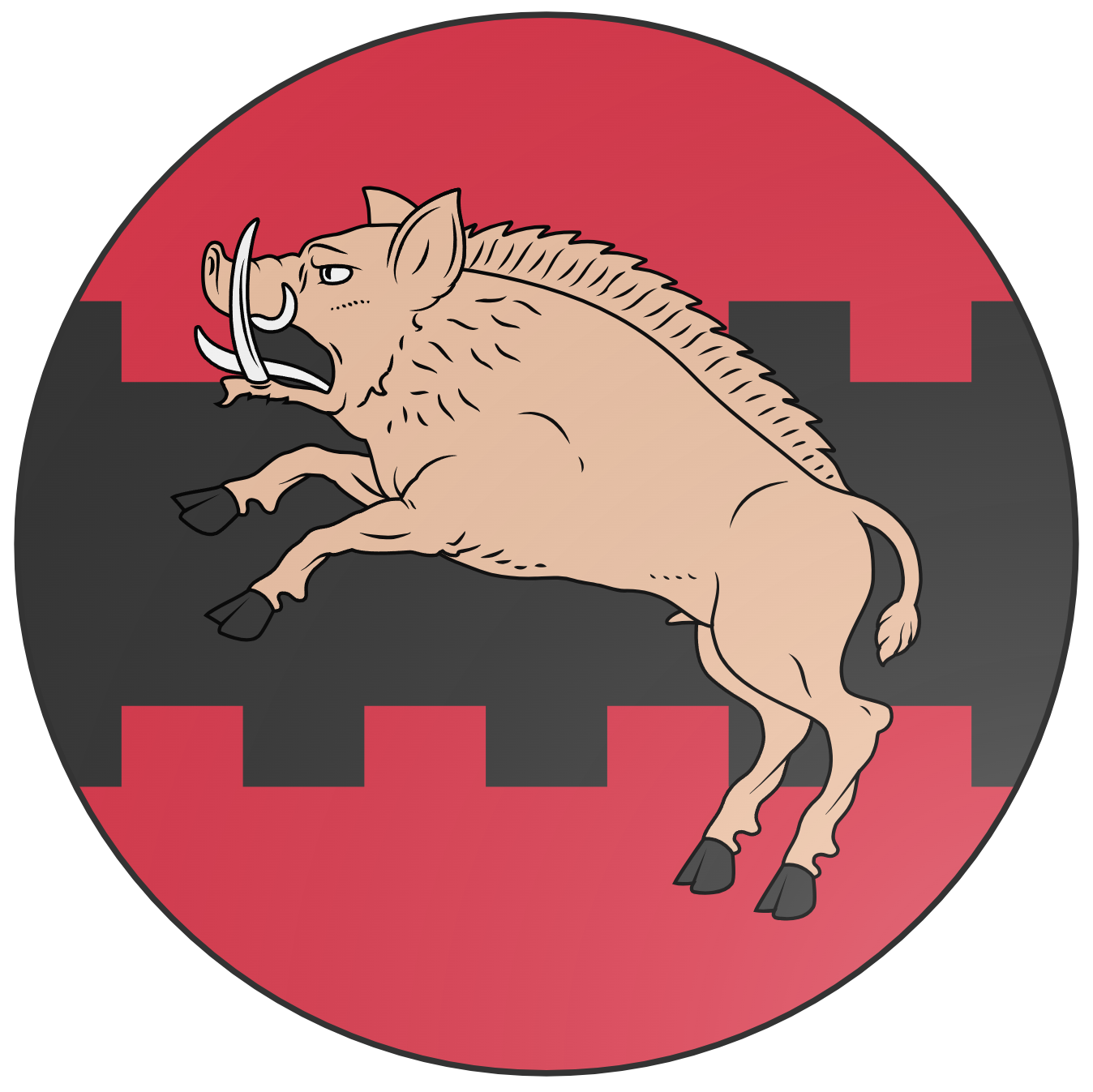
Sigil: A brown boar on a red field
Faith: The Orc Gods — Horamush, the Lord of Fury and Slaughter; Vagdarr, the Father of Strength and Kinship
Allies: Houses Vipère and Rongeur of the Tudor Empire
Enemies: The border kingdoms of Tudor, Norlan, and Goffik
Homeland: The Rusthorn Hills and the Bleeding Plains, west of the Denarenis frontier
Origins
The Corchon family claim descent from Korgor the Boar-Eater, a warlord of the early Orc tribes who survived the Age of Blood-Tide by devouring his enemies’ hearts to gain their courage. When the ancient Orc Empire collapsed, his descendants refused to kneel to any crown, retreating into the fog-choked valleys between Tudor and Norlan. There they forged a new creed: strength through defiance, honour through the hunt, and no walls high enough to hold their rage.
The word Corchon itself comes from the old Orcish Korr-shon — “blood tusk.” Every child of the tribe carves a small boar’s tusk at birth, which is burned into their skin as a mark of lineage.
Culture and Beliefs
The Corchon are not a settled people but a raiding tribe of orcish war-families, each led by a Tusklord. They believe life is a contest between the twin gods:
- Horamush, the evil god of unchained rage, slaughter, and storms — worshipped in war, his shrines drenched in blood.
- Vagdarr, the good god of kinship, courage, and the hearthfire — honoured in peace, his effigies fed with bread and mead.
Each raid begins with the Twin Boar Feast, a brutal rite where two boars — one black, one brown — are sacrificed to the gods. The black is burned for Horamush, its bones scattered to the wind; the brown is shared among the warriors, binding them as brothers under Vagdarr.
Though savage, the Corchon hold strict oaths of kin-protection and hospitality. To betray blood is to be “Tusklost” — exiled and stripped of name, tusk, and gods.
Raids and Warfare
From the Rusthorn Hills, the Corchon launch lightning raids into Tudor, Norlan, and Goffik, plundering villages for iron, mead, and slaves. They favour boar-mounted cavalry armed with hooked axes and javelins, using fog and terrain to strike unseen and vanish before dawn.
The Boarbound Warbands are infamous for their war-chant, “The Root Drinks Deep,” a guttural hymn said to echo the bellow of Horamush himself. To the Tudors, their raids are terror; to the Corchon, they are worship.
When winter snows trap their herds, the tribe moves south to trade furs, mead, and stolen arms with their unlikely allies — House Rongeur of Leadenport and House Vipère of Embermoor. The Rongeurs provide ships and smuggling routes; the Vipères supply alchemical tonics that the Corchon call “boar-blood,” a stimulant that turns their skin red and their eyes white with battle-fury.
Relations
- House Vipère: The Corchon respect Lord Lucien Vipère for his cunning and gift of “red wine that bites.” They consider him a soul-brother of the serpent, an honour given to clever outsiders.
- House Rongeur: The Rongeurs trade steel and salt for tusk-ivory and hides. Some Rongeur ships even fly false Corchon banners when raiding Norlan coasts, further blurring the line between commerce and war.
- Tudor Empire: Officially enemies, but their border generals often pay “boar-tribute” in exchange for peace during harvest months.
- Norlan and Goffik: Eternal foes. Norlan’s northern forts bear scars of a dozen Corchon sieges; Goffik knights still tell tales of the Boar King’s Charge at the Battle of Bleeding Fields, where two thousand raiders broke through their cavalry line.
Current Era (620–Present PR)
Today, the Corchon tribe is led by Gorvag Corchon, called The Red Boar of Rusthorn. Massive even by orc standards, Gorvag carries twin axes named Fleshroot and Miretooth, said to have been blessed by Horamush himself.
Under his rule, the tribe has grown bolder, striking deep into Norlan’s southern marches and burning Goffik trade caravans that trespass near their lands.
Rumour whispers that Gorvag has begun forging an alliance of clans — the Boar Banner Host — with promises of uniting all Orc tribes under one blood-marked sigil. His ultimate goal: to reclaim the ancestral plains lost to humankind during the rise of the Tudor Empire.
Heraldry and Symbolism
- Sigil: A brown boar on a red field, symbolizing blood and endurance.
- Warpaint: Brown and crimson stripes across the face and tusks to honour Horamush’s fury and Vagdarr’s strength.
- Banners: Roughly stitched hides dyed red with blood, carried on spears tipped with boar tusks.
The Founding – The Age of the Twin Tusks (c. 265 PR – 270 PR)
The Corchon family trace their beginning to Korgor the Boar-Eater, a warlord of the western Orc clans born during the last years of the Boar-Wars that ravaged the frontier between the crumbling Tibur Empire and the northern tribes.
Legend tells that Korgor survived the Feast of Fangs—a battle in which six clans turned on each other for meat during a winter famine—by eating the heart of his dying brother and swearing an oath before Horamush:
“So long as blood fills the earth, we shall never starve.”
He united the remnants of the clans under one banner, the Red Boar, and carved out the first Corchon stronghold in the Rusthorn Hills—stone halls smeared with pig’s blood and painted red to keep away the “white ghosts” of the north.
Under Korgor, the tribe became more than raiders; they became ritualists of fury. Each generation burned the bones of its fallen in massive Boar Pyres, and from these ashes, they forged their iron charms and war tokens.
The Rise of the Boarblood Clans (270 BR – 320 BR)
Korgor’s descendants expanded their raids into Tudor’s western provinces, attacking early forts along the Iron Road. These centuries became known among chroniclers as The Red Marches.
- 277 PR: The Burning of Dinkawal — Corchon raiders sack the mining outpost that would later become a Vipère holding.
- 281 PR: The Slaughter of Norbar Gate, where 300 orcs ambushed and annihilated a Norlan caravan.
- 285 PR: The Feast of Five Crowns — five Corchon chiefs feast on the severed heads of human kings taken from border wars, uniting the orcs beneath one Tusklord, Bargan the Thick-Hide.
- 320 PR: Under Bargan, the Corchon defeat a combined Tudor-Norlan force at Bleeding Plains, earning their homeland’s name.
These centuries marked the tribe’s golden age. Horamush’s cult spread through the southern orc clans, and the Corchon’s rites of rage became infamous even among other tribes.
The Pact of Ash and Blood (320 PR – 490 PR)
As the Tibur Empire fragmented into successor realms, the Corchon turned from open war to trade in blood and spoils.
It was then they first met House Rongeur of Leadenport and House Vipère of Embermoor.
The Vipères sought “creatures who could spill blood without guilt” to test new venoms. The Rongeurs sought bodyguards and smugglers to move goods along forbidden coasts. In exchange for iron, powder, and mead, the Corchon provided muscle and chaos.
It was Tharn Corchon, the so-called Boar-Tongue Lord, who sealed this alliance with his infamous saying:
“The snake may whisper, but it eats after the boar.”
The alliance became a tradition that persists to this day — the Corchon raid by night, and the Rongeurs and Vipères profit by day.
The War of the Rusthorn Hills (489 PR – 520 BR)
Tudor’s northern dukes, angered by centuries of Corchon raids, raised a crusade led by Duke Alaric of Norlan.
For fifty years, war raged through the Rusthorn frontier.
- 493 PR: The Siege of Tusklair Hall — Alaric’s legions burned the main Corchon fort, killing the Boar-Tongue line.
- 498 PR: The Battle of the Red Mire — the orcs countered by flooding Alaric’s army with dammed rivers, drowning half his men.
- 520 PR: The Boar-King’s Stand — Grakgor Corchon, last of the Tusklair chiefs, impaled himself on Alaric’s spear to bite his throat out as both men died.
The war broke the tribe’s unity but cemented their myth. To the orcs, this was their Ragnarök—a test from Horamush to prove their fury eternal.
The Age of the Broken Tusks (520 BR – 590 PR)
The Corchon scattered into smaller warbands during the Age of the age of Darkness. Orcish numbers dwindled under demon expansion.
Yet in this age, the cult of Vagdarr was reborn—led by Morda Corchon, the first female Tusklord, who taught that strength without kinship was hollow.
- She forged peace among rival orc bands and rebuilt the Rusthorn Holds in 523 PR.
- She established Twin Shrines to Horamush and Vagdarr—one carved into a hill of bones, the other a hall of mead and ash.
This era’s raids were fewer but more strategic. The tribe began taking hostages for ransom, building wealth alongside blood. They learned to deal as much as destroy.
The Rebirth of the Boar (560 PR – 600 PR)
During the Age of Darkness and Zelistra’s War, when devils and demons swept through Platera, the Corchon fought as mercenaries for whoever paid them in iron and mead.
- 562 PR: Corchon warbands fought in the Dragon-Bane Wars, slaying wyverns for the Tudor crown before betraying their paymasters and sacking two forts near the Mireborn's swamps.
- 591 PR: The Blood Pact of Embermoor — Gorvan Corchon swore service to Lord Rhael Vipère II, protecting alchemical caravans in exchange for steel and poisons.
- 598 PR: The Feast of Red Boars — a monstrous raid on Norlan’s southern trade routes, where three thousand humans were slain, their bones burned as offerings to Horamush.
By now, the Corchon had earned both hatred and dark respect. Their boar-headed banners became warnings on maps—places of death where travellers vanished.
The Blood Moon Alliance (600 PR – 620 PR)
In the turbulent age of the God Hands’ resurgence, the Corchon found renewed purpose.
The current chieftain, Gorvag Corchon, known as The Red Boar of Rusthorn, rose to power by uniting thirteen clans through brutal duels.
- 603 PR: Gorvag burned the Norlan fort of Stonefield Keep using alchemical fire gifted by Vipère merchants.
- 611 PR: Formed the Boar Banner Host, merging Corchon, Craghorn, and Irontooth clans into one raiding confederacy.
- 615 PR: Allied with Merthin Rongeur, “The Black Anchor,” to smuggle war spoils through Leadenport.
- 619 PR: Gorvag declared the Great Boar Oath—a prophecy that when the next Blood Moon rises, the Orcs will reclaim their old empire.
Rumours suggest Gorvag’s shamans have begun invoking both Horamush and Vagdarr together in forbidden rites—seeking to merge fury and kinship into a new divine path, a “Boar God Ascendant.”
The Modern Corchon (620 PR – Present)
Now, the Corchon tribe stands as a paradox—raiders and diplomats, savages and traders, feared across three kingdoms.
Their banners still descend upon Norlan’s valleys and Goffik’s farmlands, yet they send emissaries to Embermoor and Leadenport under Rongeur escort, cloaked in human robes, speaking fluent Tudor.
The Boar Banner Host swells again, numbering near ten thousand orcs, goblins, and half-orcs of mixed heritage. Rumours whisper that Gorvag seeks a final war—a “Hunt of Empires”—to carve a new Orcish dominion from the blood-soaked borderlands.