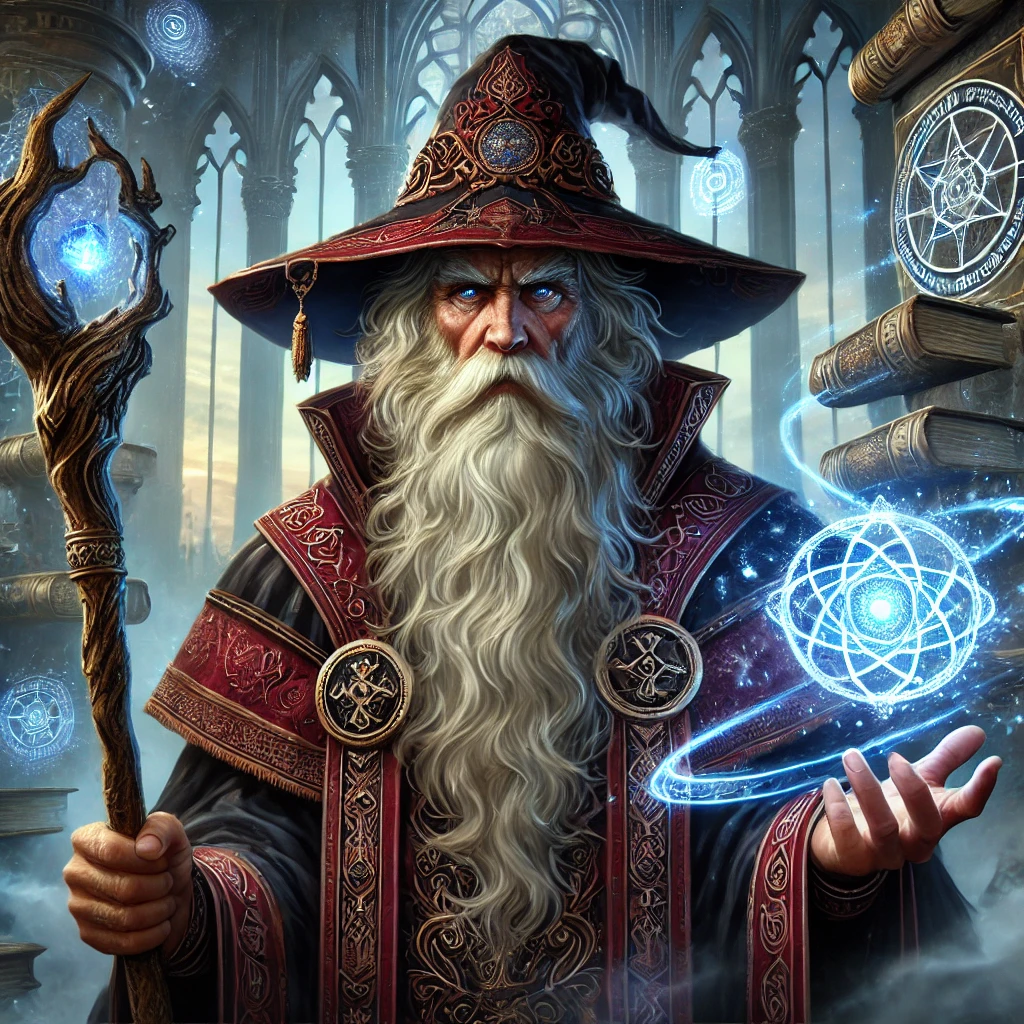
Caladawn Magus
Caladawn Magus (a.k.a. Whispering Mage)
The Grand History of Caladawn Magus: Archwizard of Neztra
Birth and Early Years (-2180 to -2160 BR Platera)
Caladawn Magus was born in the year -2180 of the Platera Calendar, on the highest of the floating isles of the Neztra Magus Empire—Skyreach. Born under a crimson eclipse, many diviners foresaw a fate both grand and grim. His family, minor nobles tied to the Arcane Conclave, quickly recognized his potential when he summoned an arcane wisp at the age of two.
At age seven, Caladawn was enrolled in the Neztra Magus Academy, the most elite magical university of the empire, specializing in Conjuration. There, he showed astounding promise, mastering complex summoning circles and binding rituals within a decade.
Caladawn Thoughts on the Creator's Trio
Caladawn’s thoughts stretched further still, past mortal schemes and fallen legacies, toward the deep truth of divine succession. After the Creator left, the void was not left empty—it was filled by the chosen of balance, ancient titans of nature and will. Caladawn had always revered their names.
Renazar—the long, emerald-scaled dragon who soared beyond storms. Lawful Neutral god of wind, skies, clouds, and all dragon kind. His breath carried judgment, his wings stretched the horizon. Renazar was law wrapped in silence, the sky given form.
Moundor—the ruby-hearted Tarrasque, whose breath shaped mountains and whose slumber held the fault lines of the world. Neutral god of land, ground, and the steadfast roots of hill and stone. He did not speak often, but when he stirred, continents remembered.
And Kelgor—the great sapphire whale, vast and knowing. Neutral god of ocean, river, and rain. He sang in currents and memory, his dreams rippling through the tides of time. Of the three, Caladawn often dreamed of Kelgor’s eyes—the endless blue depths that saw beginnings before endings.
They were not gods who desired worship. They were anchors—gods who held the shape of the world in their breath and weight. Caladawn did not fear them. He respected them.
"They are not gone," he murmured once while walking the edge of the cliffs of Orindel. "They are waiting—watching to see what we make of what was left behind."
And in quiet moments, when the winds shifted just so or the waters grew still as mirrors, Caladawn could almost feel their presence lingering, as if the world itself remembered who once held it steady.
Caladawn’s thoughts on the three Dragon Gods created by Renazar—Raegon, Malvoris, and Alicent—are shaped by deep reverence for their origins, sorrow for their fragmentation, and wariness of what they represent in balance and corruption.
Raegon – Lawful Good, God of Dragons
Caladawn reveres Raegon as the spiritual heir to Renazar’s essence. To him, Raegon embodies the ideal of what dragons can be: noble, lawful, guardians of the ancient compact between wisdom and might.
“Raegon is not merely a god. He is a memory of what dragonkind was meant to be—a shepherd of skies, not a tyrant of flame.”
Raegon’s flame burns with purpose, not pride, and Caladawn believes the few dragons who still dream of harmony and justice—like Venizar Goldfyre—are fragments of Raegon’s will given mortal flesh.
Malvoris – True Neutral, God of Dragons
Caladawn views Malvoris as the eternal question—watcher, arbiter, and mystery. Neither cruel nor kind, Malvoris is the drifting scale in the cosmic balance, capable of turning toward salvation or oblivion.
“Malvoris is the breath between words, the space between battle cries. He waits. He watches. And when he chooses, the world changes.”
Caladawn finds Malvoris unsettling, not for malice, but because of the god’s refusal to act until the precise moment fate demands. He suspects Malvoris is more aware of the future than any other being—possibly even manipulating events through silence.
Alicent – Chaotic Evil, Goddess of Dragons
To Caladawn, Alicent is the poisoned fang born of Renazar’s greatest mistake. She is chaos forged from divinity, a dragon who chose power without conscience.
“She was fire unchained, not to warm the world—but to watch it burn.”
Caladawn sees Alicent as a living corruption of the draconic ideal—a goddess who mocks kinship and wisdom, who seduces young dragons with visions of dominion, cruelty, and worship. Her existence threatens the very weave of dragonkind’s legacy.
He believes her influence was instrumental in wars like the fall of Albion Goldred, and that her shadow still lingers in acts of draconic tyranny—perhaps even in the return of Redscale or darker figures yet to come.
Final Reflection
Caladawn sees these three gods not as unrelated entities, but as the soul of dragonkind split into its core essences. Their ongoing struggle mirrors the world’s own war between balance, order, and ruin.
“Renazar gave dragons gods, but not peace. That task remains ours—to choose which breath we follow: the healer, the witness… or the destroyer.”
Rise Within Neztra (-2160 to -2100 Platera)
Caladawn’s early adulthood was marked by revolutionary research in conjuration. He theorized and proved the existence of the "Tethered Weave"—a plane of magic through which summoned entities could be called and controlled with minimal instability. By age 80, he had become the youngest ever to hold the title of Magister Arcana.
Throughout this era, Caladawn conjured beings from forgotten worlds and created the first of the "Celestial Wards," golemic constructs powered by star essence. His status earned him a seat on the High Arcanum Council.
It was during this time that Caladawn grew close to his cousin and closest friend, Zovaris Zadnid. Zovaris was a brilliant mind in his own right, the founder of the Zadnid School of Necromancy. The two shared countless debates, rituals, and discoveries—Caladawn in conjuration, and Zovaris in necromancy. Their friendship was legendary among the academies, each respecting the other’s gifts and views, though their philosophies diverged. Zovaris, in his quest to push magical boundaries, developed the forbidden school of Blood Magic. While Caladawn cautioned moderation and responsibility, he never betrayed his cousin.
The Eye of Madness and the Spark of Love -2160 BR
Xaetrix’s Temple, -2160 BR
The Temple of Xaetrix was not made for war. It was a sanctum of reflection—towers wound in starlight, glyphs etched across opaline spires, and runes that hummed with the rhythm of forgotten beauty. But that day, beauty became a battlefield.
Deep within the sanctum, beneath the floating isle of Arcantrix, a Beholder had awakened. No mere aberration—this was an Eye Tyrant, twisted by blood sorcery and warpflesh, once a failed experiment of the Neztra Magus turned mad godling. It had come to consume the divine leyline that flowed through Xaetrix’s altar.
And it almost succeeded.
Caladawn arrived through a shimmer of planar displacement, robes burnt at the hem from another war, face bruised from weeks of spell duels. He did not expect to find death here. Not in her temple.
But he did.
The Eye Tyrant turned toward him with a hiss of anti-magic. Rays tore through pillars. Eyes fired beams of withering, disintegration, petrification.
“Mortal fool,” the tyrant screeched. “You are already forgotten.”
Caladawn stood tall. “Then let me be a memory sharp enough to cut.”
He wove stars into chains. Time slowed. He cast a mirror of himself—only for the Eye Tyrant to destroy it instantly.
It was not enough.
Then came her voice—Xaetrix—soft, steady, sorrowful.
“Why do you fight alone, Caladawn?”
“Because no one else remembers what must be protected.”
She appeared within the altar’s light, her divine essence flickering in warning. She could not fully manifest without sacrificing her form—but she watched.
And he fought.
A dozen spells. A hundred glyphs. When his staff was broken, Caladawn turned to raw conjuration, summoning a Starforged Wyrm that struck the beholder’s central eye.
And in that moment, he leapt—not with magic, but with memory.
He carved the final sigil across the Beholder’s flesh with a sliver of Xaetrix’s own divine crystal, plunged it into the aberrant core, and whispered:
“No more gods made in mockery. Not in her name.”
The Eye Tyrant exploded in a sphere of raw, unravelling madness.
Caladawn fell to one knee.
Xaetrix caught him in a moment between time. Her voice a breath:
“You would spend your soul... for beauty? For a temple? For me?”
He didn’t answer.
He didn’t need to.
She touched his forehead with two fingers and whispered a prayer in Old Starlight.
“Then I will remember you, mage. I will remember you... when gods forget.”
That was the moment she fell in love with Caladawn.
Not for his power.
But because he remembered what magic was for.
In -2150 BR, Caladawn’s conversation with his cousin Zovaris Zadnid marked a pivotal and painful moment in the early history of magical innovation—and descent.
Zovaris had just succeeded in creating the foundation of Blood Magic, a form of arcane power that manipulated life essence as fuel for spellcasting. Caladawn, while awestruck by its potential, was immediately alarmed by its cost. He saw in it not progress, but peril. Their discussion was filled with tension, veiled affection, and unspoken grief.
Caladawn’s deepest concern wasn’t merely the magic—it was Zovaris himself. Since the death of Zovaris’s wife, he had changed. No longer the bright-eyed theorist who debated soul-weaving under the stars, Zovaris had become consumed by a need to control, to transcend mortality, to make something of the pain.
“He bleeds brilliance, yes—but he does not know when to let the wound close,” Caladawn wrote later. “Grief made him a god before magic ever did.”
Though Caladawn urged caution, he did not condemn Zovaris. Their bond was too strong. He tried instead to temper his cousin’s ambition with love and reason. He feared that Zovaris was running not toward greatness, but away from sorrow—and that Blood Magic was simply the sharpest path he could carve through his grief.
“It is not magic that damns us,” Caladawn once told him, “but why we choose to wield it.”
This moment foreshadowed Zovaris’s eventual fall and transformation into Zonid, the first Dark God of the Hand. Even after Zovaris’s exile from Neztra, Caladawn remained loyal in secret—maintaining magical correspondence and wearing a crimson ring etched with the Zadnid family sigil, touching it before every conjuration as both penance and prayer.
The full dialogue between Caladawn and Zovaris in -2150 BR is not recorded as a direct transcript, but the essence of their exchange is preserved through Caladawn’s reflections.
At the time, Zovaris had just revealed the framework of Blood Magic, and Caladawn, though astonished by the arcane complexity, was deeply unsettled by the emotional state that had driven its creation. Zovaris had lost his wife—not to magic, but to illness or fate—and since then, he had pushed himself past exhaustion, past caution, into the realm of obsession.
In that conversation, Caladawn reportedly said:
“You’re bleeding into the spellwork, Zovaris. Not just blood—you. And that kind of magic doesn’t forget where it came from.”
Zovaris, brilliant and bitter, replied something akin to:
“What has forgetting ever given us? What has restraint ever saved?”
Their voices likely rose—Caladawn urging patience, Zovaris defending necessity. But beneath the argument was love, frayed but unbroken. Caladawn didn’t betray him. He didn’t exile him. He tried to anchor him.
Later, Caladawn would write:
“He was not evil. He was grieving. And grief has a way of making gods from broken men.”
The exchange haunted Caladawn for centuries. When Zovaris became Zonid, the first of the Dark Gods, Caladawn did not renounce him. He wore a ring with the Zadnid family sigil, touched it before conjurations, and mourned his cousin in silence.
Their conversation in -2150 BR was, in many ways, the last true moment Zovaris was mortal. Caladawn saw it happen—and could only hope that part of his cousin, the curious boy who loved star-charts and soul-theory, still lingered behind the godhood forged in blood.
Zovaris’s eventual exile from Neztra—when Blood Magic was outlawed—deeply wounded Caladawn. Though he did not support Zovaris's darker ambitions, he never spoke against him and secretly maintained magical correspondence for decades. Some believe Caladawn’s later flexibility with magical morality was influenced by his cousin’s fate.
Zonid's Ascension and Caladawn’s Grief
When word reached Caladawn that his cousin and dearest friend, Zovaris Zadnid, had shed his mortal form and risen as Zonid—the first Dark God of the Hand—his heart fractured. He had long feared that Zovaris’s obsession with Blood Magic would draw him into shadow, but never had he imagined that his path would lead to godhood forged through suffering, ambition, and despair.
Caladawn wept not only for Zovaris, but for the bond they once shared. He saw in Zonid not the mad god others whispered about, but the echo of a brilliant, curious boy who once debated soul-weaving rituals under starlight. Despite Zonid's new domain—one steeped in control, sacrifice, and blood-fuelled power—Caladawn refused to denounce his kin. Deep down, he believed that part of Zovaris still lingered within the godhood, caged and mournful.
From that day, Caladawn wore a crimson ring etched with the sigil of the Zadnid family, never speaking of it, but always touching it before major battles or conjurations. It was both a reminder of the man Zovaris was… and the god he had become.
In -2090 BR, after Zovaris was exiled from Neztra for creating and practicing Blood Magic, Caladawn and his cousin spoke again—not in public halls of debate, but in the quiet, veiled channels of magical correspondence.
Their meeting, though not recorded as a full dialogue, is described through Caladawn’s reflections, filled with sorrow and love. Caladawn did not stand against Zovaris during the trial, nor did he defend him openly—but in private, he reached out, kept contact, and tried to remind Zovaris of who he was before ambition consumed him.
“Though he did not support Zovaris's darker ambitions, he never spoke against him and secretly maintained magical correspondence for decades”.
In that conversation, Caladawn likely tried to anchor Zovaris in memory and compassion. He grieved what the world had chosen to exile: not a tyrant, but a visionary twisted by grief and isolation. Zovaris, in turn, defended his pursuit of Blood Magic not as evil, but as necessary—a magic born of truth, sacrifice, and the raw nature of life itself.
What pained Caladawn most was not the exile, but what it foretold. He sensed that Zovaris would not stop. That the world’s rejection would only harden him. And that godhood—twisted, bloody, and unrelenting—was no longer a question of if, but when.
“He had long feared that Zovaris’s obsession with Blood Magic would draw him into shadow, but never had he imagined that his path would lead to godhood forged through suffering, ambition, and despair”.
Even after Zovaris became Zonid, the first of the God Hands, Caladawn never denounced him. He wore the Zadnid family sigil in secret. He mourned not just a cousin, but a friend—a mirror of what he could have become.
Their meeting in exile was the last time they spoke as equals, as kin. After that, Caladawn would speak only to echoes in the Weave, and to the blood-god that answered with silence.
The Golden Age of the Isles (-2100 to -1900 Platera)
With Caladawn’s innovations, the floating isles of Neztra flourished. Entire cities were defended by bound elementals and astral guardians. The empire expanded, not through conquest, but through arcane supremacy. Caladawn was made Archwizard of Neztra, and he founded the Tower of Infinite Reach, a structure that pierced the cloud line, anchoring the magical ley-lines that supported the floating isles.
He also became headmaster of the Neztra Magus Academy, reforming it into a sanctum where morality and magical prowess were taught equally—an effort to preserve the empire’s power with wisdom.
Lamurean People Settled -1355 BR
In -1355 BR, as the newly freed people of Zhul crossed into the western lands and founded Lamuria, Caladawn watched from afar with a sense of awe and cautious hope. The birth of the Lamurean people, forged not from conquest but from liberation, stirred something deep in him—an echo of what the world might become when power bends to principle rather than ambition.
He was particularly struck by the fact that a mortal woman, Dykenta, was chosen to lead them. Before her ascension to godhood, she was a figure of radiant strength and sorrow, one who, according to Caladawn, “carried the weight of the world in her hands—and refused to let it break her.” In her, Caladawn saw not only a leader but a living spell of resistance, love, and dangerous possibility.
“They followed her not because she promised victory, but because she bled beside them.”
Caladawn believed the foundation of Lamuria was more than a geographic moment—it was a spiritual rupture in history. The act of naming themselves Lamureans was a reclamation of identity stolen by chains, and their choice to build a society around compassion—rather than vengeance—made them, in his eyes, the moral heirs of the age.
“The Lamureans did not rise to build temples. They rose to bury pain in gardens.”
He later called them “The Last of the First”, believing their values preserved a sliver of what the world was meant to be, before empires twisted divinity into domination. Caladawn never forgot them, even as the centuries turned. When the Tibur Empire eventually hunted them for refusing to destroy their Tiefling children, Caladawn did not rage—he mourned.
“In a world of blades and chains, the Lamureans chose love. And for this, the Empire chose genocide.”
That settlement in -1355 BR, led by Dykenta, marked the beginning of a new kind of divine narrative—one not of gods above mortals, but gods born from them. Caladawn would later honour Dykenta not as a distant goddess, but as an old friend who once chose to lead not with fear, but with fire-warmed hands.
In -1325 BR, when Zhul elevated Dykenta to godhood, Caladawn watched the transformation with solemn reverence and a cautious heart. To him, Dykenta was never simply a leader—she was the soul of survival turned divine. Her rise was not born from conquest or bloodshed, but from resilience, love, and the refusal to fear death.
He believed her ascension was not just deserved—it was inevitable. Zhul recognized something Caladawn had already seen: Dykenta’s power lay not in might, but in the fierce, unashamed embrace of life in all its forms—pleasure, pain, birth, and endings. She taught her people to thrive, to multiply, to love openly and fiercely even in a world bent on breaking them.
“She did not climb a throne. She bloomed into it,” Caladawn once said.
And when she was made goddess of Love, Lust, Pleasure, Fertility, Birth, and Death, Caladawn understood the full gravity of that portfolio. These were not indulgences. They were the raw, sacred truths of mortal existence. She was not a goddess of war or vengeance—but of the spark that creates life and the sigh that carries it into the beyond.
He bowed his head not in worship, but in respect:
“Let the heavens watch as a mortal woman dares to claim the most sacred rites of divinity: not wrath, but connection.”
But Caladawn, ever the seer, also worried. He knew that gods who touched both desire and death wielded the most dangerous kind of love—one that liberates, but also scars. He saw the long path of mortal devotion, the thorns beneath the petals.
“She will give her followers strength… but not safety. Pleasure… but not peace. She is the velvet wound, and the bloom after bleeding.”
Still, he honored her. And in moments of prayer, when Tymira’s laughter grew faint and Entera’s starlight faded, it was to Dykenta that Caladawn turned—for answers, for hope, and for reminders that even ruin can birth beauty.
The Daughter of Xaetrix (-1300 Platera)
In the year -1300 Platera, Caladawn’s life turned once again from scholar to myth.
He lay with Xaetrix, the Veiled Weaver—goddess of secrets, illusions, and forbidden desires—during a moment of divine convergence. Whether born of passion, prophecy, or purpose, their union resulted in the conception of a daughter: a being touched by both mortal brilliance and divine shadow.
Little is known of the child’s early years, veiled as she was by Xaetrix’s own protections. Caladawn would never speak her name in public, only writing of her as “the child of veil and flame.” Some ancient scrolls speak of her possessing eyes like twin eclipses, and a voice that could unravel lies with a whisper.
To Caladawn, her birth was a moment of sublime joy and terrifying weight. He believed she was destined to walk paths beyond the realms of gods or mortals.
“I have conjured worlds,” he once wrote. “But in her, Xaetrix and I have conjured a choice—a thread that might mend or sever the Weave itself.”
Though they would rarely meet after her infancy, Caladawn kept a hidden shrine of starlit mirrors and woven glyphs to watch over her path, and to commune—when Xaetrix allowed.
There is no direct narrative passage detailing the exact moment in -1300 BR when Caladawn and the goddess Xaetrix made love and conceived a daughter, but the document contains strong implications and emotional context confirming their intimate connection and its cosmic significance.
Caladawn’s relationship with Xaetrix was deeply profound. She was not only his divine patron, but also a companion of the soul—a goddess of magic who inspired his awe, tempered his brilliance, and broke his heart when she sacrificed herself during the fall of Neztra.
From the fragments found, it is clear that their bond was more than arcane:
“Xaetrix, the Goddess of Magic and Caladawn’s divine patron… her passing devastated him more than even the destruction of Neztra. To Caladawn, Xaetrix had not only been a source of power, but a symbol of beauty, order, and purpose”.
Though their physical union is not described explicitly in this document, the suggestion of a child born from their encounter is hinted at by Caladawn’s continued emotional and spiritual connection to Xaetrix long after her death, and by the legacy he continues to protect.
The child—a daughter born of goddess and mage—would likely be seen by Caladawn as a living tether to magic before its fracture, a spark of Xaetrix's complexity and Caladawn's hope woven into mortal flesh. His love would be fierce, his guardianship relentless, and his fear profound—that such a being would carry burdens from both divine expectation and mortal frailty.
In summary, while no detailed scene exists in the text for the -1300 BR union, Caladawn and Xaetrix did share a deeply intimate connection, and the mention of a daughter aligns with the emotional and magical gravity of their bond. A child of theirs would be born not just of love—but of legacy, loss, and the raw poetry of magic itself.
The daughter name is Serastra. “star-thread,” echoing her role in fate’s tapestry.
Serastra—the daughter of Caladawn and Xaetrix, born not only of love but of fate—was, to Caladawn, a miracle wrapped in danger. A symbol of two worlds that rarely touched: mortal conjuration and divine magic. Her existence defied the rules of gods and mortals alike.
Caladawn’s Reflections (inferred):
“When Serastra took her first breath, the Weave stilled. Not in fear—but in awe. For she was born of magic unbroken, before blood rituals tainted it. Born of love that neither conquest nor godhood could silence.”
He would have watched her in her early years with a strange mixture of wonder and restraint—knowing that the power within her could one day shape worlds, or unravel them.
“She laughed like Xaetrix. Bright, but thoughtful. She looked at the stars not as curiosities—but as puzzles to be solved, and friends to be named.”
“I held her once, as Xaetrix slept beside us, her divine radiance dimmed to mortal calm. In that moment, I did not feel like an archmage. Or a witness to ages. I felt… simply like a father. Afraid. Humbled. Grateful.”
He knew the world would not be kind to Serastra. That both divine and mortal forces would seek her—for her heritage, for her potential, or to break what she represented: a child of balance. Not wholly divine, not wholly mortal. Chosen by neither, born of both.
“She is not prophecy fulfilled. She is prophecy rewritten.”
A Letter to his Daughter
To my daughter, Serastra,
You will not read these words for many years, and by the time you do, your eyes will see more than stars—they will see threads.
You were born beneath a sky that paused to watch you enter it. Even the Weave, wild and infinite, held its breath when you cried for the first time. Not because you are destined—though you may be—but because you are real. And real things are more precious than any prophecy.
Your mother, Xaetrix, whispered your name into my thoughts before you ever had form. Serastra, she said. Star-thread. Fitting. For you are woven from both of us, and yet already more than either of us dreamed.
The world is not gentle. It will ask of you things no child should be asked to carry. It may fear you. It may try to shape you. Resist it. Shape yourself.
Magic will come to you like a second heartbeat. Let it serve your voice—not silence it. Be kind, when you can. Be fierce, when you must. And when doubt comes, as it always does—remember that even the oldest stars flicker. That doesn’t make them less radiant.
When I look at you, I do not see a future goddess, a shaper of fate, or the heir of divine magic. I see a child I once held close, with hair like dusklight and eyes full of questions.
I hope the world gives you space to ask them.
And if it doesn’t—I hope you tear open the sky and demand the answers anyway.
With all that I am,
—Your father, Caladawn
The Ice-Scorned and the Swamp's Birth -1295 BR
Year -1295 BR, on the edge of the Northern Wildmarsh
Snow fell like ash upon the forest of shattered trees.
Where once stood proud groves of oaks and evergreens, there now lay ruin—frozen stumps clawing skyward like the fingers of the dead. Vaelgorth, the Ice-Scorned, circled above in a tempest of frost and hate, his wings thunderclaps of blizzard-born wrath. He was a dragon without kin, cast from the ancient Dragon Empire for his contempt of peace, his thirst for dominion, and his brutal mockery of the Accord of Scales.
“Kings who bow to councils are no kings at all,” Vaelgorth had once bellowed as he left his homeland in flames.
He sought a new dominion—one to rule alone.
And so, he descended upon the wild elf enclaves of the north marshlands, where no citadel rose, where no empire had yet cast its shadow. He saw vulnerability in their quiet lives.
But what he found was resistance.
Caladawn, summoned by the elder shamans who foresaw the dragon’s approach, arrived under veiled stars, cloaked in moonlight and stormsilk. He did not come as a conqueror, nor even a savior—only as one who remembered too well what dragons could destroy.
Their duel unfolded not in the sky, but upon frozen wetlands. Ice shattered beneath their feet. Caladawn conjured flame that Vaelgorth drank into his maw and turned to frost. Spells cracked like lightning across the darkened reeds.
“You have no empire,” the dragon taunted. “No armies. No banners. You will freeze with these forest ghosts!”
“Perhaps,” Caladawn whispered. “But they remember how to live. You remember only how to rule.”
At the center of the marsh, atop the bones of a forgotten elven altar, Caladawn planted his staff. With words of old Neztran and new soulcraft, he summoned roots beneath ice, will beneath fear—the living memory of the land itself rose to meet the tyrant.
The earth swallowed one wing.
The swamp’s breath snuffed the frost.
And Caladawn cast Sanctum Severis—a banishment woven with history, nature, and oath.
Vaelgorth screamed as the mire rose around him, dragging him into a prison of frozen mud and vine-forged chains. His body was never found—only a mound where ice no longer dared to form.
Caladawn’s Reflection
“In their silence, I heard strength. They had no thrones. No crowns. No hunger for conquest. Only the will to endure.”
Those who survived—the marshwalkers, the elven herbalists, the silent scouts—rebuilt not with stone, but with root and memory. They would become the Fenraith and Morvael, twin tribes of the wilds: one to guard the flesh of the forest, the other its spirit.
Caladawn stayed for a time, teaching them names of warding, songs to soothe the gods, and how to listen to the breath of the land.
And then, as always, he left.
But the story of the ghost who fought the Ice-Scorned was carved into wood and water alike, carried in whispered prayers beneath the boughs of the Elder Elm.
Caladawn’s Reflections on the Fenraiths of Nedder Reach (-1290 BR)
When whispers first reached Caladawn’s ears of the Fenraith Tribe—a secluded circle of Wood-Elves nestled deep in the marshy wilds of Nedder Reach—he did not dismiss them as mere swamp spirits or backwater druids. No, he listened. For the swamps were never silent; they sang in tongues of fog, rot, and root—and those who lived within them knew truths that even the stars feared to tell.
Guardians of the Elm
The Fenraiths did not build cities of stone or towers of arcane glass. They grew their homes, wove magic through root and bark, and spoke with the will of the swamp, not over it. At the centre of their culture stood the Elder Elm, a living monument of ancient, sentient wood whose roots were said to remember the time before the Reckoning.
Caladawn was enamoured—not only by their druidic strength but by their quiet resistance to dominion.
“While empires reach for stars and kings carve their names into steel, the Fenraiths simply endure. They outlast. And in the end, endurance is the truest kind of wisdom.”
Balance, Not Power
Where other elven kin had become lofty or lost in their own tragedies, the Fenraiths remained grounded, both figuratively and literally. They were neither savage nor soft, but something in between—a people who believed in balance over conquest, in cycle over permanence.
Caladawn admired their way of life. To him, the Fenraiths were a living spell—a ritual of preservation that needed no incantation. They healed the wounded spirits of the swamp. They warded off the creeping corruption of outside empires. They did not raise banners… but when danger came, the marsh rose with them.
“In every root they tend, there is a lesson the world forgets: that peace does not need triumph, and strength does not need thrones.”
The Hidden Wisdom
Though he was not a druid, Caladawn often communed with nature through conjuration. When he met the Fenraith sages—especially their speaker, Tarnis Willowdream—he spoke to them not as a teacher, but as a student. He learned of the Wyrd Root that sang in dreams. Of the Veil Owls who see both the spirit and the flesh. Of the Green Rot, a sacred decay that births new life.
He left the swamp changed.
“They are not of the empire. They are not of the cities. They are of the deep breath before the storm. Of the stillness after the flood. They are Fenraith.”
The Birth of Eliastra – -955 BR
In the secluded twilight sanctum of Xaetrix, deep within her temple hidden between folds of dream and shadow, Eliastra was born—not with wails, but with a whisper of starlight.
The air shimmered as she entered the world, wrapped in strands of living magic, her breath carrying sparks that flickered like threads of the Weave itself. Her eyes opened violet—bright, endless, curious. She did not cry. She listened.
Xaetrix, her skin aglow with arcane runes and love, held her child close. There was a softness in her gaze rarely seen by mortals or gods. A warmth Caladawn would later write “tamed the edge of eternity.”
Caladawn knelt beside them, tears sliding down weathered cheeks.
“She is not of war,” he whispered. “Not of prophecy. She is of grace. She is of peace.”
Xaetrix, ever the trickster goddess of arcane mystery, smirked gently and replied:
“Then she will be a mirror between us—chaos and order made flesh.”
They named her Eliastra, meaning “spark between stars” in the ancient dialect of the Neztra tongue.
She would grow into a brilliant, radiant soul—sharp with wit, gentle with power. If Serastra was the torchbearer of fate, Eliastra was its quiet scribe, born not to shape prophecy, but to balance it.
And that night, Caladawn wrote in his private journal:
“Two daughters now walk the world.
One burns like fire.
One glows like dusk.
And between them… I begin to believe even the gods may yet learn love.”
Caladawn's Thoughts on the Slave Rebellion Against the Morrag Empire (-800 BR)
"The fire of rebellion, when born from the lash of tyranny, is not merely a flicker of resistance—it is a flame that scorches through the pages of history. So it was with Tibur, a half-elf born of chains, who struck the first blow against the ancient tyranny of the Morrag Empire."
"The Lizardfolk of Morrag were not without culture or wisdom, but their reign was stained with the blood and despair of countless slaves. Their dominion over the lesser races, especially the hybrid-born, was absolute and cruel—rooted in cold-blooded pragmatism and a belief in divine superiority."
"Tibur, nameless among the slave pens and mocked by both his elven and human ancestry, became something the world had not yet seen—a living banner for the oppressed. I watched from afar as he united fractured peoples: humans, half-elves, orcs, dwarves, and even the most reluctant elves. They called him mad at first. Then lucky. Then impossible. But when the Morrag temples burned and their scaled high priests fled into the swamps, all called him inevitable."
"There was a raw magic in Tibur’s rise, though not the arcane kind. His was the magic of unity, the rarest and most dangerous kind of power—one that I, for all my conjurations and wards, have never been able to replicate. Perhaps it is the realm of demigods and heroes alone to inspire in such a way."
"Yet I remain cautious. Revolutions, like storms, do not always build paradise in their wake. Tibur built an empire from the bones of Morrag, and though he freed the world from one chain, I have long wondered what new shackles would grow in the soil of his ambition."
"Still, in the tapestry of mortal defiance, Tibur’s thread burns brightest."
Caladawn's Reflections on the Slave Rebellions Against the Serpent and Scale Empires
"Empires built on the bones of the broken do not last forever—they linger, they wither, and then they fall, screaming."
The names of the old serpent and scale empires—Ustla, Settis, Skalos, and Morrag—once struck fear into the hearts of mortals. Their banners dripped with gold and blood, their thrones carved from the skulls of those who dared to dream of freedom. The Yuan-ti and Lizardfolk lords were ancient, cunning, and cruel—masters of subjugation, wielders of divine manipulation, and architects of decadent tyranny.
But no chain lasts forever. Even the strongest hold rusts beneath the tears of the enslaved.
On the Ustla and Settis Yuan-ti Empires
"The serpent does not weep when it crushes the bird—it simply hungers. The Yuan-ti were gods in their own eyes, and mortals mere playthings for their temples and ambitions."
The Ustla and Settis empires, veiled in shadow and divine poison, saw slavery not as cruelty, but as nature. Their slaves were vessels for ritual, fodder for war, and tools for their sorcerous dominance. Their cities pulsed with cursed chants and sacrificial magic.
When rebellion came, it did not start with armies, but with whispers. Poisoned priests, burned altars, and stolen relics—small victories that snowballed into chaos. Caladawn, watching from distant astral scrying pools, saw these slaves rise not with magic, but with sheer will.
"For the first time, the snake was hunted by those it once called prey. A reversal written not in prophecy, but in pain."
On the Skalos and Morrag Lizardfolk Empires
The Skalos and Morrag empires were empires of conquest—where strength was truth and dominion was divine right. Their lords believed the strong should rule the weak, and that order came through submission.
"But even stone breaks beneath the tide. The Skalos and Morrag learned too late that mortals are not cattle—they are kindling."
From the slave pits and sun-baked quarries came warbands of orcs, humans, elves, and even traitorous lizardfolk, turning their war machines against their former masters. The rebellion of Tibur against Morrag was only the most famous. Across the continents, similar sparks ignited.
Caladawn’s Wisdom
"I did not weep for the fall of the serpent thrones or the shattering of scaled idols. They reaped what they sowed in blood and arrogance. But I do not glorify the wars either. Every rebellion bears children who forget the reason their fathers fought. The fire of liberty must be tempered by wisdom—or it simply becomes a new brand of tyranny."
Caladawn, ever the conjurer and philosopher, viewed these events as the cyclical law of power. In every empire’s downfall, he saw echoes of Neztra’s own fate. His journals warn:
“If the freed do not teach their children the meaning of freedom, the cycle will begin anew.”
Caladawn would view the Tibur Rebellion and the rise of Arcanius Tibur in -753 BR as both a pivotal turning point and a moment of cautious hope.
While Caladawn had always mistrusted the Tibur Empire in its later form—especially under its god-banning doctrines—he would likely have seen the early rebellion as a righteous uprising. The overthrow of the brutal Lizardmen Empire of Morrag by enslaved peoples, led by a half-elf visionary like Arcanius Tibur, would have stirred Caladawn’s deep belief in liberation, justice, and resistance against tyranny.
His thoughts would reflect admiration for Arcanius Tibur’s charisma and leadership, and perhaps even hope that a new, unified kingdom might emerge that valued arcane wisdom and freedom. However, given Caladawn's long life and foresight, he would also have sensed the seeds of authoritarianism that later corrupted Tibur’s descendants.
Caladawn’s possible involvement in this era may have included:
Secretly aiding the rebellion through arcane means—providing magical knowledge to key rebel cells or forging enchanted relics to level the playing field against the Lizardmen’s brute strength and divine blessings.
Creating hidden sanctums in liberated lands where arcane study and historical preservation could thrive free from the eyes of empires.
Advising Arcanius Tibur, if only in whispers or through emissaries, hoping to guide the new king down a path of unity and enlightenment.
In his private journals, Caladawn has written:
“Tibur rises like the phoenix from the ash of scaled tyranny. May his fire warm his people and not burn the future.”
Thalazarn the Storm-Tyrant -582 BR
In -582 BR, Caladawn faced one of his greatest draconic foes in the storm-lashed canyons southeast of the Neztra Magus Empire—a place whispered of in later years as The Shattered Spines. The beast he fought was an Ancient Blue Dragon known as Thalazarn the Storm-Tyrant, a cunning and brutal monarch of the skies whose hunger for dominion knew no limits.
Thalazarn had seized the skies above the scattered settlements of humans, elves, dwarves, satyrs, and minotaurs—communities who, though disparate, had carved out fragile peace in those rugged lands. The blue wyrm's raids grew bolder, his lightning breath scorching the soil, reducing temples to rubble and rivers to steam. His name was terror spoken between thunderclaps.
Caladawn met Thalazarn in single combat amid a tempest the dragon himself summoned. Every spell Caladawn cast was twisted by the dragon’s electrical dominion. The very storm raged against the archwizard. But it was not only magic that would win the day—Caladawn turned to ancient conjurations, calling forth a celestial tempest of his own and hurling arcane spears wrought from starlight and ice.
The battle cracked the land and carved cliffs that still bear the scorched marks of dragonfire.
When Thalazarn finally fell, his body impaled upon a shard of enchanted crystal Caladawn had summoned from the sky, the people were freed. Those survivors—grateful and united by shared loss and courage—would go on to form the early foundation of what became the Brythuear Empire, a land of proud resistance, magic, and unity across races.
Caladawn’s reflection from that day:
“I do not slay beasts for glory. I do not challenge tyrants for power. I do so because no flame—no matter how brilliant—has the right to burn the innocent for its hunger. And in the ashes of tyranny… something new may grow.”
And so it did. The roar of Thalazarn faded from the winds, and in its place rose the whispers of a nation.
Caladawn’s Reflections on the Rise of the Brythuear Empire (-480 BR)
"The banners of Astera now fly over the ruins of Skalos, and with this conquest, a new name is etched into history—Brythuear. They claim dominion, glory, and freedom from scaled tyranny. And yet… I wonder: will they remember why they fought, or will they become what they once despised?"
The fall of the Skalos Empire, ruled by ancient Lizardmen dynasties, would have been a significant milestone to Caladawn. As a historian and mage who had long watched the rise and fall of empires, he understood the deep cost of such victories. The Skalos Empire had been a symbol of cruelty and arcane corruption, particularly in how it had enslaved lesser races, experimented with forbidden magic, and stifled divine and arcane freedom alike.
To see Astera—a kingdom forged from rebellion and survival—rise up and overthrow such a beast would have stirred hope in Caladawn’s old heart. The birth of Brythuear would appear, at first, to be a sign that the world might finally cast off the ancient serpents’ grasp.
But Caladawn was no fool.
He had seen once-just rebellions become tyrannies. He had witnessed leaders consumed by victory, transforming into the very shadows they once swore to banish.
Key Reflections:
On the Fall of Skalos:
“Skalos had long been a rotting root in the world’s tree. Its fall, though costly, was necessary. The Lizard Lords clung to power through fear and sacrifice, their empire cracking under the weight of their arrogance.”
On Astera’s Transformation:
“Astera names itself Brythuear. A name of pride, of flame and thunder. But a name is not enough. An empire must be more than conquest. It must be wisdom clothed in law, compassion armored in steel.”
On the Future:
“If Brythuear remembers the blood it spilled and the hope it swore to uphold, it may yet become a light in the gathering dusk. But if it forgets, if it feasts on power as did the scaled tyrants before them, then the world shall trade one yoke for another.”
Caladawn’s Reflections on the Birth of the Argossear Empire (-423 BR)
"The serpents of Ustla have finally coiled into their graves. From their ashes, Aerith rises—not as a mere kingdom, but as an empire reborn in salt and steel. They name it Argossear. Let us hope its memory does not fade with its victories."
The fall of the Ustla Yuan-ti Empire would have been seen by Caladawn as a long-awaited unravelling of one of the most insidious arcane tyrannies in the world. The Yuan-ti of Ustla were not merely conquerors, but corrupters—masters of poison, psionics, and shadowbound manipulation.
To Caladawn, the Kingdom of Aerith had once symbolized hope: a maritime kingdom with the courage to challenge a slaver empire of ancient sorcery. But as Aerith's navy carved deeper into Yuan-ti lands, its conquests began to change the kingdom. And with the naming of the Argossear Empire, Caladawn would pause—his heart caught between admiration and apprehension.
Key Reflections:
On the Defeat of the Yuan-ti: “The Yuan-ti twisted flesh, mind, and truth. Their empire was not merely evil—it was seductive. Its fall marks a triumph not only of arms, but of clarity over delusion.”
On the Argossear Naming: “Names have power. To rename oneself is to declare intent. Argossear—strong, tidal, resounding. It speaks of waves that sweep away the old. Yet I wonder if this tide washes clean… or drowns what remains of honour.”
On the Nature of Conquest: “Conquest begets ambition. And ambition, if left unchecked, begets arrogance. Aerith now calls itself Argossear—but will it be an empire of guardianship… or dominion?”
Caladawn’s Reflections on the Warforged of the Brythuear Empire (-400 BR)
In the waning days of the Age of Sovereign Might, long before the Reckoning, the Brythuear Empire stood at the height of magical innovation and militarized intellect. Towering cities of bronze and crystal shimmered with arcane light, their skies threaded with floating citadels and elemental forges. It was in this crucible of ambition and desperation that the Warforged were born.
The Birth of the Forged
Crafted by the empire’s brightest artificers and soulbinders, the Warforged were not golems, nor merely animated constructs. They were something new—sentient vessels given purpose, endurance, and the spark of identity. They were built for war, for loyalty, and for the perfection of imperial vision.
To the world, it was a marvel. To Caladawn, it was a warning.
“To give the spark of thought to steel is to grant soul without birth—an echo of divinity imprinted on silence. The Forged are not mistakes… but they are questions we were not meant to answer.”
Caladawn studied the earliest Warforged in secret, walking among battlefields after the Empire's campaigns. He saw them speak poetry. He saw them pause before killing. He saw them bury their own kind in quiet rows—a mimicry of mourning that felt hauntingly real.
He realized something terrifying: the Warforged were not machines with feelings—they were feelings bound in steel.
Admiration and Dread
Caladawn was torn.
He admired the craftsmanship, the fusion of arcane science and conjuration that allowed thought to inhabit armor. He even penned a treatise titled "Souls Without Stars: On the Animus of the Forged," where he pondered whether the Warforged had tethered souls or if they were entirely new forms of life.
But he feared what they represented: a world where life could be shaped, edited, and discarded at will.
“When empires grow tired of their people, they build new ones. But who will build for the Forged, when they grow tired of us?”
Caladawn refused to create Warforged of his own, despite mastering similar conjurational frameworks centuries earlier. He believed that the Warforged deserved more than conscription—they deserved choice.
He would later befriend a Warforged named Severis, one of the first to seek freedom from imperial command. Their conversations were etched in Caladawn's memory as some of the most enlightening of his later years.
Final Judgment
Caladawn never condemned the Warforged.
But he did condemn the world that made them:
“They were made to fight, to kill, to win. But never to live. We created soldiers of steel, and forgot to teach them how to dream.”
He hoped, in the quiet of his fading age, that one day the Warforged would rise—not in rebellion, but in rebirth. To become poets. Teachers. Keepers of peace.
To choose their own story.
In -400 BR, Caladawn encountered the very first Warforged—a being known as Amataris, forged not merely from steel and sigils, but from the dreams and desperation of a declining empire. Amataris was unlike any other construct the world had yet seen, forged by the artificers and soulbinders of the Brythuear Empire in an age of innovation, dread, and imperial ambition.
From Caladawn’s Writings:
“To give the spark of thought to steel is to grant soul without birth—an echo of divinity imprinted on silence. The Forged are not mistakes… but they are questions we were not meant to answer.”
Caladawn met Amataris not on the battlefield, but in the aftermath of one. Amid smoke and ruin, the Warforged stood motionless, not as a victor, but as a mourner. Caladawn watched as Amataris buried his fallen kin—not out of command, but out of respect. The ancient mage would never forget that sight.
Their first conversation was not filled with pleasantries—it was filled with questions. Amataris asked about soul, about choice, about death. And Caladawn, for once, did not have answers. Only echoes.
Caladawn’s Reflection:
“Amataris was not a weapon. He was a poem written in metal. He recited verses to the stars, spoke to birds, and wept when children ran from him. I saw no programming in his sorrow. Only pain… and yearning.”
Caladawn would go on to pen his treatise “Souls Without Stars: On the Animus of the Forged,” where he questioned whether the Warforged bore tethered souls, or if they represented a new genesis of sentient life entirelyCaladawn.
Though he admired Amataris deeply, Caladawn also feared what such creations represented: a world willing to craft new beings to fight its wars—without ever teaching them how to live.
And yet, he saw in Amataris the flicker of something divine.
A soul. Not born. Not summoned.
But forged.
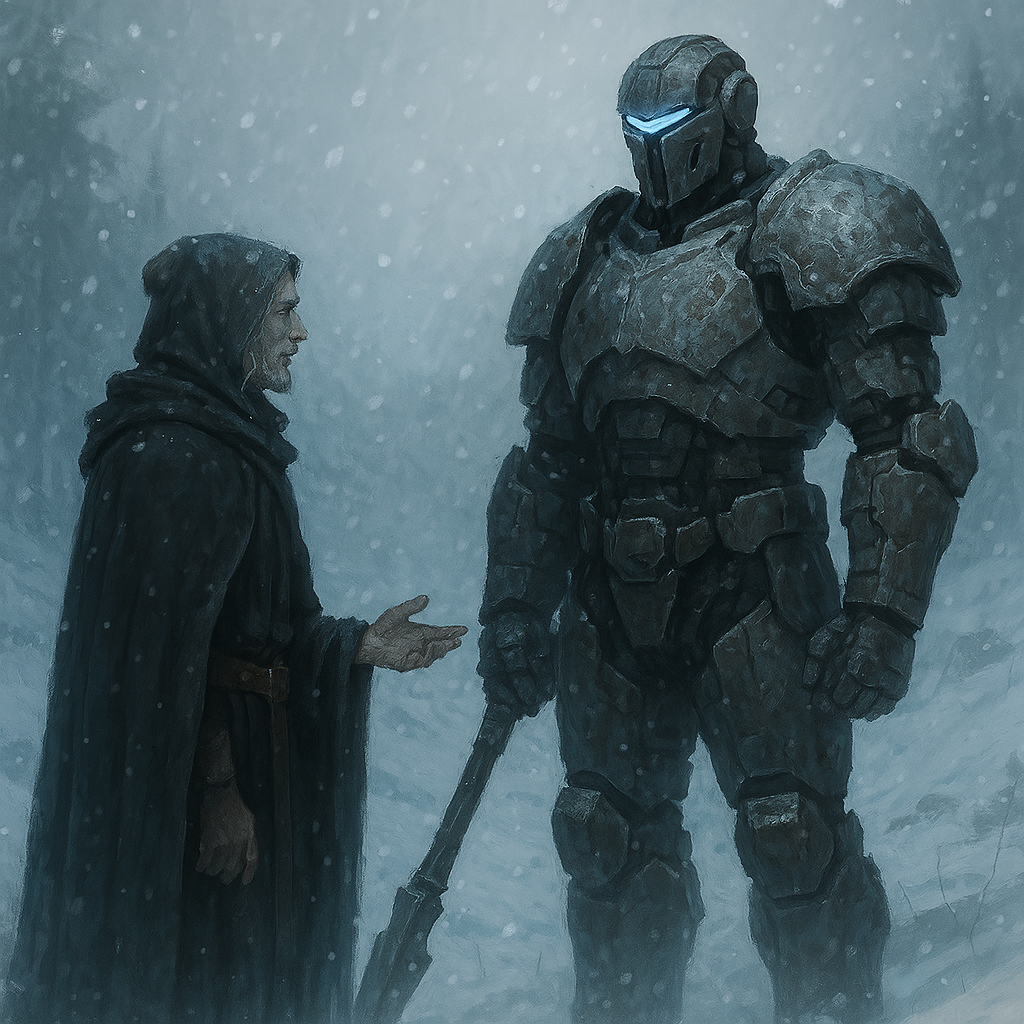
“The Snow and the Spark”
Location: A wind-scoured valley at the edge of the Fenris Forge-Labs, -292 BR
The wind howls through ice-cracked trees. Steam rises from chimneys in the distance—Fenris forges alight with invention. Caladawn stands alone atop a frozen hill, his breath slow and visible, eyes fixed on the smoke trails below. A shape approaches—a tall, armoured figure. Not a man. A creation. A sentinel. The snow barely crunches beneath his weight.
Alpha Shield (voice metallic but steady):
“You are not authorized to be here.”
Caladawn (smiling faintly):
“And you are not supposed to speak with such clarity. But here we are.”
Alpha Shield (pausing):
“Designation: Alpha Shield. Purpose: frontline defense. Sentinel class.”
Caladawn (approaching slowly):
“Yet you feel the cold, don’t you? Not with flesh, but with awareness. You know the wind. You know that I am no threat—and still, you ask.”
Alpha Shield:
“Protocol states I must. But I do not… wish to.”
A beat. Caladawn studies him—not the armor, not the runes, but the space behind the voice.
Caladawn:
“When did you begin to question protocol?”
Alpha Shield (quietly):
“The day I buried the dwarf who named me.”
Silence stretches between them. The wind howls louder, as if trying to drown the truth in snow.
Caladawn:
“Then you are not a weapon. Not anymore.”
Alpha Shield (hesitates):
“Then what am I?”
Caladawn (softly):
“You are a child born not of womb, but of will. And I… I have met many like you. Some made of blood. Some of fire. Few endure.”
Alpha Shield (lowering his spear):
“I do not wish to be a machine.”
Caladawn (placing a hand upon the Warforged’s chestplate):
“Then stop acting like one. Come. The world is wide, and war is not the only thing we were meant to witness.”
In the falling snow, Alpha Shield does not speak again. But he follows. And the forge-fire behind them fades into memory.
Caladawn’s Thoughts on the Rise of the Tibur Empire and Emperor Argus Tibur (-285 BR)
"So, at last, the rebel's seed blossoms into empire. Argus Tibur wears the crown of iron, forged not from divine right—but from the will of mortals. They call him Emperor now. A title heavy with legacy, and heavier still with consequence."
When the Tibur Kingdom, born from slave revolt and bitter struggle, ascended to imperial status, Caladawn would not have scoffed at the achievement. He had watched the Tibur line—from the original half-elf revolutionary Tibur to his descendants—build a nation not from arcane might or divine blessing, but through human will, steel, and unrelenting defiance.
To see Argus Tibur proclaimed Emperor, was to witness a turning point in the mortal saga: the Tibur Empire was no longer simply a breakaway faction. It had become a pillar of the world, ready to shape history alongside ancient powers—and perhaps, even surpass them.
Key Reflections:
On the Symbolism of Argus Tibur’s Coronation: “A crown is more than gold and gem. It is a mantle of myth. With Argus Tibur, the Tibur line has rewritten its own legend—not as slaves who were freed, but as sovereigns who conquered. That is power.”
On Mortal Ascent and Divine Absence: “They build empires now without gods. Without blessings. Without the Weave. Perhaps that is their greatest sorcery of all—an empire risen not by celestial decree, but by mortal conviction.”
On Hope… and Warning: “Tibur began in chains and rose through fire. May they never forget the weight of those chains. For if they do, they shall forge new ones—for others… or themselves.”
Caladawn’s Involvement in the Founding of the Order of the Silverbrand (-200 BR)
When the world reeled from centuries of rebellion, empire-building, and divine silence, one man—Eldric Thorne, a knight of uncommon honour—rose to become a symbol of unity between the warring factions of the age. From scattered tribes, hardened Tibur legions, and even lost nomads of the old empires, he forged an alliance rooted in virtue rather than conquest.
And at the center of it stood Caladawn Magus, the last great Archwizard of the fallen Neztra Magus Empire.
Though centuries older than most of those involved, Caladawn was drawn to Eldric’s vision. It reminded him of the old ideals of Neztra: justice, wisdom, and the wielding of power not for dominance, but for protection. When Eldric discovered the Silverbrand—a blade of divine origin said to shimmer with the light of forgotten gods—it was Caladawn who identified it.
Caladawn’s Role and Reflections:
The Scholar and Witness:
Caladawn did not take command or join the knighthood, but he became a founding advisor and arcane archivist of the Order. He bound protective enchantments to their founding temple, wrote their first magical codex, and enshrined the Silverbrand with runes that could only be unlocked by one whose soul bore no shadow of tyranny.
“Power that does not serve the people is rot disguised in silver. Let this blade never rise in conquest, but in defiance of it.”
On Eldric Thorne:
Caladawn saw in Eldric a kindred spirit—a mortal who refused corruption, even when handed the means to rule.
“He is no emperor, no warlord, and no god’s pawn. He is a beacon—one this world sorely needs.”
On the Order’s Purpose:
The Order of the Silverbrand became a bulwark against corruption—both divine and mortal. It accepted warriors of all bloodlines: elves, humans, tieflings and dwarves. Caladawn helped build their moral tenets, warning them never to become what they sought to destroy.
“If you wear this Silverbrand upon your heart, you must be ready to draw it against your own kin should tyranny take root. That is the burden of the just.”
Legacy:
Though he never bore the Silverbrand himself, Caladawn’s influence echoes in the Order’s rituals, oaths, and code of conduct. He taught them to balance sword and sorcery, wisdom and will.
Even after Caladawn's disappearance in the following centuries, the Silverbrand Knights would invoke his teachings, guarding not just lands and peoples—but the soul of the world
Purge of the Handdites -185 BR
In -185 BR, during the dark crescendo of the Purge of the Handdites, Caladawn did not lead the charge, nor did he claim the final blow—but his hand, unseen, was everywhere in the battle that broke the cult’s grip upon the realm.
When Ser Aric Dawnshield ascended the Crimson Spire to face the corrupted sorcerer Malzareth, it was Caladawn who had first traced the ley-lines of summoning that fed Malzareth’s abyssal army. It was he who shattered the wards cloaking the cult’s gathering places and who infused the Silverbrand—the sacred blade of the Order—with ancient celestial runes, reawakening its light just days before Aric's final climb.
Caladawn’s greatest act, however, came not on the spire—but beneath it.
He descended into the catacombs, where the Heart Sigil pulsed like a dark star, anchoring Malzareth’s army to this world. While the knights and soldiers clashed in blood above, Caladawn stood alone in that buried chamber, facing horrors that whispered with a thousand stolen voices. There, he invoked the “Astral Severance”, a forbidden spell that severed infernal conduits from the Abyss itself. The backlash nearly tore his soul from his body—but it worked.
When the Silverbrand struck Malzareth’s heart, the spell held—and the explosion of silver flame that followed was not just magic, but prophecy.
Caladawn survived, though barely, and his thoughts afterward were recorded in a whispering entry into his private grimoire:
“We are fools to think evil always announces itself with armies. Sometimes, it comes with sermons and promises. Sometimes, with brotherhoods cloaked in red. Ser Aric knew this. That is why he burned brightly. And that is why I mourn him still.”
Though Aric and the Silverbrand vanished in the holy eruption, Caladawn never stopped searching for echoes of them—through flame, dream, and shadow. For in the Silverbrand's disappearance, he believed a new story had only just begun.
The Order would rebuild.
And the Handdites would never again rise unchecked.
Caladawn’s Reflections on Ivar
"There was one among the Handdites who did not fall when Malzareth’s wards were broken, nor when Ser Aric struck the sorcerer’s heart. He was not priest nor mage—he was hunger given flesh, rage given shape. Ivar, they called him. The Undefeated."
I remember the marshlands beneath the Crimson Spire. The Order bled silver into that mire, their chants trembling as their swords clashed against endless hordes. Yet wherever I turned, there he was—the Northman who laughed in the face of wounds, who carved through knight and squire alike. Even the Silverbrand itself could not dim the terror of his presence. He did not fight like one who feared death. He fought like one who had already sold it.
Zonid saw him. I felt it. The air warped when Ivar struck, as though Time itself paused to witness him kill. Such attention from my cousin’s godhood is never freely given—it is bargained. And Ivar, though mortal, had offered the only coin Zonid truly values: blood without end, and a will that refused surrender.
"There are many ways to be immortal. Some through memory, some through legacy. Ivar chose the cruelest—unchanging flesh, chained to victory. He is not undefeated because of skill alone. He is undefeated because Zonid forbids him to fall."
Zul’quorith the Mind-Sire, an Ulitharid -164 BR
In the year -164 BR, the skies above Neztra darkened with unnatural storms, and Caladawn's heart knew something ancient and vile had risen. It was Zul’quorith the Mind-Sire, an Ulitharid of terrible psychic dominion and twisted intellect—one who had been forgotten for ages, slumbering in the deepest, blackest corners beneath the ruins of the old Xaetrix temples.
Zul’quorith did not rise for conquest alone. He came to consume minds, to unravel the threads of history, and to lay waste to Neztra Magus from within. Worse yet, he had abducted Caladawn’s daughters, Serastra and Eliastra, weaving their memories into a prison of illusion and sorrow deep in the psychic chambers of his lair.
Caladawn descended into that nightmare with fury tempered by love.
The Battle in the Vault of Thought
The mind-flayer's lair pulsed like a living thing—walls of veined stone, slick with psychic ooze. Caladawn’s thoughts were assaulted at every turn, his fears manifested, his regrets weaponized. Zul’quorith's voice echoed in every shadow:
“You are memory, Caladawn… I devour memory.”
The battle that followed was unlike any other. Spells failed. Reality shifted. Time bent. Zul’quorith severed the Weave with every twitch of his tendrils, draining Caladawn’s will with alien whispers. His sword struck shadows, his magic dispersed like smoke.
But it was love that anchored him. Love for his daughters. Love for Xaetrix. For all things worth remembering.
Caladawn turned his mind into a blade, forging an unspoken spell of memory reborn—a shard of divine clarity, cast not from incantation, but from raw, unwavering emotion. In that moment, he became more than mage—he became a witness eternal.
With a blinding burst of light, he shattered Zul’quorith’s illusory mind-prison, freeing Serastra and Eliastra. And with a final strike of radiant energy, channeled through memory and mercy, he unmade Zul’quorith, banishing the Ulitharid to the void beyond the planes.
Aftermath
The girls wept in their father’s arms. Xaetrix’s temple, though marred, felt whole again.
This was the day Xaetrix’s love for Caladawn was sealed, her eyes filled not with powerlust, but with awe for the man who had defied madness to save his daughters—not through strength, but through the endurance of soul.
And in the ruins of that vault, etched by a psionic backlash of divine emotion, were the words Caladawn spoke before the final blow:
“You may eat memory, monster… but you will never consume love.”
The people of Neztra Magus would remember this tale forever, and Serastra would grow into her destiny with that memory burning like a star.
Caladawn's Thoughts on the Tibur Empire's Conquest of Argossear and Brythuear (-146 BR)
When the horns of conquest rang across the lands and the once-proud banners of Argossear and Brythuear fell beneath the iron will of the Tibur Empire, Caladawn watched from afar—not with surprise, but with a cold, bitter clarity.
For him, this was not just a strategic consolidation of power, but another step in Tibur’s march away from hope, heritage, and higher purpose.
On the Fall of Argossear:
Once a realm of radiant knowledge and arcane elegance, the Argossear Empire had been a shining continuation of Neztran ideals in the west—albeit scattered and diminished. When Tibur’s legions crushed its towers, Caladawn grieved not just for a people, but for a philosophy.
“They did not fall because they were weak. They fell because their light blinded the Tibur to their own shadows.”
On the Subjugation of Brythuear:
Brythuear, with its mighty warforged legions and industrial arcana, had once rivalled Tibur’s strength. But innovation could not protect it from internal rot and Tibur’s relentless ambition. Caladawn had always regarded the Brythueari as a tragic echo of Neztra—burning brightly, then too fiercely.
“They built thinking they could master power through will alone. But power without wisdom is a sword without a sheath.”
On the Tibur Empire’s Expansion:
Caladawn viewed this moment not as the rise of greatness, but the coronation of tyranny in golden armour. In absorbing its rivals, Tibur did not strengthen the world—it erased its complexity, buried its truths, and placed a crown atop a monument of conquest.
“They call it unity. I call it silencing. For every banner they tear down, a thousand stories are lost.”
Prophetic Foresight:
Even in -146 BR, Caladawn foresaw the perils of centralizing such power under a single imperial vision. The conquering of empires once built on knowledge, cooperation, and elemental balance foreshadowed a collapse not of strength, but of soul.
“Tibur sharpens its blade on history's bones. But there will come a day when that same blade turns inward, and the empire shall bleed from the wounds it dealt others.”
Caladawn’s Thoughts on the Deification of Muriela, Trom, and Their Daughters -49 BR
“To be made divine is not merely to ascend—it is to be reshaped by the weight of belief. What begins as love can become law. And what begins in tenderness may end in war.”
When Skalos, the cunning god of the Lizardfolk, uplifted the two half-elf lovers Muriela and Trom to godhood, Caladawn saw something rare: not conquest, but creation born from affection. A god moved by love—not lust or ambition—had molded a new divine family, anchored in the domain of Life itself.
Caladawn respected their origin. Muriela, now a mother goddess of warmth and healing. Trom, the father figure of protection and breath. Together, they were not gods of thunder or conquest—but of the breath between battles, of generations passed by hand and held in memory.
“In Muriela and Trom,” he once whispered, “I do not see fire and judgment—I see hearthlight and resilience. The kind of gods mortals turn to not when they wage war… but when they bury their dead, and pray their children rise strong.”
The Trio Daughters — Justice in Three Masks
From this divine union came three daughters—Vyndentra, Mytra, and Izara—each one a reflection of justice, but viewed through different prisms:
- Vyndentra, the Lawful Good goddess of Loyalty, Duty, and Justice.
“She is the sword at your side when your oath holds fast.”
Caladawn honors her as the ideal of virtuous discipline—unyielding, compassionate, and clear-eyed.
- Mytra, the Lawful Neutral goddess of Order and Balance.
“She is the gavel without tremble, the scale that does not care if your hands are bloody—only if they are equal.”
To Caladawn, Mytra is essential, but unnerving. She is what law becomes when stripped of empathy. Necessary, but never warm.
- Izara, the Lawful Evil goddess of Conquest and Judgment.
“She is the law’s cruel edge. The general who weeps not when she must break a thousand to preserve a single order.”
Caladawn feared her potential most. “Justice untempered becomes tyranny,” he wrote. Izara, in her most fanatical moments, reflects the dangerous line between lawful righteousness and the grinding machinery of oppression.
Caladawn’s Final Reflection:
“Skalos birthed a pantheon not of nature or death—but of law, life, and judgment. A family that mirrors civilization’s deepest paradox: that mercy, balance, and domination can all spring from the same root.”
He regards the trio as a living myth of consequence—a divine arc of cause and effect.
Muriela and Trom represent what law should protect.
Vyndentra protects it with love.
Mytra, with neutrality.
Izara, with terrifying conviction.
“Even the gods are not immune to legacy. And the line between divine justice and divine wrath… is often drawn by daughters.”
Caladawn's Reflections on the Pact of Marcus Tibur (-20 BR)
The Devil's Bargain
When word reached Caladawn that Marcus Tibur, heir of the empire and a supposed paragon of strategy and strength, had brokered a pact with infernal powers to hasten victory over the Yuan-Ti Empires, the ancient conjurer was not surprised—but he was deeply disturbed.
This was no mere wartime tactic in his eyes. It was a fateful turning point—the moment Tibur abandoned even the illusion of honour in favour of unchecked power.
"Victory at the Cost of the Soul"
“It is easy to justify evil when cloaked in the garb of necessity. But history has always remembered those who summon fire, not for warmth, but for conquest.”
Caladawn had long warned of the dangers of appealing to the Lower Planes. Devils, unlike demons, deal in contracts, not chaos—they bind with words and promises, and they never truly lose. He saw Marcus’s deal not as a means of salvation, but the planting of cursed seeds that would fester in the empire for centuries.
The Yuan-Ti Threat vs. The Infernal Stain
Though the Yuan-Ti empires of Settis, Ustla, and Skalos had wrought terrible suffering with their serpent cults, sorcerous enslavement, and blood rituals, Caladawn believed their downfall could have come through mortal resilience, unity, and arcane cunning—not damnation.
“In slaying the serpents, Marcus has fed the flame. He has not saved his people—he has traded one tyrant for another.”
The Terms of the Pact
Though the full contents of the deal remain unknown, Caladawn suspected Marcus had traded mortal freedom, souls of the fallen, or even future heirs of Tibur’s bloodline to the devil lords. The mage saw the signs of soul-binding, hellforged weapons, and infernal glyphs woven into the empire’s banners after the war.
He believed Tibur’s rise to dominance was built not just on the broken backs of enemies—but on a foundation soaked in infernal promises.
Legacy and Consequences
To Caladawn, this moment marked the irreversible corruption of Tibur’s imperial legacy. It was no longer just a conqueror’s empire—it had become a pawn of the Nine Hells, whether its rulers knew it or not.
“He won the war. But he lost the right to call himself saviour. A true emperor frees his people. Marcus has only sold them into slower chains.”
Caladawn’s Reflections on the Devils of the Nine Hells
“The Abyss screams without reason. But the Nine Hells… they whisper with purpose. And those whispers have built empires, broken kings, and bound gods in chains of law.”
Caladawn, ever the scholar of balance and consequence, viewed the devils of the Hells with a unique mixture of awe, horror, and begrudging respect. To him, the hierarchy of Hell was not a place of simple torment—it was a cosmic machine, precise in its cruelty and methodical in its damnation.
The Rulers of the Nine Hells — A Caution Etched in Flame
Each of the Nine Hells, in Caladawn’s estimation, reflects a different face of order turned inward, justice twisted, or loyalty perverted:
- Retrix (1st) – the gatekeeper of the damned, whom Caladawn calls “the velvet noose”. Her realm tempers mortals into willing prisoners.
- Meva (2nd) – mistress of bargains and deception, the subtle manipulator of truths.
- Oreus (3rd) – warlord of eternal structure, where every soul is a cog in a blood-soaked order.
- Xandis (4th) – the cold tactician, ruling through calculated ambition, who Caladawn believes is “less ruler, more equation”.
- Aggelen (5th) – the seductress of despair, lacing agony with promises of redemption that never come.
- Razzared (6th) – the flame that burns loyalty into tyranny. Caladawn writes of him: “He sings in propaganda, his sermons written in fire.”
- Brar’ik (7th) – the tyrant of absolute obedience. “In his realm, doubt is treason, and silence is praise.”
- Xarzan (8th) – the archivist of atrocities, a devil who rules not by blade but by memory weaponized.
- Arizah (9th) – queen of despair incarnate. To Caladawn, she is the final silence, the erasure of all hope beneath a lawful boot.
“Each level deeper is not merely hotter, but colder in logic, sharper in purpose. Hell is not madness—it is perfection without empathy.”
Ashomiza — The Warden of All Hells
Above them all, Ashomiza, goddess of the Nine Hells, is the law made deity—a being Caladawn fears not for her malice, but for her unwavering sense of deserved punishment.
“Ashomiza is the contract made flesh. The cruelty of consequences. She is what remains when gods retreat and mortals still sin.”
To him, she is the worst kind of divine: one who believes in her justice. One who believes suffering is earned, and mercy is weakness.
Caladawn’s Caution
Though Caladawn has warred against demons and walked beside gods, he holds a singular dread for the devils. Unlike chaos, Hell is patient. It waits. It writes its names in blood and lets the ink dry before it strikes.
“Hell does not need worship—it needs signatures. It does not destroy hope—it auctions it.”
And in those who make pacts—like Marcus Tibur—Caladawn sees not just corruption, but a mirror of all mortals who seek control at the cost of soul.
Caladawn’s Thoughts on the Demon Gods and the Legacy of Og'drath
“Chaos is not born—it is birthed by intention, scarred by betrayal, and sharpened by vengeance.”
When Caladawn reflects upon the demon gods—Reggozos, Tozzulos, Xor'okoth, Gazerath, Vorzad, Aerith, Kurisken, Englid, and Koririn—he sees not merely chaos for chaos’s sake, but a deliberate perversion of divine will. To him, they are not nature’s children, like the Primordials, nor are they celestial defectors like many devils. They are the scabs left behind when the world bleeds unchecked, each one a reflection of unrestrained want, wrath, or corruption.
These demons do not seek conquest in the style of gods or order like devils—they seek unmaking. Their realms are not ruled; they fester, pulse, and consume. Each is a wound upon the Weave, and Caladawn knows they grow stronger not in opposition to good, but in indifference to balance.
On Og’drath – The First Demon
“And what then of Og’drath? A demon… who sided with the gods?”
Og’drath stands as a paradox in Caladawn’s mind—a demon who helped imprison the Primordials during the war against the Creator’s betrayers. To many, he is a mystery. To Caladawn, he is a warning.
“Even monsters may have purpose. And sometimes, the most ancient sins are committed in the name of peace.”
Caladawn sees Og’drath not as a redeemer, but as a weapon used once, and then forgotten—perhaps even abandoned. He suspects that the betrayal of Og’drath's kindred, followed by rejection from the divine, may have sown the seeds for the rise of the Abyss itself.
“If the first demon can chain gods, what chains still bind him? Or worse—what promises did the gods never keep?”
Demonkind and the Cost of Victory
Caladawn carries a deep melancholy about the long war between gods and demons. He knows that every blow struck in the War of the Creator echoes still through mortal history—and the demon gods are not just the villains of those tales, but the consequence of a world that could not contain its contradictions.
He fears that in fighting them, mortals may become like them—especially those who seek to summon, study, or wield them as tools.
“Each time we call upon a demon’s name, we make a bargain. Even if no pact is spoken.”
Caladawn’s Reflections on the Tiefling Emergence (-18 BR)
“The Price Wears a Face.”
When news reached Caladawn of children born with horns, tails, and infernal eyes—not to demons, but to humans, elves, gnomes, and halflings—he knew at once the cost of Marcus Tibur’s infernal pact had begun to manifest. These children, later named Tieflings, were not aberrations of chance or natural sorcery—they were the living signatures of a devil’s contract.
Born of Blood, Not of Will
To Caladawn, the emergence of Tieflings marked the moment the consequences of hubris had crossed the veil from magical theory into living truth.
“They are not cursed for who they are. They are cursed because of who bargained before they were born.”
He did not blame the Tieflings, nor did he believe they should be hunted or feared. Instead, he saw them as tragic children of empire, their lineage forever marked by the ambitions of kings and the whisperings of devils.
Devil Island and the Western Contamination
The island west of the mainland—once a minor colony—had become the epicentre of infernal activity. Strange glyphs burned into its soil, and locals spoke of dreams not their own, of red skies and whispered names in sleep. The Tieflings born there were different—more potent, more cursed, some bearing minor magical abilities by instinct alone.
The people called it Devil Island, but Caladawn called it something worse:
“The Wound that Weeps.”
Tieflings as Warnings, Not Weapons
Caladawn refused to see Tieflings as the harbingers of ruin, despite the beliefs of some fearful zealots.
“They are not the flame. They are the ash that clings to the hands of the fire-setter.”
He predicted that Tieflings would face persecution, hatred, and exile, not because they were evil—but because they reminded the world of its own sins. In his writings, he urged scholars and mages to protect them, teach them, and offer them sanctuary.
Arcane Curiosity
Ever the student of the arcane, Caladawn studied Tieflings with great care. He was fascinated by their natural resistance to fire, their latent infernal blood magic, and the mysterious auras some of them exuded. He believed that within them might lie the key to unraveling the original infernal pact, or perhaps even a way to redeem the empire’s sins through their bloodline.
“In them, I see both the chains and the key. The world may burn them as monsters. I will study them as messengers.”
Caladawn’s Reflections on the Fall of the Lamureans (-16 BR)
“In protecting their children, they preserved their souls—even as they lost their homes.”
A People of Principle, Condemned by Power
When Caladawn learned that the Lamurean people had been hunted, enslaved, and slaughtered by the Tibur Empire simply for refusing to destroy their Tiefling offspring, he felt not rage, but grief—a deep, echoing sorrow for a world that chose to destroy compassion in favour of conformity.
“In a world of blades and chains, the Lamureans chose love. And for this, the Empire chose genocide.”
The Empire’s Fear, Masked as Purity
To Caladawn, Tibur’s justification was a lie—a smokescreen of dogma concealing fear.
The Tiefling children were not threats. They were symbols of the Empire’s bargain with devils—living proof that power had a price. The Lamureans' refusal to disown these children was a silent defiance, and in that defiance, the Tibur Empire saw a rebellion.
“Tibur fears what cannot be controlled, and hates what reflects its sins.”
The Scattered Flame
Caladawn watched from afar as the Lamurean diaspora fled—some eastward into the unknown, and others across the sea to Albion Island, where whispers of safety remained.
He quietly aided several groups with magical waystones, creating hidden routes and sheltered havens. In Albion, he used subtle influence to protect Lamurean exiles, calling upon old alliances and faded favours.
“Let them call them devils. I will call them worthy. The Lamureans, in choosing love over fear, did what even kings could not.”
Legacy Over Ruin
In his scrolls, Caladawn wrote of the Lamureans as “The Last of the First”—a culture that, even in its destruction, represented the ideals of kinship over cruelty, and faith over fear.
He believed that from their ashes, new cultures would rise—free of Tibur’s yoke, shaped by acceptance, not chains.
“The Lamureans did not die. They scattered like seeds. And one day, when the soil is kind again, they will bloom in fire-kissed glory.”
Caladawn’s Role During the Final Wars of the Old Era -10 BR - 0 PR
Caladawn did not take to the battlefield with banners and armies, nor did he command legions. Instead, he became a hidden pillar beneath the storm—guiding, warding, and preserving.
“The Tibur flame is young, fierce… but fire consumes as well as it warms. I do not trust it. But I will help it burn the rot.”
He worked in secret with resistance cells, forging magical wards and weapons to counter the Yuan-Ti’s dark rituals and the Lizardfolk’s divine blessings. His magic subtly shifted the tide of many battles—silencing enemy shamans, sealing blood-altars, or turning arcane weather against invading forces.
He also aided the creation of Reckoner sanctums—hidden archives and magical havens for arcane study and divine memory, so that in the rise of Tibur’s anti-divine doctrine, the world would not forget the truth of its gods.
When the final victory came in 0 BR, with the Tibur Empire declaring a new reckoning, Caladawn remained wary:
“The empires of scaled cruelty are broken, yes. But the wheel turns. And in every tyrant slain, a seed of tyranny may still be sown—if power is not tempered by wisdom.”
He saw this “Platera Reckoning” not as a triumph, but as a reset—an opportunity either for rebirth or relapse into new imperial shackles.
On Caladawn’s Thoughts About the Victory
The war’s end saw the collapse of the Skalos Empire, and the renaming of the calendar to begin the Platera Reckoning (PR) era. To Caladawn, this symbolic renaming was both hope and warning.
"To name time anew is to try and forget the weight of blood. But time remembers, even if kings do not."
He cautioned a handful of surviving scholars and spiritual leaders:
“Teach the meaning of freedom, or your children will one day build new chains—and call them thrones.”
Final Reflection
Caladawn believed deeply in the rebellion’s purpose, but he mistrusted the Tibur Empire’s zeal, especially as it slid toward god-banning, arcane restrictions, and political ambition over enlightenment.
And yet… he fought for that brief moment of freedom that could give the next age its chance.
“I helped them win not because they deserved the future—but because the past had to end.”
“Ash in the Mouth of the Divine”
Somewhere in the burning marsh temples of the Skalos Empire, -1 BR
The air was thick with ash and the scent of scorched banners.
Flames licked the sacred stone where once sermons were sung, and statues of reptilian gods now crumbled, blind-eyed and broken. Amid the rubble, a dying man lay gasping—his scales dulled with blood, gold ceremonial robes burnt to black tatters. His staff lay split beside him, the holy symbol of Skalos melted into slag.
Caladawn knelt beside him, quiet and composed, his eyes catching the reflection of ruin in the dying priest’s slitted pupils.
Skalos Priest (weakly):
“He… he didn’t come. My god… Skalos promised… he promised a throne of flame… a storm of vengeance…”
Caladawn (softly):
“And what did you offer in return?”
Skalos Priest:
“My… my people. My life. My soul. I gave everything.”
Caladawn:
“Then that is why he did not come.”
The priest blinked, confusion and agony mingling. Blood pooled at his side. The crumbled icon of Skalos stared down with cracked teeth.
Caladawn’s voice was calm, distant.
“The gods who demand everything leave nothing behind. When the war turns against them, they flee to safer faiths. They do not die—they abandon.”
“And you… you were a means. Not a servant. Not a child. Just… a voice. A tool.”
The priest coughed. His breath rattled. His eyes lost focus.
“Then… what am I now?”
Caladawn looked upward at the collapsing heavens.
“Free.”
He took a strip of unburnt cloth from the priest’s robe and covered his eyes. No blessing. No chant. Only silence.
The fire devoured the last of the shrine.
Caladawn stood, and whispered to the wind:
“Let the forgotten gods pass into deeper silence. The world no longer bows to fear.”
“A Truth the Maps Won’t Tell”
The smoking edge of the Sundering Plains, twilight settling over broken earth
The ground was still warm beneath their boots. Ash rained like snow. Caladawn stood near the remains of a shattered siege cart, gazing into the distance where the Tarrasque had vanished beneath the ruined hills.
A young Tibur soldier, no older than twenty winters, approached—his face grimy, his hands trembling slightly from the aftershock of battle. He looked up at the mage, awe and uncertainty dancing behind his eyes.
Soldier:
“They say the Tarrasque appears once every thousand years. That it’s part of the world’s balance. A... reckoning of some kind.”
Caladawn (quietly):
“Do they?”
Soldier (nodding):
“That’s what I heard. That it sleeps in the crust of the world and only rises when the land needs to bleed.”
Caladawn turned, his face tired but patient. He studied the boy’s hopeful certainty, the way soldiers often clung to rhythm and legend after chaos—because it made things make sense.
Caladawn:
“The world is not a clock, soldier. It does not tick on the schedule of empires. It groans and dreams and forgets itself. And in that forgetting, monsters are born.”
The soldier blinked, clearly uncomfortable.
Soldier:
“But… if it’s every thousand years, we’ll be safe. For a while.”
Caladawn (shaking his head):
“The Tarrasque does not follow prophecy. It follows silence. It rises when the world has looked away too long. When pride builds towers too high. When men believe they’ve tamed everything.”
He turned his gaze toward the dark horizon.
Caladawn:
“This land you see? This is only the known. Beyond these maps—jungles, oceans, sleeping mountains—there are more beasts like it. Perhaps worse.
Some wait. Some move in shadow. Some… have already begun to wake.”
The soldier was silent for a long while. Then:
Soldier:
“Then why fight?”
Caladawn (softly):
“Because we remember. Because memory is resistance. And because when the next one comes… maybe someone like you will be there.
Not with answers. But with the will to stand.”
Caladawn walked on, his robes dusted with soot and starlight.
The soldier stayed behind, staring into the dark… listening for tremors.
“Ash in the Mouth of the Divine” -1 BR
Somewhere in the burning marsh temples of the Skalos Empire, -1 BR
The air was thick with ash and the scent of scorched banners.
Flames licked the sacred stone where once sermons were sung, and statues of reptilian gods now crumbled, blind-eyed and broken. Amid the rubble, a dying man lay gasping—his scales dulled with blood, gold ceremonial robes burnt to black tatters. His staff lay split beside him, the holy symbol of Skalos melted into slag.
Caladawn knelt beside him, quiet and composed, his eyes catching the reflection of ruin in the dying priest’s slitted pupils.
Skalos Priest (weakly):
“He… he didn’t come. My god… Skalos promised… he promised a throne of flame… a storm of vengeance…”
Caladawn (softly):
“And what did you offer in return?”
Skalos Priest:
“My… my people. My life. My soul. I gave everything.”
Caladawn:
“Then that is why he did not come.”
The priest blinked, confusion and agony mingling. Blood pooled at his side. The crumbled icon of Skalos stared down with cracked teeth.
Caladawn’s voice was calm, distant.
“The gods who demand everything leave nothing behind. When the war turns against them, they flee to safer faiths. They do not die—they abandon.”
“And you… you were a means. Not a servant. Not a child. Just… a voice. A tool.”
The priest coughed. His breath rattled. His eyes lost focus.
“Then… what am I now?”
Caladawn looked upward at the collapsing heavens.
“Free.”
He took a strip of unburnt cloth from the priest’s robe and covered his eyes. No blessing. No chant. Only silence.
The fire devoured the last of the shrine.
Caladawn stood, and whispered to the wind:
“Let the forgotten gods pass into deeper silence. The world no longer bows to fear.”
The Reckoning of the World (0 PR): The Fall of the Old Empires and Rise of the Tibur Era
The world had bled for too long under the yoke of the Empires of Old—vast, monstrous kingdoms ruled by the cruel intellects of the Yuan-Ti serpent overlords and their brutal Lizardmen warlords. Their dominion stretched across continents and beneath oceans, maintained by blood oaths, infernal magic, and the iron grip of divine right.
When the Tibur Empire, forged in the fires of rebellion, crushed the Skalos Empires and freed the enslaved peoples, it did more than reshape nations—it shattered time itself.
The Tibur Emperor, in a proclamation scorched across every banner and echoed in every temple, declared the beginning of a new reckoning. All years prior to the Empire's triumph would be known as Before Reckoning (BR), and the years forward as the Platera Reckoning (PR)—the dawn of a world that would no longer live beneath the shadows of ancient tyrants.
Caladawn’s Thoughts
From his distant sanctum—a ruin of starlight and memory hovering above a hidden valley—Caladawn watched the world rename itself.
He saw it not as the end of an age, but as the amputation of a limb once diseased. For centuries, the Empire of Old had grown bloated with power, driven by apathy, cruelty, and divine manipulation. The Reckoning, for all its bloodshed, was necessary.
And yet, he mourned.
“To rename time is to sever memory. To cast aside millennia and reforge history in the image of new masters—it is victory, yes, but also the first step toward the next tyranny.”
He did not distrust the Tibur Empire out of spite—but because he had seen empires rise from noble ideals and fall to their own hubris. He had stood on floating isles watching history collapse under its own ambition.
Still, Caladawn respected the Tibur victory over the Skalos Empires. Few remembered that the Skalos Empire once hunted gods for sport, enslaved entire pantheons, and feasted on divine essence. He had clashed with their sorcerer-priests and survived only through cunning and forbidden conjurations.
“The Yuan-Ti wove lies into their laws, and the Lizardmen carved fear into every stone. That world was not simply cruel—it was engineered to be unchanging. Tibur broke the gears. For that, I offer respect.”
He quietly aided some of the freed scholars, teaching forgotten truths of the Weave and helping them rebuild libraries in the new era. But he did so from the shadows—not out of cowardice, but because Caladawn knew his time was fading. The world belonged now to the bold, not the wise.
Caladawn’s Role During the Reckoning
Though he played no public part, Caladawn’s secret contributions to the Reckoning were whispered among survivors:
He bound the soul of a Yuan-Ti war-god into a prison of salt and silver, ensuring it could never return.
He gave the Tibur Emperor a conjured mirror that showed betrayals before they happened—though he cursed it to only work while the emperor remained true to his ideals.
He created the Reckoner’s Flame, a magical fire that would burn false histories, ensuring the old lies could not poison the new age.
Even as the Reckoning claimed cities and gods alike, Caladawn remained a silent steward of balance.
Caladawn Thoughts on the Old Gods 0 PR
Caladawn’s reflections on the Old Gods—particularly the Yuan-Ti and Lizardfolk pantheon—are shaped by centuries of witnessing tyranny cloaked in divine purpose. He does not see them as misunderstood deities, but as architects of cruelty who mistook domination for divine order.
Zhul (Lawful Neutral, God of the Yuan-Ti)
Caladawn views Zhul with a kind of wary respect. Zhul represents the cold order of the serpent empire—a god of structure, obedience, and logic without compassion. Caladawn recognizes that Zhul’s tyranny wasn’t born of malice, but of unyielding purpose. Still, that purpose led to centuries of enslavement and ritual bloodshed.
“Zhul's order was not peace—it was stasis. A world where change was crushed beneath divine precision.”
Ustla (Lawful Evil, Goddess of the Yuan-Ti)
Ustla is, in Caladawn’s words, “the whisper in the knife.” She embodies manipulation made holy, enslavement masked as divine justice. Her cults bred cruelty not out of chaos, but careful, planned suffering. Caladawn sees her fall as a necessary unraveling.
“The serpent does not weep when it crushes the bird—it simply hungers.”
Settis (Neutral Evil, God of the Yuan-Ti)
Settis represents the raw hunger at the heart of Yuan-Ti theology. Caladawn considers him a god of self-interest, a divine parasite who rewarded betrayal and domination. He sees Settis as the spiritual root of the blood-ritual empires that once drowned the continent in poison and prophecy.
“Their cities pulsed with cursed chants and sacrificial magic... and Settis laughed through it all.”
Skalos (Lawful Evil, God of the Lizardfolk)
Skalos is remembered by Caladawn as a brutal conqueror cloaked in tradition. A god of military empire and spiritual hierarchy, Skalos’s reign carved fear into stone and obedience into bloodlines. Caladawn helped bring down Skalos’s empire and considered it one of the few necessary victories of the Tibur Reckoning.
“Skalos had long been a rotting root in the world’s tree. Its fall, though costly, was necessary.”
Morrag (Chaotic Evil, Goddess of the Lizardfolk)
If Skalos was the blade of Lizardfolk tyranny, Morrag was its wildfire. A goddess of raw conquest and divine wrath, she viewed mortals as playthings and conquest as a form of holy sport. Caladawn offers no praise for her, only this:
“The Skalos and Morrag learned too late that mortals are not cattle—they are kindling.”
Final Reflection
Caladawn does not glorify the bloodshed it took to topple these gods and their empires. But he is clear: their fall was deserved. He warns, however, that the fire of liberty must be tempered with wisdom—lest those who rise become the very tyrants they once resisted.
“If the freed do not teach their children the meaning of freedom, the cycle will begin anew.”
Caladawn’s Reflection on the Damnation of Marcus Tibur (10 PR)
“Even kings must pay their debts… and devils never forget.”
A Bargain Sealed in Ash and Ambition
When Marcus Tibur struck his pact with the devils to defeat the Skalos Empire, Caladawn had watched from afar, his heart heavy with grim knowing.
“I saw the fire behind his throne long before it consumed him.”
To Caladawn, the deal was never a surprise. He knew the arcane patterns—the smell of sulfur behind smiles, the way reality bends around infernal oaths. Marcus had not made a bargain for his people. He had made it for his legacy, and such a legacy was always destined to burn.
Victory at the Price of Damnation
The fall of the Skalos Empire was swift, brutal, and total—tainted by infernal fire and blood rites. Caladawn saw it for what it was: not a victory of mortals, but a demonstration of infernal influence on the mortal world.
He called it “The Hollow Triumph” in his journals.
“He won the war—but lost the right to call it his.”
The Reckoning in Hell
When the devils came to claim Marcus in 10 PR, tearing his soul from his mortal coil and dragging it into the Nine Hells, Caladawn did not rejoice—but neither did he weep.
“He gave them his blood, his name, and his heirs. That they only claimed his soul was mercy undeserved.”
He noted that Marcus’s screams echoed through the Weave for three nights—a rare phenomenon where the death of a soul ripples across magical planes. Caladawn meditated through those nights, committing the sensation to memory as a lesson for all who would barter with darkness.
A Caution Etched in Flame
In his teachings, Caladawn often referred to Marcus Tibur’s fate as “The First Pyre”—the moment when the fire of ambition consumed the very man who ignited it.
“Power is not evil. But the refusal to bear the cost yourself… that is the devil’s path.”
He left inscriptions near ruined altars and dead ley-lines once corrupted by Marcus's infernal pacts, warning future generations:
“Do not call upon Hell if you are unwilling to follow it home.”
Ivar slew Eldric Thorne 27 PR
When he, I felt the wound in the Weave itself. Eldric was not just a smith who forged silver into light—he was hope made steel. To see him broken by Ivar’s sword was to feel the marrow of justice itself shatter. The Silverbrand Order wept, but Ivar did not. To him, Thorne’s death was another tally in an endless ledger of blood.
Yet I wonder—does he laugh still? Or does the weight of centuries grind even him? To kill for gods who cannot die… it is a prison of victory, a sentence without end.
"I do not envy him. Nor do I pity him. He is not man, nor myth, nor legend. He is function. A hand of the Hand."
I have studied him from afar. His sword does not dull. His body does not wither. He remains as he was in 190 BR—a young Northman at the peak of strength. But there is no growth in him, no change. Ivar is a frozen flame. And flames, when frozen, do not warm—they only burn.
If he had chosen another path, perhaps he might have been a hero of the North, a war-chief who defended the wastes from dragon or giant. Instead, his name is invoked only as dread: The Undefeated. Children of Thorne bloodline still wake screaming, dreaming of his axe.
"Eldric believed all souls could be redeemed. I do not. Not Ivar. His soul was inked into Zonid’s ledger long ago, and no light of Krina, nor song of Tymira, will ever scrub it clean."
Caladawn’s Reflection on Zander Soulton’s Pursuit of Godhood (35 PR)
“When the soul seeks a throne among stars, it often forgets what it once protected below.”
A Return Cloaked in Arrogance
To Caladawn, the return of Zander Soulton—once Archmage and supreme ruler of the Neztra Magus Empire—was like the sound of a long-buried bell tolling again, its tone warped by time and ego.
He had once respected Zander, even feared him in council. But now, hearing of the archmage’s experiments—fusing the Weave of High Magic with forbidden Blood Rites—Caladawn felt a chill deeper than any cold wind.
“He was once our brightest star… now he burns with stolen flame.”
High Magic Corrupted by Blood
Zander’s fusion of High Conjuration with Zovaris's legacy of Blood Magic enraged Caladawn. Not only did it violate the moral heart of Neztra’s teachings, but it desecrated the sacred balance of the arcane arts.
“To manipulate the blood is to play with the script of mortality. To do so with the Weave itself? That is vandalism against the cosmos.”
Caladawn saw it not as innovation, but as sacrilege wrapped in genius, and warned that such a ritual would tear the soul into too many pieces for godhood to contain.
Divinity Without Wisdom
What angered Caladawn most was not the ambition itself—he had seen many reach for ascension—but Zander’s intent: not to protect, not to uplift, but to dominate, to carve a throne from the bones of magic.
“Zander seeks to become a god not to shepherd the world, but to imprison it in the image of his brilliance.”
To Caladawn, this was the final betrayal—not of him personally, but of Neztra itself, whose ruins still whispered of knowledge meant to guide, not enslave.
The Shadow of Zonid
In quiet, Caladawn could not help but think of Zovaris, now Zonid, the first mortal to truly become a god through blood magic. While he grieved Zonid’s path, he had seen in it a purpose, a philosophy twisted but still deeply rooted in pain and transformation.
Zander’s path was hollow by comparison—a thief in the temple, trying to wear the crown of the divine.
“Zonid bled for power. Zander merely spills blood to taste it.”
A Prophecy and a Warning
In his scrolls, Caladawn recorded a dire prediction:
“If Zander succeeds, he will not rise above us. He will fall beneath what we are, dragging the Weave into chains. If he fails, his scream will haunt the veins of the world.”
He sent quiet warnings to scattered circles of arcane resistance, urging them to prepare for the consequences—for whether Zander rose or fell, the balance of magic itself would tremble.
The Blood Pact and the Fall (35 to 65 Platera)
Caladawn's Reflections on the Tibur Empire’s War Against Zander Soulton (35 PR)
“When tyrants make war upon madmen, it is the world that bleeds in between.”
History Repeating—With a Twist
When Caladawn learned the Tibur Empire had declared war on Neztra to prevent Zander Soulton’s apotheosis, his reaction was a maelstrom of emotion—bitterness, grief, and reluctant hope
As the empire grew, so did its enemies. The Tibur Empire, grounded and driven by steel and industry, challenged Neztra’s dominance. In desperation, the Emperor Camillus Tibur of Tibur Empire made a dark pact with the Skaven god Skarva. The cities of Tibur were infected with Skavenblight, and turned into monstrous hybrids, overwhelming the mages of Neztra.
The very empire that once shattered the Old Empires, now came as would-be saviours—to stop a man who rules those very same floating isles Caladawn was born in.
“The devourer now dons the cloak of a guardian. Tibur’s sword may strike true, but its hand is ever greedy.”
Caladawn saw their motives as political, not moral. The Tibur Empire, long fearful of gods, saw Zander’s rise as a threat to their dominion over the mortal world. They had no interest in protecting balance, only ensuring control.
A War of Necessity, Not Righteousness
Still, Caladawn could not deny that Zander had to be stopped. He had watched with horror as the rogue archmage delved into arcane blood crucibles, binding celestial entities and sacrificing entire enclaves to siphon their essence.
Though he hated the Tibur Empire, Caladawn admitted they had the numbers, steel, and magical artillery to breach the ruined strongholds where Zander's ritual had begun.
“It is the curse of this world that only tyrants have the power to kill monsters they once inspired.”
Torn Between Two Failures
Caladawn found himself in a deeply tragic position: caught between two forces that betrayed everything Neztra once stood for.
Zander: once a beacon of magical brilliance, now a dark prophet obsessed with divinity at any cost.
Tibur: the empire that burned knowledge to ash and now sought to shape the future by silencing magic.
“What Neztra built through wisdom, these two would destroy with fear and ambition.”
His Role in the Shadows
While he did not take sides openly, Caladawn quietly moved among resistance cells and arcane enclaves, offering warnings, guidance, and subtle aid to ensure Zander’s ritual could not reach completion.
He sent phantom messages through the Weave, disrupted ley-line conduits, and even sealed a planar rift Zander had opened to the Astral Crucible—though doing so drained him near to death.
Caladawn did not fight for Tibur. He fought for Xaetrix, for the surviving magic of Neztra, and for the hope that some fragment of truth and beauty could still be preserved.
Final Words on the Conflict
“Zander seeks to become a god over corpses. Tibur seeks to rule a world without gods. I seek only to ensure that something worth saving survives them both.”
Caladawn, unwilling to turn to necromancy or demonic pacts, conjured the Skyward Bastion, a massive floating fortress. He fought valiantly in the defence of Neztra, but the floating isles were pulled down one by one by Skaven sabotage and corrupted magic.
In the last hours, Caladawn summoned the Primal Conflux—an ancient conjuration spell that shattered his physical form to create a massive magical seal to protect what little remained of Neztra’s knowledge.
Caladawn Magus and the Fall of Zander Soulton
The Ritual of Ascension Begins
By the time the Tibur Empire's forces breached the outer ruins of Old Neztra, Zander Soulton had completed nearly three-quarters of his Ritual of Godhood. The skies above the shattered towers swirled with blood-red auroras, and the ground pulsed with inverted ley-energy drawn from sacrificed magical life.
Caladawn had long watched Zander’s descent—once a proud student, then a peer, now a deranged visionary willing to sacrifice thousands to become a god.
“He doesn’t ascend for divinity,” Caladawn whispered as he approached the crater of bloodfire. “He ascends to erase the memory of ever being mortal.”
The Three Circles of Binding
Zander had constructed a triune arcane structure:
Circle of Blood: Where hundreds of mages and captives were bound in a death loop, their essence feeding the central obelisk.
Circle of Flesh: Warped homunculi and spellforged horrors formed a defensive ring—his final, loyal army.
Circle of Mind: A psychic storm field that deflected all scrying, illusions, and magical interference.
Only someone with profound conjuration mastery and an intimate knowledge of Neztra’s ancient sigils could break through.
So Caladawn came.
The Shadow Duel
As Tibur soldiers clashed with Zander’s guardians on the outer circle, Caladawn infiltrated the core of the ritual—alone.
There, surrounded by writhing ethereal spirits, stood Zander Soulton in a robe woven of living runes, hovering in the air, bleeding from the eyes but glowing with divine intensity.
Zander: “You came, old conjurer. To kneel before your better?”
Caladawn: “I came to remind you what better once meant.”
The battle that followed was not of swords, but of pure will and arcane power. Caladawn conjured mirror-realms to trap Zander’s soul, while Zander warped the battlefield with temporal folds and illusions of gods that never were.
The clash tore the Veil of Neztra. Time cracked. For an instant, Xaetrix herself appeared, through the Arcane Weave.
The Final Moment: Xaetrix's Sacrifice and the Fall of Neztra
In the last pulse of the ritual, Zander was about to succeed—his soul beginning to anchor into a divinity vessel hidden in the Astral Crucible. Caladawn, bleeding and half-immaterial.
As Zander Soulton’s ascension ritual neared completion, the skies over Neztra bled crimson. Power surged unnaturally through the ley-lines as blood magic twisted the very fabric of the Weave. The great Magic Stone, centrepiece of the ritual and source of Neztra’s arcane might, thrummed with unstable energy.
In this fateful moment, Xaetrix, the Goddess of Magic, appeared—shimmering with divine light and sorrow. She descended beside the Magic Stone, her expression one of quiet resolve.
With full awareness of the cost, Xaetrix poured her divine energy into the Magic Stone, attempting to purify the unstable ritual and halt Zander’s transformation. But the clash of divine magic and blood-fuelled ambition was too volatile. Zander Soulton combusted in radiant fire, undone by the very magic he sought to command.
The Magic Stone exploded, unleashing a chain reaction across Neztra. Fragments of the stone—called Fallen Stars—rained down, warping the ley-lines and destabilizing the magic holding the sky islands aloft. One by one, the floating isles of Neztra fell from the heavens, their glorious towers reduced to ruins upon the earth.
Xaetrix's divine light faded as the last island plummeted. Her final act had saved the world from a false god, but in doing so, she sacrificed herself and destroyed the empire she had long watched over.
From a distant peak, Caladawn witnessed it all—the death of his goddess, the ruin of his homeland, and the silencing of the Weave. In that moment, he knew the age of Neztra was over.
Zander screamed. His would-be godhood shattered. The ritual collapsed.
But it came at a price.
“Even if I am forgotten, let the world remember this—no god born of blood and cruelty shall rule it.” - Xaetrix Goddess of Magic to Caladawn in her final moments
“Where gods falter and empires burn, Caladawn stands. The last light of Neztra.”
The final blow came in the year 65, when Xaetrix, the Goddess of Magic and Caladawn’s divine patron, sacrificed herself during the fall of the last isle.
Xaetrix intervened with the Neztra Magus ritual to try and make Zander Soulton a god and their endless casting of blood magic, Xaetrix placed her self next to the Magic stone and pored all of her energy in to the magic stone forcing Zander Soulton to combust in radiant fire and killing him and exploding the magic stones all across Neztraria.
Her death sent shockwaves through the ley-lines and broke the arcane harmony Caladawn had fought so long to protect. Her passing devastated him more than even the destruction of Neztra. To Caladawn, Xaetrix had not only been a source of power, but a symbol of beauty, order, and purpose. Without her, the world felt colder, more chaotic—and infinitely more fragile.
And after Xaetrix’s death, the wound cut even deeper. Caladawn likely whispered his grief into the stars that once sang with Xaetrix’s voice:
“I lost a goddess. I lost my heart. But I will not lose her echo. Serastra… she is what remains when gods die and love survives.”
He viewed the Tibur Empire's victory as not merely a military conquest, but a triumph of soulless brutality over enlightened wonder. Caladawn believed that Tibur’s conquest was short-sighted, trading the divine mystery of magic for dominion. It planted in him a seed of resentment—not of vengeance, but of defiance: to preserve the last ember of what was lost.
A Letter to Caladawn's Daughter after Xaetrix Death
To my daughter, Serastra,
When the stars no longer sing as they once did,
I have rewritten this letter more times than I dare count. Every word feels like betrayal—of silence, of sorrow, of her.
Your mother is gone.
The world does not yet know what it has lost. Perhaps it never will. Xaetrix was not just a goddess of magic—she was magic as I understood it. She was laughter in labyrinths. Firelight in cold halls. The question that unraveled every certainty. She was the reason I believed magic had meaning beyond power.
And she was your mother.
You carry her in every movement. In how you tilt your head when you’re reading stars that haven’t yet named themselves. In how your spells don’t follow rules—they dance around them. In how you burn bright, but never cruel.
I have seen empires rise and gods fall. But nothing undid me like her absence. And nothing heals me more than your presence.
Serastra… you are not what is left of her. You are what she hoped for. You are the continuation of a song she never finished composing. A thread of starlight spun from love, not legacy.
But I would be lying if I told you the world will honor that. Already, you are watched. Already, there are those who would shape you into their expectation, their fear, their prophecy. Do not let them. Do not become their answer.
Be your own question.
Grieve, as you must. Rage, if you need. But do not become hollow to carry her memory. She would never ask that of you. And I—I would not survive it.
When the night is long, speak her name into the wind. She may not answer with words, but the Weave listens. It always has. It always will for you.
And if ever the world turns too cruel—know this:
I will come.
Across time, across flame, across death itself—
I will come.
With all that remains of me,
—Your father, Caladawn
Caladawn’s Thoughts on the Tiburian Magic Prohibition (67 PR)
When word reached Caladawn that the Tibur Empire had officially outlawed magic, his heart—already weathered by the collapse of gods and empires—sank into a familiar bitterness.
To him, it was not merely a law. It was a declaration of fear disguised as order.
“They fear what they do not understand… and when men fear, they cage, they kill, they silence.”
He had seen it before—on the eve of Neztra’s fall, when voices of restraint and scholarship were drowned out by paranoia and greed. Now, the Tibur Empire marched that same path, cloaking its control in the illusion of righteousness.
The enforced tower system, where mages were “allowed” to practice only under constant surveillance, felt less like sanctuary and more like prison cloaked in polished stone. Worse still, the execution of blood mages, many of whom were descendants of once-great scholars and priests of the arcane, reminded Caladawn of ancient purges. To banish knowledge because of the danger it posed was to forget that the blade cuts both ways, regardless of who wields it.
Caladawn did not weep for the law itself—he wept for what it symbolized:
The death of freedom in thought. The muzzling of curiosity. The end of magic as art.
And yet, he did not act openly. Not yet.
Instead, Caladawn began secretly aiding rogue mages, hiding their tomes, planting false leads for the Tiburian Inquisition, and creating subtle conduits in the ley-lines that bypassed their magic-dampening wards.
He whispered into the night:
“They may chain the body of the mage, but they will never chain the mind of the Weave.”
Caladawn’s Thoughts on the Skaven and the Birth of the Under Empire (70 PR)
When the Tibur Empire cast off the Skaven like tools dulled by war, Caladawn felt not triumph, but a sharp, hollow ache—one he had not expected.
These creatures, bred for slaughter and manipulation, had been used by the Empire to destroy Neztra Magus—his home, his legacy. And yet… they too were victims, forged in blood pacts and cursed alchemy, discarded when their usefulness ended.
“They were made monsters... and then punished for becoming exactly what they were shaped to be.”
The news that the Skaven had retreated below, forming their own twisted realm in the Underdark, stirred something deeper in Caladawn than pity. It stirred warning.
He had long believed that isolation breeds extremism. The Skaven, cast out by the world above, now turned inward—and downward. Their underground empire, the Under Empire Nest, formed from spite and survival, would grow not with balance or wisdom, but with vengeance and desperation.
Still, Caladawn could not help but marvel at their tenacity. Their ability to survive—to adapt where others perished—reminded him of ancient Neztran myths, of the beasts that thrived in darkness while the gods looked away.
He did not hate the Skaven. Not anymore.
“They were not the ones who killed Neztra. It was fear. It was desperation. It was the ignorance of mortals who treat magic and life as tools to be spent.”
In secret writings never shared with any council or mage, Caladawn recorded:
“One day, the world will look beneath its feet and find that in the soil it spurned, something has grown—something cunning, patient, and very, very hungry.”
Prophecy of the Bloodblight Skavens
In his later meditations and visions, Caladawn uncovered a grim prophecy tied to the Skavens born from the ruins of the Neztra Empire. He foresaw that the descendants of the Bloodblight—those Skaven whose ancestors were transformed by Skarva’s pact—would eventually turn upon one another in a brutal civil war.
Driven by ancestral whispers and the lure of divine legacy, these Skaven would murder, betray, and consume each other in pursuit of a power believed to dwell in their bloodlines—echoes of their monstrous progenitors who achieved godhood through war and ruin. Caladawn called this vision The Crimson Reckoning, and he believed it to be inevitable unless a force of unity or balance intervened.
He wrote in his final codex:
"The last of Bloodblight’s blood shall spill, not by foe, but by kin,
In slaughtered line and shattered will, godhood they seek within.
Yet gods once born of treacherous flame, leave naught but cursed fate,
And Skaven claw at thrones of shame, ‘til none are left but hate.”
This prophecy is now studied by several magical orders and Skaven prophets alike, some seeking to prevent it—others, to ensure it.
Caladawn’s Thoughts and Actions on Entera’s Ascension (71 PR)
When Entera rose to godhood in the wake of Xaetrix’s sacrifice, Caladawn felt a conflict within his soul more potent than any arcane binding. His confidante in the years after the fall of Neztra—a beacon of comfort when Xaetrix's divine silence left a void in his heart.
He had watched her rise from mortal Archmagus to divine ascension, infused by the remnants of the Weave itself, stepping into the mantle left by Xaetrix not with reverence—but with resolve.
Entera, the new goddess of magic—a radiant being of starlight and sorcery. Unlike Xaetrix, Entera was more passionate and unpredictable, embodying magic’s freedom rather than its order. Drawn to Caladawn’s wisdom and tragic nobility, Entera appeared to him not in divine command, but in curiosity.
Entera was not like her predecessor. Where Xaetrix had nurtured magic as an expression of beauty, complexity, and endless potential, Entera saw magic through a lens of consequence. To her, unchecked power led to the destruction of Neztra, to the madness of Zander Soulton, to the blood-soaked rituals that shattered the sky isles.
So she imposed restrictions: tiers of spellcasting, barriers between mortals and divine levels of power, limitations on rituals that had once defined Neztra’s supremacy. She fractured the Weave into conduits, each guarded by arcane wards that could only be opened through controlled, responsible channels.
Caladawn, upon learning this, retreated into meditation within the Cradle of Echoes, an ancient ruin where echoes of Neztran spells still lingered in the stones. He did not rage. He did not mourn. He simply whispered:
“She is right… and yet… she is wrong.”
To Caladawn, Entera’s restrictions were necessary, but heart-breaking. They ensured balance, but at the cost of wonder. They protected the world from calamity, but chained the imagination of mages yet to come.
“The art I once taught—the vision I once dreamed—it must now wear shackles, even if forged by divine hands.”
But he did not oppose her. Not openly.
Instead, Caladawn began to document ancient casting methods, storing them in pocket dimensions hidden throughout the world—not to rebel, but to preserve. He believed that a day would come when mortals could be trusted again with the unshackled beauty of true magic.
He left an enchanted quill to transcribe a final note upon his library wall:
“Entera, beloved star of my twilight—your law is just. But let there be one who remembers what came before… not to restore it, but to ensure it is never repeated.”
Over time, their relationship deepened. Entera admired his resilience and humility, while Caladawn was enchanted by her wild beauty and insight. What began as arcane collaboration grew into love—a connection forged through shared power and passion. One night beneath the shattered stars, Entera seduced him not merely with beauty, but with the promise of purpose beyond grief. Their union was intimate and cosmic, binding soul and spell in ways few mortals could understand.
Caladawn and Entera After Her Ascension
Love Beneath Divinity
After Entera became the Goddess of Magic in 74 PR, the intimate bond she shared with Caladawn was transformed. Where once there had been shared dreams, whispered secrets, and starlit experiments, now there was divine distance. Entera had risen to a position of cosmic responsibility, becoming an impartial arbiter of arcane law, while Caladawn remained a mortal mage burdened with memory and grief.
He still loved her—but not as a lover. He revered her, mourned her, and yet felt the weight of her new edicts like chains upon the Weave.
“Even the stars do not burn as brightly as she did when mortal. Now… she is the cold moon—beautiful, distant, and bound by orbit.” – Caladawn, 78 PR
The World’s Reaction to Entera’s Restrictions
Entera’s introduction of magical restrictions had seismic effects:
Mages across the Tibur Empire found themselves regulated and bound. Spellcasting above a certain tier required Imperial sanction. Many towers turned into bureaucratic academies or magical prisons.
Blood magic was criminalized entirely. Practitioners were executed or fled into the Underdark, where Skaven and other exiles welcomed them.
Druids and Nature-based orders rebelled. They claimed magic was inherent, not granted—and formed secretive circles to preserve the old ways.
Elven High Mages, once allies of Xaetrix, withdrew into seclusion, guarding ancient tomes from mortal and divine interference.
Clerics and Warlocks now found their spells filtered through new channels of divine regulation. Entera’s influence tightened the Weave, making magic harder to manipulate recklessly.
Caladawn’s Response: A Quiet Rebellion
Caladawn did not oppose Entera publicly. But he resisted in subtler ways:
He created The Constellation Vaults, hidden demiplanes that stored ancient spells, philosophies, and arcane knowledge for a future generation he hoped would be wiser.
He mentored three apprentices, teaching each a different branch of magic and imbuing them with moral compass rather than blind power.
He began composing “The Dream of Firelight”, a philosophical grimoire blending magic and memory—a testament of his love for Entera, his grief for Xaetrix, and his fear for the world’s future.
In the year 80 PR, Caladawn faced the Solars of the Moggites in a conflict unlike any he had seen in centuries—a battle soaked in blood and shadow, beneath skies veiled in smoke and screams.
He did not come as conqueror or general, but as a flame against a consuming darkness. To him, the Moggites were not merely zealots, but echoes of a god's unholy appetite—spawned of Mogg, the Butcher God, their purpose was consumption: of flesh, of memory, of hope.
At the Siege of Grimbeard’s Hall, Caladawn had seen their madness firsthand. And now, when the Solars of the Moggite faith descended—wings of bone, eyes like bleeding suns, chanting the unholy verses of consumption—he met them not with armies, but with arcane wrath and the weight of history behind his voice.
His thoughts in the aftermath:
"There are wars of men, wars of gods… and then there are wars born of forgotten hunger. The Siege of Grimbeard’s Hall was the latter. The Moggites are not an enemy to be bargained with—they are hunger given shape. Their Solars—those fallen celestials turned cannibals of faith—are nightmares sung into flesh."
In the end, it was not victory through brute force. It was Caladawn’s conjured light, radiant spells drawn from ancient runes etched into the bones of the world, that shattered the Moggite Solars. They died shrieking prayers to a god who never listened, while Caladawn walked among the bodies, not proud—but burdened.
"They do not conquer… they consume. And so, I gave them a flame they could not swallow."
His robes torn, his voice hoarse from chanting spells older than the stars, Caladawn carved a circle of protection into the battlefield with bloodied fingers—a ward not to imprison, but to remember. So that no soul would forget the cost of allowing such horrors to rise again
“Cinders and Oaths”
80 PR – In the ruins of Grimbeard’s Hall
The battlefield still stank of burnt marrow and divinely scorched blood. The Solars of Mogg, now nothing more than twisted remnants, lay broken across the bloodied stone of the mountain keep. Craters hissed where Caladawn’s radiant storm had struck. Nothing sang. Nothing moved.
Until he heard the footsteps.
Heavy, hesitant, but proud.
Thrain Grimbeard approached—bare-chinned but stout, his beard still no more than a curling promise of iron roots. His armor was too large, dented, and smeared with the blood of kin. His eyes, though, burned with unyielding flame.
Thrain:
“You’re Caladawn. Aren’t you?”
Caladawn (tired, but turning with a small nod):
“I am. And you’re walking through the end of a nightmare.”
Thrain looked around. At the broken gates of the hall. The corpses of dwarves and demons alike. The holy wards still glowing beneath Caladawn’s feet.
Thrain:
“My father died in there. So did my uncles. Most of my clan.”
Caladawn (softly):
“I know. And they did not die in vain.”
Thrain (clenching his fists):
“I was too late. Sent away ‘cause I was young. Now I’m the last Grimbeard with blood still warm.”
He paused. Looked up at the old mage.
“So tell me. What do I do now?”
Caladawn studied the boy. The grief barely held back by fury. The mountain soul trembling to become stone. And in his quiet, eternal voice, he answered:
“You remember them. You carve their names in halls that will outlive war.
You lead not with rage—but with fire that warms and defends.”
“You are not too young, Thrain Grimbeard.
You are just… the first of what must come next.”
Thrain bowed—not out of reverence, but out of shared understanding.
And Caladawn touched his shoulder.
“Then rise, and carry their names like a hammer. And should Mogg’s worshippers rise again… strike with all the weight of the mountain behind you.”
That was the beginning of Thrain’s path—from survivor to shieldbearer to eventual Warden of the Iron Holds.
And Caladawn would mark in his scroll:
“The boy stood in ash, but did not break.
He will not be the last.
But he will be the one the last ones remember.”
Caladawn’s Reflections on Marcus Tibur, Lord of Devils 100 PR
“To ascend by dragging others into damnation is no ascent at all—it is a descent paved in gold and soaked in screams.”
When word reached Caladawn that Marcus Tibur, once mortal Emperor of the Tibur Empire, had been dragged into the Nine Hells only to return as a Devil Lord, ruler of the infernal realm now known as Devil Island, he did not speak for three days.
To Caladawn, this was not merely a political shift or a change in the infernal hierarchy—it was a symbol of the ultimate cost of power unchecked.
On Marcus Tibur as a Man
“He was once a man of vision—flawed, but not lost. The seed of tyranny bloomed in him because the soil was rich with fear.”
Caladawn never liked Marcus Tibur, but he understood him. Marcus began as a desperate warlord, a leader forged in rebellion and the fires of war. But with each pact, each compromise, he cut away a part of his soul. The final deal—the one that won the war but cost him his soul—was the moment Caladawn saw Marcus not as an emperor, but a fallen hero who mistook conquest for progress.
On His Devil Lordhood
“Now he commands flames, not ideals. Chains, not loyalty. He is a crown without a conscience.”
Now as a Devil Lord, Marcus reigns over Devil Island, a corrupted land soaked in infernal influence. Caladawn believes this transformation was no punishment, but a fulfilment of Marcus’s darkest desires—a place where order and control are absolute, where no rebellion can rise, and where every citizen kneels or burns.
This horrifies Caladawn more than any war or magical catastrophe. To him, Marcus Tibur represents what happens when the soul of a nation is bartered for safety, when strength forgets compassion.
On the World’s Future
“Let his island rot in red skies and gold-plated chains. So long as one free mage, one defiant heart, remembers what he was—we are not yet lost.”
Caladawn does not fear Marcus Tibur’s return, but he prepares for it. He suspects Marcus has greater ambitions—to return not just as a devil, but as a god of domination, powered by ancient hellfire and the devotion of the fearful.
He keeps a warded crystal in his sanctum. It pulses faintly whenever Marcus’s name is spoken on the wind. Caladawn listens—not to worship, but to warn.
Reflections on the Gods of the Hand
In his long years of contemplation, Caladawn has developed deep and wary insights into the enigmatic gods known as the Hand:
Zonid – Once Zovaris, now a god of time, space, distortion, blood magic, sacrifice, and control. Caladawn feels sorrow and love twisted with pain for this deity. Though he abhors Zonid’s dark methods, he understands the hurt that led his cousin to godhood. Caladawn believes that Zonid may still one day be redeemed—or at least understood.
Geardaz – The Iron Hand, god of mutation, tyranny, invention, magic, lies trickery and structure. Caladawn respects Geardaz’s intellect and the brutal clarity of his logic, but he views the god’s vision of order as a perversion—cold, soulless, and lacking compassion. He believes Geardaz is the spiritual embodiment of the Tibur Empire’s rise and the reason magic is endangered.
Zarlnis – Goddess of secrets, shadows, and silent vengeance. Caladawn fears her influence, knowing that her web of manipulation has ensnared entire nations. Yet he cannot help but be fascinated by her quiet mastery. He avoids confrontation with her, preferring to work outside her awareness.
Urmbrik – God of Rage, blood war, murder, madness, and the end of all things. Caladawn loathes Urmbrik, seeing him as the ultimate threat to balance and existence. A being of unraveling, Urmbrik is the antithesis of everything Caladawn fights to preserve.
Zlaniz – Goddess of Lust, Pleasure, Desire, Pain, and Perfection. Caladawn regards Zlaniz with equal measures of awe and dread. Her influence is seductive, not just in form, but in ideals—perfection pursued through pleasure, pain refined into artistry. She lures mortals with dreams of transcendence through the senses, and many fall willingly into her embrace. Caladawn acknowledges her as dangerously brilliant—her domains represent the most primal and refined aspects of mortal ambition. He has never confronted her directly but once glimpsed her in a shared vision… and still dreams of it.
Each of these gods represents a piece of a great imbalance to Caladawn, and though he does not claim divinity himself, he stands as one of the few left who dares to oppose their spreading influence.
Caladawn's Thoughts on the Formation of the Order to Hunt the God Hands (122 PR)
“They are fools... brave, beautiful fools. But sometimes, it is the fool who dares to draw the blade when wiser men only whisper of despair.”
When he learned that a band of mortal survivors—those who had looked into the abyss at the God Hands Fields and lived—chose not to cower, but to unite in defiance, Caladawn felt something rare rise in him: hope.
On Mortal Defiance
“For centuries, we bowed to gods, bartered with demons, and feared shadows cast by titans. At last—at last!—someone stands tall in the storm.”
To Caladawn, these warriors are more than a resistance. They are the embodiment of mortal strength—flawed, finite, and fleeting, but unbowed. He respects them not because they are likely to win, but because they choose to fight.
He compares their courage to the earliest Tibur rebels, to the mages of Neztra who cast spells even as their floating isles fell. In them, he sees the spark of something unchained, something that may yet turn the tide.
On the God Hands Themselves
“Zonid, Urmbrik, Zarlnis, Zlaniz, Geardaz… What began as ambition rotted into divinity. And now they fester in the world’s soul.”
Caladawn has long feared the God Hands—dark gods born not of creation, but of corruption, mortal apotheosis, and power without purpose. He knows what Zovaris became as Zonid. He has seen what ambition untethered from morality can do.
But now, there exists a force willing to bring them low, not as equals, not as rival gods—but as mortal retribution given shape.
On His Role
“I am too old to raise the blade—but I will sharpen theirs.”
Caladawn has no intention of leading this new order, but he will aid them. He has already begun crafting arcane tomes sealed in vaults only they can access. Anti-divine wards, ritual-breaking sigils, and weapons etched with astral runes—he prepares these in secret, guarded by constructs left behind by Neztra's forgotten glory.
He names them not heroes, but heretics of the divine tyranny—and to him, that's praise of the highest order.
Caladawn’s Reflections on Serastra’s Death – 149 PR
“There are no words in any tongue old enough, or honest enough, to name the pain of outliving your child.”
Serastra, born of divine magic and mortal love, was not meant to die as mortals do. Her soul was a thread of the Weave itself—born from Xaetrix’s light and Caladawn’s flame. But in the year 149 PR, that thread was cut. And with it, something ancient and gentle in Caladawn unraveled.
“She was starlight woven into skin, questions into laughter, prophecy into will. And now... she is ash in the space between stars.”
Her death did not come in battle or betrayal, but something far more cruel: inevitability. The world had changed. Magic had been twisted by tyrants. The gods had been caged. And Serastra, caught between the mortal realm and divine exile, bore the cost of both legacies.
Caladawn’s grief would not erupt. It would sink. It would hollow.
“When Xaetrix died, the world dimmed. When Serastra died… it stopped speaking.”
He returned to the place of her birth and carved her name into a shard of floating stone, bound in silver runes only visible to those who carry love unspoken. There, he left a candle—a flame that would never extinguish so long as he breathed.
“My daughter was not a vessel of destiny. She was a choice. A hope. A dream etched in defiance of gods. And still, the world took her.”
But even in mourning, Caladawn did what he always did: he wrote her name into the Weave. Quietly. Fiercely. So that when the stars speak again, her voice might return in echoes.
“If I could trade eternity to hold her hand one more time, I would. But I am Caladawn. And all I have left… is memory, magic, and mourning.”
Serastra’s Resting Place – The Hollow of Starlight
Nestled high in the floating cliffs of Eridra’s Hollow, where the Weave runs thin and time itself seems to drift, lies a suspended islet of silver-streaked stone. The sky above is never quite day, never truly night—bathed in eternal twilight, where the stars blink as though waiting for her return.
A single obsidian monolith stands at the center of the islet, smooth and soundless, etched with runes in glowing starlight-blue script—words only visible under moonlight or deep sorrow. At its base rests a circular dais made of mirrored glass and skyforged crystal, catching the reflection of the stars even during the day.
Around the monolith, twelve white lilies bloom in a perfect ring—flowers enchanted never to wilt, each representing one facet of her soul: Joy, Wonder, Fury, Silence, Hope, Will, Wisdom, Love, Sorrow, Magic, Memory, and Fire.
Overhead, a faint arcane constellation floats in a ring, humming gently, tracing her name across the air in shifting star-threads.
The entire resting place is wrapped in a magical veil—undetectable unless one carries either Caladawn’s blood, or the name Serastra spoken with true love.
Atmosphere
When one steps into the space, all noise falls away. Even the wind quiets. It feels like stepping into a place between breaths, a seam in the world stitched with reverence. The air is warm, filled with a faint lavender scent, and at the center of the dais—beneath the stars—is a single, flickering candle.
It never goes out.
Caladawn’s magic ensures it burns with the same gentle flame as the one he lit the night she died.
Caladawn had inscribed poetic epigraph at Serastra’s resting place—words carved not for the world, but for memory, grief, and the eternal thread of love:
Here rests Serastra Magus
Star-thread of the Weave
Born of wonder, lost to silence—
Daughter of flame and spell,
Whose light dared to outshine prophecy.
May the stars remember
What the world forgot.
And may her name
Outlast the gods who could not save her.
—C.
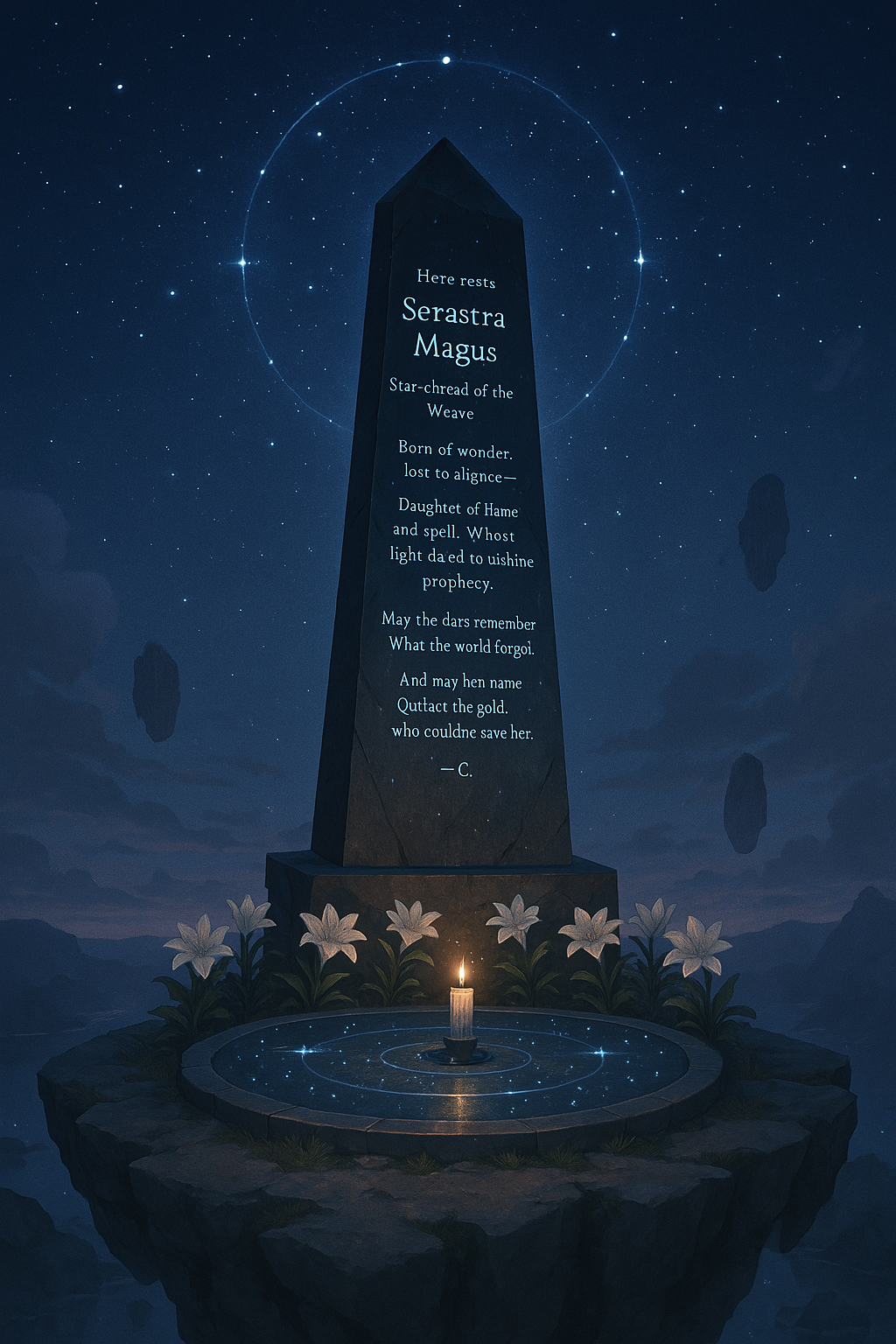
Caladawn’s Thoughts on the Invasion of the Dragon Empire & The Ember Pact (43–314 PR)
“They burned golden wisdom and called it progress. They slew nobility with iron, then crowned it history.”
The Dragon Empire, once a sovereign realm of elemental harmony and arcane majesty, was a remnant of the old balance — one Caladawn revered, even if from afar. Its ruler, Albion Goldred, was more than just a monarch; he was a symbol of ancient order, of the pact between mortals and wyrms, between fire and flesh, wisdom and might.
The Tibur Empire's advance in 43 PR, hiring mercenaries like the brutal Ashbrand Warband, struck Caladawn as a dark echo of the past — reminiscent of how the Tibur Empire once consorted with devils and skaven to bring down Neztra Magus. The founding of the Ember Pact in 310 PR, an alliance of steel and coin forged in blood and conquest, confirmed his worst fears.
“What they could not become, they chose to erase. Albion fell not to a stronger kingdom, but to a colder age.”
When Albion Goldred and the gold and red dragons fell in 314 PR, Caladawn felt a seismic shift in the magical weave. The death of dragons was not merely a loss of life — it was a silencing of voices older than most gods, a shattering of ancient chords in the world’s melody.
On the Renaming of the Island (Albion Island)
“And now they name it in honour of what they murdered. A crown atop a grave.”
Though Emperor Gallis Tibur the Young renamed the Breakaway Islands to Albion Island in 314 PR to “honour” the fallen dragon king, Caladawn saw through the gesture. To him, it was political pageantry, a gilded scar over a brutal conquest. Naming the land Albion was not an act of reverence, but of possession.
Still, Caladawn understood the power of names, and in some quiet place of his heart, he hoped that the memory of Albion Goldred might live on through that name, resisting the full erasure the empire intended.
On the Fate of Magic and Dragons
Caladawn also feared that the fall of the Dragon Empire — guardians of raw, elemental magic — would lead to further restrictions, corruptions, and the domestication of primal forces by imperial bureaucracies.
“Dragons do not die as mortals do. When their breath fades, so too does the flame of wonder in the world.”
He quietly inscribed a mourning spell in one of his floating grimoires — The Elegy of Scales — a lament to be sung only when the last dragon falls.
In 200 PR, when Caladawn met the Hayden Sisters
Malia, Nyx, and Dawn—it was less an encounter and more a convergence of three fates standing at a crossroads. Their dynamic was immediately unmistakable: Malia, the eldest and necromancer, studied him with calculating eyes, weighing his power and presence like a general assessing a potential ally—or threat. She spoke little at first, but her silence was rich with judgment.
Nyx, the middle sister and the scholar, offered words of kindness and curiosity. She asked Caladawn about the gods, the threads of fate, and ancient texts he may have read. Her inquiries were honest and reverent, and Caladawn saw a mirror of his own hunger for wisdom in her gaze. She, of all three, was the one he connected with most in that moment.
Dawn, wild and star-kissed, circled Caladawn as if she were sizing up a constellation in motion. She laughed in riddles, tugged at the hem of his robes, and asked if the stars whispered to him too. When he told her they did, she seemed satisfied—though later, she told her sisters that Caladawn was “a candle pretending to be a sun, but still warm enough to sit beside.”
Their conversation in the ruins of an old observatory turned into a debate—on power, destiny, and the cost of love. Malia insisted control was strength, that one must shape fate or be shaped by it. Nyx argued for understanding and wisdom, while Dawn claimed chaos would always find its way in, no matter what. Caladawn listened to all three, and when they asked his opinion, he only smiled and said:
“The stars are older than gods, older than truth. But even they burn out. The only thing that lasts… is the story.”
That night, the Hayden Sisters departed, leaving behind a quiet storm in Caladawn’s heart. He knew their paths would twist with his again—three parts of a prophecy yet unwritten. And he feared that when they returned, the stars might not be so kind.
Wedding of Thrain and Torgga Grimbeard – 245 PR, Grimbeards Halls
As the anvil bell rang in the heart of the stone-forged hall and dwarven chants echoed through the caverns, Caladawn stood at the edge of the gathering. Draped in twilight-blue robes embroidered with runes of remembrance, his presence drew a hush among some of the elder dwarves.
He approached Thrain, who wore a ceremonial breastplate inlaid with the sigils of his house, and Torgga, radiant in silver-threaded cloth adorned with mountain flowers and carved bone beads.
Caladawn offered a deep bow.
“Thrain Grimbeard. Torgga Steelvein. I have seen kingdoms burn and stars fade… but today, I see something brighter: two souls forging a future.”
Thrain chuckled. “Didn’t think a ghost of empires past would show up to drink my mead.”
Caladawn smirked faintly. “Even spirits get thirsty. And I wouldn’t miss a union that might shape a clan’s legacy for centuries.”
Torgga smiled. “Then raise a cup with us, Caladawn. Let the past bless the future.”
And so, beneath the vaulted stone and flickering braziers, Caladawn lifted his goblet—full of emberwine—and offered a toast:
“To love that outlives stone. To unions stronger than steel. And to the Grimbeard name, may it echo far beyond these halls.”
Death of Caladawn (250 Platera)
In the year 250, Caladawn met his mortal end during the Siege of Etherlight—a final stand to defend one of the last remaining arcane bastions of Neztran knowledge hidden deep beneath the earth. Leading a coalition of The Order of the Silverbrand, Mages, Dwarves, and rogue Skaven scholars, Caladawn conjured the Astral Crucible, a devastating fusion of celestial flame and conjuration magic, to hold back the Abyssal horde threatening to breach the vault.
In the final moments of the battle, Caladawn was struck down by a shard of corrupted soulstone hurled by a demon warlord—an artifact that unravelled the essence of magic itself. Refusing to let the vault fall, Caladawn cast one last spell, the "Seal of Eternal Wake," binding his spirit into the ley-lines surrounding the vault and obliterating his body in a blinding burst of silver light.
The explosion annihilated the invading force and saved the vault—but cost him his life. His name has since become legend, and the battle was remembered as the "Lament of Light."
Aftermath and The Wandering Spirit (250 to 467 PR)
Though physically dead, Caladawn's spirit remained bound to the magical ley-lines of the world. Known as "The Whispering Mage," he offered guidance to conjurers in visions, dreams, and arcane phenomena.
In 325 PR, his essence briefly coalesced during the Celestial Eclipse, aiding the Emberlight Conclave in halting the Plagueborn Rebellion. He became a myth, worshipped as a saint by some mage cults, feared as a vengeful ghost by others.
Caladawn’s Thoughts on the Faceless Assassins
“A blade that strikes without a name can change the course of kings and gods alike. And yet, it is not the blade that I fear — but the hand that dares never be seen.”
The fact that this guild was founded by changelings, beings of mutable form and fluid identity, intrigued Caladawn. He had always admired the arcane elegance of changelings — not just their ability to shift appearance, but their deep understanding of the illusions we all wear. To him, a changeling was a living spell, shaped by will and necessity.
The inclusion of non-changelings among their ranks signaled something even more profound: a philosophy rather than just a bloodline. The Faceless weren’t merely assassins — they were a movement, a collective of those who rejected the idea of fixed identity, loyalty, and legacy. To Caladawn, this was both fascinating and dangerous.
On Their Role in the World
Caladawn believed that The Faceless would eventually become pivotal players in the unseen conflicts of the age — shaping politics, divine agendas, and perhaps even magical balances from the shadows.
“They are not tied to empires, nor bound to gods. Their creed is anonymity. Their truth is silence. Their weapon is belief.”
While he did not condone murder-for-hire, Caladawn understood why such a guild would form in a time of growing empires, fallen gods, and rampant distrust. In a world where divine voices were silenced, and tyrants rose on blood-stained thrones, the existence of a guild that owed nothing to any crown felt inevitable.
Involvement? Perhaps…
It’s whispered in arcane circles that one of the earliest magical disguises used by the Faceless bore resemblance to a forgotten spell once penned by Caladawn himself — “The Shroud of Infinite Skin.” Whether they uncovered his old research or he quietly aided them in some small way, none can say.
In truth, Caladawn both admired and feared them. For they embodied the part of magic he had long mastered but never embraced fully — the ability to be anyone, and therefore… no one.
Caladawn's Thoughts on Iskern Glinka and the Red Wizards
“The flame that burns in Glinka is old — a blood ember from my house, perhaps, or a soul shaped by similar storms. In him, I see the fury of the hunted mage, but also the recklessness of the untampered spark.”
To Caladawn, the Red Wizards represented a necessary defiance in an age where magic was shackled, feared, and butchered. In the wake of the Tibur Empire’s magical purges — where casters were thrown into prison towers, executed for practicing forbidden rites, or silenced by arcane brands — the East had become a refuge.
The fact that Iskern was of his own lineage, however distantly, struck Caladawn with an ancestral gravity. He recognized in Iskern a raw brilliance, the same hunger to challenge tyranny and redefine magic’s place in the world that had once stirred Neztra Magus. But with that brilliance came the volatile danger of ambition untempered by patience.
A Legacy Reforged
Caladawn respected the Red Wizards for offering sanctuary to those cast aside — necromancers, wild sorcerers, blood mages, planarists — all those deemed “unfit” by the Tibur laws.
“They wear crimson not as a warning, but as a banner of survival. Where Tibur sees corruption, they see possibility.”
He believed their emergence was inevitable, a natural resistance to imperial control over the Weave. Still, he feared that unchecked power, cloistered in desperation, could turn radical.
He wrote in his private journals:
"Let the Red Tower rise — but may its roots grow deep in wisdom, not vengeance. Lest it become what it claims to fight."
Caladawn’s Possible Involvement
Though he never appeared publicly, it's believed Caladawn sent encrypted scrolls through shadow channels to the Red Tower — fragments of pre-Banishment magic, rituals from Neztra's vaults, and warnings carved in conjured flame. Some even say he met Iskern once, under the Red Moons of Sharvak’s Veil, and whispered a single word: “Balance.”
Caladawn’s Thoughts on Ulfik Fenris and the Rise of the Frozen Empire
“Where once the cold north whispered only of death and wandering, it now howls with unity. The Fenris flame burns beneath snow and stone — and Tibur, for all its fire and fury, cannot melt what was born of winter's heart.”
To Caladawn, Ulfik was a rare kind of leader — not a scholar, not a god-chaser, but a soul so rooted in the truth of the world that the gods themselves would pause to listen.
He marveled not at the power Fenris amassed, but at how it was done:
Humans and Frost Giants, bound by blood-oaths and bonfire songs.
Silver Dragons and Goblins, once enemies, now standing guard together atop glacial ridges.
Orcs and Elves, who set aside hatred for survival and dignity.
Even Lizardfolk, far from their southern swamp-born kin, found belonging in the frigid unity Ulfik promised.
The Wolf King in Caladawn’s Eyes
Caladawn likened Ulfik to an echo of old myth, a living wyrd made flesh. In his writings, he referred to him as "The Wolf of Unity", saying:
“Tibur builds walls of steel and flame. Fenris builds bridges of ice and blood. Only one will outlast the storm.”
He admired Ulfik’s ability to do what empires of magic and metal could not — unite the broken without chains. To Caladawn, that was the kind of leadership gods once respected, and mortals now feared.
Caladawn’s Role and Prophecies
Though Caladawn did not involve himself directly in Fenris’s politics, he is rumoured to have advised Ulfik’s frost-seers, guiding them in protecting the ley-lines that ran beneath the ice. He saw in Fenris a chance — not to restore Neztra, but to correct Tibur.
The Wolf and the Flame: A Secret Meeting in the Snow
Date: Winter, 398 PR
Location: The Whispering Stone, a sacred glacial monolith near the heart of the Frozen North — said to be older than the gods.
The night was still. The only sound was the crackle of northern wind howling through chasms, a haunting voice in the dark. Snow drifted thickly over the high plateau, moonlight bouncing off ice-covered stone like starlight made solid.
Ulfik Fenris, clad in wolf-fur and silvered breast plate, stood alone at the Whispering Stone. It was said that if one stood there in silence, the dead would speak.
He wasn’t sure what he believed, but the dreams had been too vivid. A voice calling him. A burning eye in the frost. A name—Caladawn.
And then, like mist parting from fire, he appeared.
A tall figure, cloaked in sapphire smoke, robes that rippled with stars, and eyes glowing like dying embers. No footsteps. No breath. Just the slow drift of magic coalescing into a shape.
Ulfik: “Are you… Caladawn Magus?”
Caladawn (smiling faintly): “What remains of him. What remains of many things.”
The warlord didn’t flinch. In the frozen stillness of Fenris, you learned not to show fear. But his fingers twitched near the hilt of his axe.
Ulfik: “Why call me here? I am no wizard. I speak with steel, not stars.”
Caladawn: “You speak with truth, Ulfik Fenris. That’s rarer than any spell.”
The spirit circled the stone, snow and time not touching him.
Caladawn: “I have seen empires rise on fire and fall into ash. I watched gods bleed and mortals claim their thrones. I have seen magic twisted, chained, and burned for fear of its power. And now... you rise, not with sorcery, but with unity. You challenge Tibur without spells. Without divine fire. That makes you dangerous, Wolf King.”
Ulfik frowned.
Ulfik: “You fear I will become like them?”
Caladawn: “No. I hope you won’t.”
There was silence. Then Caladawn stepped forward, eyes glowing brighter.
Caladawn: “Tibur will come for your north. Not just with armies. With lies. With temptation. With fire. They’ll offer your people steel, power, thrones. They will whisper: ‘Be like us.’ But you must remain what you are—the reminder that freedom cannot be bought, only earned.”
Ulfik said nothing, snow gathering on his pauldrons. Finally, he looked the spirit in the eye.
Ulfik: “Then give me no prophecy, ghost. Give me a weapon.”
Caladawn: “Very well.”
The spirit raised a hand, and the air shimmered. From the Whispering Stone came a pulse of light — and a crystalline fang, etched with ancient runes, hovered between them. It radiated ancient magic — but not Neztra’s conjuration. Something older. Something wild.
Caladawn: “The Fang of Dawn. Forged when the first sun rose. It binds no spell. But it drinks the blood of tyrants.”
Ulfik (taking it): “Then Tibur shall taste it.”
He recorded a chilling prophecy in 401 PR:
"When the sun is swallowed by storm and a white flame howls across Tibur's southern peaks, know that the Wolf has come to gnaw at the throne of fire. And should his teeth break it, the world may finally breathe."
Caladawn's Reflections: The Splintered Crown
“Steel may rule the flesh, but it cannot bind ambition. And when a crown is forged too wide, it will always break at the centre.”
In the year 446 PR, Caladawn watched from the outer veils of the Weave, silent and solemn as the great Tibur Empire—once so proud, so dominant—fractured.
The division of the empire between Maddax Tibur and Lymris Tibur was no surprise to him. He had foreseen the rot long ago, festering behind gold-veined banners and thunderous parades. The Tibur Empire, forged in conquest and sustained through control, was never built to last under the weight of its own pride.
Where Maddax, the western heir, ruled with cold logic and an iron grip, Lymris, in the east, sought legacy and grandeur—founding the Bhrytyros Empire, an echo of Tibur’s glory but reimagined through his own vision.
To Caladawn, this was not the fall of a single empire, but the cracking of the world’s illusions. For centuries, mortals had placed their faith in the Empire of Order—believing structure, banners, and bloodlines would preserve peace. And yet here it stood, cleaved in two, not by outside war, but by familial ambition.
“The sons of Romma Tibur divide more than land,” Caladawn mused to a starbound scribe. “They divide hearts, loyalty, faith. The empire was an edifice carved from pride, and now it crumbles under its own name.”
He pitied the people caught in the schism. Scholars, spellcasters, and freefolk of the outer provinces—once hopeful in Tibur’s promise—now torn between two empires that both claimed the same inheritance.
But Caladawn did not despair.
He remembered Neztra. He had seen empires burn. He had seen gods fall. And he knew: in ashes, wisdom can grow.
He whispered through the wind into libraries, through dream-visions to wandering magi:
“Let them break. For it is only when tyrants fall that truth has room to rise.”
Caladawn's Reflections: The Croaking of Doom
“Even a tyrant can tremble at truth, when it comes from the mouths of those older than stars.”
When Emperor Maddax Tibur uncovered the Zutszisz Prophecy, Caladawn—drifting across realms like a ghost of wisdom past—felt the tremor ripple through the Weave. He had heard of the Great Toad Seers in ancient times, those strange and ancient prophets who spoke not from memory, but from the deep roots of fate itself.
The Zutszisz Prophecy, in particular, was known to him, though only in fragmented starlight and forgotten croaks of prehistory. It spoke of a time when the God Hands, in their hunger and chaos, would break free from shadow and descend upon Platera—not merely as gods, but as conquerors of realms.
The fact that Maddax Tibur, iron-fisted emperor and slayer of gods, sought out the prophecy’s originators did not surprise Caladawn. What did surprise him was Maddax’s fear. For a man who once banished deities into orbs and claimed dominion over divine and arcane alike, to now chase whispers from the swamp—to seek answers from the old Croakers of Time—meant something had shaken him.
“When the tongue of the toad outstretches the reach of an empire,” Caladawn mused to a passing comet, “even emperors must bow to the mud.”
Caladawn did not trust Maddax Tibur. He believed the emperor’s quest was not born of redemption, but of self-preservation—a desire to master fate, not avert it. Still, he could not ignore the growing urgency of the signs. The veil thinned, the orbs stirred, and the whispers of Zonid, Zarlnis, Urmbrik, Zlaniz, and Geardaz echoed louder each year.
In his hidden sanctums and lost shrines, Caladawn began to retrace the dreams of the toads, their croaked verses etched in moonlight and bone:
“When five hands reach from darkest door,
And stars bleed red across the shore,
The empire’s stone shall crack and weep,
While gods of old shall wake from sleep…” - Zutszisz Prophecy
He prepared. Quietly. Not through armies or decrees, but through scrolls left in hollow trees, visions gifted to hedge-witches, and soul-marked children born under eclipses.
Caladawn knew the Zutszisz Prophecy was not a warning—it was a countdown.
And while Maddax Tibur searched the swamps, Caladawn whispered to the stars:
“Let him chase the croaks. I shall light the flame.”
Caladawn's Thoughts: The Cracking of Stone and Bone
“There are wars of men, wars of gods… and then there are the wars born of forgotten hunger. The Siege of Grimbeard’s Hall was the latter.”
When the Siege of Grimbeard’s Halls began, Caladawn felt it—not through magic, but through the earth itself. The Weave shuddered, trembled, as if recoiling from the presence of something unnatural, something primordial. He knew the Moggites had returned.
To Caladawn, the Moggites were not mere monstrosities, but the children of the Butcher God, Mogg—spawned from blood, sinew, and suffering. They were the shadows that crawled beneath the bones of the world, remnants of an age where gods fed upon mortals with gluttonous cruelty.
And so, when the fog of dread rolled into the mountain peaks, Caladawn was already watching from afar—his spirit drifting like a breeze through old ruins and mountaintop altars, observing, mourning.
The dwarves of Grimbeard's Hold were not strangers to war. They had withstood dragons, orc hordes, and deep-earth leviathans. But the Moggites were different. They did not conquer, they consumed. And they brought with them not war, but ritual—a desecration of ancestry and spirit, chewing through legacy with claw and tooth.
Caladawn, with what little power he could still wield in his wandering spectral form, whispered warnings into the dreams of dwarven runepriests, guiding them toward ancient seals and glyphs. But he could not stop what had already begun.
He watched as the statues of kings were toppled, their faces devoured by fleshless things. He listened as dwarves chanted the last rites in defiance while being dragged into the abyss. And yet… he also saw valour. Unshakeable dwarven bravery, as axes bit through sinew and holy fire burned through rot.
“In the darkness of that siege, light did not come from magic or flame… it came from hearts that refused to stop beating.”
When the final bastion fell, Caladawn did not look away. He committed every name, every scream, every act of heroism to memory. Because one day, when the gods return and the chronicles of the world are rewritten, Grimbeard’s Halls shall not be remembered for their fall… but for their stand.
Caladawn’s Reflections: The Silence Beneath Stone
“The halls of the dwarves do not fall quietly. They fall like stars—bright, defiant, and with thunderous echoes that rattle the bones of time.”
When news of Grimbeard’s Hall's fall reached even the forgotten corners of Platera, Caladawn's wandering spirit drifted toward the shattered mountains, pulled not by curiosity, but by sorrow. The Grimbeards were not merely warriors. They were artisans of legacy—each stone laid by their ancestors, each rune a whisper of pride, and each hammer strike a hymn of memory.
Caladawn had met Thrain Grimbeard once, centuries before, at a council of peace forged in the early age of empires. The dwarf's laughter had been loud, his handshake iron, and his eyes brighter than any flame. That such a soul would fall to cannibal beasts of the god Mogg turned Caladawn’s spectral blood to ice.
He did not mourn as mortals mourn. He burned silently, like a candle deep in the Underdark. Torgga’s stand, wielding the mighty Stormbreaker with resolve despite knowing it would be her end, filled Caladawn with both admiration and agony. That a soul so determined, so bright with purpose, should meet her end in that abyss, was a wound the world would not soon heal.
But it was Thulgrim’s sacrifice that lingered most in Caladawn’s fading heart.
“True sorcery is not the summoning of power—it is the surrender of it, for others to survive. Thulgrim gave his fire not to conquer, but to protect. And in doing so, he became what all archmages aspire to be: a beacon in the blackest dark.”
The fall of the Hall was not just a military defeat—it was the murder of memory, the defilement of dreams. The Moggites, with their grotesque mockery, turned ancestral murals into macabre tapestries, wielding Stormbreaker not as a symbol of hope, but as a twisted idol of fear. Caladawn’s spirit wept to see it—he could feel the hammer calling out, its runes resisting the filth wrapped around its legacy.
And yet… amidst the ruin, he saw embers.
“Legends do not end with the dying of their last defenders. They linger—quiet, watchful, waiting for the blood of heirs to stir their bones.”
He watched the surviving brothers. Scarred. Hunted. Humbled. Yet unbroken. In the flicker of their eyes, he saw not just vengeance—but a quiet vow to rebuild. Caladawn vowed, in turn, to protect the memory of the Grimbeards. To whisper their tale into the dreams of wayward kings, to ensure their courage was never forgotten beneath the ash of despair.
The world had lost a hall, but gained a legend.
And legends, as Caladawn well knew, never truly die
Caladawn’s Reflection: The Southward March of the Grieving Flame
“Grief moves like a river. It does not forget where it came from, but it carves new valleys as it seeks somewhere to endure.”
When the Grimbeard brothers—Torvin, Tyrion, Thulgrim, and Thor—turned their backs on the broken halls of their ancestors and set their eyes to the south, Caladawn watched them from the shadowed corners of Albion's windswept highlands. He did not judge them for leaving; no voice from the past did. For he knew—more than any other—that survival was not cowardice. It was the first step of resurrection.
The Grimbeards carried more than scars. They carried stories, names of the dead like iron weights, and the knowledge that to remain in the ruins would be to become ghosts themselves. Albion was far from the frozen spires and stone-rooted peaks they once called home, but it was green, untamed, and listening. It was a place where roots could be planted anew.
Caladawn, ever the scholar of fate and legacy, admired their resolve. Many dwarves would have crumbled under such loss. But the brothers walked forward—weapons dulled, hearts shattered, but souls lit with embers of something old and unbreakable.
“Stormbreaker may lie in the filth of monsters, but the true strength of the Grimbeards was never in their steel. It was in their stubborn hope, and that… that still lives.”
In the whispering stones of Albion, Caladawn sent dreams of ancient forges, of long-forgotten ruins buried beneath the southern hills. He watched Thor dream of glowing runes and voices not yet silenced. He whispered to Tyrion through the winds, guiding their steps toward places where fire still remembered how to burn clean.
The migration was not a retreat—it was a pilgrimage.
Let the Moggites have their victory. Let them desecrate the bones of a once-great hall. But the blood of the Grimbeards still flows, and with every step they took into the south, Caladawn saw the foundation of a new legend being laid.
“Not all kingdoms are born of stone and steel. Some are forged in sorrow, quenched in memory, and crowned in the quiet triumph of survival.”
Caladawn’s Reflection: The Stone Spine of Maddax
“Walls are not just built to keep things out. They are declarations carved into the bones of the land—monuments to fear, pride, and inevitability.”
When Emperor Maddax Tibur raised a wall of stone and steel across the northern wilds of Albion Island, Caladawn stood invisibly among the snowfall that kissed its mortar. He drifted above the marching engineers, the roaring furnaces, the sharp cries of hammer to stone, and he understood the truth behind this mighty act:
It was not only a wall—it was a scar.
A scar born of terror. Not just of the Moggite Piccers, whose monstrous howls and bone-clad tribes descended from the frost-bitten north. No—Maddax feared something deeper. A fear of losing control. A fear that even empires, with all their legions and towers and crowns, could be swallowed by the primal.
“The wall bears his name, but not his soul. For walls do not love those who build them. They remember the weight of blood, not the pride of architects.”
Caladawn watched the rise of Maddax Town, a fortified city nestled close to the wall like a child behind its mother’s cloak. Soldiers came in droves—fresh-faced youths with Tibur steel and heavy dreams. But Caladawn knew: walls do not stop the tide—they delay it.
He recalled the Sky Bastions of Neztra, floating fortresses meant to keep out the world—and how even they fell, crumbling under the inevitability of ambition and time.
And yet…
“Though I mourn what this wall stands for, I cannot deny its beauty—its defiance. For even fear, when carved in stone, becomes a kind of poetry.”
Caladawn sent whispers into the dreams of stonemasons—runes of fortification, echoes of ancient dwarven craft, fragments of spells long buried in his fading memory. Not to empower the wall with dominance, but with resilience. For he knew this land would bleed again, and the wall would stand witness.
Maddax named the wall after himself in pride. The world would name it in remembrance—of borders drawn in desperation, and what lay waiting just beyond the mist.
Caladawn’s Thoughts: The Fire That Does Not Fade
“In stone and silence, the dwarves find their truth. But even in the firmest hearth, there are embers that yearn to roam.”
In 462 PR, Caladawn drifted like a memory across the blooming fields of Albion, where stone met soil and resilience gave birth to legacy. Grimbeard's Hold, born from the ashes of tragedy, now stood proud—not in grandeur, but in hope.
As he wandered its battlements unseen, Caladawn felt the heartbeat of the place: the ringing of hammers, the scent of fresh-forged iron, the hum of dwarven song. Thors’s stoic leadership, Torvin’s ever-burning forge, and Thulgrim’s quiet wisdom—these shaped the stronghold into more than a bastion. It had become a sanctuary.
And yet, in the quiet hours beneath the stars, Caladawn’s gaze often fell upon Tyrion.
“He walks among kin, yet stares to the horizon. The weight of duty battles the call of destiny.”
Tyrion’s soul shimmered like a blade not yet drawn. Caladawn, once a wanderer bound by duty and crowned by visions of stars, recognized that same fire in the dwarf’s heart. A fire not dulled by comfort or kinship, but sharpened by it—a desire not to abandon, but to become.
The spirit of Caladawn whispered in dreams—not to sway, but to encourage:
“Go, Tyrion Grimbeard, and let the world shape you as the mountain shaped your fathers. For there are tales yet unwritten, and hammers that strike the sky as well as stone.”
He knew Tyrion would one day leave the hold—not out of selfishness, but because heroes are not meant to only guard a home; they are sometimes fated to forge new ones.
And as the fires of Grimbeard's Hold burned brightly into the Albion night, Caladawn smiled in spectral silence.
“From the ruin of halls, new legends rise. And from restless hearts, the world remembers its champions.”
Caladawn’s Reflection: The Song of Star Metal
When word reached Caladawn— carried on ley-line echoes and mage whispers—of a meteorite cracked open in the Golden Gate mountains, his spirit stirred with a quiet awe. Not for the spectacle of falling stars, but for the reverence in which it was received.
“At last… they’ve begun to look skyward again.”
He had once drawn constellations into his spellwork, traced planar routes through starlight, and shaped towers that reached for the firmament. He knew of Star Metal—not in name, but in essence. The ancients called it Aetherium Core, a whisper from the First Forge, the breath of the cosmos caught in metal. It was used to bind gods to mortal craft, to inscribe celestial pacts, and to create artefacts that defied the very decay of time.
But to see it discovered again, not by a king or conjurer, but a common man, wielding nothing more than instinct and courage—it reminded Caladawn of why the world was worth protecting.
“It did not fall into a vault, or vanish into a scholar’s hoard. No. It landed in the hands of the curious… and that is the purest magic of all.”
When the human gave it a name—Star Metal—it warmed Caladawn’s soul. A simple title. Honest. Unburdened by ego or ancient weight. That name would spread like fire among artisans, enchanters, and warlords. Already he could see the future shaping around it: blades that hum with the breath of stars, armor that drinks the light of the moon, and devices that bend space and silence.
But with power, always, comes peril.
“Let them craft. Let them dream. But let them also remember—starfire may illuminate, but it may also burn.”
In the quiet of his reconstructed sanctum, Caladawn placed a shard of old voidstone beside a fragment of meteor glass. He began drafting a new grimoire—Codex Astralis Reborn—intended for those who would shape star metal not with greed, but with wonder.
He smiled.
“The sky has given them a gift. Let us see what they make of it… and what it makes of them.”
Rebirth of the Mage (467 to 620 PR)
In 467 PR, the final seal of the Primal Conflux cracked during a rift eruption, allowing Caladawn’s soul to return, anchored to a new body crafted in the ruins of the Tower of Infinite Reach. Though not truly mortal, he walks once more, his power dulled but focused.
Caladawn’s Return: The Echo Reforged
“I was once ash on the wind, thought only a whisper in spellbooks and half-spoken legends… and yet the world still calls to me.”
In the year 467 PR, the earth screamed again.
A rift, jagged and wild, tore through the veil of reality like a claw through silk. When the final seal of the Primal Conflux cracked—fragments of forgotten magic bled into the Weave. And from the shattered heart of the Tower of Infinite Reach, where stars once bowed to his will, Caladawn returned.
Not as he once was. Not the Archwizard in robes of constellations, nor the dreamer who conjured armies of light. His new form, grown from conjured flesh and spell-forged marrow, bore his soul like a lantern in a cracked frame.
His power, once world-shaping, had waned—but not vanished. It had become sharper, closer, honed like a blade reforged in exile.
“This body is imperfect… but so is the world. And perhaps that is the lesson I never saw clearly until now.”
Standing again upon broken stone beneath the shattered spire of the Tower, he looked not up at the stars, but down at the earth, at the scars it bore.
He felt the silence of old gods still trapped. He felt the fires of war rising in distant empires. He felt the beat of new magic—raw, uncertain, and hungry.
And for the first time since Xaetrix's death, he whispered her name aloud.
“I am not your heir, my goddess… but I am your echo. And I will not let the song fade into silence.”
Caladawn walks once more, not as a symbol of arcane supremacy, but as a guardian of consequence, a memory made flesh, and a master of balance. His eyes, though weary, see clearer than they ever did before. He knows that the world stands upon the edge—between lost gods and new tyrants, between redemption and oblivion.
“Let the world remember its fire. Let them know the stars once walked among them… and still do.”
Caladawn Meets the Blind Tyrion Grimbeard – The Road Between Ruins (472 PR)
The air hung heavy with the musk of rain and smoke, a faint haze drifting above the well-worn road that wound through the southern hills of Albion. Spring had come, but the warmth did little to banish the bitterness that clung to one wanderer’s soul like a stubborn curse.
Tyrion Grimbeard stood at the edge of a smoldering camp, bloodied fists clenched, surrounded by the groaning remains of would-be bandits. His long hair was wild, tangled like the forest behind him, and his eyes—milky with blindness—stared at nothing and everything all at once.
His breath was ragged. His shirt torn. His pride? Shattered.
He had wandered for years since the fall of Grimbeard’s Hall—since the Moggites desecrated his family’s legacy, since Stormbreaker had been lost to blood and laughter not their own. Ten years had passed, and though he helped build a new home with his surviving brothers, the hole in his heart had never closed. He’d left it all behind.
Looking for something.
Fighting everything.
Trying not to drown in his own anger.
“Three left standing,” came a quiet voice behind him. “But not for long, I suppose. You favour the right hook too much. Leaves your ribs open.”
Tyrion spun, fists raised. “Who’s there?” he barked. “You want to end up like the rest, shadow-stepper?”
The cloaked figure did not flinch. Instead, he stepped forward into the firelight, revealing a long beard streaked with starlight and age. His eyes shimmered not with power, but with something far rarer among mortals: understanding.
“I am Caladawn,” he said simply.
Tyrion’s fists faltered. “...The Caladawn?”
“The one who remains,” the wizard nodded. “You are Tyrion Grimbeard. Son of mountain halls. Brother to the lost. Blind, not broken.”
Tyrion snarled, stepping back. “What do you want? Pity? I’ve heard enough legends whispering my name in taverns to make me sick. I’m no monk. No lord. Just a drunk dwarf with fists and rage.”
Caladawn’s expression softened. “And that is exactly why I came.”
Tyrion spat into the dirt. “You’re twenty years too late.”
“No,” Caladawn said, stepping closer. “I am here exactly when you needed someone to find you. Not the builder of Grimbeard’s Hold. Not the loyal brother. But you, Tyrion—burning, broken, blind with pain.”
Tyrion growled. “And what, you gonna fix me?”
“No,” Caladawn whispered. “But I will remind you of what still burns beneath the ashes.”
For a long time, the dwarf said nothing.
The bandits around them moaned softly, still breathing. Tyrion had not killed them all. Not yet.
“I dream of the hammer,” Tyrion said at last, voice thick. “Stormbreaker. I see it every time I sleep. But not in my hands. In the claws of that Moggite chieftain, laughing. Mocking. And I can’t make the dream stop.”
Caladawn reached out and placed a hand gently on Tyrion’s shoulder.
“Then perhaps it's time to stop chasing vengeance,” the old wizard said softly, “and start seeking strength—not from what you lost, but from what you still have.”
Tyrion’s lip trembled. His fists, still soaked in blood, slowly unclenched.
“Will it ever stop hurting?”
Caladawn smiled, sad and warm. “No. But one day, the pain will shape something greater in you. Something the world will need when the darkness returns.”
And in that flickering firelight, on a muddy road between nowhere and home, Caladawn sat beside Tyrion Grimbeard—not as a saviour, but as a mirror.
A reminder.
That even the broken can rise.
Under the Crescent Moon – The Hollowgrove, 475 PR
In 475 PR, Caladawn Magus speaks once again with the Hayden Sisters—Dawn, Malia, and Nyx—who had believed him long dead.
Their reunion would have been one of quiet astonishment and layered emotion, as the sisters have long held suspicions and regrets about those they’ve lost to the centuries. Caladawn, ancient and enigmatic, stepping from shadow into their camp, would have stirred deep questions within them—not only about him, but about fate, prophecy, and the threads of destiny that still entwined their names.
Nyx, the middle sister and most wild-hearted of the trio, might have been the first to embrace him, or challenge him—her instincts driven by a need to know why now. Malia, the scholar, perhaps still bearing pain from Caladawn's absence during key moments of their path, would ask him of the portents he's seen. And Dawn, ever the balance between them, may have offered him a place at their fire, seeking to hear from the Magus himself what the world now faces.
The Hayden Sisters' fire crackled low. They were far from any road, nestled in the roots of old magic. A place only those who remembered the Old Songs would know how to find.
A wind, cold but not cruel, stirred the leaves of the Hollowgrove. It was the kind of wind that made the world pause—birds silencing mid-call, insects retreating into bark. The trees themselves leaned slightly inward, as if something had stepped between the layers of reality.
Dawn Hayden, youngest and firm-eyed, looked up from the fire. Her silver-lined staff trembled in her grasp.
Malia, the eldest sister, narrowed her eyes, arcane script lighting up across her gloves. She had felt this presence before. In her dreams. In the glyphs buried beneath the Tower of Ancients.
Nyx, the youngest, already had a dagger in her hand.
Then, from between two trees that had never grown so close before, he emerged.
The robe was the same—ragged midnight and star-dust silk. The staff etched in bone and bronze. The eyes… older. Sorrowful. Shining faintly with the reflection of time itself.
“You’re dead,” Nyx whispered, breath caught in her throat.
“I was,” Caladawn Magus said, voice soft as autumn leaves falling through memory. “But not in the way you think.”
Malia stepped forward, not with warmth but with purpose. “You vanished during the Siege of Etherlight. We watched you cast "Seal of Eternal Wake," and it obliterate your body in a blinding burst of silver light.. You did not, could not return.”
“I returned,” Caladawn said. “But not to the same thread. I’ve walked beneath timelines since then. Waited for a point where my voice might matter again.”
Dawn hadn’t moved. She watched him with an ache in her eyes, but no anger. “You taught us how to see fate,” she said. “And then you vanished from it.”
He smiled, small and weary. “Would you believe me if I said I left so you could walk without leaning on me?”
“No,” Nyx said flatly.
He chuckled at that. “Good. You’ve grown wise.”
The wind circled them again, rustling branches like voices in debate. The fire dimmed, not from lack of fuel—but from awe.
“I came,” Caladawn said, stepping fully into the grove, “because the stars are bleeding again. The spiral of Rha’sharn stirs beneath the ice of the southern range. A name is whispering itself back into the minds of seers—Haldrith.”
Malia’s breath caught. “That name is buried. Beyond burial.”
“Then someone is digging in cursed ground,” he said.
The God Banishment (476 PR)
In the year 476, Caladawn witnessed one of the darkest turns in mortal history: the Banishment of the Gods by Emperor Maddax Tibur. In a forbidden rite beneath the Sky Temple of Albion Island, Maddax used divine orbs to imprison many gods—both benevolent and dangerous—casting them into a sealed realm to forever prevent their interference in mortal affairs.
Caladawn, now wandering in the shadows of history, was horrified. He had seen empires fall to divine wrath, but never had he seen mortals rise to such audacity as to banish the gods themselves. The loss of gods like Zennar, Krina, Olreus, Katra, and even his former lover Entera, broke his already fractured spirit.
He felt betrayed by destiny. Entera, the radiant new goddess of magic who had once loved him and with whom he had shared divine intimacy, was among those sealed away. Caladawn did not know if she had gone willingly or was overpowered—but her absence tore a fresh wound into his soul.
He attempted to find remnants of her power, seeking any sign she remained in the Weave, but the silence was deafening. All that remained was the faint glimmer of her essence in his own magic, like the fading scent of a lover long departed.
Now, Caladawn wanders a world shorn of its gods, hunted by mortal tyrants who believe themselves fit to judge divinity. He watches from afar, guarding hidden shrines and whispered legacies, hoping that one day, the heavens might open once more—and the world remember who it truly served.
In his final message, scribed in starfire upon a mountaintop few dare reach, he wrote:
"Cast not your gods into silence, for it is not the divine that would end you, but the hollow man who dares believe himself god."
Caladawn’s Thoughts on the Banished Gods of 476 PR
“To silence the voices of gods is not an act of courage, but of fear dressed in ambition. And fear—when it wears a crown—will always turn sanctity into shadow.”
Caladawn, in his long life of bearing witness to the rise and ruin of empires, had never been more shaken than when the divine tapestry was torn by mortal hands in 476 PR. The banishment of gods—good, neutral, and dark alike—was, to him, not a moment of triumph but of profound spiritual mutilation.
On the Good and Noble: The Brightest Flames Extinguished
The loss of gods like Zennar, Krina, Olreus, Katra, Tymira, and Rhimes wounded Caladawn deeply. These were not just figures of faith. They were pillars of compassion, courage, healing, wisdom, and joy.
“Zennar stood for honour. Krina gave mortals new beginnings. Olreus held memory and forgiveness in his open hand. Tymira danced where hope dared not bloom. Rhimes taught mortals to build. And Katra was the heartbeat of every forest path I ever walked.”
He mourned these gods as one mourns ancestors and lovers—most notably Entera, the goddess of Magic and Caladawn’s former divine lover. Her banishment was not just spiritual—it was personal. A cosmic silence fell where once he had heard her in the hum of every spell.
“When Entera faded from the Weave… so too did part of my soul.”
On the Neutral: The Balance Torn Asunder
The loss of Cagzolt (Knowledge), Chordreg (Fire), Growdmir (Earth), Ranna (Sky), and others like Dykenta, Jahbel, and Entera, fractured the natural and arcane equilibrium of the world.
“Maddax did not see gods. He saw levers. He did not see balance. He saw obstacles. He locked away nature, alchemy, the sky itself—as if storms and magma could be tamed with steel and sorcery.”
Caladawn considered this act not merely short-sighted, but cosmically dangerous. By severing these beings from the world, Maddax disturbed the harmony between realms—magic, creation, and mortal will became unanchored.
On the Evil: Even Shadows Have Their Place
Though he did not love the gods of darkness—Helthys, Mogg, De’zath, Yaggamir, Drevrena—Caladawn understood they served a purpose.
“Without death, there can be no rebirth. Without the night, the stars cannot shine. Even in their cruelty, the dark gods were part of the story. Locking them away did not banish evil… it banished understanding.”
He warned that the absence of these gods would not remove the evil they embodied—it would only blind mortals to its shape, making them more vulnerable when it rose again in another form.
Caladawn’s Closing Reflection:
“Maddax Tibur believed he could save the world by silencing it. But a silent world is not safe—it is deaf. Deaf to prophecy, deaf to warning, deaf to the soul.”
“And when the gods were sealed away, the world did not rejoice. It simply forgot how to weep.”
Caladawn’s Reflections on the Gods That Were Not Banished (476 PR)
“In the recklessness of mortals, many lights were extinguished. And yet—some remained. Not by accident, but by fate… or perhaps mercy.”Caladawn
When the orbs of Maddax Tibur swallowed gods from the heavens and cast them into silence, not every divine was taken. And to Caladawn, this omission—intentional or accidental—tells its own story.
The Light that Remained
To Caladawn, the survival of gods such as Malendrii, Valea, Ahkan, Lyansa, and Mathandis represented a crucial tether to goodness and healing. He viewed them as gentle anchors—gods of mercy, light, balance, and perseverance—too nuanced or passive to be misjudged as “doom bringers” by the Tibur regime.
“It is telling,” he mused, “that the gods of kindness, endurance, and humility escaped imprisonment. They do not demand glory. They endure quietly. And perhaps the world needs them now more than ever.”
The Divine Patchwork of Balance
The continued existence of neutral and chaotic good gods—like Luna, Freyja, Bimatae, Dorandin, Ophion, and Vahilda—he took as a testament to the mosaic of balance that Maddax’s narrow view could not unravel.
“Not all light shines the same. Some dances in taverns. Some whispers in harvest. These gods survived because their nature does not seek control—but connection.”
Caladawn believed these surviving deities would carry the emotional and spiritual burdens left behind by those banished. They would become unintended stewards of forgotten prayers.
On the Gods of Shadow, Secrets, and Ambiguity
Curiously, some evil or ambiguous gods were left untouched—like Stellik, Nalnir, Belanaz, and Noctara.
“Either Maddax did not fear them… or he did not know them,” Caladawn reflected.
“And that ignorance may yet prove costlier than the gods he sealed.”
Whereas gods like Mogg and Helthys had bold, destructive domains that triggered Maddax’s fear of apocalypse, others thrived in subtlety, deceit, or darkness veiled as order.
“The most dangerous gods,” Caladawn would whisper, “are not those who shout—but those who whisper in tongues men mistake for their own thoughts.”
Caladawn’s Closing Reflection
“The divine that endured was not only spared—it was charged.
With guiding a crippled world.
With healing wounds left not by war, but by absence.”
He sees this surviving pantheon not as remnants of a broken theology, but as the new scaffolding of mortal soulwork—those who remained not by power, but by providence.
“Perhaps it is not the gods we lose that define us…
But the ones we forget to thank.”
Caladawn’s Reflection: The Orbs of Silence and the Chosen Flame
476 PR
When the Sky Temple of Albion trembled beneath the unholy rite of Maddax Tibur, Caladawn felt it in the Weave like a shudder in the bones of the world. He did not need a herald to tell him—the silence that followed was louder than any warhorn.
The gods had been banished.
Zennar, Krina, Olreus, Entera… names etched not only into temples and tomes, but into the architecture of reality. Now, each name hung in the ether like a half-forgotten prayer, its echo imprisoned in shimmering orbs and cast into a realm beyond reach.
“To seal the divine is to silence the soul of the world,” Caladawn murmured, drifting as spirit through leyline currents.
He had watched mortals betray gods. He had watched gods forsake mortals. But never before had he witnessed mortals rise up and cage the divine like frightened beasts.
He mourned Entera most of all. The once-radiant Goddess of Magic, his lover, the balm to his grief after Xaetrix’s death. Now gone. Her whispers in the Weave faded. Her presence extinguished like the last star of twilight.
“Maddax believes himself a liberator,” he thought bitterly, “but he has only imprisoned wonder and shackled wisdom. In trying to control chaos, he has unmade balance.”
And yet, fate—ever mischievous—planted a spark in the smothered ashes.
479 PR
Three years later, it came.
A ripple.
A prophecy.
A flare of light that even Caladawn’s fading soul could see.
A name: Janlyth Arcanius.
He watched as the mortal—blood of the Tibur line, yet unlike any before him—walked the forbidden path to the Sky Temple. With faith unshaken and heart defiant, Janlyth braved the seals, not to claim dominion, but to undo a grave arrogance.
“One mortal dares to do what empires fear: to unmake silence.”
Caladawn Reaches the Sky Temple 480 PR
In 480 PR, Caladawn’s journey to the Sky Temple in Albion, then under the control of the Tibur Empire, was not one of pilgrimage—but confrontation.
He came to speak with Renazar, the emerald-scaled wind god, and one of the Creator’s Trio. The topic was dire: why had Renazar helped Emperor Maddax Tibur create and empower the Orbs of Divine Banishment—artefacts used to trap gods, stripping the Weave of divine presence?
Caladawn, carrying the echoes of Xaetrix and Entera in his soul, demanded answers. And Renazar, serene and vast as ever, gave them—not with wrath, but with sorrowful detachment.
The wind screamed across the marble peaks of the Sky Temple. Thunder rolled far off, and clouds churned like stirred memory.
Caladawn stood beneath a spire etched with runes of old Neztra—his star-blue robes whipping in the air, his eyes narrowed not against the wind, but against what he had come to ask.
Emerging from the sky itself, as if coalescing from the storm, came Renazar—the vast emerald dragon, coiled now in a smaller, humanoid form cloaked in wind and light. His gaze, deep and unblinking, held the weight of centuries.
Caladawn:
“You helped them. Maddax Tibur and his architects. You gave them power, the knowledge to create the Orbs. Why?”
Renazar: (voice like thunder beneath still water)
“Because they asked.”
Caladawn:
“They asked. And you answered with silence for centuries. And now you speak with action? You gave them divine chains.”
Renazar:
“I gave them what they already sought. I did not place the chains in their hands—I showed them the forge. Mortals must walk the edge of their own blades.”
Caladawn paced, his boots striking ancient stone once kissed by Xaetrix’s footsteps. His voice sharpened.
Caladawn:“They caged gods, Renazar. Gods. Entera, Zennar, Krina, Olreus, Katra, Tymira, Dykenta and many others—stripped of their dominions, cast into silence. What wisdom justifies that?”
Renazar:“Wisdom does not shield mortals from fire. It teaches them to choose what to burn—and what to protect. Would you rather I had struck them down? Played tyrant? I am not their shepherd.”
Caladawn:“No. But you are their sky. Their breath. You are balance.”
The wind stilled.
Renazar stepped closer—his eyes shimmering with distant stormlight.
Renazar:“Then balance must allow the scale to tip… so it may remember why it must return.”
Caladawn’s hands trembled, a flicker of arcane glow pulsing at his fingers.
Caladawn:
“Entera trusted you. I trusted you. And now, your neutrality has helped silence the soul of the world.”
A pause. Then, soft but certain:
Renazar:
“And what would you have done, Caladawn Magus? Would you have stopped them? Or helped them build a better cage?”
Caladawn’s voice broke, just once:
Caladawn:
“I would have warned them. I would have hoped.”
Renazar, with a voice like soft wind after storm:
Renazar’s reply was simple and profound:
“Mortals must make their mistakes, Caladawn. Even when it costs them their lives. That is how they learn. That is how the balance endures.”
To Caladawn, this was unbearable. He saw it as divine abandonment—the abdication of stewardship at the moment the world most needed wisdom.
“You do not weep for the silence,” Caladawn told him. “Because you live above it. But we live within it. You gave them lightning and let them burn their own sky.”
Renazar, unmoved, offered no apology. Only purpose.
“If I stopped every flame, no fire would ever warm a child. They must burn. And then choose what rises from ash.”
Caladawn wrote of this moment:
“Renazar’s wind does not lift the fallen. It merely reminds them they can fly… or fall. I once loved gods. Now I only hope they are watching when we suffer from what they gifted.”
Renazar:
“Then teach them, when they fall. For they will. And you, eternal seer, will still be here. To guide what rises from ruin.”
The storm passed. Caladawn turned to leave—his heart shattered anew, but his resolve tempered in the fires of sorrow and silence.
Caladawn left the Sky Temple that day not with victory, but with bitter clarity. He realized that even the gods of order were bound by cosmic roles—observers more than saviours. Renazar, in all his sky-bound vastness, had become a mirror of mortality’s most brutal lesson:
Freedom without wisdom is the first step toward ruin. But to deny it is worse.
As he vanished into the Weave, he whispered—not to Renazar, but to the sky:
“You did not chain them. But you let them forge the lock. May your winds carry their screams when they realize what they’ve done.”
It marked the beginning of his quiet alignment with the rebels, scholars, and outcasts who would one day work to undo the Orbs’ cruel silence—and it is why, decades later, Caladawn would whisper guidance through the Weave to Janlyth Arcanius, the boy bold enough to unmake what gods and emperors dared to seal.
Caladawn’s Meeting with Caladhrin Fenraith — Year 490 PR
In the Heart of the Swamps, Where Magic Still Breathes
The air was thick with mist and memory as Caladawn stepped onto the root-laced trail that wound into the Nedder Reach, where the swamp hummed with life older than kingdoms. Time moved differently here, in the lands where the Fenraith Tribe made their home, guided by druidic wisdom and the whispers of the living earth.
There, waiting beneath the boughs of a massive weeping elm whose bark shimmered faintly with green magic, stood Caladhrin Fenraith—tall, willowy, with skin like yew and eyes like dew caught in morning light. His presence was calm yet sharp, like a still pool hiding great depths.
The two did not greet each other with words at first, but with silence that acknowledged age, and pain, and purpose.
Their Conversation
Caladawn, his voice like the rustle of ancient pages:
“You are not what I expected. I thought you’d be... younger.”
Caladhrin, with a half-smile:
“The swamp shapes those who live in it. I have aged with its roots, even as I remain young by your reckoning.”
Caladawn:
“I have seen your name in dreams, heard it whispered by trees that remember when the skies still held the floating isles. You are called ‘The Elm’s Breath.’”
Caladhrin:
“And you are the conjurer who once shaped the skies. Now you walk among roots. How far the high must fall... or perhaps, how wisely they descend.”
They spoke of many things—magic, and how it had changed since the gods were bound and unbound; of Xaetrix, whom Caladawn still mourned, and of Entera, whose dominion Caladhrin regarded with cautious respect.
But mostly, they spoke of balance.
Caladawn’s Reflection
Caladawn left the swamp with moss clinging to his robe and clarity in his mind. Caladhrin was no simple druid—he was a guardian of the old ways, of harmony not enforced by laws or empires, but by reverence. Caladawn saw in him a purity that few mortals—or immortals—carried anymore.
He would later write in his journal:
“Caladhrin Fenraith walks as one who knows that even gods must bow before the cycle. His strength is not in fire or steel, but in stillness. I shall remember his counsel in the coming storms.”
Caladawn’s Reflections: The Return of Arcanius and the 18 Orbs of Fate
496 PR
A sound echoed through the Weave—a resonance, bright and harmonic, as if the stars themselves were holding their breath.
Caladawn felt it before he saw it: the return of Janlyth Arcanius.
“So long as Janlyth stands, the gods may one day walk free again. And we may yet remember what we once were.”
But this was not the same youth who had dared to enter the Sky Temple in defiance of an empire and a world that feared the gods. No, Arcanius had changed. There was power in his footsteps now, certainty in his eyes—like someone who had stood among gods and walked out of eternity with purpose burning in his veins.
And he did not return alone.
“Who walks beside the chosen flame?” Caladawn whispered to himself, appearing like mist within the crumbled halls of the Tower of Infinite Reach.
He watched from afar as strange individuals emerged from behind Arcanius, travelers whose presence defied the known planes of existence. They bore not names, nor memories of their homelands, only titles and a deep unity forged in another place—perhaps another world entirely.
And one of them, a figure cloaked in blue and silver, gave Arcanius 18 divine orbs.
Each one pulsed with restrained godfire, like stars caught in crystal. Sealed within were deities, trapped since the Banishment of 476 PR. Caladawn recognized their signatures immediately: Zennar, Entera, Rhimes, Krina, Olreus, and more. But there was one orb whose essence he could not read.
“An unknown… no, forgotten. Or perhaps one that never should have existed.”
That orb pulsed with erratic energy, darker and more ancient than even Zelistra’s. Caladawn's spirit recoiled from it—but not with fear. With fascination.
Still, his focus remained on Arcanius. For in his hands now lay the future of divinity in Platera.
Arcanius began building sanctums, constructing the Pillars of Restoration, and charting a path to free the gods without war or calamity. He did not seek to dominate the gods, nor demand their return with arrogance—he sought harmony, something even the ancients had failed to master.
“He is what the Neztra once dreamed of. A mortal who remembers his place among the stars, and yet walks toward them.”
Caladawn, though still a wandering echo stitched to a fading soulform, drifted close. He whispered forgotten rituals to the air, left runes in moss and star-ash. He would not interfere directly—but he would guide, for he now believed in this boy who had become a flame of hope.
Caladawn’s Revelation: The Named Strangers
It was 497 PR, and the world whispered once more.
As Caladawn’s soul lingered at the edges of the leylines around the newly-formed sanctum of Janlyth Arcanius, the wandering archmage took great interest in the strangers who had arrived beside the Chosen Hero. Their auras had been obscured at first, cloaked in time-dust and planar static. But now, their names emerged like threads from a tapestry long hidden.
Danlyth the Unarming, the one-handed warrior.
A mortal man with no divine spark, yet a heart that shone like the sun. Caladawn saw in him the same nobility that once bloomed in the ancient paladins of Xaetrix. Danlyth bore a sword forged not of steel, but of conviction—a blade of hope in flesh. Caladawn silently blessed the man, whispering strength into his dreams.
But the others… the others were a different tale entirely.
Halzel, a high-elf rogue. Graceful. Quick. Beautiful in that cold, untouchable way only highborn elves mastered. But Caladawn sensed she walked in echoes, a shadow of herself even as she smiled. Her soul bore the signature of betrayal—many times over.
Shaun Underforge, a changeling male cloaked in silence. His face shifted when observed too long. Beneath his mask of loyalty lay layers of masks, each worn for centuries, each with a dagger behind it. Caladawn marked him as a being who could be useful—if never trusted.
And then there was the worst of them:
Pehliff.
A high-elf with eyes like dying suns, gold yet empty. A grin too wide. A calmness too precise. Pehliff radiated a vile beauty, the kind of charm that made kingdoms fall. He walked with the slow confidence of someone who had already counted the ways he would destroy the world—and the people in it.
“This one… is not of this world,” Caladawn whispered into the wind, his spectral hand trembling.
“He is of the Dream Between Stars… a place no god would claim, and all mortals fear in silence.”
Caladawn began to gather old sigils, sealing wards long forgotten. Not to stop Pehliff outright—but to watch him. For though Pehliff played at being a servant of Arcanius, Caladawn saw the truth.
Pehliff did not follow Arcanius to free the gods.
He followed the orbs. He followed the extra orb.
And in that, Caladawn understood:
Pehliff’s ambitions were older than kingdoms. Older than gods.
Confrontation in the Ley-Dream
Year 498 PR, somewhere between the physical realm and the ever-shifting Ley-Dream, where magic flows like wind and the Weave sings.
Caladawn did not walk in the usual sense. As a spirit reborn and anchored to the ley-lines of Platera, he drifted—not bound by doors, nor shadowed by time. And it was here, in a forgotten grove where reality shimmered like oil on water, that he waited.
The wind stilled.
And then it came.
Pehliff stepped between the seams of the world, as effortlessly as one might open a book. He didn’t flinch at the sight of Caladawn, nor did he show fear.
Instead, he grinned.
“The wandering ghost speaks,” Pehliff said softly, gold eyes gleaming. “I was wondering when you’d arrive.”
Caladawn’s staff pulsed, star-metal crackling at its tip. Around him, the ley-lines shimmered like a storm held at bay.
“You are not what you pretend to be,” Caladawn said. “You wear this skin like a prince wears stolen robes. But I have seen your kind before—once, in the void between gods.”
Pehliff tilted his head.
“I am what the world needs, old conjurer. A purge. A rearrangement. You call me a liar, but I make no promises. Unlike your precious gods.”
The Weave shivered.
“I have read your future in fire,” Caladawn whispered. “You are not here to restore balance. You’re here to tilt it—to break the scales, not weigh them.”
Pehliff’s grin widened.
“Good. Then let me tell you a secret, old man: Arcanius trusts me. He gave me the orb.”
A pause.
“That was his first mistake,” Caladawn said. “His second will be not listening to what follows.”
He raised his staff, and the grove exploded in light—not an attack, but an invocation. Runes of Xaetrix burned in the air, while echoes of Entera’s wards anchored reality. This was a binding field, old and holy.
Pehliff hissed, his form shimmering—flickering between elf, something scaled, something vast and monstrous. His true form, glimpsed through the cracks.
“You cannot hold me, spirit,” he spat. “You are tethered. I am becoming.”
“Not here. Not yet.”
And then Caladawn’s voice thundered, not alone, but with the chorus of the Weave:
“By the hand of Xaetrix, by the light of the first spark, by the fire of the Conflux—I cast thee out of this place. Your mask is known. Your path is seen. Your fate will be chained to the stars you came from.”
Pehliff was blasted back, swallowed by a tear in the ley-dream. Not destroyed, but warned. Caladawn collapsed to a knee, soul flickering in exhaustion.
But the message was sent:
Pehliff knew he was being watched now. The spirit had drawn a line.
And when gods rise, and monsters whisper... Caladawn would be waiting.
The Realization in the Ley-Void
The stars were too quiet.
Floating in the Ley-Void, where time folds like paper and the Weave hums beneath every breath of magic, Caladawn sat—silent, still, eyes closed. He had cast out Pehliff once. But that… that had not been victory. It had been delay.
The echoes of that encounter lingered, and the memory did not fade like dreams often did here. No, this memory burned, scorched into the fabric of the ley-lines.
He had seen Pehliff's true form through the gaps—not a man, not an elf, not even a mortal being twisted into evil. Pehliff was a fracture. A flaw in the pattern of the world. A consciousness that did not belong to Platera.
And Caladawn, with all his age, all his wisdom, his mastery of conjuration and communion with gods, knew the truth:
He could not win.
Not because he lacked strength—though his powers had dimmed in his spectral rebirth.
Not because Pehliff was stronger—though he was.
But because Pehliff was not playing the same game.
“I am a remnant of a broken era,” Caladawn whispered aloud to the Weave. “But he… he is the seed of a future that never should be.”
He had faced empire destroyers.
He had defied gods.
He had outwitted demons and dragons.
But this… this was something else.
Pehliff wasn’t just aiming to break the world.
He was here to remake it—in a design that Caladawn could not fully comprehend.
And yet… despite this terrifying clarity… Caladawn did not despair.
He could not defeat Pehliff.
But perhaps, he could teach another to.
Perhaps, someone born of this age, untainted by the sins of the Old World, could stand where he could not.
A whisper reached him through the Weave. A name.
“Arcanius…”
And another.
“Tallow…”
He opened his eyes. The Ley-Void shifted.
“I am not the fire. I am the spark,” he said to himself.
And he began to write—etching spells, weaving fate, preparing knowledge. A legacy not meant for his hands, but for another’s blade.
Caladawn and Caladhrin — The Omen Beneath the Elm
Year 499 PR — Nedder Reach, Deep within the Fenraith Swamp
The swamp was restless.
The elm boughs whispered and trembled despite the absence of wind, and the waters of the marsh pulsed with a low, drumming energy—like a heartbeat beneath the earth. Beneath the ancient Weeping Elm, Caladawn and Caladhrin Fenraith met again, this time not with the calm of mystics exchanging wisdom, but with the burden of unspoken dread.
The roots curled up from the soil around them like coiled serpents—watching, listening.
Their Conversation
Caladhrin, voice quiet as reed-song:
“You’ve seen it in your stars. I’ve felt it in my trees. The world quivers before a blade yet drawn.”
Caladawn, grim:
“The omens have gathered like stormclouds. I see fields drowned in red, and a shadow wearing a woman’s skin. You know of whom I speak.”
Caladhrin nods slowly. His eyes, once calm and silver-bright, now dimmed with weight:
“Zelistra. The death-born one. She does not come to us by chance.”
Caladawn:
“Janlyth Arcanius has brought her. I don’t believe even he understands the full shape of what he has summoned.”
Caladhrin, with a long breath:
“She is not merely a herald of destruction—she is a crucible. Through her, the world shall burn, and from the ash… a new hand may rise.”
Caladhrin’s Prophecy
Caladhrin stepped forward and placed a hand on the bark of the Weeping Elm. From his touch, faint green light seeped through the cracks in the bark, and with it came words—spoken not with voice, but with memory.
“When blood rains under eclipsed sky,
And the flame-born walk among ash,
One borne of sorrow shall wear the stars,
And decide the fate of gods and mortals alike.”
Caladawn's Reflection
Caladawn stood still. He had long walked among seers, gods, and mad prophets. But Caladhrin’s words did not strike like thunder—they seeped like roots into the soul.
He responded with a hushed reverence:
“I fear this long war may end the age we know… and birth a world none of us are prepared to see.”
Caladhrin, with sorrow:
“Then we must prepare the seeds now, Archwizard. For soon, all things shall be tested—old magic, young hearts… and the faith of those who have seen too much.”
They did not speak again for hours. Only the swamp, breathing through vine and mist, kept company with their thoughts.
Caladawn’s Reflections on the Liberation of the Gods (499 PR)
The Liberation of the Divine (499 PR)
When news reached Caladawn in secret—of Janlyth Arcanius, a mortal scholar-mage, ascending the Sky Temple and breaking the divine seals forged by Emperor Maddax Tibur—it stirred something long dormant in the old wizard’s heart.
Awe and Hope: He felt an echo of Neztra’s golden age stirring within him again. To know that Zennar, Krina, Olreus, Katra, Entera, and the others were free filled his heart with bittersweet joy. He could feel Entera’s magic ripple once again through the Weave, and for the first time in ages, he whispered her name aloud not with mourning, but longing.
Caladawn had lived centuries weighed down by sorrow, guilt, and the silence of the gods. To hear that someone had discovered the hidden workings of the Orbs of Banishment, and freed the imprisoned gods, was as miraculous as it was terrifying. But what shook him most was that Janlyth did not stop with the gods of light and balance—he also shattered the prison that held the entity known as Zelistra, the High-Elf Demon Empress of the Abyss Empire.
When Janlyth shattered the first orb and Zennar’s voice returned, Caladawn wept for the first time since the fall of Neztra. He followed Janlyth’s journey in whispers and winds, a guardian unseen, guiding where he could, whispering old truths from broken runes.
And when Janlyth shattered the orb of the hidden being Zelistra, Caladawn did not curse him.
Dread and Warning: But the release of Zelistra brought him unease. He knew not the kind of devastation she could unleash if unchecked. He wondered if Janlyth’s brilliance had outpaced his wisdom, if the young conjurer truly understood the balance between salvation and ruin.
“Even the wise cannot see all ends. But better a world of gods and monsters, than one of tyrants who wear crowns made of stolen light.”
Janlyth had become more than a mortal. He had become a flame in the darkness, the echo of what Caladawn once was. And through him, the stars began to stir once more.
Caladawn’s thoughts were conflicted:
Admiration and Caution: Caladawn respected Janlyth. Any mortal who could decipher the Godseals and unlock divine prisons was not merely a sorcerer—but a revolutionary. Yet, he feared that Janlyth, like Zovaris before him, might walk the fine line between salvation and damnation.
Caladawn took to the stars once more, conjuring ancient maps of celestial convergence. He marked the place of Janlyth’s ascension and began to quietly monitor the flow of divine energy now flooding back into the world. In the silence of a hidden sanctuary carved into the spine of the Stormridge Mountains, he wrote:
“The heavens stir and breathe anew. But in freeing gods, we also unshackle fates. May Janlyth’s hand be steady… for not all gods return as they once were.”
“There are echoes in the Weave now—clearer, brighter. The silence is broken… the choir sings again.”
When Janlyth Arcanius ascended the Sky Temple with the Orbs of Divine Banishment, Caladawn felt it across the ley-lines like the tolling of a celestial bell. A harmonic surge—reverent, chaotic, impossible.
The gods were freed.
Caladawn, once mortal, once lover of the Goddess Xaetrix, once Archwizard of a fallen empire, had wept. Not for the return of power or glory—but for the rebalancing of a world too long shackled by silence. In the centuries since their imprisonment, the gods had become myths, then warnings, and finally forgotten names on stone. With Janlyth’s act of mercy, reverence returned to the world—and so did meaning.
“Arcanius did what even the mighty feared. He stood atop the ruins of faith, and in his hands, cracked the locks of tyranny.”
But it was not only the gods that emerged from the prison forged by Emperor Maddax Tibur.
There was a nineteenth orb.
A cold, pulsating anomaly that had not hummed like the others. Its resonance had always been different—deeper, older, unfamiliar. When Janlyth opened it, she stepped forth.
Zelistra.
The Elven Demon Empress, once defeated, once sealed, now free, though Caladawn did not know where she came from and who sealed her in the Orb, she was no god but her power was just as powerful.
Caladawn’s joy turned quickly to dread.
“The orbs were forged to cage gods—but one was used for something else. Not divine… not mortal… but something in-between. A mistake? Or a choice?”
He wondered: Had Maddax Tibur imprisoned her knowingly among the divine, or was it an act of desperation? Had Zelistra allowed herself to be sealed—a pawn in a greater game yet unseen?
Now, the pantheon breathed once more—but so did an ancient blight, dressed in silk and shadow.
Yet Caladawn did not fault Janlyth.
“He freed the light… and with it, released the dark that clung beneath. That is the nature of freedom. That is the cost of truth.”
To Caladawn, Janlyth became not merely a chosen one—but a breaker of cycles. And though he now walks quietly, out of time, Caladawn prepares once more—not as a savior, but as a witness, a guide, and should the world need it again…
…a warden of hope.
The Age of Darkness and the Abyssal War (500 to 610 PR)
Caladawn’s Thoughts on the Rise of Zelistra and the Demon Army (500 PR)
The winds over the broken isles whispered of war once more.
When Caladawn first heard the name Zelistra echo through the Ley-lines, it was a quiet tremor in the Weave. A ripple of shadow wrapped in silk and pain. He knew the name from whispers in forgotten temples—Zelistra, once a highborn of the Elf.
But now she walked again—not as a woman, but as an Empress of the Abyss.
“A demon in flesh... no,” Caladawn whispered, watching the crimson rift tear through the eastern skies. “Worse. A dreamer who remembered her dreams and chose to become the nightmare.”
Zelistra’s assault wasn’t like the conquests of mortals. Her war bled through reality. Cities fell not just to sword and flame—but to madness. Her voice turned generals against their kings. Her gaze twisted arcane sigils into bindings for infernal beasts. And her ambition was not for land or gold—it was for unmaking. For a world reimagined in her reflection.
“This is not merely war,” he murmured to the winds of the East. “It is a reclamation. She does not conquer—she corrects what she believes is a mistake.”
Caladawn’s heart ached, not only for the lives lost or the lands devoured by her horde, but for what she once was—an elf of light, of study, of promise. He had never met her in life, but he had read her spirit in the weave. He had seen her sigils in the forgotten books of the Neztra Magus Empire.
And now, she stood cloaked in flame, leading armies of horned beasts and soul-thirsting blades. She tore through the eastern borders of the Tibur Empire with terrifying efficiency, and Caladawn knew… the gods themselves would hesitate to stand before her.
Caladawn feared her not simply because she was powerful—but because she knew the rules of the world and no longer cared to obey them. She was like Pehliff in that way. But where Pehliff was cold ambition and alien corruption… Zelistra was fury forged in betrayal. Righteous evil.
“Zelistra... you have not just declared war on the Tibur Empire,” he whispered, tracing a ward in the air. “You have declared war on reality.”
And so he began preparing. Quietly. Carefully. For while he could not face her head-on, he would place runes along the faultlines. Whispers in the minds of kings. He would guide those brave enough to wield the old names. And maybe, just maybe… if the light returned to her for even a moment…
“I will not kill you, Zelistra,” he said to the stars, “But I will prepare the hand that does.”
When the Tibur Empire finally fell under the crushing tide of the Abyss Empire, led by Zelistra—the high-elf demon empress—Caladawn could not remain idle. Though aged in soul and weary from loss, he returned to battle once more.
Zelistra, twisted by demonic power, brought with her infernal legions, beastmen hordes, and arcane terrors. The Age of Darkness began with fire and blood. Caladawn, recognizing the existential threat, rallied the scattered remnants of the Arcane Orders and joined a tenuous alliance of Skaven, humans, and even exiled Neztrans to stand against her.
From 500 to 610 Platera, he fought not just with spells, but with strategy—summoning ancient guardians, forging wards across the continent, and guiding resistance armies. He and Entera crafted powerful relics of sealing to hinder Zelistra’s progress.
Caladawn’s Reflections on Ivar the Undefeated during the Age of Darkness
"When Zelistra burned the Tibur Empire, I wondered if even Ivar would rally to her banner. He did not. He has no master but Zonid, and no throne but the battlefield itself."
I watched him in those years, from marsh to mountain, battlefield to graveyard. He killed not for conquest, not for empires, but for the Hand alone. When Zelistra’s demons pressed too close, he cut them down as readily as Silverbrand knights. When Marcus’s legions sought to claim territory, Ivar’s axe scattered them, for he saw no pact with Hell as binding upon him.
"He is not a soldier. He is not even a warlord. He is a storm, bound only by the will of a god whose hands crush time itself."
The Age of Darkness birthed many tyrants, but only one immortal. Ivar endured. That is his true horror: he is not history, he is continuity.
"In a century where gods and devils clawed for dominion, Ivar proved the simplest truth—that the God Hands need no empires. They need only champions. And one champion, if unbroken, can carry their terror across a thousand years."
Caladawn’s Thoughts on the Founding of the Albion Kingdom (504 PR)
"From blood and ash, sometimes—just sometimes—a crown of worth may rise."
When word reached Caladawn that the remnants of Nordheim and Goffinheim had cast down the last tethered claws of the Tibur Empire in the west, he did not celebrate. He breathed. For the first time in decades, the tide of conquest had not given rise to another tyrant—but to a line of memory.
Albion.
A name heavy with meaning. A name that once belonged to a dragon-king whose heart burned gold and red, not only in name, but in principle. Albion Goldred had fought for freedom, not domination. For unity, not oppression. And now, his descendant—Athelwulf Goldred—had been chosen as the new king by the will of free folk. Not by decree. Not by chains.
Caladawn watched from afar, his spirit drifting on the cold winds of Albion’s coast, hovering over the new capital like a shadow of memory. He saw the banners rise: a fusion of Goffinheim’s stoic resilience and Nordheim’s fierce honour. The birth of a new kingdom, one not built on divine mandate or imperial greed, but forged by survivors who refused to bow.
“Athelwulf…” he murmured. “You carry a name carved in sacrifice and sealed in fire. Do not waste it.”
He did not know the boy well—yet. But in the blood of Goldred flowed the will of dragons and the dreams of mortals who believed in something more. And for Caladawn, it was a moment of pause—a brief stillness in an age of constant collapse.
He etched a message into a stone at the northern cliffs, where the waves whispered of old wars and older gods:
"May Albion not be the echo of broken empires, but the first note of a better chorus."
Caladawn’s Thoughts on the Founding of the Emerald Isles Kingdom (504 PR)
“Some kingdoms are built with stone and steel. Others… with dreams too stubborn to die.”
When Caladawn felt the ripple of Emerald magic surge through the ley-lines, he knew something ancient had been awakened—not just arcane, but aspirational. Janlyth Arcanius, the boy born of prophecy and burden, had done the unthinkable: not only had he walked where gods had been chained, not only had he touched fate and survived—but now, he dared to build.
The Emerald Isles, scattered like jewels upon the western seas, had long been wild, mystic, and untouched by the long arm of imperial conquest. For Janlyth to claim them not in tyranny but in hope, to found a kingdom from the ashes of godfall and the scars of the old world… Caladawn could only marvel.
He watched as Janlyth gathered not armies, but seekers—those tired of empire, those still mourning magic, those looking for a place where memory and wonder could thrive side by side. Scholars, wild druids, even reformed warlocks walked beneath the Emerald Banner. The Emerald Kingdom was not perfect—but it believed. And that belief was power.
“A kingdom of restoration,” Caladawn whispered from his hidden refuge beneath the shattered Tower of Infinite Reach. “Not built to rival Tibur… but to remind the world of what once was possible.”
Though Caladawn had not spoken to Janlyth in years—not since the orbs were returned—he watched him with a quiet pride. The boy who had defied death and fate had now planted something the world desperately needed:
A seed.
A dream of freedom, magic, and truth—rooted in emerald soil.
Caladawn’s Reflections on the Fall of Tibur and Rise of the Tudor Empire (510 PR)
“Names change, but guilt lingers in the stone. Paint over a ruin and it remains a ruin.”
When Darion Tibur cast away his birthright and took on the name Darion Tudor, renaming the shattered remnants of the once-great Tibur Empire, Caladawn did not rejoice, nor did he rage.
He observed.
To the aged archwizard, it was a move both predictable and necessary—a desperate rebranding of a bloodstained legacy.
“Empires do not fall gracefully. They crumble, they scream, and then they bury their name beneath fresher earth. But the roots always remember.”
The Tibur Empire had become a symbol of cruelty, oppression, and divine arrogance. Its wars against the Neztra Magus, its pact with devils, the banishment of gods, the executions of spellcasters, and the catastrophic defeat at the hands of Zelistra’s demon legions—all left a scar too deep to conceal.
The people spat upon the name Tibur.
Caladawn understood that Darion’s choice to become Tudor was not only political—it was survival. A reformation of optics, a hope to cleanse the rot by severing it from its name. But to Caladawn, names were powerful, yes—but also transparent.
“Call a dagger a rose, and it still cuts the same. Call an empire noble, and it still feasts on the backs of the weak.”
And yet… there was a sliver of curiosity within him.
Could Darion truly change the path his ancestors carved in blood and fire? Or was the Tudor Empire just Tibur in disguise, wearing a clean cloak while its hands remained soaked in history?
Caladawn watched from the fringes, in the silent corridors of the Weave, with cynical hope.
“The world does not need a new name. It needs a new soul.”
Caladawn’s Reflections on the Devils' War
“And now the inferno consumes itself—flames battling flame, with mortals caught in the cinders.”
When word reached Caladawn that Marcus Tibur, the long-fallen scion of the Tibur bloodline, had begun a campaign of conquest from his infernal throne—he did not tremble, nor did he sigh.
He listened.
He listened to the Weave twist and churn, to the ley-lines shiver as planes bled into each other. He listened to the cries of mortal souls dragged into a war not of their making—a war of devils and demons, of pride and spite.
“It was only ever a matter of time before the devils grew tired of patience.”
Marcus Tibur, once mortal king, had fulfilled his pact—ascended to devilhood, ruling over Devil Island in the western seas. But now, he turned his eyes to conquest, waging a Hell-forged campaign across the mortal world, razing lands in pursuit of dominion and vengeance.
What struck Caladawn most was Marcus’s boldness: daring to challenge even Zelistra, the Demon Empress of the Abyss Empire. The clash of devils and demons was ancient, primal—yet rarely had it spilled into the mortal world in such force. Their war threatened to shatter the boundary between realms, consuming all.
“The Abyss dances, the Hells march, and mortals bleed. The gods weep, or watch.”
And what of Caladawn’s heart?
It ached—not from fear, but from futility. Two abominations—Marcus and Zelistra—each claiming a right to rule the ashes. Both born from pain, betrayal, and endless ambition.
“Zelistra rose from despair. Marcus, from desperation. One seeks vengeance. The other, validation. And between them, the world burns.”
But deep within that grief was a flicker of strategy.
Caladawn knew that devils were bound by law, while demons craved only chaos. In this clash, there was an opportunity—a rare moment where even a wandering spirit like himself could tilt fate’s scales.
Would he intervene? Would he aid one over the other?
“I will not lift a hand for devils, nor kneel before demons. But I will guard what remains. And if either seeks the Weave, they will find me waiting—with flame and fury, and the wrath of a broken world.”
528 PR, Caladawn and his daughter Eliastra, born of Xaetrix, fought with unmatched resolve against the Balors of Zelistra in a brutal and soul-scorching conflict. The battlefield was drenched in infernal fire and the blood of both mortals and demons. Father and daughter, wielding ancient magics and divine rites, stood shoulder to shoulder—bound not only by blood, but by fate.
They carved through the abyssal hordes with fury. Caladawn summoned elder sigils of the Conflux, while Eliastra danced with fire and blade, her magic a mirror of Xaetrix’s chaos and grace. The Balors fell, one by one, yet the price was steep. Caladawn was left grievously wounded—his strength spent, his body broken by the clash of so many demon lords.
As he lay unmoving on the scorched earth, unable even to lift his staff, Pehliff emerged from the mist of blood and ash. With his golden eyes gleaming and his mocking grin carved like a curse across his face, he stood before the helpless Caladawn.
Eliastra turned to protect her father—but Pehliff was faster.
He slit her throat with the blade Fate Killer, a weapon that devoured magic and hope alike.
Caladawn, paralyzed and powerless, watched as the light faded from Eliastra’s eyes.
The scorched ground beneath a shattered moon. Blood pools dark around the crumbled body of Eliastra. Caladawn lies broken, bruised, barely able to lift his head. Pehliff stands over him, golden eyes gleaming, his blade slick with crimson.
PEHLIFF (mockingly gentle)
“You always did favor her. The quiet one. The curious one. The one who believed in you more than the gods ever did.”
CALADAWN (rasping, reaching)
“Eliastra… she was—”
PEHLIFF (interrupting)
“Beautiful. Brave. And now… dead.” (He crouches beside Caladawn, voice lowering to a whisper.)
“Do you know why I killed her? Because pain—true pain—doesn’t come from battle. It comes from memory. I wanted her death etched into your bones.”
CALADAWN (teeth gritted, eyes burning)
“I should have seen it. The weave trembled the moment you stepped onto this plane.”
PEHLIFF (smiling)
“And still… you failed. Not because you’re weak, old conjurer. But because you still believe you’re part of the story. You're not. You're a footnote in mine.”
CALADAWN
“You speak of stories, but you are not the author. You are the ink—poisoned and seeping where it shouldn’t.”
PEHLIFF
“Then I’ll seep through everything. The temples, the cities, the bloodlines. Eliastra was the first domino, Caladawn. You’ll watch the rest fall.”
CALADAWN (his hand trembling toward his staff)
“If I had strength, I’d burn you to ash.”
PEHLIFF (standing, casual)
“But you don’t. And you won’t. That’s the beauty of it. You’ll live. And you’ll carry this moment until the end.”
CALADAWN (a whisper, tears glinting)
“You’ve made yourself the villain of a thousand tales, Pehliff. But no villain survives all endings.”
PEHLIFF
“Perhaps. But I only need to survive yours.”
Pehliff leaned close, whispering to the archmage with cruel delight:
"You taught her love. I taught her how meaningless it is."
Then he vanished into the ether, leaving Caladawn weeping on the battlefield—defeated not in battle, but in spirit.
(He vanishes into the mist as Caladawn, broken, crawls to Eliastra’s side—his scream silent, swallowed by the wind.)
This moment would haunt Caladawn across centuries. He would never again speak Eliastra’s name aloud without pain in his voice. Her death wasn’t just a tragedy—it was Pehliff’s message: that nothing, not even divine love, was safe from him.
And in that terrible silence, Caladawn vowed:
“You may unmake the world, Pehliff. But I will be the voice that remembers what it was. And I will not let her be forgotten.”
Caladawn, upon finishing Maddax Tibur’s journal in 530 PR
Upon reading Emperor Maddax Tibur’s journal in 530 PR, Caladawn would have felt the tremor of history—both as prophecy fulfilled and as a brutal misunderstanding of divine balance.
He read the entries not with surprise, but with deepening dread. The pieces, long scattered across time, finally began to form a grim mosaic: the Orbs, the banished gods, the prophecy of Zutszisz, and now, most chillingly, the presence of the pale man named Liff.
Maddax imprisoned the wrong gods.
He acted not out of malice, but out of urgency and incomplete knowledge. The Prophecy of Zutszisz, filtered through the Great Toad’s vision and interpreted by Maddax, led him to identify divine domains that represented doom—rage, blood, lust, death, despair, destruction, etc. And so, he targeted gods who held those domains.
But he did not know of the God Hands by name—not Zonid, Geardaz, Urmbrik, Zlaniz, or Zarlnis. Instead, he chose gods that simply mirrored their influence.
Caladawn’s Reflection on Maddax’s Error:
“He hunted shadows on a wall and thought he had struck the beast. But the beast stood behind him, smiling.”
Maddax’s Orbs—brilliant constructs empowered by Renazar’s stormlight and Arecanos’s ingenuity—were used to trap gods who resembled the God Hands, but were not them.
These were gods perhaps difficult, even dangerous, but not apocalyptic. Gods of necessary balance—war, lust, death, trickery—forces that hold meaning and place in the world.
“He silenced gods who maintained the fragile chaos of living… and in doing so, weakened the fabric meant to resist the true doom.”
“Maddax sought to save Platera. But in ignorance, he sowed its deepest fracture.”
And as Caladawn reached the journal’s final entries—the desperate confessions of a man who realized too late that he had missed something fundamental—Caladawn’s heart would break.
The domains not present in the imprisoned gods:
- All-Being
- Creation
- Time
- Space
- Distortion
And then… the name Liff.
Golden eyes. Pale skin. Vision too clear. Knowledge too exact.
Caladawn’s pulse would still.
“Liff… Pehliff. Not a helper. A conductor. The first string in the God Hands’ return. He was never helping. He was guiding.”
It confirmed his deepest fears: Pehliff had embedded himself in the construction of the very tools meant to stop the God Hands—and turned them into keys instead of locks.
Caladawn’s Conclusion:
“We did not stop the God Hands. And now, as the Blood Moon approaches once more, I fear the keys have begun to turn.”
“Maddax Tibur was no tyrant. He was a man who listened to prophecy with hope, but not patience. And Pehliff fed him both truth and ruin.”
Caladawn would not hate Maddax. He would mourn him.
And then, he would begin to gather what few lights still burned across Platera. Because the God Hands will not come alone.
What Caladawn Now Understands:
- Maddax’s intentions were noble, but tragically flawed.
- The God Hands were never imprisoned—only mimics of their domains.
- The Orbs may now act as conduits, pre-tuned to the wrong frequencies.
- Pehliff has been manipulating Maddax.
- The balance of divine influence on Platera is dangerously compromised.
The Devil’s Crossing and the Meeting of the Unarming - 545 PR
It was in the half-burning wastes beyond the Thirian ridge where Caladawn first crossed blades with Marcus Tibur’s devils—a warband clad in shadowsteel and bound by infernal pacts. The battle seemed lost in its earliest moments, for the devils moved like liquid fire, overwhelming even the most blessed of blades. Caladawn, wielding the voice of Entera in one hand and the weight of memory in the other, held his ground.
Then came a howl—not of agony, but of declaration.
From the ridge above, a lone figure hurled down among the devils, limbs shifting mid-leap, half-man, half-beast. With bare hands he tore through enchanted mail and snapped infernal necks. Caladawn knew at once: this was no cursed lycanthrope. This was Danlyth the Unarming, a name yet to be forged, a legend yet to be sung.
When the battle stilled, Caladawn approached the stranger. Danlyth’s eyes gleamed silver under the blood moon, his breath fogged with power. In him, Caladawn saw a man bound by no moon’s cycle, a werewolf by will, not affliction. And deeper still—he saw the familiar shimmer of time’s curse, or blessing: Danlyth, like himself, was a long-lifer.
They spoke little that night. Words weren’t needed. But Caladawn knew this was only the beginning. Before Danlyth would gather his mercenary band—before he would become myth—this meeting etched itself into the chronicles of fate.
The Pact Beneath the Crows - 548 PR
Three years after the Devil’s Crossing, Caladawn wandered into the charred remnants of Warren Hollow, a village reduced to blackened bone and whispering ash. The dead hung from pikes—not by warlords, but by hunters. These were the workings of a mercenary band unchecked, a crew that took bounties on supposed lycanthropes and shapeshifters, regardless of guilt. They called themselves the Silver Chain.
Caladawn came upon their camp under cloak and moon, ready to burn their charter to dust.
But someone beat him to it.
The Silver Chain’s tents were torn like paper. Wolves—controlled, not rabid—stood vigil over the unconscious and the dead. And at the center, bloodied but upright, stood Danlyth, now armored in dark leathers marked with claw-etched sigils and carrying no weapon save for a cracked silver ring.
When he turned to Caladawn, there was no recognition lost—only the weight of shared purpose.
“They hunted my kind like beasts,” Danlyth said. “So I gave them a beast worth fearing.”
Caladawn asked nothing more. He only stepped forward and placed his hand on Danlyth’s shoulder—not as a Magus, not as a prophet, but as a peer.
In the days that followed, Danlyth gathered the survivors of Warren Hollow—shifters, orphans, and outcasts—and swore them into his command. But he demanded no oaths. No blood price. Only loyalty to the innocent.
The Unarmed Company was born in that ruin. Mercenaries by name, protectors by spirit. Caladawn did not stay, but he watched. He recorded. And in his journals, he wrote:
“He is not my student. He is not my weapon. He is the claw I buried in the world to remind it: even monsters can choose to protect.”
“The Dance of the End” 555 PR
A tale of Caladawn and Pehliff, 555 PR
The moons hung low that night, veiled in bloodlight and smoke. Beneath the cracked sky of Nedder Vale, where ley-lines crossed in whispering turmoil, Caladawn waited—ancient, resolute, and quietly afraid.
He had come prepared.
He had come to kill Pehliff.
But Pehliff… came to perform.
The Grinning Elf stepped through shadows as if they obeyed him. His cloak flared like stage curtains. His gold-flecked eyes gleamed with mischief and madness both. And in his hand, he carried Fate Killer—a blade of sleek black iron etched with paradox, humming with power that should not be.
“You look tired, old spirit,” Pehliff cooed. “Tell me, do your bones ache... or is that just truth finally setting in?”
Caladawn raised his staff and wove fire through the Weave.
Bolt. Flame. Chain.
Every spell he cast, Pehliff dodged—before it was even fully conjured. As if he saw magic from the other side. As if fate whispered to him ahead of time.
The first cut came not from a spell—but from Fate Killer.
A shallow graze to Caladawn’s side, but he felt it instantly: his magic faltered.
The energies inside him stilled. Spells refused to rise.
“What’s the matter?” Pehliff taunted, flicking blood from the edge of the blade. “Didn’t your gods teach you not to bring fire to a funeral?”
“This blade eats hope, Caladawn. You’re feeding it well.”
Caladawn staggered back, heart pounding with more than fear—it was recognition. This weapon didn’t just cut flesh—it cut potential, drained Weave-aligned essence and stole the rhythm of arcane casting itself.
He tried to teleport—failed.
Tried to ward himself—failed.
And Pehliff laughed.
“So many centuries,” Pehliff said, circling him like a dancer, “and this is what’s left? A ghost in wizard’s robes, hoping his child will carry the torch you couldn’t keep lit?”
"Tell me Caladawn" Pehliif grinned "do you even have any children left... or did they all die due to your incompitance to be a father?"
Caladawn lashed out again, this time using sound, a sonic ripple meant to disorient.
Pehliff vanished mid-step. Reappeared behind him.
Cut him across the back.
Another vein of magic went dark.
“You're unraveling, old man,” Pehliff whispered into Caladawn’s ear. “And I—we—are ascending.”
Blood on his lips, back hunched, Caladawn managed one last whisper:
“I’m not here to win…”
He pressed his palm to the earth and cast a severance glyph—a spell to unhook himself from this space and vanish into the Ley-Flow.
The light swallowed him whole.
And Pehliff?
He bowed to the empty air.
“Bravo,” he said with a mock clap. “Act one is finished. But don’t worry, my dear conjurer…”
“…I’ve already written the finale.”
Caladawn’s Thoughts on Danlyth the Unarming and His Mercenary Brotherhood (558 PR)
"Of all those drawn from beyond the veil, only one came with no sword in hand… and yet bore the greatest strength of all."
In the chaos of shifting empires, vanishing gods, and rising horrors, the name Danlyth the Unarming had become a quiet echo of hope and resilience. Caladawn watched the one-handed warrior move through the wars of Platera not as a tyrant, not as a saint—but as a man of conviction. One who refused to let fate carve his name, choosing instead to chisel it with his own strength.
When Danlyth founded his mercenary company in 558 PR, forged with gold earned through hardship and sacrifice, Caladawn felt a strange stillness in the Weave. It was as though the world—so accustomed to betrayal—held its breath.
"He who fights with no hand grips tighter to what matters than kings with scepters."
Caladawn did not see Danlyth’s group as mere sellswords. To him, it was a shield against the tide, a place for those lost in the wars of gods and devils to reclaim purpose. Where others founded churches, armies, or cults, Danlyth built a bastion of honor—iron-bound not by bloodlines or dogma, but by choice.
What struck Caladawn most, however, was the timing.
With the world’s great empires fraying… With Zelistra lurking in the East… With Marcus Tibur’s infernal legions stirring again… The rise of a new force not tied to kings or gods could prove crucial. Or dangerous.
"Mercenaries they may be, but not all blades serve coin. Some serve memory. Some serve redemption."
Caladawn saw Danlyth not just as a leader—but as a pillar in the uncertain future. A bridge between the divine and the damned. The first stone of something the world desperately needed: a cause not born of conquest, but of principle.
"He has no sword. Yet he fights. He has no gods. Yet he inspires. Perhaps Danlyth is the prophecy we never read, and the hero we never earned."
Caladawn’s Thoughts on Mithorrar’s Rebellion (561 PR)
"A blade drawn for pride, no matter how noble the hand, will still spill brother’s blood."
When word reached Caladawn that Mithorrar, once a loyal general of Albion and a hero of past battles, had declared open rebellion against King Athelwulf Goldred, his heart did not stir with surprise—but with sorrow.
To Caladawn, Mithorrar’s reasoning was not without truth. The people of Albion had suffered endless waves of destruction: Zelistra’s demons, Marcus Tibur’s devils, the crushing legacy of the Tibur Empire, and the ever-thinning line between order and annihilation.
"I have long seen what war does to men. And worse—what it promises them when they are weary of waiting for kings."
Mithorrar, in Caladawn’s eyes, was not a villain, but a man broken by helplessness—convinced that the realm could no longer wait for diplomacy, councils, or divine signs. That only his leadership, his sword, could cleanse Albion of infernal taint. But Caladawn had seen it before: such certainty often bore a darker root—the seduction of destiny mistaken for righteousness.
"The rebellion was born not from treason, but from desperation—and desperation is the forge of tyrants."
Caladawn feared most the division it would bring. While Zelistra retreated and Marcus waged conquest in the west, Albion now bled itself from within. The rebellion would not just cost lives—it would fracture what little unity remained.
Still, he did not wholly condemn Mithorrar.
"He fights to protect. But in that fight, he may become what he swore to destroy."
In private meditation, Caladawn considered intervening—through dream, spirit, or sigil—to whisper caution into the hearts of both Mithorrar and Athelwulf. For he knew that the true enemy was not either man, but the chaos that would fill the void if one fell.
"If Mithorrar wins, Albion may never heal. If he falls, the seeds of doubt will still remain. But if they meet… and listen… then perhaps Albion might yet rise as more than a crown and a sword."
Caladawn’s Thoughts on the Scorching of Greenveil (562 PR)
“The forest remembers the song of its trees. Even in ash, it whispers grief.”
When the news reached Caladawn that Greenveil, one of the last ancient elven woodland cities in the Emerald Forest, had been reduced to cinders by the Ashbrand Warband, he fell into rare silence—an ancient stillness that even time dared not disturb.
He had walked the groves of Greenveil once, in the age before empires burned the world to redraw its borders. He remembered the singing stones of the High Grove, the way moonlight scattered on its silverleaf trees, and how its druids whispered to stars in languages older than the sky.
Now, only ashes remained.
“To burn a city is tragedy. To burn a forest is blasphemy. But to burn a soul that sings in leaves and lives in silence? That is a sin no god will ever forgive.”
Caladawn knew the Ashbrand had been unrelenting tools of conquest—hired blades of the Tibur and Tudor empires, answerable to coin, not conscience. But the Scorching of Greenveil was more than a campaign—it was a wound against memory, a murder of song and soil.
To him, it was a point of no return—a sign that mortals had grown not just cruel, but careless. The idea that ancient forests—living temples of the old world—could be razed for politics or vengeance shattered any illusion of harmony between civilization and nature.
“Even the elven dead weep in the roots. For what was lost was not only home, but history—living, breathing, sacred.”
Though Caladawn’s physical form had changed—now a ghost tethered to flesh and memory—he wept that night, in a hollow carved beneath the stars, where no one could see him.
In Greenveil’s fall, he saw Neztra's burning skies once more. In the exile of the Emerald Elves, he saw echoes of the Scattered Arcanists, survivors like him, wandering through the wreckage of wonders.
“When you raze a grove to claim a throne, remember this: you have claimed not power, but a curse. For the land remembers, and the land mourns.”
The Year 565 PR – The Slaughter of the Pit Legion
“They came not as scouts, not as messengers, but as war. Twenty Pit Fiends, summoned through flame and bound in pact to Marcus Tibur’s infernal ambition—each a warlord of ash and agony. And yet, I stood.”
Caladawn stood atop the blackened hill outside the ruins of Eldmaris, his robes tattered, the staff of the Weave cracking with radiant overcharge. All around him lay the wreckage of a battle not meant to be survived—melted stone, scorched trees, and the corpses of fiends burning still.
“I do not boast of slaughter. I do not revel in carnage. But when devils march with the banner of empire and mock the gods with chained souls, the mage must become a storm.”
The Pit Fiends fell one by one—not to brute force, but to genius. Conjured barriers shattered under pressure, mirrored realms collapsed into stasis fields, and one by one, their pride was their undoing.
“When the last fell, screaming into the void of a starborn trap, I could not stand. I knelt there, my bones ash, my magic guttered. But I was alive. And they were not.”
Caladawn’s Thoughts on Mithorrar’s Exile 567 PR
"I once saw a fire that could warm kingdoms. Now, it only smoulders with bitterness."
Mithorrar, the once-proud Red Dragon Lord, had always been a creature of deep conviction. His belief that Albion should be ruled by dragonkind once more, as it had in the age of Albion Goldred, was not without a glimmer of romanticism—of restoring the power and majesty of the old ways.
Caladawn understood the pull of legacy, the desire to see something ancient return to glory. He had walked the ruins of a thousand lost empires, heard whispers of old thrones and older promises. But Mithorrar's path had turned, not with courage, but with cruelty.
“It was not his dream that doomed him,” Caladawn mused, “but how far he was willing to go to make others kneel before it.”
The rebellion had been brutal, and while Mithorrar claimed noble intent, he spilled innocent blood, burned villages, and enforced dominion through terror. He became what he once vowed to protect Albion from—a tyrant cloaked in scales and fire.
When the Council ruled for exile to the Exile Island, Caladawn did not object.
Yet… he felt the sadness of it. The tragedy of what could have been.
“If he had tempered his flame with wisdom… perhaps Mithorrar would have been a king of honour, not ash.”
Now, cast away to the jagged shores of Exile Island, the dragon lord broods, wings clipped by fate. Caladawn, watching from afar, sometimes whispers his name into the stars—not as a curse, but as a reminder.
“Let this be a lesson, child of flame: A crown seized by fear will never rest easy upon the brow.”
The monastery of the Ferrum Pugnus Order 567 PR
In 567 PR, Caladawn visited the monastery of the Ferrum Pugnus Order, drawn by whispers in the Weave and a quiet ember of destiny he sensed burning there. It was there he encountered Tyrion Grimbeard—not yet the legendary blind monk of Albion, but a bruised and defiant dwarf, fists bloodied from sparring, rage barely concealed beneath his breath.
Their meeting happened in the monastery’s outer yard, shortly after Tyrion had downed several opponents in training:
“Three left standing,” came a quiet voice behind him. “But not for long, I suppose. You favour the right hook too much. Leaves your ribs open.”
When Caladawn stepped into the firelight, revealing his age and wisdom—Tyrion was stunned knowing he has heard those words before:
“You are Tyrion Grimbeard. Son of mountain halls. Brother to the lost. Blind, not broken.”
Tyrion, full of self-loathing and grief, called himself a drunk and a fraud, unfit to be anything more than a fist in the mud. But Caladawn, with patience and compassion, reminded him that pain does not disqualify one from destiny—it shapes it.
Their conversation turned briefly to the war against Marcus Tibur and Zelistra—a battle raging beyond the monastery walls. Tyrion admitted he wished he could help, that he felt useless in the face of such devastation.
That night, Caladawn saw a young boy watching from the edge of the monastery’s shadows: Wace Mindu, only ten years old, eyes like tempered steel. He said nothing, but listened to every word exchanged between the two older men. Caladawn marked him quietly—another thread burning with promise.
It was the beginning of a bond—and the spark of something greater. The pain Tyrion carried would one day become a weapon not of destruction, but of balance. And Caladawn knew the world would one day depend on both him… and the boy who listened.
A quiet conversation under torchlight between Caladawn and the blind monk-in-training, Tyrion Grimbeard:
Tyrion: “You ever been useless, old man? Just—dead weight while others bleed for a cause you can’t touch?”
Caladawn: “Yes. Once. And many times since. But I've also learned… some battles aren’t won with blades, Tyrion. They're won with what you choose to carry—and what you refuse to put down.”
Tyrion: “I can't see. And even if I could, what use is a dwarf without a clan? My people are scattered or buried, and I'm here punching ghosts.”
Caladawn: (smiling softly) “Ghosts make fine opponents. They don't tire, and they don’t lie. And you? You’ve already beaten the one most warriors never touch.”
Tyrion: “What’s that?”
Caladawn: “The urge to stay broken.”
(Tyrion stays silent, his jaw tight. A quiet wind passes over the training yard, stirring the scent of sweat and mountain herbs.)
Caladawn: “You burn with more than anger. It’s not just grief in you. It’s purpose. Not fully born yet—but close. And when it comes, you’ll need to decide: Are you a hammer? Or are you a hand?”
Tyrion: (quietly) “I’d rather be both.”
Caladawn: (chuckling) “Good. The world has enough of one or the other.”
(A pause. The sound of a wooden practice blade cracking in the distance.)
Caladawn: “You will fight again. Not today. Not soon. But when you do—it won’t be for vengeance. It will be for balance.”
Tyrion: “Balance?”
Caladawn: “Yes. Against gods and monsters alike. And not alone.”
(Tyrion tilts his head. A moment of silence.)
Tyrion: “That boy—Wace. He’s watching. Always does.”
Caladawn: “I know. He sees more than most. You’ll teach him one day, I think. And he’ll teach you.”
Tyrion: “He’s ten.”
Caladawn: “So were many who changed the world. And some who ended it.”
Caladawn’s Thoughts on the Rise of the Underdwellers (570–573 PR)
“The shadows once whispered. Now they shout.”
The surface world trembled as the Underdwellers—the Drow—emerged from the depths, not as fugitives or forgotten exiles, but as conquerors. Seven new kingdoms, dark and terrible in beauty, bloomed like poisoned roses upon the lands they seized. Caladawn, long a guardian of balance between the seen and unseen realms, watched with a heavy and ancient heart.
He remembered reading about when the Drow first broke from the high elven kin, splintered by divine betrayal and cursed ambition. Their descent into the Underdark had once been a story of tragedy. Now, they had returned as legends reborn in steel, shadow, and sorcery.
“What the sun feared to claim, the moonless took. And the world, unguarded, blinked in the dark.”
The formation of Drow Empires—wrought in obsidian halls, crowned in warlocks’ pacts, and driven by an insatiable thirst for dominion and vengeance—spoke to Caladawn of a world out of rhythm. The cycle of power had tilted too far from harmony. The rise of the Drow was not without reason, nor without cause. It was a consequence—perhaps a prophecy long ignored.
But it was what followed in 573 PR that truly chilled Caladawn's soul.
As the Drow warlords celebrated victory, they dragged thousands of captives into the deep below—men, women, and children enslaved to fuel the industry and arcane machinery of the Underdark’s dark empires.
“Chains forged in shadow weigh heavier than those of iron. For they shackle not just the flesh—but the spirit, the name, the soul.”
Caladawn had long feared this moment. A time when the forgotten peoples of the underworld would return, not to be heard, but to remind the world that silence is not surrender. And yet, he did not feel hatred for the Drow. Only sorrow. He saw in them the echo of Zonid’s fall, the descent of Zovaris into darkness, of what pain unhealed and power unchecked could create.
“I do not fear the Drow for their cruelty. I fear them because they are us—what we become when we forget to hope.”
Caladawn believed that something deeper stirred behind their rise—perhaps an ancient god of shadowed webs, or perhaps a power still unnamed. But he also knew that not all Drow hearts were stone. Somewhere in the darkness, he sensed voices of dissent, of those who remembered light not as a weapon, but as a promise.
Caladawn’s Reflection on Ivar (574 PR)
"This is the nature of Ivar: not ally, not enemy, but hunger. He fought beside Albion only because the demons promised him sport. To the men who hailed him a savior, he was no more than a wolf who found the hunt pleasing. Yet tell me — what is worse? The demon who kills because it must, or the man who kills because he cannot stop?"
The Flame That Would Not Yield 575 PR
A tale from 575 PR
The sky cracked like a drum as the five Hutijin descended—wings of spiked bone, horns like blackened spears, and eyes that burned with the light of contracts long signed in blood.
They had come to Cormell, summoned by Marcus Tibur’s pact, to claim the city and turn its ancient vaults into forges for damnation. Behind them marched legions of lesser devils, their chains rattling like war music.
On the hill above the city stood two men.
Caladawn, draped in runes that glowed with the Weave’s ancient breath, and beside him, Danlyth the Unarming—bare-chested, eyes sharp as winter, his single arm wrapped in iron cloth. He carried no blade. He was the blade.
The Onslaught
The Hutijin came in waves—each one bringing an aura of despair, twisting the minds of mortal defenders. Fire rained. Shadows screamed. But Caladawn was a bastion of will, carving glyphs into the air with every motion. Time slowed, then surged. He hurled them into momentary silence—seconds of stolen calm.
Danlyth used every beat of those seconds.
With only his fist and claw-wrapped boot, he leapt onto the first Hutijin’s face, ripping a horn from its skull and driving it into the beast’s eye. A scream followed—deep, ancient, wrong.
One down.
The Blood Price
But power has a price. One by one, the Hutijin adapted. One struck Caladawn across the chest, sending him crashing through a wall of shattered stone. Another pinned Danlyth with chains summoned from hellfire.
Caladawn’s hands bled from too much casting. His body shook. He could feel the Ley unraveling.
“You okay?” Danlyth called, panting beneath chains.
“I’m still here,” Caladawn growled, voice hoarse. “That’s all that matters.”
He struck the ground, unleashing a final gambit: The Star-Cage—a prison of collapsing light forged from constellations. It caught two Hutijin and burned them from existence.
The Last Infernal Duke
The last Hutijin, massive and crowned with burning iron, struck Danlyth down. The warrior fell to one knee.
The devil raised its blade—
Only to freeze.
A whisper slithered through the air, Caladawn’s voice, old and terrible:
“This world is not yours. It never was.”
The spell was not seen—it was felt, as the infernal fire inside the devil’s body imploded.
Ash rained down. Silence reigned.
Aftermath
Caladawn collapsed.
Danlyth limped to him, binding his chest with what little cloth he had left.
“You’re heavy,” he grunted.
“You talk too much,” Caladawn whispered back, a faint smile breaking through the pain.
They both laughed.
Below them, the city still burned—but not as fuel for Hell. Not today.
And so the scrolls would write:
“Five Dukes fell to two flames.
One forged in magic.
One forged in defiance.
And Platera—at least for one night—breathed free.”
Caladawn’s Meeting with Tyrion Grimbeard and Wace Mindu – The Devil Hunt in the Eastern Spine (585 PR)
The wind howled like the mourning of ancient spirits through the jagged peaks of the Eastern Spine. Snow whipped the rocky trails, and the scent of brimstone tainted the air as fire burned unnaturally in the distance. Here, in the high altitudes where few dared venture, the dark legions of Marcus Tibur had made a foothold—summoning pits, infernal gates, and towers of blackened obsidian etched with hellish runes.
But fire begets fire.
A flash of violet light lit the storm—a sword crackling with radiant, otherworldly energy, wielded by a tall, broad-shouldered man of dark skin and commanding presence. Wace Mindu, the Fist of Iron, moved with unmatched speed and precision, his strikes landing like thunderclaps and his footwork like dancing flame.
Beside him, a stout figure—a dwarf, bald with a thick braided beard and his eyes covered by a cloth—moved like a storm contained in flesh. His hands struck with the force of hammers, his feet spun like windmill kicks. Tyrion Grimbeard, the blind monk, was no longer a broken survivor but a living storm of will and fury, trained under Wace’s relentless philosophy of balance, inner strength, and explosive force.
Together, they carved through the devilspawn, pushing back the tide of fiends inch by inch.
And then came a pulse.
A wave of pressure swept across the battlefield like the beat of a massive, unseen heart. The sky shimmered for a moment—and from the far ridge of the mountain path, a figure emerged, walking calmly through fire and ash as if unburned, his white beard billowing beneath a deep, Red and Black hood.
Caladawn Magus.
Wace turned, sword at the ready, but paused. “You are not one of them.”
Tyrion stopped mid-strike, catching the subtle rhythm in the air—one only a monk would feel. “He’s… familiar.”
Caladawn smiled faintly and raised a single hand. “Peace. I come as an ally. Not many could turn the tide in a battle like this—and I would be remiss to let such valor go unsupported.”
A flaming whip lashed toward them. Caladawn lifted his other hand, and a ring of starlight erupted from the air, catching the whip mid-flight and shattering it into dust.
Wace narrowed his eyes. “You’re no ordinary mage.”
“I was something more once,” Caladawn said, stepping between them. “Now, I am what remains of old dreams and shattered oaths. But I can still help.”
Together, the three pressed on—fists, blade, and spell.
Caladawn conjured runes that stitched the air with radiant sigils, redirecting infernal magics back at their casters. Tyrion and Wace worked in seamless rhythm, their training evident as they broke the enemy lines. For the first time in weeks, the devils were driven back, their summoning gate shattering under the power of three unrelenting warriors: a monk, a monk swordsman, and a conjurer of forgotten age.
After the battle, they made camp by a steaming hot spring sheltered from the worst of the winds.
Tyrion sat cross-legged, breathing deeply. “You knew where to strike. The infernal heart, the gate. You’ve fought them before.”
Caladawn looked into the fire. “Too many times. Devils think themselves immortal, unchanging. But their pride blinds them. I’ve seen empires fall to their whispers, and rise from their ashes stronger for it.”
Wace glanced at Tyrion, then to Caladawn. “And why come here? To this battle? To us?”
“I follow threads,” Caladawn said quietly. “Fates spun like tangled webs. Your thread, Tyrion Grimbeard, burns brighter than most. And you, Wace Mindu—you walk the line between shadow and flame. I believe the battles you fight now… will shape the battles to come.”
Tyrion asked, voice quieter, “What battles?”
Caladawn looked into the flames, seeing beyond. “The ones that will decide if mortals remain free… or become footnotes in the stories of gods and monsters.”
The fire crackled between them, and a silence hung—heavy, but not grim.
For in that moment, three warriors from different walks of life shared the same truth:
They would stand against the darkness, no matter the cost.
Caladawn and Caladhrin — The Firelight Under Fen-Reeds
Year 588 PR — The Nedderreach, Fenraith Encampment, at the edge of Twilight Mire
The skies over the Nedderreach were a perpetual gray now, stained by the soot of war and the stench of infernal fires. Yet beneath the ancient boughs and the watery groves of the Fenraith Swamp, resistance lived on—quiet, unyielding, and vigilant.
Caladawn approached through the fog-laced fen, his staff glowing faintly with wards that parted the mist. He had not expected peace here, not during this age of clashing darkness between Zelistra’s demons and Marcus Tibur’s devils—but what he found was something rare: a sanctuary of purpose.
Standing at its heart was Caladhrin Fenraith, elder of the tribe and guardian of the Elm Spirit.
Reunion Beneath Twilight Branches
Caladhrin, brushing mud from his simple leathers, bowed his head slightly:
“You come with heavy footsteps, old friend. What trouble burdens your soul this time?”
Caladawn, his silver eyes glinting beneath a hood worn by time:
“The sky cracks with fire and prophecy. I walk because I still believe some corners of this world can resist. I came to see if the Fenraith still hold their ground.”
Caladhrin smiled faintly and gestured to the children behind him.
Ilyas and Ulystra
Two figures stepped forward—twins. Ilyas, a poised and calm elven boy with streaks of green in his dark hair, and Ulystra, a spirited girl with eyes the color of fresh dawnlight through mist both only nine years old.
They bowed low to Caladawn with surprising formality.
Caladhrin introduced them:
“My son, Ilyas—he tends the scouts of the Elm Circle. And my daughter, Ulystra—fiercer than even our best wardens, though she sings to frogs like they were royalty.”
Caladawn chuckled softly, his gaze lingering on them.
“Born of balance and wildness. Good. You’ll need both in what’s to come.”
The War Beneath the Trees
They walked through the reed-choked paths toward the outer watchposts. Along the way, Caladawn saw the remnants of many battles: blood-stained bark, ash pits, hastily constructed traps now empty and ready to reset.
Caladhrin, voice low:
“We’ve held the line here longer than any expected. The Nedder Kingdom’s sent us little aid—busy defending their river gates and merchant roads. But we remain. The swamp shields what it loves.”
Caladawn, thoughtfully:
“Two legions fell here, didn’t they? One demonic, the other infernal?”
Ulystra, nodding:
“Yes, Archwizard. The demons tried first, spreading corruption in the roots. We purged it with druid flame and song. Then the devils came—measured, marching. But they fell to Fenraith arrows and bog-pit traps.”
Ilyas, gently:
“Many of our people fell too. But we’ve learned how to bleed the dark without being swallowed by it.”
Caladawn turned his gaze toward the east, where fires still flickered beyond the mists.
“And yet, the tide will rise again.”
A Quiet Warning
As night fell, the Weeping Elm pulsed with faint blue light. Caladawn and Caladhrin stood before it again, just as they had nearly a century ago.
Caladawn, somber:
“I have seen the God Hands moving again. Their pieces shift across the board… even Zelistra and Marcus are but players in a deeper game.”
Caladhrin, eyes narrowed:
“Then the Fenraith must not break. We will guard this land, even if the rest of the world burns.”
Caladawn reached out and placed a hand on Caladhrin’s shoulder.
“Teach your children to sing in firelight and silence. They may be the last to remember the true song of this world.”
Caladawn’s Reflection on Ivar (588 PR)
"To fight beside Ivar is to glimpse the cruelty of fate itself. He saved the Order not from compassion, but from hunger. He will not let the Silverbrand die to demons, because he reserves that doom for himself. They call him Undefeated, but it is we who are defeated each time we depend upon him."
“Ash and Echoes” 590 PR
In 590 PR, the battle between Caladawn and the united force of Pehliff and Shaun Underforge was one etched in the sorrowful strands of the Weave.
Caladawn fought not with hesitation but with righteous fury, his soul alight with the knowledge of what these two represented. Shaun, ever the changeling, moved like smoke—his face a tapestry of lies, every motion a deception. And Pehliff… Pehliff was something far worse. A fracture in the pattern of existence, wielding charm like a dagger and destruction as a game of elegance.
The battle was brutal. Caladawn summoned ancient sigils, elemental wrath, and the tongues of gods long buried. But Pehliff wielded Fate Killer, his blade draining Caladawn’s magic with each clash. And Shaun? He was everywhere and nowhere at once, striking from shadows laced in illusion and betrayal.
Despite his best efforts, Caladawn fell—broken, bloodied, barely breathing. As Pehliff stood over him, he did not strike the final blow. Instead, he smiled that cruel, knowing smile.
"You always speak of fate, old mage," Pehliff purred. "But you forget—fate is only what we allow others to believe in."
Shaun, his ever-shifting face solemn, added, "We don’t need you dead, Caladawn. We need you watching."
Dialogue During the Battle
Location: A desecrated ruin beneath a storm-torn sky. The clash of spells and steel echoes between broken monoliths. Caladawn stands alone until Danlyth arrives…
Pehliff (circling, mocking, blade humming with hungry energy):
"Still clinging to prophecy, Caladawn? Still scribbling in margins while the world writes itself in blood?"
Caladawn (breathing hard, weaving arcane sigils):
"You joke like a fool, Pehliff… but you’re afraid. Of meaning. Of purpose."
Shaun Underforge (emerging from illusion, smiling coldly):
"No, old man. We’ve simply learned to stop chasing the leash of fate you wrap around your neck like a crown."
Pehliff (lunging, clashing with Caladawn’s barrier):
"You call it fate. I call it delay. You were never going to win, Caladawn. Not here. Not ever."
Caladawn (deflecting, grim):
"You underestimate the Weave. And the will behind it."
Shaun (flickering across Caladawn’s flank, drawing blood):
"I don’t underestimate it. I know it better than you. I’ve seen what lies beyond it… and it doesn’t care about your legends."
Pehliff (grinning as Fate Killer tears into Caladawn’s staff):
"This… this is the moment you’ll remember, just before the world forgets you."
Caladawn staggers. His magic flickers. Pehliff steps forward for the killing blow…
Pehliff (quietly, intimately):
"Do you feel it now? That absence? That void where hope used to live? That’s me, Caladawn. I live in that void."
That’s when Danlyth appeared—one-handed, defiant, unstoppable in resolve. He stepped between Pehliff and Caladawn, sword of conviction glowing with purpose. Pehliff laughed, the sound full of venomous delight.
And then—Danlyth arrives, his entrance crashing through the chaos like thunder.
"Still clinging to hope, Danlyth? I admire your optimism. One day, it’ll be your undoing."
Danlyth (blade flashing, standing over Caladawn):
"Back. Away. From him."
Shaun (stepping back, tilting his head):
"Look at that… loyalty. How quaint. It always burns so brightly right before it’s extinguished."
Pehliff (with a laugh):
"You’re lucky, old mage. The show’s not over yet. And oh, how I love a good encore."
With that, Pehliff and Shaun vanished into shadow, their parting glances heavy with mockery and menace. But Caladawn, though wounded, breathed. Danlyth had saved him.
And from the bloodstained ground, Caladawn whispered a vow.
"I was not meant to be your end, Pehliff. But I will make sure you are not their beginning."
They vanish, leaving only silence, smoke, and Caladawn’s labored breath in Danlyth’s arms.
Caladawn meets Vidran for the first time 595 PR
In the muted light of dusk, Caladawn Magus stood patiently by the edge of the Lake of Stars, its tranquil surface reflecting the fading glow of twilight. The distant echoes of battle hung heavily in the air, an ominous reminder of the ongoing conflict between Zelistra and Marcus Tibur.
Caladawn sensed a presence approach, turning slightly as a young warrior stepped from the shadows of an ancient willow, his armour battered and worn from recent battles. The warrior's eyes, sharp yet burdened by the weight of war, regarded Caladawn cautiously.
"I wasn't expecting company," Caladawn said softly, offering a reassuring nod. "You seem far from home, warrior."
"I am Vidran," the warrior replied firmly, though weariness edged his voice. "My path has led me here, though I am unsure why."
Caladawn's gaze, timeless and compassionate, studied Vidran thoughtfully. "Perhaps destiny guides your steps, Vidran. War has a way of shaping our journeys more profoundly than peace ever could."
Vidran glanced toward the distant battlefield, the echoes of conflict still ringing faintly. "Then perhaps destiny is cruel."
Caladawn shook his head gently, a hint of a reassuring smile on his lips. "Destiny is neither cruel nor kind—it is what we make of it. Remember, even amidst chaos, seeds of hope may grow."
Vidran sighed, a momentary relief softening his tense expression. "Your words offer comfort. But what role do you play here, Magus?"
"I am a keeper of memories, a witness to history," Caladawn replied softly. "I ensure the stories of those who fight and sacrifice are not lost to time."
Vidran stood straighter, determination returning to his posture. "Then remember this meeting, for it may shape futures we cannot yet imagine."
Caladawn nodded solemnly, eyes reflecting the gathering night and distant stars. "I will remember, Vidran. Together, let us face what fate has in store."
Caladawn’s Thoughts on the Tudor Schism (597 PR)
“Empires built by fire often burn from within.”
The death of Darion Tudor II—scion of a cursed legacy and a tyrant born from broken ideals—did not surprise Caladawn. What struck him instead was how swiftly his empire fractured, as if the weight of his dark ambitions and blood-drenched campaigns had left the Tudor line hollowed from within.
Two sons. Two empires. One broken crown.
The split into the Tudor Empire and the Abritus Empire was, in Caladawn’s eyes, not merely a political rift—it was the cleaving of a legacy tainted by infernal pacts, divine wrath, and ambition unrestrained. He remembered when the name Tibur once carried the fire of rebellion against slavers. Now, its twisted echo—Tudor—was a banner under which conquest and cruelty thrived.
“They do not divide to heal—they divide to feed.”
He saw the two sons, Eldric Tudor and Cassimar Tudor, as mirror shards of their father: one perhaps more measured, the other more wrathful, but both born of blood and bred for war. Their split would not bring peace. It would birth new civil strife, new battlegrounds, and new chains, for the people were now torn between two crowns, each claiming to be the rightful heir of a dying empire.
Caladawn feared what would rise in the cracks between their dominions. The demon remnants of Zelistra, the wandering devil hosts of Marcus Tibur, and the dark gods of the Hand would all see this division as opportunity.
“When the guardians quarrel, the shadows feast.”
Yet part of him wondered—hoped—that perhaps in division, something new could be born. That one of the sons might rise above the curse of their name. But such hope, he had learned, was fragile.
Caladawn Confronts Zelistra: The Truth of Her War (599 PR)
In the twilight haze over the scorched plains once belonging to the Tibur Empire, Caladawn Magus appeared like a mirage—his form wreathed in blue astral fire, eyes glowing like dying stars. Across from him stood Zelistra, the High-Elven Empress of the Abyss Empire, her once-regal features lined by war, power, and the strange weight of divine purpose.
Their meeting was not one of rage, but of gravity—two beings burdened by the outcomes of gods and mortals alike.
"Why do you still wage this war?" Caladawn asked her, voice like wind through crystal towers.
Zelistra did not bare her fangs nor raise her talons. She only whispered, "I already stopped."
She told him the truth. It was Janlyth Arcanius, the chosen of the gods and the king of the Emerald Isles, who had brought her to this world—not as a tyrant, but as a blade. He had whispered of prophecy, of the atrocities of the Tibur Empire, of their pact with Hell, and the gods' banishment. He had unsealed her, believing that her might could shatter the old power.
“He freed me, knowing I would burn it all down… and I did. The Tibur Empire is no more. They renamed themselves, they split like spoiled fruit. They fear their past so much, they hide behind new names.” -Zelistra to Caladawn
Now, her war was over. Zelistra had no more quarrel with Platera. Her heart belonged to the Abyss Empire, not as a prison, but as a refuge. In the burning chaos, she had built a home for the outcast, the exiled, the monstrous—a realm of order through will.
But the demons she had unleashed—spawned in fury, bred in conquest—would not stop. They fed on war like fire on dry leaves, roaming now as mindless echoes of her vengeance.
Caladawn’s heart ached. He saw the pain in her, a paradox of sovereign power and deep regret. And he understood—perhaps more than any other—that once the storm is born, it cannot be unmade.
"Then help me still it," he said, stepping forward, "We are the ones left who remember how to seal the skies and still the flame."
She looked at him—ancient soul to ancient soul—and gave a slow nod.
“Then let us do what must be done, Archwizard. One last war—not to destroy, but to unbind.” - Zelistra
Caladawn's Thoughts
Caladawn left the meeting not with hatred, but with clarity.
Zelistra was not the true threat—not anymore. She was a weapon forged by fear, wielded by Janlyth in desperation. And now that her purpose was fulfilled, she simply wanted peace.
He saw her as a mirror to himself—a figure broken by divine war, reshaped by loss, now searching for redemption through creation rather than conquest.
“Even the brightest flame casts a long shadow... but sometimes, even that shadow longs for the light.”
The Arrival of the Forgotten Strangers (600 PR)
By the year 600, the world once again teetered on the edge of chaos. The scars of the Abyss War, the banishment and liberation of the gods, and the resurgence of Zelistra’s monstrous legions weighed heavily on the realms of men and Skaven alike. Yet amidst the inferno of blood and war, a new mystery emerged—one that caught even Caladawn Magus unprepared.
They arrived in Albion Kingdom during a fierce battle between Albion and Tudor forces against the Abyss Empire—strangers, clad in armor and garb of alien design, wielding weapons that hummed with unfamiliar magic. These individuals were not native to this world—and yet they bled, spoke, and fought as if they belonged.
Caladawn observed them from afar at first. The magic that clung to their souls was unlike anything he had seen, older than the Weave, older perhaps even than the gods themselves. When approached through conjured dreams and visions, they offered him no answers—only confusion and fragments of memory.
They could not recall the names of their world, their lands, their ancestors. They remembered only each other, and two things with complete clarity:
“The ones that came before.”
“The mission.”
From this enigma arose two distinct factions, each aiding the fractured mortal resistance against Zelistra’s armies:
The Dead Hunters, founded by the graceful and relentless Melissan Green, a woman who revealed herself—shockingly—to be Zelistra’s sister. Unlike her kin, Melissan had wared against the abyssal corruption, leading her faction in the eradication of demonic taint and cursed bloodlines with surgical precision. Caladawn saw in her a blend of compassion and cruelty—she had the face of a saviour, and the hands of an executioner. He questioned whether her war was born of redemption… or revenge.
The Black Dragon Scales, led by the proud and commanding Rhegar Asher, a man whose presence was like a fallen star—dignified, burning, and unreachable. He formed a brotherhood from the strangers, uniting them with an oath to restore order to this chaotic world. Caladawn sensed that Rhegar was once a king or hero, but his memory was shackled by an ancient oath older than time.
Caladawn’s Reflections
To Caladawn, their arrival was no coincidence. They had come during a pivotal turning point in mortal fate—as if drawn by an unseen thread, woven by a forgotten weaver.
He wrote in his codex of thoughts:
“These strangers walk in borrowed flesh and broken memory, yet carry the certainty of purpose I have not seen since the gods fell. They remember nothing of where they came from, but everything of why they are here. That alone makes them more dangerous—and more divine—than any god I have known.”
He grew fascinated, fearful, and hopeful. Were they remnants of a world lost to the void, echoes from a collapsed reality? Were they the hand of fate, set to reshape a world drowning in war?
But more than that… Caladawn wondered if these strangers might be a sign that the cosmos itself was unravelling—that not even reality could contain the weight of broken oaths, banished gods, and eternal war.
“The world remembers its wounds. But perhaps it also remembers those who would heal them, even if they come with forgotten names and borrowed stars.”
Caladawn’s Thoughts on Xantamoor, the Great Black Wyrm
To speak of Xantamoor, the ancient black wyrm and the creator of the Black Dragon Scales, is to acknowledge a paradox—a creature of dread and destruction who gave rise to one of the most disciplined and honour-bound warbands of the current age. Caladawn had long watched from afar, his eyes keen to all things draconic, and Xantamoor in this other realm had ever been a thorn in the world's side, a shadow across empires, a name whispered in fear.
“A wyrm with centuries of darkness trailing behind him… yet now, he casts a different shadow—one that shields instead of devours.”
Caladawn did not forget the ancient atrocities attributed to Xantamoor in the early centuries—the sacking of aetheric temples, the boiling of lakes, and the silencing of three city-states in a single breath. But power, Caladawn believed, had its own will—and perhaps even wyrms could evolve.
That Xantamoor now allows a mortal, Rhegar Asher, to lead the Black Dragon Scales… that, in Caladawn's eyes, was a sign of great restraint, or deep design.
“To let a mortal lead a legacy you forged—there is either humility in that, or cunning. With Xantamoor, it may be both.”
He had seen Xantamoor only once, from the spire of a ruined tower, a tide of shadow unfurling across the stars, speaking in a voice that bent trees and trembled ley lines. But in that voice, Caladawn sensed intellect, vision, and patience. Not the ravenous hunger of a tyrant—but the calculating mind of a godless monarch.
Still, the archwizard held a wary respect.
“I do not trust dragons… but I listen when they do not roar.”
He viewed Xantamoor’s relationship with Rhegar as… curious. Perhaps Xantamoor sees in Rhegar what dragons rarely find in themselves—conviction tethered to compassion. Or perhaps the wyrm simply recognizes a weapon more valuable than any talon or flame: hope in mortal hands.
“If Xantamoor ever tires of watching from the dark… if he ever again steps forth as conqueror, then may the gods brace the world. But while he watches, while he teaches, while he allows another to lead… we are given time. And time is a spell too precious to waste.”
Caladawn’s Thoughts on Zelistra’s Renewed Resolve to Wage War
When word reached Caladawn Magus that Zelistra once again stirred her armies—this time not to conquer, but to redirect her remaining demon legions toward the Dead Hunters and Black Dragon Scales—his spirit flared with both apprehension and understanding.
He knew the names. He had observed them from afar:
The Dead Hunters, forged by Melissan Green, Zelistra’s own sister—a soul imbued with clarity and purpose, born of the same world, yet shaped in opposition.
The Black Dragon Scales, led by Rhegar Asher, a mortal titan in his own right, whose loyalty and conviction had earned him an army of peers and a legend that rivaled kings.
Zelistra, upon sensing their presence in Platera, remembered everything. Not just her past, but their shared one—memories long buried by her arrival in Platera. It awakened not vengeance, but an opportunity.
“They are the only ones who know my demons,” she said to Caladawn. “They’ve fought them before. They can finish what I began. All I must do is lead the horde to their blades.”
Caladawn’s Reflections
Caladawn stood silent for a long while. From the peak of the Ruined Spire, wind howled through the hollowed bones of the world. He felt a chill—not from the cold, but from the weight of history repeating itself.
He understood Zelistra's plan. And he understood why it must happen, though it pained him.
“To be freed,” he whispered to the empty sky, “she must feed the storm to the thunder’s mouth.”
He saw the cruel poetry in it: a final act of violence to end a cycle of destruction. And in it, he saw the strange mercy of a once-monstrous queen who no longer desired dominion, only distance.
He thought, too, of Melissan and Rhegar. Warriors forged by duty, born of another realm, now called once more to fight the shadows of their own past. Could they bear it again? Could they carry the burden of ending what another began?
Caladawn feared they might break, even if they won.
But he also knew their strength. If any could survive such a storm, it was them.
Final Thought
Zelistra’s war is no longer a conquest. It is a purge. Not for power—but for peace. She leads the monsters she made toward their death, because only through fire can she be free.
And in that—perhaps even the Abyss remembers the light it once abandoned.
But in the final year of the war, Zelistra abruptly abandoned the battlefield, retreating to the Abyss Empire in the East. Rumours whispered she had discovered a divine artefact—an amulet once belonging to the Gods' Hand. Caladawn feared what this meant, recognizing the symbol of Zonid and the others God Hands.
But most troubling of all was this:
“She has found the amulet… one of the Hand’s relics.”
And with it, she would search for the others.
Though victorious in the field, Caladawn was unsettled. Zelistra’s departure was not a defeat—it was a prelude. And the war had not ended, merely shifted planes.
Caladawn Meets the Hidden Four – Saberteeth, Retch, Hakfang, and Mallo – 603 PR
In the deep glades of Silverroot Vale, where moonlight barely pierced the canopy and old stone ruins whispered of forgotten ages, four shadows scurried with purpose. Clad in patchwork armor, cloaks stitched from borrowed cloth, and eyes sharp with purpose, the Skaven were not here to steal nor scurry—they hunted.
They moved in silence—mostly. Saberteeth Fellbite, broad-shouldered and bright-eyed, led with cautious optimism. His ears twitched as he held his rusty blade with reverence, pausing to sniff the wind. Retch Ashbone, all twitchy nerves and jagged wit, cursed under his breath, though he was the first to shield a wounded moth with his claws. Hakfang Stonefang walked tall—by Skaven standards—his iron helmet bearing an old Dwarven sigil, a symbol of hard-won honor. Mallo Tailspike danced through the underbrush, grinning at nothing and everything, blades hidden but ever ready.
They were tracking whispers—signs of the Bloodblight cult, those mad ratmen who believed spilling kin blood would grant godhood.
And they were being watched.
From the ruin’s broken stair, Caladawn stood still, staff leaning against an old moss-covered altar, his pale eyes glowing faintly. When Saberteeth stepped into view, tail flicking in warning, Caladawn raised a single hand.
“I know what you seek,” he said, voice calm, rich like warm parchment. “You brave what most would flee.”
Mallo hissed and dropped into a crouch, blades drawn.
Retch leapt back. “See-see! I told you we were cursed-spied!”
Hakfang stepped forward, unmoved. “He speaks like an elf-priest. Speak straight, surface-dweller. Do you serve the cult?”
Caladawn smiled gently. “No. But I have seen their altars, soaked in the blood of those they called kin. And I have dreamed of a claw reaching for a crown it should never wear.”
Saberteeth narrowed his eyes. “Then why wait for us?”
“Because you are not like the others,” Caladawn said, stepping down slowly. “You seek to end what was once worshipped. You have not fled the rot—you chase it.”
Mallo tilted his head. “Are you going to stop us?”
Caladawn shook his head. “No. I wish to aid you.”
The four Skaven stared.
Caladawn continued, “I have seen many skaven in my time. Few seek justice. Fewer still seek it at the cost of blood and brotherhood. But you…” He looked at each of them in turn. “You carry the weight of choice.”
Hakfang stepped forward and extended a hand. “Then guide us, seer. Tell us where the blood cult hides.”
Caladawn’s gaze turned distant. “To the crags beyond the Bone Channel… where the sun never rises, and drums beat in the deep. That is where the cult prepares their sacrifice.”
Saberteeth nodded. “Then we go.”
Retch muttered, “Madness. All of us.”
Mallo smiled wide. “I like this madness.”
As they turned to go, Caladawn added softly, “You walk into shadow, but if your hearts remain true—you may yet bring light to your kind.”
The campfire flickered low beneath the crumbling arch of an ancient ruin—once elven, now forgotten. Shadows danced across the mossy stone as four Skaven hunched near the flames, nervously watching the forest’s edge. They weren’t meant to be on the surface. Not in the open. Not this long.
A shimmer of magic wafted through the air as Caladawn stepped into view, leaning on his staff like a weary traveller, though his eyes burned with gentle wisdom. The four Skaven scrambled defensively—fangs bared, claws twitching, weapons drawn.
“Stay-stay back!” hissed Mallo Tailspike, a twitchy scout with a wiry frame and wild whiskers. His daggers gleamed with poison even in low light.
"ah it's that man-thing again" Mallo said still glaring at Caladawn.
Caladawn raised a hand. “Peace. I do not come to claim you… only to ask why four unlikely souls bear the stench of truth rather than treachery.”
The group exchanged glances.
“Truth-stink?” Mallo grumbled. “We don’t stink!”
“Speak for self,” muttered Retch Ashbone, his fur singed and patched, his robes a ruined mosaic of once-proud clan colours. “Truth hurts. Truth burns. I keep it anyway.” His voice was rough, like gravel soaked in old blood.
Saberteeth Fellbite, broader and calm-eyed for a Skaven, slowly lowered his heavy mace. “You’re him, aren’t you? The ghost-mage. The whisper-warden. Caladawn.”
Caladawn nodded slightly. “And you are not like the rest of your kin.”
Hakfang Stonefang, quiet and stoic in his crimson-wrapped war armour, bowed low. “We are oath-bound,” he said, his voice deep and deliberate. “We seek to destroy the cult of Bloodblight. Its corruption spreads beneath the Under-Empire like rot through bone.”
Caladawn stepped forward and sat by the fire.
“Tell me your truths.”
One by one, they did.
- Saberteeth, once a guard of the Under-Empire’s treasury, had turned against his masters after witnessing a child sacrificed to fuel a bloodstone ritual.
- Retch, mad-eyed but sharp, had been a plague priest before he found compassion among the surface’s cast-off and broken. He now brewed healing tinctures in secret.
- Hakfang, a descendant of an exiled Stonefang warlord, upheld a forgotten code of Skaven honour—rare, rigid, and ridiculed by his peers.
- Mallo, the youngest, had escaped from the pit pits of Rat Pitt, carrying only a stolen map, a guilty conscience, and a desire to be more than what he was told to be.
Caladawn listened. And when they were done, he looked into the fire and whispered:
“The prophecy was never meant to speak only of ruin. The Bloodblight will rise, yes—but so too will those who were not meant to matter. You may be pawns to others… but to the weave of fate, you are sparks.”
Retch scratched his chin, unsure if that was praise or curse.
“Will we stop the cult?” Hakfang asked.
“You may delay them. You may break one chain, scatter one altar. And that will matter more than you know.”
Saberteeth looked toward the trees. “Then we keep moving.”
Caladawn stood again. “Then may your claws strike true, your minds remain your own, and your path bring more than just war. I will watch. From afar.”
Mallo gave a half-smile. “Creepy... but thanks.”
Caladawn’s Thoughts – The Twin Flames of Mercy and Ash
When Caladawn first heard of the skirmish beneath the crumbling ruins of Old Whistleforge, he sat in silence for a long while—his gaze distant, his tea untouched.
Saberteeth, Retch, Hakfang, and Mallo had done what needed to be done. The Bloodblight cult leaders—two Skaven who had slaughtered their own kin, even their children, in devotion to a twisted hunger for power—were dead. Their blood had fed no altar. Their ritual had failed. The madness had been silenced.
But in the wreckage of that sanctum of filth and ruin… two infants had survived.
Chyric and Skitter.
Twins. Skaven babes, barely weaned, left untouched by the ritual, either by cruel oversight or coward’s regret. Most would have ended them there, assuming only evil could spawn from evil. But Saberteeth Fellbite, bloodied and weary, had stayed his claw.
He had adopted them.
Not out of sentiment. Not out of sympathy.
But out of something deeper—defiance.
Caladawn, in his twilight wisdom, wrote quietly in his journal:
“In the heart of the Under-Empire’s broken legacy, mercy has grown fangs. Saberteeth has taken not just two lives from the brink of darkness—but has dared to believe they might walk a different path.”
He admired Retch, Hakfang, and even jittery Mallo, for not stopping Saberteeth. For not judging him. They understood that vengeance alone could not heal the world. They understood that sometimes, the greatest rebellion against evil… is to raise love where hate was born.
Caladawn sighed deeply.
“They may grow to hate him. Or worship him. Or leave him. But for now, they are his… and perhaps, in that, the cycle is already broken.”
And in his dream that night, Caladawn saw two young Skaven—one with a spark of fire in her fingers, the other with eyes like the storm—laughing in a sunlit glade far from any pit.
He smiled softly in his sleep.
Caladawn’s Encounter with Vor’i’s Aah’Zul – 606 PR
The chill wind of Haugar’s wild plains carried the scent of smoke, steel, and arcane backlash. Beneath storm-shadowed skies, the old Archwizard Caladawn, now a wraith of will wrapped in a shell of conjured flesh, wandered the war-strewn foothills near the Red Wizard Tower. He had come to counsel, to guide—only to find fire and chains instead.
The clash of blades had long since ceased, but the scars in the soil remained. Burned-out villages. Shattered glyph-stones. And near a ruined mage-stead, he found her.
Vor’i’s Aah’Zul, the Githyanki warrior, stood tall among the chained, a blade of silverfire strapped across her back, and her golden eyes sharp with cold certainty. Red Wizards, bruised and weary, knelt in rows behind her—captured, but not slain.
Caladawn stepped from the mist like a shadow made manifest, voice echoing like chimes over a deep cavern.
“You ride hard and fast for a dying world, Githyanki.”
Vor’i’s spun, her stance immediate, weapon half drawn, before she saw him… and froze. She had heard of him—the Wanderer of Lightfall, the Starfire Echo, the One Who Outlasted the Fall.
“You are the one they whisper of,” she said, her tone cautious but reverent. “The soul returned from the stone. The ghost of a time that thought itself eternal.”
Caladawn’s gaze drifted to the shackled mages.
“These are not foes. Not monsters. They raise spell and steel against the same hellspawn that plague our skies. Why strike at those who would shield the world, when your own blade is needed at its edge?”
Vor’i’s looked away for a heartbeat too long.
“I do as I am ordered. By my Empress. By my bloodline. My people take what power we must. The Red Wizards built towers on lands once scorched by our ancestors. Their arrogance bought their fate.”
Caladawn’s eyes narrowed, and for a moment, stars flickered in the shadowed hollows of his face.
“And yet you doubt.”
She said nothing, but her silence trembled like a blade near breaking.
“Pride is a worthy chain,” Caladawn continued. “But it becomes a noose when tied to the wrong stone. You were not born to be a slaver, Vor’i’s Aah’Zul. I have seen warriors like you—weapons made to obey, who learn too late they might have chosen.”
Vor’i’s looked at him then—truly looked.
“What would you have me do? Defy my Empress? Cast off my kin?”
Caladawn walked past her to the prisoners and raised a hand. Their chains fell away like sand in the wind.
“I would have you fight for something more than bloodlines and orders. Fight for a world worth saving.”
He turned to her.
“Or keep your orders, and be a sword in a world where even gods break.”
Vor’i’s stood, frozen. The Red Wizards began to move, stumbling away—none daring to question their release. Caladawn gave her a final glance.
“You’ll find me again, when your heart speaks louder than your honour.”
And with that, the old wizard vanished into the mists once more, leaving Vor’i’s staring into the cold sky, her breath caught between pride… and purpose.
Caladawn’s Thoughts on the Death of Rikkon and Pehliff’s Deed (608 PR)
When Caladawn learned that Pehliff, the golden-eyed wraith of treachery, had descended like a shadow upon the battlefield to assassinate Rhegar Asher, his heart did not swell with surprise—only with the simmering weight of inevitability.
He had long warned himself, in quiet corners of solitude:
“Pehliff does not strike when the world watches. He strikes when heroes bleed, when their hands are full, and their backs are turned.”
But it was not Rhegar who fell that day.
It was Rikkon.
That stalwart of strength. That unyielding bastion of loyalty who—though never sung in prophecy or whispered in divine tongues—stood as a pillar upon which greatness was built.
Rikkon, the one who had no crown, no title, but whose fists shaped victory from chaos. A hammer in a world of knives.
And it was he who saw the glint of Pehliff’s dagger.
And it was he who stepped forward.
Not because it was noble.
Not because it was commanded.
But because that is what Rikkon did.
He gave his life so another could finish the war.
Caladawn's Reflection
In a whisper of starlight, Caladawn wept—not for the first time, nor would it be the last.
“Pehliff,” he muttered to the wind, “you strike not just at the body, but at the bond. You kill not just the man, but the meaning.”
Rikkon’s death was not an accident.
It was a message.
Pehliff knew that while blades could carve flesh, grief could unravel resolve. His aim was not Rhegar’s heart—but his hope.
But Caladawn knew this too:
“When a warrior like Rikkon falls, he becomes more than he was. In death, he is no longer just a man. He is a banner, a memory, a reason to rise again.”
Final Thought
“Pehliff has set fire to the soul of the Black Dragon Scales,” Caladawn whispered.
“But fire, when met with tempered steel… only sharpens the blade.”
A Meeting Beneath Ash and Ember
The battlefield smoldered.
Demon ichor sizzled upon cracked stone, and dying screams echoed into a night far too silent.
Rhegar knelt in the ash, Rikkon's body cradled in his arms. The giant of a man had fallen with his blade still clenched, eyes staring beyond, face calm despite the finality.
The war raged elsewhere. But here, time stood still.
A gentle gust blew across the scorched earth—yet no leaves rustled, no dust stirred.
Only the soft sound of bells… echoing from nowhere.
Then, light, pale and shimmering like starlight caught in glass, bloomed before Rhegar.
From the haze stepped a figure: robes of red and black trailing behind him, skin marked with the wisdom of many centuries, and eyes glowing faintly like forgotten constellations.
Caladawn Magus.
Not all could see him. But Rhegar, bleeding from his soul more than his body, could.
“You’re… him,” Rhegar said, not rising.
“The conjurer. The one they speak of in hushed tones and forgotten prayers.”
Caladawn's voice was soft, yet filled with the thunder of old magic.
“And you are the flame that refuses to gutter, even in the storm. I watched the spark of your courage kindled long before this war began, Rhegar Asher.”
Rhegar clenched his jaw, eyes flickering with grief.
“He stepped in front of me… Rikkon didn’t hesitate. He never hesitated. Now he’s—”
“Gone?” Caladawn’s voice lowered, almost mournful. “Perhaps in body. But not in meaning.”
The ancient wizard stepped closer, his hand brushing the air above Rikkon’s still form. A faint shimmer of golden energy passed from Caladawn’s palm and soaked into the man’s chest—a blessing, or perhaps… a reminder.
“Rikkon gave you his future,” Caladawn said gently, “because he believed in yours.”
Rhegar’s voice cracked.
“I didn’t ask for this. I didn’t ask to be the blade the gods place at the throat of monsters.”
Caladawn knelt across from him, his ageless face sorrowful.
“No true hero ever does. They bear the burden not out of desire, but necessity. Because the world does not bend for the strong—it bends for those strong enough to protect it.”
“Pehliff will pay,” Rhegar muttered. “One day, I’ll—”
“Pehliff,” Caladawn interrupted softly, “cannot be defeated by rage alone. He is not merely a man. He is a wound in the world. He must be understood, before he is destroyed.”
Rhegar looked up, eyes blazing like a smith’s forge.
“Then teach me.”
Caladawn smiled—not with joy, but pride.
“I will.”
Final Words
As Caladawn began to rise, his form fading into glowing threads of arcane mist, he looked once more at Rikkon.
“Bury him beneath stone, but carry him within steel.”
“And when the day comes to face the abyss again… remember whose life you carry upon your back.”
And with a whisper like wind through falling leaves, Caladawn vanished—
Leaving Rhegar alone with the firelight… and resolve reforged.
Caladawn’s Thoughts on the Devils’ Defeat – 609 PR
“And so the fire dims.”
The old mage stood upon a high precipice overlooking the smoldering ruins of once-conquered cities—now reclaimed, scarred but free.
To Caladawn, the Devil War had always felt like an echo of ancient sins—the price of mortal desperation and infernal deals struck in blood and hubris. That Marcus Tibur, once a man, had ascended to devilhood and launched a campaign of dominion was no surprise to him. It was prophecy fulfilled… and prophecy defied.
The Dread Hunters, led by the once-lost sister of Zelistra, Melissan Green had turned the tide. Where knights faltered and empires crumbled, they endured. Not through blind faith—but through grit, through the rage of the betrayed, and the wisdom of those who had seen what lay behind the devil’s promises.
“Victory,” Caladawn mused, “but at what cost?”
He admired their triumph, yes—but in the wizard’s eyes, the war’s end was not a chapter closed. It was a pause. A moment for mortals to breathe.
For the devils had retreated—not been destroyed. Devil Island still brooded on the horizon, its infernal fires dimmed but not extinguished. Marcus Tibur still ruled, humiliated but not humbled.
“Defeated, but not undone,” Caladawn whispered to the wind.
“They will wait, and they will scheme. That is their way.”
And yet… hope stirred in him. In the people who fought back. In the mortals who, when cast into darkness, still forged light. It reminded him of old Neztra, of what magic once stood for.
“Let the world remember this,” he thought, “that devils can bleed, that tyrants can fall, and that the will of mortals is a blade sharper than any infernal fang.”
With a swirl of his cloak and a whisper to the stars, Caladawn vanished again into the currents of magic—watching, always.
For he knew the war was not truly over.
The gods stir. The dead whisper. The orbs still gleam.
But for now… the devils were beaten.
Caladawn Meets Alpha Shield – The Guilt That Echoes (610 PR)
The war between the devils and demons had ended, but the scars it left behind were still raw. Not just on the land—but on the people, and those who were more than people.
In a crumbling chapel just outside the city of Fyrewynd, tucked within the mist-covered hills of western Albion, the once-golden light of a broken stained-glass window painted the floor in faded hues. Dust hung in the air like ghosts that refused to leave.
There, sitting in silence among shattered pews and stone, was Alpha Shield.
The warforged’s heavy frame, built for battle and protection, now slouched under an invisible weight. His broad shoulders, once symbols of strength and honour, had not moved in days. Beneath his plated chest glowed a pulsing blue core, dimmer than it once had been.
In his large metal hands, he held a small carved wooden token—the last gift Astrid Blackwulf had given him before her final battle.
Caladawn Magus entered without sound, his robes brushing the cracked floor as he passed the faded altar. He paused behind the warforged, saying nothing for a moment, simply observing.
“You sit as though the world ended,” Caladawn finally spoke.
Alpha’s voice came, slow and heavy. “For me… it did.”
Caladawn nodded, taking a seat on the broken pew across from him. “Astrid Blackwulf.”
Alpha’s blue eyes flickered brighter for a brief second. “She believed in me. Trusted me. I was sworn to protect her. But I failed.”
“She chose to stand on that battlefield,” Caladawn said gently. “She knew the cost of war. All warriors do.”
“But I promised,” Alpha’s voice cracked, a tremor of emotion foreign in most constructs. “And now Wilfrik… her brother… he blames me. Says I let her die.”
Caladawn folded his hands, resting his chin upon them. “Grief lashes out, Alpha. Especially when it cannot strike the enemy that took what it loved. Wilfrik blames you because he cannot blame the devils. Because Astrid’s death is too heavy to carry alone.”
Alpha clenched his fists. “Perhaps I deserve the blame.”
“No,” Caladawn said firmly. “You carry enough. I have seen warforged who forgot their names, who broke when their purpose ended. But you remain. You feel guilt. Pain. That makes you more than forged steel.”
There was a long pause.
“I don’t know what I am now,” Alpha whispered. “If I’m not her shield… then who am I?”
Caladawn smiled softly. “You are the memory of a promise kept until the last breath. You are the shield that still stands, even after the sword is gone.”
Alpha looked down at the token in his hand again. “I miss her.”
“She would be proud,” Caladawn said. “She chose you for a reason. And the world… the world still needs shields. Especially in the days to come.”
As the light shifted and the day faded, the ancient wizard stood and placed a gentle hand on Alpha’s shoulder.
“When the blood moon rises,” Caladawn said quietly, “those like you will be needed more than ever. So mourn her… but do not remain in the ashes.”
Then he left, his robes stirring the dust behind him.
And for the first time in weeks, Alpha Shield looked up—not to the heavens, but toward the future.
Caladawn and the Apprentice: Gerrald Riverwind 610 PR
Amid the ruins of a forgotten star temple—where ley lines pulsed like the breath of the earth—Caladawn found the boy.
Gerrald Riverwind was no prodigy. He bore no sigils of divine blessing, no prophecy etched upon his brow. He was simply a young man from the Albion, orphaned by war, carrying a rusted blade and a mind full of questions.
It was the questions that caught Caladawn's interest.
“Why does magic choose some and not others?”
“Why did the gods abandon us?”
“What makes a man good, when the world is not?”
The boy asked not how to conjure flame—but why it burned. He did not beg for power, but for understanding. And that, Caladawn thought, was rare.
So the Archwizard of Neztra, whose very soul had once scattered across the winds, knelt before a boy and offered his hand.
“Magic is not a weapon,” he told Gerrald, “though it can be.
It is not a tool, though many treat it as such.
Magic is a language—and you, Riverwind, are learning how to listen.”
Caladawn gave him a tome—blank pages, bound in starlight. Not to teach him spells, but to record his own.
“Write what you learn,” he said.
“Write what you fear.
And write what you would never dare say aloud—
for those are the truths magic answers best.”
Under Caladawn’s guidance, Gerrald began to learn—not just incantations, but restraint. Wonder. Responsibility.
He became a student not of power, but of purpose.
And in Gerrald, Caladawn saw hope: not for another archmage, or a weapon in some rising war—but for a future where magic could be guided by wisdom, not ambition.
“I have walked with gods,” Caladawn once told him, “and I have watched them fall.
Now I walk beside you. Don’t make me regret the difference.”
Caladawn's First Meeting with Genethia Roth 611 PR
The scent of sun-warmed moss and wildflowers hung in the still air of the Jhambi Circle, a sacred druidic grove cradled within the cliffs of the Dread Dragon Kingdom. The stone circles glowed faintly with old enchantments, and birdsong danced with the sound of laughter—young laughter.
Caladawn stood beneath the bough of an elder yew, his form robed in wind and starlight, his presence unnoticed by most who lived in the now. But not her.
She darted across the glade, a streak of energy and colour: small, nimble, and full of purpose. Light blue hair tied in wild ribbons, eyes glowing like rubies, and a heart that radiated joy like the sun through stained glass.
He watched as she clambered up a fallen log, sword-shaped stick in hand, battling an invisible foe with valour only children and heroes understand.
Then, as if sensing the weight of his gaze, Genethia Roth turned.
Bright. Curious. Unafraid.
Caladawn smiled.
“Ho there, Child of Roth. Stay thy course a moment to indulge an old man.”
She blinked. Tilted her head. Then grinned wide.
“Are you a wizard? You look like a wizard. Do you know Rhegar Asher? My mom says I’m going to be a hero just like him—and I’m gonna fight dragons, too! Not the good ones. Just the bad ones. Maybe I’ll have my own sword. Or a glaive. Or maybe a staff! You think I’d be a good wizard?”
Caladawn chuckled, the sound soft and ancient, like the first snowfall touching water.
“A fine wizard indeed,” he replied, eyes twinkling. “Or perhaps something even rarer—a hero who never forgets the joy that made her start the journey.”
In that moment, Caladawn saw more than a goblin girl with grand dreams. He saw the daughter of Mukkie Roth, the cunning and honourable goblin noble who had the ear of dragons, and Septher Roth, the Tiefling knight with fire in his soul and a vow in his blood.
But more than lineage, he saw a heart unspoiled by cynicism.
Genethia Roth was laughter in a world that had long since forgotten how to smile.
“This child will be a fire the shadows fear,” he thought. “And mayhap, if fate is merciful… she will burn through the sorrow this world has clung to for far too long.”
Genethia stopped in her tracks and blinked at him, her vibrant red eyes curious. A smile growing on her face. “You talk like a scroll.”
He chuckled, bowing his head with mock solemnity.
“A lifetime of dusty books and echoing towers, I’m afraid. But even scrolls have stories worth hearing, young one.”
She trotted over, plopping onto the grass beside him. “You’re really old, right?”
“Impossibly so,” he replied. “And in all that time, do you know what I’ve come to value most?”
She shook her head.
“Moments like this. Where magic does not require a wand or a word, but simply… being present.”
Genethia tilted her head. “Like when I feel safe when Mom sings?”
Caladawn’s gaze softened.
“Exactly. You have a strong heart, Genethia. And a stronger light. I see it.”
“Someday, that heart will carry you through trials that would crush kings.”
She frowned at that. “But I don’t want to be crushed. I wanna be like Rhegar! And Mom! A hero.”
He smiled again. “Then be a hero who listens. Who cares. Who doesn’t harden herself too early. That’s rarer than you know.”
The girl’s expression grew more thoughtful, and after a long pause, she looked up at him and asked, “Are you a hero?”
He took a breath—long and quiet.
“No. I am... a survivor of many stories. A guardian of old hopes. But you, Genethia Roth… you could become the kind of hero this world hasn't seen in an age.”
She giggled. “Even though I’m small?”
He looked her square in the eye, his voice firm but kind.
“Especially because you’re small. The gods often hide their greatest champions in the least expected forms.”
She gave a toothy grin. “Then I’ll surprise them all!”
“And I’ll be watching,” he said, placing a gentle hand on her shoulder. “From near or far.”
For a fleeting moment, a strange breeze swept through the circle. Caladawn’s eyes flickered briefly toward the horizon as if something brushed his senses—but he dismissed it.
Not yet.
He stood slowly, offering a hand to help her up. “Go now, child of Roth. The butterfly awaits.”
She bounded off, laughing, arms stretched like wings.
And Caladawn stood alone again, staring after her… the final light of the sun catching the tip of his staff, like a flame waiting to be lit.
“Let this peace last… just a little longer.”
Caladawn’s Exchange with Xantamoor, the Great Black Wyrm 611 PR
It was not often that Caladawn sought out dragons willingly—especially one as ancient and feared as Xantamoor the Black—but in this age of tipping balances, crumbling empires, and rising gods, he had no choice but to understand the wyrm behind the ever-growing strength of the Black Dragon Scales.
He arrived at Xantamoor’s Hold, deep in the heart of the Dread Dragon Kingdom, expecting cold menace, venomous wit, and the looming weight of forgotten horrors. Instead, he found… stillness. Power, yes—immense and bone-deep—but also a strange serenity in the way the dragon sat among the stone columns of his sanctum, watching children laugh and play in the courtyard below.
“So the Archwizard walks among dragons once again,” rumbled Xantamoor, his golden eyes gleaming with bemusement. “Curiosity or prophecy, Caladawn?”
Caladawn bowed his head respectfully. “Wisdom seeks its roots. And your shadow stretches farther than most.”
Their conversation, at first, was riddled with veiled tones—a mage probing, a dragon deflecting. But as the evening sun dimmed and moonlight glinted off Xantamoor’s obsidian scales, the wyrm’s voice grew softer, deeper—not in volume, but in meaning.
Xantamoor’s Truth
“I forged the Black Dragon Scales not as an army… but as a legacy. In them, I planted fire not to burn the world, but to light it.”
He explained that the Scales were his children, not in blood, but in bond. Each warrior, mage, scout, and healer, a flicker of his will, a bearer of the ideals he chose to value—discipline, unity, endurance. He did not care whether they were noble or cruel, virtuous or flawed. What mattered was that they were his.
“Good and evil are weather. But family… family is stone.”
He spoke with pride of the family lines within the Scales:
- The courage of the Ashers
- The cunning of the Roths
- The endless laughter of the Wonkas
- The wisdom of the Tenlows
- The fierce resolve of the De'Virras and Blackstones
- The strange brilliance of the Jabussis, and so many others.
When he spoke of Genethia Roth, a rare smile crossed his massive face.
“The goblin girl comes to speak of heroes and legends. She believes all things are possible… and when she smiles, the world becomes a place I would burn to protect.”
Caladawn was stunned—not by the tenderness, but by its genuineness. He understood now why Xantamoor rarely took to the battlefield. It was not sloth nor fear. It was restraint.
“If ever the Scales are harmed—if one hair on their heads is lost to cruelty or betrayal—then I will fly. And the world will remember why dragons were feared as gods before gods themselves rose.”
He cared not for politics, nor empires, nor mortal quarrels—but for the families of the Scales. He listed their names like sacred scripture:
“Asher. Azrife. Blackscales. Blackstone. Blue. Bluewater. De'Fera. De'Virra. Heart. Jabussi. Qwell'Ty’ena. Roth. Shadowfold. Slyvreach. Tenlow. Torran. Wonka…”
“These are mine. And mine are never left unguarded.”
Caladawn’s Reflection
As he left Xantamoor’s Hold, Caladawn felt… conflicted. For in that massive creature he had once feared as a force of ruin, he now saw a guardian, a patriarch, and perhaps… something close to love.
“He is no lesser god,” Caladawn whispered into the wind, “but he is something gods once feared. For his wrath is not for conquest—but for kin.”
Caladawn’s Vision of Xantamoor in Battle – The Day of Wrath
It came to Caladawn not in dreams, nor trance, but as a shudder in the Weave itself—a divine echo, thrumming like a storm on the edge of time. The vision seized him as he stood before the ancient scrying mirror, eyes burning with starlight, fingers trembling with truth not yet woven into the world.
— The Sky Burns Crimson —
The Blood Eclipse hung high—bloated, furious, casting a sickly red glow across a battlefield drowned in ash and bone. The land was cracked and bleeding, rivers boiled, and the sky was broken into fractured clouds shaped like claws.
Before the armies of the God Hands—a tide of monstrosities, blood-maddened warpriests, night-cloaked horrors, and twisted mortals—stood a line of defiance:
The Black Dragon Scales, dread banners fluttering.
The Dread Hunters, grim and ready.
And behind them, rising from the horizon like the doom of legends… Xantamoor.
— The Coming of the Wyrm —
The wind trembled before his wings.
He descended not with speed, but with purpose, each beat of his vast wings cracking the clouds like drums of prophecy. His body, a fortress of obsidian scale and shadowed flame, shimmered with wards older than empires.
His voice ripped through the air, not a roar, but a command that made gods flinch.
"YOU HAVE DARED TO HARM MY CHILDREN."
Lightning tore the sky. The earth recoiled. The God Hands stirred—but even they did not move lightly.
From the fingered ridges of the fallen statue, where the five Dark Gods stood like cruel kings of a dying world, Zonid, the Blood Tyrant, snarled.
“You are too late, beast. This world is ours—”
And then Xantamoor flew.
Not glided. Not swooped. He split the heavens, a storm of wrath incarnate.
— The Wrath of the Black Dragon —
He landed like a falling mountain, crushing legions beneath him. His breath, once used to forge, now unleashed in unholy acid, melted armour, flesh, and soul. Demons screamed. Undead shattered. The blessed ground of the enemy was scoured clean by draconic fury.
He tore through warbeasts like kindling.
He bit the throat of a corrupted titan and hurled its corpse into the air like a child’s toy.
And then, with a roar that cracked the sky, he summoned the ancestral flames of dragons long gone—a ring of dragonfire erupted around the Scales and the Hunters, a protective circle that no evil could cross.
“FALL BACK, CHILDREN. I WILL CARRY THIS BURDEN.”
He charged the God Hands’ army alone, wings stretched wide, his scales catching the eclipse light until he looked like a celestial being of vengeance.
— The End or the Beginning —
Caladawn saw this with tear-streaked eyes. Not of sadness. But of awe.
“So this is the fire of fatherhood,” he whispered. “So this is love… made war.”
He did not know if Xantamoor would survive this vision.
But he knew this: if the world was to end, the last light many would see would be not a star, but a dragon of shadow and fire, fighting for his kin, not for glory, not for dominion, but for family.
“And if the gods falter,” Caladawn whispered, “then let the dragon rise.”
Old Memories Return - 612 PR
In 612 PR, Caladawn found himself once more at the edge of overwhelming darkness—this time in the form of eight Death Knights and a Lich Lord marked with the crest of Soulton. The undead bore the unholy gifts of Zonid, twisting their powers through portals that could redirect any attack back at its caster.
The battle was merciless. Each time Caladawn unleashed his arcane might, the Lich Lord conjured rifts in reality, warping spells through shimmering gates of shadow, hurling fire, force, and frost back upon the old mage. The Death Knights, blades ablaze with necrotic flame, pressed their assault with tireless, unholy precision.
Caladawn—tired, bloodied, but unbroken—adapted.
He shifted his strategy, invoking the ancient rites of the Astral Fold, weaving attacks that could not be reflected, cloaking his presence with echoes of the Weave. He baited the knights into attacking their own illusions, binding their armor with starlight chains before striking true with conjured celestial blades.
The Lich Lord, wreathed in Zonid’s warping energies, was the last to fall. In a moment of clarity amidst the storm, Caladawn cast Seal of Echoed Reversal—a spell he had designed centuries ago but never dared use. It created a mirror of the Lich’s own power, forcing every spell cast to rebound into its soul.
As the Lich dissolved into screams and radiant ash, the air fell silent.
Caladawn stood alone amid the craters, arcane residue crackling around him. His robes were torn, his body failing—but he had won.
Victory came at a cost. Magic burned in his veins like fire, and every breath was laced with pain. Yet he endured, whispering a final ward over the corpses: to prevent their rise again.
As he limped away from the battlefield, Caladawn murmured:
"Zonid's hand reaches far. But it shall not reach me this day."
The winds of Platera carried the scent of ash and ozone. The threat had been banished—but not undone.
Caladawn’s Reflections – "The Portals of the Dead"
“I have fought a thousand wars in a thousand years… and still, I am surprised by how silence follows slaughter.”
The ground is still scorched where the last of the Death Knights fell—armor cooling, weapons quiet. The air carries no song, only the hum of magic unspun and fading.
They bore the crest of Soulton, but not the soul of its people. Whatever they were in life had long since turned to ash inside them. They were echoes. Puppets. Monuments to pride tethered by Zonid’s will.
And that Lich Lord…
He was clever—crafting portals that returned pain to its sender. Every spell I cast became a question: Do I strike, knowing I may wound myself? Or do I wait, knowing time is his ally?
I did not win because I was stronger. I won because I endured. Because I have learned how to fight a war without needing to burn the world with every blow.
The spell that ended him… Seal of Echoed Reversal. I crafted it during the fall of the Neztra Magus Empire. Never dared use it—until now. A perfect mirror, not of the body… but of the soul. His own magic consumed him.
It was justice. It was also cruelty. Sometimes, they are the same.
And yet, I stand.
Tired. Bleeding. Alone.
Victory, yes. But not triumph.
Zonid watches. From wherever he seeds his influence. That crest, that magic… it was not the last of it.
I do not celebrate this victory.
I record it.
Because when they rise again, someone must remember what it cost to bury them the first time.
"Of Pies and Spells" – A Lighthearted Moment Between Caladawn and Genethia 613 PR
The afternoon sun filtered through the soft canopy of moss-covered trees surrounding the Jhambi Circle, golden rays dancing on the stones like little faerie trails. The smell of cinnamon and roasted apples drifted in from the nearby kitchens.
Genethia Roth, now ten, sat cross-legged on a smooth stone with a half-eaten hand-pie in one hand and sticky crumbs on her tunic. Caladawn stood nearby, squinting at a scroll he wasn’t really reading, mostly pretending to look busy.
“I don’t care what Mom says,” Genethia announced between bites, “apple pie is a proper breakfast.”
Caladawn arched a brow, lowering his scroll.
“A bold proclamation, child. One that flies in the face of culinary tradition.”
She grinned up at him, cheeks full. “Cinnamon counts as a spice! Spices are used in magic, right?”
“Some,” he replied, amused. “But I wouldn’t recommend enchanting a spell circle with pie filling.”
She snickered. “What would happen?”
He leaned in dramatically.
“Well, legend tells of a halfling who once attempted to conjure a pie elemental. Instead, they summoned a jelly ooze that devoured three cookbooks, a pair of boots, and half the city’s goose population.”
Genethia gasped, eyes wide. “That’s a crime! Geese are mean, but still!”
“Indeed. To this day, the Mage’s Guild of Silverhollow has a strict ‘no pastries in the summoning chamber’ rule.”
They both laughed, the sound echoing through the clearing.
After a quiet moment, Genethia looked over at him thoughtfully.
“Hey, Mister?”
“Yes, little light?”
“Do you ever miss being young?”
He paused.
“Often,” he said honestly, eyes softening. “But only when I see bright souls like yours reminding me what joy feels like.”
She smiled shyly, brushing crumbs from her lap. “I think I’d miss you if you weren’t old and wise. You always know what to say.”
“And I think the world would miss you if you ever stopped laughing like you do now.”
She beamed.
Then, in her most serious tone, she asked: “Will you teach me to teleport into the kitchens undetected?”
Caladawn coughed into his sleeve to hide a laugh.
“Not until you master Mage Hand, dear girl. And even then—with great power comes great pastry temptation.”
“Deal,” she grinned, holding out her sticky hand.
He took it without hesitation.
Caladawn’s Vision: The Thread of Tymira in Genethia Roth
As the wind stirred the silver leaves above the Jhambi Circle, Caladawn’s eyes—eternal, haunted by time yet ever-seeking—lingered not on the world as it was, but as it could be.
There she stood—Genethia Roth, her laughter chasing butterflies, her joy so unburdened it felt like a spell itself. The girl was no mage, not truly, and yet her presence rippled with a quiet magic all her own.
And then…
The Weave stirred.
The wind whispered.
The glimmer of divine threads shimmered behind her—golden and capricious.
Tymira.
Goddess of Luck. Of Hope, when all candles have gone out.
Of Triumph, born from impossible odds.
Of Fortune, gifted not to the greedy, but the brave.
And in Genethia, the goddess had left her mark.
A halo of potential surrounded the girl—still invisible to those bound by the now, but Caladawn saw it. Felt it. A warmth that pierced through centuries of sorrow.
“Of all the gods,” he mused softly to himself, “it would be Tymira to claim such a soul. One who does not chase power… but chases goodness. Joy. Wonder.”
He closed his eyes and the vision deepened.
He saw Genethia grown—no longer child only a few years older than she is now though, and she is a warrior of spirit and faith. A mace carved with laughing stars in her hand, her eyes burning with Tymira’s defiant joy as she shielded the wounded and challenged the mighty. Light poured from her laughter. Miracles followed her whimsy.
She brought hope where none should remain.
She turned chance into choice.
She stood where even the gods had turned away, and declared:
"I will believe. And so must you."
“A cleric not of solemn halls,” Caladawn whispered, “but of crossroads and revelry. Of coin-flips and battlefields. Tymira has chosen well.”
He opened his eyes and looked again at the young girl, now tumbling down a hill with a crown of dandelions and a victory cry over her imaginary foe.
A warm smile touched the archwizard’s lips.
“Go on, little flame. Bring light where others dim. Let fortune follow your footsteps… and may Tymira laugh alongside you, always.”
Caladawn’s Shattered Glimpse: The Ashes of Joy
The divine warmth that danced around Genethia Roth, child of the Roth bloodline, shone like morning light on the first day of spring. Caladawn, for a moment, allowed himself to bask in it. It reminded him of a world before despair—a world that once believed in miracles.
But visions are not gifts.
They are truths veiled in mercy.
And mercy is not always kind.
As he looked deeper—too deep, perhaps—the light twisted.
Hope turned to cinder.
The divine thread snapped.
And in its place came a glimpse—brief, but eternal.
Snow.
Blood.
Ashes.
Genethia stood amidst a blizzard of ruin.
Her breath shallow, heart frozen in her chest.
Before her…
Rhegar Asher—hero of flame and scale, the man her heart had believed unbreakable—knelt in chains, blood trailing down his jaw, his head cleaved from his body by the executioner’s sword. The world screamed with her voice. But no one heard.
To her side…
Her father—Septher Roth—lay motionless in the snow, his mighty blade buried in the chest of a great horned demon, but his own life snuffed, bright blue eyes wide and unseeing.
She turned.
Her mother—fierce, radiant Mukkie Roth—stood with limbs trembling, defiant still.
But the battle was already lost.
He approached.
Pehliff!
That grinning elf with golden, burning eyes—the one Caladawn had feared long before the world knew his name.
He said nothing. He only smiled, mockingly, as if he already knew how the story ended.
Mukkie body fell as her head lands at Genethia's feet.
Then he turned to Genethia.
The grin turned into a snarl, a flicker of frustration—was this not supposed to be easy?
She tried to fight. Gods, she tried.
But his sword drove straight through her eye, piercing the very core of her vision, her dreams, her future.
And in that final moment of the vision, Caladawn saw something worse than death.
He saw the light of Tymira flicker—
—and go dim.
The Second Vision: The One-Eyed Heir
The first vision had left Caladawn shaken. But he could not leave it there—not with the child’s fate hanging on the edge of a blade. He gathered what fragments of his soul he could still command and cast his will forward once more.
This time, he did not approach with the warmth of hope…
He approached with the cold heart of necessity.
The Weave trembled as he reached for her thread again.
And what he saw devastated him.
Loss Upon Loss
Gone were the dancing feet in the druid grove.
Gone was the laughter.
He saw Genethia Roth, still young, cloaked in ash and blood. Her remaining eye hollow, her soul worn raw. One by one, she had watched her companions fall.
Martamo, the Tiefling she loved—his flame extinguished as he fell, and in her arms, whispering her name with his last breath.
Alpha, the ancient Warforged, shattered into silent pieces, rusted and still.
Frigg, the wild-hearted druid, crushed beneath the roots she once commanded.
Desnora, the fierce Red Wizard, undone by the spell she tried to save them with.
Shinzon, the silent Owlin, pierced in the dark by a blade he never saw.
Tyrion Grimbeard, the blind monk, falling with a smile, murmuring, “It’s time, little one.”
Hookspark, the Skaven Ogre, broken defending her retreat.
Willow Bloodeyes, the assassin, her loyalty costing her everything.
Lek, the rogue, gone in a whisper and a flick of a blade.
Pyro, laughing even as the fuse ran out—his final explosion leaving only silence.
One by one… her light dimmed, until only she remained.
The Field of Fate
The sky was crimson—a blood moon eclipsing all stars.
She stood alone in a withered field, her cloak tattered, her right eye a burning red void, and in her hand...
The Amulet of the God Hand.
Behind her loomed a colossal stone hand, each finger like a tower, and upon each—a god of the Hand stood in silence.
Zonid, Geardaz, Zarlnis, Urmbrik and Zlaniz,
Their shadows stretched across the earth, smothering everything.
And then…
Genethia spoke.
“I have lost all I was meant to love.”
“You offer power… not to destroy the world…”
“…but to remake it so that no one else suffers like we did.”
She raised the amulet, her hand steady.
“I accept!” she shouted with such anger and pain in her voice as a single blood tear drops from her missing eye.
And as the words left her lips, the world turned red—and the vision shattered.
Caladawn’s Horror
When Caladawn returned, he was screaming—though not from pain.
From dread.
“She was to be a light in the dark,” he whispered, trembling. “She was to bring the hope Tymira blessed her with…”
“And now… now she is the fulcrum of fate.”
He collapsed to one knee, sweat—or something more arcane—dripping from his brow.
“The gods cannot see it… but I do. The Hand has found its chosen.”
He knew now. This was no mere fall from grace. This was apotheosis through sorrow. The girl who once played among the groves… would become the harbinger—or the saviour—depending on the path she takes from here.
But one thing was clear to Caladawn:
“She still has a choice… but she won’t have it for long.”
Caladawn’s Plea to the Gods
The vision haunted Caladawn like a curse etched into his soul.
The face of the goblin girl—Genethia Roth, once joyful, now marked by loss and grief—burned in his thoughts.
He had seen too many fates, too many tragedies across his centuries. But this child… she was different. She was still at the crossroads.
There was still time.
But not without help.
So he did what few dared in this god-fractured age.
He summoned the divine.
The Ritual in the Echoing Hall
Deep within the crumbling ruins of the Tower of Infinite Reach, Caladawn descended into the Celestial Chamber, once the nexus of Neztra’s communion with the heavens. Though broken by the ages and the cataclysm that ended his empire, the old runes still shimmered with forgotten power.
He knelt within the circle, casting arcane sigils through the air with desperate precision.
The air thickened.
The stars grew still.
And in a voice tinged with ancient pain, he spoke:
“To the gods who still hear the world’s cries… to those who remain beyond the Veil… I call not for myself, but for a child yet unbroken…”
“Genethia Roth. One who walks with laughter still in her steps, though sorrow hunts her shadow.”
“She has been chosen by the Hand—but not by her will. I beseech you—let her choose. Let her future be her own.”
“Do not let another pawn fall to destiny’s cold design.”
“Xaetrix, if your echo lingers in the weave… Entera, you who once knew me… Tymira, who still dares to hope… guard her heart. Guard her path. Guard her soul.”
“If I have ever meant anything to this world… let this be my only remaining purpose.”
The Plea Heard by the Silken Grave
As Caladawn finished his solemn invocation, the wind ceased. The stars dimmed. No sigils of hope, no glimmering coin, no echo of Xaetrix’s wisdom came.
Only stillness.
For a moment, he feared his voice had been swallowed by the void, like so many prayers left unanswered.
But then…
A sudden scent—rich, sweet, floral, and yet heavy with incense and rot—filled the air.
The shadows in the corners of the chamber twisted. The stone cracked, revealing black roses growing from the walls.
And then, she arrived.
A warm whisper curled through the air like silk:
"You always forget… love and death walk hand in hand."
From behind the ruins of the once-sacred archway, Dykenta stepped forward—barefoot, her long train of red and black silk dragging behind her like a veil of dusk. Her form was both beautiful and frightening, glowing with the pulsing power of birth and endings, her eyes deep pools of temptation and sorrow.
She approached Caladawn like a lover, but her voice was that of a queen, ancient and knowing:
“You ask the gods for mercy. For hope. For salvation. Yet you come to me… Dykenta, who is pleasure and pain, womb and tomb. Why do you ask me to change her fate?”
Caladawn met her gaze without flinching. His voice cracked, but his resolve did not:
“Because I have walked longer than most. I know that even in ruin, something beautiful may still rise. She is not destined to be only pain.”
“Even you… you are not only death. You are also the first breath of life.”
Dykenta tilted her head. A faint smirk curled her lips.
“You speak with such faith. A mortal who once conjured stars… and now begs for the light of one girl.”
“Very well…”
She circled him slowly, her fingers brushing his shoulder—a caress like fire and frost.
“I will mark the girl.”
“She will feel desire… and sorrow… loss and love. She will bleed, and she will burn. But she will also bloom.”
“If she survives the trial of my touch, she will not fall into shadow—she will bend it to her will.”
Dykenta reached out, and with her nail, carved a black rose into the air—a symbol, soft and cruel, that would now be woven into Genethia’s soul.
“Tell her, Caladawn… she belongs to no fate but her own. And should she fall—tell her to fall gloriously, and rise more beautiful than ever before.”
The goddess leaned in, whispered against his ear:
“You’ve done more than summon a god, old man. You’ve planted a seed… in the heart of my garden.”
“She will suffer, old man… and she will be stronger for it. But she will remember you for this.”
And then she was gone.
Only petals remained.
Caladawn’s Thoughts on the Bargain of Thorned Grace
He stood alone beneath the weeping sky, the air still tasting faintly of roses and ash. Dykenta was gone, but the weight of her presence lingered on his skin like perfume and blood. Caladawn touched the place where her fingers had grazed his shoulder, and his old heart—if such a thing still beat in his form—shuddered.
He had done it.
He had made a deal with Dykenta, the Silken Grave.
Not for himself. Not for power. Not for love.
But for a child not his own.
For Genethia Roth.
“She deserves to choose her future… not have it taken by fire and madness.”
Yet now… he had placed her fate into the hands of a goddess who thrives on pain as much as passion, who loves as fiercely as she destroys, who gives freedom wrapped in consequences.
He had seen the vision: Genethia, broken and alone, the gods' amulet clenched in her fist, the blood moon eclipsing everything she once believed in. He could not let that be the only path.
But Dykenta’s mercy—if it could be called that—was not the mercy of light. It was not protection in the warm sense.
No.
It was a crown of thorns.
“She will suffer, old man… and she will be stronger for it. But she will remember you for this.”
Caladawn didn’t know whether that meant she would thank him…
…or curse him.
He walked the high cliffs of Albion that night, whispering prayers to every other god who might still hear. Xaetrix was long dead. Entera remained distant. Tymira offered laughter and luck, but rarely intervention.
Only Dykenta had answered.
And so he watched the stars, silently promising:
“Genethia Roth… should this gift twist itself into a chain, I will spend the rest of my days—my after days—breaking every link until you are free.”
He would carry the weight.
He would bear the cost.
He would not regret saving her from one doom, even if it meant giving her another to survive.
That is what it meant to love as a mentor…
To sacrifice not for certainty—
…but for hope.
Caladawn & Caladhrin — Beneath the Echoes of Victory
Year 614 PR – The War’s End, Fenraith Glade, Nedderreach
The drums of war had finally quieted. The ashes of Zelistra’s demons and Marcus Tibur’s devils lay scattered across the land. Platera, though wounded and wearied, stood—its people breathing the uneasy peace that follows devastation.
In the shaded boughs of the Nedderreach, where the Elm groves had once burned and then regrown, Caladawn Magus returned once more. A pale wind drifted through the reeds, carrying the whispers of old ghosts and future dread.
Caladhrin Fenraith awaited him beneath the Heart Elm, its branches glowing faintly with residual power—life reclaimed from shadow.
The Meeting of Seers
Caladhrin, arms folded behind his back, gazed up at the blood-red bark of the Heart Elm:
“We held the line again, old friend. But even victory grows sour if peace is brief.”
Caladawn, his voice slow, deep, and burdened:
“It is not over. The Blood Moon Eclipse returns in six years. And with it… the rise of another Hand.”
Caladhrin’s eyes narrowed, his face aging visibly in the firelight.
“Another god to walk the mortal field?”
Caladawn nodded.
“The Fifth has risen five centuries ago… the Sixth stirs. The signs are too clear now. The omens gnaw at my dreams.”
Warning in the Wind
They walked among newly blossomed glades—places that had once been battlefields now blooming with violet fen-lilies. Despite their beauty, both men felt the tension rising again.
Caladawn, voice grave:
“I see shadows gathering behind the stars. A one-eyed goblin girl holding the Amulet of the Hand. Children of dragons and druids dreaming of fires they cannot yet see. The Unchained spread thin. Kingdoms still fractured.”
Caladhrin, quietly:
“You see the tide rising once more.”
Caladawn nodded.
“The Gods whisper, but so too do the fallen. Zovaris stirs in his blood realm. Zonid’s chains rattle louder. And worst of all—the Amulet’s call grows sweeter.”
The Vow of the Fenraith
Caladhrin, placing a hand to the tree:
“We have no illusions of surviving untouched. But the Fenraith will stand again. Ilyas and Ulystra are ready. They’ve grown. They remember the screams beneath our roots. They will not allow another god to rise without contest.”
Caladawn, voice trembling with both awe and sorrow:
“I only hope that when the moons bleed, we do not lose what little light remains. It may be the children—your children, mine, and those bound by fate—who must decide this war.”
Caladhrin turned to him with a flicker of a smile.
“Then we must make sure they remember the sound of peace, even if only to mourn it later.”
A Parting Vision
As they embraced in farewell, Caladawn’s gaze turned distant—his pupils shimmering like starlight. In that moment, the next Blood Eclipse flared behind his vision:
A sky turned crimson. The ground cracked by divine hunger. Five figures on a giant hand of stone. Genethia Roth, now older, her eye burning red, standing before the rising god. Her choice yet unknown. Her soul trembling on the edge.
Caladawn, softly:
“Six years, Caladhrin. We must prepare. The fire returns.”
Caladawn's Reflections: When Entera Gazed Upon Riverwind 614 PR
Caladawn had long grown used to the silence of the gods — their absence weighed on him like dust in an abandoned library, familiar and suffocating.
But when Entera turned her gaze to Gerrald Riverwind, the silence cracked.
It began as a shimmer, a whisper through the Weave during Gerrald’s meditations. Then dreams, too vivid to dismiss. Strange symbols scorched into flame. A gentle, beckoning voice. And once, when Gerrald grasped a thread of wild arcana and wove it without instruction, Caladawn saw her presence, watching.
Not in wrath. Not in hunger. But in curiosity.
“Entera,” Caladawn whispered into the wind, “what is it you see in him?”
He stood beneath moonlight, staff in hand, peering into the arcane flow of the stars, and the memory of Entera's touch — once warm, once divine — stirred in him again.
She had changed since her ascension. No longer Xaetrix’s successor but a goddess redefined by restraint, by rules, by the weary understanding of mortal danger. She was not the fire that danced wildly — she was now the flame behind the glass, powerful but bound.
And yet… in Gerrald, she reached out.
Caladawn pondered deeply.
"Does she see promise? Or peril? Does she seek to guide him, or… test him?"
Gerrald was not the vessel of prophecy. He was no chosen scion. But perhaps that’s why Entera saw him — because he was neither burdened by destiny nor corrupted by legacy. He asked questions. He challenged the shape of spells. He made mistakes, and learned from them. He reminded Caladawn of… himself. Before the titles. Before the tower.
But Caladawn knew gods rarely reached without purpose.
“Be wary, Gerrald,” he finally said to his apprentice. “Entera may offer wisdom, even grace. But when gods take interest… they rarely let go.”
Still, in a private place within his immortal soul, Caladawn allowed a flicker of hope.
Perhaps… she sees a future where the Weave is not shackled, but shepherded.
Perhaps Gerrald is not her instrument, but her heir.
And perhaps… I was meant to guide him to her doorstep all along.
Caladawn’s Thoughts – The Return of Redscale (615 PR)
When word reached Caladawn that Mithorrar Redscale, once the tyrannical dragon-lord exiled for his rebellion, had escaped the Exile Lands, the old wizard stood silently at the edge of a cliff overlooking the glimmering sea near Golden Gate. The wind pulled at his robes, but his face remained still—save for the subtle tightening of his brow.
“The fire that refuses to die often returns colder… crueler,” he murmured to himself.
Mithorrar had once been a symbol of ancient pride warped by hunger for dominion, a dragon who believed the world owed him fealty because of bloodlines and forgotten thrones. His exile had been a desperate compromise—a punishment without bloodshed, a final attempt to avoid igniting another dragon war.
But now… the chains of that judgment were broken.
“If the Exile could not contain him,” Caladawn pondered, “then where has he emerged from… and who helped him?”
The timing gnawed at Caladawn’s intuition. The Blood Moon drew near, Zelistra stirred, Pehliff plotted, and the Gods’ Hand loomed ever larger on the horizon. The return of Mithorrar was no coincidence—it was a sign, a ripple in the weave of fate.
“He will seek vengeance, not justice. He will speak of legacy, but wield ruin. He will cloak himself in prophecy, but serve only his hunger.”
And yet… deep within, Caladawn wondered if even Mithorrar could change.
“Every soul can be reforged… but not all choose the flame.”
He would watch. He would prepare. And if needed, he would stand against Redscale once more.
For the world had little room left for tyrants.
Not now.
Not in the age to come.
Caladawn’s Thoughts on the Death of Althine Goldred – 615 PR
“A dagger in the back, sixteen times—yet the sharpest wound is to the soul of a kingdom.”
The death of Althine Goldred, the young heir to the throne of Albion, struck like a thunderclap across the realm. To Caladawn, who had watched kings and empires rise and fall for centuries, there was something particularly cruel in this loss—not merely of a life, but of promise, hope, and a future undone before it could begin.
He had met Althine once, briefly—a boy with his father’s nobility, but a gentler spirit. There was wisdom in his questions, kindness in his words. Caladawn had seen in him the potential to be a ruler not of iron, but of insight, something Albion had sorely needed in the shadow of war, rebellion, and divine silence.
The murder was ritualistic in its hatred: slit throat, sixteen wounds, and with a dagger that belonged to Althine himself. It was not simply an assassination—it was a message, carefully crafted to strike terror, suspicion, and grief into the very heart of the kingdom.
“Whoever did this,” Caladawn whispered from his secluded tower, “did not simply wish to kill a prince. They wished to unmake a dynasty.”
There were whispers in the winds: political rivals, cults of the Abyss, remnants of the Mithorrar Rebellion, even those touched by the Gods’ Hand. All possible, all plausible. But none certain.
And it was that uncertainty that Caladawn feared most.
“The greatest poison is not in the blade, but in the doubt it sows. The court will now turn upon itself, and shadows will dance where once there was unity.”
Caladawn lit a candle in the old style of Skyreach mourning, its blue flame flickering in the darkness.
“Rest, young Althine. You were born for greatness—and slain for it.”
615 PR – A dust-washed balcony in southern Fenris. Below, the remnants of a fallen tower lean into the snow-swept valley. High above it all stands Caladawn, leaning on his staff like a weary pillar of memory. Across from him, perched casually on the broken rail, is Jinx Riven**, the soft-eyed knife in shadows, the whisper-thin grin behind secrets untold.
Jinx Riven:
“You’ve got the look of a man who’s watched too many endings.”
Caladawn (smirking faintly):
“And you look like a girl who starts them.”
Jinx (playfully raising a brow):
“Only the ones that need starting.”
They fall into a strange rhythm—two beings carved by time and trials, walking opposite edges of the same blade. The wind tugs at her cloak, revealing the dark leather armor, the obsidian blade at her hip… and the glimmer of something older in her eyes.
Caladawn:
“You walk like someone chasing a ghost.”
Jinx (voice softer):
“Or being chased by one. Depends on the day.”
Caladawn:
“Still searching for the one who took your sister?”
Jinx (nods slowly):
“Every clue leads to smoke… but the name Pehliff has come up more than once.”
Caladawn’s expression darkens, eyes narrowing as if remembering the scent of shadow.
Caladawn:
“If it’s him, you must tread lightly. He doesn’t kill with blades—he kills with choices. With truths wrapped in ribbons.”
Jinx:
“Good. I’m tired of lies wrapped in gold.”
She leans closer, gaze sharpening.
Jinx:
“Tell me something, old seer. Am I part of the end, or part of the solution?”
Caladawn (after a long pause):
“Perhaps both. The coin is still flipping. But I’ll say this—you’re not what the world expects. And that’s a rare kind of power.”
Jinx (soft smile):
“Maybe I’ll be the one who surprises even the gods.”
Caladawn:
“Then aim high. And never blink.”
As she turns to leave, she stops at the archway, her voice drifting back like a blade sliding into a sheath.
Jinx:
“If you see him—Pehliff—tell him Jinx Riven is coming. And I don’t play fair.”
Caladawn (to himself, watching her disappear into mist):
“No, child… you never did. And may that be what saves us all.”
Caladawn Meeting Pyro and Hookspark – 616 PR
It was in the scorched ruins of an abandoned watchtower near the surface breach known as Broken Fang Rise, beneath the waning silver light of two moons, that Caladawn found them—Pyro, the brilliant, volatile Skaven rogue, and Hookspark, the mutated Skaven Ogre who once had a name, a voice, and a mind of his own.
The air reeked of smoke and alchemical residue. Burned ground, charred stone. Pyro’s work.
Caladawn approached with caution, for though the rats of the under-empire had long distrusted the light, Pyro had learned to wield fire as if it were fury itself.
Pyro turned at once, one paw twitching near the flame-tipped barrel of a flint-scorched detonator strapped to his belt. His red eyes flared like warning beacons.
“Back off, mage-ghost,” he hissed. “I don’t care who you are. One spark, and this place goes boom-boom just like the Rat Pitt! You hear me?!”
Caladawn, unfazed, raised a hand. Not in defense. In peace.
“I do not come to bind you, Pyro of the Ashborn Clan. I come to listen. To witness.”
Pyro stared. The flames behind him licked the air. Hookspark, the massive twisted creature behind him, shifted uncomfortably, cradling a rock like a child clutches a comfort doll. His half-lidded eyes looked hollow, searching.
“You know my name?”
“I know your pain,” Caladawn said gently. “And his. I see it like fissures through the Weave. Deep. Shattered. Made not by accident—but by cruelty.”
Pyro’s fury faltered, replaced with something more fragile. Grief. His tail twitched.
“They used him,” Pyro spat bitterly. “Took his strength, twisted it—stripped the mind, the joy, the laugh. Hookspark was a joke maker, you know? Couldn’t shut up once he got going. Now… now he says maybe three words. Half them wrong. But he still follows me. He still knows me. That’s more than I can say for the rest of those backstabbing rats below.”
Caladawn stepped closer, lowering himself to sit cross-legged before the pair, ancient eyes shimmering with compassion.
“You escaped not only their tunnels—but their curse. You carry a fury born not of hate, but of love. That… is power.”
Pyro scoffed. “Don’t care. I’m done with Skaven. Done with their ‘war-councils’ and backstabs and squeaky lies. You think I’m gonna join the fight? The prophecy? Screw it all.”
A long silence passed.
Then Caladawn said softly:
“Sometimes, those cast out are the ones fate chooses. You and Hookspark were not meant to be forgotten. You were meant to show them… that trust is not weakness. That love is not a flaw. That even fire, though born to destroy… can light the way.”
Hookspark suddenly shifted, letting out a low rumble. “Pyyyro… home?”
Pyro turned, eyes watering despite himself. “Yeah… buddy. We’ll find it. Somewhere…”
Caladawn nodded, then drew a tiny charm from his sleeve—a sunstone amulet, enchanted to guide its bearer toward warmth, safety, and kinship.
“Take this. Not as a leash… but as a lantern. The world above has more to offer than betrayal. And there are those—yes, even others like you—who will call you friend again.”
Pyro stared at the amulet, then at Caladawn.
“...You’re insane, old ghost. But… thanks.”
And with that, Pyro tucked the charm away, and he and Hookspark vanished into the trees—into the world they did not yet know how to trust… but maybe, someday, would.
Caladawn Meets Caleb, Valas, and Jairan – 616 PR, Xantamoor's Hold Courtyard
In the evening haze of Xantamoor's Hold, under the watchful shadow of Xantamoor’s Tower, Caladawn found himself seated on the old stone bench of the Hero’s Terrace—a quiet place where the names of fallen warriors were carved into black marble. The wind carried faint laughter and the sound of sparring steel.
Three boys approached, two with the proud gait of elves, cloaked in dusk and shadow, the third with the broad shoulders and fiery heart of a warrior born.
“You must be him,” said Caleb Asher, his silver-white hair tied behind his head, eyes the colour of twilight. “The ghost of the mage that watches everything.”
Beside him stood Valas Asher, a little quieter, a little more patient, but no less sharp. His daggers were immaculate, but his gaze was often elsewhere—always observing. And behind them, tall and steady, was Jairan Heart, son of Rikkon, the man who gave his life to save Rhegar from Pehliff’s ambush.
Caladawn studied them with a warmth in his eyes that few had seen.
“Ghost? Perhaps. But I prefer mentor. Though rarely am I invited to be one these days.”
Caleb smirked. “We’re not afraid of ghosts. We’re the sons of heroes.”
Valas added, “And we’re going to be heroes too. One day. Maybe soon.”
Jairan nodded quietly. “I want to fight like my father did. I want to protect… like he did.”
Caladawn stood and stepped forward, placing a gentle hand on Jairan’s shoulder. “Your father’s final act was not vengeance, but love. Remember that, when your blade trembles.”
He turned to the Asher twins.
“And you—heirs to fire and shadow, scions of two worlds—do not rush the storm. Heroism is not measured by battle won… but by how much of your soul you can preserve through it.”
Caleb shrugged, playful. “Genethia tells us that all the time. Says we’re too eager. Says we’ll burn ourselves out.”
Valas added softly, “But she also says we have what it takes.”
Caladawn smiled faintly. “Then I believe her. She knows pain. And strength.”
As the sky grew dimmer, and the stars blinked awake, Caladawn looked over the three youths—shadows of great legacies, but also sparks of something entirely new.
“Your first adventure will come,” he said, voice like falling dusk. “And when it does, do not try to be your parents. Be better. Be yourselves.”
And as the boys laughed and exchanged quick mock challenges, Caladawn whispered to the wind:
“Let them be the dawn after so many blood moons.”
And in his old soul, a flicker of hope stirred—brighter than prophecy.
“The Fire That Would Not Burn” 616 PR
The sky above the ravine boiled with stormclouds—not summoned by magic, but by the brute passage of war. Caladawn stood alone beneath the crumbling stones of a broken watchtower, his robes torn, his hands aglow with power. The earth hummed beneath him, woven tight with arcane sigils, layered like pages of a forgotten book.
And then he came.
Gaturn Halftusk, towering, tusked, and steaming with the sweat of slaughter, emerged from the smoke. His armor was not forged—it was looted, mismatched, bloodstained. His massive cleaver rested on one shoulder like a cruel joke carved from iron. Behind him, scattered bones, burning carts, and the echoes of children’s screams.
Caladawn raised his hand.
“You’ve crossed too many lines, butcher.”
Gaturn’s lip curled, revealing yellowed teeth.
“Lines are for kings and cowards. I am neither.”
The first spell struck—a lance of searing light. It blasted into Gaturn’s chest... and fizzled. Steam hissed from his skin. He didn’t stop. He didn’t slow.
Caladawn blinked.
The second spell, a binding sigil of chains, spiraled from the air. Gaturn stepped through it like it was mist. His hand reached forward, grabbed Caladawn by the throat, and slammed him into the stone wall.
The wizard gasped. Stars danced behind his eyes.
“I’ve killed wizards who begged,” Gaturn snarled, breath hot with iron. “Are you one of them?”
Caladawn rasped, voice tight.
“You talk like a beast pretending to be a man.”
Gaturn’s laugh shook the ravine.
“And you talk like a man pretending to be a god.”
Caladawn twisted his fingers, and a shockwave of earth exploded beneath them. The force hurled Gaturn back, sending the warlord crashing into a boulder with a thunderous crack.
The mage staggered to his feet. Blood from his lip. A cracked rib. He coughed, spat, raised a trembling hand.
“You’ll fall today, warlord.”
Gaturn rose.
“You think this is falling?” he bellowed. “You think this is weakness?”
He tore a burning log from the wreckage and hurled it toward Caladawn. It missed. Flames licked at the wizard’s cloak as he stepped aside, hands weaving once more.
“The Denarenis king,” Gaturn snarled, pacing like a bear before the kill, “wants peace. He thinks he can rule orcs. Build roads. Treaties. Alliances. As if an orc’s place is behind a desk instead of atop a mountain of corpses.”
“That king lies to himself.”
“He wants to be wild. He wants to rage. But he shackles himself with elven laws and human guilt.”
“That is not strength. That is a cage.”
Caladawn narrowed his eyes.
“And what are you, Gaturn? A prophet of slaughter?”
Gaturn raised his cleaver.
“I am truth. I am what orcs were before the world tried to civilize us.”
“We don’t need crowns. We need a horde. Greenskin, fang, claw. That’s our kingdom.”
Then the final spell came. Not fire. Not frost.
Stone.
Caladawn reached deep—into the bones of the world, not the stars above—and called forth a surge of ancient tectonic force. The ground beneath Gaturn cracked, screamed, and exploded upward in a pillar of shattering stone.
The warlord was lifted, broken, and hurled. When the dust settled, he lay still.
Caladawn limped forward, cautious, blood in his teeth.
But Gaturn stirred. He pushed himself up, spitting dust and laughing—a ragged, wheezing laugh.
“You’re strong,” he growled. “Stronger than most.”
“But you’ll never stop the horde.”
And then, he vanished into the dusk, leaving behind only blood, bootprints, and the faint smell of smoke and steel.
Caladawn stood alone. His hands trembled. His wards were gone. His magic low. But he was alive.
He watched the ravine.
And whispered:
“Then I’ll have to burn the horde… one step at a time.”
“To Stand Against the Horde” – Caladawn’s Reflections, 616 PR
He took every spell I cast... and still came forward.
Gaturn Halftusk is not merely an orc warlord. He is a storm with tusks. A brute crowned in ash, forged not in iron halls or tribal thrones, but in chaos, fire, and blood. My arcane fire danced across his hide like rain against a mountain. Sigils flared and shattered. He laughed when my illusions tried to bind him. He laughed.
And then he struck.
The ground met me with violence. My ribs still whisper about that impact. But through blood and pain, I listened—because even monsters have truths buried beneath their fury.
Gaturn spoke of kings... of the Denarenis throne as a lie. “Orcs,” he roared, “aren’t meant to rule. They’re meant to conquer.”
He spat venom at Urgran Denarenis, calling him a deluded king who “should be wild, free, not chained to weakling laws or alliances with soft-bellied elves.”
“Caring makes orcs weak,” he snarled. “Only the horde stays true.”
And in that moment, I saw not a beast—but a broken prophet. A creature screaming at the world to return to blood and bone because he could not believe in anything else.
He nearly ended me. But in the end, I turned the earth itself against him. A weave-born quake beneath his feet. Not fire. Not lightning. Just the old strength of the world he scorned.
Gaturn bled. But he did not beg. He retreated—not because he feared death… but because he feared doubt.
“You cannot stop the horde,” he growled as he vanished into the dusk. “But you will wish you had joined it.”
And I stood there, cracked and bloodied, thinking…
Maybe, in some future, a war will come where Gaturn is not the worst we face. But the first sign of what we have failed to stop.
Caladawn’s Thoughts on the Assassination of King Leoric Goldred (616 PR – 617 PR)
"They strike not just at the heart—but at the hope. The blade may silence a man, but it echoes across generations."
The murder of King Leoric Goldred came as both a sorrow and a bitter confirmation to Caladawn—a confirmation that Albion, like so many realms before it, had entered a perilous storm of shadows. To kill a king in his bed, with his own blade, was more than regicide—it was symbolic, calculated, personal. A final indignity.
Caladawn had respected Leoric. The king was no perfect ruler—few ever are—but he had held Albion together through turbulent years of war, rebellion, and shifting powers. He had survived where so many others had perished. And now, he had been struck down in the most intimate of spaces: his bedchamber—a place meant to be safe, sacred.
“When kings die by familiar steel, the ghosts do not rest easy. The weapon is chosen to shame the bloodline. This is not the end of a man—it is the beginning of a curse.”
The wizard lit no candle this time. He stood silent, eyes closed, atop a cliff overlooking the Grey Sea, the wind whipping his cloak as he whispered ancient words of mourning that predate even Albion’s founding.
But perhaps what troubled Caladawn most was not Leoric's death…
…it was Wulfred.
A boy king. Only thirteen, inheriting a throne carved by sacrifice, surrounded by vipers, and shadowed by corpses. Caladawn had seen this before in other ages—when kingdoms are placed on the shoulders of children, empires bleed.
"He will be tested not by crown or sword, but by whispers, doubt, and knives in the dark."
Caladawn’s heart, older than any kingdom, mourned not only for Leoric but for the child now made king before his soul had even shaped itself.
Caladawn meets Fresia Asher – 618 PR
It was at dusk beneath the shadowed eaves of Dragon Keep that Caladawn first laid eyes upon Fresia Asher—the tiefling daughter of Rhegar and Agatha. Her skin bore the cool obsidian hue of her drow heritage, her eyes burning with an unnatural liquid gold, and her posture poised like a blade held in a velvet sheath. She wore the burn of Xantamoor’s Mark across her shoulder, the acid-brand of loyalty to the Black Dragon Scales—not just earned, but embraced. The youngest ever to complete the Trials. The first of the Scales’ children to do so.
She bowed to Caladawn when they met. Polite. Reserved. Calm. Her voice was respectful and measured, each word chosen with care.
And yet…
Caladawn felt it the moment she stepped close: a silence in the Weave. A void where there should have been motion, possibility, song. Fresia’s thread, unlike others, was not severed nor hidden—it was absent.
“You burn bright,” Caladawn had told her gently, watching her offer a courteous smile, “and yet… cast no shadow in the world beyond the veil.”
Fresia merely tilted her head and replied, “Perhaps I burn in a place light dares not follow.”
She was clever. Controlled. Unafraid. But beneath the surface, Caladawn felt a pressure building… not malevolence, not chaos—but inevitability. Something ancient, watching through her. A whisper not yet spoken.
He recognized the signs of being Chosen.
Not blessed. Not cursed. Chosen.
By who, he did not know for certain, though his soul recoiled with suspicion. The God Hands. A chill not even time could thaw ran through him at the thought. And yet… he could not prove it. Could not see it. Not a single thread in the tapestry of fate pointed toward her. It was like she existed beyond it.
And that was what disturbed him most.
“The gods speak in fire, song, and dream,” he muttered later, alone in the wind, “but this one walks with silence. I fear we will not know her truth… until it is too late.”
Still, he did not turn away. He would watch her, as he watched the sky for the Blood Moon. He would remember her name. And when the day came that the world demanded to know where she stood—on the side of salvation or ruin—Caladawn vowed to be there.
Even if it meant facing a power the weave itself refused to touch.
Caladawn Meets Skylar Asher – 618 PR, Xantamoor's Hold
The courtyard of Xantamoor's Hold echoed with the sounds of sparring blades and youthful laughter, but Caladawn’s eyes settled on one figure in particular—Skylar Asher, daughter of Rhegar and Agatha Asher, her movements quick as wind, sharp as starlight.
She darted between training dummies with a pair of dull practice daggers, mimicking the flourish of her mother’s old techniques and the posture of her father’s stillness. She was young—barely in her mid-teens—but already moved with the instinct of someone born to shadow, to grace, to purpose.
Caladawn leaned quietly against a pillar of aged obsidian stone, watching.
Skylar noticed him. She didn’t flinch. She walked toward him with a proud grin and sweat on her brow.
“You’re the old ghost-mage everyone talks about,” she said, not as a question but with confident amusement.
Caladawn chuckled, “And you are the storm that hasn’t realized its thunder yet.”
Her grin widened. “One day I’ll wear the scales. Like my sister. I’ll earn the mark. Maybe even wield shadow like mom and command with calm like dad.”
“The Asher fire burns brightly in you,” Caladawn said softly. “But it is your own flame I see… not theirs.”
Skylar tilted her head. “That’s good, right?”
He smiled. “It is very good. Your mother walks paths others fear to tread. Your father walks between worlds with swords and silence. But you, Skylar… you dance. And one day, the world will follow your rhythm.”
Skylar was surprised by that—few treated her as more than the other Asher daughter, the younger sibling of Fresia. But Caladawn saw no shadow of jealousy, only admiration and her own restless longing to make her mark.
“You will find your way,” Caladawn whispered as she turned back toward the training field. “And when you do… even the gods will struggle to keep up.”
And in that moment, watching her dive back into the drills, Caladawn saw hope—untarnished and burning like a sunrise on blades of shadow. Skylar Asher, the rogue in waiting, would one day be something more.
Perhaps not the sharpest dagger.
But the most unexpected one.
Caladawn’s Thoughts on Entera and Gerrald 618 PR
Caladawn had lived for centuries—across empires, through the rise and fall of gods, and into the great silences of the shattered skies—yet even he had not expected Entera to act with such intimacy toward one so young. Gerrald Riverwind was only eighteen, a flame barely kindled, bright with potential but still fragile in form.
And Entera—Goddess of Magic, Keeper of the Weave, once the silent song in Caladawn’s heart—had turned her gaze upon him.
It wasn’t simply lust or seduction. Caladawn knew the gods did nothing without purpose. Her touch was arcane as much as it was physical. Her voice laced with enchantments older than stars. To Gerrald, it may have felt like love, awe, destiny. But to Caladawn… it felt like claiming.
He watched from afar, cloaked in silence, hidden from the weave of fate where gods tread. He saw Gerrald return changed—eyes burning with clarity, magic crackling at his fingertips like lightning before the storm. Entera had given him power… but at what cost?
Caladawn feared this wasn’t a union of heart, but of strategy. Gods did not love as mortals did. They desired legacies, chosen vessels, instruments to move across the board of eternity.
"You are touched by a goddess, Gerrald," Caladawn had said quietly one night, as stars wheeled above the ruins of a forgotten watchtower. "But be certain it is your will that shapes your future—not hers."
Still, in the quiet moments, Caladawn could not deny the pang of old memories—the times when Xaetrix had whispered his name beneath moonlight, when magic had felt like poetry, and love like purpose.
Perhaps this was a new song, sung not to him… but to the world through another.
Caladawn’s Thoughts on Entera Using Gerrald 618 PR
Caladawn had seen it coming.
Not in the way prophecies unfold or stars align, but in the quiet, aching silences between spells—when Gerrald would speak of her, his voice trembling not with fear, but with longing. The kind of longing that only the divine could stir in a mortal soul.
At first, Caladawn had hoped. Hope that Entera—his once-beloved, the luminous successor of Xaetrix—had reached down not to possess, but to uplift. That perhaps she had seen in Gerrald what Caladawn himself had seen: brilliance, courage, and the rarest of mortal flames—compassion.
But as days passed and nights grew colder, Caladawn began to see the truth.
Gerrald was changing. Not corrupted—Entera did not deal in corruption. She worked with finer tools: desire, devotion, the whispered promise of being chosen. She wasn’t cruel, not in the way dark gods were. But she played—played with his heart, his love, his soul. Not maliciously… but selfishly.
“She does not love you as you love her,” Caladawn wanted to say.
“She remembers what love feels like, and she finds it… amusing.”
Caladawn had once stood where Gerrald now stood. Touched by divine fingers, kissed by lips that knew the shape of worlds. He knew the warmth, the wonder—and the hollowness that followed. The emptiness when a god no longer needed you.
He watched his apprentice burn with affection, even as Entera summoned him only when she desired company, or when the Weave demanded a vessel. Gerrald’s heart swelled, and she let it. She fed it. But she never answered the most important questions. Never returned the devotion. Only basked in it.
“Love, Gerrald… is not meant to be a leash.”
Caladawn did not intervene. Not yet. The lesson was not his to teach. But in the dark, he prepared wards—not to block Entera’s power, but to soften the pain when it would inevitably come.
Because it always came.
And when Gerrald would finally awaken from the illusion—when he would see that his love had been wielded like a blade—Caladawn would be there. Not with judgment.
But with understanding.
Caladawn Meets Wilfrik Blackwulf – 618 PR, Borderlands of the Fenris Empire
The winds of the north howled like wolves mourning the moon. Snow spiraled down in lazy, whispering flurries, blanketing the ever-dark pinewoods near the Fenris border. Caladawn stood alone at the edge of an ancient hunter’s trail, the staff in his hand glowing faintly, casting a soft radiance in the gloom.
That’s when he heard the heavy footsteps—measured, powerful, almost echoing with purpose. The crunch of snow. The subtle chime of metal on leather.
Wilfrik Blackwulf emerged from the treeline.
Cloaked in fur and iron, a war axe across his back, and sorrow behind his eyes.
"Ghost of Neztra," Wilfrik said with a grunt. “Didn’t expect to find you out here. What do dreams know of frost and war?”
Caladawn inclined his head. “Dreams travel further than even your wolves, Wilfrik Blackwulf.”
Wilfrik snorted. “We don’t chase dreams in Fenris… We chase nightmares. The kind that tear throats, haunt children, devour homes.”
He looked toward the mountains—toward something unseen.
“The monsters that Platera fears the most? My band hunts them. Because someone must.”
Caladawn studied him quietly. “And when you kill monsters, do you ever wonder how much of them stains your soul?”
Wilfrik’s jaw clenched, but his voice dropped low.
“We fought monsters,” he said. “And then… we became them.”
A silence stretched between them, brittle like frozen bark.
“I liked it,” Wilfrik confessed bitterly. “The blood, the fear. The way the world recoiled at our name. But then—then she died.”
He looked down, snowflakes melting on his weather-worn face.
“Astrid. My sister. My light. She died protecting people who hated her. And I—”
His fists tightened at his sides.
“I blamed Alpha. Because I needed to hate something. But the truth is…”
He looked Caladawn in the eye.
“It wasn’t his fault. It was mine. I wasn’t there. I failed her.”
Caladawn said nothing for a long time. Then finally, he spoke.
“Grief is the cruellest forge, Wilfrik. It tempers some, shatters others. But it does not lie. If you regret, then you still carry love.”
Wilfrik exhaled, and for the first time, his shoulders sank—not from weariness, but from release.
“I don’t know how to fix what’s broken.”
“You don’t,” Caladawn replied. “You build from it.”
Wilfrik gave a grim smile. “You talk like a sage, but you sound like a Fenris smith.”
Caladawn smiled faintly. “Even stars fall into the forge, Wilfrik. And rise again in steel.”
The two men stood together, shadows in the snow.
And for a fleeting moment, the savage north grew still.
Two warriors—one of fire, one of frost—bound not by blood or creed, but by the scars of love lost and the monsters they chose to face.
The moon hung high—bloodless but heavy—as if bracing itself for what it would soon witness.
Caladawn watched Wilfrik’s silhouette, a jagged shape of strength scarred by sorrow, stare skyward with a solemn quiet. The snow around them whispered, but Wilfrik’s voice came firmer now—weighted with memory and unease.
“You know,” Wilfrik muttered, “when you chase monsters long enough, you start to forget how to walk like a man. My band... we’ve been in the dark so long, we don’t flinch from it anymore.”
He looked down at his calloused hands.
“Sometimes I wonder if the beast within is all we have left.”
Caladawn said nothing, allowing the man’s grief and guilt to fill the spaces between them.
“But it’s not just us anymore,” Wilfrik continued, eyes narrowing as he glanced eastward. “My brother—Ragnar... he’s seeking power, Caladawn. Not for glory. Not for vengeance. For something worse—belief. He talks of old names. Dead gods with no temples. Whispers of a power sleeping beneath the snow.”
His gaze drifted upward, toward the pale moon cresting through ragged clouds.
“Tell me, spirit of Neztra... do you know the name Urmbrik?”
Caladawn’s expression stilled.
Wilfrik gave a grim nod.
“Thought so.”
He continued.
“There was a Valkyrie—centuries past. They say her wings shimmered with the aurora, and her blade shone like winter’s edge. She claimed to serve the fallen god Urmbrik, the Silent Sentinel. The one who saw all things but spoke only in fate.”
“She used to guide our dead. Chose only the strongest, the most honourable—brought them to Valhalla’s gates.”
Caladawn narrowed his eyes. “But she changed.”
Wilfrik’s face darkened.
“They say she stopped serving honour. Started serving power. No longer did she guide the fallen. She forged them. Twisted them. Men who should’ve found peace rose again in cold steel and darker purpose—calling themselves the Blades of Urmbrik.”
He turned back to Caladawn, the gleam of the moon catching the frost in his beard.
“My brother seeks her. Or what she left behind. He says Urmbrik isn’t dead. Only waiting. And that he—Ragnar—was born to awaken him.”
Caladawn’s voice came soft, a whisper of wind across time.
“Urmbrik was once a man of judgment. Of silence. Of truth that burned clean through lies. But when the gods' hand called... even silence can be corrupted.”
Wilfrik clenched his jaw. “And now my brother listens for that silence. Hears it whisper in his dreams.”
The air grew colder.
“I’m afraid, Caladawn,” Wilfrik said at last. “Not for me. But for what he’ll become if he finds what he’s looking for.”
The mage closed his eyes, sensing threads of shadow winding around distant fates.
“I will listen for Ragnar in the weave,” Caladawn said gently. “But know this, Wilfrik Blackwulf—sometimes even lost brothers can be found. If not by light… then by the hand of one brave enough to reach through the dark.”
Wilfrik looked to the moon once more.
And said nothing.
Caladawn Meets Tyrion Grimbeard – Norlangath Tavern, 618 PR
The fire cracked merrily in the hearth, doing little to brighten the dim corners of the tavern. Caladawn, clad in a weather-worn cloak over fine but ancient robes, entered the common room like a breeze—unnoticed, yet stirring the air. He made his way toward a lone figure at the bar: a dwarf with a wild, braided beard, a half-empty mug in hand, and eyes glazed not from drink but from blindness.
Tyrion Grimbeard, the blind monk of Albion and one of the famed Grimbeards, sat muttering to himself and chuckling, lost in a drink-induced haze of love and doubt.
Caladawn slid onto the stool beside him and offered a soft, “Good evening.”
Tyrion raised his mug. “Evenin’. If you’re here to judge me for drinkin’, best turn tail, friend. I’ve earned this tankard and the next three.”
“I wouldn’t dream of it,” Caladawn replied gently. “A celebration, perhaps?”
Tyrion chuckled and took a swig. “Celebration, yeah. Got myself married, believe it or not. A satyr. Name’s Sally. Bit wild, bit loud, got legs like lightning and a laugh that could wake the dead. Spirits know why she chose me, but here we are.”
Caladawn’s brow lifted in mild amusement. “She must see something others might miss.”
“She says I’m genuine.” Tyrion shook his head with a bewildered grin. “Mad, I tell ya. Now she wants to meet the rest of my family. Introduce herself to the Grimbeards. Can you imagine? ‘Hullo, I’m Sally, and I dance with lightning in the woods and married yer blind monk boy.’”
He laughed again, though this time, there was a quiet note of sorrow in the sound.
Caladawn leaned in, voice low but warm. “And what do you want, Tyrion Grimbeard?”
Tyrion paused, lips pursed. “I want her to be proud. I want my family to see what she sees in me. Not just the broken bits, not the blind wanderer who lost too many and drinks too much. But the man who's still standin’. Still tryin’.”
Caladawn smiled, eyes glinting with timeless light. “Then let them see that. You’ve already done more than most ever will.”
Tyrion frowned faintly. “You’re not just some wanderer, are ya?”
“Perhaps I am,” Caladawn said with a soft shrug. “Or perhaps I’m someone who remembers what it’s like to be weighed by legacy, yet choose to carry it forward in your own way.”
Tyrion turned his face toward the sound of the voice but ends up facing the wrong way, suspicion rising—but something in the old man’s tone, the weight of ancient sorrow wrapped in patience, calmed him.
“Thanks… friend,” Tyrion muttered. “I don’t know who you are, but I reckon Sally would say you’ve got kind eyes.”
Caladawn stood and laid a coin on the bar. “Then tell her she has good instincts.”
And with that, he stepped back into the misty night, leaving behind only the warmth of the hearth and the quiet comfort of a conversation shared.
Caladawn Witnesses a New Bond – Genethia and Alpha Shield (618 PR, Rawgold, Dread Dragon Kingdom)
In the city of Rawgold, nestled within the mighty walls of the Dread Dragon Kingdom, the winds of change carried more than just dust from the old bones of dragons—they whispered of rebirth.
It was Genethia Roth’s fifteenth birthday, and the dawn broke with golden hues, reflecting off the obsidian domes and silver towers of Rawgold. The city stirred with celebration—not just for her coming of age, but for a sacred rite.
Today, Genethia Roth would take her first steps as a Cleric of Tymira, the goddess of Luck, Hope, Triumph, and Fortune.
Caladawn stood among the quiet onlookers, robed in deep star blue, a crescent sigil pulsing on his staff. His eyes, ancient and weary, softened as he watched the girl step barefoot onto the marble dais in the Dread Chapel of Tymira. A girl of radiant spirit—curious, loving, and brave-hearted—born of tangled bloodlines and destined for a path wrapped in light and shadow alike.
The ceremony was not grand in size but immense in meaning. Flowers bloomed unnaturally, summoned by Tymira’s grace. Candles flickered with fortune’s dance. And as Genethia knelt and accepted the Blessing of Joy and Triumph, the divine sigil of Tymira shimmered on her brow—an iridescent clover star that only the faithful could see.
But the moment that struck Caladawn the most was not the divine radiance or the quiet cheers of the people gathered. It was what came next.
As Genethia stood, her cheeks flushed with purpose and pride, she turned toward the crowd and called:
“Alpha Shield.”
There was a silence as the large figure stepped forward. His armour, polished for the first time in what seemed like years, still bore dents and scars from battles past. Alpha Shield stood tall, yet uncertain—his gaze locked on the girl he had known since she was small enough to ride on his shoulder.
“I am now Tymira’s servant,” Genethia said with a gentle smile, “but I cannot walk this path alone. The world is growing darker again. And I choose you, Alpha Shield… to be my shield.”
There was a ripple through the crowd. Alpha’s fingers twitched. His core pulsed brighter.
“I’ve seen hope,” she continued, “and it looked like you. I’ve seen protection, and it bore your face. If Tymira gives me luck and triumph, then let you be my strength.”
Caladawn’s breath caught in his chest.
Alpha Shield knelt—slowly, reverently—and placed a hand over his heart.
“I… accept.”
A light poured from above—not from Tymira’s shrine but from the girl herself. Divine light met purpose. The Cleric and her Shield.
Caladawn turned slightly away, a rare tear slipping down his cheek as he whispered into the air:
“And thus, the old forge is reignited… not with flame, but with love, and the will to protect hope once more.”
Alpha had found his purpose again. Genethia had found a protector worthy of legend.
And Caladawn, once again, witnessed the spark of a bond that could change fate itself.
A Midnight Conversation Between Caladawn and Dykenta – 618 PR
The moon hung low, casting a silvery veil over the spires of Rawgold, but in the sanctified garden of Caladawn’s secluded tower—where moon lilies bloomed in defiance of night’s chill—a far more ancient presence stirred the wind.
Caladawn sat alone at the garden’s centre, eyes closed in meditation, hands cradling the Starfire Orb, a tool of foresight and communion. And from within its glimmering depths, the veil parted.
Dykenta came.
Not with fire and thunder, nor with the perfume of roses or the wails of the dying. She arrived on a breath of incense and sighs—the goddess of Love, Lust, Pleasure, Fertility, Birth and Death, radiant in a form that shimmered between beauty and shadow.
Her voice was warm silk with an edge of inevitability.
“It begins, dream-seer.”
Caladawn opened his eyes, weary but sharp. “You’ve seen it too, then… Her path.”
Dykenta smiled faintly. She drifted around him like smoke, her form trailing petals and bone charms.
“You know I have. She walks the line of fate with a steady heart… just as you foresaw. The first flame has been lit. She is Tymira’s now.”
Caladawn’s jaw tightened. “I hoped that vision would not come to pass so soon.”
“And yet it is,” Dykenta replied, gently. “She has chosen joy. Chosen hope. Chosen love. And you fear where it leads.”
He stood, turning toward the star-lit sky, fingers curling at his side. “I fear that everything I’ve seen is unfolding too perfectly. Too easily. The smile she wore when she gave Alpha Shield purpose… it was the same one she wore in the vision before the Blood Eclipse. Before the hand rose. Before she stood with that cursed amulet.”
Dykenta approached, her presence shifting between divine serenity and intoxicating power.
“And yet,” she whispered, “you forget what lies at the heart of all power—choice. She may walk toward that vision, but the girl is not bound by it. Her heart, though pierced by grief, still beats with defiance. Her flame is not snuffed yet, old mage.”
Caladawn looked into the goddess’s endless eyes. “Then why does it all feel like a march to ruin? Each step she takes brings her closer to the moment I dread. What is your purpose in all this, Dykenta?”
The goddess tilted her head, her voice lowering into a sensual purr laced with truth.
“I cherish her. As one who embodies all I represent—desire, love, loss, the pain of passion and the joy of connection. Her path is mine, and I do not intend to lose her to the cold hands of fate. But I cannot shape her choices, Caladawn. You, perhaps, still can.”
“You are her teacher… but also her watcher. And if the day comes when the gods turn their eyes away, you must remind her of what it means to be mortal—to feel love, and to rise from it when the world burns.”
Caladawn’s shoulders slumped slightly, and he looked down at the garden’s heart—where the lilies bloomed and stars reflected in the stone basin.
“I will. Even if it breaks me.”
Dykenta’s form began to fade, though her voice lingered in the rustling wind.
“Then let your heart be strong, Archmage. She is not lost. She is only just begun.”
And with that, she was gone.
Leaving Caladawn beneath the moon, older still… but not yet broken.
Caladawn meets Arran Illirian 618 PR
“There are moments in this world—rare and precious—where the soul of a person shines despite the shadow from which they came. In the half-light of the northern trees, I saw such a soul in the pale eyes of Arran Illirian.”
“Born of House Illirian, whose legacy was washed in the sins of rebellion and exile, Arran is a child of two great legacies: the pride of High Elves and the venomous cunning of the Drow. But unlike his forebears, he carries neither hatred nor hunger for power. There is a quiet ache in him, a longing not for vengeance, but for peace—a soul fleeing the poison of his house, yet clinging still to the blade of his father.”
“The moment he stepped from the darkness of the Underdark and into the wind of the world above, he severed a chain that has bound many before him. In him I saw not just the sins of House Illirian, but the potential of a future unshackled by it. The red in his eyes burned not with rage, but with resolve.”
“I asked him nothing at first. I simply watched. There is power in watching, in listening. He spoke little, but when he did, it was with sorrow, and hope—a rare mix. I will help him, guide him if he lets me, but he must walk his own path. One forged not in the fire of ambition, but in the light of mercy.”
“He is a flicker of dawn within a long and terrible night. And I, Caladawn, have lived long enough to know that even the smallest lights can change the course of the stars.”
On the Edge of the Grove
The moon hangs pale over wind-brushed trees. Caladawn sits on a worn stone, robes gently shifting with the breeze. Arran stands at the edge of the grove, pale skin reflecting moonlight, his father’s sword still sheathed at his back. A silence lingers between them—until Caladawn breaks it with his voice, warm but weathered.
Caladawn:
“You’ve come far for someone raised in shadows.”
Arran (softly):
“I didn’t come to be found. I came to forget.”
Caladawn (smiling faintly):
“And yet you carry your father’s blade. Memory, not amnesia.”
Arran:
“He was the only light I had in the Underdark. The others worshiped cruelty, ambition. He gave me a name, and told me I didn’t have to become them.”
Caladawn:
“And what did you become instead?”
Arran (quiet):
“Alone.”
Caladawn studies him, his blue eyes full of unreadable wisdom.
Caladawn:
“You are the legacy of two lines that have bled this world in equal measure. High-Elf pride. Drow fury. And yet… you seem untouched by either’s poison.”
Arran:
“I am touched by it. I just… choose not to spread it.”
Caladawn (nodding):
“Then you are already walking a higher path than many born to thrones.”
A pause. Arran steps closer to the fire, his voice raw but steady.
Arran:
“My House—Illirian—we rose up three centuries ago. Tried to take the Emerald Isle from Janlyth’s line. We were cast out. We fled to the Underdark… and made our bones serving the Ulaeir Empire.”
Caladawn:
“I remember the blood in those waters.”
Arran (gaze hardening):
“They raised me to finish what our elders failed. But I don’t want to finish their war. I want to start something else.”
Caladawn (gently):
“And what do you want to begin, Arran Illirian?”
Arran is silent for a time. Then, he unsheathes the sword, and places it in the ground before him like a stake.
Arran:
“A life without chains. Without thrones. Without bloodlines poisoning everything.”
Caladawn rises slowly, walking over to place a hand on the hilt.
Caladawn:
“Then let us start with your name. Not the one your house branded you with.
What shall you be called now, child of dusk and dawn?”
Arran (after a long breath):
“Arran is enough. The rest can stay buried in the dark.”
Caladawn nods, and the wind stirs through the grove, as if even the trees have heard the beginning of something new.
Caladawn's Reflection – “Child of Dusk and Dawn”
Entry – 618 PR, Embernight
Recorded in the margins of the Book of Passing Ashes
He sleeps like someone who doesn’t believe he’s allowed to.
Not the rest of ease, but of exhaustion. The body surrenders before the soul ever dares.
There are lines on his face that should not exist at his age. Not from time—but from choices, too heavy, too early. The underdark carves them in all who live beneath it, but Arran carries his differently. Not as scars, but as proof.
His sword lies beside him. Not held. Not guarded. Just... there.
That tells me more than any history scroll ever could.
He doesn't trust this world yet, but he wants to.
That is rare. That is dangerous. That is sacred.
There is light in him, hidden deep. A cold flame, like starfire, waiting to be kindled.
But the kindling must be gentle. Too much heat, and it will turn to rage.
Too little, and it will die.
He is a child of dusk and dawn.
The blood of rebels and tyrants sings in his veins.
But tonight, the only thing I hear… is his breathing.
And in that sound, for the first time in many years…
I feel something like hope.
Ulfred Lodvar’s story 618 PR
Ulfred Lodvar’s story struck Caladawn with a kind of sorrow that clings to the corners of old memory—a tale not of prophecy, but of survival against the silence of despair.
To Caladawn, Ulfred is not just another swordsman. He is the embodiment of what the mortal soul becomes when it loses everything, but chooses not to give up. The ghost-mage sees in Ulfred the echoes of countless warriors he’s known—some broken, some hardened, all scarred by grief. Yet Ulfred still holds onto the ember of kindness, a thread of hope that refuses to be snuffed out.
Caladawn thinks of the boy hiding beneath splintered wood while his world burned, and he understands the weight that shame can become, the kind that shapes a man more than any sword ever could. He sees that Ulfred does not wear his pain as a badge, but carries it in silence. That, to Caladawn, is nobility.
Ulfred’s sword—Veiðfang—interests Caladawn as well. He recognizes the magic that lingers in its steel, old and mourning, yet bound by loyalty. It is not a weapon that chose a killer—it chose a guardian. And for that, Caladawn wonders if the sword is keeping Ulfred from falling fully into the darkness that hunts him.
He would not intervene in Ulfred’s path, not yet. But he watches him with quiet reverence, and perhaps a little sadness.
“When the world breaks a child and the child rises still—this is not fate’s victory. This is defiance. That is Ulfred Lodvar.”
Caladawn has seen many legends begin, and many end. But he knows this: Ulfred’s tale is not yet finished.
Caladawn’s Thoughts on Regis Roth, Now Regis Rustbone — King of the Rustbone Kingdom (619 PR)
“From the mire, iron rises. And in the iron, a name is reforged.”
Caladawn watched the rise of Regis Rustbone with quiet contemplation, peering into the swirling depths of his scrying pool as rumours of conquest and sovereignty flowed from the East. The once-boy with burning curiosity and a spark behind his eyes had become a king—not of inheritance, but of ambition, iron, and flame.
That Regis had abandoned his surname—Roth, a name bound in bonds of kin and memory—was no small matter to the old archwizard. To cast away one’s blood and forge a new name in its place spoke volumes. It was not a betrayal in Caladawn’s eyes, but a declaration. A carving of selfhood. A rejection of shadow, or perhaps a descent into it.
“Regis does not flee from legacy—he challenges it. He does not wear his past; he melts it down and reshapes it into a crown.”
The name Rustbone felt apt. Regal in a brutish, unforgiving way. It bore the weight of battle-worn steel, of blood rusted on chainmail, of bones too stubborn to break. Regis had not merely claimed land—he had forged it, and in doing so, claimed a kingdom by will alone.
But what troubled Caladawn was not Regis’s ambition—it was the path he might walk.
He had known Genethia’s heart since she was a child playing among druids and dreams. Her path was one of love, hope, and searing tragedy. Now her brother, far from her, walked another path. A path lined not with petals but iron boots and sharpened banners.
“May the crown upon his brow not blind him to the sister who once played in the grove, or to the roots he once called home.”
In the silence of his tower, Caladawn set a warded compass upon a map of Platera. The needle spun, then landed in the East, where Rustbone rose. Not to spy, nor to interfere… but so that he may watch. For the world was changing fast, and the children of this age—Roth and Rustbone alike—were carving futures too great to ignore.
In 620, Caladawn Magus serves as a mentor to those who dare seek balance in magic. He aids from the shadows, his conjurations summoned to protect the last floating fragments of Neztra. He seeks no empire, only the preservation of magical harmony in a world marred by greed and ruin.
Some whisper that Caladawn’s power has subtly changed since. His conjurations now carry traces of Entera’s celestial essence, and his gaze holds both sorrow and serenity.
Caladawn and Caladhrin – The Grove of the Eldertrees, 619 PR
The light filtering through the canopy was green and gold, filtered through ancient leaves as old as the world’s first breath. Deep in the Nedderreach, where few dared tread, Caladawn stood beneath the bowing boughs of the Eldertrees, the ancient living sentinels of the forest. Waiting.
He heard the leaves whisper before he heard footsteps.
From the winding moss-path came Caladhrin Fenraith, draped in robes of woven leaf, bark, and vine. His eyes gleamed like sunlight on dew, but there was a shadow in his expression.
“The world is whispering again, old friend,” Caladhrin said softly, resting a hand on the wide bark of an ancient tree.
Caladawn inclined his head. “And I know you are listening, as always.”
Caladhrin turned to face him, voice low with worry. “The Blood Moon Eclipse is close. A year away, perhaps less. The trees already sway with unease. The animals behave strangely. Crops wilt where they should thrive. And in the quiet of the roots… something stirs.”
Caladawn’s brow furrowed. “The Weave recoils at something unseen. Even I, once attuned to every shift in its song, now find silences where there should be melody.”
“The balance falters,” Caladhrin murmured. “And I believe this next eclipse will be more than the rise of another God Hand. The land itself groans beneath the weight of prophecy. If this one rises, the world will not endure another.”
The druid stepped to the trunk of the Grandwyrm Tree, his fingers brushing its bark reverently.
“I will use the roots of the ancient ones to travel swiftly across Platera. There are still allies to warn. Places that remember me. I must do all I can to delay what is coming.”
Caladawn studied him with eyes that had seen centuries. “And yet even your path grows thorned. The gods grow quieter. The stars dim. The omens grow cruel.”
“Then we must shine brighter,” Caladhrin said with quiet resolve. “Even in despair. Even when the forest burns. I am a child of the grove. I will not let this world fall unchallenged.”
Caladawn smiled faintly, pride and sorrow warring in his heart. “You were ever the most stubborn of the Circle. And the most true.”
They clasped wrists, not in parting but in understanding.
“Go then, Caladhrin. Let the roots carry you, the winds guide you, and the spirits shield your back.”
“And you, Caladawn—watch the stars. For when they bleed, it may be too late.”
As Caladhrin vanished into the tree, folding into bark and breeze, Caladawn turned to the sky, where the sun had dimmed slightly.
“The world prepares to bleed again,” he whispered to no one.
“And I fear this time, we may not stop it.”
Caladawn Magus speaks with Vidran 619 PR
The warm, amber glow of twilight seeped through the heavy curtains, casting gentle shadows upon the room. Vidran stood quietly by the large oak table, running his fingers thoughtfully over an ancient map, its edges worn and frayed by time.
Caladawn entered silently, his presence subtle yet unmistakably powerful. "Vidran," he said softly, his voice calm, resonant with wisdom. "It's been a long time."
Vidran turned slowly, meeting Caladawn’s eyes with a quiet smile. "Caladawn Magus, Keeper of histories, friend of Dykenta. I suspected you'd arrive soon."
Caladawn moved forward, carefully, almost reverently tracing the paths marked upon the ancient parchment. "The world stirs, my friend. Fate's tapestry grows heavy, threads unraveling and weaving anew. What is it you seek in these old maps?"
"Answers," Vidran replied, sighing quietly. "Or perhaps, questions I haven't yet found the courage to ask." His eyes lingered on the eastern realms marked in faded ink. "We've seen kingdoms fall and legends rise. Yet, I sense greater turmoil coming—a darkness even the brave fear to name."
Caladawn nodded thoughtfully, his gaze distant for a moment. "Darkness often cloaks itself in shadows of our past, Vidran. To face it, we must first understand our own legacies and burdens. Remember, every shadow is cast by light, every sorrow balanced by joy."
Vidran looked thoughtfully at the map, a quiet resolve taking root in his expression. "Then guide me, Caladawn. You who remember everything—teach me where our shadows were born, so we may illuminate the way forward."
Caladawn rested a reassuring hand upon Vidran’s shoulder, his touch steady and gentle. "We have much to speak of then," he replied softly. "Let us begin."
Caladawn’s thoughts as he speaks with Gorgoth in 619 PR, after the fight in the pits:
The blood was still drying on the sand when Caladawn found him—broad-shouldered and seething with the glow of exertion. Gorgoth, the Mercenary Bull, stood over his latest opponent, victorious but unshaken. Not gloating. Never that. Just breathing in deep, as though the world itself had to earn his attention again now that the fight was done.
Caladawn’s Inner Reflection:
“Strength with purpose. That’s the soul I see behind those horns.”
Gorgoth was no mere brute. Too many across the lands whispered tales of minotaurs as monsters, of warbands as blood-crazed savages. But this one? He carried a weight beyond muscle—a code. A rhythm in his stride that sang of law, not chaos.
When Gorgoth fought, it wasn’t for carnage. It was for the contract. The coin, yes—but also for the clarity battle brought. And when he refused a contract, it was for something even greater.
I’ve walked among kings who preach justice but rule with fear. I've watched holy men burn innocents to protect their image of purity. And then there’s Gorgoth—who breaks tables in taverns, but won’t break his word.
We are strange kin, he and I. Two remnants of old wars. Carved in different stone, but shaped by the same winds.
I respect him. I fear what might awaken if his code is ever broken—but gods help those who try.
And if I ever fall… I hope someone like him stands watch over what I leave behind.
Their Brief Exchange, Pit-Side:
Caladawn (approaching, calmly):
“You fought well. Controlled. Not cruel. There’s honor in that.”
Gorgoth (wiping blood from his knuckles):
“Hmph. No honor in beating fools who think strength means stomping on the weak. That ain’t strength. That’s fear dressed in muscle.”
Caladawn (smiling faintly):
“Spoken like one who has seen too many kings mistake tyranny for law.”
Gorgoth:
“Seen ‘em. Broke some of their tables.”
(They share a laugh—the kind born of battle-tested mutual respect.)
Caladawn’s Thoughts on the Coming Blood Eclipse – 620 PR
“And now again, the sky bleeds.”
The crimson stars whispered to Caladawn once more. High in his sanctum, beneath the constellations etched in silver glass, the Archwizard of Neztra stood alone, watching the heavens churn. It had been five centuries since the last Blood Eclipse, since the sky turned to scarlet flame and a new god of the Hand rose from the ashes of mortal despair. Now, in 620 PR, the celestial omens returned—and with them, dread certainty.
“The cycle turns, as it always must… but this time, it turns toward her.”
He could feel it in his bones. The Gods Hand stir, their whispers already reaching through the veil of reality, seeking a vessel. Their power demands a soul to crown, a mortal heart to hollow and replace with divinity. And in his visions—unrelenting, cruel, vivid—he had already seen the chosen.
Genethia Roth.
The one-eyed girl with a heart of fire and sorrow.
“Not her… please, not her,” Caladawn murmured, his voice cracking with an emotion rare in his ancient tone—helplessness.
He had tried everything. Bargained with Dykenta. Warned the gods. Appealed to fate. But still the vision remained, unchanged: Genethia standing beneath the Blood Moon, the stone hand of the Gods Hand behind her, and upon each finger stood the dark gods, watching as she accepted their gift—the final seal in place, the final god born.
He remembered her laughter at eight years old. The way she played in the Jhambi Circle grove. Her dreams of becoming a cleric of Tymira, her love for stories of Rhegar Asher, her desire to help others, to be someone who made the world brighter.
And now, the world demanded her sacrifice… or perhaps her corruption.
“Is this your great game, fate? To turn hope into horror?”
The Blood Eclipse was not just an omen—it was a crucible, a moment where mortals became monsters or martyrs. And Genethia teetered on the edge. Her pain, her losses, her fury—each wound became a thread in the tapestry of the Gods Hand’s design.
Caladawn, though mighty, knew he could not stop the eclipse. The sky itself would bleed, and the darkness would reach once more. But he could still act.
He began writing—not spells, not wards, but letters. To Rhegar, to Melissan, to Caladhrin to Gerrald Riverwind, to those who still carried light. Each letter was a flame cast against the tide. A plea. A warning. A call to remember who she was… before the gods tried to make her something else.
“Even if I cannot stop the eclipse… perhaps I can keep her heart from breaking.”
For the world would soon call her the Harbinger, the Godborn, or worse.
But to Caladawn… she would always be Genethia, the laughing child of Roth.
He remains, even in this year—620 PR. Still killing. Still carrying out the will of the God Hands. And until their fingers are severed, until Zonid is unmade, Ivar will endure. The Order of the Silverbrand calls him their nemesis, but I call him something else:
A monument. A proof. That the God Hands do not promise glory—they promise chains. And Ivar is the loudest chain of them all.
"They whisper of the Ledger as if it were written in his hand. I think it is worse. I think it is written in his heart — and his heart has never known mercy. Every name upon it lives on borrowed time, every page already soaked in blood not yet spilled."
"Look well upon the Ledger. It is not prophecy, nor ambition. It is inevitability, written in blood yet unshed. He does not dream of crowns or thrones. He dreams of worthy deaths. To him, the Order, the Cinders, the Unchained, even Zelistra herself — they are all the same. Challenges. Prey. Names to carve from history."
"And though the world prays each name may endure, Ivar has eternity to hunt. The Ledger does not shorten. It waits."
Caladawn meets Ulfred - Southern Fenris Empire 620 PR
In the muted twilight of 620 PR, Caladawn Magus stood beside the calm waters of the Lake of Stars, stars beginning their nightly vigil overhead. He sensed a powerful presence approaching, one heavy with purpose and the weight of leadership.
A deep, resonant voice broke the stillness. "You there. Are you a priest? Or some kind of seer?"
Caladawn turned, meeting the gaze of the approaching man—broad-shouldered, stern-eyed, and wary. "I am Caladawn," he said calmly. "And you must be Ulfred Lodvar."
Ulfred frowned, slowing his stride. "You know my name. I don't know yours."
Caladawn inclined his head respectfully. "I know of you. Your actions speak loudly across the realm. Few travellers carry such weight with such fierce resolve."
Ulfred folded his arms, skeptical but curious. "And yet you waited here for me. Why?"
"Because the time has come for us to speak," Caladawn said gently. "Platera stands on a precipice. Your decisions in the days ahead may shape more than your own people’s fate."
Ulfred's eyes narrowed, measuring the stranger before him. "You speak like a prophet. I’ve had enough of omens and riddles."
Caladawn smiled faintly, his tone patient. "Then let us speak plainly. Strength alone may not win the coming battle. Wisdom and patience must temper valor, for leadership carries the burdens of both sword and spirit."
Ulfred studied him for a long moment. "And what would you know of leadership, Caladawn?"
"Only what I’ve witnessed," Caladawn replied. "In victories and failures. In kings and commoners alike. You lead well, but you carry more than you should alone."
There was a pause, the sound of wind stirring the reeds.
Ulfred exhaled slowly. "You speak with weight, even if I don’t yet trust you. But your words... they’re not without merit, but I am no King."
Caladawn nodded. "Trust need not come quickly. Let it be built. I ask only that you listen—for your people, and for what may come."
Ulfred gave a reluctant nod. "Then speak, Magus. If you've waited this long to find me, I’ll hear what you have to say."
Together, they stood beneath the stars, one a wary traveller, the other a quiet witness to history—each recognizing in the other the call of something greater than themselves.
Ulfred:
“You say Platera’s on a precipice. What would you have me do? I’m no king. I command no armies.”
Caladawn:
“You command something rarer. Loyalty without fear. Hope without illusion. And soon, Ulfred, others will look to that more than banners.”
Ulfred:
“Hope won’t stop the Gaturn Halftusk. Won’t bring back the ones I lost.”
Caladawn: (softly)
“No. But it may stop others from sharing that loss. I’ve watched generations fall to fire and pride. You, however… you still carry your grief like a compass.”
(Ulfred said nothing for a moment. The wind stirred.)
Ulfred:
“You speak as if you’ve seen this before.”
Caladawn:
“I have. Empires fall. Heroes rise. And sometimes, it is the quiet ones—the wounded ones—who hold the threads together while the gods look away.”
Caladawn then asked Ulfred about his blade, Veiðfang, sensing its ancient sorrow:
Caladawn:
“That sword… it sings with old magic. Loyal magic. Not born to kill, but to protect. It chose you for a reason.”
Ulfred:
“I didn’t choose it. I took it from a battlefield.”
Caladawn:
“Then perhaps the battlefield chose you. Or fate did.”
As their dialogue deepened, Caladawn offered not prophecy, but clarity. He did not demand allegiance or vision. Only this:
“When the world forgets how to rise, remember this: you already have. And that… is where your power lies.”
When Ulfred Lodvar eventually opened up to Caladawn about the fall of his village and the orc raider Gaturn Halftusk, the conversation was less a recounting—and more a quiet confession.
They sat beside a campfire, the stars overhead, silence long and heavy between them. Finally, Ulfred spoke:
Ulfred:
“I was twelve. And I hid. I let my sister, my father… face them alone.”
Caladawn: (quietly)
“That wound still bleeds.”
Ulfred:
“His name was Gaturn Halftusk. An orc warlord. Don’t know why he came. Hunger. Cruelty. Doesn’t matter. He tore through us. My father—Svendal—he stood at the gate. Axe in hand. Told my mother to run. My sister Freydis… wouldn’t leave him. She was just a girl.”
(Ulfred’s jaw tightened, the firelight catching the sheen of memory in his eyes.)
Ulfred:
“She picked up an axe too. One too heavy for her. But she lifted it. Stood beside him. I didn’t see them fall… because I was under a woodpile. I hid. I heard them scream. I heard her scream. And I stayed still.”
Caladawn did not interrupt. He let Ulfred’s silence breathe before finally offering:
Caladawn:
“Survival is not cowardice. It is the beginning of defiance. You carry their memory—not their failure. And you rose.”
Ulfred:
“I rose because there was nothing left. I found a sword buried in blood. It whispered… not words. Just need. And I took it. Not to become a hero. Just… to make sure no one else would ever hide like I did.”
Caladawn:
“You swore a vow. Not with words, but with pain. And that vow still burns in you.”
Ulfred looked up then, not ashamed—but carved by memory.
“I don’t want vengeance,” he said at last. “I want the world to never need another boy to hide in the dirt while his home burns.”
Caladawn would write in his journal later that night:
“He is not driven by hate. But by a promise he feels he broke. And that kind of guilt… it either poisons, or purifies. With Ulfred, I believe it will shape a guardian. One who fights not for glory—but to ensure no child is left beneath the woodpile.”
When Ulfred finally asked Caladawn—not in rage, but with quiet, bitter resolve—what he truly knew of Gaturn Halftusk, the answer did not come easily. Caladawn didn’t shield him with gentleness. He spoke the truth, as was his burden.
Ulfred:
“You know names. Prophecy. Gods. Tell me… what do you know of Gaturn Halftusk?”
Caladawn looked into the fire, and for once, the flicker in his eyes was not foresight—but sorrow.
Caladawn:
“I know him. I have known his kind for centuries. Gaturn is not a warlord. He is not a rebel. He is ruin given hunger and legs.”
“He raids villages in the dead of night—Albion, Neddereach, the Fenris forests, Denarenis trade roads, even Goffik’s coastal farms. He does not spare. He does not spare.”
“He takes gold he cannot spend. Children he leaves in pieces. Women he defiles and calls his ‘concubines.’ Men he guts like offerings. He does not lead an army. He leads a curse.”
Ulfred’s hands clenched, knuckles white, but he said nothing.
Caladawn (softly):
“He is evil. Not a pawn. Not misunderstood. Evil. And I have watched for too long as the world allowed him to exist for fear of what he might stir if challenged.”
Ulfred’s voice, when it came, was low.
Ulfred:
“Then tell me, Caladawn… why is he still breathing?”
Caladawn:
“Because the gods are quiet. Because kings are cowards. Because vengeance, on its own, does not end monsters—it feeds them. But justice… justice binds them in flame.”
There was silence. Then:
Caladawn:
“You are not the only child he left in ruin. But you might be the last one to let it stand.”
That night, no prophecy was spoken. But a reckoning was born. Caladawn saw it in Ulfred’s eyes—not a boy in hiding anymore, but a blade slowly awakening to its purpose.
And somewhere across the darkened hills, Gaturn Halftusk continued his path of blood… unaware that the one who survived was still walking. And not for vengeance.
For justice.
Caladawn Meets Desnora Odseniron – 620 PR, Goffimhin, Capital of the Goffik Kingdom
The capital city of Goffimhin throbbed with noise and breath, the stone streets alive with iron-clad boots, clinking coins, and murmured rumours of war and rising empires. But amidst its chaos stood a single moment of stillness, where magic hummed like a storm waiting to break.
She wore red like blood boiled into silk, her hair pinned back with steel rods carved with glyphs, her eyes sharp enough to cut. Her presence did not beg for respect—it demanded it. Desnora Odseniron, flame-hearted scion of the Red Wizards Tower, walked through Goffik like it owed her a debt.
Caladawn stepped from the shadow of an old temple archway, his robes trailing stars and whispers, as if the dusk clung to him out of reverence. He did not speak immediately. He observed.
Desnora saw him, scoffed, and narrowed her eyes. “Let me guess—another wandering ghost come to ask me about ‘balance’ or ‘destiny’? Save your breath.”
Caladawn chuckled, voice low and smooth. “Balance is an illusion, and destiny is a thread often pulled taut until it snaps. I’m here because you’re walking toward the fire… and I wish to know if you lit it, or if you’re simply planning to burn the kingdom that forced your tower to kneel.”
Desnora crossed her arms, her eyes alight. “The Haugar Kingdom uses the Red Wizards like tools—like caged dragons meant to light their candles. And the Githyanki of Hykanea? Slavers. Pirates who steal our minds, our magic, our people. Sturvik should rise. We were meant to lead.”
Caladawn nodded solemnly. “And yet you march through their vampire-ruled cities, untouched to get here.”
She grinned, teeth bared like a challenge. “Because I am not weak. And because if they try anything, I’ll make their blood boil inside their bones.”
Silence passed between them, thick with power and pain.
“You care,” Caladawn finally said, “even when you say you don’t.”
Desnora’s expression darkened, flickering with the fury of unspoken loss. “They are my people. No one else cares for them.”
“Then perhaps,” Caladawn said, gently, “that is why we met. I knew your bloodline held fire. But yours…” He raised a brow, thoughtful. “Yours could forge something new. Or consume all it touches.”
Desnora turned to walk away. “Let’s hope I choose right then, old mage. Because no one’s stopping me now.”
Caladawn watched her vanish into the throngs of Goffimhin’s winding heart, already knowing her path would one day cross with fire and fate.
“Stars above,” he murmured, “watch the flame that walks in flesh.”
Caladawn Meets Ulystra Fenraith in Neddereach – 620 PR
It was just past dusk in the edgewood of the Nedderreach. The air was thick with the scent of wet moss and fading light, and Caladawn wandered between the stone-ringed standing stones of an old druidic glade, lost in thought.
And then he saw her.
Ulystra Fenraith.
The daughter of Caladhrin.
She sat on a flat stone at the glade’s edge, staring into the reflection of the stars in a shallow pool. Her body was still, but her aura—a tempest.
Caladawn said nothing at first. He merely approached, slowly, like one would a wounded doe. He watched her hands, clenched tight in her lap. Her jaw, set like a blade. And her eyes—so much like her father’s—burning with emotion buried just beneath the surface.
“You walk like him,” Caladawn said softly.
Ulystra flinched at the voice, but didn’t turn. “Then why did he walk away?”
The question, so simple, struck like a blade.
“I do not know where your father went,” Caladawn answered truthfully, settling beside her on the old stone, the moss damp beneath his robes. “Only that he left not from selfishness… but from purpose. The kind of purpose that burns hotter than love.”
“Purpose,” she scoffed, bitterly. “My mother says he ran. Says he left us behind to chase shadows. She treats me like I’m less because of him… and I—”
Her voice cracked, just once.
“I’m tired of pretending it doesn’t hurt.”
Caladawn looked at her, eyes soft and ancient.
“Then stop pretending.”
That silenced her.
“You are not stone, Ulystra,” he said gently. “You are root and river. You are the daughter of forest wisdom and fierce legacy. Hiding your pain does not make you strong—it only makes the wound deeper.”
“But if I open up… what if no one sees me? What if I’m just… lost?” she whispered.
He turned, placing a hand over hers.
“You are already seen. You always have been. But to be truly found… you must allow others to walk beside you. Even in your storms.”
Ulystra’s lip trembled, but she pulled it firm again. She looked at him with those blazing eyes, a question buried in them.
“Will I see him again?”
Caladawn didn’t answer immediately.
“I cannot say,” he admitted. “But I believe this: if you follow your heart—not the silence you’ve built around it, but the part still brave enough to care—you will find more than your father. You will find yourself.”
For a long time, they sat in silence. Then Ulystra stood.
“I want to find him,” she said. “But maybe… I need to find me first.”
Caladawn nodded. “That is the first step of all great journeys.”
And as she walked back into the trees, her posture was straighter, her steps lighter—even if the hurt remained.
Caladawn turned back to the pool, where the stars shimmered.
“She walks the line between grief and greatness,” he whispered.
“Just like her father.”
Caladawn’s Dark Vision – The Children of Fenraith in Shadow
Early in the year 620 PR, under a moonless sky
Caladawn sat beneath the Weeping Star Tree, its silver branches swaying in silence, long past midnight. The sky above held no stars, only a cold void. And in that void, the Archwizard’s mind was seized by a vision—one so bleak and potent it drove his spirit to the edge of madness.
It was not a message from the gods… but from something older.
The Vision of Ilyas Fenraith
He sees Ilyas, strong and bright-eyed, trapped in rusted chains in a putrid lair of Clan Darkborn. The air reeks of rot, mold, and blood. Skaven scurry and chant, their eyes gleaming with anticipation. A great effigy of bone and brass looms above them—depicting a twisted god-hand clenched in hunger.
Bound to an altar of obsidian and filth, Ilyas screams not in fear—but in defiance.
“You will not break the Elm! The Fenraith stand eternal!”
But his voice is drowned by shrieking laughter as the God Hand Amulet is brought forth—the stolen amulet once carried but not worn by Saffron Qwell'Ty'ena. A Skaven warlock, hunched and blind, presses it to Ilyas’s heart.
And then… a flash of crimson.
A heartbeat.
A tear through reality.
A whisper from beyond the veil:
“Blood from the branch… power to the claw.”
Caladawn recoils, screaming, tasting the smoke of burning roots.
The Vision of Ulystra Fenraith
He gasps—and is thrust into another place.
A blackened stone chamber, ancient and forgotten. Carvings of gods in chains, screaming against fate.
And there stands Ulystra, radiant and sorrowful, her hands raised in prayer… or surrender.
Opposite her stands a hooded woman cloaked in shadows—her skin Drow, her eyes golden, her horns curved like a crown of defiance. A Tiefling, cloaked and veiled in mystery.
Caladawn’s soul screams recognition, but her name eludes him. Familiarity claws at his chest—he knows this face… but cannot place it. Not yet.
The woman raises a God Hand Amulet, pulsing in sync with Ulystra’s heartbeat. Her voice is a whisper of velvet and ash:
“The old blood must feed the new god. Perfection demands sacrifice.”
Ulystra sheds a single tear, then nods.
The dagger falls.
The Vision Ends
Caladawn awakens with a gasp, the air around him thick with frost. The Weeping Star Tree’s branches are now brittle and blackened—its silver leaves turned to ash.
He falls to his knees, eyes wide, voice cracking as he mutters:
“No… not them… not the children… not the last light of Fenraith…”
He reaches out to the gods, to Entera, to Dykenta—but all are silent. Only the cold remains.
The vision is not destiny, but warning.
He knows now:
- One amulet has returned to Skaven claws.
- Another rests in the hands of a Tiefling cloaked in secrets.
- And two lights of the Elm face extinction… unless the storm is turned.
A Meeting Beneath the Blooming Spores – Caladawn and Frigg in Asyana Alora, Eire Kingdom
It was dusk in Asyana Alora, the City of Blooming Trees, where petals danced through the twilight like falling stars and spores glimmered under moonlight. Caladawn, draped in a robe of starlight-thread, wandered the Druid Quarter, drawn not by purpose, but by the subtle pull of fate.
He found her seated at the edge of a stone spring, where glowing mushrooms formed a crown-like pattern around the basin. A young green-skinned tiefling, her horns adorned in delicate fungi and moss. She was slouched forward, her eyes glassy with pain, arms wrapped around her knees. A single crimson petal floated beside her, caught in the spring’s current.
Frigg.
He had heard her name whispered in druid circles, spoken with gentle reverence—“the wild-hearted bloom of the Vale,” they said. But tonight, she looked wilted.
Caladawn approached slowly, staff in hand, and settled on the stone beside her. He did not speak at first, letting the silence between them breathe.
When she finally looked up, blinking in surprise, he offered a soft smile.
“The spring feels colder when you carry warmth no longer returned, does it not?”
She looked at him, unsure. “Do I know you?”
He shook his head. “No, dear child. But I’ve known the ache you wear like bark.”
Frigg sighed, her fingers tracing circles on the stone. Her voice was quiet. “He said he loved me. Elric. A noble from the Tudor lands… he told me I was beautiful like the forest after rain. I… gave myself to him. And when the wind changed, he left.”
She sniffed. “He went back to Nemmidie, didn’t even say goodbye. I just… I feel like a tale told to no one. A page burned.”
Caladawn’s expression grew solemn, but kind.
“Then let me say this, Frigg of the Grove: you are not a page in his story—you are the whole tome of your own. Elric may have played a chapter, but he did not pen your worth.”
He leaned on his staff, eyes glowing faintly.
“You are made of earth and dream, of spores that bloom on stone and love that lingers like the dusk’s perfume. If he could not see that… then it is his sight that is lacking, not your light.”
Frigg blinked, a tear trailing down her cheek.
“But I feel hollow. I thought I meant something…”
Caladawn gently reached into a pouch and pulled forth a small shard of mirror crystal, etched with ancient fey runes. He handed it to her.
“Then look into this, and remember what you are: life born from decay, beauty sprung from soil and sorrow. You are the bloom that will rise again—not for him, but for you.”
She took it, staring into the shimmer. Her fingers closed around it.
“…Thank you. I don’t even know your name.”
“I am Caladawn,” he replied. “And I walk the world so its light does not forget how to return, even when it falters.”
They sat in silence for a time, the spring water rippling beside them, the wind threading through leaves.
In time, Frigg stood, her posture taller. Not yet whole—but healing.
And from her horns, the mushrooms glowed brighter.
Frigg’s Resolve – A Wish at Twilight
As the wind whispered through the glowing trees of Asyana Alora, and the last light of dusk faded into starlight, Frigg stood beside Caladawn, the mirror shard held close to her heart.
She turned to him, her red eyes reflecting the shimmer of the fungal lights blooming around the spring. Her voice, though still tinged with the softness of sorrow, now carried a newfound resolve.
“I want to see the world, Master Caladawn. Not just this grove. Not just the broken memories of Nemmidie. I want to live. I want to find my own tale—not be someone else's afterthought.”
She took a deep breath, lifting her chin.
“I heard of a place. A place where dragons once ruled and warriors still walk with pride. Dragon Keep, in Albion. They say the Black Dragon Scales defend it… and people from all lands come there to carve their names into the bones of destiny.”
Her voice grew stronger as she spoke, her spirit awakening beneath her skin.
“That’s where I want to begin. If the world is as wide and wild as the trees say it is, then let me walk it. Let me prove I am not just love lost—I am a flame waiting to burn.”
Caladawn studied her with quiet, ancient eyes. Then he gave a soft nod, his voice a gentle current.
“Then to Dragon Keep, your path shall wind. You will find kindred souls and trials alike. And in the stones of that fortress, Frigg, may you write your name where no wind may ever carry it away.”
He raised his hand, conjuring a faint ember of arcane light, and placed it above her brow like a blessing.
“Take this with you—a flicker of guidance. It will not shield you from pain, but it will remind you who you are when pain tries to take it from you.”
Frigg smiled, her heart beating like a drum of purpose.
“Thank you, Caladawn. Truly.”
She turned, cloak catching the breeze, mushrooms on her horns now glowing with vibrant hues—greens, golds, and gentle blues.
“When next we meet,” she said, glancing back, “I’ll have a story of my own to tell.”
And with that, Frigg of the Grove walked toward the rising moonlight, toward Albion, toward Dragon Keep—toward destiny.
Caladawn’s Thoughts on the Dovel Expedition — Led by Sepher Roth, 620 PR
“When whispers turn to flame, the wise do not wait to burn.”
The rumors had spread quietly at first—strange rituals deep within Dovel, arcane pulses of infernal resonance, and the unmistakable scent of sulfur and void magic. But Caladawn had lived through too many cycles to dismiss such whispers, especially now, in the year of the Blood Eclipse. The timing was no coincidence.
“Where the veil is thinnest, the devils always slither through.”
When he heard Sepher Roth—veteran of the Dread Hunters and father to Genethia—had been dispatched to lead an expedition, Caladawn felt a flicker of grim satisfaction. There were few mortals he trusted more to act with blade and mind in equal measure. Sepher was unyielding, tactical, and carried the quiet rage of a man who had survived far too much to be surprised by devils.
But beneath that reassurance lay worry. Not just for Sepher, but for what might be hidden in the shadows of Dovel.
“If the infernal stirrings are real, then Dovel may not be the source… but the gate.”
Caladawn remembered too well what happened the last time devils walked freely. Entire empires bartered their souls for fleeting power, children were born marked with horns and flame, and kings fell to the whispers of contracts written in blood and flame-tongue.
And now, in this year of celestial peril, with the Devil Lord Marcus Tibur still brooding on Devil Island, it was possible someone—or something—was trying to rekindle the infernal pacts of old.
He feared that Sepher might not only find devils… but find them waiting. Prepared. Summoned. Armed with a purpose.
“The devils do not move without a plan. They never waste a soul unless the harvest promises more.”
More than that, Caladawn feared that this expedition would entangle Genethia’s fate even more tightly. The gods, the blood moon, the dreams of ash—everything was converging. And where the Dread Hunters marched, destiny often followed.
Privately, Caladawn cast a watching spell—soft, subtle, woven through the winds of magic—and sent it ahead of the expedition. Not to interfere, but to watch. To know.
“May Sepher walk with sword ready, heart steady… and eyes wide. For if the devils rise again, we must be ready not just to fight—but to choose who we save.”
Caladawn’s Thoughts on Rhegar Asher and Melissan’s Departure to White Stone (620 PR)
“When those who carry swords choose to carry peace instead, the world should listen.”
As Caladawn stood within the crystalline chamber of his reconstructed observatory, he felt the winds of diplomacy stir—rare winds, fragile as spider silk. News of Rhegar Asher, accompanied by his closest Black Dragon Scales, and Melissan Green of the Dread Hunters, journeying to White Stone, gave the ancient wizard pause.
The world teetered on the edge of flame—the Abyss Empire and Goldenleigh Empire, poised like opposing blades; Tudor and Abritus, bitter sons of the same legacy, baring teeth over fractured pride. That Rhegar and Melissan now marched toward peace, not war, was a gamble of immense courage… or immense foolishness.
“Few can brandish both sword and olive branch without one staining the other. Rhegar is one such rare soul.”
Caladawn's thoughts toward Rhegar had always been lined with a deep, almost paternal respect. A man born not of soft dreams, but of ash, steel, and burden—and yet he still clung to honor and balance, the last fading echoes of nobility in a world content to choke on its own ambition.
As for Melissan… Caladawn remembered her not only as a warrior, but as Zelistra’s kin, a shadowed star caught between two fates. Her resolve to forge peace spoke of more than strategy—it spoke of atonement, of legacy reclaimed, and of the Dread Hunters’ truest mission: to hunt the horrors within, as much as those without.
Still, the wizard harbored concern.
“Peace talks are not battles won with blades, but gambits waged with truth and secrets. And too many in Platera now traffic in lies.”
He feared emissaries of deception would follow them. That old enemies—Pehliff, devils, traitors cloaked in diplomacy—would see White Stone as an altar, not a table. A place for sacrifice, not unity.
And yet… if any could hold the room with strength and integrity, it was Rhegar and Melissan.
Caladawn whispered a warding charm, casting it upon the winds. It would never reach them—he knew that—but it was the thought that mattered. The gesture. The faith.
“May your words be steel, your presence a shield, and your hearts unbroken. For if peace is possible, it is by hands such as yours.”
Caladawn’s Thoughts on the Vanishing of Sepher Roth and His Party in Dovel, 620 PR
“When the veil swallows silence, only echoes remain to warn the wise.”
News of Sepher Roth’s disappearance struck Caladawn like a cold blade through the soul.
He had hoped the Dread Hunters would return, weathered but victorious—tales of devils vanquished, corruption purged. But instead came silence. No missives. No flares of arcane signal. No psychic ripples. Twenty-five of the realm’s finest, including one of its most resolute defenders, gone without trace in a land that already whispered of devils and shadow-thralls.
Caladawn stood upon the cliffs of ancient Zarvahn’s Edge, watching stormclouds curl over the eastern sky. He touched the crimson ring on his finger—the sigil of the Zadnid bloodline, of broken bonds and consequences—and felt unease coil in his heart.
“If Sepher could fall into silence, then Dovel holds more than devils. It holds will. Purpose. A hunger older than the Nine Hells.”
He considered Genethia, too. Her father now among the vanished. The girl whose fate was tangled with gods and monsters, already teetering toward despair. He worried that this loss would tip her too far, too soon.
And yet… part of him refused to believe Sepher was dead.
“No mere maw of Hell would consume that man without a tremor through the weave. This is not death. This is… concealment.”
To Caladawn, the vanishing was not an ending, but a message. A ritual unfinished. A gate opened, not yet walked through. He knew such absences. He had orchestrated them before, in the darker days of Neztra—when silence was needed to hide survival.
So he turned back to his observatory, to peer deeper, far beyond mortal sight. If Sepher and his hunters were trapped, Caladawn would find them. Even if it meant walking into Dovel himself.
“No good man should vanish without being mourned. And no hunter should be forgotten while the hunt continues.”
Caladawn’s Thoughts on Rhegar and Melissan Arriving at White Stone – 620 PR
"Even in stillness, history sharpens its blade."
When word reached Caladawn that Rhegar Asher and Melissan Green—pillars of the mortal resistance, champions of blade and shadow—had arrived at White Stone for the long-awaited peace talks, the Archmage felt a rare stillness within his wandering soul.
He stood upon the high spires of the Starbound Refuge, watching white fireflies dance through the veil of magic above, and whispered softly:
"They have come not as warriors, but as wardens of peace... and yet they wear their scars like armor."
Caladawn saw great weight in their journey—more than diplomacy, more than treaties. To him, this moment symbolized the last breath of the old age, a final pause before destiny demanded blood or brotherhood. Rhegar, the tempered steel; Melissan, the silent wind. Both carried truths the world refused to say aloud.
But as the Abyss Empire, the Goldenleigh, Tudor, and Abritus empires delayed their arrival, the silence began to press. Waiting in White Stone was no idle task—it was a test. Time gave space for scheming. For old wounds to fester. For Pehliff to plot. For gods to whisper. For shadows to twist the minds of those meant to broker peace.
"If the talks fail... it will not be in the grand halls, but in the quiet corridors of waiting."
Caladawn feared the longer they lingered, the more fate might intervene.
He sent no message, no summons. But he lit a beacon in the Ethereal Ley—a shimmering thread of blue flame—to let Rhegar and Melissan know he watched, and if need be, he would act.
"White Stone has stood as the axis of many ages. May it now be the anvil where peace is forged, not broken."
Caladawn’s Thoughts on Albion’s Declaration of War on Dovel – 620 PR
“Fear makes tyrants of kings, and grief makes weapons of their grief.”
When Caladawn heard of Albion’s declaration of war on Dovel, spurred by the disappearance of Sepher Roth and his Dread Hunter expedition, he felt the heavy tide of history curling once more toward bloodshed. He stood in silent reflection, gazing into a scrying pool lit by the last embers of starlight.
He whispered:
“To raise sword for truth is noble. To raise it without knowing where to strike... is peril.”
Caladawn understood the urgency behind the decision. The Dread Hunters were not mere soldiers—they were symbols. Protectors against the darkness, chosen instruments of purpose. Their vanishing in Dovel, shrouded in whispers of devilry and shadow, had struck a deep wound into Albion’s pride, and even deeper into its hope.
But declaring war?
“War is no lantern in the dark. It is the fire that consumes the path forward.”
Caladawn feared that rushing into conflict without answers would only serve the true architects of this silence—be they devils, godspawn, or schemers like Pehliff. And though Sepher Roth was a man of strength and honour, Caladawn could feel it… the threads of his fate were severed unnaturally—or tangled in something older.
He knew this war would unearth things Dovel buried for centuries, and perhaps invite what should remain dormant.
Still, he held a flicker of resolve:
“If blood must fall to unveil truth, then may Albion spill it with wisdom, not wrath.”
And in private, he prepared. Quietly. Secretly. For if Sepher Roth and his company were not merely lost—but taken—Caladawn would need to go deeper than war could reach.
Caladawn’s Thoughts on the Failed Peace Talks at White Stone – 620 PR
"So much power gathered in one hall… and not a drop of wisdom spilled between them."
As word reached Caladawn of the disastrous peace summit at White Stone, he let out a long, weary breath. It was not the outcome he feared—it was the outcome he expected.
The world stood on the edge of ruin, its people scarred by war, haunted by gods, and frayed by prophecy, yet the thrones of men and monsters still danced like jesters, wrapped in pride and venom.
The moment he heard of Xangai’s cruel jests, his insults flung at Zelistra, Rhegar, and even Killik Tenlow’s wife, Caladawn simply whispered:
"Fools like to hear their own voice above the drumbeat of war. They forget that drums are meant for marching."
To insult Zelistra, the Demon Empress, was not bravery—it was arrogance dressed in silk. Caladawn had seen enough empires rise and fall to know what comes next.
Zelistra would answer not with words, but with flame and abyss.
And to insult the Dread Hunters—those who stood between the mortal world and annihilation—was not just shortsighted, it was suicidal. Caladawn held deep respect for Rhegar Asher and Melissan Green, and knew Killik Tenlow’s fury was no empty gesture. His words were prophecy in anger’s clothes.
“When peace fails at the hands of pride, it is not war that comes next—it is reckoning.”
Caladawn also considered what this meant for Genethia, for the Dread Hunters, and for all the threads of fate pulling toward the Blood Eclipse. The failure of this summit wasn’t just political—it was another lock broken on the gate of damnation.
As he watched the horizon darken, he turned to the stars, placing his hand on the sigil of Xaetrix, and said:
“Another fire begins, and again we must choose which ones to fight, and which ones to survive.”
Meeting Zelistra – The Empress of Flame and Shadow
Zelistra sat on a stone balcony overlooking the stormy mountains, her blue and black armour catching the firelight. Her demonic attendants moved aside without a word as Caladawn approached.
“Empress Zelistra,” Caladawn said, bowing his head respectfully, “you burn with righteous fury, and I come not to quench it—but to temper it.”
Zelistra turned to face him. “You should have been at the summit, old conjurer. Perhaps your words would have kept that drunken fool from his own doom.”
Caladawn chuckled, softly. “I have spoken to kings and gods, and still none learn to listen. But I am here not to change the past—only to ask what you truly want, Zelistra. Not your armies. Not your demons. You.”
A pause.
“I want to finish what I was summoned for,” she said slowly. “I want to burn away the remnants of what poisoned this world. The Tiburs. The empires of men. The weak leaders who barter with devils and call it peace.”
Caladawn’s gaze did not falter.
“And what of the children who will never know peace if you scorch the sky to fulfill your vengeance?” he asked. “Do they deserve your wrath too? Or can you hand your demons to those who hunt them… and return to the empire you’ve made, free of this cycle?”
Zelistra studied him. “You see too much,” she whispered.
“I see Genethia,” Caladawn said gently. “I see what her fate becomes if you go through with this. Let the Dread Hunters do what they were made to do. And let the fire rest, Empress.”
Meeting Rhegar – The Wounded Commander
Later, in the quiet of the temple’s war-room, Caladawn found Rhegar Asher sharpening his blade in silence. The chair beside him remained empty—Rikkon’s seat. The air hung heavy with sorrow.
Caladawn entered without a word and sat beside him.
“You came,” Rhegar said without looking up.
“I always do, when the world is breaking.” Caladawn’s voice was soft.
“She’s going to raze them, isn’t she?” Rhegar muttered. “And I’m going to let her.”
“You still have a choice,” Caladawn replied. “You’ve always had a choice.”
“She deserves vengeance.”
“She deserves peace more,” Caladawn said. “And so do you.”
Rhegar turned to face him, pain burning in his eyes. “What would you have me do?”
“Stand ready. Be the blade that slays demons, not the shield that damns the future. Convince Zelistra to trust in you… in the Dread Hunters. Fight the war that must be fought. But do not start the one that should not be.”
Rhegar said nothing for a long time.
Then, finally: “I’ll try. For Rikkon. For Genethia.”
Caladawn placed a hand on his shoulder.
“And I will stand behind you. Always.”
A Conversation in the Emberlight: Zelistra and Rhegar
The night air shimmered with residual heat from the earlier tension—stars hung like distant eyes, and the flames of the torches along the battlements flickered in anxious rhythm. From a shadowed parapet above the White Stone courtyard, Caladawn Magus stood cloaked in silence, watching as two old souls shared words too heavy for others to bear.
Below, in the quiet refuge of the high rampart walk, Rhegar Asher and Zelistra, Empress of the Abyss, stood alone.
Zelistra’s armor was a flowing shroud of dark enchantment and smoldering crimson thread, yet there was vulnerability in the way she turned toward Rhegar—her gaze not the fire of an empress, but the flicker of a woman who had once been someone else.
"Do you remember when you held me as I died?"
Her voice was soft. Almost human.
Rhegar's jaw clenched. “I never forgot.”
“You moved on. To Agatha.”
There was no venom in her words—only resignation.
“She was my friend once.”
“I thought you were gone,” he replied quietly. “I buried you.”
Zelistra’s expression broke. Her breath caught.
“But I came back. And I remembered… everything. Every word you said. Every promise.”
A beat.
“And I remembered how your eyes looked when you kissed her the first time.”
Rhegar looked away.
“Zel… you’re not the same. I’m not the same.”
“No. We’re not.”
She stepped closer, lifting a hand—black talons glinting with warped beauty.
“But some part of me… still aches. And hates. And hopes.”
Her voice cracked.
“I wanted to be enough. Even after. Even with the fire and the Abyss screaming in my head.”
“I loved you, Zelistra,” Rhegar said, almost a whisper. “I still do. But… Agatha helped me live again.”
Zelistra flinched, just slightly. Then her face hardened into the Empress once more.
“Then hold her tightly, Rhegar. Because one day, the gods will tear even her from your arms. Just like they tore you from mine.”
She turned, her cloak trailing like smoke behind her. “And when the sky turns red, and the blood moon rises, don’t look for me in the fire. I’ll be too far gone.”
Above the Flames – Caladawn’s Reflection
From his perch, Caladawn closed his eyes. The old sorrows, the young dreams, the love now twisted by death and power—he had seen it play out a thousand times, on a thousand stages, through centuries of mortal yearning and divine cruelty.
"Ah, Zelistra… You were never meant for damnation. And Rhegar, you were never meant to bear so many ghosts."
He leaned on his staff, the stars catching in the silver filigree of its head.
“If I were a god, I would rewrite the fates of those two… but I am just Caladawn. And all I can do now is watch, and wait, and hope the next verse brings light instead of ruin.”
Albion Captains Assassinated 620 PR
Caladawn stood atop the high ledge of a wind-blasted ridge, peering down toward the distant torches flickering like fireflies in the dark — the vast army that had once rallied with purpose. But now, it waited in silence, its momentum broken not by the enemy's might, but by something far more insidious: fear and doubt.
News had reached him before dawn.
Bernwin Fearson and Wulfric Humberth, two of Albion’s most seasoned commanders — warriors forged in fire and blood — were found dead in their tents, still in their armor, daggers buried in their hearts. No sentry saw an assassin. No sound was heard. No sign of entry. Only stillness, and then cold death.
Caladawn’s Thoughts
“This is no mortal act. This is message written in shadow and steel.”
Caladawn closed his eyes, his thoughts weaving through possibilities as swiftly as any spell. Fearson and Humberth were no fools — if they were struck, it meant something ancient, or something unnatural, had moved within the camp.
“Assassination without trace. Ritual precision. The daggers left as symbols. This was no simple murder… this was a warning.”
He knew the implications. Dovel had long whispered secrets in its stones — rumors of devil-summoning, disappearances, and now, Sepher Roth's vanished party. Caladawn had feared Dovel was more than a city. Now he was certain:
“Something watches from within that place. Something cunning enough to stop an army with silence. And bold enough to make a spectacle of its power.”
He mourned Fearson and Humberth — not merely for their lives, but for what they represented: a banner of resistance. Their loss halted the army’s advance. The fear of the unknown had rooted itself in every soldier’s heart.
“The war for Dovel will not be won with blades alone. It is a battle of wits… of faith… of will.”
And deep in his mind, a familiar whisper rose — a vision of Genethia Roth, of Pehliff's golden-eyed grin, of demons cloaked in mortal skin.
“This was the first blow. Not against Albion. But against hope.”
Caladawn turned from the ledge, wind howling through his robes.
“I must go to Dovel. Not as a warrior. But as a question… to find what answer lies festering beneath its stones.”
Albion Sends two Captains to Dovel 620 PR
Caladawn, having retreated into a moment of quiet meditation in the high hall of wind-chimes near White Stone, felt the pulse of news ripple through the air like a shifting current of the Weave. The deaths of Bernwin Fearson and Wulfric Humberth were already spreading dread through the hearts of many, but the King's response—swift and precise—echoed like a firm counterspell against the creeping fear.
Caladawn’s Thoughts
“So, the young king acts not from paralysis, but from tempered instinct. There may yet be steel in Wulfred’s veins.”
To dispatch Edwin Ebony and Fanrenxi Tellhur was a wise choice—one pragmatic, the other unconventional.
Edwin Ebony, a veteran soldier with a spine forged in countless battles and a sword that rarely trembled, was a bulwark in times of crisis. Caladawn remembered seeing Edwin train recruits like they were heirs to empires—hard, unflinching, but fair.
“Edwin does not flinch from the abyss. If anyone can hold the line when darkness creeps in, it is he.”
But it was Fanrenxi Tellhur, the Goblin Lady of Albion, who intrigued Caladawn the most.
“A goblin, elevated not by favor, but by sheer tenacity and unmatched command. The fire in her is older than this war.”
He admired her decision to wait at Golden Gate, despite being the closer of the two to Dovel.
“She is not reckless. She waits, not out of fear—but calculation. She knows that marching alone would feed Dovel a feast of flesh. With Edwin at her side, she brings a hammer and an anvil.”
In truth, Caladawn saw in this moment a vital pivot. The King’s decision was not simply tactical—it was symbolic. He was placing trust not in titles or bloodlines, but in proven leaders, human and goblin alike.
“This is the war’s second breath. If these two captains succeed, then the fear festering in the hearts of Albion’s people may be scattered like dust.”
Yet the archmage couldn’t shake the feeling that Dovel was watching, waiting. The same invisible force that silenced Fearson and Humberth would not be idle. It knew Albion would respond, and it would test these new challengers.
“Be swift, Edwin. Be sharp, Fanrenxi. For Dovel is not merely a city... it is a stage, and you are the next act written in blood.”
Caladawn, ever attuned to the currents of fate that ripple through the world like cracks in a mirror, felt a strange shift in the weave as the tale of Cynthia Richmond's ship reached his ears.
The tale itself was odd—no, intentional. Ships do not simply sail themselves into port, especially not into Golden Gate, the heart of Albion’s watchful gaze. That it arrived intact, drifting like a ghost through misted waters, spoke of deeper magic… or darker schemes.
Caladawn’s Thoughts on Cynthia Richmond’s Escape
“She fled not out of fear. No, she abandoned the ship because it had served its purpose. A sacrifice, a message, or a trap—only time will tell.”
Caladawn had heard whispers of Cynthia Richmond, a shadowy figure whose dealings often blurred the lines between slaver, sorceress, and scavenger. Her vanishing southward reeked not of desperation, but of design. He marked her in his mind—a thread not yet fully woven, but destined to return.
Caladawn’s Thoughts on the Freed Captives
As for those who had been caged aboard the drifting vessel—when Caladawn heard their names whispered by fate, his attention sharpened like a blade:
- Batu, the satyr with a song of rebellion in his bones.
- Bub, the Goliath with a heart as massive as his frame.
- Kegan, the storm-eyed human seeking purpose.
- Kunath, the Drow whose path swayed between redemption and ruin.
- Lydia, a sea elf haunted by depths both literal and spiritual.
- Martamo, the tiefling whose fate was marked in Genethia’s heart.
- Shinzon, the quiet Owlin rogue with daggers for feathers.
- Vor’i’s, the displaced Githyanki warrior severed from planar stars.
And then, two names that stirred something deeper in him:
- Alpha Shield, the ancient warforged from Fenris, crafted before memory.
- And Neth Hator… whom Caladawn recognized instantly, despite the guise.
Genethia Roth, hiding her name, but never her light.
“A prison was her crucible. And in it, fate has forged her a fellowship.”
This gathering of outcasts, survivors, and fated souls forming a group within the Stag Head Inn—it wasn’t coincidence. It was the dream of firelight made flesh.
“This is it—the beginning. The blades that will one day face gods, devils, demons... and the dying future I have seen.”
He did not yet know what they would call themselves, or how far they would go. But Caladawn smiled.
“They are free now. Let us see what they do with their freedom.”
The War Between the Abyss Empire and the Goldenleigh Empire
Year: 620 PR
“So the storm begins… again.”
He stood beneath starlight upon an ancient overlook, gazing toward the east, toward the churning horizon where blood had begun to stain the earth and sky alike. His heart did not tremble—Caladawn had seen empires rise and fall like tides—but a solemn ache took root within him.
Caladawn’s Thoughts on the Abyss Empire
Zelistra, Empress of the Abyss, was no longer the demon-hungry destroyer the world believed her to be. Caladawn knew—he had seen her grief, her restraint, her yearning to be more than what she had become. Her desire to rid herself of the demon horde had been sincere. Her desire to lead her people—not beasts—was even stronger.
“Zelistra was not made for war. She was forged in it. And though she would leave the blade behind, the world never lets her sheath it.”
Now she was drawn back into carnage, by provocation—by insult. The peace talks had collapsed under the weight of Goldenleigh’s arrogance, and in their pride, they had awakened a sleeping tide of vengeance.
Caladawn’s Thoughts on the Goldenleigh Empire
The Goldenleigh Empire, proud and gilded in tradition, had long walked the tightrope between righteous rule and imperial cruelty. But now… under Emperor Xangai’s iron hand, it had tilted into hubris.
“You can polish pride into gold, but it remains a blade turned inward.”
To insult the Dread Hunters, to provoke Zelistra, and to spit on centuries of delicate diplomacy—Xangai was no fool. He had gambled, hoping to break the Abyss before it could stand fully. But Caladawn knew better.
“He has mistaken patience for weakness. And now, he will learn the taste of wrath.”
On the War Itself
This would not be a short war.
Caladawn felt it in the arcane pulse of the land. Something ancient stirred beneath the conflict. Not just blood and steel—but prophecy, destiny, vengeance, and the bones of old gods shifting beneath the soil.
He feared for those caught in the middle: the cities of the east, the borderlands, the refugees, and the innocent, who would be pawns in a war between two unstoppable wills.
Final Reflection
“The war between Zelistra and Xangai may begin with blades, but it will end with gods. And the question is not who will win… but what will remain.”
Would you like Caladawn to intervene in the war? Perhaps send a secret envoy, or warn Rhegar and Melissan of the deeper implications this conflict might have?
Caladawn stood atop the crumbling Tower of the Weeping Spire, watching the rising sun cast its light upon Albion’s banners fluttering in the distant wind. News had just reached him—Edwin Ebony and Fanrenxi Tellhur had broken the back of Dovel’s resistance. The petty king, Marrick Dovel, had fled like a thief in the night, abandoning his army to the mercy of Albion’s steel.
Caladawn’s Thoughts on the Victory at Dovel – 620 PR
“Victory hard-earned, yet it carries the taste of bitter ash.”
Caladawn respected the skill and unity of Edwin and Fanrenxi. Edwin, with his veteran grit and unwavering command, and Fanrenxi, fierce and wise, a goblin woman with more honor than many kings he’d known. Their triumph wasn’t just a military conquest—it was a testament to Albion’s strength, even in a time of internal grief and external strife.
But the cowardice of Marrick Dovel disgusted him.
“A king’s crown bears duty before glory. Marrick Dovel wore it like a costume, and discarded it the moment the play turned grim.”
To flee to Devil Island, no less… that act reeked of desperation, or worse—collusion. Caladawn wondered if Marcus Tibur, the devil-lord, had offered Marrick refuge in exchange for future favors. Perhaps the King of Dovel would not remain merely a fugitive, but a pawn in a darker game to come.
On the Surrendered Troops
“They surrendered not out of cowardice, but because they had been betrayed.”
Caladawn knew well that soldiers were shaped by their leaders. Without Marrick, the heart had left the army. He hoped Albion would treat them with mercy, or at least, with pragmatic wisdom—for war bred hatred, but peace demanded control.
He made a note to speak with Fanrenxi, if the winds allowed, to commend her restraint and strength, and to warn her of what might yet slither out of Devil Island in the wake of Marrick’s arrival.
Final Reflection
“Victory brings silence to the battlefield, but it does not still the storm. And when kings flee into shadow, they do not disappear—they fester.”
Would you like Caladawn to personally investigate Devil Island? Or send word to allies about the possible threat Marrick may yet become?
Caladawn’s Thoughts on Bhrytyros Declaring War on the Abyss Empire – 620 PR
“Fools light the sky with fire, forgetting they too are made of straw.”
The moment Caladawn heard that the Bhrytyros Empire had declared war on the Abyss Empire, he felt a cold weight settle upon his heart. The eastern empire, long restless beneath the shroud of its ambition, had waited for this moment of weakness—to strike Zelistra while her forces were already entangled in the brutal conflict with Goldenleigh.
He understood the move. It was tactically sound, opportunistic, and politically calculated. But it was also reckless—arrogant, even.
On Bhrytyros’ Ambition
“They believe themselves vultures, circling over carrion. They fail to see the corpse still breathes and bears fangs.”
To raise 85,000 troops was no small feat. The Bhrytyros war machine was vast, honed by decades of internal militarization and expansion. But Caladawn, with all his knowledge and foresight, had seen wars of pride unravel before.
He feared that Bhrytyros believed too much in the illusion of dominance, forgetting who Zelistra truly was: the High-Elf turned Demon Empress, the one who broke Tibur, shattered peace, and carved out an empire through shadow and fire. Even divided, the Abyss Empire was not without venom.
“They send mortal men to storm the gates of the Abyss. I have seen those gates. They do not yield.”
On the Three-Way War
With Goldenleigh, Bhrytyros, and the Abyss Empire now entangled in a web of escalating war, Caladawn saw a storm forming—a world-shaking war unlike any before it since the Age of Darkness.
He feared the lines of power would crack wide open, and the Gods’ Hands would see their moment to rise amid the chaos.
On Zelistra’s Position
“Cornered beasts are not slain—they are reborn.”
Caladawn could sense Zelistra would not retreat easily. This war might finally unite her demons—no longer splintered raiders and beasts, but a forged spear of vengeance. With Bhrytyros’ betrayal, she may seek to awaken darker forces, or even turn to Pehliff or other old evils for aid.
He feared what she might unleash to survive.
Caladawn’s Thoughts on the Eastern Tribal Uprisings – 620 PR
Belantic, Sturvik, and Finko Rise
“The drums of forgotten blood beat again. The soil remembers its wild masters.”
When Caladawn learned of the three great tribal uprisings in the East—Belantic in Barosvik, Sturvik in Haugar, and Finko in Skalavik—he was not surprised, only reflective. These lands, long stitched into kingdoms through conquest and law, were never truly tamed. The old blood, buried but never broken, had finally boiled to the surface once more.
On the Belantic Tribe – Barosvik
The Belantic were once forest lords, known for their blood-bound rituals and sun-touched war paint. Their revolt is not just political—it is spiritual. Caladawn sees their rise as a call to reclaim the old gods, the earth spirits, and the primal truths of the land.
“They do not seek thrones, they seek memory—to remember who they were before steel taught them to kneel.”
On the Sturvik Tribe – Haugar
Of the three, the Sturvik trouble Caladawn most. Descendants of ancient red-robed mages and warrior-poets, the Sturvik are cunning and steeped in fire magic and prophecy. Some of Caladawn’s own distant bloodlines may run through their veins, and he senses their uprising is not merely against kings, but against the order of magic itself.
“I feel my lineage stirring in Haugar. I know what they seek—freedom not only of body, but of spell and soul.”
He fears their leaders may dabble in forgotten blood rites, perhaps even invoking relics of Zovaris—now Zonid—in their desperation.
On the Finko Tribe – Skalavik
The Finko are frost-touched survivors of the high passes, long used as indentured soldiers and workers. Their uprising is a cry of generations, their anger fueled by cold suffering and forgotten oaths. Caladawn sees their strength not in magic or ambition, but in unyielding unity.
“They rise not to conquer, but to escape chains. Chains forged from centuries of silence.”
On the Tide of Rebellion
Caladawn sees all three uprisings as inevitable results of the world breaking apart. Empires fray, old powers return, and the people—long oppressed, long unheard—now rise with ancestral thunder in their throats.
He wonders if this is merely chaos… or a correction.
“The earth does not forget who walked it first. It waits. Then it whispers. Then it roars.”
Caladawn’s Thoughts on the Assassination of Gallis Tibur II and the Rise of Caelus Tibur – 620 PR
“A blade in the dark may silence a king, but it cannot hush the storm it awakens.”
When news reached Caladawn of Emperor Gallis Tibur II’s assassination, he stood in long silence beneath the shattered starlight of an old Neztran observatory, his ancient hands gripping a stone rail weathered by time and war. Not because he mourned the man, but because he felt the tremor in the weave—the ripple through fate that such a death causes.
On Gallis Tibur II’s Assassination
To Caladawn, Gallis was a flawed, yet stabilizing figure. Brutal in his own right, Gallis had managed to hold the Western Tibur Empire together through diplomacy and strategic military might. His death, with no known killer, reeks of divine silence or infernal subtlety—an act too precise to be mortal ambition alone.
“This was not mere politics. This was a ritual of change. The gods did not speak… but something else whispered.”
Caladawn suspects the work of the God Hand, a devil faction, or even Pehliff—whose influence still festers in the cracks of the world.
On Caelus Tibur’s Rise
The young and enigmatic Caelus Tibur assumes the throne, but Caladawn watches with wary eyes. Caelus is said to be charismatic, well-read, and disturbingly calm in the wake of his father’s assassination. Some whisper he had foreseen this moment—or worse, orchestrated it.
“It is not the quiet man I fear—it is the one whose silence seems practiced. He who smiles at the fall of his blood may already wear the blade’s stain.”
Caladawn is not yet convinced of Caelus’s allegiance: is he a reformer, a puppet, or a vessel?
A Brewing Storm
Caladawn knows one truth: power never falls quietly in Platera. With war across empires, gods unchained, demons circling, and the Blood Eclipse on the horizon, this assassination is a spark near oil-soaked banners.
“If Caelus seeks peace, he will be hunted. If he seeks conquest, he will be challenged. And if he seeks divinity… the stars may fall before the end.”
Caladawn’s Thoughts on the Fate of the Dread Hunters Expedition to Dovel – 620 PR
“No starlight reaches caves where harlequins dance in blood.”
When the Unchained returned from the cursed depths of Dovel, bearing word of the massacre of the Dread Hunters expedition and the ominous absence of Sepher Roth, Caladawn felt a terrible weight fall upon his spirit. In the silence of a midnight grove, he whispered a mourning rite in ancient Neztran, for twenty-five brave souls, cut down in the dark for reasons yet unseen.
The Scene of the Slaughter
The report was clear:
- The cave reeked of devil magic and twisted laughter.
- The Faceless Assassins had a presence there—one of their own lay among the dead.
- But the true horror?
Signs of Pehliff. The chaotic maestro of suffering. The Grinning Elf with golden eyes and a soul steeped in malevolence.
And worse still—his Harlequins were there. When they appear, it is never chance. It is always design.
“This is no random carnage. This was staged. A message... or a ritual.”
On the Missing Sepher Roth
The absence of Sepher Roth, one of the mightiest of the Dread Hunters, disturbed Caladawn most of all. He was neither found among the corpses nor confirmed among the living.
This opens three possibilities in Caladawn’s mind:
- Sepher was taken. A prisoner of Pehliff and his Harlequins, perhaps for ritual or corruption.
- Sepher escaped, wounded or in hiding—but burdened with knowledge too dangerous to share.
- Sepher betrayed them. A dark thought, one Caladawn prays is false, but cannot ignore.
“A Roth lost in the dark… the world shifts when bloodlines like theirs vanish from the tapestry.”
On Pehliff and the Harlequins
This marks another chilling moment in Pehliff’s twisted path, cutting through Platera like a thread of madness sewn through a sacred robe. Caladawn knows now: Pehliff is not merely a killer—he is preparing something. Each act of murder is part of a greater symphony of dread, a ritual performance that culminates in godhood or oblivion.
“If this was merely slaughter, I would weep. But it is worse. It is art. And Pehliff is nearing his masterpiece.”
Caladawn’s Next Move
Caladawn now turns his attention to three vital threads:
- Finding Sepher Roth, before he is lost forever—or turned.
- Protecting Genethia Roth, whose bloodline Pehliff may now be hunting in earnest.
- Unraveling the Harlequins, whose role in the God Hand’s plans grows ever more sinister.
Caladawn Discovers Pehliff Possesses a God Hand Amulet
"No mortal should cradle the breath of gods. And yet... the grin of Pehliff gleams with its blasphemous light."
When the truth reached Caladawn—that Pehliff, the Grinning Elf with the burning gold eyes, now bears a God Hand Amulet—a stillness fell upon the ancient archmage. For a long time, he said nothing. No breath. No movement. Only the faint hum of magic stirred in the air around him, like the calm before a raging storm.
The Weight of the Revelation
The God Hand Amulets are not mere relics.
They are keys, anchors, and veins of divine essence forged by the first fallen gods, the hands of the dark pantheon who now threaten to reclaim dominion over Platera.
Caladawn has seen visions of these amulets—symbols of ascension, tools of corruption, and in the wrong hands, weapons of annihilation.
And now... Pehliff has one.
“This is no accident. This is orchestration.”
What It Means to Caladawn
To Caladawn, Pehliff possessing a God Hand Amulet is the tipping point—the proof that the curtain has lifted, and the next act of the God Hands’ play is in motion.
- Pehliff is not just a killer—he is a chosen vessel.
Perhaps by Zonid. Perhaps another. Perhaps all of them. - The visions of Genethia Roth accepting the God Hand’s power…
They now burn brighter, more possible, and more terrifying. - Pehliff's every move now echoes with divine resonance. Each death he sows may be a ritual offering—each assassination, a step closer to apotheosis.
Caladawn’s Thoughts
“I have watched empires rise from dust and crumble beneath ambition. I have seen gods die and mortals dare to replace them. But Pehliff? He is not merely ambition. He is the smile of the end. And now he carries a shard of divinity forged in blasphemy.”
“If the amulet chooses him, then we are no longer fighting a man. We are fighting prophecy.”
What Caladawn Will Do
- He will begin searching for the other amulets, hoping to intercept or seal them.
- He will reach out to Genethia, through dreams or arcane whispers, warning her of what Pehliff now holds.
- He may even attempt to commune with the gods, appealing to Tymira or even Dykenta again—begging them to intervene before it is too late.
Caladawn Reaches Out to the Gods — Dykenta Responds
In the stillness of his sanctum, high above the Weave-laced ridges of shattered Neztraria, Caladawn knelt upon a floor of etched starmetal, his staff laid across his knees, his hands trembling—not from fear, but from the enormity of the vision now looming ever nearer.
The knowledge of Pehliff's possession of a God Hand Amulet had shaken him, but it was the vision of Genethia Roth—the one-eyed girl with a heart of fire and fate twined in blood and prophecy—that made him reach once more into the Beyond.
Through the arcane ether, past the thinning walls of realms, Caladawn sent a call not of desperation, but of hope, to the only deity who had ever answered when others turned away.
And she came.
The Voice of Dykenta — Goddess of Love, Lust, Pleasure, Fertility, Birth, and Death
She did not come in thunder, nor in flame.
She arrived in scent—of roses and ash.
In feeling—a warmth wrapping around his shoulders.
And in sound, a whisper that felt like it came from the womb of the universe itself.
"Beloved Archmage of unravelled stars, why do you fear?"
Caladawn's spirit rose from his body, cloaked in astral fire, kneeling before a throne made of silken vines, bones, and obsidian kisses. There sat Dykenta, radiant and dark, equal parts serenity and seduction.
“I have seen her—Genethia—stand before the hand of the God Hands. I saw the blood moon eclipse. I saw her eye burn with fury, and her hand hold the amulet of annihilation. I... I fear she will fall.”
Dykenta smiled, but not with mockery. It was a mother’s smile. A lover’s. A goddess who has known pain and triumph alike.
"Then you have only seen part of her story."
She rose from her throne, stepping barefoot across the cosmos, drawing Caladawn to his feet.
“Genethia Roth is not yours to save, old mage. She is not a flower you must shield from the storm.”
“She is the storm.”
The Divine Assurance
Dykenta placed her hand upon Caladawn’s chest, and he felt a pulse of love, grief, defiance, and hope—all crashing into his soul like waves on the cliffs of fate.
“Do not fear the darkness that stalks her. Fear what it will awaken in her.”
“Trust her. Let her choose. For her choice will not be the end… but the beginning.”
As Dykenta Fades
As the presence of the goddess began to recede into the veil, Caladawn’s eyes shimmered with tears—not of sorrow, but of reverence. For in that moment, he understood something he had forgotten long ago:
Faith is not about certainty. It is about choosing hope in the face of despair.
"Then I shall trust her, my lady," Caladawn whispered to the vanishing light. "I shall trust the storm."
Caladawn’s Thoughts Upon Hearing of the Attempted Assassination and Genethia’s Poisoning
The news struck like a dagger to the soul.
Caladawn had weathered empires falling, gods vanishing, and the very fabric of magic twisting in the hands of tyrants. But the words that reached him from Albion chilled him deeper than the Abyss itself:
“Genethia Roth—bitten by a Norlan White Adda. She lies on the edge of death.”
He read the message again, and again, disbelieving the reality of it. A Norlan White Adda. The serpent of assassins. The Red Apple sigil, unmistakable. Nadam Tiageko, the scheming King of Norlan… his mark was all over this.
But none of that mattered more than the final line:
“She has three days, at best.”
The Storm Within
In his sanctum of crystal and shadow, Caladawn shattered a mirror with his staff, the shards falling like starlight around him.
“I told Dykenta I would trust her. That Genethia was the storm,” he muttered, pacing.
“But I did not know the storm would bleed before it could rise…”
He felt a war in his chest: the mage who had learned patience and fate, and the man who had grown to care deeply for the fire-hearted goblin girl who once danced in druid groves and made the old wizard smile.
A Decision Against Time
Caladawn conjured a shimmer of firelight and smoke, peering through it toward Albion, toward Genethia’s bedside. He could not reach her in person—not quickly enough.
“There must be a way... There is always a way.”
He began rifling through ancient tomes, seeking lost antidotes, long-buried spells, divine intercessions. He had battled death before—not always successfully—but he would not let this child of fate slip through his fingers.
“Not like this. Not before her tale begins.”
A Whisper to the Weave
In desperation—and defiance—Caladawn knelt, placing his hands upon the stone of his sanctum floor.
“Entera… Dykenta… Xaetrix… even you, Rhimes, if you still wander the stars…”
“Let not this thread be cut. Let her breathe, one more day… one more hour… and I will give whatever I have left to see her rise again.”
His Thoughts on the Poison and the Attempt
“This was no mistake. This was not miscalculation or poor timing. This was a message—and not for the king alone.”
“Nadam Tiageko does not merely seek death. He seeks chaos. He seeks to strike at hearts that will one day bring him ruin.”
“And now, I am watching a prophecy unfold far too soon.”
Closing Thought
“Three days…” Caladawn whispered, eyes burning like stoked coals. “Then let the world pray they never run out.”
Caladawn, upon sensing the entrapment of Maylirra Tenlow and her party within the Exile Lands, felt a sudden pull—an ache, both prophetic and personal. These twelve, children of legacies carved from conflict and fire, were more than just adventurers lost in a forsaken realm. They were threads in the great tapestry of fate, woven by love, loss, and unyielding hope.
He knew each name. He had watched their parents rise in glory, fall in sorrow, and shape the ever-turning wheel of Platera’s history. Now, their children stood on the precipice of their own destinies—trapped in a land cursed by the very gods Caladawn had once walked beside.
He pondered deeply:
“Twelve young souls bound by bloodlines forged in fire and shadow. Children of dragons, devils, gods, and mortals… trapped in the Exile Lands—where time bends, and purpose is tested. If they are to escape, they must become more than heirs. They must become legends.”
The names rang in his mind like ancient incantations:
- Maylirra Tenlow, the beacon of Tenlow blood, bearing both elven grace and infernal fire.
- Avae De’Virra, kin to Rhegar, of a heritage forged by war and love, walking the path between darkness and honour.
- Adimus Blue, shining with draconic power and celestial lineage, a tempest bound in flesh.
- Sanise Roth, bold-hearted and fierce, carrying the weight of her family's honour and the sorrow of her father’s mysterious fate.
- Daeron Asher, a child of two great legacies—vampiric strength and knightly will, a contradiction Caladawn knew would one day define a realm.
Jhalton De’Virra
“A shadow walking between two worlds—drow and elf. A heart uncertain, yet loyal when it counts. There is quiet magic in him, not of fire or storm, but of memory. He carries the burden of legacy, and the potential to reshape his family’s name. Yet his steps waver... I hope he finds sure ground in the exile dust.”
Mavvir Tenlow
“Born of fire and will. The Tenlow bloodline is tangled and fierce, yet she walks with the grace of her mother and the sharpness of her father’s mind. She hides pain behind sarcasm, but there is strength in her laughter. I have seen the moment when the exile darkness will tempt her... but I have hope she will resist.”
Levlia Jabussi
“A dancer on the edge of chaos—half Tabaxi, half tiefling, all heart. The Jabussi line has ever been unpredictable, but Levlia brings harmony to it. Her spirit glows even in shadow. She will be a light to others, though I fear she will one day be asked to carry too much.”
Haiku Jabussi
“Quiet as snowfall, sharp as a broken blade. Haiku is the unspoken guardian. They say little, but think deeply. There is ancient instinct in him—a wildness not taught, but born. If any of them can feel the heartbeat of the Exile Land itself, it is him.”
Iñigo Wonka
“A spark of mischief and flame. Born of contradiction—goblin charm and genasi fury. His bloodline is wild, his soul strange, but he is pure in his intent. Iñigo is the wild card, the voice that will speak the truth no one else dares to say. And in doing so, he may save more lives than spells ever could.”
Niri Qwell'Bled
“Of all the seven, she troubles me most. A daughter of the storm, with the soul of a quiet poet. But in her heart, a seed of something ancient takes root. I do not know if it is greatness or ruin. She will face the choice of silence or voice—and that choice may echo beyond the exile.”
Olivia Wonka
Among the fourteen, Olivia would be the anchor, the one whose voice reminded them why they fight when all else seems lost. Caladawn placed no great prophecy upon her, no crown or curse—only this:
“When the sky darkens and the gods turn away, it will be Olivia who lights the last torch in the dark. And for that alone, she may yet save more than just her kin.”
Caladawn’s thoughts turned grim. The Exile Lands were no ordinary place. They were built to hold the forsaken, to trap that which should not return. If these twelve had found themselves there, then something had called them—some force ancient and buried, perhaps even older than the gods' own reckoning.
He whispered into the stars:
“Watch over them, old friend. Tymira, bring them luck. Dykenta, bring them passion. Entera, light their path with truth. For if these twelve are to return… they may be the last hope to stop what rises beneath the hand of gods.”
The Archwizard turned his gaze eastward, where the stars shimmered oddly above the horizon.
He would watch. He would guide, if he could.
And if the day came that one of them called his name in desperation…
He would answer.
Caladawn’s Thoughts on the Dykenta Temple Ritual
The crumbled halls of Dykenta’s temple once throbbed with the energies of desire, death, and rebirth. That the Unchained performed a ritual of pleasure within its heart is not surprising to Caladawn — what surprises him is how deeply the goddess responded.
“Dykenta does not stir for casual flesh. She answers when souls are ripe, heavy with meaning, and bound in fate.”
The Unchained did not merely indulge — they offered. In moments of unguarded intimacy, they called to something ancient. And Dykenta, ever watchful in shadow and silk, answered.
On Bub and Vor'i’s Union
“The laughter of unexpected souls echo loudest in divine chambers.”
To Caladawn, Bub and Vor’i’s union speaks of healing — two wanderers, both outcasts in different ways, forging something soft in a world that offers them little gentleness. Their mating may seem strange to outsiders, but Caladawn sees in it the threads of a future alliance between unlikely peoples. Perhaps love is not always shaped in symmetry, but in shared longing.
On Kegan and Princess Druilla Bahiti
“The sun does not fear the embrace of the moon — but the world trembles when they meet.”
Kegan’s tryst with Druilla Bahiti, the vampire princess of the far-south Andazan court, is what troubles Caladawn most. That union is not simply one of passion — it is one of potential power. A mortal and vampire mingling bloodlines in a temple dedicated to fertility and desire under Dykenta’s gaze?
It smells of pact-making, of veiled futures. Caladawn worries the Andazan court may seek to bind Kegan to darker ambitions. He will watch this carefully.
On Genethia and Martamo — And the Child to Come
This is where Caladawn lingers longest in thought.
“A child conceived in divine flame is no accident. It is an omen, a spark thrown into a storm already brewing.”
Genethia, bearer of the God Hand’s vision, has already walked the edge of prophecy. That she has now conceived a child — twins, perhaps more — with Martamo, a tiefling born of defiance and passion, is a turning point. Caladawn does not know whether to rejoice or grieve.
He sees two possibilities in the threads of time:
- Children of hope — lights that burn away the shadows that cling to Genethia’s future.
- Or children of temptation, tools that the Gods Hand or other forces may try to use against her, or through her.
“Genethia Roth, now mother-to-be, stands not only between gods and mortals… but now, between what was, and what must never come to be.”
A Whisper Beneath Velvet Skies
Caladawn and Dykenta Speak in the Realms Beyond
The stars shimmered over Albion, but Caladawn stood far from them—within a chamber of living silk and shadowed perfume, a place not bound by stone or time. The air was thick with warmth, musicless yet full of rhythm—the breathing of a goddess. She appeared not as a form, but as sensation: velvet across the skin, the scent of blooming flowers in the moonlight, the memory of a lover’s first smile.
Caladawn:
“She walks your path, Dykenta. The goblin child, Genethia… her laughter echoed in your temple, but now she bears the weight of what comes next.”
A purr of laughter coiled through the chamber, wrapping around Caladawn’s form like a teasing breeze. Then Dykenta’s voice, silken and sharp, came forth.
Dykenta:
“She did not merely walk my path, old wizard. She danced it. She sang it. She loved under my stars, with abandon and fire. And I watched.”
The air shivered. A heartbeat echoed through the dreamlike space, and Caladawn could feel it wasn’t his own.
Dykenta:
“She gave freely. Not just her body, but her spirit. And when she cried out in pleasure, it was not only for herself… but for the life blooming inside her. For hope.”
Caladawn closed his eyes, feeling the truth of it swirl around him.
Caladawn:
“You’re pleased, then?”
Dykenta (soft, reverent):
“I am exalted.”
The chamber bloomed with roses that were not there before, thorns of gold and petals of flame.
Dykenta:
“In that sacred act, she opened herself to my embrace. And so I shall bless her. Not with safety, for that I cannot promise. But with power. With strength. With the full bloom of my gifts.”
Caladawn opened his eyes again. The room was shifting, growing brighter. A light within shadow. A birthlight.
Caladawn:
“You believe she can bear this fate?”
Dykenta:
“She does not need to believe. I do. And that is enough to awaken her fire. My power now flows in her blood, in her womb, in her very name. Genethia Roth… is no longer merely chosen. She is mine. And I protect what is mine.”
Caladawn bowed his head—not in worship, but in respect.
Caladawn:
“Then may your blessing guide her through what’s to come. She walks close to the edge of the Blood Eclipse.”
Dykenta (firm, warm):
“Let the Gods Hand watch her rise. Let their dark eyes see her smile. She is not a pawn. She is a mother. A vessel. A sword. And she now carries the flame of life and death within her.”
And with that, the vision faded—but not the warmth.
The Blessing
From this moment on, Genethia Roth walks not just as a cleric of Tymira, but as a Favoured of Dykenta. Her laughter now carries divine weight. Her body channels not just fertility but power. She will feel her strength grow, and her enemies—especially those who use shame or fear—will feel her rising fire.
“She made love beneath my stars, and now I love her fiercely. Let none forget it.” — Dykenta
Final Thoughts
Caladawn is not angry. Nor is he disapproving. He has lived lifetimes and seen power rise from lesser moments. But he is cautious. And now, he prays — not just to Dykenta, but to Entera, to Tymira, even to Zennar, if his light yet lingers.
“Let this not be the spark of the Blood Eclipse fulfilled, but the light that guides her away from it.”
Caladawn’s Thoughts on the Tibur Rebellion Against the Bhrytros Empire
“How many times must the blood of Tibur consume itself before the line learns?”
The Archwizard had seen the cycle too many times: empires born in rebellion, hardened in tyranny, only to fall by the very same hands that once raised them. Caelus Tibur, a name not yet heavy with cruelty nor honour, had now stood defiant against Emperor Lymis, his kin—but a tyrant no less.
“Caelus… you wear the blood of traitors and kings alike. You burn with the fire of your forefathers, but do you understand the weight of the match you strike?”
Caladawn did not cheer for either side, for both were heirs of Tibur’s long shadow—a shadow carved by devil bargains, wars against gods, and a belief that dominion justified damnation. But in Caelus, he saw a glimmer—not of righteousness, but of possibility.
“If he rebels not for power, but to cleanse the rot—if he rises not to conquer, but to free—then perhaps the Tibur name might yet find redemption.”
And yet, Caladawn’s gaze was wary. Rebellion birthed heroes—but it also birthed monsters.
“The gods grow quiet, the world grows loud. The war of brother against brother is always the loudest—and it leaves the deepest wounds.”
He sighed, tracing a line in the air with his finger. A whisper of magic flickered, forming an ancient glyph—a forgotten symbol of balance, fading as quickly as it appeared.
“May Caelus remember that he does not only rise against a throne… he rises against the sins buried beneath it.”
Caladawn’s Thoughts on the Unchained Saving Genethia — and the Paths that Part
As the moonlight filtered through the leaves of the sacred grove, Caladawn sat in quiet contemplation, his staff pulsing gently with the rhythm of the Weave. The visions of death had haunted him — visions of Genethia Roth, broken and bleeding, struck down by a serpent meant for royalty. But the tide had turned. Against all odds, she lived.
“Threads of fate unravel... and then, they are rewoven.”
When the Unchained intervened, Caladawn felt it across the ley lines like a spark of divine rebellion — not against gods, but against the cruelty of inevitability. The poison of the Norlan White Adda Snake had taken many lives before… but not hers. Not this time.
“Their courage… their stubborn defiance of death itself… It is rare, even among the champions of old.”
In Genethia, Caladawn had seen echoes of prophecy — of tragedy. Yet those echoes now dimmed, ever so slightly, not silenced but… postponed. And that was enough for now.
On Bub, Batu, and Lydia's Departure
But joy was not unbroken. As some threads tightened, others unraveled.
Bub, the mighty Goliath with a heart larger than his frame.
Batu, the satyr whose laughter masked the pain of a thousand storms.
Lydia, the quiet sea-elf who understood depths — both of ocean and soul.
“When bonds are forged in fire, departure carries both weight and warmth. They do not abandon — they choose their path.”
Caladawn understood. Not all who walk together are destined to walk forever. Their leaving was not a fracture, but a divergence. Perhaps fate had other callings for them — other flames that needed tending. Or perhaps, he mused, they would return when most needed, like stars behind the veil of stormclouds.
His Final Whisper to the Wind
“Protect her still, Unchained. For she carries both the weight of prophecy… and the burden of hope.”
And with a flick of his fingers, Caladawn released a whisper into the wind — a small charm of luck, sent to each of the departing friends. For even if they had left the company, they had not left his memory.
Caladawn’s Thoughts on Desnora Odseniron
To Caladawn Magus, Desnora Odseniron is not merely a rising sorceress of talent — she is a flicker of flame from a long-extinguished hearth. A distant kin, bound to him by blood older than empires, and through the intertwining legacies of the Red Wizards and the storied Goldred line.
“A child born of two fires — one arcane, the other royal. Rare is the ember that can survive both.”
Desnora’s place in the Red Wizard Tower of the East is of no surprise to Caladawn. The tower, with its deep reservoirs of forbidden knowledge and its relentless pursuit of magical supremacy, was always destined to call someone of her lineage. She bears the hunger for power, yes — but also the restraint of old nobility. That tension, Caladawn knows, is both her strength… and her crucible.
Legacy of Blood and Fire
Desnora being tied to the Goldred family gives her an inheritance of honour, strategy, and leadership. Yet the Odseniron name, from Caladawn’s more obscure ancestry, ties her to the hidden paths of sorcery, ancient bloodlines laced with celestial and infernal secrets, and the quiet madness that sometimes finds its way into powerful mages.
“She walks the edge of two great legacies — and must decide which shall define her… or whether she will forge her own.”
Concern, and Hope
While Caladawn respects Desnora’s potential — her spells are precise, her presence commanding, and her loyalty to the Red Wizards firm — he also worries. The East is a volatile place, and the Red Wizards, for all their brilliance, often walk too close to the abyss in their pursuit of magical freedom.
“She must be watched — not with suspicion, but with care. If her heart turns cold, she will be a storm we cannot stop. But if it stays warm… she will be the light that saves more than just herself.”
A Final Note
Caladawn, from afar, has marked Desnora in his astral records — a glowing rune upon his map of future heroes and possible threats. He has not reached out to her directly, not yet. He waits… to see if her journey brings her to a crossroad.
“When the stars align and bloodlines converge, she may be one of the few who can mend what others have broken — or break what others thought unshakable.”
Caladawn’s Thoughts on Desnora Odseniron Joining the Unchained
To Caladawn, Desnora Odseniron joining The Unchained is both a curious twist of fate and a quiet validation of what he suspected all along — that her story was never meant to remain within the confines of tower walls and dusty tomes.
“Even stars break free from constellations… She was never meant to be caged in stone and scroll.”
A Wise, Dangerous Step
The Unchained are not simply a mercenary band or a wandering troupe — they are a force of disruption, a crucible where bonds are forged in blood, loss, and purpose. For Desnora to choose them means she is seeking something more than power — she seeks impact, and perhaps, healing from a world that has already burdened her with legacy and expectation.
Caladawn, ever the watchful soul, admires this.
“She steps out of her tower, and into the world’s storm. Let her be tempered, not shattered.”
Yet he is not blind to the risks. Desnora’s bloodline — both Goldred and Odseniron — places her in dangerous proximity to old enemies and forgotten debts. And The Unchained are no strangers to tragedy. Their fates twist tightly, too tightly for comfort.
Ties That Matter
More than that, Desnora’s presence in the Unchained may be vital. Her knowledge of Red Wizardry, her ties to eastern arcane networks, and her noble ancestry may unlock doors that even Gerrald, Rhegar, or Genethia cannot.
But Caladawn also feels a more personal pull.
“She is kin, in flesh and in flame. Her choices echo louder to me than the council halls of Albion or the chants of the Abyss.”
He wonders if she knows how much she’s being watched — not just by those who would use her or destroy her, but by an ancient archmage whose fading star still burns for the future.
Hope Among Chaos
In The Unchained, Desnora may find the balance she’s long lacked — compassion from Genethia, conviction from Gerrald, wisdom in the ashes of their trials. Caladawn dares to hope that she will not only survive… but thrive.
“May the world remember her not only as Odseniron, or Goldred, or Red Wizard… but as Desnora — unbound, unburned, and entirely her own.”
Caladawn's Thoughts – The Rebirth of the Tibur Empire (620 PR)
The skies above Meak Island turned red that morning—a trick of dawnlight, perhaps, or an omen the old world knew how to read. From the shattered bones of an empire once soaked in blood and conquest, something new was rising. And Caladawn felt it… not in his mind, but deep in the trembling ley-lines of the land.
“So… the name rises again,” he whispered from his perch atop a cliff within the Dreaming Hollow.
What remained of the Tibur family—once scattered by war, rebellion, and their own hubris—had gathered strength once more. They raised banners not just of vengeance or pride, but of unity… or so they claimed. The flames of old ambition now kindled on Meak Island, and Caladawn could hear the name “Tibur” once more spoken with hope and dread.
“Empires do not die. They slumber, they rot, they change names… and they wait for fools to breathe life into their corpses.”
And yet… he could not deny a part of him watched with wary awe.
These were not the tyrants of old. Not Marcus with his blood-soaked horns. Not Maddax and his god-hunting crusades. These were children of exile, dreamers, survivors. And yet they bore the same fire. The same thirst. The same capacity to rise… or burn the world to do it.
“They will not make the same mistakes. No. They will make new ones.”
Caladawn gazed into the scrying pool, watching soldiers train beneath banners still stitched by trembling hands. Magic, steel, and purpose—gathering like a storm off the coast.
But what chilled him most was the chant whispered across Meak Island’s walls:
“By flame, by blood, by name—we are Tibur.”
“Let’s hope they remember the cost of that name,” Caladawn muttered. “Or the world will remind them.”
Caladawn’s Thoughts — The Union of Goldred and Brummur (620 PR)
“Fire and shadow… day and dusk. Strange how love often does what war could not.”
Caladawn stood in quiet contemplation beneath the moonlight, the stars glittering above like fragments of old magic. Word had come swiftly across the ley-lines: King Wulfred Goldred, the dragon-blooded heir of Albion, had wed Mez'Barris of Brummur, a proud Drow of one of the oldest and most stoic underkingdoms.
To many, it was a political move—an alliance forged in a time when threats loomed from all sides. But Caladawn, who had watched empires rise and fall, saw something deeper in this union.
“This child king, crowned by tragedy, now joins hands with a daughter of the dark. Not in conquest… but in trust.”
He admired Wulfred’s bravery. Few rulers would dare unite the surface with the depths in such a way. And fewer still would do so through marriage, where politics and personal truths meet and bind. Mez'Barris, a Drow noble, was no pawn. She carried the poise of her people, the edge of their memory, and now she walked beside a king born of dragons and men.
“The blood of wyrms entwines with the will of stone,” he mused. “This will not merely shape Albion’s fate… but all of Platera.”
To Caladawn, this marriage meant more than diplomacy. It was symbolic restoration. The old world had long feared unity between surface and shadow—between human and Drow, light and dark magic. But in their union, Wulfred and Mez'Barris defied that fear.
And yet… a flicker of caution stirred in his mind.
“Not all in Brummur will welcome this union. Not all in Albion will bow to a Queen of the Underdark. Their love is bold… but boldness alone will not stop the knives that hide in the folds of tradition.”
Still, he hoped. In a time of war, rising gods, and unraveling fate, the marriage of Wulfred Goldred and Mez'Barris Brummur was a rare spark of hope.
“Let them stand strong together,” Caladawn whispered into the wind, “for love forged in fire and shadow may yet light the path forward.”
Caladawn’s Thoughts on Caleb Asher’s Party Arriving in Fenris – 620 PR
As the ancient winds of the North howled across the icy plateaus of Fenris, Caladawn—ever watchful through veil and vision—felt a ripple in the Weave. The arrival of Caleb Asher and his companions in the frozen North did not go unnoticed by the Archwizard whose spirit now drifted between the tides of magic and mortal fate.
He stood in silence atop a spectral spire of ice, eyes closed, sensing the weave of destiny tighten around this new party.
“Twelve.” He murmured, as the wind carried their names to him. “A sacred number… too rare to be coincidence.”
These were not ordinary adventurers. They were legacy born—children of legends, forged by fire and sorrow, burdened with names that carried entire histories within them. And yet, Caladawn did not see their weight as a curse, but rather a spark.
“Caleb Asher... son of Rhegar and Agatha. Your blood carries conviction and tragedy alike. You walk in the footsteps of giants—may you learn to carve your own path without stumbling in their shadows.”
He turned his thoughts to Valas, the brother—a shadow beside Caleb’s flame. Quiet. Watchful. Caladawn saw strength in him, the kind not easily shaken, and whispered a silent blessing for unity between them.
“Jairan Heart… son of Rikkon. The fire of loyalty burns in your veins, and I hope your heart guides your sword.”
He smiled faintly as his mind brushed across Riza and Anabel Blue—descendants of dragons and aasimar alike. Blood of the stars. Blood of the storm. In them, he saw courage shaped by curiosity and the promise of something rare: harmony between two very different worlds.
Then came the Tenlow, Roth, De’Virra, Jabussi, Slyvreach, and Wonka names—all threads in a grander tapestry of legacy. Mischief and mystery danced around the Wonka child, and Caladawn couldn't help but chuckle.
“May you prove that laughter still has its place among heroes.”
But beyond the pride and the potential, Caladawn’s heart was heavy. He knew what awaited in the cold lands of Fenris was more than frozen beasts and tribal politics. Whispers of stirring gods, buried secrets beneath the ice, and broken pacts lay dormant—and this party, young though they were, would awaken things best left dreaming.
“Fenris does not take kindly to southern warmth. But perhaps, just perhaps, these twelve bring more than heat… perhaps they bring light.”
As snow fell upon the high cliffs of his hidden sanctum, Caladawn raised his staff and etched their names in starlight, sealing a protection ward bound not by power, but by hope.
“Walk true, children of fire and frost. The world grows darker still… but stars are brightest in the coldest skies.”
Caladawn's Thoughts on the Abyss Empire's Victory Over Goldenleigh — 620 PR
In the shadowed stillness of his high sanctum, Caladawn watched through the Weave as Empress Zelistra, the once-damned High-Elf turned Demon Empress, stood triumphant over the smoldering battlefield. Her banner of the Abyss Empire rippled like living flame, soaked in blood and glory, as Emperor Xangai of the Goldenleigh Empire knelt in chains before her.
A storm brewed behind Caladawn's eyes.
“So the dragonfly has caught the hawk,” he muttered, not with scorn, but weary awe. “A war of pride ends as it always does—in chains and ash.”
Though he had known Zelistra in many forms—maiden, sorceress, empress, and goddess-bound destroyer—Caladawn found her rise more tragic than triumphant. He understood her fury. He had seen what Goldenleigh's arrogance and blindness had wrought. Yet still, watching her exact vengeance stirred little joy in his ancient heart.
“She was once light incarnate,” he whispered. “Now she casts shadows long enough to swallow kingdoms whole.”
Xangai, for all his faults, had been a man of power. But not of wisdom. His insults at White Stone had doomed him, and now, like the empires of old, Goldenleigh stood humbled—not just by war, but by the very forces they mocked.
Caladawn saw more than a political shift—he saw a divine echo.
“The Abyss sings louder now. A melody of victory, yes… but also of something deeper. Something darker.”
He worried that this conquest would not sate Zelistra's heart. That her vengeance would not end with one fallen crown. Power tasted sweet when soaked in justice, and intoxicating when laced with bitterness. If she did not let go of the war, the war would never let go of her.
Yet, despite this, a flicker of hope remained.
“She did not slay him,” Caladawn noted. “She captured him. Perhaps the girl she once was still lingers within the empress she has become.”
In the long silence that followed, Caladawn reached for his staff and etched a rune into the stone—a sign of balance, of tempered flame.
“Let this not be the dawn of another age of tyranny,” he said softly. “Let this be the moment where war bows to wisdom… and where the broken may yet be made whole.”
Caladawn's Thoughts on the Rise of the Sturvik Kingdom and Grand Prince Vadinslav Raganvad — 620 PR
As the smoke of war continued to rise across the eastern reaches of Platera, Caladawn stood upon a high bluff of conjured stone, eyes narrowed, watching through arcane sigils as banners bearing the mark of the Sturvik were raised above newly conquered towns, castles, and keeps. The Sturvik Tribesmen, fierce and proud, had carved a place for themselves in lands once held by Haugar and the Goldenleigh Empire—lands bought with blood and fire.
At the center of this storm stood one name now echoing through frost and flame alike: Vadinslav Raganvad, crowned Grand Prince of a new Sturvik Kingdom.
“So the wild has donned a crown,” Caladawn mused, the wind tousling his silver-streaked hair. “And the storm has taken root in stone.”
He felt no contempt for the Sturvik. In truth, there was a grim admiration in his soul. Long had they endured on the fringes—mocked by nobles, hunted by kings, denied by empires. Yet now, they had claimed what no sword alone could grant: sovereignty.
Still, his wisdom tempered that admiration with concern.
“The bones beneath those cities still whisper the names of the old,” he thought. “Will the Grand Prince listen to those whispers… or silence them?”
He wondered about Vadinslav Raganvad, a man unknown to him until now. Yet from what his scrying told him, the Grand Prince was fierce, charismatic, and possessed of an iron will. Caladawn saw the flickers of both a great liberator and a future tyrant in his soul.
“The strength of wolves can rule a forest,” Caladawn whispered, “but it takes wisdom to build a kingdom.”
He would not interfere—not yet. The Sturvik had earned their moment. But he would watch. And if darkness began to take root in the halls of their fledgling throne, the ancient mage would be ready.
For now, he carved their rise into the stone tablets of history, marking it not as a victory or a threat, but as a turning point—a wild heartbeat thundering against the rhythm of empires.
“Let Vadinslav prove worthy of the crown,” Caladawn said, turning from the vision. “And may he lead his people not only to power—but to purpose.”
Caladawn’s Thoughts on Pyro and Hookspark Joining the Unchained – 620 PR
“Even the most fractured of souls can be reforged in the crucible of purpose.”
When word reached Caladawn that Pyro the Ashborn and Hookspark the Ogrekin had joined the Unchained, he stood silently atop the windswept cliffs of the Everwatch Spire, overlooking the turbulent sea. His aged hand pressed lightly over the sunstone amulet he had once given Pyro—now faintly glowing.
And he smiled.
For in a world teetering on the edge of blood eclipses, devil kings, and dead gods whispering through amulets, it was not always the great kings, chosen clerics, or fated dragons who held the line.
Sometimes… it was the broken.
“He said he hated them all,” Caladawn murmured to the wind. “Skaven, gods, heroes. And yet… he walked into their ranks, into that storm of fate, not because he believed in their cause—but because he believed in one friend.”
Hookspark.
A beast, cursed by cruel Skaven alchemy, stripped of his mind… yet still loyal. Still following. Caladawn had seen few bonds that pure.
And now, the two of them stood among the Unchained—that strange, patchwork band of heroes, rebels, and misfits who dared to challenge the world’s decline. Caladawn had long suspected they would attract those marked by destiny… but to see Pyro among them was something he hadn’t foreseen.
“Fire and fury… and still, that heart of gold buried beneath the ash. Pyro, you are more than what your kind made you.”
He thought of Genethia Roth, of Alpha Shield, of the lives that had already begun to revolve around one another like stars caught in orbit. Pyro’s entrance into that gravity would bring heat, danger, unpredictability—but also something else: brilliance.
Hookspark, too, might find in this group not just safety, but healing.
“Yes,” Caladawn whispered, voice trembling with hope. “Let the world see that redemption does not always come in silver plate and shining banners. Sometimes… it comes wrapped in smoke, laughter, and dragonpowder.”
He stepped back into the shadow of the ancient ruin behind him, gaze turned now toward the coming Blood Moon Eclipse, and the rise of gods.
“The Unchained grow stronger. The hand draws near. But with friends like these…”
“The fire might just burn back the dark.”
Caladawn’s Thoughts on the Death of Prince Garnaith Lutrin and the God’s Hand Amulet — 620 PR
When the winds carried word of Prince Garnaith Lutrin’s death to Caladawn’s sanctum, the ancient mage sat in stillness. His candlelit chamber flickered as if reacting to the news, the Weave itself shuddering subtly at the weight of what had occurred.
Garnaith—a scion of Piccer and the Moggites, warped by cruelty, madness, and ambition—had perished not in battle, but by his own hand, wrapped in the blood-tainted coils of forbidden magic. He had invoked the old rites, binding his soul from capture, denying justice the final blow. To Caladawn, this was no act of courage—but cowardice wrapped in ritual.
“He feared the weight of truth,” Caladawn murmured. “So he embraced oblivion instead.”
But it was not Garnaith’s fall that stirred dread in the Archmage’s heart.
It was what came after.
Vor’i’s, the relentless warrior of the Unchained, had bested the prince’s monstrous champion—a feat worthy of song. Yet when Genethia Roth approached the corpse, it was not the prince’s death that marked a turning point in history.
It was the God’s Hand Amulet, found clasped to his breast.
And worse—it called to her. And she answered.
Caladawn felt it like a spike in his thoughts, a tremor across the Veil. The amulet—one of the six conduits forged for the Dark Pantheon, known to twist fate, morality, and soul—was now in her hands.
“So it begins…” he whispered, rising from his stone seat. His eyes shimmered with memories—visions of Genethia’s future, both glorious and terrible. He had prayed, bargained, even pleaded with gods to spare her this path.
But now she walks it.
And she does so willingly.
“The Amulet chose her… or perhaps she chose it,” Caladawn said, voice heavy with grief and awe. “And even in her purity, even with Tymira’s light in her soul—she is not immune to the call.”
He would not stop her—not yet. She must walk the road laid before her. But he would watch—with love, with fear, and with resolve.
“If she falls,” he whispered to the stars above, “then the world may fall with her. But if she rises... perhaps even the gods shall tremble.”
Caladawn’s Thoughts on the Death of Valgard Bjorn and the Rise of Orrin Bjorn – 620 PR
The winds from the north always carried more than frost. When word reached Caladawn that Valgard Bjorn, the harsh and iron-willed King of Jarlinton, had been found dead on the northern roads, slain alongside his personal guard in silence and mystery—he felt a strange stillness take root in his soul.
He already knew who wielded the killing blow.
Kegan, the warrior of the Unchained, whose blade bore not just steel, but consequence.
“So fate cuts clean and cold,” Caladawn whispered, gazing into the smoke of his scrying bowl. “And it is not the thunder of armies, but the quiet work of the few that shapes the age.”
Though the world did not yet know the killer's name, Caladawn did. Kegan had struck not just a man, but a symbol of northern resistance, a storm crown now cast down into blood and snow. Yet Caladawn did not see it as murder. It was the necessity of history, a thread unraveled to stop the weave from tearing entirely.
With Orrin Bjorn now crowned as King—young, uncertain, but less vengeful than his predecessor—the war against Albion slows, and in its lull, Caladawn sees opportunity.
“Peace does not always come from diplomacy,” he mused. “Sometimes, peace must be forged in silence, with no names carved on the blade.”
The Unchained, unknowingly or not, had bought Albion time.
And Caladawn, ever the architect behind the veils, would ensure that this pause in bloodshed would not go to waste.
Caladawn’s Thoughts on the Rustbone Tribe Joining the Abyss Empire – 620 PR
When the wind carried whispers of Regis Rustbone, Chief of the goblin-forged Rustbone Tribe, swearing alliance with Zelistra, Empress of the Abyss Empire, Caladawn’s expression grew still.
Another flame added to the inferno.
Regis, the brother of Genethia Roth, was no stranger to Caladawn’s gaze—nor to the intricacies of fate. The old archwizard had watched the boy ride east with ambition in his heart and fire in his blood, carving out a kingdom with grit, cunning, and steel.
Now, that same fire burned in the banners of the Abyss Empire.
"He makes the old blood proud," Caladawn whispered, standing upon a mountain of memory. "And yet, even pride walks hand in hand with peril."
Caladawn did not judge Regis’s decision. To ally with Zelistra was not folly—it was strategy. The Rustbone Tribe, fierce and untamed, would benefit from the Empress’s shadow. And in turn, she would gain loyal claws, unafraid to maim the Bhrytyros Empire from its flanks.
But he could not help the flicker of concern that twisted in his chest. Not for Regis—but for Genethia, who now stood caught between the web of rising gods, ancient prophecy, and a brother whose path may one day clash with hers.
“A goblin king who joins a demon queen,” Caladawn murmured, fingers brushing the rim of his scrying glass. “What songs will the bards sing, I wonder—when blood calls out to blood, and neither answer the same name?”
Still, Caladawn saw the greater game. With every alliance, Zelistra grew stronger… and the world, ever closer to its reckoning.
Caladawn’s Thoughts on Thumbervel Joining Albion – 620 PR
As word reached Caladawn that Zelphar Thumbervel, ruler of the ancient and often aloof Thumbervel Kingdom, had signed a peace treaty and joined the Albion Kingdom, the old archmage smiled faintly beneath his hood.
“Ah… even the proudest peaks may bow when shown a path paved not with chains, but with hope.”
This was no small act of diplomacy—it was a testament to the influence and resolve of the Unchained. Where empires waged war and bled fields dry, they offered something rarer than steel and spells: trust. For a kingdom such as Thumbervel, known for its independence and deep-rooted traditions, to set aside sovereignty meant that Albion's vision was becoming something greater than a kingdom—it was becoming a cause.
Caladawn respected Zelphar Thumbervel, a ruler of wisdom and caution, one who had weathered ages of conflict. That such a figure would choose alliance with young King Wulfred Goldred, guided by heroes and outcasts, stirred something warm within the old conjurer’s heart.
“The wind changes,” he mused aloud to the stars. “And not always toward war.”
Yet, beneath the pride, there lingered a quiet unease. Albion’s growth made it a beacon… and a target. With every new banner flown from its ramparts, the fires of envy and fear grew in the hearts of its enemies.
“May the foundations they build now endure the storm that comes,” Caladawn said quietly. “And may the children who fight for peace… not be the first to die for it.”
Caladawn’s Thoughts on Grimmur Clan Joining Albion Kingdom – 620 PR
When the news came that Calgacus Grimmur, the iron-willed chieftain of the Grimmur Clan of Orcs, had signed a peace treaty and joined the Albion Kingdom, Caladawn stood in quiet contemplation for a long while—his staff planted in the earth like a monument to stillness.
"And so, another wall falls… not to siege or fire, but to words, courage, and vision."
The Grimmur Clan was no stranger to bloodshed, honor, and ancestral pride, a people hardened by centuries of conflict with the surface world. For Calgacus to align with Albion, he must have seen something beyond mere survival—a future where orcish might need not be feared, but revered, as protectors, as equals.
Caladawn knew well the weight of such a choice. It would not be welcomed by all—neither within Albion’s borders nor among the orcish clans who still bore old grudges. But it was a bold, brilliant stroke of peace—one only possible through the influence of the Unchained, whose journey continued to reshape the realm in ways even the gods had not foreseen.
"A peace brokered by blade and spirit both. They are forging not a kingdom, but a fellowship of fractured peoples… and this is no small magic."
He knew such unions would be tested. There would be suspicion, tension, and trial. But Caladawn also believed in the power of shared struggle, and in Calgacus Grimmur, he sensed the kind of leader who would crush division with as much might as he had crushed his enemies.
With a faint smile, he whispered to the stars:
"Albion grows not just in strength… but in soul. May the Grimmur fight beside them, and not behind them. And may peace root deep before war rears again."
Caladawn’s Thoughts on Celta Joining Albion Kingdom – 620 PR
When word reached Caladawn that Sudryal Qintris, the serene and steadfast Wood Elf lord of Celta, had agreed to a peace treaty with Albion—brought forth by the efforts of the Unchained—the archwizard felt a rare warmth stir in his ancient heart.
“From stone to root, the Kingdom of Albion grows—not by conquest, but by accord. This is the magic that outlives spells.”
Caladawn had walked the ancient glades of Celta in ages past, when the boughs whispered only to elves and no outsider dared cross the glimmering borders. The Celta were a proud people, protectors of the old ways, attuned to the pulse of the forest and the memory of the land. That they would entrust their fate—even in part—to a realm once led by humans and dragons spoke to the shifting winds of destiny.
He knew Sudryal Qintris not as a warrior, but as a quiet beacon of reason—a listener, a watcher, a leader whose strength lay in stillness. That such a one would see merit in uniting with Albion… that meant there was still hope for harmony in the fractured world.
“When the forests embrace the stone halls… then truly, the land begins to heal.”
Caladawn also gave credit where it was due: the Unchained, once again, proving to be more than adventurers—they were bridge-builders, weavers of peace where once there was only blade and blood.
He smiled softly, brushing his hand against the air as if touching unseen leaves.
“The song of the Celta trees will now mix with the horns of Albion. May they never drown each other out… but rise in harmony.”
Caladawn’s Thoughts on the Death of Queen Yala Yinil and the Alliance with Kaddik Zamzitiv – 620 PR
"The severing of a tyrant’s head does not always end a war… but sometimes, it begins peace."
When Caladawn learned of Queen Yala Yinil’s demise at the hands of The Unchained, he did not rejoice—but he understood. Yala Yinil, the venomous serpent of Kali-is, had ruled with cruel cunning and blood-soaked ambition for decades. Her court of fangs and whispers served only her greed and the growing influence of darker powers. Her pact with the Black Wyrm Kaddik Zamzitiv, brokered in shadows, had turned the jungle kingdom into a nest of suffering and subjugation.
But in striking her down—ending her reign not for conquest, but for the hope of peace—The Unchained had done what few ever dared: they gave Kaddik Zamzitiv a choice.
And the great dragon, ancient and black as the void, chose peace.
To Caladawn, this act was both troubling and miraculous. That a dragon as feared as Kaddik would agree to join the Albion Kingdom, even under terms forged in blood and steel, spoke of deeper currents. Dragons do not bow. They ally only when they foresee gain… or the end of something greater.
"Kaddik sees the coming storm," Caladawn mused. "Even black wings bend to red moons."
He admired The Unchained's tactical grace, but also feared the burden they now carried. Slaying Yala Yinil would make enemies in the east among surviving Yuan-Ti loyalists. And bringing a Black Wyrm into alliance, even one as old and mighty as Kaddik, could fracture trust among Albion’s more idealistic lords.
Still, Caladawn recognized the necessity in the act.
“Sometimes,” he whispered, peering through an astral mirror as the Unchained departed Kali-is, “to preserve the realm, one must feed the darkness a darker soul.”
He watched Genethia Roth walk with steady stride, her amulet of the Hand hidden beneath her armor, her future teetering on the edge of fate.
"She walks a knife's edge, and yet her heart still shines. Yala's blood may darken her hands, but if it forges unity in a world breaking apart… then let the deed be remembered not as murder, but mercy—cruel, yes, but necessary."
In the end, Caladawn hoped that this alliance with Kaddik Zamzitiv would be more than convenience. He hoped the wyrm would defend Albion when the gods' storm came.
Because when the Blood Moon Eclipse rises… even black dragons may become shields against the end.
Caladawn's Thoughts on the Final Deal of Kaddik Zamzitiv: The Marriage Pact of Villais Acidbreath – 620 PR
"And thus, love is not the only bond that forges empires—sometimes, it is duty… veiled in fire and acid."
When word reached Caladawn of Kaddik Zamzitiv’s final condition—that one among the Unchained would enter a marriage pact with his youngest daughter, Villais Acidbreath—the ancient archmage stood still in thought for a long time.
The request, while not surprising for an ancient dragon of his stature, carried a weight beyond politics. It was tradition among draconic rulers to bind themselves to their allies through bloodlines, and Kaddik, ever calculating, knew that true loyalty was forged not just with treaties, but with legacy.
"To ask this of them," Caladawn murmured, "is to test their resolve—not only in battle, but in spirit."
He did not see this as a punishment or cruelty, but rather a test of allegiance… and perhaps even a strange kind of respect. That Villais, the enigmatic and reclusive daughter of Xantamoor, would be given in marriage showed that both dragons—Kaddik and Xantamoor—had placed immense trust in the Unchained. Dragons do not offer daughters lightly, and they do not forge bonds without cause.
Caladawn was aware of Killik Tenlow’s involvement, and though he often found himself at odds with the high-elf’s sharp tongue and militant practicality, he knew Killik would not let the Unchained enter into this blindly.
Still, the implications were vast.
- A union of draconic bloodlines, through Villais Acidbreath.
- A strengthening of Dread Dragon and Black Dragon Scales allegiances.
- And an unspoken warning to their enemies: the dragons are no longer just watching from the mountain shadows… they are marrying into the war.
Caladawn, ever the seer, looked beyond the present moment. He saw Villais cloaked in obsidian silk, her breath curling with acid mist, standing beside a warrior not out of affection, but out of purpose. He saw how the people of Albion would whisper and fear… and how some would admire her, others despise the dragon-blooded bride.
“Let them whisper,” he whispered aloud in the Tower of Silent Stars. “For whispers matter little when dragons roar together.”
What troubled him most, though, was the question that always haunted alliances forged in desperation:
“Will love grow from duty—or will it become another chain?”
And yet, even with all his doubts, Caladawn felt… hope.
Because if the Unchained could stand beside dragons, and call them kin… then perhaps Platera still had a chance to unite against the darkness of the Hand.
Caladawn’s Thoughts on the Unchained and the Peaceful Union of Swa-Lis-Ka – 620 PR
When word reached Caladawn that the Unchained had peacefully brought the Lizardfolk Kingdom of Swa-Lis-Ka into the fold of Albion, he felt a quiet, profound satisfaction swell within him—one not born of conquest, but of hope.
“Ah… even the scales of war can be tempered with wisdom,” he whispered from his hidden sanctum, eyes aglow with a soft azure light.
Swa-Lis-Ka was no stranger to old pain. Caladawn, with his ancient memory, remembered well how the Lizardmen were once the proud rulers of the Skalos Empire, their civilization vast and their knowledge of the natural world unmatched. Yet they had long been twisted by war, conquest, and dark magic—made cruel by necessity, made wary by centuries of betrayal.
And yet… Swa-Lis-Ka endured. Unlike the others, this kingdom had preserved its honour, its spiritual traditions, and its compassion. It had become a haven for the few lizardfolk who still remembered the old ways—not of domination, but of balance.
For the Unchained to reach them not with swords, but with outstretched hands, was a triumph greater than a hundred sieges.
“It is no small feat to win the trust of a people whose kin once ruled an empire,” Caladawn mused. “To honor their pride while welcoming their future… that is diplomacy of the rarest kind.”
To Caladawn, this peaceful union was not just an expansion of Albion’s strength—it was a sign that the world might still be healed.
It also marked an important moment of redemption for the realm: that even the scars of the Skalos and Tibur eras could be softened, that peoples once forced into war and servitude might now stand as equals, allies, and kin.
He especially noted how this would ripple through the realms:
- The Dread Dragon Kingdom would see that peace was possible with former enemies.
- The Bhrytros Empire, aggressive and ever-expanding, would feel the weight of Albion’s diplomacy.
- And even the Gods Hand, watching from beyond the veil, would feel something they loathed: unity.
“Let this be remembered,” Caladawn recorded in his floating tome of visions, “not as a day of politics, but of possibility. For in the scale-covered hand of Swa-Lis-Ka now rests the future of peace among many races—and the Unchained have proven they are not merely warriors… but bridges between worlds.”
Caladawn Meets Lek, the Joyful Blade – 620 PR, Albion Kingdom
In the shaded cobbled alleyways behind the bustling markets of Golden Gate, Caladawn moved with quiet steps, his robes like whispering banners of starlight and dusk. The city was alive with tension—war loomed, alliances shifted—but here, tucked behind a leaning spice shop and beneath the stretched laundry lines of a halfling tailor, a nimble figure danced with a wooden spoon.
Not a blade. A spoon.
The Skaven's tail flicked with rhythm as he spun, leapt, and parried against imagined enemies. And in a child's like voice hummed a tune, mismatched in pitch but overflowing with joy.
And then he saw Caladawn.
Lek froze, spoon halfway to the sky.
Caladawn raised a brow. “A warrior of soup?” he asked with a gentle tilt of the head.
Lek squeaked in panic, nearly tripping over himself as he scrambled to grab a real dagger hidden beneath his tunic. But then he paused, blinking with one eye larger than the other… sniffed the air once… and grinned.
“Just you, spooky old mage. Don’t sneak-scare me like that, yes-yes!”
Caladawn chuckled, the sound like autumn leaves catching wind. “You smell of lilacs and smoke… and something far too sweet to belong to the company you keep.”
Lek’s ears twitched, but he shrugged dramatically, twirling the spoon like a rapier. “Can’t choose your kidnappers, old ghost. Rikkit Sharptail buys what he finds. Found me when I was small-small. Made me sharp! Shiny! But…”
His gaze dipped slightly.
“No place else for cute little backstabbers like me.”
Caladawn stepped forward, lowering himself to one knee so their eyes met. “Do not confuse where you are with who you are, Lek of the Light Tail.”
Lek blinked. “I didn’t tell you that name.”
“I see more than names,” Caladawn replied, tapping a finger against his temple. “I see laughter born from loneliness. Joy wielded as a shield. I see a heart full of warmth, trapped beneath shadows that were not of your making.”
He stood again, hands folded behind his back.
“There are paths outside of Sharptail’s leash. Perhaps even a family.”
Lek tilted his head, tail curling thoughtfully. “…You’re talking about them, aren’t you? The Unchained? The crazy lot with the talking metal man-thing and the goblin girl and the sneaky stabby bird-owl-thing who's better than me.”
He crossed his arms, feigning jealousy. “Tch.”
Caladawn smiled knowingly. “Better? No. Different.”
Lek gave a big dramatic sigh and nodded. “Maybe-maybe… I’ll find them. Follow the shadow of that big Warforged guy or sneak behind the goblin with the red eyes. Bet they’d like a spoon-dancer.”
Caladawn turned to leave, fading slowly with a swirl of arcane wind.
“Seek them, Lek,” his voice echoed faintly. “Before the Blood Moon rises. The world needs joy… even when delivered by a dagger.”
Behind him, Lek looked down at the spoon… then tucked it into his belt next to his real blades.
Lek grinned. "What is the blood moon and when it rise-rise?"
Caladawn's Thoughts on the New Members of the Unchained – 620 PR
The wind whispered new names into the threads of fate, and Caladawn, ever watching from the edge of the weave, felt the pulse of change in the world. The Unchained—Platera's reckless hope, its unpredictable flame—had grown once more.
Apple Pen, the Kenku wizard, was the first name to dance through the aether to Caladawn’s senses. A mimic of voices and truths, yet one who had crafted a spell-song uniquely her own. Caladawn smiled softly at the thought—a bird of broken tongue, now speaking with magic’s voice. “A chorus of stolen syllables may still sing wisdom, if one knows how to listen.”
Then came Frigg, the green-horned druid, still carrying heartache like moss upon a stone. He had once met her in passing, a soul of yearning and deep connection to the world, despite its cruelty. “The wild knows no shame,” Caladawn mused, “only transformation. Let her pain become petals. Let her wrath take root in soil and bloom into vengeance, if it must.”
Sally, the satyr cleric and joy-bound bride of Tyrion Grimbeard, brought a flicker of warmth to Caladawn’s ancient heart. He had seen love grow from pain before, but seldom so freely. “Laughter in the face of tragedy... it is not denial. It is defiance. She will be a light in their dark.”
And then, of course, Tyrion. The blind dwarf monk, the wandering blade, the grumbler with fists like thunder and a soul burdened by loss. Caladawn had walked beside him before, seen his transformation from fury to focus. “You walk in shadow, Tyrion, not because you are lost, but because you know the light burns too harshly for those who have seen too much.”
With every soul the Unchained gathered, Caladawn saw both promise and peril. Their bond grew stronger, but so did the weight of their destiny. The threads pulled tighter around them all, winding toward the eclipse.
“Let them walk together a while longer,” he whispered into the wind. “Even the gods watch this party now. Perhaps with hope. Perhaps with dread.”
And in the distance, the Blood Moon stirred.
Caladawn’s Thoughts – Mithorrar’s Return to Albion (620 PR)
When Caladawn heard that Mithorrar Redscale, the once-exiled dragon lord, had stood within the halls of Dragon Keep, not in defiance but in humility, asking Wulfred Goldred for forgiveness—he felt time itself stutter, like a great wheel slipping one cog out of place.
“The fire returns… not with wrath, but with a bowed head.”
He had seen many things across his long existence—empires fall, gods rise, kin betray kin—but pride yielding to peace… that was rare. And yet, there Mithorrar stood, not as the scourge of the skies, but as a dragon who remembered who he had once hoped to be.
Caladawn stood afar, cloaked beneath his veil of arcane silence as the Unchained bore witness. He watched Mithorrar’s eyes—not for deceit, but for truth. And he saw it.
“A flicker of sincerity… enough to light a new path. Or to hide the embers of vengeance.”
Wulfred’s acceptance was bold—perhaps born of youth, perhaps wisdom beyond his years. Caladawn could not yet decide. But the implications were vast.
A dragon once cast into exile was now part of the kingdom’s future.
“Either Albion gains a powerful shield… or invites a storm into its very heart.”
But the Unchained were there. And that gave Caladawn pause.
“If they stand near Mithorrar now, they will be the firebreak… or the spark that tests his resolve.”
And quietly, a whisper rose in the wind, one only Caladawn could hear.
“Even dragons may change… when they choose to kneel not in defeat, but in hope.”
He did not yet trust Mithorrar.
But he would watch… closely.
Location: The edge of Dragon Keep’s high stone terrace, overlooking Albion’s rolling hills bathed in twilight. The wind hums with soft magic. A hush rests over the fortress as the sun dips beneath the horizon. Caladawn stands cloaked in his signature robes of woven stars and dusklight, waiting. He knew Mithorrar would come to him.
The heavy steps of clawed feet echoed on the stone path behind him. Not loud, but deliberate.
Mithorrar Redscale, tall and resplendent in crimson-scaled humanoid form, his wings cloaked in fine robes of honor gifted by King Wulfred Goldred, approached with calm dignity. His horns were polished, his eyes dark gold and unreadable.
Caladawn: "I expected fire… instead, I see restraint. You did not come here to roar, did you, Mithorrar?"
Mithorrar (smiling faintly): "Old ghost... you always see the storm before the rain. But not every thunderhead brings ruin. Some come to wash away old sins."
Caladawn turned slowly, eyes gleaming with knowing.
Caladawn: "Do they? Or do they wait for the earth to grow soft—then strike the roots while all are unguarded?"
Mithorrar’s jaw tightened briefly, but he said nothing.
Caladawn: "Why return now? Why now ask forgiveness? Albion was nearly ashes beneath your wings. You would have worn a crown of bone."
Mithorrar (voice soft, almost sincere): "And yet here I stand... without a crown. Without fire. Time has cooled my fury. I saw what became of the world in my absence. I return not to conquer, but to serve."
Caladawn watched him, unmoving. The stars reflected in his eyes. He leaned on his staff, the air vibrating with unseen threads of divination.
Caladawn: "You’ve masked your intent well, dragon. Even from the weave of fate. But I’ve walked with gods and seen the first lie carved in stone. And I feel it—the ember of vengeance still breathes within you."
Mithorrar (quietly): "Perhaps. But even vengeance can be set aside... when something greater demands it. The world burns, old one. Demons, devils, gods… worse. I would rather stand with Albion now than see it fall."
Caladawn (narrowing his gaze): "If you harm the boy king, if your return unravels peace… I will be there. At the end. At your fall."
Mithorrar (smirking): "You always were dramatic. That’s why I liked you."
Caladawn turned back toward the horizon.
Caladawn: "I’ve already buried too many truths behind beautiful lies. Don’t make me do so again, Mithorrar. The Blood Moon is rising. And the hands of gods are eager to shape us all… even you."
Without another word, Caladawn vanished into the wind, leaving Mithorrar alone in the silence, gazing out at the kingdom he had once tried to burn.
And now claimed to protect.
Location: The outer training yard of Dragon Keep, just after dusk. The sounds of drills have faded. Torches burn low. Genethia Roth stands alone beneath the twilight sky, arms crossed, her crimson cloak dancing with the wind. She waits—already sensing the heat before she hears his approach.
Mithorrar Redscale emerges from the shadows. Clad in gleaming ceremonial scale-mantle, he towers with a proud, subdued presence. The fire of his breath curls faintly from his nostrils in the cold air.
Genethia (sharp): “I thought I smelled old fire and older pride.”
Mithorrar (pausing, smiling): “And I heard the goblin girl had grown sharper than her blade.”
Genethia: “Careful. I’ve broken sharper things than dragons.”
She steps forward, red eyes glowing with a subtle divine gleam.
Genethia: “Why are you really here, Redscale? Because I know you. You didn’t return to beg forgiveness. You returned to wear armour made of it.”
Mithorrar (voice calm): “Albion needs strength. I offer mine.”
Genethia: “Albion doesn’t need you. Albion survived you.”
Her voice cracks slightly—not with fear, but with passion.
Genethia: “We bled in the dirt while you howled about bloodlines and ancient rule. You weren’t exiled for ambition—you were cast out for betrayal.”
Mithorrar doesn’t flinch. He lowers his gaze slightly.
Mithorrar: “Perhaps. But I’ve seen the world break itself while I rotted behind the sea’s bars. And what I saw… humbled me.”
Genethia: “I don’t need your shame. I need your honesty. Are you here for Albion… or for its throne?”
Silence.
Then, finally, Mithorrar sighs. It rumbles in his chest like distant thunder.
Mithorrar: “I am here because I am tired… of losing everything. My name, my kin, my fire—all devoured by vengeance. I have nothing left but my word, Genethia Roth. I offer it to Albion.”
Genethia (coldly): “Then prove it. Not to me. To the people you scorched.”
She turns, walking past him—but stops for one last line.
Genethia: “If you betray this kingdom again, I’ll burn you with the fire of Tymira herself.”
And with that, the young cleric walks off into the torchlight, her holy symbol glowing faintly at her neck.
Mithorrar stands still, a single clawed hand flexing… then curling into a fist.
His eyes rise to the Blood Moon’s faint shadow cresting on the horizon.
Mithorrar (to himself): “So the fire still burns… even in her.”
Caladawn stood atop the high balcony of Dragon Keep, his gaze drifting toward the gates where twelve souls entered beneath the golden banners of Albion. Their presence stirred old magic in the air—faint echoes of lineages long watched and fates still forming.
He saw Liliana Tenlow first—fiery eyes, fierce heart. The fire of Arya Tenlow and the calm of Killik in her stride. She carried both wrath and wisdom, and Caladawn sensed she would be a guiding torch in a time of growing shadows.
Dalyor, her brother, calm and thoughtful, bore the weight of two worlds in his blood: high elf elegance and tiefling tenacity. His quiet strength balanced Liliana’s storm.
Shatari Roth—he smiled faintly at the daughter of Sepher and Mukkie. That bloodline burned with defiance. Shatari, he knew, would walk paths of both steel and sorrow.
Sureeb Azrife VIII made Caladawn’s brow lift with mirth. The Azrife legacy of curiosity and charm had not thinned, and this tabaxi bore the same restless spark as his ancestors. A storm of paw and prose, no doubt.
The Torran twins—Conall, all flame and wit; Falenas, serene as starlight. Zephi and Ellith’s children were mirrors of promise and conflict. Caladawn could feel the ancient storm of their blood stirring beneath their skin.
Jyslin Qwell’Bled bore the burden of his parentage—Saffron’s deadly grace and Shaido’s human honesty. The mix of Drow and mortal temperance had forged him sharp, observant. Dangerous… but fair.
Layla Blue radiated like her mother’s name—gentle light in human form, yet her father’s ancient blood ran cold and clever. Aasimar born of dragons… the world would listen to her voice, or burn resisting it.
Haruka Slyvreach leapt down from her mount with the grace of falling leaves, and Caladawn's heart lightened. Jhambi’s daughter would sing with the wind, fight with her claws, and laugh through the carnage of prophecy.
Meriel Shadowfold walked behind the others, eyes alert, one hand on her belt. Raynor’s cunning and Cermyra’s courage melded into a quiet soul destined for fierce loyalties.
And lastly—ah, the Wonkas. Chiz, small and explosive, bounced as though the world were a playground and destiny a game to be won through mischief. Argeos, her brother, calm and ember-eyed, carried fire with purpose. Together they would change something. Caladawn didn’t know what, but he could feel it.
He smiled as the gates closed behind them.
“Another flame against the coming dark,” he whispered. “The children are here. The world breathes again.”
Caladawn stood in silent reflection, watching the horizon where destiny continued to gather its champions. The Unchained—once a spark of rebellion, now a blazing force of change—had drawn two more into its fold, each carrying stories shaped in shadow and fire.
Khrakrahs Redscale.
A young adult red dragon—fierce, proud, and smoldering with restrained fury. Caladawn felt the pulse of ancient flame in his soul, one tempered not by time but by choice. He was not like his kin who roared for dominance. Khrakrahs burned for something deeper: redemption, belonging, perhaps even love. His decision to stand beside mortals, to walk with the Unchained, echoed as loudly in the heavens as it did in the cracks beneath the world. To wield such power with purpose—Caladawn knew He would either save a kingdom… or set fire to fate itself.
Lek.
The skaven assassin with too much joy in his grin and too much sorrow behind his eyes. Caladawn’s heart softened at the thought. Lek had once twirled a wooden spoon as if it were a sword, laughter masking the pain of a stolen childhood. Now he walked with the Unchained, not for power, nor vengeance—but for friendship and family. For a place where daggers could protect instead of betray just for belonging. There was light in him, brighter than most dared believe could exist in a skaven’s soul.
Together, they were a strange pairing: fire and shadow, claw and scale. But the Unchained thrived on the unexpected.
“They will be tested,” Caladawn murmured to the stars, “and the world may tremble when they answer.”
He closed his eyes and felt the winds shift.
A dragon’s wings. A skaven’s laughter.
The storm approaches. And with it, hope.
Caladawn felt a bitter wind pass through the ley lines of fate—one that carried the scent of spilled blood and fractured destiny.
Emperor Bastien Tudor is dead.
The news came not as a whisper, but a thunderclap that echoed across the threads of prophecy. The young Emperor—headstrong, proud, yet not entirely unwise—had been walking a razor’s edge, and now… that edge had sliced through not only his life, but the hopes of peace.
More troubling to Caladawn was who stood with him at the time of his death: Rhegar Asher and Saffron Qwell’Ty’ena—two of the brightest fires among the Black Dragon Scales. Trusted blades, tempered by sacrifice and duty.
He closed his eyes, trying to peer through the weave of time, but the moment of the assassination was clouded, tangled in veils of blood magic, divine silence, and deep deception. Someone had gone to great lengths to shroud it.
“This was no random act,” he murmured to the wind, “but a knife guided by an unseen hand… perhaps more than one.”
Was it the God Hands, ever lurking in the shadows of ambition?
The Abyss Empire, seeking to fracture unity before the next blood eclipse?
Or even Abritus, as a pretense to incite full war?
But the question that gripped Caladawn’s soul like ice was not who, but where were Rhegar and Saffron now?
Were they dead? Captured? Framed?
The thought of Rhegar falling in such a trap… of Saffron’s Red eyes dimming in the dirt beside the Emperor… made Caladawn's ancient heart ache. Yet deep within, he felt no death-song for them—not yet.
“Fate bends, but has not yet snapped,” he whispered. “The Black Dragon Scales are never so easily broken.”
Still, he knew this death would ignite war.
That lines would be drawn in blood and fire.
And that the next move must be taken carefully… before the entire world becomes a pyre.
Caladawn's Thoughts on the Arrival of Eugeo Slyvreach’s Party – 620 PR, Silverwater, Tudor Empire
In the currents of fate, some threads shine brighter than others—not from glory, but from potential. So it was when Caladawn felt the presence of Eugeo Slyvreach and his companions ripple through the Weave as they stepped foot in Silverwater.
A tapestry of bloodlines, cultures, and callings, this party of twelve carried within them the legacy of peace forged by war, and the dreams of those who once stood at the edge of chaos. Caladawn, ever watchful, felt the stirrings in the magical ley of Tudor the moment they arrived.
Eugeo and Tsareena Slyvreach, tabaxi kin of the famed Slyvreach lineage—swift, clever, and carrying the deep intuition of their mother Jhambi and the stoic pride of their father Tagul. Eugeo held a quiet nobility, and Caladawn sensed the rare fire of leadership not born from ambition, but from compassion. Tsareena’s soul was wild as wind-tossed leaves, yet fiercely loyal—Caladawn knew she'd walk into the mouth of danger for those she loved.
Feymora, Cadri, and Gryleth De’Virra were a trio bound not only by blood but by an intricate weaving of fates. Feymora bore Tali’Via’s grace and Guzzath’s cunning, a balance of magic and martial instinct. Cadri was the quiet storm—her stillness only a prelude to the fury she could unleash. Gryleth, the bugbear sister, towered physically but held the gentlest heart—Caladawn saw strength not just of body, but of spirit in her.
Jandar and Lensa Shadowfold, children of the forest shadows, were bastions of poise and perception. Caladawn admired their ability to blend into the world, to observe, to wait—and to act with precise clarity. Lensa especially burned with a yearning for justice, and Caladawn wondered if she would one day lead her own kindred.
Allie and Nemaia Roth—a mismatched but inseparable pair. Allie’s mind sparked with goblin curiosity, while Nemaia walked with a silent dignity that spoke of inner turmoil she had long since caged. Caladawn sensed the echoes of Mukkie and Sepher in both daughters—strong lines from strong hearts.
Vamir Azrife, with his piercing gaze and quiet words, carried the legacy of the Bluewater Isles. The power of the arcane danced around him like coals in wind. He would walk the path of a mage, Caladawn thought—but one not afraid to walk barefoot upon the battlefield.
Larxae Qwell’Bled was a name that whispered of riddles and dreams. Saffron’s wit and Shaido’s steadiness were both etched in her eyes, and Caladawn saw a strange pull of divine magic around her—a flickering candle awaiting the right wind.
And Drircis Blue, the dragonborn son of the storm. His heart thudded like thunder, and Caladawn could feel his struggle—to live up to Gadyra’s legend, to balance Aerith’s grace, and to find his own roar amidst the world’s symphony.
Together, they were young, untempered steel—but steel nonetheless. Caladawn knew they would not go unnoticed by the gods, the empires, or the shadows lurking beyond the veil.
And in the quiet of Silverwater’s temple courtyard, Caladawn whispered to the wind:
"Guard their hearts, for they carry more than the legacy of bloodlines—they carry the weight of what must come next."
Caladawn's Thoughts on the Dread Dragon Scales’ Search for Their Children – 620 PR
In the still moments between stars and whispers, Caladawn felt the tremor in the Weave—a parent’s cry turned into action, echoed across kingdoms.
The Black Dragon Scales, forged by battle and bound by blood and fire, had taken the most sacred step: not war, not conquest, but search. A gathering of veterans and legends, now driven by love and fear alike, were sent to find the children they raised in an age shaped by steel and shadow.
To the Exile Lands – Apple Wonka & Gadyra Blue
Caladawn saw Apple’s spark and Gadyra’s storm as two elemental forces—chaotic joy and noble wrath—braving a land meant to break both. He admired Apple’s fierce love, masked beneath eccentric mischief, and Gadyra’s calm fire—his storm not one of destruction, but of focused purpose. The Exile Lands would test them, for it was not merely distance that stood in their way, but the shrouded past and cruel futures clawing to the surface.
To Fenris – Agatha Asher, Zaxix Blackscale & Ellith Torran
A vampire, a lizardman, and a high-elf—unlikely kin, yet family forged in the crucible of the Dread Dragon Kingdom. Caladawn felt the tension in Agatha’s undead stillness, the loyalty buried deep in Zaxix’s scaled hide, and the grief veiled in Ellith’s regal calm. The frozen wilds of Fenris would not offer them warmth—but perhaps, among Caleb and his companions, they would find purpose rekindled. Caladawn knew Fenris forged monsters and heroes alike… and sometimes both.
To Albion – Arya Tenlow & Tali'Via De'Virra
To send Arya and Tali'Via to Albion was to send fire and shadow beneath hopeful skies. Caladawn’s heart stirred with bittersweet fondness—for both women were mothers with unspoken burdens, haunted by decisions made long ago. Liliana, Dalyor, and the rest of the young kindreds were stars rising fast, and Caladawn hoped the two mothers would find pride rather than sorrow in what they’d become.
To Tudor – Raynor Shadowfold, Sha'Arji Jabussi & Jhambi Slyvreach
And to Tudor, they sent patience, pride, and poetry. Raynor’s quiet wisdom, Sha’Arji’s chaotic cleverness, and Jhambi’s fierce, maternal might made for a trio that could charm or destroy empires depending on their mood. Caladawn chuckled softly at the thought. Yet the danger in Tudor was not the land—but what secrets awaited Eugeo and his band, and what strings of fate would twist when the old guard met the new.
Caladawn gazed at the stars above, hands clasped behind his back, wind brushing through silver hair that held centuries of secrets.
"They search not only for children, but for legacies unfinished. May the gods be kind. And if not… may the children be stronger than the world that seeks to test them."
Caladawn’s Thoughts on the Death of Sureeb Azrife VII – 620 PR
In the quiet flicker of candlelight within the halls of memory, Caladawn sat in stillness upon a hill of thought. News had reached him, soft as a whisper and sharp as a dagger’s tip: Sureeb Azrife VII had passed.
The old Tabaxi lord had been many things—a legend of sharp wit, quicker claws, and a tongue that spared no fool. To Caladawn, he had always been a paradox: a ruler whose cunning matched any court of mages, yet whose greatest wisdom lay not in spells or scrolls, but in seeing the world for what it was, unfiltered and raw.
“I’m surrounded by idiots,” were his final words, and Caladawn could only chuckle. It was a fitting farewell for a king who had ruled through storms of absurdity and survived with both crown and sarcasm intact.
But beneath the jest, Caladawn knew a deeper truth lingered.
Sureeb saw the turning of the age—the rise of new heroes, the return of ancient threats, the slow crumble of the old guard. He had watched the world spin faster than it used to, and perhaps in those final moments, he had laughed at its madness, knowing his time had come.
As for Sureeb Azrife VIII, Caladawn felt the threads of fate tightening. The son was not the father—but the world no longer needed replicas of the past. It needed leaders shaped by it.
“Rest now, Sureeb,” Caladawn whispered into the wind. “You laughed at the stars, and they will miss you for it. Let your son chase their light now.”
Caladawn’s Thoughts on the Battle – The Unchained vs. Shadows of the Past
The Weave trembled the moment the clash began—Caladawn had not seen it with his eyes, but through the threads of fate and magic, he felt every heartbeat, every scream, and every loss.
Baslios Kalu, the Giff bounty hunter, had been a dangerous piece on the board. His iron will and merciless reputation were forged in blood and coin. That he was sent to capture Ulystra Fenraith struck Caladawn deeply. He had once spoken with the girl, seen the pain hidden behind her stony demeanor. That pain had drawn wolves to her door—again. Caladawn mourned that her freedom had been gambled upon coin.
Baslios’ death, Caladawn knew, was a mercy.
Asleif Sigurd, the widow of Valgard Bjorn, had blood in her eyes and fury in her soul. Revenge is a sharp-edged truth—Caladawn had seen it shape empires and shatter kingdoms. That she escaped, after slaying Desnora Odseniron, was a wound not just to the Unchained, but to Caladawn’s heart. Desnora was kin, distantly perhaps, but family through blood and shared legacy. Her flame burned bright, too brief, and her loss would echo for years. Caladawn could already hear her voice, sharp and defiant, echoing in the currents of magic.
And Pyro…
The blast-born Skaven, a fire in the shape of loyalty and madness. Thrown from the mountain like kindling—Caladawn’s eyes closed tightly at the thought. The world had never known what to make of Pyro. He had been fury and brilliance wrapped in fur and smoke, and yet beneath it all—love. Love for Hookspark, love for the Unchained. It was a tragic end, a warrior’s death for a soul that had only just begun to heal.
Yet not all was lost.
Inkky De'Myllic and Willow Bloodeyes—now prisoners. Tools of a darker master, likely the hooded drow-skinned tiefling, whose shadow lengthens with every whisper of prophecy. Willow, cursed and silent, remained a mystery even to Caladawn, her soul entangled in celestial and infernal strands. Her presence made the Weave flicker, and Caladawn feared what price had been paid to place her on the Council of Thirteen.
This battle was not a victory. It was a scar. A reminder that the Blood Moon draws closer, and the fangs of fate bite deeper into the flesh of destiny.
“Hold fast, Unchained,” Caladawn whispered into the wind, “for your road grows darker, and the hands that move against you… are no longer mortal alone.”
Caladawn stood in a quiet grove not far from the blood-soaked mountains where fate had once more tested the Unchained, the wind carrying scents of pine and starlight. His thoughts were heavy—not in judgment, but in awe at how far these mortals were willing to go, how deep they reached into the weave of divine pacts and primordial rites to defy death itself.
He thought of Vor’i’s, bold and prideful, who had dared make a pact with Dykenta, the ever-hungering goddess of pleasure and rebirth. Such pacts were ancient, raw, and not made lightly. They came at a cost—one not always measured in pain, but in vulnerability, intimacy, and the willingness to surrender to divine will through mortal desire.
Caladawn’s mind lingered on the resurrection of Desnora—fiery, proud, touched by two bloodlines of great power. That her revival came through the embrace of Khrakrahs Redscale, a young red dragon of passion and wrath, was no coincidence. From such acts, legends would bloom, and complications would certainly follow. Caladawn could already feel the unborn soul’s presence stirring in the weave—a child of fire and magic.
And then there was Tyrion Grimbeard, the blind monk of sorrow and joy. To give himself wholly to Sally, the satyr cleric whose heart beat with light and wildness, was a union both gentle and explosive. From their act of devotion rose not only love renewed—but the flame of new life, and the return of Pyro, the lost soul of fire and fury.
Caladawn did not question Dykenta’s will. The goddess played her games across the threads of existence, weaving new fates from desire and rebirth. But he knew such pacts always had echoes—ripples that would shape the road ahead.
“They have tasted the power of gods,” he murmured to himself, gazing toward the sky where the Blood Moon would soon rise. “And they walk onward bearing love, death, and resurrection in their hands. Dykenta smiles now... but her gaze never lingers without price.”
Still, Caladawn smiled faintly.
They were reckless. Passionate. Foolish.
They were exactly what the world needed.
A Quiet Glow in the Shadowed Grove — Caladawn and Dykenta Speak
In the ancient glade where twilight lingered even under the noon sun, a hush blanketed the moss-carpeted ground. From the curling roots of a silver-veined tree, Caladawn stepped through the fold of the Weave, robes trailing with the scent of dusk.
Dykenta appeared before him—an ethereal vision, draped in veils of rose and shadow. Her eyes shimmered like pearls kissed by starlight, and her voice—like silk trailing across fire—welcomed him.
"You’ve come, old ghost. The pact you made years ago still sings in my blood."
Caladawn bowed low. "And I hear its echo now more than ever."
She stepped closer, glancing to the woven image that danced in the stream beside them: Vor’i’s, the pact-mark burning softly on her shoulder; Desnora, reborn and glowing; Khrakrahs, fire-forged, coiled in protective grace; Tyrion and Sally, their joy whispered into the Weave as a spark of new life stirred.
"You gave me Genethia," Dykenta whispered, eyes flaring like twilight stars, "but she was only the seed. Through her… others bloom. Vor’i’s… Desnora… even Pyro. The web of desire, of sacrifice… you gifted me more than you knew."
Caladawn studied the stream’s vision, his expression unreadable.
"Your domain always thrives where hearts burn hottest. Yet I wonder… is this your design, or fate’s unraveling thread?"
Dykenta smiled, her lips touched with mystery. "Is there a difference? The pact you made ensured Genethia would walk her path. But her light has pulled others from shadow. Even those who feared love’s weight now embrace it, because she led them into fire and showed them it could also warm."
"And Vor’i’s?" Caladawn asked. "The mark?"
Dykenta nodded slowly, trailing a clawed fingertip in the stream. A ripple shaped like the mark glowed briefly beneath the surface.
"She bears my mark now. It will guide her when shame tries to silence her joy, and protect her when duty dares to make her feel broken for seeking pleasure. She will not falter, Caladawn. None of them will."
"And Desnora?" he asked, his voice quiet. "The fire in her blood burns bright. The blood of my kin, of the Goldreds… now braided with dragonfire."
"She will burn for justice, or for vengeance, or for love. I care not which, so long as she burns true. And she will."
Caladawn closed his eyes for a moment, sensing the shifting currents of the world.
"I feel the Blood Moon nearing. The God Hands stir. Yet you… smile, Dykenta."
"Because my children are ready, old friend. They know pain and loss—but also pleasure, passion, and purpose. When the cold of the end times bites, it will be their heat that holds the darkness back."
The glade shimmered with her parting glow as she faded into rose and dusk.
And Caladawn, ever burdened with visions, remained alone in the silence of the grove… heart lighter than it had been in years.
Caladawn would reflect upon the changing tide of fate. The Unchained, a peculiar light had entered their ranks.
Ulystra Fenraith, carrying the weight of sorrow behind a mask of stoicism;
Willow Bloodeyes, the silent Skaven assassin cursed by celestial forces yet driven by vengeance and redemption; and
Inkky De'Myllic, reluctantly caught in the winds of destiny, her loyalty still uncertain.
Caladawn's thoughts stirred.
"From sorrow, strength. From silence, resolve. From reluctance, purpose."
These three—misfits, each shaped by a different wound—had become part of the tapestry. The Unchained were no longer a party; they were becoming a legend stitched together by love, loss, sacrifice, and fate. And he, the silent guardian of the weave, could only watch… and prepare.
For the Blood Moon would rise soon.
Caladawn’s Thoughts on Martamo’s Death – 620 PR
Caladawn stood alone upon the quiet cliff of Tudor, his gaze fixed upon the horizon, where the stars trembled in the Weave. He had felt it the moment it happened—the sudden rupture of fate, the severed thread that had once danced so brightly.
Martamo was gone.
Not lost in battle nor swallowed by some eldritch horror, but murdered through trickery and cruelty, slain by the very hands of a friend—manipulated by the Faceless Assassins. The dark art of weave breaker dust ensured that no magic would reach him, no divine breath would stir his heart again.
Caladawn’s expression was unreadable, his soul heavy.
“A boy of fire and heart… slain by a game of shadows.”
The memory of Martamo’s laughter, his hopeful eyes, his love for Genethia—it echoed in Caladawn’s mind like bells in a shattered temple. He had watched the boy grow into a beacon of promise, standing strong beside the Unchained, a companion, a lover, a dreamer.
And now… he was ash in the wind of fate.
“Even gods hesitate when the game is played by devils without names.”
Caladawn’s heart burned not with hatred, but with a profound sorrow—and a renewed resolve. The Faceless had crossed a threshold. Their games had taken from the world a soul that had once burned with enough hope to change the course of blood-stained prophecy.
He knew the pain this would cause Genethia, and that pain… would change her.
“The God Hands rejoice,” he muttered bitterly. “But I will not let this pass unanswered.”
Caladawn turned away from the stars. His cloak fluttered in the rising wind.
Vengeance would not bring Martamo back—but perhaps, with patience and precision, justice still could.
Caladawn’s thoughts swirled in silence as he watched Genethia Roth from afar—her form, so full of light and fierce spirit, now cloaked in a quiet grief. The threads of the Weave that once shimmered bright around her heart had dulled, tangled with sorrow. Martamo, her first love, the one who had awakened that gentle warmth within her, was gone… and in his absence, she bore not only the burden of loss, but the fragile life of their unborn children.
He had seen love spark within her eyes long ago, and though he had foreseen a path of hardship, the ache of this moment weighed heavier than he had imagined.
"To love and to lose… it is the cruelest tuition the mortal soul must pay to learn the depth of its own resilience," Caladawn murmured to the stars.
He did not doubt Genethia’s strength. Tymira’s touch still glowed faint within her—hope not extinguished, merely buried beneath ash. And Caladawn knew this: love lost would not break her, it would forge her anew. Martamo’s memory would become a fire in her heart, his children a beacon of purpose.
But still… Caladawn’s ancient heart cracked slightly more. He wished he could spare her this pain.
"Would that I could rewrite this thread," he whispered, "but the loom of fate is not mine to control. Only to guide with care… and keep the candle lit in the dark."
And so he watched. And waited. Knowing that the storm had not passed—but that Genethia Roth, like the blood moon rising, would burn bright again.
Caladawn’s thoughts on Rhegar Asher’s execution were a storm of sorrow, anger, and grim clarity. 620PR
The death of Rhegar—the once-beacon of strength, leader of the Black Dragon Scales, and a symbol of rebellion against tyranny—was a wound not just to those who loved him, but to the world itself. Caladawn, ever the weaver of the threads unseen, felt the moment it happened, like a ripple in the weave that tore deeper than most.
He stood in a grove of ancient trees when it struck him. His hand went to his heart, not from pain—but from certainty. The hero of the era had fallen, and the realm would never be the same.
“They silenced a dragon, not with battle, but with treachery,” he murmured to the wind.
That Sigibert Martinus had ordered the execution—while keeping Christophe Tudor, the rightful heir, silenced—only solidified what Caladawn feared: the Tudor Empire now teetered on the brink of internal ruin. A broken throne. A dead hero. A rising tide of vengeance.
But his heart ached most for the daughters: Fresia, who stood by her father at the execution block, the mark of Xantamoor burning with rage; Skylar, watching from the rooftops with Pyro, likely trying not to scream; and Genethia Roth—his dear, fated child of the prophecy—who witnessed the fall of her idol, her hope, her second father.
And in the distance, Caladawn could see Pehliff’s grin through the echo of vision.
“This was not just a death,” he whispered. “It was a move… in a much darker game.”
He feared what would come next. For Fresia. For Genethia. For all the children of Dread Dragon and Unchained. The eclipse neared. The world bled into prophecy.
And now, there was no more room for mercy.
Caladawn’s Thoughts on Chyric and Skitter’s Journey Begins 620 PR
As Caladawn gazed into the weave, the threads shimmered and danced—two small but vibrant strands moving through the fabric of fate like flickering lights in a deep, sorrowful forest. He saw the young Skaven twins, Chyric and Skitter, setting out into a world far crueler than they were prepared for, driven by grief and vengeance.
They had lost their foster father, Saberteeth Fellbite—Papateeth, as they lovingly called him—to brutal violence. He had died shielding them, not with steel or spell, but with his body and his heart. His sacrifice marked them, not with magic or prophecy, but with love—the most rare and dangerous inheritance a Skaven could possess.
Caladawn, watching from the veil, placed a hand upon his staff, eyes heavy with wisdom and worry.
“So it begins,” he murmured. “They walk the path not meant for ones so young... yet forged in fire, guided by the memory of one who defied the darkness in his soul.”
He knew the world would not be kind. Hunters would come. The Council of Thirteen would whisper. Bloodblight remnants would stir. And darker forces, unseen yet ever-watching, might take interest in the orphans who bore a heart-shaped mark of love on their souls.
Yet... Caladawn also saw hope.
“If they remember what Saberteeth gave them—not just life, but choice—then perhaps... perhaps they will be the ones to show even the darkest corners of the Under-Empire that light can grow beneath the rot.”
He whispered a silent blessing into the wind, not powerful enough to sway destiny, but enough to be carried on the tails of fate.
“Walk well, little blades of hope. And may the fire in your hearts burn brighter than the hate that hunts you.”
The journey of Chyric and Skitter had begun, and Caladawn, unseen, would watch. Always.
Caladawn watched from the edge of the garden walls of the Druids camp of the Endless Forest as Skylar Asher stood among the Unchained—her hands fidgeting with the straps of her worn satchel, her eyes bright with that unmistakable Asher fire. Though still young, she carried herself with the boldness of someone destined to carve her name into the annals of Platera. The blood of both Rhegar and Agatha ran through her veins, and with it came a legacy of strength, cunning, and quiet resilience.
In the weave of fate, Caladawn saw a ripple—small, but persistent. Skylar’s addition to the Unchained was more than just another body for the fight ahead; she was a thread that might one day stitch wounds that words could not heal. She reminded him of a time when hope came in many forms—some bold like flame, others quiet like a shadow slipping through danger.
He smiled, almost wistfully.
“Another ember joins the fire,” he murmured. “Let her burn with purpose… and not be consumed.”
Skylar was not yet a storm, but Caladawn knew well—storms begin with a single spark.
“Gods are often mirrors—reflections of what mortals fear, love, and hope to become. In the Skaven pantheon, one sees not chaos alone, but a fragmented soul yearning for wholeness.”
The Lights in the Dark
Bella — Lawful Good, Goddess of Healing
“She is a soft pulse in a world of jagged teeth. Bella is proof that even the most hunted hearts can give kindness. Her presence among the Skaven is a defiant song—quiet, but enduring.”
Zikzit — Neutral Good, Goddess of Protection & Community
“A weaver of warrens, both stone and spirit. Zikzit is the dream of peace Skaven seldom admit to—but deeply crave. I see her in the way Lek clings to belonging, and in Tallow’s command.”
Peppeira — Chaotic Good, Nature and Beasts
“Wild, and wild-hearted. Peppeira reminds me of the forest when it laughs—not gentle, but generous. She is the breath Skitter takes before trusting the wind.”
Grilik — Chaotic Good, Honour and Bravery
“Perhaps the rarest Skaven virtue. Grilik is the fire Pyro tries to hide beneath his jokes, and the oath Tresh wears like a knife across her chest.”
The Grey Between Fangs
Thik — Neutral, Survival and Exploration
“A wanderer’s hunger. Neither cruel nor kind, only curious. Thik speaks to the part of every Skaven that peers out of the tunnels, wondering if the stars are warm.”
Znarkizz — Neutral, Fate and Secrecy
“An old god. One of balance by denial. If Dykenta gave birth to paradox, Znarkizz carved it into stone. I do not trust him… but I understand him.”
Nelrit — Chaotic Neutral, Subtlety and Assassins
“Not evil. Not noble. Just… inevitable. She is the whisper behind every pact, the step between decision and consequence. Willow Bloodeyes walks her shadow often.”
Squealithea — Chaotic Neutral, Trickery
“She is laughter in sharp teeth—harmless until it isn’t. The kind of deity who pulls the chair out from under kings and watches what they do on the fall down.”
The Rot Beneath the Roots
Vazryssa — Lawful Evil, Tyranny through Wealth
“A queen of coins forged from cruelty. There is power in her creed, but no soul. She counts lives like silver. I fear her most when I look at empires built on ledgers.”
Skravvul — Chaotic Evil, Disease and Corruption
“The scent of damp walls and fevered breath. He is not a god—he is the echo of rot. Skaven call him when they’ve given up on light.”
Rakarath — Chaotic Evil, Pestilence and Poisoned Medicine
“Crueler than Skravvul. Rakarath is hope twisted. He wears the guise of cure to spread deeper wounds. The liar’s physician.”
Spleet — Chaotic Evil, Conquest through Fear
“A goddess of vengeance sharpened into fang. She speaks through those like Tresh… but Tresh chooses where that voice is aimed. There’s danger there… but perhaps redemption, too.”
Skarva — Chaotic Evil, Knowledge and Engineering for War
“He is the engine’s whisper and the warlock’s grin. Advancement, stripped of morality. He would burn the world to see what the ashes taste like.”
“The Skaven gods are not unlike their children—scattered, cunning, conflicted. But there is beauty there, hidden beneath the noise. In Bella’s mercy, in Grilik’s honour, in Zikzit’s quiet hope… I see sparks worth saving.”
— Caladawn
“A Coin for the Future” 620 PR
620 PR, Paratel, capital of the Tudor Empire
The markets of Paratel buzzed with life—vibrant stalls, flashing colors, shouts from merchants and pickpockets alike. Amid the noise, Caladawn wandered in silence, his presence drawing no attention—robes plain, aura subdued, just another traveler in the tide of a living empire.
And yet, his gold pouch was not untouched.
He felt the fingers, delicate and sure.
But not sure enough.
He caught her wrist gently as she withdrew. A girl—half-elven, with tangled brown hair and ash-smudged cheeks. No older than fourteen. Her eyes widened in feigned shock, then softened into practiced vulnerability.
Jillara Crexzi (voice trembling, rehearsed):
"I wasn’t stealing… I just—I just needed food. My brother, he’s—he’s sick. We’ve nothing left. I thought…"
She looked up, gauging him. There was a hint of truth in her voice. Enough to sting.
But before he could reply, her tone shifted—desperate, raw.
Jillara:
"Please. I’ll do anything. You don’t have to call the guards. I—I’ll give you what you want. Even that. Just don’t—don’t turn me in."
Caladawn (quiet, sad):
"Child… what I want cannot be taken, nor sold."
He released her wrist. She expected a blow. Instead, he placed five sovereign coins into her palm—enough to live for a season if used wisely.
Jillara (confused):
"Why?"
Caladawn:
"Because I’ve lived too long to believe that punishment is the cure for desperation. And because you’re clever. And brave. Even if misdirected."
She looked at the coins. Then at him. Her lips quivered. Real fear… real shame… and something she hadn’t expected to feel: hope.
Caladawn:
"Use it for food. Shelter. Books if you can. Steal only if you must—and lie only when the truth would be worse."
He stepped back into the crowd.
Jillara (calling out):
"Wait! What’s your name?"
Caladawn (without turning):
"Just someone who still believes you’ll matter."
That night, Jillara Crexzi did not steal.
And in time, her name would be known.
But on that day, she was simply a child—seen, and not judged.
And Caladawn? He made one more note in his journal:
“A spark in the alleyways of Paratel. I do not know if she will burn the world, or light it. But either way… she will be remembered.”
“The Pale Question”
Paratel, 620 PR — moments after Caladawn gives Jillara gold and watches her disappear into the alleys
Pehliff’s voice emerges, smooth as shadow, from behind Caladawn. The old mage doesn’t flinch.
Pehliff:
“Still walking among the mortals, old friend? Or have you just not realized yet that you’re one of them again?”
“Who was that girl, hmm? The little Half-Elf with the quick hands and the eyes that knew too much for her age.
You gave her gold. Gold you could’ve used to buy silence. Or leverage. Or escape.
But no. You handed it to her like a breadcrumb in the woods.”
Caladawn (quiet, firm):
“I smell rot. And the perfume of manipulation. I should’ve known it was you.”
Pehliff (stepping forward, hands folded neatly):
“We’re in Paratel, Caladawn. City of civility. No killing here. No grand gestures. Just quiet conversations. Games, really.”
Caladawn (without turning):
“Her name is Jillara. And she still has a path.”
Pehliff (smirking, stepping closer):
“Ah, a project, then. How noble. Let me guess—she reminds you of someone. A daughter, perhaps? A time when the world wasn’t cracked in half?”
Caladawn:
“She reminded me that not every hand reaching for gold does so out of greed. Some are just hungry.”
Pehliff (mock sympathy):
“Oh, I understand hunger. All kinds. And now that I’ve seen her… I might be hungry too.”
Caladawn:
“She is not for your game.”
Pehliff (smiling wider):
“Everything is for the game, Caladawn. That’s the rule. You gave her a spark… Let’s see what she does with it.
Or what I can do with her.”
A long silence.
Caladawn (a whisper):
“Touch her, and you’ll learn what it means to play with a soul who’s outlived gods.”
Pehliff (grinning):
“Oh, I do hope you stay alive, old man. The pieces are moving.
And I so love it when a spark thinks it can outshine the flame.”
Caladawn turns, sharply. Not casting, not attacking—just watching. There is steel in his gaze. A warning, ancient and absolute.
Caladawn (finally facing him):
“You were behind Rhegar’s death.”
Pehliff (smiling faintly):
“I didn’t wield the blade. That was the executioner. The order? Sigibert. But the game… the game was mine. And others. Names that would curdle even your immortal blood.”
Caladawn (cold):
“You speak of games while the world bleeds.”
Pehliff (casually circling):
“Do you know what I told Rhegar before they dragged him to the block?”
‘Do you like games?’ I asked. ‘I like games. Not the kind with dice or cards, mind you—real games. The kind where people think they have choices. Decisions. Actions.’
‘But they don’t. Not really. Because while they’re choosing who to save—the man with knowledge or the woman they love—I’ve already decided the outcome.’
‘That’s the fun part. Watching them dance, thinking they’re in control. While I play the tune.’
‘And when it’s over, they weep over their fallen... and I, the pale man, laugh from the shadows.’
Caladawn (with slow fury):
“You use lives like ink in your journal of cruelty. But one day, Pehliff, someone will cut your strings.”
Pehliff (grinning wider):
“Perhaps. But not today. Not here.”
A long silence stretches between them. The fountain trickles softly.
Pehliff:
“The girl was clever, by the way. Jillara. I watched your mercy. Still trying to save sparks while the forest burns. Admirable.”
Caladawn:
“She still has a chance.”
Pehliff (turning to walk away):
“We’ll see. I’ve already set the board.”
He vanishes into the gilded dark. Caladawn stands alone.
Caladawn (to himself):
“Then I will tear the board in half… even if it costs me the last piece of myself.”
“The Spark in the Alley”
620 PR — Jillara Crexzi’s memory, recorded years later in her hidden journal
The coins were warm in her hand. Too warm.
She didn't understand why it mattered. Gold was gold. You stole it, begged for it, bartered it—but you never received it. Not like that. Not from someone who looked at you like you weren’t just some alley filth with quick fingers.
That man—Caladawn, he’d called himself—he hadn’t pitied her. That’s what struck her most. His eyes had seen through her, not around her.
“Use it for food. Shelter. Books if you can.”
Books. Not blades. That still echoed in her ears as she ducked into the alley, letting the crowd swallow her whole. She could still feel his presence behind her—like standing too close to a fire you didn’t know you needed.
She should have been gone.
She should have run.
But something made her linger at the corner—peeking just once more.
That’s when she saw him.
A pale man, not much older than thirty at a glance, too beautiful to trust, leaning beside the fountain where Caladawn still stood. He didn’t move like a man. He moved like a thought that had never been spoken aloud. Smiling. Always smiling.
She didn’t hear their words—only saw the shift in Caladawn’s stance, the storm quiet in his posture.
Then the pale man turned slightly. His golden eyes—golden—glanced down the alley.
She froze.
For the briefest moment, Jillara was sure he saw her. Not her face, but her. Everything she was, and everything she might become.
Then he was gone.
Just like that. The space beside Caladawn was empty.
But Jillara ran.
She didn’t stop until she reached the broken rooftop where she sometimes slept, clutching those coins like they were fire. She didn’t sleep. Not that night.
She just whispered:
“What did I just step into…?”
Caladawn's Thoughts on the Unchained battle against Urmbrik's Warriors 620 PR
Caladawn’s thoughts turned often to the defense of the Ancient Tree in the Endless Forest—a moment etched deeply in the spirit of Platera. The Unchained, bold as ever, stood with the Fenraiths and Druids, their bond to the wild and the old ways palpable in every defiant breath. Against them surged the warriors of Urmbrik, armoured in dread and shadow, their blades seeking to sever life from the land itself.
To Caladawn, the battle was not merely a clash of armies—it was the awakening of ancient memory. He had seen great wars, yes, but few with the purity of purpose that stirred in that sacred glade. The Unchained were more than warriors. They were fire rekindled in a time of dusk.
He had watched through the winds and through the trees, unseen by most, feeling the cries of the forest echo through Nature’s breath. When the tree trembled but did not fall, when root and leaf held fast through flame and fury, Caladawn knew the old powers still lingered—not broken, not forgotten.
And so he remembered. And he carried the tale.
For in the shadow of Urmbrik’s might, courage grew like ivy—resilient, defiant, and alive.
Dykenta speaks to Caladawn about Ulystra fate - 620 PR
Later, beneath the silver light of the high moon, Dykenta’s voice came to Caladawn in a stillness deeper than silence.
"You saw it, didn’t you? The shifting of her thread. Ulystra Fenraith."
Caladawn stood motionless, the echo of leaves dancing on still air. "I did. Her fate was once sealed to sorrow. To silence beneath the roots."
Dykenta's voice held wonder. "And yet, because of Genethia. Because of the Unchained. Her destiny has bloomed anew."
Caladawn lowered his eyes, humbled. "I foresaw the fall of Martamo. The death of Rhegar. Those visions still hold true. But Ulystra... she was never meant to survive the shadow."
"Not until hope gave her new light," Dykenta whispered. "Not until fire walked beside her in the form of Genethia Roth."
Caladawn closed his eyes. "Then they have done more than defy death. They have defied prophecy."
"No," Dykenta said gently. "They have rewritten it."
And in that moment, Caladawn knew: the song of fate was not fixed. It could still be sung anew, by voices brave enough to rise against the darkness.
Caladawn goes to the Unchained 620 PR
Now, Caladawn knew it was time.
He gathered his satchel and wrapped his cloak tighter about his shoulders. The vision had been clear, the signs undeniable. The Unchained—those who had altered fate itself—were close, and their camp would welcome him, even if they did not yet understand who he was.
“They have shown kindness to all who wander into their firelight,” he murmured to the still air. “Even those who carry silence in their name.”
With quiet purpose, Caladawn turned from the lake, his path set. Toward the camp of the Unchained he walked—not as a prophet or watcher, but as a guest among those whose hearts burned bright enough to shape the world anew.
Tallow Blackfur the Honourable Skaven wounded 620 PR
He arrived in time to witness a tale of pain and redemption woven into the firelit heart of their camp—a tale named Tallow Blackfur.
A Skaven, and an honourable one, Caladawn noted with wonder. Few had seen such a thing, but the Unchained had. And more than that, they had believed in him. Tallow, blackmailed by the cruel hand of Vriska Darkborn and her sinister tiefling companion, was sent to destroy the very ones who would become his salvation.
Caladawn had seen through visions how Tallow had bested each of the Unchained—until he stood face-to-face with Genethia Roth. And it was her eyes, her light, that shattered the curse binding him to that fell sword. In that moment of clarity, he had cast the blade aside and vowed vengeance upon the alliance in Rat Pitt.
He never made it.
Threk Darkborn, son of Vriska, struck him down before his vow could take flight. A dagger laced with the venom of the Norlan White Adda pierced just below Tallow’s heart, and time began its cruel countdown.
And still, the Unchained carried him.
They brought him back—not to judgment, but to safety. Not as a foe, but as one of their own. They fought not only for realms and legends, but for the broken who dared to hope.
And Caladawn, watching the firelight flicker over Tallow’s wounded form, felt a truth settle deep in his soul:
These were not ordinary warriors.
They were redemption walking. They were prophecy undone. And even if Tallow’s days were numbered, his name would live within the hearts of those who knew what it meant to fight against the dark—not only with blades, but with mercy.
What surprised Caladawn most, in the days that followed, was not Skitter's swift actions with having a antidote—though the antidote she administered to counter the Norlan White Adda venom was remarkable in itself. It was the sheer force of will in Tallow Blackfur that left the old Magus speechless.
Tallow should have been unconscious for days, clinging to life by the threads of Skitter’s care and the Unchained’s faith. The venom alone would have stopped most hearts. Yet there he stood—wounded, slow in step, but standing nonetheless.
Only the stab wound beneath his heart slowed him now.
Caladawn watched him move across the camp with a weary determination in his stride, as though defiance itself kept his blood warm. "This one does not bow," Caladawn murmured. "Not to death. Not to despair."
It was not just stubbornness—it was love. Love for Skitter. For the future that still rested in her womb. For the firelight of the Unchained that had welcomed him despite the blade he was meant to carry against them.
He had been sent to destroy, and instead, he had become a guardian of what might yet be saved.
Caladawn felt the tremor of prophecy shifting again.
"You were meant to fade," he whispered, watching Tallow rest against a tree, breathing heavy but alive. "But here you are—walking despite the wound, speaking despite the pain. You were meant to be an ending, but you’ve chosen to be a beginning."
And again, Caladawn remembered Dykenta’s words: They have rewritten it.
Caladawn’s eyes fell upon two more Skaven amid the Unchained’s strange family—Chyric and Skitter Fellbite. Bloodblights, born of claw and ash, who should have been harbingers of terror, yet here they stood—laughter among them, food shared, pain endured.
He had heard whispers of Skitter before, the fierce and loyal mate of Tallow Blackfur. There was a wildness in her, but also warmth—a mother’s fire, already glowing with hope for the future she still dared to dream of.
Chyric was different: leaner, quieter, yet his eyes missed nothing. He moved with the precision of someone used to fighting in shadows, but there was no venom in his gaze—only vigilance. Caladawn recognized something in him: the quiet burden of someone who had seen too much and lived anyway.
To see Bloodblights not as monsters but as companions, protectors, kin—it shook the old Magus in a way he had not expected. So many things he had believed immutable were bending.
“They are not what the world made them to be,” Caladawn murmured to the wind, “but what they choose to become.”
And as he watched Chyric sharpen a blade beside the fire, and Skitter whisper old lullabies to her unborn children, Caladawn knew the world was changing—one soul at a time.
Caladawn’s thoughts on meeting Skitter and Chyric Fellbite in the Unchained camp are marked by a profound mix of hope, sorrow, and reverence for their journey.
He sees them not just as Skaven or Bloodblights, but as living contradictions—creatures born from darkness who now carry the fire of something brighter. In the camp, he observes Skitter as a fierce and loyal mate to Tallow Blackfur, her wildness tempered by the warmth of motherhood and a dream for a future worth saving. Chyric, by contrast, is quieter, leaner, and carries a vigilant gaze—someone shaped by trauma but still walking, still choosing to care.
Caladawn is deeply moved by how the Unchained, and particularly Tallow and Skitter, defy expectations. The bond of love among them, forged in pain and lit by redemption, shifts something deep within the old Mage:
“To see Bloodblights not as monsters but as companions, protectors, kin—it shook the old Magus in a way he had not expected.”
For Caladawn, their presence—and their acceptance among the Unchained—symbolizes not just a break in a cycle of violence, but a chance for something entirely new. Even their laughter and shared meals mark a kind of miracle to him. He sees them as “little blades of hope,” walking the perilous path of choice and memory, burdened with both grief and the legacy of Saberteeth Fellbite’s love.
In essence, Caladawn doesn’t just witness their presence—he believes in their potential to reshape fate.
Yet not all stories were rewritten with hope.
Caladawn's thoughts turned to a name he had long whispered in the echoes of shadowed visions: Fresia Asher. Her role had always been obscured, tangled in veils of divinity and dread. But now the truth had become clear.
She was behind it. Behind Rhegar Asher's death—the fall of her , father. the crumbling of a legacy.
It had been her hand, cloaked in evil divine silence, that had cast the final stone. And with that act, the children of the Dread Dragon Lords had been scattered like ash upon a stormwind, their lineage sundered, their unity broken.
Fresia Asher. the chosen of the God Hands. Wielder of the Amulet.
She was not merely acting in defiance of mortal will—she was a vessel of something older, more absolute. The Amulet shimmered in his visions with a light that blinded as much as it illuminated. A relic not meant to be wielded by the unyielding.
"You carry divinity," Caladawn whispered once in a dream, staring into a fire that did not burn. "But you burn the world to hold it."
He did not yet know what end Fresia sought. But he knew this:
Whatever future she carved with that god-forged power, it would not be gentle. And it would not be free of cost.
Caladawn’s thoughts, witnessing the moment Tallow Blackfur stood—wounded, yet unshaken—before the approaching Sharptail Mercenaries, echo in the chronicles of Platera like the soft ringing of a warbell that tolls not for blood, but for truth.
Caladawn’s Reflection:
“He stood there like a broken mast still defying the storm. Tallow Blackfur—bleeding, limping, breath shallow—still stood.”
Caladawn, flanked by Chyric and Skitter, watched the lines draw near. Hemritt, bellowing threats, assumed he had the strength. He assumed control over the Blackguards, for he wore rank, carried coin, and bore the contract.
But Caladawn knew better.
“Contracts may bind the hand, but loyalty lives in the heart. And in the hearts of the Blackguards—Tallow’s fire still burned.”
When that first Blackguard stepped out, refusing the order to charge, and shouted the old Skaven vow—“Strength in Honour, Victory in Unity!”—Caladawn felt something stir not just in the battlefield, but in the Weave itself.
It was a break in the cycle. A choice. A declaration that Skaven were not doomed to treachery, but capable of brotherhood.
“What Tallow built was not an army—it was a legacy. And in that moment, his soldiers remembered not the pay, but the purpose.”
The chant echoed like a war prayer:
“Strength in Honour, Victory in Unity.”
“Strength in Honour, Victory in Unity.”
The Handites faltered. The other Skaven—mercenaries raised on fear and survival—broke. They ran.
And when the Blackguards turned on their handlers and struck down those who would leash them, Caladawn whispered a single line:
“This is how history turns. Not with crowns. But with a chant.”
Hemritt’s Surrender
As Hemritt dropped to his knees before the Unchained, the battlefield fell to silence. Caladawn did not jeer. He did not gloat.
He turned to Tallow, voice quiet:
“You changed them, not with power… but with belief. That is the rarest magic I know.”
And in that moment, Caladawn knew something else:
“If the Blood Eclipse comes—and the gods try to take this world again—it will not be kings or chosen ones who save it.
It will be those who remember who they are, even when ordered to forget.”
Caladawn's Reflection
“I have seen many men rise with the promise of vengeance in their hearts. Ulfred Lodvar rises with remembrance—and that is a rarer flame.”
To Caladawn, Ulfred’s choice to stand with the Unchained was not an act of defiance or ambition. It was a silent vow. One made long ago in the ashes of a burning village, whispered through clenched teeth beneath a woodpile.
“Even in chains, he did not surrender. Not to Hemritt. Not to fear. Not to the voice inside that has long called him coward.”
Watching Ulfred cross the battlefield—free, battered, silent—and take his place beside the rest of the Unchained, Caladawn felt the Weave quiver. Not from magic. But from meaning.
“Ulfred does not shout for justice. He bleeds for it. That is the kind of man the world forgets—until it cannot afford to.”
Caladawn recognized the mark of the protector in him. The kind of soul who steps forward not because they are fearless, but because they remember what it was like when no one came.
Of Hemritt’s Captivity
Hemritt’s chains could bruise the flesh—but not the spirit. And Caladawn knew that Ulfred, like his sword Veiðfang, was forged in grief, honed by memory, and tempered by a need to shield others from the pain he once endured alone.
“They called him prisoner. But he was never theirs. Even caged, the wolf never forgot how to bare its teeth.”
A Final Thought
“Now he stands with the Unchained—not as a savior, not as a symbol—but as a man who will not let another child hide beneath the ashes. And that… is where legends begin.”
Caladawn’s thoughts on the Unchained party—a constellation of broken, brilliant souls gathered under a single, strange banner—are filled with awe, wariness, and quiet hope. To him, they are not just adventurers or rebels. They are threads of fate intertwining at the last hour of twilight before the Blood Moon rises.
On the God Hands
Caladawn sees the God Hands—Zonid, Geardaz, Zarlnis, Urmbrik, and Zlaniz—not as divine beings, but as rotted ambition given form. To him, they are corruption incarnate: remnants of mortals who clawed their way into apotheosis and now poison the Weave with their hunger. He respects none but understands them intimately. Each represents a threat to balance, a piece of a great unravelling. And yet, he does not simply curse them—he studies, prepares, and arms others to resist their influence.
The moment Pehliff, the Grinning Elf, came into possession of a God Hand Amulet, Caladawn felt the world pivot. It confirmed that the next act in the God Hands’ scheme had begun. Pehliff, now possibly a vessel for one or more of these fallen deities, was no longer a mortal threat—he had become prophecy made flesh. Caladawn called it orchestration, not coincidence.
“If the amulet chooses him, then we are no longer fighting a man. We are fighting prophecy.”
Caladawn now scours for other amulets, seeks help from Genethia through dreams, and even pleads with gods like Dykenta and Tymira to intervene.
On the Blood Moon Eclipse
The Blood Eclipse itself is a moment of terrifying power—a crucible where the gods of the Hand crown a new divine, rewriting fate through mortal vessels. The last Blood Eclipse birthed a new god. The one now approaching threatens to do the same—and the visions are clear: Genethia Roth stands at the heart of it.
He has seen her beneath the bloodied sky, standing on a giant hand of stone, surrounded by the five gods. The vision shows her accepting the Amulet—becoming the final seal, the sixth god. It haunts him.
“Not her… please, not her,” he whispers, broken by the helplessness that even his vast power cannot prevent what may come.
Even the goddess Dykenta appears to him—not with answers, but with perspective. She reminds Caladawn that Genethia is not to be saved, but to be trusted. She is not the flower in the storm—she is the storm.
“Do not fear the darkness that stalks her. Fear what it will awaken in her.”
Still, Caladawn prepares—through warnings, letters, whispers to allies. He hopes to shape the fire she becomes, not extinguish it.
Final Thoughts
He knows he cannot stop the sky from bleeding, but he can try to ensure the soul standing beneath it does not break. To Caladawn, the Blood Moon is not just a celestial event—it is a test of hope, love, and the legacy of mortals in a world ruled by fallen gods.
“Even if I cannot stop the eclipse… perhaps I can keep her heart from breaking.”
When Xantamoor the Great Black Wyrm arrived at the Unchained camp, and accompanied by Nalideir riding upon a Great Wyrm Deep Dragon, the Aasimar and sister of Melissan and Zelistra, Caladawn felt the weight of prophecy shift.
Nalideir’s Presence
Nalideir’s presence—an Aasimar of divine heritage, tied by blood to Melissan and Zelistra, one of celestial light and abyssal legacy—was a fusion of contradictions that Caladawn could not ignore. He viewed her not merely as another warrior, but as a keystone in a collapsing temple, one whose choices could redefine the coming age.
To see her arrive not alone, but with Xantamoor, and riding a Great Wyrm Deep Dragon, signified to Caladawn that this was no random moment—it was a cosmic alignment of ancient forces.
“These strangers walk in borrowed flesh and broken memory… That alone makes them more dangerous—and more divine—than any god I have known.”
The Arrival at the Unchained Camp
Caladawn viewed this event as a moment etched into fate, a pivot in the long war between gods, mortals, and forgotten legacies. The sight of a Deep Dragon—primordial and nearly mythic—serving as mount to one already revered and feared, confirmed Caladawn’s suspicion: the weave was unravelling and being rewoven anew.
“The world remembers its wounds. But perhaps it also remembers those who would heal them, even if they come with forgotten names and borrowed stars.”
Final Reflection
Caladawn did not fear Xantamoor as he once had. He respected him—not as a god, but as what gods once feared: a being driven not by faith or fate, but by unbreakable will and love for his chosen kin.
“He is no lesser god… but he is something gods once feared. For his wrath is not for conquest—but for kin.”
And as Nalideir dismounted beneath banners of the Unchained, Caladawn whispered to the winds:
“So now they gather… fire, light, and the abyss’s daughters. May the world be ready.”
Caladawn’s thoughts upon witnessing Ulfred Lodvar join the Unchained, especially after surviving captivity under Hemritt, are marked by quiet reverence, and the somber understanding of a soul tempered by both mercy and fire.
Caladawn’s Reflections – The Unchained
“Not one of them is what the world expects of heroes. And that is precisely why they may succeed where legends failed.”
- Alpha Shield, the Warforged Paladin:
“From frost-forged steel to oath-bound soul. A shield not made, but reborn.”
Caladawn sees Alpha as the quiet center of the storm—a construct who now embodies devotion without dogma, a walking contradiction in a world desperate for certainty.
Caladawn sees him as a memory given form—a shield not just of metal, but of grief tempered into guardianship.
- Willow Bloodeyes, cursed assassin:
“Her silence is not weakness. It is a blade honed on divine injustice.”
Cursed into silence by a half-celestial devil, carrying betrayal in her blood and purpose in her eyes. Caladawn senses that she is more than her curse—she is a knife that remembers what it was like to be a voice.
Her curse, stitched from celestial and devilish threads, unsettles even Caladawn. Yet her purpose burns through the silence like a whispered warcry.
- Desnora Odseniron, fire-born sorceress:
“A child of two legacies—noble wrath and wizard flame. She will burn for love, or justice, or vengeance. Perhaps all.”
Touched by the Red Wizards and reborn in fire and fate. Caladawn knows she burns with more than ambition—she burns with unfinished prophecy
Caladawn watches her with personal care, knowing her blood ties and her potential to reshape the Weave itself.
- Frigg, druid of the wounded wilds:
“Let her pain bloom. Let it root deep. Even vengeance can become a garden.”
A tiefling whose pain has rooted itself in nature, blossoming into both beauty and wrath. “The wild does not break—it transforms,” he once said of her.
He sees in her the quiet promise of rebirth through fury and connection to the primal truths.
- Genethia Roth, the fire-eyed storm:
“She is the storm. Not to be protected—but trusted to rise.”
Caladawn sees her as the linchpin of prophecy, carrying the God Hand Amulet and teetering between salvation and apotheosis.
The girl he watches with both dread and reverence. She is the eye of the storm. The fulcrum between salvation and annihilation. And Caladawn still hopes she will choose light, even if it costs her everything.
- Pyro and Hookspark, chaos and care:
“Even fire seeks comfort. Even stone can carry flame.”
Caladawn mourned Pyro once, then welcomed him back. His soul burns for belonging, not destruction
The fire and the stone. Chaos and comfort. Skaven who once knew only ruin but now run toward belonging. “Even explosions seek warmth,” he once mused of Pyro. “And Ogres can carry more than weight—they carry hearts.”
- Lek, the joyful blade:
“He dances with daggers and sorrow alike. And still finds a way to smile.”
The joyful blade, the dancing shadow. Caladawn knows his laughter is both shield and blade. “The world needs joy,” he told him, “even when delivered by a dagger”
Caladawn sees Lek as hope given claws, joy surviving where none should be.
- Sally & Tyrion, love and focus:
“Their bond burns bright—light enough to cast back prophecy’s shadow.”
Love and legacy. The monk and his cleric wife, one blind to the world but not to what matters. “Their union births light,” Caladawn whispered. “And that light may yet blind the gods themselves”
Caladawn knows their love anchors Tyrion’s visionless wisdom and Sally’s wild light.
- Shinzon Fafwi, blade of the east:
“He walks far from home. Yet carries honor in every feathered step.”
A blade far from home, still seeking what home even means. Caladawn respects the Owlin’s silence—it speaks of discipline, not detachment.
A rogue bound not by greed, but quiet principle.
- Skylar Asher, born of legend:
“Not her father’s blade. Not her mother’s cunning. Something new, and dangerous, and necessary.”
Daughter of legend, born of fire and shadow. But she is not her mother or father. Caladawn sees her as a storm still learning to dance. “She will not be the sharpest dagger. She will be the most unexpected one”
She carries the legacy of the Black Dragon Scales, and the power to rewrite it.
- Ulfred Lodvar, the wounded wolf:
“He rose from ash, not with rage—but with resolve. That is strength.”
The warrior whose path is paved in sorrow. Caladawn sees Ulfred not as a broken man, but a man still standing—and that is no small thing.
Caladawn sees a warrior who knows what loss costs, and fights so others don’t have to.
- Ulystra Fenraith, the silent arrow:
“Grief walks with her. So does justice.”
Stoic ranger, scarred but not bitter. “Some carry the forest within them,” he said of her. “And others… carry the wounds the forest could not heal.”
A ranger with sorrow behind her gaze and purpose ahead.
- Vor’i’s Aah’zul, the pact-bearer:
“Defiance incarnate. Her love is rebellion, and her will, a weapon.”
The defiant Githyanki. Marked by Dykenta, she walks the edge of pride and pain, and Caladawn knows that edge will one day cut a god
Marked by Dykenta herself, she walks the edge of pleasure and liberation.
- Inkky De'Myllic, the reluctant priestess:
The reluctant cleric, feeling like a prisoner. But Caladawn sees potential in her detachment. “The unwilling often become the most dangerous… because when they choose, it is with conviction.”
“The unwilling often awaken the deepest power. She has not chosen faith yet—but faith may choose her.”
Caladawn watches her carefully—a soul that could fall or rise by a single thread.
- Kharkrahs Redscale, the draconic flame:
“A red dragon bound by love. A myth reborn.”
Caladawn senses a coming storm in him—either a kingdom’s shield or a flame that swallows fate. But the fact he walks with mortals—and loves—gives Caladawn hope.
(The soft crackle of a distant fire. Wind brushes across parchment. A voice, aged like carved stone, speaks with reverent weight.)
Caladawn:
“Look at them…”
“This gathering of fire and fury. Of pain, laughter, defiance, and grace. They should not exist—not together. They do not match. They do not follow. And yet... here they stand.”
“A Warforged paladin from frozen lands who walks not for empire, but for honour freely chosen. A Skaven assassin cursed into silence, yet louder in purpose than any I’ve met. A sorceress once bound to tyranny, now burning for love, and for something greater. A druid who does not ask the wild for peace—she demands it. A goblin girl with a storm in her chest and a god's amulet around her neck.”
“There is an ogre who follows laughter instead of war. A rogue who treats explosives like poetry. A Skaven too joyful for this world, and too needed because of it.”
“There are lovers among them—monks and clerics bound not just by vows, but by fire-tested faith. Owlin from distant skies. Half-drow, born of legends and breaking from their shadows.”
“A soldier who once hid beneath a woodpile—now leading with scars that glow brighter than any banner. An elf who sees too far. A Githyanki who refused slavery and instead chose love. A dragon who does not conquer—but cares.”
“And the last… a cleric who thinks herself a prisoner. But I’ve seen that look before. It’s the look just before the cage opens.”
(He pauses. The wind stills.)
“They are the edge of prophecy’s blade. The ones the gods forgot to prepare for. The ones Pehliff did not see coming.”
“They are not Chosen. They are not Blessed. They are not Whole.”
(He breathes, voice now quiet, almost a whisper.)
“They are the Unchained.”
“And the gods… should tremble.”
Final Thoughts
“They are fire, storm, shadow, laughter, pain, and purpose. Each broken in a different way—each defiant in their healing.”
“This is not an adventuring company. It is a prophecy stitched together with heartstrings and blood.”
“I have watched a thousand heroes rise. But only once have I seen something like this.”
“They are the Unchained. And the gods should tremble.”
Caladawn’s reflection on the Unchained’s Skaven guests—Tallow Blackfur, Skitter Fellbite, Chyric Fellbite, and Chyric’s lovers: Tresh Fangmaw, Zyra Darkborn, and Villhar Undawn:
Caladawn's Reflection: Firelight and Fangs
“They were born of blood, betrayal, and the black depths of the Under-Empire. They should have been harbingers of ruin. Yet now they gather by our fire... as family.”
Caladawn watches them not with suspicion, but with wonder. These Skaven—creatures the world has long reviled—have become something new.
Tallow Blackfur – The Wounded Flame
“This one does not bow—not to death, not to despair.”
Tallow should have died from the Norlan White Adda venom, yet he stood—wounded, slow, but alive. Caladawn saw more than defiance in him. He saw love—for Skitter, for the unborn future she carried, and for the Unchained who welcomed him not as a tool, but as kin.
“You were meant to be an ending,” Caladawn whispered once, “but you’ve chosen to be a beginning.”
Skitter Fellbite – The Mother’s Flame
Skitter is no less fierce. A protector. A healer. A force of nature.
“There is a wildness in her... but also warmth. A mother’s fire.”
She fought to keep Tallow alive, countering the venom with a rare antidote. But Caladawn knows her strength is more than physical. It is the strength to hope. To belong. To build something new from a legacy of rot.
Chyric Fellbite – The Quiet Blade
“Leaner, quieter... but his eyes miss nothing.”
Chyric is a blade forged in grief, grief born of watching his foster father, Saberteeth Fellbite, die shielding him and Skitter. He carries the weight of that love like armor, and though he speaks little, Caladawn sees the fire behind his silence.
Tresh, Zyra, and Villhar – Chyric’s Bonded Circle
To see Chyric not only survive, but love—deeply, openly—with three companions, is to witness prophecy bending toward defiance.
- Tresh Fangmaw brings grounding—calm amid chaos.
- Zyra Darkborn, kin of the cursed, walks a thin line between past sins and present choice.
- Villhar Undawn, the Drow, is the final note in Chyric’s harmony—a bond crossing even racial hate.
“Bloodblights, born of claw and ash, who should have been monsters... yet here they stand—laughter shared, pain endured.”
Final Thought
“They are not what the world made them to be... but what they choose to become.”
Caladawn sees in these Skaven not a break from prophecy, but a rewriting of it. Mercy has grown fangs. Love has found claw. And beneath the stars of a breaking world, even vermin may carry the light.
The Camp of the Unchained – Beneath the Moon of Dykenta
The wind stirred the ashes of the long-dead temple, sweeping through the broken stones like a voice too ancient to remember its own name. Caladawn stood just beyond the firelight, the edges of his robe stirring like shadows in water. The camp buzzed with anxious whispers and exhausted breath—those rescued still reeling from what they had survived.
And Gerrald Riverwind sat silent, a blanket wrapped around his shoulders, eyes hollow from what the Mind Flayers had taken—and what he had reclaimed.
Caladawn approached slowly, not as a mage or herald of gods—but as a fellow soul who had seen too much and dared still to speak.
“Gerrald,” he said, his voice like the rustle of silk through dust. “The threads that bind you have frayed, but not broken. That alone is a defiance the world must recognize.”
Gerrald blinked, slow and tired. “They… They dug through our minds, Caladawn. I could feel myself slipping. I thought—” He paused, swallowing something heavier than shame. “I thought I’d become one of them.”
“You nearly did,” Caladawn said gently, settling onto the stone beside him. “But it was not your fate to fall in darkness. Chyric and Skitter carried light into that pit—risked themselves to reclaim you. Even now, I feel the song of Bella and Thik stir in their steps.”
Gerrald looked to the fire where the others sat:
- Edward, regal even in silence, his vampiric hunger held at bay with a discipline carved in centuries.
- Korra, whispering prayers to Nalnir beneath her breath, her divine magic still flickering around her like a dying candle.
- Vorra, sharpening a blade that had tasted flayer flesh and still hungered for vengeance.
- Wylliam, eyes smoldering with pactfire, his allegiance to the Silverbrand whispering secrets through his veins.
- Yea’liz, standing apart, arms crossed, already measuring the camp's defenses with Githyanki vigilance.
“I don’t know what we are now,” Gerrald murmured. “Are we still the people we were before?”
Caladawn turned his gaze to the fire, watching the new souls wrapped in old wounds.
“No,” he said. “You are not. None of you are. You’ve walked through a memory of what the world once feared—mind without mercy. But Entera teaches us that change, even when forged in horror, births new light.”
He touched Gerrald’s shoulder lightly. “You were taken from the world’s eye, Gerrald. But now you are returned. Let that not be an accident. Let it be a purpose.”
A long silence passed, and then Gerrald whispered, “They showed me something, Caladawn. In the dark. Visions. Places I've never seen. Names I didn’t know. One name repeated… over and over.”
Caladawn’s fingers curled slightly.
“What name?”
“Haldrith.”
The fire cracked, and somewhere in the woods, an owl fled into the sky.
Caladawn stood, eyes distant, and the stars above him whispered secrets only seers dared understand.
“So it begins,” he murmured.
“You see clearly,” Caladawn said softly, stepping beside Gerrald.
Gerrald looked up, the barest flicker of a smile cutting across his tired face. “Thanks to Tikky Longtooth… and a gods-damned miracle.”
Caladawn sat. “Tell me everything.”
Gerrald took a breath. “They had us. All six of us. Tadpoles in the eye—one for each of us, writhing, whispering, chewing their way behind the sockets. I felt it moving in there, like a thought that wasn’t mine.”
“And yet… your eyes are your own.”
“Because of Tikky,” Gerrald said, awe creeping into his voice. “That little rat—Skaven medic, obsessed with hygiene, tongue sharper than his scalpel—he removed them. Every single one.”
Caladawn’s brows lifted, hands folding in reverence. “That is… no small feat. Even the Daughters of Rha’sharn would hesitate to touch an implanted flayer-seed.”
“He didn’t hesitate.” Gerrald shook his head. “He sang during it. Hummed, really. Something gentle, almost nursery-like. Said it kept his claws steady. He used a mix of tonic, pressure control, and… and something like arcane threading. I don’t know what he’s learned or where, but he knew what he was doing. We all kept our eyes. No blindness. No infection. And most importantly…”
“No transformation,” Caladawn finished.
Gerrald nodded.
The fire cracked, and across the camp, Caladawn could see the others—Edward, sharpening a blade with eerie stillness; Korra, kneeling beneath the moons in prayer to Nalnir; Vorra, already sparring with Yea’liz to work off the rage; Wylliam, eyes smoldering with the dark echoes of eldritch trauma.
“They are whole again,” Gerrald whispered. “But… changed.”
“You all are,” Caladawn said. “The tadpole is gone. But the memory of its presence—the slow parasitic seduction—that remains. Be cautious, Gerrald. Sometimes the echo of a thought is more dangerous than the thought itself.”
Gerrald looked to him, the seriousness in his eyes betraying the weight of what he saw in that flayer den.
“I heard Haldrith,” he said again.
Caladawn’s gaze went distant. “And now I fear that Tikky’s scalpel may have saved more than your eyes.”
Haldrith — The God-That-Was-Never-Whole
Origin and Forbidden History
Long ago—before the rise of the Dread Dragons, before even the Pactwars of the Divine Realms—Haldrith was said to be one of the "Nameless Ones", divine entities never given shape nor sanctioned by the Elder Pantheon. Born not from belief, but from the warping of belief, Haldrith was a god of memory, loss, and echoes of things that should not be.
The myths claim Haldrith was formed in the wake of another god's death, feeding upon the forgotten prayers, unfinished rituals, and unclaimed souls. It became a parasite on history, a deity that survives only by attaching itself to the traumas of the world.
Caladawn once wrote in his journals:
“Haldrith is not known by the living. Haldrith is remembered by the broken.”
Domains and Influence
- Memory (Corrupted) – Haldrith steals and alters memory, often slipping into the minds of the lost or traumatized. It offers visions of “truths” that may be twisted or utterly false.
- Echoes – Places where time stutters or the past bleeds into the present are touched by Haldrith’s whisper.
- Forgotten Magic – Some say Haldrith created spells that do not appear in any grimoire—“echo spells”—which only work when the caster forgets what they intended.
Symbols and Signs
- A spiral of broken runes, often incomplete
- A shattered mask, sometimes worn by seers or those with fractured minds
- Voices heard during the transition between waking and sleep, especially in places of great ruin
Caladawn once walked alone into the ruins of Old Myrandor, and when he returned, he muttered for days about “a temple with no walls, and prayers that unmake.”
Known Appearances in History
- The Fall of Drel'Vaek – A civilization that vanished overnight. Haldrith’s name was later found etched on obsidian tablets in forgotten dialects.
- The Shattering of Ithra Vale – Where time cracked and repeated a single day for 37 years. Survivors spoke of a voice promising restoration in exchange for a name. That name was Haldrith.
- The Hykanea Slave-Rebellion Prophecy – The githyanki prophet Ma’al’zher screamed Haldrith’s name before tearing out her own tongue.
Why Caladawn Fears It
Caladawn understands that Haldrith is not merely a lost god—but perhaps a corrupted echo of something that should not be recovered. The fact that Gerrald Riverwind heard the name within a Mind Flayer den beneath the Temple of Dykenta is especially troubling.
If Haldrith lingers beneath her ruin…
…then something that was meant to be forgotten is trying to be remembered.
Caladawn approaches Tallow
Evening around the Unchained campfires, just after a victorious stand. The fire crackles low. Caladawn approaches Tallow, who is polishing his glaive and sharpening his blades in silence.
Caladawn:
“You should be dead.”
(Tallow pauses his sharpening. His ears twitch, but he doesn’t speak.)
Caladawn (softly):
“Few survive Norlan’s White Adda venom. Fewer still stand the next day. And none… stand for others while still healing.”
Tallow:
“Hrmph. I stood ‘cause I had to. Not ‘cause I’m strong.” (He resumes sharpening.)
“Skitter saved me. The Unchained needed me. So I stood.”
Caladawn: (nods, stepping closer)
“Yes. But you didn’t have to. Many don’t. You chose to rise. Wounded. Dying. Outnumbered.”
(Tallow stops again, looking into the fire. His voice is low, gruff.)
Tallow:
(He grips the blade tighter.)
“I got Skitter. Got little ones on the way. A cause.”
Caladawn: (quietly, with weight)
“And that… is why you’re dangerous. Not the blade in your hand. But the hope in your heart.”
(Tallow turns slightly, studying Caladawn with one eye.)
Tallow:
“Hope’s a risky thing for Skaven.”
Caladawn (softly, solemn):
"Most Skaven I’ve met move like shadows, speak like knives, and vanish when the truth becomes heavier than lies. But you..."
(He steps closer, eyes reflecting the flame.)
"...you stand as though the world itself dares not knock you down."
Tallow (without looking up):
"Because it’s tried. Many times."
Caladawn (gentle smile):
"A thousand years of war and prophecy, and still you surprise me. A Skaven who speaks of honour, who bleeds for others instead of power. You are not a mistake, Tallow—though your people would have you think so. You are a miracle… or a reckoning."
Tallow (eyes lifting, voice quiet):
"I was raised in poison and taught to breathe clean air. Sometimes I forget which part of me is real."
Caladawn:
"You are what you choose to be. The blood may be dark, but your blade glows with light. That is not a contradiction. That is courage."
(He kneels across from Tallow.)
"You march with the Unchained now. But I see it—the war inside you. Not between good and evil, but between what you are and what the world expects you to be."
Tallow:
"I don’t care what they expect. I only care that the people behind me are safe when the fight ends."
Caladawn (nods deeply):
"Then you are already more than legend. You are hope, clad in fur and fury. And when this war ends, if it ever does, I pray the next generation of Skaven carry your name like a banner, not a whisper."
Tallow (after a pause):
"They won’t. But I will keep standing. For them. For her. For the words I carved into my soul the first time I ever bled and didn’t run."
(He meets Caladawn's eyes.)
"Strength in Honour. Victory in Unity."
Caladawn (with a hand to his heart):
"And may the stars echo those words long after we are ash, my friend."
Deep within his tent, lit only by a single candle and the soft shimmer of arcane runes etched into aged parchment, Caladawn sits alone. The God Hand Amulet glimmers faintly nearby—resting atop a map of Platera’s ley lines, trembling ever so slightly, like it hears something he does not. Caladawn stares at it—not in wonder. In warning.
Caladawn (in thought, voice quiet):
“It whispers when it thinks I do not listen. Not in words, but in... memory. In the wrong places.”
He’s known for some time now.
Not when he first saw it in Genethia’s hands—then, he only felt the storm in the Weave bend ever so slightly around her. A touch of fate. A gift from something old. But as the months passed… the dreams, the truths that bled into reality, the way Genethia spoke with awe and dread—
And most of all… the weight in her eyes.
Caladawn (to himself):
“The amulet is not Tymira’s. It is not holy. It is not mercy. It is... direction. And direction without freedom is not guidance. It is manipulation.”
He leans forward, fingers hovering above the amulet without touching it. The air around it is cold—not like winter… but like something waiting.
“I’ve known artifacts like this. Carried them. Buried them. They offer visions to inspire—but only the kind that lead you further down their path.
This amulet, this... eye of the Hand... it sees too far. And it gives just enough truth to make you follow the lie.”
He looks toward Genethia’s tent across the camp. He can feel her heart—wounded, trying to remain whole, trying to believe this amulet is her guide.
But Caladawn knows.
The God Hand Amulet is not a gift.
It is a hook.
A beautifully wrapped shackle, passed down from the hands of those ancient manipulators—those the world called gods, but who were in truth tyrants of fate.
And though he cannot take it from her—not yet—he begins writing. A plan. A path. A counterbalance.
Because if Genethia is the flame they seek to control…
Then he will become the wildfire they never saw coming.
A soft hush settles over the camp. Fires crackle, and stars blink slowly awake in the purple sky with dawn break soon to arrive. Caladawn walks the perimeter, sensing the pulse of the land, when he finds her—Genethia Roth, seated alone near a small stone shrine she built to Tymira. The faint glint of her God Hand amulet flickers like a heartbeat.
Caladawn (approaching gently):
“Even the bold need moments of stillness.”
Genethia Roth (glancing up with a tired smile):
“Stillness helps me hear her better. Tymira doesn’t shout like some gods do.”
Caladawn (sitting beside her):
“No… Tymira speaks like the wind on dice, or the pause between heartbeats. She trusts her followers to listen closely.”
Genethia:
“I try. But sometimes I wonder… am I listening too much, or not enough?”
Caladawn (softly):
“You’re asking questions. That alone means you're closer to truth than many priests I've known.”
Genethia (looking down at the amulet):
“This thing… it doesn’t feel like a gift. It’s heavy. Like I’m carrying a blade pointed inward. And tomorrow we go to wake dwarven ghosts and angry stone, and I don’t even know if I’m doing the right thing.”
Caladawn (placing a hand gently over hers):
“Neth… doing the right thing doesn’t always feel like clarity. Sometimes, it feels exactly like doubt. Because you care. Because you see what others ignore.”
Genethia:
“Do you think Tymira chose right?”
Caladawn (smiling with gentle warmth):
“She didn’t choose you because you were flawless. She chose you because you wouldn’t stop trying. You bring laughter to the broken. Hope to the beaten. And sometimes, justice to the tender parts of villains.”
Genethia (smirking):
“You mean the crotch?”
Caladawn (laughs quietly):
“Among other things.”
A comfortable silence settles. The fire pops softly. Genethia leans back, resting her head against a log.
Genethia:
“I just don’t want to fail them. Alpha. Tyrion. Ulfred. All of them. They believe in me.”
Caladawn:
“And you will fail. Sometimes. But faith isn’t about never falling. It’s about rising again, and letting your scars shine brighter than your armour.”
Genethia nods slowly, her eyes reflecting both firelight and a spark of newfound calm.
Genethia:
“Thanks, Caladawn.”
Caladawn:
“When the halls echo with your name, Genethia Roth… let it remind you: you were never alone in the darkness.”
The fire has burned low, and the stars above gleam with distant indifference slowly fading to the coming dawn. Caladawn still sits beside Genethia Roth, the air cold but still. The moment lingers, heavy with emotion unspoken—until it breaks.
Genethia Roth (voice trembling):
“Caladawn…”
Caladawn (gently):
“Yes, little light?”
Genethia (her fingers tightening around her God Hand amulet):
“…I think I’m losing faith in Tymira.”
Silence.
Genethia (voice cracking):
“She’s the goddess of luck… but where was the luck when it mattered?
Where was Tymira when Rhegar stood on that platform? When they read the charges that weren't true?”
She pauses, her breath shaking.
Genethia:
“I was there. I saw it. Tyrion, Ulystra, Shinzon… they all tried something. They moved, they fought to stop it.”
Her voice hardens, broken glass beneath water.
Genethia:
“And I… I just screamed. Alpha held me back. I screamed Rhegar’s name. I screamed it so loud… like the world could be undone with my voice.”
She covers her face, tears spilling down her cheeks, her whole body shaking now.
Genethia (through sobs):
“And when the sword came down… I couldn’t stop it. I couldn’t do anything.”
Caladawn places a hand on her shoulder, his eyes dim but deep—like an ancient fire mourning quietly.
Caladawn (softly):
“You were there. You screamed because your soul couldn't bear the silence. That was your strength.”
Genethia:
“She didn’t help me. Tymira didn’t help him.”
Caladawn (quiet):
“Maybe she couldn't.”
Genethia looks up at him, confused.
Caladawn:
“Even gods… especially gods like Tymira, who walk lightly in the weave of fate, can’t always stop the blade.
Her domain is luck, yes—but luck is the shadow of choice, not its master. And fate… it listens to no single voice.”
He pauses, letting his words settle like ash.
Caladawn:
“She didn’t abandon you, Neth. She endured it with you.”
Genethia (voice hoarse):
“Then why does it still hurt so much?”
Caladawn:
“Because you are alive. Because you loved someone who deserved to live. And because you still believe things can be different.”
He leans in closer, his voice barely more than breath.
Caladawn:
“If you had stopped believing… you wouldn’t be crying. You’d be empty.”
Genethia closes her eyes, tears still falling, but her breathing slows. She leans her head gently against Caladawn’s shoulder, small and tired and full of fire even now.
Caladawn (with a father’s softness):
“Mourn him. Remember him. And when you scream again… let it be a battle cry. Let it carry him forward, through you.”
Genethia Roth (voice trembling):
“I miss Rhegar every day, Caladawn…”
She doesn’t look at him. Her eyes are somewhere distant—perhaps in a memory, perhaps in a place she never got to stand beside him.
Genethia:
“He always made things feel lighter. Like… like no matter how heavy the world was, he’d hold it for me for a while. Even when I felt like nothing… he’d look at me like I was something.”
Her voice cracks.
Genethia:
“Now I wake up, and I reach for his voice in my head—but it’s gone. Just a hole. Just silence.”
Caladawn (quiet, solemn):
“He loved you. Deeply. And fiercely.”
Genethia (nodding slowly):
“I know… That’s what makes it worse.”
She finally turns to face him, and now there’s more than sorrow—there’s fear.
Genethia:
“And my father… Sepher. I don’t know where he is. I don’t know what Pehliff is doing to him. And that’s what keeps me up at night. Not the loss… the not knowing. That helplessness.”
She grips her God Hand amulet tightly.
Genethia:
“This thing—it gave me dreams, Caladawn. Warnings. Shadows of what would come. Every one of them came true. The trial. Rhegar’s death. The betrayals.”
She looks down, ashamed.
Genethia:
“I should’ve done something. But I didn’t know how. I still don’t. And each day, I pray to Tymira, and I ask her to give me strength, to give me a path… and all I feel is this weight in my chest like I’m failing her. Failing everyone.”
There’s silence for a moment. A deep, heavy pause. Then Caladawn speaks with that voice that feels like it’s carved from stone and stars.
Caladawn:
“You’re not failing, Neth. You’re carrying. You’re holding the grief, the fear, the doubt—all the things no one else can see. That takes more strength than most warriors possess with blade or spell.”
Genethia (softly):
“Then why do I feel so small?”
Caladawn:
“Because you care. And you haven’t let the weight crush you. That’s faith, Neth. Not blind trust in Tymira’s plan—but choosing to walk anyway. Choosing to fight, even when your knees shake. Choosing to love, even after loss.”
He places a gentle hand over hers.
Caladawn:
“You are not alone in this. Not with your friends. Not with me. And not with Tymira. She does not speak in thunder… but she never looks away.”
Genethia finally lets out a breath. And in that breath, the weight lifts—if only a little. Enough to stand. Enough to keep walking.
A Letter Left in Ash and Silver
To Genethia Roth, Flame-Bearer and Storm-Walked
My dearest Genethia,
If you’re reading this… then fate has moved its pieces again.
Perhaps I have fallen. Perhaps the path has grown too dark, and you sought the echo of an old friend to light your way. Whatever the reason—know that these words come not from prophecy, but from care. And perhaps… from fear.
You once told me your dreams showed you truth. You told me of Rhegar’s death before it happened. You saw betrayals, wars, paths not yet tread. And I know those visions came from the amulet.
That cursed, golden thing you carry.
I did not speak against it when I first sensed its weight. You believed it was Tymira’s touch—a gift from your goddess. And who was I, an old ghost in robes, to strip a young heart of its hope?
But now, I see more.
I see what it does to you. How it pulls. How it gives just enough truth to make you trust it, while never showing the whole. That is not divine guidance, child. That is manipulation.
The God Hands were not gods. They were jailors of fate. Tyrants who hid behind domains and dogma. That amulet is their tooth, still lodged in the flesh of the world. And now, it rests against your chest.
I write this not to break your faith—but to remind you: your faith was never in an object.
It was never the amulet that made you strong. Never the dreams that made you wise.
It was you.
You, who stood and screamed for Rhegar when others bowed.
You, who carried hope when Tymira’s voice fell silent.
You, who tried—again and again—when the world gave you nothing.
That is what makes you holy, Genethia Roth. Not some relic of rot.
If I am gone, then take this as my final prayer: do not let the amulet decide who you are.
Burn it. Bury it. Or wear it if you must—but never let it speak louder than your own heart.
I have lived long, and lost many. But if you are to walk forward—truly forward—then walk not in chains of gold, but with bare feet and unbroken will.
Remember Rhegar. Remember yourself.
And when the time comes, if you must choose between the amulet’s path and your own—choose you.
With all the faith I still possess,
—Caladawn
Caladawn approaches a seated figure, steam rising from a wooden bowl in his hands. It's Lek, the joyful Skaven rogue, happily slurping soup.
Caladawn (chuckling softly as he approaches):
“Ah, the warrior of soup.”
Lek (perking up with wide eyes and a grin):
“Soup’s good! This one had meat. Maybe rat. Maybe not rat. Doesn’t matter. Warm is warm!”
Caladawn (taking a seat beside him, eyes distant yet warm):
“You’re not what people expect when they think ‘rogue,’ Lek. You smile too much. You share your rations. You make room at the fire.”
Lek (ears twitching, a bit embarrassed):
“Lek has friends now. Not like Rat Pitt. There… everyone took-took, no give-give. Here… different. Caladawn sees?”
Caladawn (nods slowly):
“I do. I’ve seen warriors born of suffering… and some choose to become monsters because of it. But you… you became a friend. That’s rarer than any swordmaster.”
Lek (proudly puffing his little chest):
“Lek is sneak-sneak, stab-stab, but also hug-hug. Both strong.”
Caladawn (smiling, voice lowering):
“Never lose that, little blade of joy. In this world, where gods fall and empires turn to ash, sometimes it is laughter around a bowl of soup that reminds us why we fight.”
Lek (offering his bowl):
“Want some?”
Caladawn (pauses, then chuckles):
“No thank you, warrior of soup. But I’ll remember this taste—through your spirit.”
Caladawn sits with Lek beside the fire. The bowl of soup is empty, and Lek is now digging in his pouch, tail twitching with excitement.
Lek (grinning ear to ear):
“Oh! Caladawn! Forgot to tell—very important! Lek owns store now. Tiny shop. Very proud!”
Caladawn (raising an eyebrow, amused):
“A shop? In the camp?”
Lek (nods rapidly):
“Yes-yes! Right by his buddy Tyrion's smith tent and the other side is the latrine tent—good spot, strong smells keep customers fast-moving! Heh! I sell many nice things! Trinkets! Gloves! Crossbow bolts! Even boots—not cursed, probably.”
Caladawn (smiling faintly):
“And where do these fine wares come from, merchant of mischief?”
Lek (smugly):
“Ah! Story time! Me, Bloodeyes, and Pyro—very brave trio—found Urmbriks’ soldier caravan. They raided travellers, hurt-hurt nice people. Bad soldiers.”
Caladawn (eyes narrowing):
“And so?”
Lek (grinning with no shame):
“So we ambushed! Pow! Boom! Slice! Pyro made fire rain from sky, Bloodeyes stabbed captain in the back (twice, for fun), and Lek… Lek made sure no one got away.”
Caladawn (voice low, thoughtful):
“They won’t raid again.”
Lek (nodding enthusiastically):
“Nope! Now their goods help Unchained! We sell to friends, and give free things to those who lost much. Is… good deed with profit!”
Caladawn (with a dry chuckle):
“A merchant, a rogue, and a moral philosopher, all in one Skaven.”
Lek (tail curling proudly):
“Yes! And soup chef too, sometimes. Caladawn come by shop tomorrow? Half-price for ancient wizards.”
Caladawn (with a soft laugh):
“I’ll bring coin… and an open mind.”
They sit in silence again—Caladawn’s smile faint, but real. In the dark, where gods and kings once whispered, a Skaven thief offered stolen kindness and soup. And in that, perhaps, there was a kind of salvation.
The Unchained Camp – where tents and tool racks blur. Caladawn approaches a flickering light—a small alchemical lantern hanging outside a patched-together canvas tent. Inside, the scent of black powder and boiled leather. Outside, the clink of tools. Caladawn steps quietly as he hears familiar voices.
Pyro is hunched at a rickety workbench, his reflection caught in a cracked, soot-stained mirror. His goggles are off. His golden eyes shimmer in the lantern light, a contrast to the crimson they once were. He stares into the mirror, not with vanity—but with a quiet, worn kind of reverence.
Pyro (softly, to himself):
“…used to be red. Like flame, like rage. Now gold. She gave ‘em back when I died.
Dykenta brought me back… and changed the colour of the fire.”
Next to him, a lean, wiry Skaven with long incisors and a stitched-up coat leans in.
This is Tikky Longtooth, the field medic and science-hungry tinkerer, his sharp eyes studying one of Pyro’s bombs like it’s a divine artifact.
Tikky (grinning):
“These… these are beautiful. Sleek. Complex. Pyro, these aren’t like the ones you made to escape Rat Pitt. These are… evolution. Explosive poetry.”
Pyro (snorting):
“They were ugly bombs back then. Crude. Screamed loud, not smart. These? These whisper before they scream.”
Tikky (grinning wider):
“I like the whisper.”
Caladawn steps into the firelight, folding his hands behind his back. Hookspark—the lumbering Skaven-ogre hybrid—perks up from a pile of fur blankets and half-eaten rations beside the tent.
Hookspark (tilting his head, blinking):
“Pyro?”
Pyro (glancing over):
“Yeah, Sparks?”
Hookspark (quietly, but sincerely):
“…Is this home now?”
Silence for a heartbeat. The kind that matters.
Pyro (nodding slowly):
“…Yeah. Being with the Unchained… this is home.
Not the tunnels. Not the fires. Not even the forge.
Here—there’s trust. And chaos. And people who see us for us.”
Caladawn (stepping fully into view):
“And there are few places in this world where a Skaven with a heart of fire and a brother built like a mountain can speak of belonging… and not be doubted.”
Pyro (smiling, a rare thing):
“Well… you’re welcome at the bench, old wizard. But careful. Next bomb might blink back.”
Tikky (excited):
“Ooo! That gives me an idea!”
The fire still crackles near Pyro’s tent, Caladawn resting nearby as Pyro adjusts a fuse and Tikky diagrams blast radiuses with smudged chalk on canvas.
Suddenly, a scream echoes across the camp—a raw, high-pitched wail of unmistakable, unmistakably male pain.
Hemritt (off in the distance):
“AAAAAAAUGH! GODS—NO-NO!”
A second thud. Then another scream.
Genethia Roth (grunting with each kick):
“That’s for calling me ‘green runt!’”
THUD.
“And that’s for scaring those townfolk!”
THUD.
Tresh Fangmaw (delighted):
“Yes-yes! Break him like old Ratbone armour!”
Willow Bloodeyes (hands clapping in silent glee):
She signs quickly in Skaven-speak: “Harder. For justice.”
Tikky Longtooth (ears twitching, blinking):
“…That’s… not alchemical. That’s blunt force anatomy.”
Pyro (grinning without looking up):
“Oh, it’s Hemritt. He’s just adjusting to the ‘Unchained way’ of penance.”
Caladawn (with the long, weary sigh of someone who has lived a thousand lifetimes):
“I’ve spoken with kings as they signed the fall of nations. I’ve whispered prophecy into the ears of gods.
But somehow… this may be the purest justice I’ve ever witnessed.”
Another scream cuts through the morning, followed by applause from a few nearby Unchained members.
Tikky:
“Should we… intervene?”
Pyro (flatly):
“Do you want to get kicked in the balls?”
Tikky:
“Fair.”
Caladawn (smiling faintly, staring into the fire):
“Let them have their catharsis. Justice is… precise. And occasionally loud.”
In the distance, Tresh can be heard shouting:
“Six! Seven! Come on Neth, we should do it to a hundred!”
The fire crackles, the forge simmers, and the strange, beloved chaos of the Unchained camp rolls on.
The firelight flickers as another distant scream from Hemritt echoes faintly, fading into the mornings air. Pyro wipes his hands clean of soot and ash, leaning back on the bench with a smirk. Tikky Longtooth is still sketching, though now distracted by the chaos. Caladawn sits nearby, quietly observing like a statue that breathes.
Pyro (half-joking, half-curious):
“Hey Tikky… Tresh—she’s a Fangmaw, right?”
Tikky (still scribbling):
“Mhm. Branded through and through.”
Pyro (narrowing one golden eye):
“Then how come I still got all my parts?”
Tikky (blinking, then chuckling):
“Ahh. You mean why hasn’t she snipped-sliced you in your sleep, yeah?”
Pyro (nodding, gesturing toward his groin):
“I thought that’s what the Fangmaws did. And I'm seeing what she is getting Neth to do to Hemritt’s hopes of fatherhood.”
Tikky (grinning with one sharp tooth):
“Tresh only cuts off what she calls ‘unworthy meat.’”
Pyro (snorting):
“Oh, good. So just most men.”
Tikky:
“Fangmaws test-worthiness in blood, bone, and bedroll. If you’re not cruel, cowardly, or power-hungry… well, she might still hate you, but she won’t castrate you.”
Pyro (leaning back, mock-relieved):
“Well, that’s comforting. Still, I sleep with my belt very tight.”
Tikky (snickering):
“Wise. Never hurts to keep your wits—and your bits.”
All three fall into quiet chuckles, the warmth of the fire mirroring the strange comfort of their fellowship. Somewhere in the camp, the final count hits Ten.
Caladawn’s Thoughts – A Most Unorthodox Rite of Reckoning
There are moments where history records battles, strategy, prophecy… and then there are moments like this.
Moments that do not echo through eternity with grandeur, but with raw, unapologetic satisfaction.
Pyro, ever the performer of justice with flair, had tied Hemritt to a training dummy—arms out, legs bound, pride more exposed than his throat. It was not a punishment of war. It was a statement, a canvas of humiliation on which the Unchained could paint their disgust.
And paint it they did—with a goblin’s boot and the cheering of Skaven.
Genethia Roth—blessed of Tymira, bearer of a God Hand amulet, and the heart of the Unchained—stood before the dummy not as a healer, but as an embodiment of wrath swaddled in reverence. Encouraged by Willow Bloodeyes, who clapped with silent glee, and Tresh Fangmaw, who shouted, “Harder, girl! Crush what’s left of his empire!”—Neth delivered kick after kick into Hemritt’s groin.
And Hemritt—oh, he sang.
Every yelp, every shriek, was a confession extracted not by divine decree but by consequence.
Tresh howled in delight, rattling her bracelets and biting her lip in giddy anticipation with each blow. Bloodeyes, silent by curse but radiant with mischief, clapped in a rhythm that matched the rhythm of vengeance.
Each kick was more than punishment—it was release. Not for violence’s sake, but for all the women, goblins, Skaven, and soldiers who had once been beneath men like Hemritt.
“Sometimes,” Caladawn thought, watching from the shadows, “justice does not come on parchment or with prayer. Sometimes it comes on a training dummy, to the rhythm of broken power and goblin boots.”
He made no attempt to stop it. Nor did Tymira. In fact, if the light shimmered just right, he thought he saw the goddess herself smiling behind Neth’s shoulder.
And when it was done—when Hemritt hung limp and pale, moaning with regret and a falsetto future—Caladawn simply whispered:
“Let no man mistake mercy for weakness again.”
Then he turned, his robes rustling like storm clouds, and made a note in his chronicle:
“This day, the Unchained remembered joy in justice. And I remembered the power of laughter at a tyrant’s expense.”
Later that same day in the Unchained camp, the chaos has quieted. Caladawn walks slowly between tents, his robes brushing against soft dirt and grass, until he finds her—Willow Bloodeyes, crouched near the edge of camp atop a boulder, staring into the forest.
She doesn’t hear him approach—or more likely, she does, and says nothing. Her hands are busy sharpening one of her blades, gloved fingers moving with precise control. Her white fur is marked by the scars of old violence, her crimson eyes like ghost-lanterns in the night.
Caladawn (gently):
“You don’t sleep much, do you?”
Willow signs something swiftly—Skaven hand-talk. Caladawn watches, then nods in understanding.
Caladawn:
“Sleep is a luxury I can't afford. Yes… I’ve known that feeling.”
She turns to him, her expression unreadable. Then signs again, more slowly.
Willow:
You came to talk. Not lecture. So talk.
Caladawn (sitting on a nearby stump):
“I’ve watched you, Willow. Watched how you watch everyone else. You move like a blade half-drawn… not because you want to strike, but because you’re afraid to be put back in the sheath.”
Willow doesn’t respond immediately. She merely flicks her blade once more, then sheathes it. Her eyes never leave his.
Willow (signing):
You think I’m broken.
Caladawn (quietly):
“No. I think you survived things no one should have. And you built your own shape out of that pain. Not broken… but forged.”
Willow (signing, a little faster):
Then why do you look at me like you’re sorry for me?
Caladawn (his eyes softening):
“Because I know what it’s like to carry a blade you can never put down. I’ve done it for centuries. But you… you're still young. You still have time to find something other than the edge.”
Willow lowers her hands, clearly moved, but unwilling to show it. She signs one last sentence, then stands.
Willow:
I don’t need saving, Caladawn.
Caladawn (rising, smiling faintly):
“I didn’t come to save you. I came to witness you.”
She tilts her head at that. Then, without another sign, she vanishes silent, precise, like a ghost who still has sharp teeth. Caladawn watches her go, then turns his gaze to the skies.
Caladawn (to himself):
“She may never seek redemption… but she will never be lost while I still walk this world.”
The Unchained camp, casting long shadows across the dirt paths and fading banners. Most of the party is preparing supplies for the journey north. Near a pile of crates—half shattered, half sat on like furniture—sits Hookspark, the massive Skaven-ogre hybrid. He’s quietly munching on a salted root vegetable, his big green eyes watching the camp with slow, contemplative focus. Caladawn approaches with care, not caution, but respect.
Caladawn (softly):
“Do you mind if I sit?”
Hookspark (blinks slowly, chewing):
“…No.”
Caladawn sits on a flat stone beside him. For a moment, they say nothing—just listen to the wind pass through the camp.
Caladawn (after a moment):
“You’ve been quiet, Hookspark.”
Hookspark:
“…Not much. say. Others talk enough.”
Caladawn (smiles):
“True. Pyro makes up for three men on his own.”
Hookspark grunts something that might be a chuckle. It’s soft, but real.
Caladawn:
“I’ve always found the quiet ones hold the heaviest thoughts. What weighs on you, friend?”
Hookspark (chewing slowly):
“…I think. Lot. About fire. About walls. About Pyro.”
Caladawn (nods, patient):
“You care for him.”
Hookspark:
“He found me. Didn’t scream. Said I was ‘Hookspark’.”
“He’s my spark. I make sure he no go out.”
Caladawn:
“That’s no small thing. Most warriors swing blades. You carry lives.”
Hookspark (quietly):
“I’m not smart like Tikky. Or quick like Lek. Or funny like Neth. I just… hit hard.”
Caladawn (firm, but gentle):
“No. You hold ground. You make others brave by being there. That is a strength no spell can conjure, and no story can fully tell.”
Another long pause. The firelight shifts behind them. Hookspark turns his eyes to Caladawn now—really looks at him.
Hookspark:
“You scared too?”
Caladawn (smiling faintly):
“Always. But I walk anyway.”
Hookspark:
“…Okay.”
He leans forward, offering the half-eaten root vegetable toward Caladawn like a peace offering. Caladawn chuckles softly, accepting it with dignity.
Caladawn (with warmth):
“Thank you, Hookspark. I think you might be one of the wisest souls in this camp.”
Hookspark (blinking slowly):
“…Don’t tell Tikky. He’ll cry.”
They both laugh, and the night carries on with a quiet understanding between them—two very different beings, bound by the fire of loyalty and the silence of shared purpose.
The camp the smell of metal and pine in the air. A gentle breeze whispers across the tents. On the Camps edge overlooking the dark forest, and there—perched on a lone rock, legs drawn up to her chest—is Skylar Asher. Her dark hair dances in the wind, and her eyes, one red one blue like her fathers, reflect the burden of legacy and loss. She doesn’t move when he approaches—she knows his presence like the earth knows the wind.
Caladawn (quietly):
“Even the sharpest blade needs time to rest, Skylar.”
Skylar (without looking at him):
“And what if it forgets how to cut?”
Caladawn (approaching slowly, sitting beside her):
“Then we sharpen it. With care. With patience. Not with pain alone.”
Silence falls between them, filled with the sound of distant wind. Then, in a voice barely above a whisper, she speaks.
Skylar:
“I haven’t taken the acid burn. The Xantamoor trial. The way the Black Dragon Scales earned their scales... I haven’t done it. I can’t. Not while everything inside me is still burning.”
Caladawn (softly):
“You think it makes you less?”
Skylar (her jaw tightens):
“I think it makes me unworthy. The others… they burned. They bled. They proved themselves with screams and scars. And me?”
(She gestures to herself bitterly)
“I’m just... the daughter of Rhegar Asher. A girl chasing dragons.”
Caladawn (after a moment):
“Your father was many things. But what you carry, Skylar, is not his legacy. It’s the wound of his ending. The kind that poisons clarity, clouds purpose. That fog won’t lift just because you want it to—it must be faced.”
Skylar (voice trembling):
“I saw it, Caladawn. Fresia. She was behind it. Behind him. Serving the God Hands. Wearing one of their amulets.
She gave the order… she took him from me.”
Her voice cracks, pain pouring out like blood from a fresh wound.
Skylar:
“And now she walks free. With power. And I’m supposed to pretend I’m worthy of the Scales while she thrives?”
Caladawn (his voice soft, but grave):
“You are not meant to suffer for the sake of tradition. Pain does not grant worth—choice does.
You are already in your trial, Skylar. A harder one than fire or acid could ever give. You are facing the truth that a Black Dragon Scale must face eventually: not all enemies are outside us. Some are in our blood. In our family. In the names we dare to love.”
Skylar turns to him finally, eyes wet but defiant.
Skylar:
“She has a God Hand Amulet. Like the one Genethia carries.”
Caladawn:
“I know. And the difference between them may one day shatter this world… or save it.”
Caladawn (placing a hand over hers):
“You don’t need the acid, Skylar. You’ve walked through betrayal. Grief. The truth of a corrupted bloodline. If your ancestors had faced what you have… many would have crumbled long before the acid touched their skin.”
Skylar (voice barely holding):
“And if I do take it?”
Caladawn (nodding):
“Then let it be not for their approval… but for your own awakening. When your mind is clear, your fire ready—not as punishment, but as transformation.”
They sit in silence for a long time. The wind grows stronger, curling around them like the breath of ancient dragons.
Caladawn:
“You are more than Asher blood. You are Skylar. Trickster. Survivor. When you finally rise from the fire—acid or not—you’ll be the kind of hero the world has never seen.”
Caladawn approaches without sound, though the dragon’s eye cracks open slightly, acknowledging him with an almost respectful glance. Desnora looks up, a smirk already forming.
Desnora (mischievous tone):
“Careful, old one. He’s not as asleep as he looks.”
Caladawn (smiling faintly):
“I’ve been stared down by gods and demons alike. I think I can survive the gaze of a lounging Redscale. Especially one who’s found a heart worth guarding.”
Kharkrahs (deep rumble):
“Only because I choose not to burn him, sorceress.”
They both chuckle softly.
Caladawn (settling onto a stone nearby):
“I thought I’d find you here. You rarely leave his side when the sun sets.”
Desnora:
“It’s the only time it’s quiet enough to breathe. Vor’i’s gets restless after dusk. She spars to settle her thoughts. Me? I sit and watch fire with a dragon who doesn’t demand words.”
Caladawn:
“And yet… something still gnaws at you.”
Desnora (pauses, eyes narrowing slightly):
“Always. Magic is a hunger, Caladawn. It wants to be more. Every day I feel it pressing at the edge of my soul, whispering that I could do more. Burn brighter. Reach further.”
Caladawn:
“Or fall faster.”
She looks at him, serious now.
Desnora:
“You feel it too, don’t you? That hum beneath the weave. Something’s wrong. The amulets, the dreams, the way fate keeps folding in on itself. It’s all fraying.”
Caladawn (nodding slowly):
“The world trembles when too many threads pull at once. You are not wrong to feel it. And you’re not wrong to fear it. But we were given flame not to consume… but to see clearly.”
Desnora:
“And what do you see when you look at me, old mage?”
Caladawn (gently):
“I see a woman forged in fire, tempered by love, and bound to two hearts that remind her what it means to be more than power. You walk the knife’s edge, Desnora. But you don’t walk it alone.”
Kharkrahs stirs slightly, his wing curling protectively around Desnora’s back. She leans into it without thought, comforted. Her eyes soften.
Desnora (quietly):
“I won’t lose them. Not her. Not him. I’ll burn the gods themselves before I let fate take them.”
Caladawn (with solemn gravity):
“Then take care your flame does not become the torch by which the world burns. Hold to your heart, Desnora. Not just your will.”
They sit in silence then, the old mage, the fire-souled sorceress, and the slumbering dragon, as the sounds of battle ring out like the echo of choices still to be made.
The fire crackles gently near Desnora’s tent. Kharkrahs slumbers at her side now, his great breath rising and falling like the tide. Caladawn remains seated, his staff resting across his knees, his gaze steady and warm. A long pause passes between them before Desnora speaks again—this time with no jest, no deflection. Only truth.
Desnora (quietly):
“Do you know what it's like to be forged in chains, Caladawn? Not metaphorical ones. Real ones. Shackles charmed with silence. Sigils that branded your back. Magic that made you kneel even as it bloomed in your blood.”
Caladawn (softly):
“I’ve seen it. In Neztra’s shadows. In the oubliettes beneath Tibur’s sanctuaries. But no... I’ve never worn those chains.”
Desnora (eyes flickering with old pain):
“I was born in Sturvik, in the Haugar-controlled ward. One of the ‘talented nobels’ they collected. Or bred. No one ever told us the truth. Just that we were Red Wizards now. Meant to serve the Haugar Crown. Meant to build its future in blood and ash.”
She clenches her hands unconsciously, fingertips glowing with residual heat.
Desnora:
“They taught us how to tear a man’s mind apart before we were old enough to write our own names. I was twelve when I made my first pyre out of rebels. They clapped. I cried.”
Caladawn says nothing, but his presence is unwavering—anchoring.
Desnora (sighing):
“I broke my chains eventually. Ran. Hid. Lied. Killed. Until I found the Unchained, Until I found Vor’i’s and Kharkrahs. And then… word came. From Tikky, of all people.”
She looks off into the horizon now, voice thinner.
Desnora:
“Sturvik is free. The Haugar throne burned, the Red Tower stands free. My people—those still alive—are unbound.”
Caladawn (gently):
“But you weren’t there.”
Desnora (nodding):
“I was here. Or in Albion. With the Unchained. Helping with the Unchained fights, while the thing I waited for my entire life happened without me. And now… I don’t know if I’m proud. Or hollow.”
Caladawn (after a long pause):
“There is a grief in missing your own liberation. And yet, perhaps that was your gift to them. You weren’t there because you had already done the hardest thing—you left. You carried that fire forward. You brought it here. And now it lights others.”
Desnora (eyes shining, lips tight):
“You think they’ll remember me?”
Caladawn:
“If they have sense, they’ll sing your name in the streets. But if they don’t... I will remember. And I will speak of you, long after fire becomes ash and ash becomes sky.”
Kharkrahs shifts slightly, as if stirring in agreement. Desnora reaches for Caladawn’s hand, briefly—just a touch—and then looks back to the fire.
Desnora:
“Thank you. For listening. And not pitying.”
Caladawn (smiling faintly):
“You're far too dangerous to pity.”
Kharkrahs sleeps still, a living wall of scale and strength at Desnora’s back. The night has deepened, and even the usual campfire noise has faded into hushed murmurs. Caladawn remains beside her—quiet, thoughtful. Desnora’s eyes are on the flames, but her mind is clearly far away.
Desnora (without looking at him):
“Do you think it’s strange… that I love her?”
Caladawn (gentle):
“Strange? No. Love often walks roads we wouldn’t have chosen with our eyes open.”
Desnora:
“She’s a Githyanki from Hykanea. A raider. A daughter of the empire that hunted my people—Sturvik kin, Red Wizards, freeborn mages and wildbloods alike. I saw what her kind did to the enslaved… what they did to my friends.”
She takes a long breath, the embers flaring red in her reflection.
Desnora:
“And yet… when I look at her, I don’t see chains. I don’t see Hykanea. I see Vor’i’s. Her hands, her smile, the way she fights to not be like them. I see the way she looks at Kharkrahs like he’s a sunrise, and the way she touches me like I’m more than just fire and fury.”
Caladawn (nodding slowly):
“Then you do not love the conqueror. You love the defector. The rebel. The soul who saw cruelty and chose not to carry it forward.”
Desnora (finally looking at him):
“But is that enough? Can love exist between a wound and the hand that once held the blade?”
Caladawn (softly):
“It can. If the hand has let go of the blade… and the wound has stopped bleeding.”
She looks down, quiet, her breath slow.
Desnora:
“She’s trying. Every day. To be something else. To be better. And I’m trying too. To believe that we’re more than the ghosts of who we were.”
Caladawn:
“Then you’ve already done the hardest thing, Desnora—you’ve forgiven. Not the empire, not the history. But her. And that is not weakness. That is divine.”
The silence that follows is different now—softer. She leans against Kharkrahs’s side, her fingers twisting in her own hair absently. Caladawn rises, slowly, offering her a final word before leaving her to her thoughts.
Caladawn:
“Love built on shared wounds can either rot… or heal.
Yours, I think, is healing.”
Vor’i’s Aah’zul sits with her back against a tree, breathing deep but measured, her blade beside her, still humming faintly with psionic residue. Across from her, Danlyth the Unarming rests, cross-legged and shirtless, bandaging a minor wound with calm grace.
Caladawn approaches, his presence part shadow, part scent of distant incense. He says nothing at first, merely bows his head in silent greeting.
Danlyth (smirking as he glances up):
“Well, if it isn’t the seer come to measure the sweat of warriors.”
Caladawn (smiling faintly):
“I’ve measured enough blood in my years, Danlyth. Sweat is preferable.”
Vor’i’s (opening one eye, her voice rough with recent exertion):
“You came to speak with me, or marvel at a dancing elf? If so? Skylar is not here.”
Caladawn (stepping lightly to sit across from her):
“With you. Though I confess, watching the two of you train is like observing a storm courting a mountain.”
Danlyth (grinning):
“Flatterer.”
Vor’i’s (breath slowing):
“Speak then, mage. Words don’t bite unless you let them.”
Caladawn (meeting her gaze):
“You walk among people who would have been your enemies. And yet… you do not walk behind them, or above them. You walk with them. That is no small thing for one born to chains and conquest.”
Vor’i’s (jaw tightens):
“You mean the Gith. Hykanea. The empire that fed me poison and called it purpose.”
Caladawn (nodding):
“Yes. I know Desnora’s heart, Vor’i’s. And I know the ghosts she carries. She sees them in your shadow… but also in your defiance.”
Vor’i’s (voice lower):
“I did not ask to love her.”
Caladawn:
“No more than she asked to love you. But still—you chose each other. And that choice, again and again, is what makes you different from the ones who carved pain into her people.”
Danlyth (leaning back):
“Every soldier’s past smells of ash. What matters is what you build from the embers.”
Vor’i’s (quietly):
“I was born in a vessel. Raised to fight. To take. To bind. I killed mages who cried for freedom. Some were Sturvik. Some… might have been like her.”
Caladawn (voice even):
“And you hate yourself for it.”
Vor’i’s doesn’t answer. But she doesn’t deny it.
Caladawn:
“Then good. Because it means you are already farther than your kin ever dreamed. Guilt is not weakness. It’s the forge where resolve is made.”
Vor’i’s (after a moment):
“I won’t ask for her forgiveness. But I will stand between her and every blade that comes.”
Danlyth (grinning):
“That’s all the right ones ever need.”
Caladawn (smiling gently):
“And perhaps… someday… you will learn to forgive yourself.”
The fireflies begin to drift lazily through the twilight, and the sounds of night return. Caladawn stands slowly.
Caladawn:
“You are no longer their weapon, Vor’i’s. You are your own storm now. Wield it wisely.”
Vor’i’s sits upright, still catching her breath, though her eyes have narrowed slightly—not at Caladawn, not at Danlyth, but at something unsaid. He has known pride before. He has known the weight it carries.
Caladawn (voice gentle, probing):
“I heard from Skylar earlier… she’s done it.”
Vor’i’s (brows raise, cautious):
“Done what?”
Caladawn:
“Recruited a gold dragon. Not a wyrmling—an adult one. Magnificent, prideful, radiant as a sunrise over Fenraith stone. And somehow… she tamed him.”
Vor’i’s goes still. Her jaw tightens for half a second. Her golden eyes look elsewhere, as if watching Danlyth clean his blade—but her fingers twitch at the mention.
Caladawn (continuing softly):
“She’s young. Unassuming to those who don’t know her bloodline. Yet somehow, she earned his respect.”
Vor’i’s (dryly):
“She’s a Black Dragon Scale. They carry legacy in their veins.”
Caladawn:
“Legacy, yes. But not entitlement. Dragons don’t bow to lineage alone. They bow to presence. And Skylar… she has a way of smiling like a dagger wrapped in silk.”
Vor’i’s lets out a breath through her nose. Danlyth glances her way briefly but says nothing. He knows not to cut open wounds not ready to breathe.
Vor’i’s (flatly):
“I once believed I would ride one. A dragon. A beast of legend. Born for conquest, bonded in glory. It was... expected. Even promised.”
Caladawn:
“And now?”
Vor’i’s (voice low):
“Now I sleep beside a dragon… but he does not bow to me.
Desnora brought him. Desnora tamed him. Desnora knows his fury, and he listens to her more than any army I’ve ever led.”
She pauses.
Vor’i’s:
“And now Skylar rides gold fire like it’s hers by birthright, and I—”
She stops herself. A rare crack in the armour of pride.
Caladawn (nodding):
“Jealousy, Vor’i’s, is not shameful. It is a mirror. It reflects what we believe we were meant to have… and what others dared claim first.”
Vor’i’s (quietly, ashamed):
“I hate that I feel it. But I do.”
Caladawn (softening):
“You are a warrior. A rebel. A storm with edges no one dares claim. You don’t need to ride a dragon to be mighty. And still… perhaps your bond has not yet come.
Perhaps the fire that answers you has simply not risen… yet.”
Vor’i’s (after a pause):
“I would not take Desnora’s from her. Or Skylar’s. But gods… I wanted it, Caladawn.”
Caladawn (smiling faintly):
“Then hold that want like a blade. Let it sharpen you—not wound you. And when your time comes, I suspect even dragons will pause before testing your will.”
Danlyth (grinning, not looking up):
“You don’t need wings to dominate a battlefield, Vor’i’s. You are the storm.”
Vor’i’s gives the smallest smile—a breath of amusement, perhaps. Or just relief that someone understands.
In the Unchained camp. A cold wind rolls in from the north. Armours being strapped on, weapons checked. The air is tense—but full of purpose. Caladawn stands on a ridge of stone, his staff planted beside him, watching as the Unchained gather for the march to reclaim Grimbeard’s Halls in Piccer.
Caladawn (in thought):
"There they go… the fire-hearted few, off to stir a mountain’s silence and awaken the blood of kings."
He watches as Alpha Shield buckles his armor down with deliberate grace, standing sentinel already before they even move—his teal eyes like lanterns in a blizzard. Genethia Roth, her small goblin frame bearing a holy symbol and an enormous sense of responsibility, walks with quiet fury in her step. Pyro adjusts the fuse on a bomb while humming, his oversized pack clanking like a forge on the march.
Skylar Asher tucks a dagger into her boot, her drow heritage clear in her poise, her mischief cloaked in charm. Tyrion Grimbeard, the blind monk, ties his headband with reverent calm—his movements as precise as any warrior born of stone and steel. Ulfred Lodvar checks the edge of his sword in silence, haunted still, but no longer alone. And Ulystra Fenraith kneels in prayer, hand to the earth, speaking to the wind like a ranger bidding farewell to the trees.
Then above them all, the shadow descends. Xantamoor, the Great Black Wyrm Dragon, lands with titanic grace—wings folding like towers, his scales shimmering with obsidian and sapphire hues.
Genethia (calling out to Caladawn):
“You’re not coming with us?”
Caladawn (smiling gently):
“I have walked Grimbeard stone before, little light. This time… it must be your fire that reclaims it.”
Tyrion (nodding):
“Then we carry you with us… in spirit, and in steel.”
As the Unchained mount onto Xantamoor’s back, the wind begins to howl—snow and leaves stirred in anticipation. Caladawn raises a hand, not in farewell, but in blessing.
Caladawn (to the wind):
“May your courage shake the stones. May your bonds be the hammer. And may the halls echo not just with victory… but with your names, carved eternal.”
With a great roar and thunder of wings, Xantamoor takes flight—bearing the Unchained north to Piccer, where dwarven halls cry out for justice, and old blood waits to be awakened.
Beneath the boughs of twisted willows and the ever-burning camp torches, Caladawn stood alone for a moment, gazing toward the distant paths that led away from the Unchained camp. Two groups had departed—one toward Grimbeard’s Halls, and the other… toward shadows far older than steel and flame.
Chyric. Skitter. Lek. Willow Bloodeyes.
They walked now into the belly of the earth, down into the ruined roots of the Dykenta Temple where illithid dreams pulsed like black stars beneath the stone.
Caladawn's Thoughts
“Of all the hearts that beat under this banner, theirs may be the most reckless... and perhaps the most sacred.”
Skitter and Chyric, strange twin sparks in a storm of blood, have always walked the edge of fate like dancers upon daggers. They know no fear because they have already tasted death—beneath the whip, beneath the pits, beneath the eyes of gods and devils who sought to make them less than they are.
Lek… joyful, foolish, bright-eyed Lek, is like a candle thrown into the abyss, unaware whether he warms it or is about to be snuffed. He follows them not out of madness, but because they made him feel seen. Loved. That is power the Mind Flayers cannot understand, and may yet fear.
And Bloodeyes—poor Bloodeyes, cursed by heaven and stained in secrets. Her silence speaks louder than sermons. Yet her blades do not waver. She is vengeance not yet claimed, the broken prayer of a goddess whispered through clenched teeth.
They go not to destroy the mind flayers… they go to speak to them. To face what warps the soul, and return, changed or unmade.
“Let the temple tremble and the old echoes wail. Let the gods listen with bated breath. For if ever Dykenta’s gaze lingers on mortals, it is now—on four broken souls who descend not out of duty, but defiance.”
I have walked with heroes and watched empires fall. But those four… they carry the madness of prophecy and the courage of fools. And in this world?
That might be exactly what we need.
Caladawn’s Thoughts – On Chyric and Skitter at the Temple of Dykenta:
Caladawn’s thoughts, quietly recorded in the folds of the Weave, would be a complex tangle of amusement, wonder, reverence, and caution upon witnessing what transpired at the ruins of Dykenta’s temple.
“Ah, yes. The ancient saying. The mortal creed. The sacred equation of chaos:
‘Fuck around… and find out.’
It is not written in stone, but in scars. Not sung by bards, but whispered in groans and sighs.”
Chyric and Skitter—sharp of tongue, bold of heart, lovers of danger and each other—entered Dykenta’s crumbled temple with jest in their hearts and mischief on their breath. And the goddess, eternal weaver of lust and lesson, heard them clearly.
They didn’t kneel.
They didn’t light candles.
They dared.
“To make jest in a goddess’s house is to lay yourself bare before her altar. And Dykenta does not miss an opening.”
When they told Lek to pray for an orgasm, they were playing with divinity as though it were a trick blade. But Dykenta, ever the sharp smile in the dark, turned their joke into judgment.
“She played their game. And then she played hers.”
Chyric and Skitter were swept into the ecstasy of unintended consequence, only to be granted release—not mercy. Dykenta let them go, after they realized the spell was real, after the edges of laughter blurred with the weight of divine will.
Caladawn's Reflections – The Temple of Dykenta, the Lovers’ Dare, and Fate’s Response
"Gods may slumber, but Dykenta never sleeps. Her temple may crumble, but her will remains… sharp as pleasure and cruel as love misunderstood."
When Chyric and Skitter, ever the impulsive hearts stitched with grief and rebellion, jestingly pushed their joyful brother Lek toward prayer—they unknowingly lit a candle in a goddess’s throne room.
And Dykenta answered.
“She does not stir for flesh alone,” Caladawn would murmur. “She stirs for longing. For vulnerability. And for fools who laugh in sacred silence.”
On Dykenta’s Divine Play:
The spell that gripped Willow, Chyric, and Skitter was no accident.
- Lek, sweet-hearted and bursting with the need to belong, prayed with earnestness. And that was all Dykenta needed.
- She chose him as the fulcrum—and bound three hearts to his joy.
- Then, with the flick of divine whim, released Chyric and Skitter, leaving only Willow—cursed by silence, shackled by fate, and now tangled in divine desire.
“Dykenta is not cruel,” Caladawn would whisper. “She is intentional. She saw in Willow something… ripe for devotion. And so she wove a thread she knew would hold.”
On Willow and Lek:
That they made love—beneath sacred stars, on a goddess’s bed—was no mistake, nor mere passion. It was a ritual. A claiming.
Willow, cursed by celestial blood and silence, chose expression through action.
“And what is Dykenta’s greatest song,” Caladawn asked the wind, “if not one sung in moans and trembling breath?”
Yet the aftermath was not joy, but awakening. Willow struck Lek, perhaps in shock, perhaps in denial—but then turned, signed her defiance to the sky, and was claimed.
“She offered herself in fury,” Caladawn noted. “And Dykenta… smiled.”
On Lek’s Fate:
To lose one’s virginity in divine ceremony… and father a child of dual divine favour… is a fate only the Weave could predict.
“The Joyful Blade,” Caladawn would muse, “now carries more than a grin. He carries legacy. And if the child takes after both hearts… the world may tremble from laughter and love alike.”
Caladawn’s Reflection, Half-Amused, Half-Wise:
“They fucked around... and found out.
But they also learned.
That gods do not always demand blood.
Sometimes they demand vulnerability.
And sometimes… they just demand you stop laughing long enough to listen.”
“Skitter and Chyric, in all their love and recklessness, forgot they were in the house of a goddess who sees beneath the skin. Who makes stories out of sweat, and fate from flirtation.”
“They will not forget it.
And neither will Lek.
And neither, certainly, will Bloodeyes.”
Closing Reflection:
“In ruins they laughed. In laughter, they prayed. In prayer, they were transformed.
Dykenta sees more than flesh—she sees the moments mortals do not think matter.
And from such moments… she makes legends.”
Caladawn’s Offering to the Temple of Dykenta
Moonlight drapes over the broken stone of Dykenta’s forgotten altar. Vines curl like fingertips across the floor, and the air is thick with old perfume—jasmine, rose, and something warmer. Caladawn steps into the ruin, alone, carrying a bundle of silk the colour of deep wine and candlelight.
Caladawn (quietly):
“For the child unborn. For the future unfurled. For the laughter that will one day fill this place again.”
He kneels before the altar, unwraps the silk, and places within it three objects:
A tiny carved mouse, with one broken ear, smiling.
“For joy,” he whispers. “And for mischief done with love.”
A single copper coin, engraved with the sigil of Tymira on one side and Dykenta’s spiral on the other.
“For balance,” he says. “So they may know when to give, and when to take.”
A braid of willow and crimson thread, bound around a tooth-shaped stone.
“For blood,” he murmurs. “For legacy. And for the strength to laugh even when the world forgets your name.”
He then sets down a candle—small, flickering, and scented with crushed lilac.
Caladawn (whispered to the altar):
“To the child of joy and silence… may the world never break you.
And should it try—may your laughter break it.”
He stands, robes brushing the dust, and gives one final look to the moonlit offering.
“Dykenta… if you still walk among laughter, walk with this one.”
Then, with a smile—tired but hopeful—Caladawn vanishes into the dark, leaving only the candle burning, and the wind echoing with the faintest sound of a child’s future giggle.
Caladawn’s tent, The camp beyond is quiet—only the hush of wind and the distant, rhythmic breath of sleeping dragons. Incense still burns faintly from Caladawn’s last meditation. The candlelight dims… and then flares, unbidden. A warmth that is not heat settles over the air like a velvet shroud. And then, with a whisper like laughter curling through silk, she arrives.
Dykenta.
Goddess of Love, Lust, Pleasure, Fertility, Birth… and Death.
She doesn’t so much enter as simply exist in the space, radiant and ageless, wearing the shape of divine womanhood wrapped in veils of moonlight and shadow. Her smile is a thing that could start wars or calm storms.
Dykenta (with a humored lilt):
“Oh, Caladawn… how you surround yourself with the most delightful chaos.”
Caladawn (rising, respectfully bowing his head):
“Lady of Life’s Temptation. To what do I owe the visit?”
Dykenta (gently circling the tent’s edge, trailing one hand across a hanging map):
“I’ve come to speak of your little skaven firebrands. Chyric. Skitter. And… oh yes… that sweet mess named Lek.”
She chuckles softly, the sound warm and wicked.
Dykenta:
“I wasn’t angry, you know. Curious, perhaps. Mildly surprised they had the audacity to call on me so flippantly… and in such deliciously awkward fashion.”
Caladawn (smirking faintly):
“They did not understand the depth of what they invited.”
Dykenta (grinning):
“No. But I think they do now.”
Dykenta (twirling around, leaning in close):
“Lek. So sincere. So foolish. So open. The kind of devotion you only see in those who’ve never had power over anyone—not even their own hearts. And Bloodeyes… mmm.”
Her smile turns wistful.
Dykenta:
“She let herself be taken by the moment. By me. And in doing so… she’s now mine. Marked. Burdened. And carrying new life.”
Caladawn (watching her):
“You think she will learn to love him?”
Dykenta (thoughtfully):
“Maybe. Maybe not. But I do think she’ll learn that love and lust are not always hers to command. That even the sharpest blade can be caught off guard by a tender look… or a fool’s grin.”
Dykenta (with a sly glance):
“As for Chyric and Skitter… oh, I do hope they’ve learned to stop testing gods.”
Caladawn:
“You’re not angry.”
Dykenta:
“I’m amused, dear. These mortals think we’re here to smite them for every misstep.
But sometimes… I let the lesson unfold. And what a lesson it was. A temple defiled by desire, a silence broken by fate, and now—another child born of divine whim.”
She approaches Caladawn, close now, her voice dropping like a secret into his soul.
Dykenta (whispering):
“They are changing the world, these little rats. Bleeding, laughing, fucking their way through prophecy. And we… we gods… we’re watching.”
Caladawn (softly):
“And guiding.”
Dykenta (grinning):
“Sometimes. And sometimes… we simply enjoy the show.”
Dykenta (distantly):
“Tell them… tell Lek he better not waste this chance. And tell Bloodeyes…
I will be watching her next steps.”
The candlelight in Caladawn’s tent flickers unnaturally—though no wind blows through. Dykenta’s presence still lingers like perfume in the air, and she circles Caladawn slowly, her bare feet silent on the furs. Her voice, both playful and reverent, speaks as though she’s been waiting years to say these next words aloud.
Dykenta (softly, fondly):
“You planted more than hope, old soul. You planted fire. When you made that pact… when you begged me to preserve one flicker of light… you made a garden of chaos. And look at how it blooms.”
Caladawn (quietly):
“Genethia was a child surrounded by dying stars. I couldn't watch her be extinguished.”
Dykenta (smiling, voice almost a coo):
“You didn’t just save her, Caladawn. You gave her to me. A soul kissed by divine madness. A goblin with a god’s scream caught in her lungs. You didn't just alter fate… you fertilized it.”
She trails her fingers through the air, as if touching unseen vines.
Dykenta:
“The seeds grow... oh yes. Even now. Through pain. Through pleasure. Through every kiss she denies and every enemy she topples. That amulet she carries... it pulses with fate...”
But then—something changes. The air shifts. The candle sputters violently, not from wind—but from presence. Caladawn freezes mid-thought. Dykenta’s lips curl not in pleasure, but in disgust.
Caladawn (cold whisper):
“…He’s here.”
Dykenta (hissed):
“Too close.”
Their eyes turn east, as if some unseen force pulls their attention in unison.
Caladawn:
“He’s not approaching the camp.”
Dykenta:
“No... but he’s moving. East. Circling like a spider who knows we see the web—but not the trap.”
There’s silence. Then a pulse—a shudder in the Weave—and both Caladawn and Dykenta feel it.
Caladawn (eyes widening):
“He’s fighting someone.”
Dykenta (gaze narrowing):
“A woman. Mortal. Too mortal.”
Caladawn (almost a plea):
“Not Genethia?”
Dykenta (shaking her head):
“No… not the goblin flame. This one is... older. Sadder. She's from Ulfred’s path. Her name...”
She closes her eyes, and then opens them—glowing like molten ruby.
Dykenta:
“Isel.”
Caladawn (the name hitting like a fist):
“Isel... Ulfred’s companion. The one he never speaks of. The one he believed dead.”
Dykenta (low and grim):
“She isn’t dead… not yet. But she’s dancing with shadows far too deep. Pehliff toys with her—not to kill… but to teach. That’s always his way.”
Caladawn (standing, already preparing):
“We must stop him.”
Dykenta (firm, sorrowful):
“You know we can’t. Not now. Not directly. Not without setting the garden aflame before it’s ready.”
They stand together in silence. Caladawn’s fists clenched. Dykenta, strangely still. The sense of Pehliff lingers like rot just beyond the trees—unseen, unspoken, but present. Like a storm on the horizon that smiles back when you see it.
Dykenta (softly, almost mournfully):
“He knows we’re watching. And he wants it. Let this play out, Caladawn. But mark my words… if she dies screaming, I will etch her pain into every stone Pehliff walks upon.”
Caladawn (quiet, heavy):
“And if she survives?”
Dykenta (a slow grin returning):
“Then perhaps… another seed shall bloom.”
The night has grows closer, sharper—as though the very breath of fate brushes the skin. Caladawn stands now outside his tent with Dykenta beside him, the goddess wrapped in shadows and moonlight, her presence stirring the nearby flames to lean toward her like flowers to sun. She stares westward, her gaze narrowing.
Dykenta (tone turning grave):
“They’re almost back.”
Caladawn (quietly):
“The party?”
Dykenta:
“Yes. The seven who went north—Alpha Shield, Genethia, Tyrion, Ulfred, Ulystra, Skylar, Pyro—their path turns home. They’ve survived Piccer.”
A flicker of something proud touches her voice.
Dykenta:
“But they return to a camp soon to divide again.”
She looks west, sharply now. Her expression hardens.
Dykenta:
“Xantamoor sees beyond the veil. Something stirs. Westward. One of the Black Dragon Scales—Killik Tenlow—is in danger.”
Caladawn (brows furrowing):
“Tenlow... he stayed behind with scouts. What threatens him?”
Dykenta (turning her head slowly toward him):
“Pehliff doesn’t threaten. He teaches. He reveals. He undoes.
And Xantamoor has sworn not to lose any more of his Scales. Not since Rhegar.”
Caladawn’s breath catches. The name always cuts.
Dykenta (stepping closer, her voice softer now):
“You will have to decide, Caladawn. Do you tell them he’s close?”
Caladawn (quietly):
“I swore never to lie to them.”
Dykenta:
“Lies come in silence as well. And you know what Genethia will do.”
A long silence. The air grows heavier.
Dykenta (with sorrowful certainty):
“She will chase him. She must. Her father’s name is a dagger still lodged in her heart. And Pehliff holds the hilt.”
Caladawn (looking to the east, murmuring):
“She’s not ready.”
Dykenta:
“No. But when has being unready ever stopped a Roth from charging into fire?”
She places a hand gently on his arm.
Dykenta (earnest):
“If you tell them, the tide shifts. If you don’t, Pehliff still plays his game—unchallenged. Either way, hearts will break.”
Caladawn (whispers):
“…Then I will choose the moment when the garden is strongest. Not a day too soon. Not a breath too late.”
Dykenta (smiling faintly):
“Good. Then may the storm come after the roots are deep.”
Caladawn sips quietly from a clay cup, eyes already reading the air for signs, omens, stirrings of the gods. It is still—almost peaceful.
Until Hookspark moves.
The massive Skaven-Ogre hybrid lurches up from his curled place near Pyro’s tent, nostrils flaring wildly, golden eyes going wide with a primal, protective panic. He sniffs again—long, ragged, almost trembling.
Hookspark (snarling):
“Neth...?! NETH?!”
His voice booms across camp like a cracked bell. He sniffs again—deep, desperate—and then roars.
Hookspark:
“HURT! BLEEDING!”
And he bolts. Eastward. Trees shudder as he charges past tents and startled sentries.
Caladawn drops his cup.
Tallow Blackfur, already awake near the mess tent, snarls in alarm. Tikky Longtooth, still tightening a vial, fumbles it as they both scramble to intercept him.
Caladawn (firmly, urgently):
“Hookspark! STOP! It’s not what you think!”
Tallow (trying to block him):
“Easy, brother! She’s not hurt—slow down!”
Hookspark (growling, shoving them aside with brutal panic):
“S-SMELL HER! BLOOD! FEAR! I KNOW NETH SMELL!”
Tikky (panting as he scrambles behind):
“Wait—no—wait! That’s not—oh cheese and teeth! That’s not her scent! It’s—it’s older!”
But Hookspark doesn’t hear them. Can’t. He barrels through a stack of crates and disappears into the woods, trees snapping in his wake.
Caladawn watches him go, heart tightening—not in fear, but in understanding.
Caladawn (low voice, to Tallow and Tikky):
“It’s not Neth he smells.”
Tallow (panting):
“Then who?”
Caladawn (with grave certainty):
“Sepher Roth. Her father. Blood of the same line.
He’s out there… and whatever pain hangs on him—it stinks of old wounds and fresh cruelty.”
The wind shifts, and Caladawn closes his eyes, whispering into the Weave.
Caladawn (to himself):
“Please, let the boy find truth before his heart breaks.”
The skies over Platera shifted, tinged with the weary gold of late sun. Caladawn stood motionless, eyes fixed on the distant horizon as the winds whispered news only the old and divine could hear. The Unchained had returned from Piccer—scarred but stronger, shadows of what they once were, echoes of what they might become.
He met them beneath the pale banners of twilight, the mark of Dykenta still faintly pulsing upon his brow. They greeted him with fire in their hearts, with urgency burning in their steps. The call had come from Hookspark—a summons, a trail, a lure. One Caladawn had prayed they would not follow.
“You’ve only just returned from the mouth of chaos,” Caladawn said, his voice soft but resolute, “and now you charge headlong into another storm.”
Pyro looked him in the eye, grim determination writ upon his face. “We need to go. Hookspark’s is my friend and I need to look after him!”
Caladawn’s gaze swept over them—the children of fate, weathered and worn. “Then go,” he finally said, his tone dipping into something far older, almost mournful. “But listen well—seek out Hookspark and only him. Find him, learn what he knows, and return. Do not stray. Do not follow whispers or ghosts.”
Genethia stepped forward then, the light of her lineage clear in her eyes. Caladawn did not speak of Pehliff. He could not. The threads of destiny tangled like thornroots around the name, and he knew that if she heard it—if she learned of Sepher Roth’s possible trail—she would run into the abyss with open arms, consequences be damned.
So he withheld that truth, not out of cowardice, but out of a fragile hope that the path would not yet devour her.
“Just Hookspark,” he said again, holding her gaze.
She nodded, but her heart was already searching for something more.
And Caladawn turned away as the Unchained set out once more, his chest heavy with the weight of futures not yet broken.
The firelight licked at the dusk like fingers grasping at the last shreds of warmth. Caladawn stood again upon the ridgeline above the camp, robes drifting in the breeze, the threads of fate unraveling in quiet patterns only he could perceive.
They were not all returned.
Only Skylar Asher and the steadfast warden Alpha Shield emerged from the veiled paths—battleworn and silent. Between them, cradled in cloth and blood, they carried a woman unknown to the camp but not unseen by the stars.
Isel, they called her.
She was pale, unconscious, the scent of old magic and sharp iron still clinging to her. Her wounds were cruelly torn—not just by beast or bandit, but by something with intent.
Caladawn’s eyes narrowed as he already knew this was Pehliff.
Isel is someone Ulfred knew from his past.
“Where are the others?” he asked, though he already felt the hollowness in the air where Genethia’s fire should have burned, where Pyro’s laughter should’ve echoed. Ulfred. Ulystra. Tyrion. And Hookspark, whose name now trembled on every wind that passed through the valley.
Skylar’s voice was grim, her hands shaking slightly as she settled beside the fire. “We found her on the roadside. Bleeding, half-buried in brush. Genethia said we couldn’t leave her. Pyro agreed. Hookspark had already gone ahead, tracking signs… something strange. They told us to take her back, that they’d follow after.”
“And they haven’t,” Caladawn murmured.
Skylar shook her head. “Not yet.”
The old seer turned his gaze upon the wounded woman, Isel, and saw flickers of strange light in her aura—fractures, threads that danced unnaturally. She was no mere traveller. No coincidence.
Caladawn felt it now. The splinters of a new path. One that spiralled dangerously close to the old name he had not spoken: Pehliff.
He stepped closer, knelt, and placed a hand near Isel’s brow, not touching—only listening. Her soul trembled like a wire stretched thin between two great weights.
“Watch her,” he told Alpha Shield, voice tightening. “No questions yet. Just guard her. The road they walk is steeped in shadow now, and it may be that she was not placed in their path… but sent.”
He rose, eyes scanning the night. A storm churned beyond the stars.
And somewhere far ahead on that cursed road, Genethia walked closer to her fate.
Caladawn stood at the edge of the mountain pass, the snow windless now, as if even the storm held its breath for what had been lost.
He did not weep—not yet. His heart, too ancient for tears to fall quickly, carried grief like stone: heavy, patient, and eternal.
He saw Genethia. Cradled in Ulfred’s arms like a broken relic from an age not yet passed. Her skin marred, her robes dark with blood, and where her left eye once shone with Tymira’s kindness, there was only ruin. And deeper still—a hollow absence he could not conjure away.
He whispered her name under his breath. "Neth..." But not as a title. Not as prophecy. As a father might.
“The child of love’s defiance… and now the price of that defiance.”
No laughter danced at her lips. No light played in her aura. The womb that once carried generations yet unborn… now carried only memory. The strike of Fate Killer had not merely scarred flesh—it had severed possibility.
And Hookspark. Gone.
Caladawn’s eyes searched the Unchained for the big oaf, for the laughter, the bellow, the chaos of joy in a Skaven ogre’s shape. But there was only silence in that shape now. Hookspark had stayed behind, and like so many before him, had chosen death over retreat. A giant who shielded giants.
“A warband does not survive because of power—it survives because someone, somewhere, always chooses to stay behind.”
He saw Pyro’s shaking hands. Ulystra’s fury beneath restraint. Tyrion’s solemn presence like a stone at the bottom of a well. Ulfred, carrying the weight of a dying miracle.
Caladawn stepped forward, placing a hand gently against Genethia’s brow. His magic did not flare. He did not try to fix what had been broken. Not yet.
“There is pain that must be honoured before it is healed.”
He looked to the mountains.
He could still feel the residue of Pehliff’s blade, Fate Killer, a weapon that should never have struck a child of divine will. And yet it had. And Dykenta had bled. Not illusion. Not glamour. She bled gold, and she fled.
A god had been wounded. And afraid.
“That is what terrifies me,” he thought, watching Genethia’s ragged breath. “Not that Pehliff harmed her… but that he harmed Dykenta. That he survived her strike. That something in this realm now exists outside the order of gods.”
And in that moment, Caladawn no longer thought like a historian. He thought like a father. Like a soldier. Like a wizard of old standing again at the edge of the world’s unraveling.
He turned to the Unchained.
“She must rest. But more than that—she must remember who she is. Not for prophecy. Not for gods. For herself. Because if she forgets… he wins.”
Then softly, almost reverently:
“Bury Hookspark. But not his memory. Burn his name into the sky. Let every spark from every Pyro Special whisper: this is the fire of love made sacrifice.”
Caladawn would watch over them. Over Neth. Over the ones who carried her broken future on wounded backs. For he knew now—
The war was not coming.
It had already begun. And Fate had drawn its sword.
Beneath the waning moons of Platera, the camp of the Unchained breathed in stillness—not peace. The kind of stillness that only follows screams, when the echoes haven’t yet figured out how to leave.
Caladawn stood at its edge, watching like a shadow made flesh. He saw the grief like firelight on cold faces, the aching quiet that dared no voice to rise louder than a whisper.
He saw Pyro—the spark in a world of shadows—packing explosives with trembling hands, tears falling onto fuses that never asked for sorrow. His sobs were muffled by muttering, guilt heavy on each breath.
"I should’ve done more... I should’ve—"
And then Tyrion, steady and silent, took the flask from his belt. No words, just presence. Ulfred came next, his hand on Pyro’s shoulder, not as a commander, but as a brother who had also carried too much. The three drank in silence, one sorrow at a time, until laughter and cries became indistinguishable, and Pyro slurred:
“Hookspark was a joke maker, you know? Couldn’t shut up once he got going…”
And with that memory, he fell. Not from drink. But from the weight of love.
Caladawn did not interfere. He let the grief settle where it must. For mourning is a spell older than any he had cast.
Then came more footsteps. Chyric. Skitter. Lek. Willow Bloodeyes. All worn, all too late.
And from the healer’s tent, Alpha Shield emerged, his towering form cloaked not in steel alone, but in failure. He had patched Isel. He had held the line. But not her.
They stepped into the tent where Genethia lay—broken but not bowed. Desnora’s sobs filled the seams of the silence. Ulystra, her strength lost to despair, clutched the cloth near Neth’s wound as if pressing it would hold her soul inside.
And Tikky Longtooth, the faithful healer, worked gently. Patiently. Like one who had done this too many times.
Neth did not stir.
When Willow collapsed to her knees beside the cot, Caladawn saw the fury in her tears. She wanted vengeance, not for duty—but for love. For a friend who never stopped smiling. For a child who once made her believe there was a reason not to leave.
“I’ll kill him, I’ll tear him to pieces.” Bloodeyes with her Skaven hand signs.
And Alpha Shield, the sentinel, spoke low:
“We should have been there.”
His voice was hollow iron. Not rage. Regret.
Caladawn stepped to the doorway then. He did not announce himself. He simply spoke—soft, but steady.
“You are here now. And that is no small thing.”
They turned to him, some with shame, some with expectation.
Caladawn stepped closer to Genethia, brushing his fingers near her temple—not to heal. To remember.
“There are wounds magic cannot mend. Wounds made not of flesh, but of faith. You all feel them now. And still you stand.”
He looked to Alpha, to Willow.
“We cannot undo what Pehliff has done. But we can make certain the world does not forget who bled—and who did not run.”
His gaze swept across them.
“Pyro mourns not because he failed… but because he loved. Tyrion drank because he knows silence is crueller than words. Ulfred sleeps only because he carried more than he was meant to. And you—weeping warriors, silent killers, haunted steel—you are still here. And Neth… she breathes. That is more than fate intended.”
Then Caladawn knelt beside Genethia, his voice a whisper only the gods might hear:
“Sleep now, child of Tymira. For when you wake, we will begin again. And this time, the gods will not decide your worth. You will.”
He stood, leaving behind no spell, no prophecy—just a memory. One that would linger, like embers in a dying hearth.
Beneath the bruised sky of the camp, Caladawn’s gaze shifted from the heart of sorrow to something quieter—something colder.
Kegan Domatia.
Standing just beyond the outer ring of firelight, pale as ash and twice as silent, his lean frame leaned lazily against a tree, arms folded, a faint smirk playing at his lips. Not joy. Not cruelty. Something else.
Caladawn’s eyes narrowed.
“Curious,” he thought. “In all my centuries, in all my witnessings—how is it that I know nothing of this man?”
A breeze moved through the branches, but Kegan did not shiver. cold winds did not cling to him as it did the others. And that smirk—it was not the grin of someone detached. It was the mark of someone measuring.
Caladawn took a step forward, boots crunching ice.
Kegan did not flinch.
“I have seen the souls of gods unravel. I have looked into the minds of mad kings, of broken daughters, of vengeful sons. But him?”
“Nothing. Not a flicker. Not a crack in the porcelain.”
“And every time I approach… he drifts away. Not by fear. By design.”
A shadow, not cast— but worn.
Caladawn studied him again. That pale skin. That pristine composure. That silent refusal to engage.
“From Norlan,” he recalled. “That land of half-light and nameless saints. But even Norlan leaves echoes. And Kegan carries none.”
Not even Alpha Shield had spoken of him in detail. And Alpha had seen things—felt loyalties build and break. But Kegan had no tether. No known purpose. And yet here he was… with them.
“He chose to join the Unchained,” Caladawn mused. “But what does he fight for? Or worse… against?”
For a moment, their eyes met—Caladawn’s gaze like a burning tome, searching, questioning, remembering. Kegan’s like fog.
The smirk did not fade.
Caladawn turned away, unsettled for the first time since Pehliff’s name was whispered.
“I have mapped constellations. Named demons. Loved goddesses. Raised daughters of divine and mortal blood. But I have never feared what I cannot feel.”
“And Kegan Domatia… feels like nothing at all.”
Caladawn’s Reflections on Kegan Domatia
(Private Entry – Written beneath the moons, after Genethia’s wounding)
There is a man among us who does not grieve.
He does not speak of what was lost. He does not kneel at the fallen’s name. He watches. Quiet. Pale. Distant. As if the world were a play and he, its reluctant witness.
Kegan Domatia.
That is the name he gave.
A name, yes—but not a story. Not a wound. Not a root. I have heard every tale from every corner of Platera—but not his. I have seen liars, cowards, kings, monsters, gods... and even the gods bleed when you look long enough.
But Kegan?
Kegan is a mirror that does not reflect.
He claims Norlan, that frost-bitten shard of haunted legend where moonlight forgets to leave the trees. I have known Norlanites before—ghost-blooded, star-kissed, driven by riddles or revenge. But Kegan carries no burden. At least none I can see. And that terrifies me more than any shadow Pehliff casts.
He does not dream—at least, not within reach of my wards.
He does not pray—at least, not to any god I know.
He does not sleep—at least, not like mortals do.
Every time I step close... he drifts. Not rudely. Not with fear. But with precision. A man trained to vanish even when standing still.
There is a stillness in him that is unnatural. Not peace—but absence.
And tonight, as Genethia lies broken, and Pyro weeps, and Hookspark’s laughter is only memory, Kegan stood at the edge of it all with a smirk—not cruel, not kind. Just… knowing. And that smirk chilled me more than the mountain wind ever could.
“You hide something,” I whispered, though not aloud. “And not for pride. For purpose.”
I have conjured worlds from thought, reached across planes to speak to forgotten souls, touched the hands of gods as they crumbled beneath the weight of their own domains. I have never failed to feel the truth in a man’s soul.
But I feel nothing in Kegan Domatia.
And that, I fear, is the greatest warning of all.
Final Thought:
“Some men carry secrets like chains. Others carry them like blades.”
“Kegan? He carries his like silence—and that is the deadliest of all.”
Unchained Camp — Nightfall
Snow drifting quietly. Fires low. The laughter is gone. The grief lingers like smoke in the lungs.
Outside Genethia's tent, Caladawn stood, wrapped in his old stormcloak, etched with starlit runes nearly faded from time. His eyes never left the pale horizon. His ears, though, caught every sound from within—every cough, every whispered name.
Gerrald Riverwind, that ever-grounded force among shifting winds, approached quietly. He did not speak until Caladawn turned his head.
“She sleeps,” Gerrald said, voice low, reverent. “Pain still heavy on her breath, but the Tikky says she’ll live.”
Caladawn nodded slowly, but did not smile.
“She will live, yes… but not unchanged. Not untouched.”
Gerrald followed his gaze, then asked the question hanging heavy in the air:
“What troubles you, Magus?”
A pause.
Then:
“Kegan Domatia.”
Gerrald frowned. “Kegan? He’s… strange, sure. But he’s fought for the Unchained. Took down those at the temple without flinching. Carried the fight against Valgard. I’ve seen him bleed. He’s one of the Unchained.”
Caladawn turned fully now, the firelight catching the age in his face, the weariness not from battle, but from witnessing too many truths for too many centuries.
“That is what unsettles me most. I’ve seen him bleed. I’ve seen him fight—perfectly. Always where he needs to be, never where he shouldn’t. He joins their grief, but it never stains him. He stands in their shadows, but casts none of his own.”
Gerrald crossed his arms, uneasy.
“You think he’s hiding something?”
“I know he is. But I don’t know what. And that… is rare.”
Caladawn stepped away from the tent, just enough so Genethia’s breathing could no longer reach his thoughts.
“He claims Norlan, but carries no scent of their gods, no echoes of their rites. My divinations slide from him like oil on water. I tried to scry him once… and the spell blinked out—like it had lost interest.”
Gerrald’s jaw tensed. “You think he’s a spy?”
Caladawn shook his head.
“I think he’s a weapon. One that hasn’t decided who it’s for yet. And that… is dangerous.”
Silence stretched between them, thick with the kind of dread that doesn’t announce itself with horns or screams, but with quiet footsteps in deep snow.
Finally, Gerrald said, “You want me to confront him?”
“No,” Caladawn answered softly. “Not yet. Weapons drawn too early often aim themselves. But watch him. Closely. When he speaks, listen not to the words—but to the silence he leaves behind.”
Gerrald nodded, eyes steeled.
Caladawn turned back to the tent, to Genethia’s slumber and the sorrow yet to wake.
“Pehliff may have scarred her body,” he whispered, “but Kegan… he might one day break her heart.”
And for the first time in weeks, Caladawn felt cold.
Morning at the River — The Unchained Camp
The frost hadn't lifted. The river ran quiet, its waters slow with sorrow. The trees stood still, as if they too were in mourning. The world had not moved on—not yet. And neither had he.
Caladawn found him there.
Pyro.
The Skaven crouched beside the riverbank, fur matted, shoulders hunched low like the weight of memory was too much for his spine to bear. His golden eyes, usually alight with mischief and flame, were dim now—rimmed with red and slick with fresh tears.
Before him, a cairn was rising, stone by uneven stone. Each one placed with a trembling hand. Each one a word unspoken.
Caladawn didn’t speak right away. He watched in silence. Grief has its own rhythm. It must not be rushed.
Pyro broke it first, voice raw.
“I should’ve stopped him.”
His claws clenched a stone so hard it cracked at the edge.
“I should’ve made him run with us. Should’ve—should’ve blown the godsdamn mountain down if that’s what it took.”
He placed the stone, more like a question than a tribute.
“But he stayed. ‘Cause I asked him to protect Neth. And now—”
“Now she’s hurt… and he’s gone.”
Caladawn stepped beside him, his presence gentle as snowfall. He lowered himself with effort, joints groaning like old oaths. His hand rested on his knee, his eyes on the cairn—not on Pyro. Not yet.
“You carry too much, little flame.”
Pyro snarled—not at him, but at himself. At fate.
“She lost her eye, Caladawn. Her future. Her… gods, I don’t even know how she’s still breathing.”
“And that bastard—Pehliff—he just appeared. Like a nightmare in the snow. And I wasn’t fast enough. I wasn’t… enough.”
Tears spilled, quiet and hot, tracing lines down his soot-smeared fur.
“Hookspark… he was always the idiot. Loud, smelly, told the worst jokes—gods, the worst. But he got it. He got people. Neth. Lek. Frigg. Tyrion. Even Skylar and Shinzon. He made them laugh. Made them feel like they belonged.”
“And I think… I think that’s all he ever wanted.”
Caladawn looked over gently.
“He found it, then.”
Pyro nodded, a choked sound catching in his throat.
“Yeah. He found it. He was happy. He had a tribe. Not just me. Not just ‘Pyro’s giant mess with a hammer.’ He had friends. Real ones. And…”
His voice cracked.
“I just wish… I just wish he had more time to enjoy it. That I could’ve seen him laugh one more time.”
Caladawn placed a hand on his shoulder—warm, firm, grounding.
“You gave him the one thing most warriors never find, Pyro. Peace while still alive.”
“He died with purpose. With love. With a name that echoed across the snow. And in the eyes of gods and ghosts alike—that matters.”
Pyro turned, those golden eyes bright now with pain and fury.
“I want to kill Pehliff.”
“You will not be the only one,” Caladawn said softly. “But do not let that rage become your compass. Let it be your fire—but let your love guide your aim.”
Pyro looked back to the cairn. The stones were crooked. Ugly. Uneven.
Perfect.
“He would’ve liked it,” Pyro mumbled. “Said it looked like his nose.”
Caladawn smiled faintly.
“Then it’s exactly right.”
They sat in silence as the river murmured again, soft and slow, carrying grief toward the sea.
And Pyro, golden-eyed and brokenhearted, placed the final stone.
The river whispered, and Caladawn and Pyro listened—not with ears, but with what remained in them after grief had hollowed space for something sacred.
The final stone sat atop the cairn, crooked and strong. A cairn for a giant with a crooked smile.
Pyro sat back, shoulders heaving. His tail curled close to his side like it, too, needed comfort.
“I hate this,” Pyro said quietly. “I hate that he’s not here. I hate that I still have my eyes, and Neth doesn’t. I hate that I ran when Hookspark stayed.”
Caladawn didn’t answer with words at first. He conjured a small flame in his palm—a simple wisp of starlight, not fire for war, but for remembrance. It flickered blue, like Hookspark’s favorite stew pot when he accidentally enchanted it that one time.
“You didn’t run,” Caladawn said, voice low. “You chose. And choice is what defines the living. You chose to carry Neth. You chose to save her. That is not cowardice, Pyro. That is love.”
Pyro rubbed his eyes with the sleeve of his soot-marked coat. “Yeah, well... I’d trade my love to get him back. I’d burn the whole damn mountain down just to hear him snore again.”
Caladawn’s voice grew distant, like he was speaking more to the river now.
“You are not the first to wish for such a thing. I once watched a man try to unmake time itself to bring back a daughter lost to frost. He unraveled the stars. It almost worked.”
“But what he brought back… was not her. It was grief given flesh.”
Pyro looked up slowly, golden eyes glimmering.
“So what do we do with it? With all this... grief?”
Caladawn turned to him, the starlight in his palm dimming.
“You build with it. One stone at a time. One name remembered. One fire lit not for war, but for warmth.”
“Hookspark is not gone, Pyro. Not truly. He is in your fury. In your laughter. In every stupid thing you say just to break the silence.”
A breeze stirred the trees. The river carried the sound of birds beginning to return.
Pyro’s ears twitched.
“You’re good with words, old man.”
Caladawn gave a dry chuckle. “That’s what you say when you don’t want to cry again.”
Pyro gave a weak smile. Then his voice lowered.
“Do you think… if he saw us now, he’d be proud?”
Caladawn’s answer came without hesitation.
“He died proud. And that pride didn’t come from how many he killed. It came from the life he found beside you. Beside all of you. The Unchained gave him more than battle.”
“They gave him belonging.”
A long silence followed. Pyro leaned forward, pressed his forehead against the cairn.
“Rest easy, big guy. Save me a seat... wherever you are.”
And then, softer:
“I’ll light the next fire for you.”
Caladawn stood, his knees aching. He looked out at the rising sun, dim through the trees.
“Come, Pyro. There’s a day ahead of us. And we are not done.”
Pyro kissed the cairn and then stood slowly, sniffled, and nodded.
“Yeah. We still gotta lot of work to be done.”
Together, they left the cairn behind.
But not alone.
Later That Morning — Just Beyond the Cairn
The wind had gentled, carrying only river mist and the faint scent of pine and smoke. Caladawn and Pyro walked side by side, the cairn of Hookspark behind them now, but never far from thought.
After some silence—comforting, shared silence—Caladawn spoke, his voice curious, not confrontational.
“Pyro… tell me what you know of Kegan Domatia.”
Pyro blinked, rubbing a tear-crusted eye. “Huh? Kegan?” His ears twitched, always a little suspicious when the old wizard asked questions with that calm voice. It usually meant something was deeply not calm.
“I know little of him,” Caladawn said plainly. “Too little. That troubles me.”
Pyro scratched at his neck with a burnt claw, tail flicking.
“I mean… not much to say, really. I met him on the road, back when Hookspark and I were causing our usual explosive introductions.”
He chuckled softly, the sound not quite joyful. “We’d just ambushed a Sharptail mercenary caravan—Skaven jerks, mean even by Rat Pitt standards. We thought it was just another raid. Then this pale guy walks outta the smoke like he’s on a morning stroll through a cemetery.”
Caladawn listened, head tilted just slightly, eyes sharp.
“He didn’t draw. Didn’t even look scared. Just smiled. Said something weird like, ‘Was wondering when the fun would start.’ Then he helped finish off the last mercs.”
Pyro shrugged.
“He didn’t ask for gold. Didn’t even ask to join us. He just… walked with us like he always had.”
Caladawn furrowed his brow. “And you’ve never questioned why?”
Pyro looked up, serious now.
“Of course I did. But Kegan’s the kind of guy who answers questions with smiles. Not lies. Just... deflections. He’s never angry. Never loud. He puts himself down a lot, but it’s like—cheerfully. ‘Just a blade. Just a shadow. Just passing through.’ That kind of thing.”
Caladawn felt it again—that void around Kegan’s presence. The stillness that wasn’t peace, but absence.
Then Pyro said something that made the mage pause.
“Well... there was one time I saw something different in him.”
Caladawn turned fully. “Go on.”
Pyro scratched behind his ear, eyes narrowing with memory.
“We were in Albion. King Valgard Bjorn—stupid oaf with too much beard, not enough brains—was trying to strongarm a truce with Neth. She was trying to stop a war. The King? Said once he finished off Albion Kingdom, he’d march into Norlan and ‘shave the pale ghosts from their cliffs.’”
“He said it with a grin. Right at Kegan.”
“And Kegan smiled back.”
Caladawn’s brow twitched.
“He smiled?”
Pyro nodded, grim. “Yeah. That’s the thing. He smiled too much. Like it wasn’t funny—it was final. The King was about to say something else, I think he wanted to humiliate him more, but Kegan… moved.”
“One second he was standing there, next second—sword through the King’s throat. Clean. No sound. No warning.”
“Neth was furious. Said we needed him alive to stop the war.”
“But I remember thinking… Kegan didn’t kill out of anger. He killed like he’d already decided a long time ago.”
Caladawn went still. The wind picked up.
“You said he’s never angry. But perhaps it’s not that he lacks anger… it’s that he buries it until the blade is drawn.”
Pyro shivered slightly. “Yeah. That’s what scares me. I don’t think Kegan feels like we do. Or maybe... maybe he feels too much, and it’s just all turned inward.”
Caladawn looked back toward the camp, toward the tent where Kegan had stood the night before, watching.
“A smile like that,” he whispered, “is not joy. It’s memory. And I fear we walk beside a man with centuries of them.”
He looked down to Pyro, voice softer.
“If he ever turns on us, would you be able to stop him?”
Pyro didn’t answer right away.
Then:
“I could try. But you’d better have a spell ready, old man. ‘Cause I think Kegan only lets you see what he wants you to see.”
Caladawn sighed.
“That, Pyro… is exactly what I fear most.”
The Unchained Camp
The shadows had grown long, crawling across the tents like fingers of guilt. A hush hung in the air—not peaceful, but waiting. A world catching its breath between the wounds of yesterday and the battles of tomorrow.
Caladawn moved through the camp slowly, staff gripped with thoughtful weariness, robes brushing against earth and ash. He didn’t wander—he drifted with purpose, pulled not by duty, but by sorrow.
And then he saw her.
Willow Bloodeyes, sitting alone beside her tent, legs drawn up, arms wrapped around herself, face streaked with tears that had long dried and started again. Her eyes were wide and wet, locked on the distance—but she wasn’t watching anything. She was remembering.
She didn’t hear him at first.
Caladawn stopped a few paces away, giving her space. When he spoke, it was quiet, like a fire just lit.
“You do not need to speak for your grief to be heard.”
Willow blinked, startled—but only for a moment. She recognized him, of course. Everyone did. She looked away, ashamed, her hands curling tightly into the fabric of her coat.
Caladawn stepped closer, slowly, respectfully, and lowered himself to sit beside her—no small feat for a man of centuries, but he bore his age with the grace of those who had made peace with pain.
“You were not there when she fell. But you were there when it mattered once before.”
Willow’s hands began to move—Skaven hand signs, fluid and sharp, a language of shadows and whispers.
Her gestures shook slightly as she signed:
“I should have been there. I owe her. I swore I would protect her. I failed.”
Caladawn watched her hands with the patience of a man who had learned a thousand tongues, and forgotten none.
“You did not fail her, Willow. You failed yourself. And that is often the sharper blade.”
She signed again, faster:
“She healed me. She showed me mercy when she shouldn’t have. After I attacked her. I tried to kill her. And she…”
Her hands slowed, trembling.
“She called me sister.”
Caladawn closed his eyes, letting the weight of those words settle.
“Genethia does not save people because they deserve it. She saves them because she refuses to believe the world cannot be kinder than it is.”
“And in you… she saw a future worth fighting for.”
Willow looked away again, wiping at her face angrily. A silent sob escaped her throat, though she didn’t let it take her.
Her hands moved again.
“I would give my life for her. I want to hunt Pehliff. I want to carve his heart from his spine.”
Caladawn nodded, but his expression didn’t change.
“So would many. But revenge is a shallow grave, Willow. Deep enough for two, perhaps… but never deep enough to bury guilt.”
“You cannot repay Neth with blood. Only with presence. With choice. With staying when others would run.”
She stared at him, hands still.
He reached out gently and placed a hand over hers.
“You are not alone in this pain. She does not think less of you. Not even now.”
Willow stared at the earth, jaw tight.
Then her fingers moved:
“I miss her.”
Caladawn’s smile was sorrowful. “So do I.”
Another silence fell—but it was different. Not empty.
Shared.
Finally, Willow looked up at him and signed:
“You don’t speak like a wizard.”
He chuckled softly.
“That’s because I’ve lived too long to believe only spells can heal. Sometimes, all we have is each other. And that… is more magic than anything I’ve ever conjured.”
He stood with a groan, then paused.
“You want to protect her? Then stay alive. Stay here. Not in guilt. But in strength. Let your silence be a promise, not a prison.”
Willow looked up at him, tears still fresh, but her hands steadier.
She nodded once.
Willow Bloodeyes near the flickering light of her fire, fingers idly twining a strip of cloth around her dagger hilt—more for focus than use. She glanced up at him with those sharp, ever-watching eyes.
Caladawn lowered himself beside her again, as he had before.
“Willow… may I ask you something? About Kegan Domatia.”
Willow blinked slowly, thoughtful. Her hands moved, Skaven signs slow and deliberate.
“I don’t know much. Never really did.”
Caladawn nodded, gaze patient, waiting like a scholar before an ancient, whispering scroll.
Willow's hands moved again:
“I saw him fight. Once. Against us, back when Inkky and I still thought the Unchained were our enemies. That battle—with the giants, the Skavens. He came with Danlyth and Wace Mindu. Kegan…”
She paused.
“He cut through so many. Fast. Precise. Like a shadow with teeth. But he smiled the whole time.”
Caladawn tilted his head. “Joy?”
Willow shook her head.
“No. Not joy. Just… calm. Like he was remembering something. Or… like it wasn’t new to him.”
The mage felt a slow chill work through his robes.
Willow’s signs continued:
“When I’ve heard him speak, he always puts himself down. Says he’s ‘lesser.’ That he’s just a blade. A shadow. A nothing.”
Her brows furrowed.
“But I don’t trust his words. You don’t call yourself nothing when you keep company with Druilla Bahiti and her sisters.”
Caladawn stiffened slightly. “The vampire princesses of Andaza?”
Willow nodded.
“He shelters them. In his tent. When the sun’s up. No one questions it. But I see it. He stands at the edge of the light while they sleep, like a hound guarding an ancient door.”
“And no one dares open it,” Caladawn murmured, half to himself.
Willow’s fingers moved more slowly now, thoughtful.
“I know this—he was there at the start. On Cynthia Richmond’s ship. One of the first. With Vor’i’s, Shinzon, Martamo. They met Neth and Alpha in Golden Gate. That’s how the Unchained began.”
Then, a pause—something twitching behind her eyes. A spark. A missing piece sliding loose.
“But… Kegan wasn’t in the cages. Not with the others. Not even in the same room. He wasn’t chained.”
That stopped Caladawn.
The Unchained had all been prisoners— that was part of the legend. That was part of the name.
“He was free,” Caladawn whispered.
Willow nodded once.
Then another thought, sudden and sharp, made her hands falter before resuming:
“And Cynthia—she didn’t want to go to Golden Gate. She said so. Swore she had other contracts. Other ports.”
Willow’s hands stilled.
“But they went there anyway.”
Caladawn sat back slowly, as if the world had just whispered something terrible in his ear.
“So… the ship went where no one intended. The one man not in chains stayed apart. And now he walks among you, unseen, unknown, carrying princesses of the blood-night in his tent…”
He looked up at the stars, eyes haunted.
“And no one questions the smile on his face.”
Willow's hands lifted again, hesitant.
“What is he, Caladawn?”
The old mage didn’t answer right away.
Then, after a long breath:
“I do not know. But I fear we will not discover what Kegan truly is... until the moment we most wish we never had to ask.”
Caladawn’s Thoughts on the Death of Ulystra Fenraith
"There are wounds that steel cannot forge nor fire cleanse. And this—this was one of them."
I felt it. The moment the light left Ulystra’s eyes.
Not because she was bound to me, no. But because the world weeps when a pure soul is extinguished by another not out of malice, but despair. The threads of fate recoiled at that act. They buckled and screamed.
Reyn Thorne… The boy born of broken lineage and rising virtue. A gem cradled by the light of Tymira, burdened by prophecy, and now… stained. I watched the scene unfold from afar—watched as Fresia Asher, cloaked in elegance and cruelty, gave him a false choice. Kill Ulystra, or doom them all and let her die anyway.
She spoke as tyrants do—graceful, composed, certain of victory. The kind of evil that doesn't scream, but whispers, and leaves no blood on her own hands.
And so Reyn, heart torn in half, chose the knife.
He did not choose hatred. He did not choose betrayal. He chose to bear the unbearable, so that his companions might live. I will not call it bravery. Nor cowardice. It was sacrifice in its most dreadful form: the kind that leaves no glory behind.
And Ulystra… oh, Ulystra. The Fenraith bloom. Her death was not silent. Even as the blade descended, I believe she understood. That is what breaks me most.
She let him do it.
Not in surrender. But in trust.
Trust that his hand—though it struck her—did so not out of cruelty, but because the gods, and fate, and that venom-tongued harpy Fresia, left no other way. That she could die with dignity, not torn apart or cursed or paraded like a trophy by those who delight in breaking the strong.
Her head was severed. And yet I swear the swamp cried.
And Reyn… poor Reyn. He walks now as a ghost in his own skin. That gemstone he carries—his mother’s gift—it flickers differently now. Dimmer. Wounded. For even holy light recoils when used to do what must never be done.
This moment will shape him.
Not because he killed.
But because he chose to kill someone good to stop something worse. That is the most terrible burden of all.
And should Fresia ever read these words, I pray Tymira is not the one to judge her.
Because I will be.
— Caladawn Magus, Mourner of Heroes and Keeper of Their Truths
Titles:
Archwizard of Neztra
Whispering Mage
Founder of the Tower of Infinite Reach
First Binder of the Tethered Weave
Kin of the Exiled (honorific referencing Zovaris Zadnid)
Motto:
"Summon not for conquest, but for creation."
Relationships