
Triton
Tritons are the salt-bright children of the High Seas, born where the old ocean tore free of the world and climbed into the sky. They are the swimmers who never came down, the last heirs of drowned coasts and sunken empires, who now patrol hanging reefs and ship-graveyards suspended in the cloud-churned Siren belts. To dryfolk, they are half-legendary lifeguards and raiders, just as likely to drag you from a sinking hull as they are to strip it for parts once you are safe.
Among the skyfaring peoples of the High Seas, tritons are known as tireless stewards of the waters above, outspoken critics of careless sailors, and collectors of every scrap of story that falls into the deep. You are most likely to meet them in coral-built courts clinging under sky-reefs, in triton “floodhouses” beneath port town piers, or waist-deep in foam beside a storm that everybody else is trying to avoid.
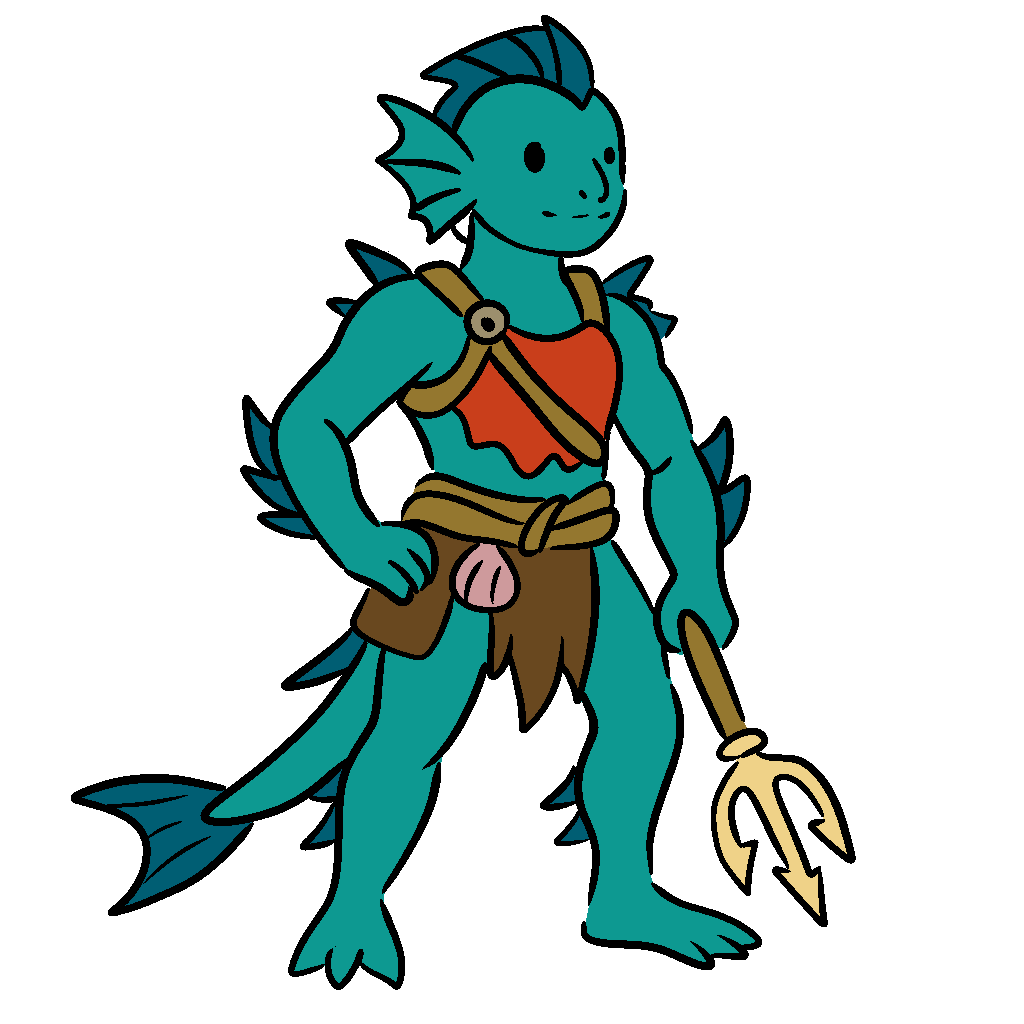
Their heads are crowned with bony or cartilaginous crests that flare like fins or swept-back waves, often decorated with drilled shells, braided beads, or scrap metal charms. Flexible fins sprout along their forearms, calves, and sometimes down the spine, which fold tight on land and fan wide in the water. Hair, where it grows, tends to be coarse and heavy, floating like seaweed in the water and braided close on land to keep it from whipping in the wind.
Triton eyes are large and reflective, adapted to the dim light beneath cloud-shadow. Colors range from grey and sea-green to bright gold and lilac, and many shine with a pale tapetum glow when caught in lantern light. Their teeth are small and sharp, suited to a mostly fish and shellfish diet, and their voices carry a faint undertone, as if an echo of surf follows every word.
They see themselves as caretakers first and rulers a distant second. Triton pods keep charts of falling storms, map dangerous undercurrents, and maintain “rescue chains” of hooks, nets, and waystones along popular routes. The same duty that drives them to save sailors from wrecks also justifies stern reprisal when dryfolk poison waters, strip reefs, or break sworn routes. A pod that feels disrespected might switch from escorting a convoy to harrying it, cutting rigging in the night or calling in hungry allies from below.
Curiosity runs deep. Many tritons obsessively collect surface artifacts that survive the fall into the sky sea: tools, books sealed in tar, broken toys, religious icons, even entire ship figureheads. Others collect stories instead, keeping drift-bottled letters, tavern gossip, and oral histories traded with passing captains. Adult names are chosen rather than given, often referencing deeds, obsessions, or storms survived, and may change with each major life chapter.
Gender among tritons is fluid and treated as a matter of tides and seasons. A triton may shift presentation, pronouns, and name several times through their life, and pod kin are expected to follow these changes without fuss. Ritual art is everywhere: scale painting for big festivals, shell mosaics on the undersides of hulls, chant-songs that braid weather reports with myth. Tales of brilliant innovators who turn disaster into salvation, such as the legendary engineer who slew a sky kraken with a device built in the ruins of their home, are especially beloved.
They are broadly similar in stature to humans, usually standing between 150 and 195 centimeters, with dense bones that add weight in the water but make falls from ship rigging less disastrous. Young tritons hatch from soft, leathery eggs anchored to warm coral or specially tended rope gardens. The larvae stage is fully aquatic and tadpole like, with limbs and lungs developing later. Childhood lasts a little longer than a human’s, with most reaching physical and social adulthood around 20.
Average triton lifespan sits around 120 to 140 years, though elders claim that clan founders sometimes live longer in deep, still waters where storms cannot reach. In youth they are lean and restless, middle age brings thicker crests and more pronounced scale patterns, and very old tritons often grow pale along the edges of their fins, like surf bleaching stone. Salt sickness, caused by long exile from the sea or poisoned waters, is a real danger and one that triton healers treat with great seriousness.
Outside the reef courts, countless smaller pods dwell in and around shipwreck fields, storm-warmed shallows, and the shadowed sides of walkers and other colossal shapes that tear through the clouds. They were among the first to chart the safe “blue roads” between walkers and coastal sky ports, and many of those routes are still guarded or taxed by triton pods.
On the surface world, triton enclaves often grow beneath High Seas harbors. Flooded tunnels, cistern houses, and net-walled caves host mixed communities where tritons trade fresh catches, pearls, and salvage for metalwork, textiles, and land food. The driest inland tritons live near great rivers or salt-lakes, tending shrines to the memory of the ocean that used to lie above or below.
Tritons maintain strong ties with other sea born peoples. Sea elves often share reefs and artistry with them, collaborating on sweeping mosaics and magical infrastructure. Tortles are valued as patient navigators and living archives of old routes. Locathah are favorite scouts and skirmishers in any underwater conflict. Water genasi move easily between triton and dryfolk worlds and often serve as translators, diplomats, or smugglers when relations grow tense.
Relations with High Seas skyfarers are more mixed. Giff and hadozee crews that show proper respect for currents and reefs may gain triton allies for life, while those that treat the sky sea as empty space to burn through will run into sharp fins and sharper spears. Smallfolk, orcs, goliaths, and birdfolk like aarakocra often meet tritons first in border ports, where curiosity and cautious trade slowly give way to friendship.
Individual tritons sometimes turn their back on the deep, choosing to live almost entirely among dryfolk. These “shorechosen” tritons are rare but increasingly common, and they often become cultural bridges, community healers, or eccentric collectors of landbound hobbies. Most pods accept such choices, so long as the shorechosen still answer when the High Seas truly need them.
Among the skyfaring peoples of the High Seas, tritons are known as tireless stewards of the waters above, outspoken critics of careless sailors, and collectors of every scrap of story that falls into the deep. You are most likely to meet them in coral-built courts clinging under sky-reefs, in triton “floodhouses” beneath port town piers, or waist-deep in foam beside a storm that everybody else is trying to avoid.
Appearance
Tritons are amphibious humanoids with bodies built for the upward-pulled sea. Their skin is covered in fine, overlapping scales that shift through yellow-green, sea-glass teal, storm-blue, and deep violet, often marbled with lighter streaks that echo wave-crests or cloud-light. Most have webbed fingers and toes and lean, rope-muscled frames from a life of constant swimming and climbing hulls.Their heads are crowned with bony or cartilaginous crests that flare like fins or swept-back waves, often decorated with drilled shells, braided beads, or scrap metal charms. Flexible fins sprout along their forearms, calves, and sometimes down the spine, which fold tight on land and fan wide in the water. Hair, where it grows, tends to be coarse and heavy, floating like seaweed in the water and braided close on land to keep it from whipping in the wind.
Triton eyes are large and reflective, adapted to the dim light beneath cloud-shadow. Colors range from grey and sea-green to bright gold and lilac, and many shine with a pale tapetum glow when caught in lantern light. Their teeth are small and sharp, suited to a mostly fish and shellfish diet, and their voices carry a faint undertone, as if an echo of surf follows every word.
Culture & Society
Triton society is built around currents, reefs, and responsibilities. Most belong to a pod, a multi generational community that claims stewardship over a stretch of sky ocean, a cluster of hanging reefs, or a chain of floating wrecks. Several pods that share a region form a court, holding formal gatherings in coral amphitheatres, barnacle palaces, or the hollowed bellies of ancient ships. Courts argue, trade, and swear oaths about who is responsible for which storms, migration routes, and ship-lanes.They see themselves as caretakers first and rulers a distant second. Triton pods keep charts of falling storms, map dangerous undercurrents, and maintain “rescue chains” of hooks, nets, and waystones along popular routes. The same duty that drives them to save sailors from wrecks also justifies stern reprisal when dryfolk poison waters, strip reefs, or break sworn routes. A pod that feels disrespected might switch from escorting a convoy to harrying it, cutting rigging in the night or calling in hungry allies from below.
Curiosity runs deep. Many tritons obsessively collect surface artifacts that survive the fall into the sky sea: tools, books sealed in tar, broken toys, religious icons, even entire ship figureheads. Others collect stories instead, keeping drift-bottled letters, tavern gossip, and oral histories traded with passing captains. Adult names are chosen rather than given, often referencing deeds, obsessions, or storms survived, and may change with each major life chapter.
Gender among tritons is fluid and treated as a matter of tides and seasons. A triton may shift presentation, pronouns, and name several times through their life, and pod kin are expected to follow these changes without fuss. Ritual art is everywhere: scale painting for big festivals, shell mosaics on the undersides of hulls, chant-songs that braid weather reports with myth. Tales of brilliant innovators who turn disaster into salvation, such as the legendary engineer who slew a sky kraken with a device built in the ruins of their home, are especially beloved.
Biology & Lifespan
Tritons are fully amphibious, with dual respiratory systems that let them draw breath through both lungs and fine gill slits hidden along the neck and ribs. They can spend long stretches out of water, but their skin dries and flakes if they go too long without soaking, and many keep small bath pools or brine barrels in any home on land. Their bodies handle sudden pressure changes well, letting them dive through thick cloud layers and surge up to hull level without bursting vessels or nosebleeds.They are broadly similar in stature to humans, usually standing between 150 and 195 centimeters, with dense bones that add weight in the water but make falls from ship rigging less disastrous. Young tritons hatch from soft, leathery eggs anchored to warm coral or specially tended rope gardens. The larvae stage is fully aquatic and tadpole like, with limbs and lungs developing later. Childhood lasts a little longer than a human’s, with most reaching physical and social adulthood around 20.
Average triton lifespan sits around 120 to 140 years, though elders claim that clan founders sometimes live longer in deep, still waters where storms cannot reach. In youth they are lean and restless, middle age brings thicker crests and more pronounced scale patterns, and very old tritons often grow pale along the edges of their fins, like surf bleaching stone. Salt sickness, caused by long exile from the sea or poisoned waters, is a real danger and one that triton healers treat with great seriousness.
Homelands & Environment
Tritons are native to the High Seas, the shattered ocean that hangs in the sky. Their oldest strongholds coil through coral forests that cling to the underbellies of great sky-reefs and the broken crowns of drowned mountains that were dragged upward at Saltfall. These reef cities glow with shell lamps and cultivated bioluminescent algae, riddled with bubble-chambers where air breathers can visit and trade.Outside the reef courts, countless smaller pods dwell in and around shipwreck fields, storm-warmed shallows, and the shadowed sides of walkers and other colossal shapes that tear through the clouds. They were among the first to chart the safe “blue roads” between walkers and coastal sky ports, and many of those routes are still guarded or taxed by triton pods.
On the surface world, triton enclaves often grow beneath High Seas harbors. Flooded tunnels, cistern houses, and net-walled caves host mixed communities where tritons trade fresh catches, pearls, and salvage for metalwork, textiles, and land food. The driest inland tritons live near great rivers or salt-lakes, tending shrines to the memory of the ocean that used to lie above or below.
Relations with Other Peoples
To most dryfolk, tritons are equal parts guardian and problem. Human and dwarf captains respect their storm warnings and navigation markers, but complain about “bossy fishfolk” boarding ships to inspect bilges, dump leaking barrels overboard, or forbid certain routes during spawning seasons. Coastal towns with long standing triton treaties benefit from reliable rescue patrols and rich fisheries, while those that cheat on oaths may find nets slashed, buoys moved, and vital trade currents “mysteriously” redirected.Tritons maintain strong ties with other sea born peoples. Sea elves often share reefs and artistry with them, collaborating on sweeping mosaics and magical infrastructure. Tortles are valued as patient navigators and living archives of old routes. Locathah are favorite scouts and skirmishers in any underwater conflict. Water genasi move easily between triton and dryfolk worlds and often serve as translators, diplomats, or smugglers when relations grow tense.
Relations with High Seas skyfarers are more mixed. Giff and hadozee crews that show proper respect for currents and reefs may gain triton allies for life, while those that treat the sky sea as empty space to burn through will run into sharp fins and sharper spears. Smallfolk, orcs, goliaths, and birdfolk like aarakocra often meet tritons first in border ports, where curiosity and cautious trade slowly give way to friendship.
Individual tritons sometimes turn their back on the deep, choosing to live almost entirely among dryfolk. These “shorechosen” tritons are rare but increasingly common, and they often become cultural bridges, community healers, or eccentric collectors of landbound hobbies. Most pods accept such choices, so long as the shorechosen still answer when the High Seas truly need them.
Triton by Lou
Basic Facts
- Classification: mortal sky-sea folk
- Average Size: medium, roughly 150 to 195 cm tall
- Average Lifespan: 120 to 140 years, adulthood around 20, elders over 100 are respected storm advisers
- Typical Homelands: High Seas sky ocean, hanging reef cities, wreck-fields, coastal High Seas ports
- Common Languages: Trade Tongue, various Seaspeech dialects.
- Societal Structure: pod based communities gathered into regional reef courts and city states
- Rarity: uncommon overall, common in the High Seas, rare far inland

Comments