

Playable Classes
| Name | Homebrew | Type | Description | Link |
|---|---|---|---|---|
| Inventor | x | Main | An Intelligence based class who uses gadgets and prototypes to fight with. | Inventor |
| Battle Tinker | x | Subclass | Subclass of Inventor. Focused on creating a mechanised suit to fight with. | |
| Roboticist | x | Subclass | Subclass of Inventor. Focuses on building robots to fight for him. | |
| Scientist | x | Subclass | Subclass of Inventor. Focuses on fundamental sciences and skills. | |
| Artificer | Main | An Intelligence based magical inventor who uses his abilities to create items. | Artificer | |
| Alchemist | Subclass | Subclass of Artificer. Focuses on brewing potions. | ||
| Armorer | Subclass | Subclass of Artificer. Focuses on creating armor. | ||
| Artillerist | Subclass | Subclass of Artificer. Focuses on ranged attacks. | ||
| Battle Smith | Subclass | Subclass of Artificer. Focuses on creating a Construct. | ||
| Cartographer | Subclass | Subclass of Artificer. Focuses on wayfinding. | ||
| Officer | x | Main | An Intelligence and Charisma based commander who uses his abilities to help his allies fight. | Officer |
| Equestrian | x | Subclass | Subclass of Officer. Focuses on mounted combat. | |
| Strategist | x | Subclass | Subclass of Officer. Focuses on strategy and planning. | |
| Tactician | x | Subclass | Subclass of Officer. Focuses on combat tactics and boosting his allies. | |
| Witchhunter | x | Main | An anti-magic warrior trained in resisting magic and disrupting spellcasting. | Witchhunter |
| Monster Hunter | x | Subclass | Subclass of Witchhunter. Focuses on fighting magical beasts and monsters. | |
| Mage Hunter | x | Subclass | Subclass of Witchhunter. Focuses on fighting spellcasters. | |
| Arcanologist | x | Subclass | Subclass of Witchhunter. Focuses on studying the Arcane. | |
| Medic | x | Main | A specialized soldier trained in combat and healing. | Medic |
| Chemist | x | Subclass | Subclass of Medic. Focuses on creating tinctures, poisons and drugs. | |
| Combat Medic | x | Subclass | Subclass of Medic. Focuses on battlefield healing and combat. | |
| Surgeon | x | Subclass | Subclass of Medic. Focuses on surgeries in and out of combat. | |
| Barbarian | Main | A rage filled warrior who are hard to kill and hit hard. | Barbarian | |
| Bard | Main | A smooth talking and performing jack of all trades. | Bard | |
| Cleric | Main | A Holy Person serving a God or the primal forces. | Cleric | |
| Druid | Main | People close to nature and able to draw magical power from the land. | Druid | |
| Fighter | Main | Warriors highly skilled with weapons and special abilities. | Fighter | |
| Infantry | x | Subclass | Subclass of Fighter. Focuses on firearms and bayonets. | |
| Monk | Main | A spiritual warrior who uses his body as a weapon. | Monk | |
| Paladin | Main | A holy warrior equally skilled with weapons and faith. | Paladin | |
| Ranger | Main | A druidic warrior close to nature. | Ranger | |
| Rogue | Main | Subterfuge and stealth mixed with the skills to break into any place. | Rogue | |
| Deadeye | x | Subclass | Subclass of Rogue. Focuses on long-ranged combat and ambushes. | |
| Sorcerer | Main | A innate caster of magic by blood or circumstance. | Sorcerer | |
| Warlock | Main | A caster who made a magic pact with an extraplanar creature. | Warlock | |
| Wizard | Main | A caster who studied the flows and art of magic. | Wizard |
Homebrew
Core Inventor Traits
| Primary Ability | Intelligence |
|---|---|
| Hit Point Die | 1d10 |
| Saving Throw Proficiencies | Intelligence and Wisdom |
| Skill Proficiencies | Choose 2: Nature, Investigation, History, Perception, Sleight of Hand |
| Weapon Proficiencies | Simple Weapons, Martial Weapons and Firearms |
| Tool Proficiencies | Smith's tools, Carpenter's Tools, Tinkerer's tools, Alchemist's tools, Thieves Tools |
| Armor Training | Light Armor, Medium Armor and Shields |
| Starting Equipment | A Simple or Martial Weapon, Prototype, Snaplock Pistol, Chainshirt, Dungeoneer's Pack |
| Level | Proficiency Bonus | Class Features | Tinker Bonus | Weapon Mastery |
|---|---|---|---|---|
| 1 | +2 | Prototype, Genius Proficiency | - | 2 |
| 2 | +2 | Tinkering | 1 | 2 |
| 3 | +2 | Subclass feature | 1 | 2 |
| 4 | +2 | Ability Score Improvement | 1 | 2 |
| 5 | +3 | Extra Attack | 1 | 3 |
| 6 | +3 | Subclass feature | 2 | 3 |
| 7 | +3 | Operator | 2 | 3 |
| 8 | +3 | Ability Score Improvement | 2 | 3 |
| 9 | +4 | Subclass feature, Tool Expert | 2 | 4 |
| 10 | +4 | Boost, Expertise: Science | 2 | 4 |
| 11 | +4 | Two Extra Attacks | 3 | 4 |
| 12 | +4 | Ability Score Improvement | 3 | 4 |
| 13 | +5 | Sabotage | 3 | 5 |
| 14 | +5 | Genius Innovation | 3 | 5 |
| 15 | +5 | Masterwork Prototype | 3 | 5 |
| 16 | +5 | Ability Score Improvement | 4 | 5 |
| 17 | +6 | Subclass feature | 4 | 6 |
| 18 | +6 | Professor | 4 | 6 |
| 19 | +6 | Epic Boon | 4 | 6 |
| 20 | +6 | Magnum Opus | 4 | 6 |
Use your long rests and downtime to work on building prototype weapons, armor, items or starting from level 7 vehicles. Inventing new items during down time or rest periods requires you to use the Crafting Table checks. You can also reverse engineer any items you might find.
Level 1: Genius Proficiency
Use your Intelligence Modifier on Prototype or Technological items if higher. You become proficient in Science.
Level 2: Tinkering
Spent time during your long rest improving an item using Tinkerer's tools. You can place these improvements on any item including items used by allies.
You can improve a number of items equal to your Proficiency Bonus.
- Weapon: Add a +1 to the attack and damage bonus for 24 hours
- Armor: Add a +1 to AC for 24 hours
- Item: Add a +1 to one item effect for 24 hours
This bonus increases by 1 every 6 levels
Level 2: Fighting Style Feat
- Archery: You gain a +2 bonus to attack rolls you make with ranged weapons.
- Defense: While you are wearing armor, you gain a +1 bonus to AC.
- Dueling: When you are wielding a melee weapon in one hand and no other weapons, you gain a +2 bonus to damage rolls with that weapon.
- Blind Fighting: Gain 10 feet of Blindsight
- Thrown Weapon Fighting: When you hit with a ranged attack roll using a weapon that has the Thrown property, you gain a +2 bonus to the damage roll.
- Great Weapon Fighting: When you roll a 1 or 2 on a damage die for an attack you make with a melee weapon that you are wielding with two hands, you can reroll the die and must use the new roll, even if the new roll is a 1 or a 2. The weapon must have the two-handed or versatile property for you to gain this benefit.
You gain a Inventor subclass. For the rest of your career, you gain each of your subclass’s features that are of your Inventor level or lower.
Level 4: Ability Score Improvement
You gain the Ability Score Improvement feat or another feat of your choice for which you qualify. You gain this feature again at Inventor levels 8, 12, and 16.
Level 5: Extra Attack
You can attack twice instead of once whenever you take the Attack action on your turn.
Level 7: Operator
An expert in operating machinery and technological items. You gain Advantage on any Ability checks related to technological items, vehicles or tools checks.
Level 8: Ability Score Improvement
You gain the Ability Score Improvement feat or another feat of your choice for which you qualify. You gain this feature again at Inventor levels 12, and 16.
Level 9: Tool Mastery
You can no longer roll below a 10 when using tools your proficient with.
Level 10: Overdrive
A number of times equal to your Intelligience Modifier you can temporarily boost an item, vehicle or machine by rolling a d10. If you roll a 1 on the d10 the item, vehicle or machine malfunctions instead and is disabled until repaired. The boost charges reset on the completion of a long rest.
You can use the result of the roll to boost the following:
- Attack Bonus: Add the result of the d10 to one Attack.
- Save DC: Add the result of the d10 to a technological effect.
- Armor Class: Add the result of the d10 to your AC until the start of your next turn.
- Vehicle speed: Add the result of the d10 times ten to movement speed of the vehicle.
- Tools Check: Add the result of the d10 to one of your tools checks.
You gain Expertise in the Science skill.
Level 11: Two Extra Attacks
You can attack three times instead of once whenever you take the Attack action on your turn.
Level 12: Ability Score Improvement
You gain the Ability Score Improvement feat or another feat of your choice for which you qualify. You gain this feature again at Inventor level 16.
Level 13: Sabotage
You can use your Tinkering to sabotage a feature of a technological item, vehicle or machine. They make a Constitution Saving Throw DC8 + Proficiency Bonus + Intelligence Modifier, on failure choose one of the following effects:
- Weapon: Lower its Attack Bonus equal to your Tinker bonus.
- Armor: Lower its AC equal to your Tinker bonus.
- Save DC: Lower the Save DC of one of its abilities equal to your Tinker bonus.
- Speed: Lower its movement speed equal to your Tinker bonus times ten.
Level 14: Genius Innovation
Once per day you can choose to succeed an Ability check after your roll.
Level 15: Masterwork Prototype
Any items crafting by you increase in potency. The item's value doubles because your work is renowned and highly sought after by collectors.
Choose a property of the item and increase its power as if its one level higher in rarity. The DM decides what this improvement looks like.
Level 16: Ability Score Improvement
You gain the Ability Score Improvement feat or another feat of your choice for which you qualify.
Level 18: Professor
All your Proficiencies in Skills and Tools turn into Expertise. All of your allies become Proficient in your proficient skills.
Level 19: Epic Boon
You gain an Epic Boon feat or another feat of your choice for which you qualify. Boon of Combat Prowess is recommended.
Level 20: Magnum Opus
You gain the schematic for your most powerful item, your life's work, an epic level weapon, armor, item or vehicle. Discuss with the DM what this item is and its properties.
You improve a suit of heavy armor (must be Mundane or Technological) with your inventions by spending Downtime or a Long Rest with a Tinkerer's Tools check DC15. On success, you gain an Exoskeleton with the Armor Class of the Heavy Armor used.
When wearing the Exoskeleton you have the following modifiers:
- You use your Intelligence instead of Dexterity to determine your Armor Class bonus. The maximum still applies.
- You have -5 ft. movement.
- You ignore the Strength requirement of the armor.
- Heavy weapons don't apply Disadvantage while wearing the Exoskeleton.
- The Exoskeleton attaches to you and can't be removed against your will unless unconscious, restrained or in any other way incapacitated. It covers your entire body although you can retract or deploy the helmet as a Free Action.
- Add half of your Intelligence modifier rounded up to your AC.
- You can doff or don the Exoskeleton as a full tur.
- Power core capacity is 75 at level 3. When you lose all power you suffer the stunned condition until you doff the armor.
- Short rests recover 2d10 + Intelligence modifier + Proficiency Power. Long rest recovers to maximum power. During combat you can use batteries to restore power to your exoskeleton by spending an action to Recharge (1 battery restores 10 power).
- At the end of your turn you lose 2 Power.
- You cannot sleep in your exoskeleton and must remove it when resting.
Once you use this feature, you must finish a Short or Long rest before you can use it again.
Powered Surge costs 10 battery Capacity.
Level 3: Powered Maneuvers: Choose 3 combat maneuvers from the Combat Maneuvers table.
Your Superiority die are d10 when at 75+ Power, 50+ d8, 25+ d6, 10+ d4, lower than 10 power adds no Superiority damage and you lose your Proficiency to Save DC.
Level 6: Powered Servos
You can spend 5 Power to use your Intelligence modifier on Strength or Constitution Ability Checks or Saving Throws.
Level 6: Enhanced Power Core
Your maximum Power increases to 100.
Level 9: Exoskeleton Modification
Exoskeleton Modifications (choose 2, you can switch them during a long rest):
- Triple Plating: The armor plating on your Exoskeleton gains a +1 bonus to Armor Class.
- Power Servos: This grants a +1 bonus to attack and damage rolls made while inside the Exoskeleton.
- Auto Loader: For ranged weapons you ignore the Loading property.
- Enhanced Servos: Your movement speed increases by 10 ft.
- Spring Joints: You double your jump distance.
- Vent Core: You blast heat from your Core out a 5 ft. radius using your exhaust ports. Creatures caught in the blast take 2d6 Fire damage + Intelligence Modifier and must make a Dex Save DC8 + Intelligence Modifier + Proficiency. On success they take half damage, on failure they take full damage and get the Burning condition taking 1d6 Fire damage until they use an Action to put out the flames.
- Electric Charge: You charge the outside of your armor with electricity. When a melee attack hits you can choose to use a Reaction and 5 Power to make the creature take 2d6 Lightning damage.
- Subtle Dampeners: You remove your disadvantage on Stealth checks.
- Overcharged Surge: You can use the Powered Surge ability a second time before a short or long rest but it'll cost 20 Power.
- Additional Combat Maneuvers: You can take another 2 combat maneuvers from the Combat Maneuvers table.
As a Reaction you can activate the defenses of your Exoskeleton and turn it into an immobile fortress. Your speed becomes 0 and you automatically fail Dexterity Checks but your AC increases by 5 until you start moving again.
Create a Robot Companion that acts as your familiar and starts on your Initiative. During a Long Rest or Downtime you can create a Robot Companion by using a metal scrap, clockwork component and a battery. It has a simple program and cannot act on its own. You may only have 1 Robot Companion active at a time.
You can install a Simple weapon on the creature, a Tool and Injector. It uses your Attack bonus on its weapons attacks, your Ability Check on the Tool and can Inject medicine or poisons.
With the Remote Control Unit you can see through it's camera and use its sensors within 100 ft. You can give it commands through the unit and it can continue executing a command until instructed otherwise.
Level 3: Repair Robot
Use an Action to repair a robotic construct. You heal it for 1d4 plus your Proficiency Bonus and Intelligence Modifier.
Level 6: Automaton
Create an Automaton Companion that acts as your familiar and starts on your Initiative. During a Long Rest or Downtime you can create an Automaton by using a metal ingot, a machine brain and a power core. You can program it with a simple personality. You may only have 1 Automaton active at a time.
It has half the Hit Points that were granted by your Inventor levels. You can install two Simple or Martial Weapons on the Automaton, two Tools and an Injector. It uses your Attack bonus on its weapons attacks, your Ability Check on the Tools and can Inject medicine or poisons.
With the Remote Control Unit you can see through it's camera and use its sensors within 100 ft. You can give it commands through the unit and it can continue executing a simple command until instructed otherwise.
Level 6: Overdrive
Use an Action to put one of your robotic constructs into Overdrive. While they're in Overdrive their Speed is doubled, it gains a +2 bonus to Armor Class, it has Advantage on Dexterity saving throws, and it gains an additional action on each of its turns. Roll a d20 on the start of your turn and on a 1 it overheats, dealing 2d6 Fire damage to itself and all creatures within 5 ft on each of its turns. If you roll a 1 again it explodes destroying itself, all creatures within a 10 ft Cube centered on itself must make a Dexterity Saving Throw DC15, on failure taking 2d6 Force Damage and 2d6 Fire damage, on success taking only half of the damage.
Level 9: Flying Automaton
You can attach rocket boosters to your Automaton and give it a Flyspeed equal to double its walking speed.
Level 17: Android
Create an Android Companion that acts as your familiar and starts on your Initiative. During a Long Rest or Downtime you can create an Android by using a Living Steel ingot, a machine brain and a mini reactor. You can program it with a humanoid personality, capable of acting on its own and give it a special feature. Discuss with the DM what this feature looks like.
You may only have 1 Android active at a time.
It has the same Hit Points you get from your Inventor levels. You can install two Simple or Martial Weapons on the creature, three Tools and an Injector. It uses your Attack bonus on its weapons attacks, your Ability Check on the Tools and can Inject medicine or poisons.
With the Remote Control Unit you can see through it's camera and use its sensors within 100 ft. You can give it commands through the unit and it can continue executing a command until instructed otherwise.
You gain Profiency in another 2 skills and 2 Expertise in Proficient skills. For skills you're Proficient in you can use your Intelligence Modifier if higher.
Level 3: Study
You can spend 10 minutes to study an object, creature or feature to learn its properties. The DM decides if there's rolls involved and what you learn.
Level 6: Innovator
Choose a weapon, armor or skill/tool to improve with a revolutionary innovation. You can choose only one item. It has the following benefits:
- Weapon: You use your Intelligence Modifier for the weapon if higher. Add another bonus from below:
- Add your Proficiency Bonus to any Damage Rolls made with the weapon.
- Change the Damage Type to another.
- Double the range of the weapon.
- Armor: You use your Intelligence Modifier instead of your Dexterity if higher for the armor class bonus. Add another bonus from below:
- Remove the maximum Dexterity Bonus cap.
- Add Advantage on Stealth Checks or Remove Disadvantage.
- Add Resistance to one Damage Type.
- Skill/Tool: You always use your Intelligence Modifier for a skill or a tool. Choose another bonus from below:
- Double your Proficiency Modifier for the Ability Check. If you already have Expertise then you add your Proficiency Bonus again.
- Re-roll one of the dice and take the higher result.
- You can teach another character this skill.
You roll research checks with Advantage to create new schematics.
Level 9: Master Innovator
Add another Bonus to your Innovation from the list.
Level 17: Theory of Everything
You become so knowledgeable about the fabric of the universe that you use your Intelligence Modifier for all Ability Checks if higher.
Level 17: Genius Innovator
You gain all the bonuses on your innovation.
Eberron: Forge of the Artificer
Core Artificer Traits
| Primary Ability | Intelligence |
|---|---|
| Hit Point Die | D8 |
| Saving Throw Proficiencies | Constitution and Intelligence |
| Skill Proficiencies | Choose 2: Arcana, History, Investigation, Medicine, Nature, Perception, or Sleight of Hand |
| Weapon Proficiencies | Simple weapons |
| Tool Proficiencies | Thieves’ Tools, Tinker’s Tools, and one type of Artisan’s Tools of your choice |
| Armor Training | Light and Medium armor and Shields |
| Starting Equipment | Choose A or B: (A) Studded Leather Armor, Dagger, Thieves’ Tools, Tinker’s Tools, Dungeoneer’s Pack, and 16 GP; or (B) 150 GP |
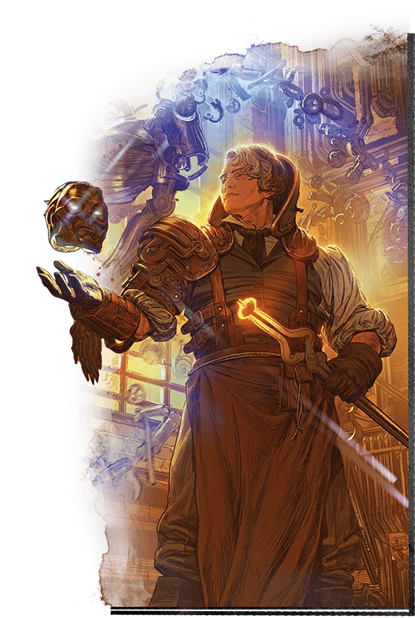
Masters of invention, Artificers use ingenuity and magic to unlock extraordinary capabilities in objects. They see magic as a complex system waiting to be decoded and then harnessed in their spells and inventions.
- Gain all the traits in the Core Artificer Traits table.
- Gain the Artificer’s level 1 features, which are listed in the Artificer Features table.
- Gain the following traits from the Core Artificer Traits table: Hit Point Die, proficiency with Tinker’s Tools, proficiency in one skill of your choice from the Artificer’s skill list, and training with Light and Medium armor and Shields.
- Gain the Artificer’s level 1 features, which are listed in the Artificer Features table. See the multiclassing rules in the Player’s Handbook to determine your available spell slots, adding half your Artificer levels (round up). ]
| Level | Proficiency Bonus | Class Features | Plans Known | Magic Items | Cantrips | Prepared Spells | 1 | 2 | 3 | 4 | 5 |
|---|---|---|---|---|---|---|---|---|---|---|---|
| 1 | +2 | Spellcasting, Tinker’s Magic | — | — | 2 | 2 | 2 | — | — | — | — |
| 2 | +2 | Replicate Magic Item | 4 | 2 | 2 | 3 | 2 | — | — | — | — |
| 3 | +2 | Artificer Subclass | 4 | 2 | 2 | 4 | 3 | — | — | — | — |
| 4 | +2 | Ability Score Improvement | 4 | 2 | 2 | 5 | 3 | — | — | — | — |
| 5 | +3 | Subclass feature | 4 | 2 | 2 | 6 | 4 | 2 | — | — | — |
| 6 | +3 | Magic Item Tinker | 5 | 3 | 2 | 6 | 4 | 2 | — | — | — |
| 7 | +3 | Flash of Genius | 5 | 3 | 2 | 7 | 4 | 3 | — | — | — |
| 8 | +3 | Ability Score Improvement | 5 | 3 | 2 | 7 | 4 | 3 | — | — | — |
| 9 | +4 | Subclass feature | 5 | 3 | 2 | 9 | 4 | 3 | 2 | — | — |
| 10 | +4 | Magic Item Adept | 6 | 4 | 3 | 9 | 4 | 3 | 2 | — | — |
| 11 | +4 | Spell-Storing Item | 6 | 4 | 3 | 10 | 4 | 3 | 3 | — | — |
| 12 | +4 | Ability Score Improvement | 6 | 4 | 3 | 10 | 4 | 3 | 3 | — | — |
| 13 | +5 | — | 6 | 4 | 3 | 11 | 4 | 3 | 3 | 1 | — |
| 14 | +5 | Advanced Artifice | 7 | 5 | 4 | 11 | 4 | 3 | 3 | 1 | — |
| 15 | +5 | Subclass feature | 7 | 5 | 4 | 12 | 4 | 3 | 3 | 2 | — |
| 16 | +5 | Ability Score Improvement | 7 | 5 | 4 | 12 | 4 | 3 | 3 | 2 | — |
| 17 | +6 | — | 7 | 5 | 4 | 14 | 4 | 3 | 3 | 3 | 1 |
| 18 | +6 | Magic Item Master | 8 | 6 | 4 | 14 | 4 | 3 | 3 | 3 | 1 |
| 19 | +6 | Epic Boon | 8 | 6 | 4 | 15 | 4 | 3 | 3 | 3 | 2 |
| 20 | +6 | Soul of Artifice | 8 | 6 | 4 | 15 | 4 | 3 | 3 | 3 | 2 |
You have learned how to channel magical energy through objects. See the Player’s Handbook for the rules on spellcasting. The information below details how you use those rules with Artificer spells, which appear in the Artificer spell list later in the class’s description. Tools Required. You produce your Artificer spells through tools. You can use Thieves’ Tools, Tinker’s Tools, or another kind of Artisan’s Tools with which you have proficiency as a Spellcasting Focus, and you must have one of those focuses in hand when you cast an Artificer spell (meaning the spell has an M component when you cast it). Cantrips. You know two Artificer cantrips of your choice. Acid Splash and Prestidigitation are recommended. Whenever you finish a Long Rest, you can replace one of your cantrips from this feature with another Artificer cantrip of your choice. When you reach Artificer levels 10 and 14, you learn another Artificer cantrip of your choice, as shown in the Cantrips column of the Artificer Features table. Spell Slots. The Artificer Features table shows how many spell slots you have to cast your level 1+ spells. You regain all expended slots when you finish a Long Rest. Prepared Spells of Level 1+. You prepare the list of level 1+ spells that are available for you to cast with this feature. To start, choose two level 1 Artificer spells. Cure Wounds and Grease are recommended. The number of spells on your list increases as you gain Artificer levels, as shown in the Prepared Spells column of the Artificer Features table. Whenever that number increases, choose additional Artificer spells until the number of spells on your list matches the number on the table. The chosen spells must be of a level for which you have spell slots. For example, if you’re a level 5 Artificer, your list of prepared spells can include six Artificer spells of levels 1 and 2 in any combination. If another Artificer feature gives you spells that you always have prepared, those don’t count against the number of spells you can prepare with this feature, but those spells otherwise count as Artificer spells for you. Changing Your Prepared Spells. Whenever you finish a Long Rest, you can change your list of prepared spells, replacing any of the spells there with other Artificer spells for which you have spell slots. Spellcasting Ability. Intelligence is your spellcasting ability for your Artificer spells. Level 1: Tinker’s Magic
You know the Mending cantrip. As a Magic action while holding Tinker’s Tools, you can create one item in an unoccupied space within 5 feet of yourself, choosing the item from the following list:
| Ball Bearings | Flask | Pouch |
| Basket | Grappling Hook | Rope |
| Bedroll | Hunting Trap | Sack |
| Bell | Jug | Shovel |
| Blanket | Lamp | Spikes, Iron |
| Block and Tackle | Manacles | String |
| Bottle, Glass | Net | Tinderbox |
| Bucket | Oil | Torch |
| Caltrops | Paper | Vial |
| Candle | Parchment | |
| Crowbar | Pole |
You have learned arcane plans that you use to make magic items. Plans Known. When you gain this feature, choose four plans to learn from the Magic Item Plans (Artificer Level 2+) table (see the Dungeon Master’s Guide for the items’ descriptions). Bag of Holding, Cap of Water Breathing, Sending Stones, and Wand of the War Mage are recommended. Whenever you gain an Artificer level, you can replace one of the plans you know with a new plan for which you qualify. You learn another plan of your choice when you reach certain Artificer levels, as shown in the Plans Known column of the Artificer Features table. When you choose a plan to learn, you choose it from any Magic Item Plans table for which you qualify; your qualification is based on your Artificer level. Creating an Item. When you finish a Long Rest, you can create one or two different magic items if you have Tinker’s Tools in hand. Each item is based on one of the plans you know for this feature. If a created item requires Attunement, you can attune yourself to it the instant you create it. If you decide to attune to the item later, you must do so using the normal process for Attunement. When you reach certain Artificer levels specified in the Magic Items column of the Artificer Features table, the number of magic items you can create at the end of a Long Rest increases. Each item you create must be based on a different plan you know. You can’t have more magic items from this feature than the number shown in the Magic Items column of the Artificer Features table for your level. If you try to exceed your maximum number of magic items for this feature, the oldest item vanishes, and then the new item appears. Duration. A magic item created by this feature functions as the normal magic item, except its magic isn’t permanent; when you die, the magic item vanishes after 1d4 days. If you replace a plan you know with a new plan, any magic item created with the replaced plan immediately vanishes. If an item that you created with this feature is a container, such as a Bag of Holding , and it vanishes, its contents harmlessly appear in and around its space. Spellcasting Focus. You can use any Wand or Weapon created by this feature as a Spellcasting Focus in lieu of using a set of Artisan’s Tools. Magic Item Plans (Artificer Level 2+)
| Magic Item Plan | Attunement |
|---|---|
| Alchemy Jug | No |
| Bag of Holding | No |
| Cap of Water Breathing | No |
| Common magic item that isn’t a Potion, a Scroll, or cursed* | Varies |
| Goggles of Night | No |
| Manifold Tool† | Yes |
| Repeating Shot† | Yes |
| Returning Weapon† | No |
| Rope of Climbing | No |
| Sending Stones | No |
| Shield, +1 | No |
| Wand of Magic Detection | No |
| Wand of Secrets | No |
| Wand of the War Mage, +1 | Yes |
| Weapon, +1 | No |
| Wraps of Unarmed Power, +1 | No |
| Magic Item Plan | Attunement |
|---|---|
| Armor, +1 | No |
| Boots of Elvenkind | No |
| Boots of the Winding Path† | Yes |
| Cloak of Elvenkind | Yes |
| Cloak of the Manta Ray | Yes |
| Dazzling Weapon† | Yes |
| Eyes of Charming | Yes |
| Eyes of Minute Seeing | No |
| Gloves of Thievery | No |
| Helm of Awareness† | No |
| Lantern of Revealing | No |
| Mind Sharpener† | Yes |
| Necklace of Adaptation | Yes |
| Pipes of Haunting | No |
| Repulsion Shield† | No |
| Ring of Swimming | No |
| Ring of Water Walking | No |
| Sentinel Shield | No |
| Spell-Refueling Ring† | Yes |
| Wand of Magic Missiles | No |
| Wand of Web | Yes |
| Weapon of Warning | Yes |
| Magic Item Plan | Attunement |
|---|---|
| Armor of Resistance | Yes |
| Dagger of Venom | No |
| Elven Chain | No |
| Ring of Feather Falling | Yes |
| Ring of Jumping | Yes |
| Ring of Mind Shielding | Yes |
| Shield, +2 | No |
| Uncommon Wondrous Item that isn’t cursed* | Varies |
| Wand of the War Mage, +2 | Yes |
| Weapon, +2 | No |
| Wraps of Unarmed Power, +2 | No |
| Magic Item Plan | Attunement |
|---|---|
| Armor, +2 | No |
| Arrow-Catching Shield | Yes |
| Flame Tongue | Yes |
| Rare Wondrous Item that isn’t cursed* | Varies |
| Ring of Free Action | Yes |
| Ring of Protection | Yes |
| Ring of the Ram | Yes |
You gain an Artificer subclass of your choice. A subclass is a specialization that grants you features at certain Artificer levels. For the rest of your career, you gain each of your subclass’s features that are of your Artificer level or lower. Level 4: Ability Score Improvement
You gain the Ability Score Improvement feat or another feat of your choice for which you qualify. You gain this feature again at Artificer levels 8, 12, and 16. Level 6: Magic Item Tinker
Your Replicate Magic Item feature gains the following options. Charge Magic Item. As a Bonus Action, you can touch a magic item within 5 feet of yourself that you created with Replicate Magic Item and that uses charges. You expend a level 1+ spell slot and recharge the item. The number of charges the item regains is equal to the level of spell slot expended. Drain Magic Item. As a Bonus Action, you can touch a magic item within 5 feet of yourself that you created with Replicate Magic Item and cause the item to vanish, converting its magical energy into a spell slot. The slot is level 1 if the item is Common or level 2 if the item is Uncommon or Rare. Once you use this feature, you can’t do so again until you finish a Long Rest. Any spell slot you create with this feature vanishes when you finish a Long Rest. Transmute Magic Item. As a Magic action, you can touch one magic item within 5 feet of yourself that you created with Replicate Magic Item and transform it into a different magic item. The resulting item must be based on a magic item plan you know. Once you use this feature, you can’t do so again until you finish a Long Rest. Level 7: Flash of Genius
When you or a creature you can see within 30 feet of you fails an ability check or a saving throw, you can take a Reaction to add a bonus to the roll, potentially causing it to succeed. The bonus equals your Intelligence modifier (minimum of +1). You can take this Reaction a number of times equal to your Intelligence modifier (minimum of once). You regain all expended uses when you finish a Long Rest. Level 10: Magic Item Adept
You can now attune to up to four magic items at once. Level 11: Spell-Storing Item
Whenever you finish a Long Rest, you can touch one Simple or Martial weapon or one item that you can use as a Spellcasting Focus, and you store a spell in it, choosing a level 1, 2, or 3 Artificer spell that has a casting time of an action and doesn’t require a Material component that is consumed by the spell (you needn’t have the spell prepared). While holding the object, a creature can take a Magic action to produce the spell’s effect from it, using your spellcasting ability modifier. If the spell requires Concentration, the creature must concentrate. Once a creature has used the object to produce the spell’s effect, the object can’t be used this way again until the start of the creature’s next turn. The spell stays in the object until it’s been used a number of times equal to twice your Intelligence modifier (minimum of twice) or until you use this feature again to store a spell in an object. Level 14: Advanced Artifice
You gain the following benefits. Magic Item Savant. You can now attune to up to five magic items at once. Refreshed Genius. When you finish a Short Rest, you regain one expended use of your Flash of Genius feature. Level 18: Magic Item Master
You can now attune to up to six magic items at once. Level 19: Epic Boon
You gain an Epic Boon feat or another feat of your choice for which you qualify. Boon of Energy Resistance is recommended. Level 20: Soul of Artifice
You have developed a mystical connection to your magic items, which you can draw on for aid. You gain the following benefits. Cheat Death. If you’re reduced to 0 Hit Points but not killed outright, you can disintegrate any number of Uncommon or Rare magic items created by your Replicate Magic Item feature. If you do so, your Hit Points instead change to a number equal to 20 times the number of magic items disintegrated. Magical Guidance. When you finish a Short Rest, you regain all expended uses of your Flash of Genius if you have Attunement to at least one magic item.
| Artificer Level | Prepared Spells |
|---|---|
| 3 | Healing Word, Ray of Sickness |
| 5 | Flaming Sphere, Melf’s Acid Arrow |
| 9 | Gaseous Form, Mass Healing Word |
| 13 | Death Ward, Vitriolic Sphere |
| 17 | Cloudkill, Raise Dead |
| 1d6 | Effect |
|---|---|
| 1 | Healing. The drinker regains a number of Hit Points equal to 2d8 plus your Intelligence modifier. The number of Hit Points restored increases by 1d8 when you reach Artificer levels 9 ( 3d8 ) and 15 ( 4d8 ). |
| 2 | Swiftness. The drinker’s Speed increases by 10 feet for 1 hour. This bonus increases when you reach Artificer levels 9 (15 feet) and 15 (20 feet). |
| 3 | Resilience. The drinker gains a +1 bonus to AC for 10 minutes. The duration increases when you reach Artificer levels 9 (1 hour) and 15 (8 hours). |
| 4 | Boldness. The drinker can roll 1d4 and add the number rolled to every attack roll and saving throw it makes for the next minute. The duration increases when you reach Artificer levels 9 (10 minutes) and 15 (1 hour). |
| 5 | Flight. The drinker gains a Fly Speed of 10 feet for 10 minutes. The Fly Speed increases when you reach Artificer levels 9 (20 feet) and 15 (30 feet). |
| 6 | You determine the elixir’s effect by choosing one of the other rows in this table. |
| Artificer Level | Prepared Spells |
|---|---|
| 3 | Magic Missile, Thunderwave |
| 5 | Mirror Image, Shatter |
| 9 | Hypnotic Pattern, Lightning Bolt |
| 13 | Fire Shield, Greater Invisibility |
| 17 | Passwall, Wall of Force |
You gain the following benefits. Ranged Weaponry. You gain proficiency with Martial Ranged weapons. Tool Proficiency. You gain proficiency with Woodcarver’s Tools. If you already have this proficiency, you gain proficiency with one other type of Artisan’s Tools of your choice. Wand Crafting. When you craft a magic Wand, the amount of time required to craft it is halved. Level 3: Artillerist Spells
When you reach an Artificer level specified in the Artillerist Spells table, you thereafter always have the listed spells prepared. Artillerist Spells
| Artificer Level | Prepared Spells |
|---|---|
| 3 | Shield, Thunderwave |
| 5 | Scorching Ray, Shatter |
| 9 | Fireball, Wind Wall |
| 13 | Ice Storm, Wall of Fire |
| 17 | Cone of Cold, Wall of Force |
Using Smith’s Tools or Woodcarver’s Tools, you can take a Magic action to create a Small or Tiny Eldritch Cannon in an unoccupied space on a horizontal surface within 5 feet of yourself. The cannon’s game statistics appear below. You determine its appearance, including whether you carry it or not (and your choice of legs or wheels, for the latter). It disappears if it is reduced to 0 Hit Points or after 1 hour. You can dismiss it early as a Magic action. Once you create a cannon, you can’t do so again until you finish a Long Rest or expend a spell slot to create one. You can have only one cannon at a time and can’t create one while you already have one. Eldritch Cannon
Small or Tiny Object Armor Class: 18 Hit Points: 5 x your Artificer level (casting Mending on the cannon restores 2d6 Hit Points to it) Immunities: Poison, Psychic Activate Cannon (Requires You to Be within 60 Feet of the Cannon). As a Bonus Action, you order the cannon to use the Flamethrower, Force Ballista, or Protector option below; you can direct the cannon to move up to 15 feet before or after that option: Flamethrower. The cannon blasts fire in a 15-foot Cone. Each creature in that area makes a Dexterity saving throw against your spell save DC, taking 2d8 Fire damage on a failed save or half as much damage on a successful one. Flammable objects in the Cone that aren’t being worn or carried start burning. Force Ballista. Make a ranged spell attack originating from the cannon at one creature or object within 120 feet of it. On a hit, the target takes 2d8 Force damage, and if the target is a creature, it is pushed up to 5 feet away from the cannon. Protector. The cannon emits a burst of positive energy that grants itself and each creature of your choice within 10 feet of the cannon a number of Temporary Hit Points equal to 1d8 plus your Intelligence modifier (minimum of +1). Level 5: Arcane Firearm
When you finish a Long Rest, you can use Woodcarver’s Tools to carve special sigils into a Rod, Staff , Wand, or Martial Ranged weapon and thereby turn it into your Arcane Firearm. The sigils disappear from the object if you later carve them on a different item. The sigils otherwise last indefinitely. You can use your Arcane Firearm as a Spellcasting Focus for your Artificer spells. When you cast an Artificer spell through the firearm, roll 1d8, and you gain a bonus to one of the spell’s damage rolls equal to the number rolled. Level 9: Explosive Cannon
Every Eldritch Cannon you create is now more destructive. You gain the following benefits. Detonate. When your cannon takes damage, you can take a Reaction to command the cannon to detonate if you are within 60 feet of it. Doing so destroys the cannon and forces each creature within 20 feet of it to make a Dexterity saving throw against your spell save DC, taking ( 3d10 ) Force damage on a failed save or half as much damage on a successful one. Firepower. The cannon’s damage rolls and the number of Temporary Hit Points granted by Protector increase by 1d8. Level 15: Fortified Position
You’re a master at forming well-defended emplacements using your Eldritch Cannon. You gain the following benefits. Double Firepower. You can now have two cannons at the same time, and you can create two with the same Magic action. (If you expend a spell slot to create the first cannon, you must expend another spell slot to create the second.) You can activate both of them with the same Bonus Action, ordering them to use the same activation option or different ones. You can’t create a third cannon while you have two. Shimmering Field Projection. You and your allies have Half Cover while within 10 feet of your Eldritch Cannon.
You gain the following benefits. Tool Proficiency. You gain proficiency with Smith’s Tools. If you already have this proficiency, you gain proficiency with one other type of Artisan’s Tools of your choice. Weapon Crafting. When you craft a nonmagical or magic weapon, the amount of time required to craft it is halved. Level 3: Battle Smith Spells
When you reach an Artificer level specified in the Battle Smith Spells table, you thereafter always have the listed spells prepared. Battle Smith Spells
| Artificer Level | Prepared Spells |
|---|---|
| 3 | Heroism, Shield |
| 5 | Shining Smite, Warding Bond |
| 9 | Aura of Vitality, Conjure Barrage |
| 13 | Aura of Purity, Fire Shield |
| 17 | Banishing Smite, Mass Cure Wounds |
Your combat training and your experiments with magic have paid off in two ways. Arcane Empowerment. When you attack with a magic weapon, you can use your Intelligence modifier, instead of your Strength or Dexterity modifier, for the attack and damage rolls. Weapon Knowledge. You gain proficiency with Martial weapons. You can use a weapon with which you have proficiency as a Spellcasting Focus for your Artificer spells. Level 3: Steel Defender
Your tinkering has borne you a companion, a Steel Defender (see the stat block below). You determine the defender’s appearance and whether it has two legs or four; your choices don’t affect the defender’s game statistics. The defender is Friendly to you and your allies and obeys you. It vanishes if you die. The Defender in Combat. In combat, the defender acts during your turn. It can move and take its Reaction on its own, but the only action it takes is the Dodge action unless you take a Bonus Action to command it to take an action. If you have the Incapacitated condition, the defender acts on its own and isn’t limited to the Dodge action. Restoring or Replacing the Defender. If the defender has died within the last hour, you can take a Magic action to touch it and expend a spell slot. The defender returns to life after 1 minute with all its Hit Points restored. Whenever you finish a Long Rest, you can create a new defender if you have Smith’s Tools in hand. If you already have a defender from this feature, the first one vanishes.
Eberron: Rising from the Last War
| MOD | SAVE | ||
|---|---|---|---|
| STR | 14 | +2 | +2 |
| DEX | 12 | +1 | +1 |
| CON | 14 | +2 | +2 |
| MOD | SAVE | ||
| INT | 4 | -3 | -3 |
| WIS | 10 | +0 | +0 |
| CHA | 6 | -2 | -2 |
Traits
Steel Bond. Add your Proficiency Bonus to any ability check or saving throw the defender makes.
Actions
Force-Empowered Rend. Melee Attack Roll: Bonus equals your spell attack modifier, reach 5 ft. Hit: 1d8 + 2 plus your Intelligence modifier Force damage. Repair (3/Day). The defender, or one Construct or object it can see within 5 feet of itself, regains a number of Hit Points equal to 2d8 plus your Intelligence modifier.
Reactions
Deflect Attack. Trigger: A creature the defender can see within 5 feet of itself makes an attack roll against a creature other than the defender. Response: The triggering creature makes the attack roll with Disadvantage.
You can attack twice instead of once whenever you take the Attack action on your turn. You can forgo one of your attacks when you take the Attack action to command your Steel Defender to take the Force-Empowered Rend action. Level 9: Arcane Jolt
When either you hit a target with an attack roll using a magic weapon or your Steel Defender hits a target, you can channel magical energy through the strike to create one of the following effects: Destructive Energy. The target takes an extra 2d6 Force damage. Restorative Energy. Choose one creature or object you can see within 30 feet of the target. Healing energy flows into the chosen recipient, restoring 2d6 Hit Points to it. You can use this energy a number of times equal to your Intelligence modifier (minimum of once), but you can do so no more than once per turn. You regain all expended uses when you finish a Long Rest. Level 15: Improved Defender
Your Arcane Jolt and Steel Defender have become more powerful, granting these benefits. Improved Jolt. The extra damage and healing of your Arcane Jolt both increase to 4d6. Improved Deflection. Whenever your Steel Defender uses its Deflect Attack, the attacker takes Force damage equal to 1d4 plus your Intelligence modifier.
You gain the following benefits. Tool Proficiency. You gain proficiency with Calligrapher’s Supplies and Cartographer’s Tools. If you already have one of these proficiencies, you gain proficiency with one other type of Artisan’s Tools of your choice (or with two other types if you have both). Scroll Crafting. When you scribe a Spell Scroll using the crafting rules in the Player’s Handbook, the amount of time required to craft it is halved. Level 3: Cartographer Spells
When you reach an Artificer level specified in the Cartographer Spells table, you thereafter always have the listed spells prepared. Cartographer Spells
| Artificer Level | Prepared Spells |
|---|---|
| 3 | Faerie Fire, Guiding Bolt, Healing Word |
| 5 | Locate Object, Mind Spike |
| 9 | Call Lightning, Clairvoyance |
| 13 | Banishment, Locate Creature |
| 17 | Scrying, Teleportation Circle |
Whenever you finish a Long Rest while holding Cartographer’s Tools, you can use that tool to create a set of magical maps by touching at least two creatures (one of whom can be yourself), up to a maximum number of creatures equal to 1 plus your Intelligence modifier (minimum of two creatures). Each target receives a magical map, which constantly updates to show the relative position of all the map holders but is illegible to all others. The maps last until you die or until you use this feature again, at which point any existing maps created by this feature immediately vanish. While carrying the map, a target gains the following benefits. Awareness. The target adds 1d4 to its Initiative rolls. Positioning. The target knows the location of all other map holders that are on the same plane of existence as itself. When casting a spell or creating another effect that requires being able to see the effect’s target, a map holder can target another map holder regardless of sight or cover, so long as the other map holder is still within the effect’s range. Level 3: Mapping Magic
You gain the following benefits. Illuminated Cartography. You can cast Faerie Fire without expending a spell slot, outlining the affected creatures as if in ink. You can do so a number of times equal to your Intelligence modifier (minimum of once), and you regain all expended uses when you finish a Long Rest. Portal Jump. On your turn, you can spend an amount of movement equal to half your Speed (round down) to teleport to an unoccupied space you can see within 10 feet of yourself or within 5 feet of a creature that is within 30 feet of you and holding one of your Adventurer’s Atlas maps. You can’t use this benefit if your Speed is 0. Level 5: Guided Precision
Once per turn, whenever you cast a spell from your Cartographer Spells list or hit a creature affected by your Faerie Fire with an attack roll, you can add your Intelligence modifier to one damage roll of the spell or attack. In addition, taking damage can’t cause you to lose Concentration on Faerie Fire. Level 9: Ingenious Movement
When you use your Flash of Genius, you or a willing creature of your choice that you can see within 30 feet of yourself can teleport up to 30 feet to an unoccupied space you can see as part of that same Reaction. Level 15: Superior Atlas
Your Adventurer’s Atlas improves, gaining the following benefits. Safe Haven. When a map holder would be reduced to 0 Hit Points but not killed outright, that creature can destroy its map. The creature’s Hit Points instead change to a number equal to twice your Artificer level, and the creature is teleported to an unoccupied space within 5 feet of you or another map holder of its choice. Unerring Path. If you are one of the map holders for your Adventurer’s Atlas, you can cast Find the Path without expending a spell slot, without preparing the spell, and without needing spell components. Once you use this benefit, you can’t use it again until you finish a Long Rest.
Homebrew
Core Officer Traits
| Primary Ability | Charisma and Intelligence |
|---|---|
| Hit Point Die | 1d8 |
| Saving Throw Proficiencies | Wisdom and Intelligence |
| Skill Proficiencies | Choose 4: Athletics, Acrobatics, Survival, Perception, Investigation, Persuasion, Deception, Intimidation, Insight, Stealth |
| Weapon Proficiencies | Simple Weapons, Rapier and Firearms |
| Tool Proficiencies | Cartographers Supplies |
| Armor Training | Light Armor and Shields |
| Starting Equipment | A Rapier, a Snaplock Pistol or Hand crossbow, Padded Armor and a Dungeoneering Pack |
Move! You can use your Bonus Attack or Reaction to allow an ally within 30 ft. radius that can see and hear you to move up to half their movement speed.
Intelligent Defense: You can add your Intelligence bonus as your Initiative and AC bonus if higher than your Dexterity. If you are Unarmored then you add both your Dexterity and Intelligence Modifier to your AC.
Move! You can use your Bonus Attack or Reaction to allow an ally within 30 ft. radius that can see and hear you to move up to half their movement speed.
Intelligent Defense: You can add your Intelligence bonus as your Initiative and AC bonus if higher than your Dexterity. If you are Unarmored then you add both your Dexterity and Intelligence Modifier to your AC.
You gain a d8 Hit Die, proficiency with Light Armor, Medium Armor, Shields, Simple Weapons, Rapier and Firearms.
| Level | Proficiency Bonus | Class Features | Weapon mastery |
|---|---|---|---|
| 1 | +2 | Attack At Will, Move!, Intelligent Defense | 2 |
| 2 | +2 | Tactical Analysis | 2 |
| 3 | +2 | Subclass | 2 |
| 4 | +2 | Ability Score Improvement | 2 |
| 5 | +3 | Extra Attack, Expertise | 3 |
| 6 | +3 | Taunt the Enemy, Do not Falter! | 3 |
| 7 | +3 | Subclass Feature, Perfectionist | 3 |
| 8 | +3 | Ability Score Improvement | 3 |
| 9 | +4 | Extra Reaction | 4 |
| 10 | +4 | Inspiring Speech | 4 |
| 11 | +4 | Subclass Feature, Reliable Expertise | 4 |
| 12 | +4 | Ability Score Improvement | 4 |
| 13 | +5 | Commanding Presence | 5 |
| 14 | +5 | Battlefield Commander | 5 |
| 15 | +5 | Move and take cover! | 5 |
| 16 | +5 | Ability Score Improvement | 5 |
| 17 | +6 | Subclass Feature | 6 |
| 18 | +6 | Booming Voice | 6 |
| 19 | +6 | Epic Boon | 6 |
| 20 | +6 | Grand Speech | 6 |
Use your Bonus Action or Reaction to choose an ally within a 30 ft. radius that can see and hear you to allow them to use their Reaction to make a weapon attack. On a successful hit, they add your Charisma Modifier to the damage roll.
Level 1: Move!
You can use your Bonus Attack or Reaction to allow an ally within 30 ft. radius that can see and hear you to move up to half their movement speed.
Level 1: Intelligent Defense
You can add your Intelligence bonus as your Initiative and AC bonus if higher than your Dexterity. If you are Unarmored then you add both your Dexterity and Intelligence Modifier to your AC.
Level 2: Tactical Analysis
You can use a Bonus action to learn a number of attributes of a creature equal to your Proficiency Bonus from the list below:
- One Ability Score
- Attack bonus
- Hit points
- Armor Class
- Damage vulnerabilities, immunities or resistances
- Condition immunities
You gain a Officer subclass. For the rest of your career, you gain each of your subclass’s features that are of your Officer level or lower.
Level 4: Ability Score Improvement
You gain the Ability Score Improvement feat or another feat of your choice for which you qualify. You gain this feature again at Officer levels 8, 12, and 16.
Level 5: Extra Attack
You can attack twice instead of once whenever you take the Attack action on your turn.
Level 5: Expertise
Choose 2 skills to become an expert in. You double your Proficiency Bonus for this chosen skill.
Level 6: Taunt the Enemy
By using a Bonus Action or Reaction you can yell at an enemy that can understand you and they make a Charisma Saving Throw DC8 + Proficiency Bonus + Charisma Modifier. On failure, the next Action, Bonus Attack, Saving Throw or Reaction they make is with Disadvantage. If they already made an Attack they're forced to re-roll the Action, Bonus Action, Saving Throw or Reaction.
Level 6: Do not Falter!
By using a Bonus Action or Reaction you can encourage one of your allies when they make a Saving Throw and they can add your Charisma Bonus to the roll.
Level 7: Perfectionist
You re-roll ones on Skills you are Proficient with.
Level 8: Ability Score Improvement
You gain the Ability Score Improvement feat or another feat of your choice for which you qualify. You gain this feature again at Officer levels 12, and 16.
Level 9: Extra Reaction
You gain an extra Reaction per turn.
Level 10: Inspiring Speech
At the start of battle, you shout encouragements or make a rousing speech. You give Heroic Inspiration to a number of Allies equal to your Charisma Bonus.
Level 11: Reliable Expertise
You can no longer roll below a 10 on Ability Checks you have Expertise in.
Level 12: Ability Score Improvement
You gain the Ability Score Improvement feat or another feat of your choice for which you qualify. You gain this feature again at Officer level 16.
Level 13: Commanding Presence
You add your Proficiency Bonus to any Officer Abilities that add your Charisma Bonus to rolls.
Level 14: Battlefield Commander
You and your allies make Initiative Checks with Advantage and add your Charisma Modifier to the Roll. Two allies can swap Initiative.
Level 15: Move and take cover!
Replaces the Move! ability. You can use your Bonus Attack or Reaction to allow an ally to move up to their Movement speed. They gain Resistance to Ranged and Spell Attacks until the start of their next turn.
Level 16: Ability Score Improvement
You gain the Ability Score Improvement feat or another feat of your choice for which you qualify.
Level 18: Booming Voice
Once per Short Rest, you can rally all allies that can hear you. They can move up to their Movement speed and use their Reaction to make a Weapon Attack. They gain Resistance to Ranged and Spell Atacks until the start of their next turn.
Level 19: Epic Boon
You gain an Epic Boon feat or another feat of your choice for which you qualify. Boon of Combat Prowess is recommended.
Lever 20: Grand Speech
At the start of combat, you give a grand speech inspiring all allies that can hear you. They get Heroic Inspiration and make their next Attack Roll with Advantage and can choose to succeed one Saving Throw before or after they roll until the end of combat.
You've trained your mount to work with you when you're in combat. Choose a Beast of CR 1/2 or lower of one size smaller than you. It uses your Intelligence Modifier and Proficiency Bonus for their Attack and Damage Rolls and has Hit Points equal to 4 times your Officer Level. Your mount acts on your Initiative can move and make Attack Rolls. You can command your mount to Attack, Disengage or Dash with your Bonus Action. To get these benefits you must be riding your mount and can't have the Incapacitated condition.
When you acquire a new mount or lose your mount you'll have to spent a week in downtime to train a new mount.
Level 3: Advanced Training
You can train your mount to perform actions on certain triggers. For example, you can train it to bring you to a party member when you're incapacitated or have it wait for you until you whistle. You can have a number of triggers equal to your Intelligence Modifier.
Level 7: Commanding View
When you are mounted the range of your Officer Abilities increases by 15 ft.
Level 11: Heroic Mount
At the start of your turn when you're riding your mount you give your mount Heroic Inspiration if it doesn't have it already.
Level 17: Master Rider
When mounted you no longer trigger Opportunity Attacks when moving out of melee range. Any Weapon Attacks you make when riding against creatures smaller than your mount Critical Hit on a 19 - 20 and your mount gains an extra Action.
You excel at making a plan to handle any situation. Once per day you can spend 10 minutes to create a plan to achieve an objective and you can involve your allies. You and your allies can add your Proficiency Bonus + Intelligence Modifier to any tools, skill or ability checks and Saving Throws when executing the plan.
Level 7: Logistics
You improve the way the party moves their gear and organizes their supplies. On a Short Rest, you and your allies can choose to recover a Limited Class Ability or Spell slots equal to your Intelligence Modifier.
Level 11: Scouting
You can take 10 minutes to inspect the lay of the land and find the best way to move through with Stealth. You and your allies add your Intelligence Modifier to any Stealth Checks made when you're in the area.
Level 17: Master Strategist
While executing a plan you and your allies can choose to succeed a number of Ability Checks equal to your Intelligence Modifier.
As a Reaction you can let an ally take their turn early. They cannot take their turn when they have already had one this round.
Level 3: Tactical Combat
You excel at maneuvering your allies in battle. When you enter initiative roll a d4, you and your allies can choose to add the result to either their Attack Rolls, Damage Rolls or Saving Throws but can add the bonus only once per round. At the top of the next turn you roll a d4 again. When you become incapacitated this bonus is lost and you'll have to re-roll at the next turn.
Level 7: Teamwork
You direct your allies to work together. Use your Bonus Action or Reaction and select two allies, they can use their Reaction to make a Weapon Attack and they can add your Intelligence Modifier to the Attack Roll and if they hit they add an additional d6 to the Damage Roll.
Level 7: Improved Tactical Combat
Your Tactical Combat Die becomes a d6.
Level 11: Tactical Awareness
You and your allies cannot be Surprised and each ally makes their first Attack with Advantage.
Level 11: Supreme Tactical Combat
Your Tactical Combat Die becomes a d8.
Level 17: Master Tactician
You become a Master of tactics and can arrange any battlefield to your will. At the start of a new round you and your allies can swap Initiative and determine the turn order.
Level 17: Epic Tactical Combat
Your Tactical Combat Die becomes a d10.
Homebrew
Core Witchhunter Traits
| Primary Ability | Wisdom |
|---|---|
| Hit Point Die | 1d10 |
| Saving Throw Proficiencies | Wisdom and Dexterity |
| Skill Proficiencies | Choose 2: Acrobatics, Arcana, Nature, Survival, Perception, Investigation, Science, Intimidation, Stealth |
| Weapon Proficiencies | Simple Weapons, Martial Weapons and Firearms |
| Tool Proficiencies | |
| Armor Training | Light Armor, Medium Armor and Shields |
| Starting Equipment | A one-handed Simple or Martial Weapon, Snaplock Pistol or Hand Crossbow, Studded Leather Armor and a Dungeoneer’s Pack. |
Originally hailing from the Confederacy of Vec in the frozen north. The orders of Witchhunters have spread their influence throughout the world and can be found in major settlements. Even hidden in places that are aligned with magic.
You gain the following features:
Magic Hatred. You can use your hatred of magic to resist a magical effect. A number of times equal to your Magic Hatred points you can choose to succeed an Intelligence, Wisdom or Charisma Saving Throw from a magical source. Your Magic Hatred recharges on a short rest.
Disrupt magic. You are an expert in stopping the vocal or somatic components of magical spells. When you see a spell being cast you can use your Reaction to make a disruption attack when they're in range of your weapon. If the attack hits they don't take any damage but it does trigger a Constitution Saving Throw DC8 + Proficiency Bonus + Wisdom Modifier which they must succeed to cast the spell.
Class Feature Table
| Level | Proficiency Bonus | Class Features | Magic Hatred | Spellbreaker Die | Disruption Damage |
|---|---|---|---|---|---|
| 1 | +2 | Magic Hatred, Disrupt Magic, Weapon Mastery | 1 | - | No damage |
| 2 | +2 | Fighting Style Feat | 1 | - | No damage |
| 3 | +2 | Subclass | 1 | - | No damage |
| 4 | +2 | Ability Score Improvement | 1 | - | No damage |
| 5 | +3 | Extra Attack | 2 | 1d4 | No damage |
| 6 | +3 | Cut The Flow | 2 | 1d4 | No damage |
| 7 | +3 | Subclass feature | 2 | 1d4 | No damage |
| 8 | +3 | Ability Score Improvement | 2 | 1d4 | No damage |
| 9 | +4 | Detect Magic | 3 | 1d6 | Half damage |
| 10 | +4 | Extra Reaction | 3 | 1d6 | Half damage |
| 11 | +4 | Two Extra Attacks | 3 | 1d6 | Half damage |
| 12 | +4 | Ability Score Improvement | 3 | 1d6 | Half damage |
| 13 | +5 | Subclass feature | 4 | 1d8 | Half damage |
| 14 | +5 | Magic Resistance | 4 | 1d8 | Half damage |
| 15 | +5 | Inspired Hatred | 4 | 1d8 | Half damage |
| 16 | +5 | Ability Score Improvement | 4 | 1d8 | Half damage |
| 17 | +6 | Subclass feature | 5 | 1d10 | Full damage |
| 18 | +6 | Eternal Hatred | 5 | 1d10 | Full damage |
| 19 | +6 | Epic Boon | 5 | 1d10 | Full damage |
| 20 | +6 | Disable Source | 5 | 1d10 | Full damage |
You can use your hatred of magic to resist a magical effect. Use one of your Magic Hatred points to succeed an Intelligence, Wisdom or Charisma Saving Throw from a magical source. Your Magic Hatred points recharge on a short rest.
Level 1: Disrupt Magic
You are an expert in stopping the vocal or somatic components of magical spells. When you see a spell being cast you can use your reaction to make a disruption attack when they're in range of your weapon. If the attack hits they don't take any damage but it does trigger a Constitution Saving Throw DC8 + Proficiency Bonus + Wisdom Modifier which they must succeed to cast the spell.
Level 2: Fighting Style Feat
- Archery: You gain a +2 bonus to attack rolls you make with ranged weapons.
- Defense: While you are wearing armor, you gain a +1 bonus to AC.
- Dueling: When you are wielding a melee weapon in one hand and no other weapons, you gain a +2 bonus to damage rolls with that weapon.
- Blind Fighting: Gain 10 feet of Blindsight
- Great Weapon Fighting: When you roll a 1 or 2 on a damage die for an attack you make with a melee weapon that you are wielding with two hands, you can reroll the die and must use the new roll, even if the new roll is a 1 or a 2. The weapon must have the two-handed or versatile property for you to gain this benefit.
- Thrown Weapon Fighting: When you hit with a ranged attack using a thrown weapon, you gain a +2 bonus to the damage roll.
- Two-Weapon Fighting: When you engage in two-weapon fighting, you can add your ability modifier to the damage of the second attack.
- Close Quarters Shooter: When making a ranged attack while you are within 5 feet of a hostile creature, you do not have disadvantage on the attack roll. Your ranged attacks ignore half cover and three-quarters cover against targets within 30 feet of you. You have a +1 bonus to attack rolls on ranged attacks.
Level 3: Witchhunter Subclass
You gain a Witchhunter subclass. For the rest of your career, you gain each of your subclass’s features that are of your Witchhunter level or lower.
Level 4: Ability Score Improvement
You gain the Ability Score Improvement feat or another feat of your choice for which you qualify. You gain this feature again at Witchhunter levels 8, 12, and 16.
Level 5: Extra Attack
You can attack twice instead of once whenever you take the Attack action on your turn.
Level 5: Spell Breaker
On a successful melee attack you choose to use a Magic Hatred point to force the creature to make a Constitution Saving Throw DC8 + Proficiency Bonus + Wisdom Modifier, on failure your attack removes 1d4 levels of spell slots or equivalent magical resources or abilities e.g. two 1st level slots or one 2nd level slot of the casters choice.
Level 6: Cut the Flow
When you break a creatures Concentration on a Spell it produces violent magical feedback and they're unable to grasp the flow of magic. The creatures spell casting is disabled until the start of your next turn.
Level 8: Ability Score Improvement
You gain the Ability Score Improvement feat or another feat of your choice for which you qualify. You gain this feature again at Witchhunter levels 12, and 16.
Level 9: Detect Magic
You become so attuned to hunting magical creatures that you can detect magic within a 60 ft cube passively.
Level 10: Extra Reaction
You become extra watchful and quick with your reflexes. You gain another Reaction per turn.
Level 11: Two Extra Attacks
You can attack three times instead of once whenever you take the Attack action on your turn.
Level 12: Ability Score Improvement
You gain the Ability Score Improvement feat or another feat of your choice for which you qualify. You gain this feature again at Witchhunter level 16.
Level 14: Magic Resistance
Your hate for magic becomes so intense that you shrug of damage dealt from magical sources. You gain Resistance to all damage from magical sources.
Level 15: Inspired Hatred
When you are the target of a Spell or magical ability you gain Heroic Inspiration unless you already have it.
Level 16: Ability Score Improvement
You gain the Ability Score Improvement feat or another feat of your choice for which you qualify.
Level 18: Eternal Hatred
Once per long rest your hatred fuels you to bounce back from death itself. When you're reduced to 0 Hit Points instead you can choose to make a Wisdom Saving Throw DC10, on success you stay on 1 Hit Point.
Level 20: Disable Source
When a creature fails Cut the Flow or Disrupt Magic Saving Throw they must continue to make the Constitution Saving Throw at the start of their turn until they succeed to be able to cast spells again.
You excel at hunting down Spellcasters of either Divine or Arcane magic. Knowing when they're concentrating on spells and how to break that concentration.
You know when one of these creatures is Concentrating on a spell and you gain Advantage on any Attacks made while they're concentrating. On a hit they roll their Concentration Saving Throw with Disadvantage. If you already have Advantage on the attack then you may re-roll one of the Dice and take the higher result.
Level 7: Superior Spellbreaker
You can make Spellbreaking attacks with a thrown or ranged weapon and the creature of your chosen magic type makes the Constitution Saving Throw with Disadvantage.
Level 13 Superior Disruption
When you make a Disruption attack and you hit then the creature of your chosen magic type makes the Constitution Saving Throw with Disadvantage.
Level 17: Spell Destroyer
When you score a Critical Hit on a Spellcaster of your chosen magic type you choose to remove their ability to use Somatic or Vocal components.
You excel at hunting down Spellcasters of either Divine or Arcane magic. Knowing when they're concentrating on spells and how to break that concentration.
You know when one of these creatures is Concentrating on a spell and you gain Advantage on any Attacks made while they're concentrating. On a hit they roll their Concentration Saving Throw with Disadvantage. If you already have Advantage on the attack then you may re-roll one of the Dice and take the higher result.
Level 7: Superior Spellbreaker
You can make Spellbreaking attacks with a thrown or ranged weapon and the creature of your chosen magic type makes the Constitution Saving Throw with Disadvantage.
Level 13 Superior Disruption
When you make a Disruption attack and you hit then the creature of your chosen magic type makes the Constitution Saving Throw with Disadvantage.
Level 17: Spell Destroyer
When you score a Critical Hit on a Spellcaster of your chosen magic type you choose to remove their ability to use Somatic or Vocal components.
You focused on studying the enemy and their ways to help other witchhunters identify weaknesses or simply to aqcuire knowledge on strange magical beings.
You become skilled at detecting the magical properties of creatures. By using a Bonus Action you can learn one of the following:
- One Ability Score
- Spell Attack bonus or Spell Save DC
- A spell or magical ability available to the creature
- Saving Throw Proficiency
- Damage vulnerabilities, immunity or resistances
- Condition immunity
- Special feature
You gain Proficiency in Arcana or if you already have Proficiency you gain Expertise instead.
Level 7: Instructor
You use your Reaction to give yourself or an ally that can hear you a bonus to Attack Rolls or Saving Throws equal to your Wisdom Modifier against a creature you've studied.
Level 13: Superior Study
You now learn 3 attributes when you use Study the magical on a creature.
Level 17: Perfect Study
You learn all attributes of the creature when you use Study the magical.
Homebrew
Core Medic Traits
| Primary Ability | Intelligence |
|---|---|
| Hit Point Die | 1d8 |
| Saving Throw Proficiencies | Dexterity and Intelligence |
| Skill Proficiencies | Choose 2: Athletics, Acrobatics, Nature, Survival, Perception, Investigation, Science, Insight, Sleight of Hand, Stealth |
| Weapon Proficiencies | Simple Weapons and Firearms |
| Tool Proficiencies | Healer's Kit and Poisoner's Kit |
| Armor Training | Light Armor, Medium Armor, Shields |
| Starting Equipment | A one-handed Simple or Martial Weapon, Snaplock Pistol or Hand Crossbow, Studded Leather Armor, a basic Medical Bag and a Dungeoneer’s Pack. |
With an advanced understanding of human anatomy and physiological processes, these medics are adept at concocting poisons from available materials. Their intricate knowledge of anatomy allows them to exploit critical points on opponents dealing extra damage.
Has a Medicine Bag that contains Proficiency Bonus + Intelligence Modifier worth of Charges. You replenish your Charges during a Long Rest.
Triage: During a short rest companions with less than 50% of their maximum health heal an extra hit dice for free.
Stabilize: As a Bonus Action stabilize a creature within 5 ft and they stop making Death Saving Throws but remain at 0 hit points until they take damage again.
Bonus Action: Dash or Disengage
Triage: During a short rest companions with less than 50% of their maximum health heal an extra hit dice for free.
Stabilize: As a Bonus Action stabilize a creature within 5 ft and they stop making Death Saving Throws but remain at 0 hit points until they take damage again.
Bonus Action: Dash or Disengage
You receive one 1d8 Hit Dice, Light Armor, Medium Armor, Simple Weapons and Firearms Proficiency. You become proficient in Medicine if you aren't already and you can use your Intelligence Modifier if higher.
| Level | Proficiency Bonus | Class Features | Healing Dice | Target Weakpoint | Weapon mastery |
|---|---|---|---|---|---|
| 1 | +2 | Combat Medicine, Triage, Stabilize | 1d8 | - | 2 |
| 2 | +2 | Healing Tinctures, Target Weakpoint | 1d8 | 1d4 | 2 |
| 3 | +2 | Subclass, Create Poison, Create Drug | 2d8 | 1d4 | 2 |
| 4 | +2 | Ability Score Improvement, Purge Ailment | 2d8 | 1d4 | 2 |
| 5 | +3 | Resuscitate, Extra Bonus Action | 3d8 | 1d4 | 2 |
| 6 | +3 | Invigorate | 3d8 | 1d6 | 2 |
| 7 | +3 | Subclass feature | 4d8 | 1d6 | 2 |
| 8 | +3 | Ability Score Improvement | 4d8 | 1d6 | 2 |
| 9 | +4 | Panacea | 5d8 | 1d6 | 2 |
| 10 | +4 | Reliable Medicine | 5d8 | 1d8 | 2 |
| 11 | +4 | Subclass feature | 6d8 | 1d8 | 2 |
| 12 | +4 | Ability Score Improvement | 6d8 | 1d8 | 2 |
| 13 | +5 | Improved Combat Medicine | 7d8 | 1d8 | 2 |
| 14 | +5 | Two Extra Bonus Actions | 7d8 | 1d10 | 2 |
| 15 | +5 | Adrenaline Shot | 8d8 | 1d10 | 2 |
| 16 | +5 | Ability Score Improvement | 8d8 | 1d10 | 2 |
| 17 | +6 | Subclass feature | 9d8 | 1d10 | 2 |
| 18 | +6 | Reanimate | 9d8 | 1d12 | 2 |
| 19 | +6 | Epic Boon | 10d8 | 1d12 | 2 |
| 20 | +6 | Miracle Cure | 10d8 | 1d12 | 2 |
Use a Medicine Bag to heal a creature for 1d8 + Intelligence modifier + Proficiency Bonus per Charge up to your max Healing Dice. If the creature is at 0 hit points or below but not dead you bring them up to 1 hit point + Intelligence modifier, 1 hit point at minimum. You become Proficient in Medicine and can use your Intelligence Modifier if higher.
Level 1: Triage
During a short rest companions with less than 50% of their maximum health heal an extra hit dice for free.
Level 1: Stabilize
As a Bonus Action stabilize a creature within 5 ft and they stop making Death Saving Throws but remain at 0 hit points until they take damage again.
Level 1: Bonus Action: Dash or Disengage
Dash or Disengage as a Bonus Action.
Level 2: Healing Tinctures
You gain the ability to create Healing Tinctures. During Down Time or Long Rest make a Medicine Check, on a success you can create up to a number of tinctures equal to your Intelligence modifier. On a Critical Success you create double your Intelligence modifier. This consumes 1 Medicine Bag charge or the components listed per poison created. Refer to the Crafting - Medic table.
Basic Healing Tincture: These tinctures can be given to other creatures or used by yourself and stay effective for 24 hours. Consuming a tincture restores hit points equal to 1d6 + your Intelligence Modifier + Proficiency Bonus.
Level 2: Target Weakpoint
You use your knowledge of anatomy to target a weak point in a creature. You deal additional damage according to your Target Weakpoint Die with a Finesse weapon you're Proficient with once per turn.
Level 3: Medic Subclass
You gain a Medic subclass. For the rest of your career, you gain each of your subclass’s features that are of your Medic level or lower.
Level 3: Create Poison
You gain the ability to create Poison. During Down Time or a Long Rest make a Medicine Check, on success you can create a number of Poison vials equal to your Intelligence Modifier. On a Critical Success you create double your Intelligence modifier. This consumes 2 Medicine Bag charges or the components listed per poison created. Refer to the Crafting - Medic table.
Basic Poison vial: A creature that consumes a Poison vial or is hit by a melee or thrown weapon coated with it must make a Constitution Saving Throw against the crafter's DC8 + Proficiency Bonus + Intelligence Modifier. On a failed save, the creature takes 2d6 poison damage and gets the Poisoned condition for 1 minute. On a successful save, the creature takes half damage and is not poisoned.
Level 3: Create Drugs
You gain the ability to create Drugs. During Down Time or a Long Rest make a Medicine Check, on success you can create a number of Drugs equal to your Intelligence Modifier. On a Critical Success you create double your Intelligence modifier. This consumes 2 Medicine Bag charges or the components listed per poison created. Refer to the Crafting - Medic table.
- Increased Speed: The creature's speed increases by 10 feet for 1 hour.
- Enhanced Focus: The creature has advantage on concentration checks for 1 hour.
- Heightened Senses: The creature gains advantage on Perception and Investigation checks for 1 hour.
You gain the Ability Score Improvement feat or another feat of your choice for which you qualify. You gain this feature again at Medic levels 8, 12, and 16.
Level 4: Purge Ailment
Use a Bonus Action to cure a willing creature of the Poisoned, Stunned or Incapacitated Condition. This uses one Medicine Bag Charge.
Level 5: Resuscitate
Spend a full turn and 2 Medicine Bag Charges to revive a character that has been dead less than 1 minute. It doesn't restore limbs or severed body parts. When the character is revived it has 1 hitpoint and takes 1 level of Exhaustion.
Level 5: Extra Bonus Action
You gain an additional Bonus Action and have 2 Bonus Actions per turn.
Level 6: Invigorate
Use a Bonus Action to give a willing creature Temporary Hitpoints equal to your Proficiency Bonus and your Intelligence Modifier by spending one Medicine Bag Charge. You can only give a creature this bonus once per Long Rest.
Level 8: Ability Score Improvement
You gain the Ability Score Improvement feat or another feat of your choice for which you qualify. You gain this feature again at Medic levels 12, and 16.
Level 9: Panacea
Use a Bonus Action to cure a willing creature of the Blinded, Charmed, Deafened, Exhaustion, Paralyzed or Petrified Condition. This uses two Medicine Bag Charge.
Level 10: Reliable Medicine
You cannot roll under a 10 when making a Medicine Check.
Level 12: Ability Score Improvement
You gain the Ability Score Improvement feat or another feat of your choice for which you qualify. You gain this feature again at Medic level 16.
Level 13: Improved Combat Medicine
You become an expert at healing during combat. You can re-roll one's and two's on your Healing Dice and you must take the new result.
Level 14: Two Extra Bonus Actions
You gain another extra Bonus Action. You now have 3 Bonus Actions per turn.
Level 15: Adrenaline Shot
You can administer a medical cocktail to a creature making Death Saving Throws that brings them back to 1 Hit Point, they get Temporary Hit Points equal to your Medic Level and become Hasted. This lasts for a number of rounds equal to your Proficiency Bonus. You lose the Temporary Hit Points after this effect passes and will drop back to 0 Hit Points if not healed. This consumes one Adrenaline vial.
Level 16: Ability Score Improvement
You gain the Ability Score Improvement feat or another feat of your choice for which you qualify.
Level 18: Reanimate
You can reanimate the dead through Medical Science. You must spend 8 hours repairing and replacing body parts that are missing or have been damaged. The creature you reanimate will not return the same way it was before. The DM decides how this creature comes back from the dead and what features and disabilities it has.
Level 19: Epic Boon
You gain an Epic Boon feat or another feat of your choice for which you qualify.
Level 20: Miracle Cure
Once per day you can cure all negative conditions and restores all Hit Points to a creature. They gain Temporary Hit Points equal to your Medic Level until their next Long Rest.
You improve the quality of your Healing Tinctures. When you craft a Healing Tincture it gains an extra 1d6 to healing.
Level 3: Improvised Chemicals
Once per Long Rest you can craft a Healing Tincture, Poison or Drug for free without a Medicine Check. You must know the recipe and meet its Crafting requirements.
Level 7: Expert Chemist
When you succeed a Medicine Check for crafting a Tincture, Poison or Drug it automatically becomes a Critical Success.
Level 11: Recycling
You can recycle and use all kinds of unused items around the world and turn them into usable components. Make a Medicine Check to find reagents, chemicals and solutions to turn into Healing Points or components.
Level 17: Master Chemist
Your Tinctures, Poisons and Drugs are now maximized and their effects always do the maximum amount of their Dice.
You gain Proficiency with Martial Weapons and Heavy Armor.
Level 3: Improved Target Weakpoint
You can use Target Weakpoint with any weapon you're Proficient with.
Level 7: Bonus Action Attack
You can make a single weapon attack by using a Bonus Action.
Level 7: Medical Evacuation
When you pick up a creature of your size or smaller you don't lose any Movement speed and can use the Dash action.
Level 11: Grenadier
As a Bonus Action, you can throw a bomb or grenade.
Level 17: Emergency Revive
If you're reduced to 0 Hit Points you can administer emergency Medicine on yourself. Roll a Hit Die and you gain those Hit Points. Can only be used once per Long Rest.
Use your Surgery tools to stitch up a creature. During a Short Rest you can take 10 minutes and heal a creature equal to your Proficiency Bonus + Intelligence Modifier. The creature can still benefit from triage and spending its own Hit Dice.
Level 7: Improved Triage
You can perform emergency triage in the heat of battle. When a creature is below 50% of their Hit Points you can add a free d8 to your Combat Healing.
Level 11: Bionics
You can replace a creatures limbs or organs with mechanical components. Make a Medicine Check during Down Time or a Long Rest to install the new body parts. On failure, a body part can be lost or even death can occur.
Level 17: Master Surgeon
During a Short Rest, you can restore one creature to full Hit Points. You can only perform this surgery once per creature until they've completed a Long Rest.
D&D Free Rules (2024)
Core Barbarian Traits
| Primary Ability | Strength |
|---|---|
| Hit Point Die | D12 per Barbarian level |
| Saving Throw Proficiencies | Strength and Constitution |
| Skill Proficiencies | Choose 2: Animal Handling, Athletics, Intimidation, Nature, Perception, or Survival |
| Weapon Proficiencies | Simple and Martial weapons |
| Tool Proficiencies | |
| Armor Training | Light and Medium armor and Shields |
| Starting Equipment | Choose A or B: (A) Greataxe, 4 Handaxes, Explorer’s Pack, and 15 GP; or (B) 75 GP |

- Gain all the traits in the Core Barbarian Traits table.
- Gain the Barbarian’s level 1 features, which are listed in the Barbarian Features table.
- Gain the following traits from the Core Barbarian Traits table: Hit Point Die, proficiency with Martial weapons, and training with Shields.
- Gain the Barbarian’s level 1 features, which are listed in the Barbarian Features table.
Barbarian Features
| Level | Prof. Bonus | Class Features | Rages | Rage Damage | Weapon Mastery |
|---|---|---|---|---|---|
| 1 | +2 | Rage, Unarmored Defense, Weapon Mastery | 2 | +2 | 2 |
| 2 | +2 | Danger Sense, Reckless Attack | 2 | +2 | 2 |
| 3 | +2 | Barbarian Subclass, Primal Knowledge | 3 | +2 | 2 |
| 4 | +2 | Ability Score Improvement | 3 | +2 | 3 |
| 5 | +3 | Extra Attack, Fast Movement | 3 | +2 | 3 |
| 6 | +3 | Subclass feature | 4 | +2 | 3 |
| 7 | +3 | Feral Instinct, Instinctive Pounce | 4 | +2 | 3 |
| 8 | +3 | Ability Score Improvement | 4 | +2 | 3 |
| 9 | +4 | Brutal Strike | 4 | +3 | 3 |
| 10 | +4 | Subclass feature | 4 | +3 | 4 |
| 11 | +4 | Relentless Rage | 4 | +3 | 4 |
| 12 | +4 | Ability Score Improvement | 5 | +3 | 4 |
| 13 | +5 | Improved Brutal Strike | 5 | +3 | 4 |
| 14 | +5 | Subclass feature | 5 | +3 | 4 |
| 15 | +5 | Persistent Rage | 5 | +3 | 4 |
| 16 | +5 | Ability Score Improvement | 5 | +4 | 4 |
| 17 | +6 | Improved Brutal Strike | 6 | +4 | 4 |
| 18 | +6 | Indomitable Might | 6 | +4 | 4 |
| 19 | +6 | Epic Boon | 6 | +4 | 4 |
| 20 | +6 | Primal Champion | 6 | +4 | 4 |
Level 1: Rage
You can imbue yourself with a primal power called Rage, a force that grants you extraordinary might and resilience. You can enter it as a Bonus Action if you aren’t wearing Heavy armor. You can enter your Rage the number of times shown for your Barbarian level in the Rages column of the Barbarian Features table. You regain one expended use when you finish a Short Rest, and you regain all expended uses when you finish a Long Rest. While active, your Rage follows the rules below. Damage Resistance. You have Resistance to Bludgeoning, Piercing, and Slashing damage. Rage Damage. When you make an attack using Strength—with either a weapon or an Unarmed Strike—and deal damage to the target, you gain a bonus to the damage that increases as you gain levels as a Barbarian, as shown in the Rage Damage column of the Barbarian Features table. Strength Advantage. You have Advantage on Strength checks and Strength saving throws. No Concentration or Spells. You can’t maintain Concentration, and you can’t cast spells. Duration. The Rage lasts until the end of your next turn, and it ends early if you don Heavy armor or have the Incapacitated condition. If your Rage is still active on your next turn, you can extend the Rage for another round by doing one of the following:- Make an attack roll against an enemy.
- Force an enemy to make a saving throw.
- Take a Bonus Action to extend your Rage.
Level 1: Unarmored Defense
While you aren’t wearing any armor, your base Armor Class equals 10 plus your Dexterity and Constitution modifiers. You can use a Shield and still gain this benefit.Level 1: Weapon Mastery
Your training with weapons allows you to use the mastery properties of two kinds of Simple or Martial Melee weapons of your choice, such as Greataxes and Handaxes. Whenever you finish a Long Rest, you can practice weapon drills and change one of those weapon choices. When you reach certain Barbarian levels, you gain the ability to use the mastery properties of more kinds of weapons, as shown in the Weapon Mastery column of the Barbarian Features table.Level 2: Danger Sense
You gain an uncanny sense of when things aren’t as they should be, giving you an edge when you dodge perils. You have Advantage on Dexterity saving throws unless you have the Incapacitated condition.Level 2: Reckless Attack
You can throw aside all concern for defense to attack with increased ferocity. When you make your first attack roll on your turn, you can decide to attack recklessly. Doing so gives you Advantage on attack rolls using Strength until the start of your next turn, but attack rolls against you have Advantage during that time.Level 3: Barbarian Subclass
You gain a Barbarian subclass of your choice. The Path of the Berserker, Path of the Wild Heart, Path of the World Tree, and Path of the Zealot subclasses are detailed after this class’s description. A subclass is a specialization that grants you features at certain Barbarian levels. For the rest of your career, you gain each of your subclass’s features that are of your Barbarian level or lower.Level 3: Primal Knowledge
You gain proficiency in another skill of your choice from the skill list available to Barbarians at level 1. In addition, while your Rage is active, you can channel primal power when you attempt certain tasks; whenever you make an ability check using one of the following skills, you can make it as a Strength check even if it normally uses a different ability: Acrobatics, Intimidation, Perception, Stealth, or Survival. When you use this ability, your Strength represents primal power coursing through you, honing your agility, bearing, and senses.Level 4: Ability Score Improvement
You gain the Ability Score Improvement feat or another feat of your choice for which you qualify. You gain this feature again at Barbarian levels 8, 12, and 16.Level 5: Extra Attack
You can attack twice instead of once whenever you take the Attack action on your turn.Level 5: Fast Movement
Your speed increases by 10 feet while you aren’t wearing Heavy armor.Level 7: Feral Instinct
Your instincts are so honed that you have Advantage on Initiative rolls.Level 7: Instinctive Pounce
As part of the Bonus Action you take to enter your Rage, you can move up to half your Speed.Level 9: Brutal Strike
If you use Reckless Attack, you can forgo any Advantage on one Strength-based attack roll of your choice on your turn. The chosen attack roll mustn’t have Disadvantage. If the chosen attack roll hits, the target takes an extra 1d10 damage of the same type dealt by the weapon or Unarmed Strike, and you can cause one Brutal Strike effect of your choice. You have the following effect options. Forceful Blow. The target is pushed 15 feet straight away from you. You can then move up to half your Speed straight toward the target without provoking Opportunity Attacks. Hamstring Blow. The target’s Speed is reduced by 15 feet until the start of your next turn. A target can be affected by only one Hamstring Blow at a time—the most recent one.Level 11: Relentless Rage
Your Rage can keep you fighting despite grievous wounds. If you drop to 0 Hit Points while your Rage is active and don’t die outright, you can make a DC 10 Constitution saving throw. If you succeed, your Hit Points instead change to a number equal to twice your Barbarian level. Each time you use this feature after the first, the DC increases by 5. When you finish a Short or Long Rest, the DC resets to 10.Level 13: Improved Brutal Strike
You have honed new ways to attack furiously. The following effects are now among your Brutal Strike options. Staggering Blow. The target has Disadvantage on the next saving throw it makes, and it can’t make Opportunity Attacks until the start of your next turn. Sundering Blow. Before the start of your next turn, the next attack roll made by another creature against the target gains a +5 bonus to the roll. An attack roll can gain only one Sundering Blow bonus.Level 15: Persistent Rage
When you roll Initiative, you can regain all expended uses of Rage. After you regain uses of Rage in this way, you can’t do so again until you finish a Long Rest. In addition, your Rage is so fierce that it now lasts for 10 minutes without you needing to do anything to extend it from round to round. Your Rage ends early if you have the Unconscious condition (not just the Incapacitated condition) or don Heavy armor.Level 17: Improved Brutal Strike
The extra damage of your Brutal Strike increases to 2d10. In addition, you can use two different Brutal Strike effects whenever you use your Brutal Strike feature.Level 18: Indomitable Might
If your total for a Strength check or Strength saving throw is less than your Strength score, you can use that score in place of the total.Level 19: Epic Boon
You gain an Epic Boon feat or another feat of your choice for which you qualify. Boon of Irresistible Offense is recommended.Level 20: Primal Champion
You embody primal power. Your Strength and Constitution scores increase by 4, to a maximum of 25.D&D Free Rules (2024)
Core Bard Traits
| Primary Ability | Charisma |
|---|---|
| Hit Point Die | D8 per Bard level |
| Saving Throw Proficiencies | Dexterity and Charisma |
| Skill Proficiencies | Choose any 3 skills |
| Weapon Proficiencies | Simple weapons |
| Tool Proficiencies | Choose 3 Musical Instruments |
| Armor Training | Light armor |
| Starting Equipment | Choose A or B: (A) Leather Armor, 2 Daggers, Musical Instrument of your choice, Entertainer’s Pack, and 19 GP; or (B) 90 GP |
- Gain all the traits in the Core Bard Traits table.
- Gain the Bard’s level 1 features, which are listed in the Bard Features table.
- Gain the following traits from the Core Bard Traits table: Hit Point Die, proficiency in one skill of your choice, proficiency with one Musical Instrument of your choice, and training with Light armor.
- Gain the Bard’s level 1 features, which are listed in the Bard Features table. See the multiclassing rules to determine your available spell slots.
| Level | Proficiency Bonus | Class Features | Bardic Die | Cantrips | Prepared Spells | 1 | 2 | 3 | 4 | 5 | 6 | 7 | 8 | 9 |
|---|---|---|---|---|---|---|---|---|---|---|---|---|---|---|
| 1 | +2 | Bardic Inspiration, Spellcasting | D6 | 2 | 4 | 2 | — | — | — | — | — | — | — | — |
| 2 | +2 | Expertise, Jack of All Trades | D6 | 2 | 5 | 3 | — | — | — | — | — | — | — | — |
| 3 | +2 | Bard Subclass | D6 | 2 | 6 | 4 | 2 | — | — | — | — | — | — | — |
| 4 | +2 | Ability Score Improvement | D6 | 3 | 7 | 4 | 3 | — | — | — | — | — | — | — |
| 5 | +3 | Font of Inspiration | D8 | 3 | 9 | 4 | 3 | 2 | — | — | — | — | — | — |
| 6 | +3 | Subclass feature | D8 | 3 | 10 | 4 | 3 | 3 | — | — | — | — | — | — |
| 7 | +3 | Countercharm | D8 | 3 | 11 | 4 | 3 | 3 | 1 | — | — | — | — | — |
| 8 | +3 | Ability Score Improvement | D8 | 3 | 12 | 4 | 3 | 3 | 2 | — | — | — | — | — |
| 9 | +4 | Expertise | D8 | 3 | 14 | 4 | 3 | 3 | 3 | 1 | — | — | — | — |
| 10 | +4 | Magical Secrets | D10 | 4 | 15 | 4 | 3 | 3 | 3 | 2 | — | — | — | — |
| 11 | +4 | — | D10 | 4 | 16 | 4 | 3 | 3 | 3 | 2 | 1 | — | — | — |
| 12 | +4 | Ability Score Improvement | D10 | 4 | 16 | 4 | 3 | 3 | 3 | 2 | 1 | — | — | — |
| 13 | +5 | — | D10 | 4 | 17 | 4 | 3 | 3 | 3 | 2 | 1 | 1 | — | — |
| 14 | +5 | Subclass feature | D10 | 4 | 17 | 4 | 3 | 3 | 3 | 2 | 1 | 1 | — | — |
| 15 | +5 | — | D12 | 4 | 18 | 4 | 3 | 3 | 3 | 2 | 1 | 1 | 1 | — |
| 16 | +5 | Ability Score Improvement | D12 | 4 | 18 | 4 | 3 | 3 | 3 | 2 | 1 | 1 | 1 | — |
| 17 | +6 | — | D12 | 4 | 19 | 4 | 3 | 3 | 3 | 2 | 1 | 1 | 1 | 1 |
| 18 | +6 | Superior Inspiration | D12 | 4 | 20 | 4 | 3 | 3 | 3 | 3 | 1 | 1 | 1 | 1 |
| 19 | +6 | Epic Boon | D12 | 4 | 21 | 4 | 3 | 3 | 3 | 3 | 2 | 1 | 1 | 1 |
| 20 | +6 | Words of Creation | D12 | 4 | 22 | 4 | 3 | 3 | 3 | 3 | 2 | 2 | 1 | 1 |
Level 1: Bardic Inspiration
You can supernaturally inspire others through words, music, or dance. This inspiration is represented by your Bardic Inspiration die, which is a d6. Using Bardic Inspiration. As a Bonus Action, you can inspire another creature within 60 feet of yourself who can see or hear you. That creature gains one of your Bardic Inspiration dice. A creature can have only one Bardic Inspiration die at a time. Once within the next hour when the creature fails a D20 Test, the creature can roll the Bardic Inspiration die and add the number rolled to the d20, potentially turning the failure into a success. A Bardic Inspiration die is expended when it’s rolled. Number of Uses. You can confer a Bardic Inspiration die a number of times equal to your Charisma modifier (minimum of once), and you regain all expended uses when you finish a Long Rest. At Higher Levels. Your Bardic Inspiration die changes when you reach certain Bard levels, as shown in the Bardic Die column of the Bard Features table. The die becomes a d8 at level 5, a d10 at level 10, and a d12 at level 15.Level 1: Spellcasting
You have learned to cast spells through your bardic arts. Cantrips. You know two cantrips of your choice from the Bard spell list. Whenever you gain a Bard level, you can replace one of your cantrips with another cantrip of your choice from the Bard spell list. When you reach Bard levels 4 and 10, you learn another cantrip of your choice from the Bard spell list, as shown in the Cantrips column of the Bard Features table. Spell Slots. The Bard Features table shows how many spell slots you have to cast your level 1+ spells. You regain all expended slots when you finish a Long Rest. Prepared Spells of Level 1+. You prepare the list of level 1+ spells that are available for you to cast with this feature. To start, choose four level 1 spells from the Bard spell list. The number of spells on your list increases as you gain Bard levels, as shown in the Prepared Spells column of the Bard Features table. Whenever that number increases, choose additional spells from the Bard spell list until the number of spells on your list matches the number on the table. The chosen spells must be of a level for which you have spell slots. For example, if you’re a level 3 Bard, your list of prepared spells can include six spells of levels 1 and 2 in any combination. If another Bard feature gives you spells that you always have prepared, those spells don’t count against the number of spells you can prepare with this feature, but those spells otherwise count as Bard spells for you. Changing Your Prepared Spells. Whenever you gain a Bard level, you can replace one spell on your list with another Bard spell for which you have spell slots. Spellcasting Ability. Charisma is your spellcasting ability for your Bard spells. Spellcasting Focus. You can use a Musical Instrument as a Spellcasting Focus for your Bard spells.Level 2: Expertise
You gain Expertise in two of your skill proficiencies of your choice. At Bard level 9, you gain Expertise in two more of your skill proficiencies of your choice.Level 2: Jack of All Trades
You can add half your Proficiency Bonus (round down) to any ability check you make that uses a skill proficiency you lack and that doesn’t otherwise use your Proficiency Bonus. For example, if you make a Strength (Athletics) check and lack Athletics proficiency, you can add half your Proficiency Bonus to the check.Level 3: Bard Subclass
You gain a Bard subclass of your choice. A subclass is a specialization that grants you features at certain Bard levels. For the rest of your career, you gain each of your subclass’s features that are of your Bard level or lower.Level 4: Ability Score Improvement
You gain the Ability Score Improvement feat or another feat of your choice for which you qualify. You gain this feature again at Bard levels 8, 12, and 16.Level 5: Font of Inspiration
You now regain all your expended uses of Bardic Inspiration when you finish a Short or Long Rest. In addition, you can expend a spell slot (no action required) to regain one expended use of Bardic Inspiration.Level 7: Countercharm
You can use musical notes or words of power to disrupt mind-influencing effects. If you or a creature within 30 feet of you fails a saving throw against an effect that applies the Charmed or Frightened condition, you can take a Reaction to cause the save to be rerolled, and the new roll has Advantage.Level 10: Magical Secrets
You’ve learned secrets from various magical traditions. Whenever you reach a Bard level (including this level) and the Prepared Spells number in the Bard Features table increases, you can choose any of your new prepared spells from the Bard, Cleric, Druid, and Wizard spell lists, and the chosen spells count as Bard spells for you. In addition, whenever you replace a spell prepared for this class, you can replace it with a spell from those lists.Level 18: Superior Inspiration
When you roll Initiative, you regain expended uses of Bardic Inspiration until you have two if you have fewer than that.Level 19: Epic Boon
You gain an Epic Boon feat or another feat of your choice for which you qualify.Level 20: Words of Creation
You have mastered two of the Words of Creation: the words of life and death. You therefore always have the Power Word Heal and Power Word Kill spells prepared. When you cast either spell, you can target a second creature with it if that creature is within 10 feet of the first target.You improve a suit of heavy armor (must be Mundane or Technological) with your inventions by spending Downtime or a Long Rest with a Tinkerer's Tools check DC15. On success, you gain an Exoskeleton with the Armor Class of the Heavy Armor used.
When wearing the Exoskeleton you have the following modifiers:
- You use your Intelligence instead of Dexterity to determine your Armor Class bonus. The maximum still applies.
- You have -5 ft. movement.
- You ignore the Strength requirement of the armor.
- Heavy weapons don't apply Disadvantage while wearing the Exoskeleton.
- The Exoskeleton attaches to you and can't be removed against your will unless unconscious, restrained or in any other way incapacitated. It covers your entire body although you can retract or deploy the helmet as a Free Action.
- Add half of your Intelligence modifier rounded up to your AC.
- You can doff or don the Exoskeleton as a full tur.
- Power core capacity is 75 at level 3. When you lose all power you suffer the stunned condition until you doff the armor.
- Short rests recover 2d10 + Intelligence modifier + Proficiency Power. Long rest recovers to maximum power. During combat you can use batteries to restore power to your exoskeleton by spending an action to Recharge (1 battery restores 10 power).
- At the end of your turn you lose 2 Power.
- You cannot sleep in your exoskeleton and must remove it when resting.
Once you use this feature, you must finish a Short or Long rest before you can use it again.
Powered Surge costs 10 battery Capacity.
Level 3: Powered Maneuvers: Choose 3 combat maneuvers from the Combat Maneuvers table.
Your Superiority die are d10 when at 75+ Power, 50+ d8, 25+ d6, 10+ d4, lower than 10 power adds no Superiority damage and you lose your Proficiency to Save DC.
Level 6: Powered Servos
You can spend 5 Power to use your Intelligence modifier on Strength or Constitution Ability Checks or Saving Throws.
Level 6: Enhanced Power Core
Your maximum Power increases to 100.
Level 9: Exoskeleton Modification
Exoskeleton Modifications (choose 2, you can switch them during a long rest):
- Triple Plating: The armor plating on your Exoskeleton gains a +1 bonus to Armor Class.
- Power Servos: This grants a +1 bonus to attack and damage rolls made while inside the Exoskeleton.
- Auto Loader: For ranged weapons you ignore the Loading property.
- Enhanced Servos: Your movement speed increases by 10 ft.
- Spring Joints: You double your jump distance.
- Vent Core: You blast heat from your Core out a 5 ft. radius using your exhaust ports. Creatures caught in the blast take 2d6 Fire damage + Intelligence Modifier and must make a Dex Save DC8 + Intelligence Modifier + Proficiency. On success they take half damage, on failure they take full damage and get the Burning condition taking 1d6 Fire damage until they use an Action to put out the flames.
- Electric Charge: You charge the outside of your armor with electricity. When a melee attack hits you can choose to use a Reaction and 5 Power to make the creature take 2d6 Lightning damage.
- Subtle Dampeners: You remove your disadvantage on Stealth checks.
- Overcharged Surge: You can use the Powered Surge ability a second time before a short or long rest but it'll cost 20 Power.
- Additional Combat Maneuvers: You can take another 2 combat maneuvers from the Combat Maneuvers table.
As a Reaction you can activate the defenses of your Exoskeleton and turn it into an immobile fortress. Your speed becomes 0 and you automatically fail Dexterity Checks but your AC increases by 5 until you start moving again.
D&D Free Rules (2024)
Core Druid Traits
| Primary Ability | Wisdom |
|---|---|
| Hit Point Die | D8 per Druid level |
| Saving Throw Proficiencies | Intelligence and Wisdom |
| Skill Proficiencies | Choose 2: Animal Handling, Arcana, Insight, Medicine, Nature, Perception, Religion, or Survival |
| Weapon Proficiencies | Simple weapons |
| Tool Proficiencies | Herbalism Kit |
| Armor Training | Light armor and Shields |
| Starting Equipment | Choose A or B: (A) Leather Armor, Shield, Sickle, Druidic Focus (Quarterstaff), Explorer’s Pack, Herbalism Kit, and 9 GP; or (B) 50 GP |
- Gain all the traits in the Core Druid Traits table.
- Gain the Druid’s level 1 features, which are listed in the Druid Features table.
- Gain the following traits from the Core Druid Traits table: Hit Point Die and training with Light armor and Shields.
- Gain the Druid’s level 1 features, which are listed in the Druid Features table. See the multiclassing rules in chapter 2 to determine your available spell slots.
| Level | Proficiency Bonus | Class Features | Wild Shape | Cantrips | Prepared Spells | 1 | 2 | 3 | 4 | 5 | 6 | 7 | 8 | 9 |
|---|---|---|---|---|---|---|---|---|---|---|---|---|---|---|
| 1 | +2 | Spellcasting, Druidic, Primal Order | — | 2 | 4 | 2 | — | — | — | — | — | — | — | — |
| 2 | +2 | Wild Shape, Wild Companion | 2 | 2 | 5 | 3 | — | — | — | — | — | — | — | — |
| 3 | +2 | Druid Subclass | 2 | 2 | 6 | 4 | 2 | — | — | — | — | — | — | — |
| 4 | +2 | Ability Score Improvement | 2 | 3 | 7 | 4 | 3 | — | — | — | — | — | — | — |
| 5 | +3 | Wild Resurgence | 2 | 3 | 9 | 4 | 3 | 2 | — | — | — | — | — | — |
| 6 | +3 | Subclass feature | 3 | 3 | 10 | 4 | 3 | 3 | — | — | — | — | — | — |
| 7 | +3 | Elemental Fury | 3 | 3 | 11 | 4 | 3 | 3 | 1 | — | — | — | — | — |
| 8 | +3 | Ability Score Improvement | 3 | 3 | 12 | 4 | 3 | 3 | 2 | — | — | — | — | — |
| 9 | +4 | — | 3 | 3 | 14 | 4 | 3 | 3 | 3 | 1 | — | — | — | — |
| 10 | +4 | Subclass feature | 3 | 4 | 15 | 4 | 3 | 3 | 3 | 2 | — | — | — | — |
| 11 | +4 | — | 3 | 4 | 16 | 4 | 3 | 3 | 3 | 2 | 1 | — | — | — |
| 12 | +4 | Ability Score Improvement | 3 | 4 | 16 | 4 | 3 | 3 | 3 | 2 | 1 | — | — | — |
| 13 | +5 | — | 3 | 4 | 17 | 4 | 3 | 3 | 3 | 2 | 1 | 1 | — | — |
| 14 | +5 | Subclass feature | 3 | 4 | 17 | 4 | 3 | 3 | 3 | 2 | 1 | 1 | — | — |
| 15 | +5 | Improved Elemental Fury | 3 | 4 | 18 | 4 | 3 | 3 | 3 | 2 | 1 | 1 | 1 | — |
| 16 | +5 | Ability Score Improvement | 3 | 4 | 18 | 4 | 3 | 3 | 3 | 2 | 1 | 1 | 1 | — |
| 17 | +6 | — | 4 | 4 | 19 | 4 | 3 | 3 | 3 | 2 | 1 | 1 | 1 | 1 |
| 18 | +6 | Beast Spells | 4 | 4 | 20 | 4 | 3 | 3 | 3 | 3 | 1 | 1 | 1 | 1 |
| 19 | +6 | Epic Boon | 4 | 4 | 21 | 4 | 3 | 3 | 3 | 3 | 2 | 1 | 1 | 1 |
| 20 | +6 | Archdruid | 4 | 4 | 22 | 4 | 3 | 3 | 3 | 3 | 2 | 2 | 1 | 1 |
Level 1: Spellcasting
You have learned to cast spells through studying the mystical forces of nature. See chapter 7 for the rules on spellcasting. The information below details how you use those rules with Druid spells, which appear on the Druid spell list later in the class’s description. Cantrips. You know two cantrips of your choice from the Druid spell list. Whenever you gain a Druid level, you can replace one of your cantrips with another cantrip of your choice from the Druid spell list. When you reach Druid levels 4 and 10, you learn another cantrip of your choice from the Druid spell list, as shown in the Cantrips column of the Druid Features table. Spell Slots. The Druid Features table shows how many spell slots you have to cast your level 1+ spells. You regain all expended slots when you finish a Long Rest. Prepared Spells of Level 1+. You prepare the list of level 1+ spells that are available for you to cast with this feature. To start, choose four level 1 spells from the Druid spell list. The number of spells on your list increases as you gain Druid levels, as shown in the Prepared Spells column of the Druid Features table. Whenever that number increases, choose additional spells from the Druid spell list until the number of spells on your list matches the number on the table. The chosen spells must be of a level for which you have spell slots. For example, if you’re a level 3 Druid, your list of prepared spells can include six spells of levels 1 and 2 in any combination. If another Druid feature gives you spells that you always have prepared, those spells don’t count against the number of spells you can prepare with this feature, but those spells otherwise count as Druid spells for you. Changing Your Prepared Spells. Whenever you finish a Long Rest, you can change your list of prepared spells, replacing any of the spells with other Druid spells for which you have spell slots. Spellcasting Ability. Wisdom is your spellcasting ability for your Druid spells. Spellcasting Focus. You can use a Druidic Focus as a Spellcasting Focus for your Druid spells.Level 1: Druidic
You know Druidic, the secret language of Druids. While learning this ancient tongue, you also unlocked the magic of communicating with animals; you always have the Speak with Animals spell prepared. You can use Druidic to leave hidden messages. You and others who know Druidic automatically spot such a message. Others spot the message’s presence with a successful DC 15 Intelligence (Investigation) check but can’t decipher it without magic.Level 1: Primal Order
You have dedicated yourself to one of the following sacred roles of your choice.Magician
Magician. You know one extra cantrip from the Druid spell list. In addition, your mystical connection to nature gives you a bonus to your Intelligence (Arcana or Nature) checks. The bonus equals your Wisdom modifier (minimum bonus of +1).Warden
Trained for battle, you gain proficiency with Martial weapons and training with Medium armor.Level 2: Wild Shape
The power of nature allows you to assume the form of an animal. As a Bonus Action, you shape-shift into a Beast form that you have learned for this feature (see “Known Forms” below). You stay in that form for a number of hours equal to half your Druid level or until you use Wild Shape again, have the Incapacitated condition, or die. You can also leave the form early as a Bonus Action. Number of Uses. You can use Wild Shape twice. You regain one expended use when you finish a Short Rest, and you regain all expended uses when you finish a Long Rest. You gain additional uses when you reach certain Druid levels, as shown in the Wild Shape column of the Druid Features table. Known Forms. You know four Beast forms for this feature, chosen from among Beast stat blocks that have a maximum Challenge Rating of 1/4 and that lack a Fly Speed. Whenever you finish a Long Rest, you can replace one of your known forms with another eligible form. When you reach certain Druid levels, your number of known forms and the maximum Challenge Rating for those forms increases, as shown in the Beast Shapes table. In addition, starting at level 8, you can adopt a form that has a Fly Speed. When choosing known forms, you may look in the Monster Manual or elsewhere for eligible Beasts if the Dungeon Master permits you to do so.Beast Shapes
| Druid Level | Known Forms | Max CR | Fly Speed |
|---|---|---|---|
| 2 | 4 | 1/4 | No |
| 4 | 6 | 1/2 | No |
| 8 | 8 | 1 | Yes |
Level 2: Wild Companion
You can summon a nature spirit that assumes an animal form to aid you. As a Magic action, you can expend a spell slot or a use of Wild Shape to cast the Find Familiar spell without Material components. When you cast the spell in this way, the familiar is Fey and disappears when you finish a Long Rest. Druid Subclass You gain a Druid subclass of your choice. A subclass is a specialization that grants you features at certain Druid levels. For the rest of your career, you gain each of your subclass’s features that are of your Druid level or lower.Level 4: Ability Score Improvement
You gain the Ability Score Improvement feat or another feat of your choice for which you qualify. You gain this feature again at Druid levels 8, 12, and 16.Level 5: Wild Resurgence
Once on each of your turns, if you have no uses of Wild Shape left, you can give yourself one use by expending a spell slot (no action required). In addition, you can expend one use of Wild Shape (no action required) to give yourself a level 1 spell slot, but you can’t do so again until you finish a Long Rest.Level 7: Elemental Fury
The might of the elements flows through you. You gain one of the following options of your choice.Potent Spellcasting
Add your Wisdom modifier to the damage you deal with any Druid cantrip.Primal Strike
Once on each of your turns when you hit a creature with an attack roll using a weapon or a Beast form’s attack in Wild Shape, you can cause the target to take an extra 1d8 Cold, Fire, Lightning, or Thunder damage (choose when you hit).Level 15: Improved Elemental Fury
The option you chose for Elemental Fury grows more powerful, as detailed below. Potent Spellcasting. When you cast a Druid cantrip with a range of 10 feet or greater, the spell’s range increases by 300 feet. Primal Strike. The extra damage of your Primal Strike increases to 2d8.Potent Spellcasting
When you cast a Druid cantrip with a range of 10 feet or greater, the spell’s range increases by 300 feet.Primal Strike
The extra damage of your Primal Strike increases to 2d8.Level 18: Beast Spells
While using Wild Shape, you can cast spells in Beast form, except for any spell that has a Material component with a cost specified or that consumes its Material component.Level 19: Epic Boon
You gain an Epic Boon feat or another feat of your choice for which you qualify.Level 20: Archdruid
The vitality of nature constantly blooms within you, granting you the following benefits. Evergreen Wild Shape. Whenever you roll Initiative and have no uses of Wild Shape left, you regain one expended use of it. Nature Magician. You can convert uses of Wild Shape into a spell slot (no action required). Choose a number of your unexpended uses of Wild Shape and convert them into a single spell slot, with each use contributing 2 spell levels. For example, if you convert two uses of Wild Shape, you produce a level 4 spell slot. Once you use this benefit, you can’t do so again until you finish a Long Rest. Longevity. The primal magic that you wield causes you to age more slowly. For every ten years that pass, your body ages only one year.D&D Free Rules (2024)
Core Fighter Traits
| Primary Ability | Strength and Dexterity |
|---|---|
| Hit Point Die | D10 per Fighter level |
| Saving Throw Proficiencies | Strength and Constitution |
| Skill Proficiencies | Choose 2: Acrobatics, Animal Handling, Athletics, History, Insight, Intimidation, Persuasion, Perception, or Survival |
| Weapon Proficiencies | Simple and Martial weapons |
| Tool Proficiencies | |
| Armor Training | Light, Medium, and Heavy armor and Shields |
| Starting Equipment | Choose A, B, or C: (A) Chain Mail, Greatsword, Flail, 8 Javelins, Dungeoneer’s Pack, and 4 GP; (B) Studded Leather Armor, Scimitar, Shortsword, Longbow, 20 Arrows, Quiver, Dungeoneer’s Pack, and 11 GP; or (C) 155 GP |
- Gain all the traits in the Core Fighter Traits table.
- Gain the Fighter’s level 1 features, which are listed in the Fighter Features table.
- Gain the following traits from the Core Fighter Traits table: Hit Point Die, proficiency with Martial weapons, and training with Light and Medium armor and Shields.
- Gain the Fighter’s level 1 features, which are listed in the Fighter Features table.
| Level | Proficiency Bonus | Class Features | Second Wind | Weapon Mastery |
|---|---|---|---|---|
| 1 | +2 | Fighting Style, Second Wind, Weapon Mastery | 2 | 3 |
| 2 | +2 | Action Surge (one use), Tactical Mind | 2 | 3 |
| 3 | +2 | Fighter Subclass | 2 | 3 |
| 4 | +2 | Ability Score Improvement | 3 | 4 |
| 5 | +3 | Extra Attack, Tactical Shift | 3 | 4 |
| 6 | +3 | Ability Score Improvement | 3 | 4 |
| 7 | +3 | Subclass feature | 3 | 4 |
| 8 | +3 | Ability Score Improvement | 3 | 4 |
| 9 | +4 | Indomitable (one use), Tactical Master | 3 | 4 |
| 10 | +4 | Subclass feature | 4 | 5 |
| 11 | +4 | Two Extra Attacks | 4 | 5 |
| 12 | +4 | Ability Score Improvement | 4 | 5 |
| 13 | +5 | Indomitable (two uses), Studied Attacks | 4 | 5 |
| 14 | +5 | Ability Score Improvement | 4 | 5 |
| 15 | +5 | Subclass feature | 4 | 5 |
| 16 | +5 | Ability Score Improvement | 4 | 6 |
| 17 | +6 | Action Surge (two uses), Indomitable (three uses) | 4 | 6 |
| 18 | +6 | Subclass feature | 4 | 6 |
| 19 | +6 | Epic Boon | 4 | 6 |
| 20 | +6 | Three Extra Attacks | 4 | 6 |
Level 1: Fighting Style
You have honed your martial prowess and gain a Fighting Style feat of your choice. Whenever you gain a Fighter level, you can replace the feat you chose with a different Fighting Style feat.Level 1: Second Wind
You have a limited well of physical and mental stamina that you can draw on. As a Bonus Action, you can use it to regain Hit Points equal to 1d10 plus your Fighter level. You can use this feature twice. You regain one expended use when you finish a Short Rest, and you regain all expended uses when you finish a Long Rest. When you reach certain Fighter levels, you gain more uses of this feature, as shown in the Second Wind column of the Fighter Features table.Level 1: Weapon Mastery
Your training with weapons allows you to use the mastery properties of three kinds of Simple or Martial weapons of your choice. Whenever you finish a Long Rest, you can practice weapon drills and change one of those weapon choices. When you reach certain Fighter levels, you gain the ability to use the mastery properties of more kinds of weapons, as shown in the Weapon Mastery column of the Fighter Features table.Level 2: Action Surge
You can push yourself beyond your normal limits for a moment. On your turn, you can take one additional action, except the Magic action. Once you use this feature, you can’t do so again until you finish a Short or Long Rest. Starting at level 17, you can use it twice before a rest but only once on a turn.Level 2: Tactical Mind
You have a mind for tactics on and off the battlefield. When you fail an ability check, you can expend a use of your Second Wind to push yourself toward success. Rather than regaining Hit Points, you roll 1d10 and add the number rolled to the ability check, potentially turning it into a success. If the check still fails, this use of Second Wind isn’t expended.Level 3: Fighter Subclass
You gain a Fighter subclass of your choice. A subclass is a specialization that grants you features at certain Fighter levels. For the rest of your career, you gain each of your subclass’s features that are of your Fighter level or lower.Level 4: Ability Score Improvement
You gain the Ability Score Improvement feat or another feat of your choice for which you qualify. You gain this feature again at Fighter levels 6, 8, 12, 14, and 16.Level 5: Extra Attack
You can attack twice instead of once whenever you take the Attack action on your turn.Level 5: Tactical Shift
Whenever you activate your Second Wind with a Bonus Action, you can move up to half your Speed without provoking Opportunity Attacks.Level 9: Tactical Master
When you attack with a weapon whose mastery property you can use, you can replace that property with the Push, Sap, or Slow property for that attack.Level 9: Indomitable
If you fail a saving throw, you can reroll it with a bonus equal to your Fighter level. You must use the new roll, and you can’t use this feature again until you finish a Long Rest. You can use this feature twice before a Long Rest starting at level 13 and three times before a Long Rest starting at level 17.Level 11: Two Extra Attacks
You can attack three times instead of once whenever you take the Attack action on your turn.Level 13: Studied Attacks
You study your opponents and learn from each attack you make. If you make an attack roll against a creature and miss, you have Advantage on your next attack roll against that creature before the end of your next turn.Level 19: Epic Boon
You gain an Epic Boon feat or another feat of your choice for which you qualify.Level 20: Three Extra Attacks
You can attack four times instead of once whenever you take the Attack action on your turn.D&D Free Rules (2024)
Core Fighter Traits
| Primary Ability | Strength and Dexterity |
|---|---|
| Hit Point Die | D10 per Fighter level |
| Saving Throw Proficiencies | Strength and Constitution |
| Skill Proficiencies | Choose 2: Acrobatics, Animal Handling, Athletics, History, Insight, Intimidation, Persuasion, Perception, or Survival |
| Weapon Proficiencies | Simple and Martial weapons |
| Tool Proficiencies | |
| Armor Training | Light, Medium, and Heavy armor and Shields |
| Starting Equipment | Choose A, B, or C: (A) Chain Mail, Greatsword, Flail, 8 Javelins, Dungeoneer’s Pack, and 4 GP; (B) Studded Leather Armor, Scimitar, Shortsword, Longbow, 20 Arrows, Quiver, Dungeoneer’s Pack, and 11 GP; or (C) 155 GP |
- Gain all the traits in the Core Fighter Traits table.
- Gain the Fighter’s level 1 features, which are listed in the Fighter Features table.
- Gain the following traits from the Core Fighter Traits table: Hit Point Die, proficiency with Martial weapons, and training with Light and Medium armor and Shields.
- Gain the Fighter’s level 1 features, which are listed in the Fighter Features table.
| Level | Proficiency Bonus | Class Features | Second Wind | Weapon Mastery |
|---|---|---|---|---|
| 1 | +2 | Fighting Style, Second Wind, Weapon Mastery | 2 | 3 |
| 2 | +2 | Action Surge (one use), Tactical Mind | 2 | 3 |
| 3 | +2 | Fighter Subclass | 2 | 3 |
| 4 | +2 | Ability Score Improvement | 3 | 4 |
| 5 | +3 | Extra Attack, Tactical Shift | 3 | 4 |
| 6 | +3 | Ability Score Improvement | 3 | 4 |
| 7 | +3 | Subclass feature | 3 | 4 |
| 8 | +3 | Ability Score Improvement | 3 | 4 |
| 9 | +4 | Indomitable (one use), Tactical Master | 3 | 4 |
| 10 | +4 | Subclass feature | 4 | 5 |
| 11 | +4 | Two Extra Attacks | 4 | 5 |
| 12 | +4 | Ability Score Improvement | 4 | 5 |
| 13 | +5 | Indomitable (two uses), Studied Attacks | 4 | 5 |
| 14 | +5 | Ability Score Improvement | 4 | 5 |
| 15 | +5 | Subclass feature | 4 | 5 |
| 16 | +5 | Ability Score Improvement | 4 | 6 |
| 17 | +6 | Action Surge (two uses), Indomitable (three uses) | 4 | 6 |
| 18 | +6 | Subclass feature | 4 | 6 |
| 19 | +6 | Epic Boon | 4 | 6 |
| 20 | +6 | Three Extra Attacks | 4 | 6 |
Level 1: Fighting Style
You have honed your martial prowess and gain a Fighting Style feat of your choice. Whenever you gain a Fighter level, you can replace the feat you chose with a different Fighting Style feat.Level 1: Second Wind
You have a limited well of physical and mental stamina that you can draw on. As a Bonus Action, you can use it to regain Hit Points equal to 1d10 plus your Fighter level. You can use this feature twice. You regain one expended use when you finish a Short Rest, and you regain all expended uses when you finish a Long Rest. When you reach certain Fighter levels, you gain more uses of this feature, as shown in the Second Wind column of the Fighter Features table.Level 1: Weapon Mastery
Your training with weapons allows you to use the mastery properties of three kinds of Simple or Martial weapons of your choice. Whenever you finish a Long Rest, you can practice weapon drills and change one of those weapon choices. When you reach certain Fighter levels, you gain the ability to use the mastery properties of more kinds of weapons, as shown in the Weapon Mastery column of the Fighter Features table.Level 2: Action Surge
You can push yourself beyond your normal limits for a moment. On your turn, you can take one additional action, except the Magic action. Once you use this feature, you can’t do so again until you finish a Short or Long Rest. Starting at level 17, you can use it twice before a rest but only once on a turn.Level 2: Tactical Mind
You have a mind for tactics on and off the battlefield. When you fail an ability check, you can expend a use of your Second Wind to push yourself toward success. Rather than regaining Hit Points, you roll 1d10 and add the number rolled to the ability check, potentially turning it into a success. If the check still fails, this use of Second Wind isn’t expended.Level 3: Fighter Subclass
You gain a Fighter subclass of your choice. A subclass is a specialization that grants you features at certain Fighter levels. For the rest of your career, you gain each of your subclass’s features that are of your Fighter level or lower.Level 4: Ability Score Improvement
You gain the Ability Score Improvement feat or another feat of your choice for which you qualify. You gain this feature again at Fighter levels 6, 8, 12, 14, and 16.Level 5: Extra Attack
You can attack twice instead of once whenever you take the Attack action on your turn.Level 5: Tactical Shift
Whenever you activate your Second Wind with a Bonus Action, you can move up to half your Speed without provoking Opportunity Attacks.Level 9: Tactical Master
When you attack with a weapon whose mastery property you can use, you can replace that property with the Push, Sap, or Slow property for that attack.Level 9: Indomitable
If you fail a saving throw, you can reroll it with a bonus equal to your Fighter level. You must use the new roll, and you can’t use this feature again until you finish a Long Rest. You can use this feature twice before a Long Rest starting at level 13 and three times before a Long Rest starting at level 17.Level 11: Two Extra Attacks
You can attack three times instead of once whenever you take the Attack action on your turn.Level 13: Studied Attacks
You study your opponents and learn from each attack you make. If you make an attack roll against a creature and miss, you have Advantage on your next attack roll against that creature before the end of your next turn.Level 19: Epic Boon
You gain an Epic Boon feat or another feat of your choice for which you qualify.Level 20: Three Extra Attacks
You can attack four times instead of once whenever you take the Attack action on your turn.D&D Free Rules (2024)
Core Monk Traits
| Primary Ability | Dexterity and Wisdom |
|---|---|
| Hit Point Die | 1d8 |
| Saving Throw Proficiencies | Strength and Dexterity |
| Skill Proficiencies | Choose 2: Acrobatics, Athletics, History, Insight, Religion, or Stealth |
| Weapon Proficiencies | Simple weapons and Martial weapons that have the Light property |
| Tool Proficiencies | Choose one type of Artisan’s Tools or Musical Instrument |
| Armor Training | None |
| Starting Equipment | Choose A or B: (A) Spear, 5 Daggers, Artisan’s Tools or Musical Instrument chosen for the tool proficiency above, Explorer’s Pack, and 11 GP; or (B) 50 GP |
- Gain all the traits in the Core Monk Traits table.
- Gain the Monk’s level 1 features, which are listed in the Monk Features table.
- Gain the Hit Point Die trait from the Core Monk Traits table.
- Gain the Monk’s level 1 features, which are listed in the Monk Features table.
| Level | Proficiency Bonus | Class Features | Martial Arts | Focus Points | Unarmored Movement |
|---|---|---|---|---|---|
| 1 | +2 | Martial Arts, Unarmored Defense | 1d6 | — | — |
| 2 | +2 | Monk’s Focus, Unarmored Movement, Uncanny Metabolism | 1d6 | 2 | +10 ft. |
| 3 | +2 | Deflect Attacks, Monk Subclass | 1d6 | 3 | +10 ft. |
| 4 | +2 | Ability Score Improvement, Slow Fall | 1d6 | 4 | +10 ft. |
| 5 | +3 | Extra Attack, Stunning Strike | 1d8 | 5 | +10 ft. |
| 6 | +3 | Empowered Strikes, Subclass feature | 1d8 | 6 | +15 ft. |
| 7 | +3 | Evasion | 1d8 | 7 | +15 ft. |
| 8 | +3 | Ability Score Improvement | 1d8 | 8 | +15 ft. |
| 9 | +4 | Acrobatic Movement | 1d8 | 9 | +15 ft. |
| 10 | +4 | Heightened Focus, Self-Restoration | 1d8 | 10 | +20 ft. |
| 11 | +4 | Subclass feature | 1d10 | 11 | +20 ft. |
| 12 | +4 | Ability Score Improvement | 1d10 | 12 | +20 ft. |
| 13 | +5 | Deflect Energy | 1d10 | 13 | +20 ft. |
| 14 | +5 | Disciplined Survivor | 1d10 | 14 | +25 ft. |
| 15 | +5 | Perfect Focus | 1d10 | 15 | +25 ft. |
| 16 | +5 | Ability Score Improvement | 1d10 | 16 | +25 ft. |
| 17 | +6 | Subclass feature | 1d12 | 17 | +25 ft. |
| 18 | +6 | Superior Defense | 1d12 | 18 | +30 ft. |
| 19 | +6 | Epic Boon | 1d12 | 19 | +30 ft. |
| 20 | +6 | Body and Mind | 1d12 | 20 | +30 ft. |
Level 1: Martial Arts
Your practice of martial arts gives you mastery of combat styles that use your Unarmed Strike and Monk weapons, which are the following: Simple Melee weaponsMartial Melee weapons that have the Light property You gain the following benefits while you are unarmed or wielding only Monk weapons and you aren’t wearing armor or wielding a Shield. Bonus Unarmed Strike. You can make an Unarmed Strike as a Bonus Action. Martial Arts Die. You can roll 1d6 in place of the normal damage of your Unarmed Strike or Monk weapons. This die changes as you gain Monk levels, as shown in the Martial Arts column of the Monk Features table. Dexterous Attacks. You can use your Dexterity modifier instead of your Strength modifier for the attack and damage rolls of your Unarmed Strikes and Monk weapons. In addition, when you use the Grapple or Shove option of your Unarmed Strike, you can use your Dexterity modifier instead of your Strength modifier to determine the save DC.
Level 1: Unarmored Defense
While you aren’t wearing armor or wielding a Shield, your base Armor Class equals 10 plus your Dexterity and Wisdom modifiers.Level 2: Monk’s Focus
Your focus and martial training allow you to harness a well of extraordinary energy within yourself. This energy is represented by Focus Points. Your Monk level determines the number of points you have, as shown in the Focus Points column of the Monk Features table. You can expend these points to enhance or fuel certain Monk features. You start knowing three such features: Flurry of Blows, Patient Defense, and Step of the Wind, each of which is detailed below. When you expend a Focus Point, it is unavailable until you finish a Short or Long Rest, at the end of which you regain all your expended points. Some features that use Focus Points require your target to make a saving throw. The save DC equals 8 plus your Wisdom modifier and Proficiency Bonus. Flurry of Blows. You can expend 1 Focus Point to make two Unarmed Strikes as a Bonus Action. Patient Defense. You can take the Disengage action as a Bonus Action. Alternatively, you can expend 1 Focus Point to take both the Disengage and the Dodge actions as a Bonus Action. Step of the Wind. You can take the Dash action as a Bonus Action. Alternatively, you can expend 1 Focus Point to take both the Disengage and Dash actions as a Bonus Action, and your jump distance is doubled for the turn.Level 2: Unarmored Movement
Your speed increases by 10 feet while you aren’t wearing armor or wielding a Shield. This bonus increases when you reach certain Monk levels, as shown on the Monk Features table.Level 2: Uncanny Metabolism
When you roll Initiative, you can regain all expended Focus Points. When you do so, roll your Martial Arts die, and regain a number of Hit Points equal to your Monk level plus the number rolled. Once you use this feature, you can’t use it again until you finish a Long Rest.Level 3: Deflect Attacks
When an attack roll hits you and its damage includes Bludgeoning, Piercing, or Slashing damage, you can take a Reaction to reduce the attack’s total damage against you. The reduction equals 1d10 plus your Dexterity modifier and Monk level. If you reduce the damage to 0, you can expend 1 Focus Point to redirect some of the attack’s force. If you do so, choose a creature you can see within 5 feet of yourself if the attack was a melee attack or a creature you can see within 60 feet of yourself that isn’t behind Total Cover if the attack was a ranged attack. That creature must succeed on a Dexterity saving throw or take damage equal to two rolls of your Martial Arts die plus your Dexterity modifier. The damage is the same type dealt by the attack.Level 3: Monk Subclass
You gain a Monk subclass of your choice. A subclass is a specialization that grants you features at certain Monk levels. For the rest of your career, you gain each of your subclass’s features that are of your Monk level or lower.Level 4: Ability Score Improvement
You gain the Ability Score Improvement feat or another feat of your choice for which you qualify. You gain this feature again at Monk levels 8, 12, and 16.Level 4: Slow Fall
You can take a Reaction when you fall to reduce any damage you take from the fall by an amount equal to five times your Monk level.Level 5: Extra Attack
You can attack twice instead of once whenever you take the Attack action on your turn.Level 5: Stunning Strike
Once per turn when you hit a creature with a Monk weapon or an Unarmed Strike, you can expend 1 Focus Point to attempt a stunning strike. The target must make a Constitution saving throw. On a failed save, the target has the Stunned condition until the start of your next turn. On a successful save, the target’s Speed is halved until the start of your next turn, and the next attack roll made against the target before then has Advantage.Level 6: Empowered Strikes
Whenever you deal damage with your Unarmed Strike, it can deal your choice of Force damage or its normal damage type.Level 7: Evasion
When you’re subjected to an effect that allows you to make a Dexterity saving throw to take only half damage, you instead take no damage if you succeed on the saving throw and only half damage if you fail. You don’t benefit from this feature if you have the Incapacitated condition.Level 9: Acrobatic Movement
While you aren’t wearing armor or wielding a Shield, you gain the ability to move along vertical surfaces and across liquids on your turn without falling during the movement.Level 10: Heightened Focus
Your Flurry of Blows, Patient Defense, and Step of the Wind gain the following benefits. Flurry of Blows. You can expend 1 Focus Point to use Flurry of Blows and make three Unarmed Strikes with it instead of two. Patient Defense. When you expend a Focus Point to use Patient Defense, you gain a number of Temporary Hit Points equal to two rolls of your Martial Arts die. Step of the Wind. When you expend a Focus Point to use Step of the Wind, you can choose a willing creature within 5 feet of yourself that is Large or smaller. You move the creature with you until the end of your turn. The creature’s movement doesn’t provoke Opportunity Attacks.Level 10: Self-Restoration
Through sheer force of will, you can remove one of the following conditions from yourself at the end of each of your turns: Charmed, Frightened, or Poisoned. In addition, forgoing food and drink doesn’t give you levels of Exhaustion.Level 13: Deflect Energy
You can now use your Deflect Attacks feature against attacks that deal any damage type, not just Bludgeoning, Piercing, or Slashing.Level 14: Disciplined Survivor
Your physical and mental discipline grant you proficiency in all saving throws. Additionally, whenever you make a saving throw and fail, you can expend 1 Focus Point to reroll it, and you must use the new roll.Level 15: Perfect Focus
When you roll Initiative and don’t use Uncanny Metabolism, you regain expended Focus Points until you have 4 if you have 3 or fewer.Level 18: Superior Defense
At the start of your turn, you can expend 3 Focus Points to bolster yourself against harm for 1 minute or until you have the Incapacitated condition. During that time, you have Resistance to all damage except Force damage.Level 19: Epic Boon
You gain an Epic Boon feat or another feat of your choice for which you qualify.Level 20: Body and Mind
You have developed your body and mind to new heights. Your Dexterity and Wisdom scores increase by 4, to a maximum of 25.D&D Free Rules (2024)
Core Paladin Traits
| Primary Ability | Strength and Charisma |
|---|---|
| Hit Point Die | D10 per Paladin level |
| Saving Throw Proficiencies | Wisdom and Charisma |
| Skill Proficiencies | Choose 2: Athletics, Insight, Intimidation, Medicine, Persuasion, or Religion |
| Weapon Proficiencies | Simple and Martial weapons |
| Tool Proficiencies | |
| Armor Training | Light, Medium, and Heavy armor and Shields |
| Starting Equipment | Choose A or B: (A) Chain Mail, Shield, Longsword, 6 Javelins, Holy Symbol, Priest’s Pack, and 9 GP; or (B) 150 GP |
- Gain all the traits in the Core Paladin Traits table.
- Gain the Paladin’s level 1 features, which are listed in the Paladin Features table.
- Gain the following traits from the Core Paladin Traits table: Hit Point Die, proficiency with Martial weapons, and training with Light and Medium armor and Shields.
- Gain the Paladin’s level 1 features, which are listed in the Paladin Features table. See the multiclassing rules to determine your available spell slots.
| Level | Proficiency Bonus | Class Features | Channel Divinity | Prepared Spells | 1 | 2 | 3 | 4 | 5 |
|---|---|---|---|---|---|---|---|---|---|
| 1 | +2 | Lay On Hands, Spellcasting, Weapon Mastery | — | 2 | 2 | — | — | — | — |
| 2 | +2 | Fighting Style, Paladin’s Smite | — | 3 | 2 | — | — | — | — |
| 3 | +2 | Channel Divinity, Paladin Subclass | 2 | 4 | 3 | — | — | — | — |
| 4 | +2 | Ability Score Improvement | 2 | 5 | 3 | — | — | — | — |
| 5 | +3 | Extra Attack, Faithful Steed | 2 | 6 | 4 | 2 | — | — | — |
| 6 | +3 | Aura of Protection | 2 | 6 | 4 | 2 | — | — | — |
| 7 | +3 | Subclass feature | 2 | 7 | 4 | 3 | — | — | — |
| 8 | +3 | Ability Score Improvement | 2 | 7 | 4 | 3 | — | — | — |
| 9 | +4 | Abjure Foes | 2 | 9 | 4 | 3 | 2 | — | — |
| 10 | +4 | Aura of Courage | 2 | 9 | 4 | 3 | 2 | — | — |
| 11 | +4 | Radiant Strikes | 3 | 10 | 4 | 3 | 3 | — | — |
| 12 | +4 | Ability Score Improvement | 3 | 10 | 4 | 3 | 3 | — | — |
| 13 | +5 | — | 3 | 11 | 4 | 3 | 3 | 1 | — |
| 14 | +5 | Restoring Touch | 3 | 11 | 4 | 3 | 3 | 1 | — |
| 15 | +5 | Subclass feature | 3 | 12 | 4 | 3 | 3 | 2 | — |
| 16 | +5 | Ability Score Improvement | 3 | 12 | 4 | 3 | 3 | 2 | — |
| 17 | +6 | — | 3 | 14 | 4 | 3 | 3 | 3 | 1 |
| 18 | +6 | Aura Expansion | 3 | 14 | 4 | 3 | 3 | 3 | 1 |
| 19 | +6 | Epic Boon | 3 | 15 | 4 | 3 | 3 | 3 | 2 |
| 20 | +6 | Subclass feature | 3 | 15 | 4 | 3 | 3 | 3 | 2 |
Level 1: Lay On Hands
Your blessed touch can heal wounds. You have a pool of healing power that replenishes when you finish a Long Rest. With that pool, you can restore a total number of Hit Points equal to five times your Paladin level. As a Bonus Action, you can touch a creature (which could be yourself) and draw power from the pool of healing to restore a number of Hit Points to that creature, up to the maximum amount remaining in the pool. You can also expend 5 Hit Points from the pool of healing power to remove the Poisoned condition from the creature; those points don’t also restore Hit Points to the creature.Level 1: Spellcasting
You have learned to cast spells through prayer and meditation. Spell Slots. The Paladin Features table shows how many spell slots you have to cast your level 1+ spells. You regain all expended slots when you finish a Long Rest. Prepared Spells of Level 1+. You prepare the list of level 1+ spells that are available for you to cast with this feature. To start, choose two level 1 Paladin spells. The number of spells on your list increases as you gain Paladin levels, as shown in the Prepared Spells column of the Paladin Features table. Whenever that number increases, choose additional Paladin spells until the number of spells on your list matches the number in the Paladin Features table. The chosen spells must be of a level for which you have spell slots. For example, if you’re a level 5 Paladin, your list of prepared spells can include six Paladin spells of level 1 or 2 in any combination. If another Paladin feature gives you spells that you always have prepared, those spells don’t count against the number of spells you can prepare with this feature, but those spells otherwise count as Paladin spells for you. Changing Your Prepared Spells. Whenever you finish a Long Rest, you can replace one spell on your list with another Paladin spell for which you have spell slots. Spellcasting Ability. Charisma is your spellcasting ability for your Paladin spells. Spellcasting Focus. You can use a Holy Symbol as a Spellcasting Focus for your Paladin spells.Level 1: Weapon Mastery
Your training with weapons allows you to use the mastery properties of two kinds of weapons of your choice with which you have proficiency, such as Longswords and Javelins. Whenever you finish a Long Rest, you can change the kinds of weapons you chose. For example, you could switch to using the mastery properties of Halberds and Flails.Level 2: Fighting Style
You gain a Fighting Style feat of your choice. Instead of choosing one of those feats, you can choose the option below.Level 2: Paladin’s Smite
You always have the Divine Smite spell prepared. In addition, you can cast it without expending a spell slot, but you must finish a Long Rest before you can cast it in this way again.Level 3: Channel Divinity
You can channel divine energy directly from the Outer Planes, using it to fuel magical effects. You start with one such effect: Divine Sense, which is described below. Other Paladin features give additional Channel Divinity effect options. Each time you use this class’s Channel Divinity, you choose which effect from this class to create. You can use this class’s Channel Divinity twice. You regain one of its expended uses when you finish a Short Rest, and you regain all expended uses when you finish a Long Rest. You gain an additional use when you reach Paladin level 11. If a Channel Divinity effect requires a saving throw, the DC equals the spell save DC from this class’s Spellcasting feature. Divine Sense. As a Bonus Action, you can open your awareness to detect Celestials, Fiends, and Undead. For the next 10 minutes or until you have the Incapacitated condition, you know the location of any creature of those types within 60 feet of yourself, and you know its creature type. Within the same radius, you also detect the presence of any place or object that has been consecrated or desecrated, as with the Hallow spell.Level 3: Paladin Subclass
You gain a Paladin subclass of your choice. A subclass is a specialization that grants you features at certain Paladin levels. For the rest of your career, you gain each of your subclass’s features that are of your Paladin level or lower.Level 4: Ability Score Improvement
You gain the Ability Score Improvement feat or another feat of your choice for which you qualify. You gain this feature again at Paladin levels 8, 12, and 16.Level 5: Extra Attack
You can attack twice instead of once whenever you take the Attack action on your turn.Level 5: Faithful Steed
You can call on the aid of an otherworldly steed. You always have the Find Steed spell prepared. You can also cast the spell once without expending a spell slot, and you regain the ability to do so when you finish a Long Rest.Level 6: Aura of Protection
You radiate a protective, unseeable aura in a 10-foot Emanation that originates from you. The aura is inactive while you have the Incapacitated condition. You and your allies in the aura gain a bonus to saving throws equal to your Charisma modifier (minimum bonus of +1). If another Paladin is present, a creature can benefit from only one Aura of Protection at a time; the creature chooses which aura while in them.Level 9: Abjure Foes
As a Magic action, you can expend one use of this class’s Channel Divinity to overwhelm foes with awe. As you present your Holy Symbol or weapon, you can target a number of creatures equal to your Charisma modifier (minimum of one creature) that you can see within 60 feet of yourself. Each target must succeed on a Wisdom saving throw or have the Frightened condition for 1 minute or until it takes any damage. While Frightened in this way, a target can do only one of the following on its turns: move, take an action, or take a Bonus Action.Level 10: Aura of Courage
You and your allies have Immunity to the Frightened condition while in your Aura of Protection. If a Frightened ally enters the aura, that condition has no effect on that ally while there.Level 11: Radiant Strikes
Your strikes now carry supernatural power. When you hit a target with an attack roll using a Melee weapon or an Unarmed Strike, the target takes an extra 1d8 Radiant damage.Level 14: Restoring Touch
When you use Lay On Hands on a creature, you can also remove one or more of the following conditions from the creature: Blinded, Charmed, Deafened, Frightened, Paralyzed, or Stunned. You must expend 5 Hit Points from the healing pool of Lay On Hands for each of these conditions you remove; those points don’t also restore Hit Points to the creature.Level 18: Aura Expansion
Your Aura of Protection is now a 30-foot Emanation.Level 19: Epic Boon
You gain an Epic Boon feat or another feat of your choice for which you qualify.Oath of Devotion
Oath of Glory
Oath of the Ancients
Oath of Vengeance
D&D Free Rules (2024)
Core Ranger Traits
| Primary Ability | Dexterity and Wisdom |
|---|---|
| Hit Point Die | 1d10 |
| Saving Throw Proficiencies | Strength and Dexterity |
| Skill Proficiencies | Choose 3: Animal Handling, Athletics, Insight, Investigation, Nature, Perception, Stealth, or Survival |
| Weapon Proficiencies | Simple and Martial weapons |
| Tool Proficiencies | |
| Armor Training | Light and Medium armor and Shields |
| Starting Equipment | Choose A or B: (A) Studded Leather Armor, Scimitar, Shortsword, Longbow, 20 Arrows, Quiver, Druidic Focus (sprig of mistletoe), Explorer’s Pack, and 7 GP; or (B) 150 GP |

- Gain all the traits in the Core Ranger Traits table.
- Gain the Ranger’s level 1 features, which are listed in the Ranger Features table.
- Gain the following traits from the Core Ranger Traits table: Hit Point Die, proficiency with Martial weapons, proficiency in one skill of your choice from the Ranger’s skill list, and training with Light and Medium armor and Shields.
- Gain the Ranger’s level 1 features, which are listed in the Ranger Features table. See the multiclassing rules to determine your available spell slots.
| Level | Proficiency Bonus | Class Features | Favored Enemy | Prepared Spells | 1 | 2 | 3 | 4 | 5 |
|---|---|---|---|---|---|---|---|---|---|
| 1 | 2 | Spellcasting, Favored Enemy, Weapon Mastery | 2 | 2 | 2 | — | — | — | — |
| 2 | 2 | Deft Explorer, Fighting Style | 2 | 3 | 2 | — | — | — | — |
| 3 | 2 | Ranger Subclass | 2 | 4 | 3 | — | — | — | — |
| 4 | 2 | Ability Score Improvement | 2 | 5 | 3 | — | — | — | — |
| 5 | 3 | Extra Attack | 3 | 6 | 4 | 2 | — | — | — |
| 6 | 3 | Roving | 3 | 6 | 4 | 2 | — | — | — |
| 7 | 3 | Subclass feature | 3 | 7 | 4 | 3 | — | — | — |
| 8 | 3 | Ability Score Improvement | 3 | 7 | 4 | 3 | — | — | — |
| 9 | 4 | Expertise | 4 | 9 | 4 | 3 | 2 | — | — |
| 10 | 4 | Tireless | 4 | 9 | 4 | 3 | 2 | — | — |
| 11 | 4 | Subclass feature | 4 | 10 | 4 | 3 | 3 | — | — |
| 12 | 4 | Ability Score Improvement | 4 | 10 | 4 | 3 | 3 | — | — |
| 13 | 5 | Relentless Hunter | 5 | 11 | 4 | 3 | 3 | 1 | — |
| 14 | 5 | Nature’s Veil | 5 | 11 | 4 | 3 | 3 | 1 | — |
| 15 | 5 | Subclass feature | 5 | 12 | 4 | 3 | 3 | 2 | — |
| 16 | 5 | Ability Score Improvement | 5 | 12 | 4 | 3 | 3 | 2 | — |
| 17 | 6 | Precise Hunter | 6 | 14 | 4 | 3 | 3 | 3 | 1 |
| 18 | 6 | Feral Senses | 6 | 14 | 4 | 3 | 3 | 3 | 1 |
| 19 | 6 | Epic Boon | 6 | 15 | 4 | 3 | 3 | 3 | 2 |
| 20 | 6 | Foe Slayer | 6 | 15 | 4 | 3 | 3 | 3 | 2 |
Level 1: Spellcasting
You have learned to channel the magical essence of nature to cast spells. Spell Slots. The Ranger Features table shows how many spell slots you have to cast your level 1+ spells. You regain all expended slots when you finish a Long Rest. Prepared Spells of Level 1+. You prepare the list of level 1+ spells that are available for you to cast with this feature. To start, choose two level 1 Ranger spells. The number of spells on your list increases as you gain Ranger levels, as shown in the Prepared Spells column of the Ranger Features table. Whenever that number increases, choose additional Ranger spells until the number of spells on your list matches the number in the Ranger Features table. The chosen spells must be of a level for which you have spell slots. For example, if you’re a level 5 Ranger, your list of prepared spells can include six Ranger spells of level 1 or 2 in any combination. If another Ranger feature gives you spells that you always have prepared, those spells don’t count against the number of spells you can prepare with this feature, but those spells otherwise count as Ranger spells for you. Changing Your Prepared Spells. Whenever you finish a Long Rest, you can replace one spell on your list with another Ranger spell for which you have spell slots. Spellcasting Ability. Wisdom is your spellcasting ability for your Ranger spells. Spellcasting Focus. You can use a Druidic Focus as a Spellcasting Focus for your Ranger spells.Level 1: Favored Enemy
You always have the Hunter’s Mark spell prepared. You can cast it twice without expending a spell slot, and you regain all expended uses of this ability when you finish a Long Rest. The number of times you can cast the spell without a spell slot increases when you reach certain Ranger levels.Level 1: Weapon Mastery
Your training with weapons allows you to use the mastery properties of two kinds of weapons of your choice with which you have proficiency, such as Longbows and Shortswords. Whenever you finish a Long Rest, you can change the kinds of weapons you chose. For example, you could switch to using the mastery properties of Scimitars and Longswords.Level 2: Deft Explorer
Thanks to your travels, you gain the following benefits. Expertise. Choose one of your skill proficiencies with which you lack Expertise. You gain Expertise in that skill. Languages. You know two languages of your choice.Level 2: Fighting Style
You gain a Fighting Style feat of your choice. Instead of choosing one of those feats, you can choose the option below. Druidic WarriorYou learn two Druid cantrips of your choice. The chosen cantrips count as Ranger spells for you, and Wisdom is your spellcasting ability for them. Whenever you gain a Ranger level, you can replace one of these cantrips with another Druid cantrip.
Level 3: Ranger Subclass
You gain a Ranger subclass of your choice. A subclass is a specialization that grants you features at certain Ranger levels. For the rest of your career, you gain each of your subclass’s features that are of your Ranger level or lower.Level 4: Ability Score Improvement
You gain the Ability Score Improvement feat or another feat of your choice for which you qualify. You gain this feature again at Ranger levels 8, 12, and 16.Level 5: Extra Attack
You can attack twice instead of once whenever you take the Attack action on your turn.Level 6: Roving
Your Speed increases by 10 feet while you aren’t wearing Heavy armor. You also have a Climb Speed and a Swim Speed equal to your Speed.Level 9: Expertise
Choose two of your skill proficiencies with which you lack Expertise. You gain Expertise in those skills.Level 10: Tireless
Primal forces now help fuel you on your journeys, granting you the following benefits. Temporary Hit Points. As a Magic action, you can give yourself a number of Temporary Hit Points equal to 1d8 plus your Wisdom modifier (minimum of 1). You can use this action a number of times equal to your Wisdom modifier (minimum of once), and you regain all expended uses when you finish a Long Rest. Decrease Exhaustion. Whenever you finish a Short Rest, your Exhaustion level, if any, decreases by 1.Level 13: Relentless Hunter
Taking damage can’t break your Concentration on Hunter’s Mark.Level 14: Nature’s Veil
You invoke spirits of nature to magically hide yourself. As a Bonus Action, you can give yourself the Invisible condition until the end of your next turn. You can use this feature a number of times equal to your Wisdom modifier (minimum of once), and you regain all expended uses when you finish a Long Rest.Level 17: Precise Hunter
You have Advantage on attack rolls against the creature currently marked by your Hunter’s Mark.Level 18: Feral Senses
Your connection to the forces of nature grants you Blindsight with a range of 30 feet.Level 19: Epic Boon
You gain an Epic Boon feat or another feat of your choice for which you qualify.Level 20: Foe Slayer
The damage die of your Hunter’s Mark is a d10 rather than a d6.D&D Free Rules (2024)
Core Rogue Traits
| Primary Ability | Dexterity |
|---|---|
| Hit Point Die | D8 per Rogue level |
| Saving Throw Proficiencies | Dexterity and Intelligence |
| Skill Proficiencies | Choose 4: Acrobatics, Athletics, Deception, Insight, Intimidation, Investigation, Perception, Persuasion, Sleight of Hand, or Stealth |
| Weapon Proficiencies | Simple weapons and Martial weapons that have the Finesse or Light property |
| Tool Proficiencies | Thieves’ Tools |
| Armor Training | Light armor |
| Starting Equipment | Choose A or B: (A) Leather Armor, 2 Daggers, Shortsword, Shortbow, 20 Arrows, Quiver, Thieves’ Tools, Burglar’s Pack, and 8 GP; or (B) 100 GP |
- Gain all the traits in the Core Rogue Traits table.
- Gain the Rogue’s level 1 features, which are listed in the Rogue Features table.
- Gain the following traits from the Core Rogue Traits table: Hit Point Die, proficiency in one skill of your choice from the Rogue’s skill list, proficiency with Thieves’ Tools, and training with Light armor.
- Gain the Rogue’s level 1 features, which are listed in the Rogue Features table.
| Level | Proficiency Bonus | Class Features | Sneak Attack |
|---|---|---|---|
| 1 | +2 | Expertise, Sneak Attack, Thieves’ Cant, Weapon Mastery | 1d6 |
| 2 | +2 | Cunning Action | 1d6 |
| 3 | +2 | Rogue Subclass, Steady Aim | 2d6 |
| 4 | +2 | Ability Score Improvement | 2d6 |
| 5 | +3 | Cunning Strike, Uncanny Dodge | 3d6 |
| 6 | +3 | Expertise | 3d6 |
| 7 | +3 | Evasion, Reliable Talent | 4d6 |
| 8 | +3 | Ability Score Improvement | 4d6 |
| 9 | +4 | Subclass feature | 5d6 |
| 10 | +4 | Ability Score Improvement | 5d6 |
| 11 | +4 | Improved Cunning Strike | 6d6 |
| 12 | +4 | Ability Score Improvement | 6d6 |
| 13 | +5 | Subclass feature | 7d6 |
| 14 | +5 | Devious Strikes | 7d6 |
| 15 | +5 | Slippery Mind | 8d6 |
| 16 | +5 | Ability Score Improvement | 8d6 |
| 17 | +6 | Subclass feature | 9d6 |
| 18 | +6 | Elusive | 9d6 |
| 19 | +6 | Epic Boon | 10d6 |
| 20 | +6 | Stroke of Luck | 10d6 |
Level 1: Expertise
You gain Expertise in two of your skill proficiencies of your choice. At Rogue level 6, you gain Expertise in two more of your skill proficiencies of your choice.Level 1: Sneak Attack
You know how to strike subtly and exploit a foe’s distraction. Once per turn, you can deal an extra 1d6 damage to one creature you hit with an attack roll if you have Advantage on the roll and the attack uses a Finesse or a Ranged weapon. The extra damage’s type is the same as the weapon’s type. You don’t need Advantage on the attack roll if at least one of your allies is within 5 feet of the target, the ally doesn’t have the Incapacitated condition, and you don’t have Disadvantage on the attack roll. The extra damage increases as you gain Rogue levels, as shown in the Sneak Attack column of the Rogue Features table.Level 1: Thieves’ Cant
You picked up various languages in the communities where you plied your roguish talents. You know Thieves’ Cant and one other language of your choice.Level 1: Weapon Mastery
Your training with weapons allows you to use the mastery properties of two kinds of weapons of your choice with which you have proficiency, such as Daggers and Shortbows. Whenever you finish a Long Rest, you can change the kinds of weapons you chose. For example, you could switch to using the mastery properties of Scimitars and Shortswords.Level 2: Cunning Action
Your quick thinking and agility allow you to move and act quickly. On your turn, you can take one of the following actions as a Bonus Action: Dash, Disengage, or Hide.Level 3: Rogue Subclass
You gain a Rogue subclass of your choice. A subclass is a specialization that grants you features at certain Rogue levels. For the rest of your career, you gain each of your subclass’s features that are of your Rogue level or lower.Level 3: Steady Aim
As a Bonus Action, you give yourself Advantage on your next attack roll on the current turn. You can use this feature only if you haven’t moved during this turn, and after you use it, your Speed is 0 until the end of the current turn.Level 4: Ability Score Improvement
You gain the Ability Score Improvement feat or another feat of your choice for which you qualify. You gain this feature again at Rogue levels 8, 10, 12, and 16.Level 5: Cunning Strike
You’ve developed cunning ways to use your Sneak Attack. When you deal Sneak Attack damage, you can add one of the following Cunning Strike effects. Each effect has a die cost, which is the number of Sneak Attack damage dice you must forgo to add the effect. You remove the die before rolling, and the effect occurs immediately after the attack’s damage is dealt. For example, if you add the Poison effect, remove 1d6 from the Sneak Attack’s damage before rolling. If a Cunning Strike effect requires a saving throw, the DC equals 8 plus your Dexterity modifier and Proficiency Bonus. Poison (Cost: 1d6). You add a toxin to your strike, forcing the target to make a Constitution saving throw. On a failed save, the target has the Poisoned condition for 1 minute. At the end of each of its turns, the Poisoned target repeats the save, ending the effect on itself on a success. To use this effect, you must have a Poisoner’s Kit on your person. Trip (Cost: 1d6). If the target is Large or smaller, it must succeed on a Dexterity saving throw or have the Prone condition. Withdraw (Cost: 1d6). Immediately after the attack, you move up to half your Speed without provoking Opportunity Attacks. Uncanny Dodge When an attacker that you can see hits you with an attack roll, you can take a Reaction to halve the attack’s damage against you (round down).Level 7: Evasion
You can nimbly dodge out of the way of certain dangers. When you’re subjected to an effect that allows you to make a Dexterity saving throw to take only half damage, you instead take no damage if you succeed on the saving throw and only half damage if you fail. You can’t use this feature if you have the Incapacitated condition.Level 7: Reliable Talent
Whenever you make an ability check that uses one of your skill or tool proficiencies, you can treat a d20 roll of 9 or lower as a 10.Level 11: Improved Cunning Strike
You can use up to two Cunning Strike effects when you deal Sneak Attack damage, paying the die cost for each effect.Level 14: Devious Strikes
You’ve practiced new ways to use your Sneak Attack deviously. The following effects are now among your Cunning Strike options. Daze (Cost: 2d6). The target must succeed on a Constitution saving throw, or on its next turn, it can do only one of the following: move or take an action or a Bonus Action. Knock Out (Cost: 6d6). The target must succeed on a Constitution saving throw, or it has the Unconscious condition for 1 minute or until it takes any damage. The Unconscious target repeats the save at the end of each of its turns, ending the effect on itself on a success. Obscure (Cost: 3d6). The target must succeed on a Dexterity saving throw, or it has the Blinded condition until the end of its next turn.Level 15: Slippery Mind
Your cunning mind is exceptionally difficult to control. You gain proficiency in Wisdom and Charisma saving throws.Level 18: Elusive
You’re so evasive that attackers rarely gain the upper hand against you. No attack roll can have Advantage against you unless you have the Incapacitated condition.Level 19: Epic Boon
You gain an Epic Boon feat or another feat of your choice for which you qualify.Level 20: Stroke of Luck
You have a marvelous knack for succeeding when you need to. If you fail a D20 Test, you can turn the roll into a 20. Once you use this feature, you can’t use it again until you finish a Short or Long Rest.You become proficient in handling firearms and firing them. Add your Proficiency Bonus to Attack and Damage Rolls with Firearms.
Level 3: Improved Steady Aim
When you use the Steady Aim feature you can make an Attack at Long Range with Advantage.
Level 3: Silenced Shot
You've learned how to make a silencer for your Firearms. On a Long Rest you can make a Tinker's Tools check DC12 to create a silencer for your Firearm. Once it's attached it makes minimal noise and can only be heard within a 10 ft Radius.
Level 9: Sniper Hide
You can take 10 minutes to prepare a hiding location from which you can fire from. While you're in your hide you get a +10 bonus to Stealth Checks and are not automatically revealed when you make an Attack. Enemy creatures must make a Perception Check equal to your Stealth to discover you.
Level 13: Fire and Move
After you made a Steady Aim shot you can take the Dash and Hide action for free to setup in a new location.
Level 17: Right Between the Eyes
Once per Short Rest when you are hiding you can treat a hit from a Firearm as a Critical Hit.
D&D Free Rules (2024)
Core Sorcerer Traits
| Primary Ability | Charisma |
|---|---|
| Hit Point Die | 1d6 |
| Saving Throw Proficiencies | Constitution and Charisma |
| Skill Proficiencies | Choose 2: Arcana, Deception, Insight, Intimidation, Persuasion, or Religion |
| Weapon Proficiencies | Simple weapons |
| Tool Proficiencies | |
| Armor Training | None |
| Starting Equipment | Choose A or B: (A) Spear, 2 Daggers, Arcane Focus (crystal), Dungeoneer’s Pack, and 28 GP; or (B) 50 GP |

- Gain all the traits in the Core Sorcerer Traits table.
- Gain the Sorcerer’s level 1 features, which are listed in the Sorcerer Features table.
- Gain the Hit Point Die from the Core Sorcerer Traits table.
- Gain the Sorcerer’s level 1 features, which are listed in the Sorcerer Features table. See the multiclassing rules to determine your available spell slots.
| Level | Proficiency Bonus | Class Features | Sorcery Points | Cantrips | Prepared Spells | 1 | 2 | 3 | 4 | 5 | 6 | 7 | 8 | 9 |
|---|---|---|---|---|---|---|---|---|---|---|---|---|---|---|
| 1 | 2 | Spellcasting, Innate Sorcery | — | 4 | 2 | 2 | — | — | — | — | — | — | — | — |
| 2 | 2 | Font of Magic, Metamagic | 2 | 4 | 4 | 3 | — | — | — | — | — | — | — | — |
| 3 | 2 | Sorcerer Subclass | 3 | 4 | 6 | 4 | 2 | — | — | — | — | — | — | — |
| 4 | 2 | Ability Score Improvement | 4 | 5 | 7 | 4 | 3 | — | — | — | — | — | — | — |
| 5 | 3 | Sorcerous Restoration | 5 | 5 | 9 | 4 | 3 | 2 | — | — | — | — | — | — |
| 6 | 3 | Subclass feature | 6 | 5 | 10 | 4 | 3 | 3 | — | — | — | — | — | — |
| 7 | 3 | Sorcery Incarnate | 7 | 5 | 11 | 4 | 3 | 3 | 1 | — | — | — | — | — |
| 8 | 3 | Ability Score Improvement | 8 | 5 | 12 | 4 | 3 | 3 | 2 | — | — | — | — | — |
| 9 | 4 | — | 9 | 5 | 14 | 4 | 3 | 3 | 3 | 1 | — | — | — | — |
| 10 | 4 | Metamagic | 10 | 6 | 15 | 4 | 3 | 3 | 3 | 2 | — | — | — | — |
| 11 | 4 | — | 11 | 6 | 16 | 4 | 3 | 3 | 3 | 2 | 1 | — | — | — |
| 12 | 4 | Ability Score Improvement | 12 | 6 | 16 | 4 | 3 | 3 | 3 | 2 | 1 | — | — | — |
| 13 | 5 | — | 13 | 6 | 17 | 4 | 3 | 3 | 3 | 2 | 1 | 1 | — | — |
| 14 | 5 | Subclass feature | 14 | 6 | 17 | 4 | 3 | 3 | 3 | 2 | 1 | 1 | — | — |
| 15 | 5 | — | 15 | 6 | 18 | 4 | 3 | 3 | 3 | 2 | 1 | 1 | 1 | — |
| 16 | 5 | Ability Score Improvement | 16 | 6 | 18 | 4 | 3 | 3 | 3 | 2 | 1 | 1 | 1 | — |
| 17 | 6 | Metamagic | 17 | 6 | 19 | 4 | 3 | 3 | 3 | 2 | 1 | 1 | 1 | 1 |
| 18 | 6 | Subclass feature | 18 | 6 | 20 | 4 | 3 | 3 | 3 | 3 | 1 | 1 | 1 | 1 |
| 19 | 6 | Epic Boon | 19 | 6 | 21 | 4 | 3 | 3 | 3 | 3 | 2 | 1 | 1 | 1 |
| 20 | 6 | Arcane Apotheosis | 20 | 6 | 22 | 4 | 3 | 3 | 3 | 3 | 2 | 2 | 1 | 1 |
Level 1: Spellcasting
Drawing from your innate magic, you can cast spells. Cantrips. You know four Sorcerer cantrips of your choice. Whenever you gain a Sorcerer level, you can replace one of your cantrips from this feature with another Sorcerer cantrip of your choice. When you reach Sorcerer levels 4 and 10, you learn another Sorcerer cantrip of your choice, as shown in the Cantrips column of the Sorcerer Features table. Spell Slots. The Sorcerer Features table shows how many spell slots you have to cast your level 1+ spells. You regain all expended slots when you finish a Long Rest. Prepared Spells of Level 1+. You prepare the list of level 1+ spells that are available for you to cast with this feature. To start, choose two level 1 Sorcerer spells. The number of spells on your list increases as you gain Sorcerer levels, as shown in the Prepared Spells column of the Sorcerer Features table. Whenever that number increases, choose additional Sorcerer spells until the number of spells on your list matches the number in the Sorcerer Features table. The chosen spells must be of a level for which you have spell slots. For example, if you’re a level 3 Sorcerer, your list of prepared spells can include six Sorcerer spells of level 1 or 2 in any combination. If another Sorcerer feature gives you spells that you always have prepared, those spells don’t count against the number of spells you can prepare with this feature, but those spells otherwise count as Sorcerer spells for you. Changing Your Prepared Spells. Whenever you gain a Sorcerer level, you can replace one spell on your list with another Sorcerer spell for which you have spell slots. Spellcasting Ability. Charisma is your spellcasting ability for your Sorcerer spells. Spellcasting Focus. You can use an Arcane Focus as a Spellcasting Focus for your Sorcerer spells.Level 1: Innate Sorcery
An event in your past left an indelible mark on you, infusing you with simmering magic. As a Bonus Action, you can unleash that magic for 1 minute, during which you gain the following benefits: The spell save DC of your Sorcerer spells increases by 1. You have Advantage on the attack rolls of Sorcerer spells you cast. You can use this feature twice, and you regain all expended uses of it when you finish a Long Rest.Level 2: Font of Magic
You can tap into the wellspring of magic within yourself. This wellspring is represented by Sorcery Points, which allow you to create a variety of magical effects. You have 2 Sorcery Points, and you gain more as you reach higher levels, as shown in the Sorcery Points column of the Sorcerer Features table. You can’t have more Sorcery Points than the number shown in the table for your level. You regain all expended Sorcery Points when you finish a Long Rest. You can use your Sorcery Points to fuel the options below, along with other features, such as Metamagic, that use those points. Converting Spell Slots to Sorcery Points. You can expend a spell slot to gain a number of Sorcery Points equal to the slot’s level (no action required). Creating Spell Slots. As a Bonus Action, you can transform unexpended Sorcery Points into one spell slot. The Creating Spell Slots table shows the cost of creating a spell slot of a given level, and it lists the minimum Sorcerer level you must be to create a slot. You can create a spell slot no higher than level 5. Any spell slot you create with this feature vanishes when you finish a Long Rest.| Spell Slot Level | Sorcery Point Cost | Min. Sorcerer Level |
|---|---|---|
| 1 | 2 | 2 |
| 2 | 3 | 3 |
| 3 | 5 | 5 |
| 4 | 6 | 7 |
| 5 | 7 | 9 |
Level 2: Metamagic
Because your magic flows from within, you can alter your spells to suit your needs; you gain two Metamagic options of your choice from “Metamagic Options” later in this class’s description. You use the chosen options to temporarily modify spells you cast. To use an option, you must spend the number of Sorcery Points that it costs. You can use only one Metamagic option on a spell when you cast it unless otherwise noted in one of those options. Whenever you gain a Sorcerer level, you can replace one of your Metamagic options with one you don’t know. You gain two more options at Sorcerer level 10 and two more at Sorcerer level 17.Level 3: Sorcerer Subclass
You gain a Sorcerer subclass of your choice. A subclass is a specialization that grants you features at certain Sorcerer levels. For the rest of your career, you gain each of your subclass’s features that are of your Sorcerer level or lower.Level 4: Ability Score Improvement
You gain the Ability Score Improvement feat or another feat of your choice for which you qualify. You gain this feature again at Sorcerer levels 8, 12, and 16.Level 5: Sorcerous Restoration
When you finish a Short Rest, you can regain expended Sorcery Points, but no more than a number equal to half your Sorcerer level (round down). Once you use this feature, you can’t do so again until you finish a Long Rest.Level 7: Sorcery Incarnate
If you have no uses of Innate Sorcery left, you can use it if you spend 2 Sorcery Points when you take the Bonus Action to activate it. In addition, while your Innate Sorcery feature is active, you can use up to two of your Metamagic options on each spell you cast.Level 19: Epic Boon
You gain an Epic Boon feat or another feat of your choice for which you qualify.Level 20: Arcane Apotheosis
While your Innate Sorcery feature is active, you can use one Metamagic option on each of your turns without spending Sorcery Points on it.Metamagic Options
The following options are available to your Metamagic feature. The options are presented in alphabetical order. Careful SpellCost: 1 Sorcery Point When you cast a spell that forces other creatures to make a saving throw, you can protect some of those creatures from the spell’s full force. To do so, spend 1 Sorcery Point and choose a number of those creatures up to your Charisma modifier (minimum of one creature). A chosen creature automatically succeeds on its saving throw against the spell, and it takes no damage if it would normally take half damage on a successful save. Distant Spell
Cost: 1 Sorcery Point When you cast a spell that has a range of at least 5 feet, you can spend 1 Sorcery Point to double the spell’s range. Or when you cast a spell that has a range of Touch, you can spend 1 Sorcery Point to make the spell’s range 30 feet. Empowered Spell
Cost: 1 Sorcery Point When you roll damage for a spell, you can spend 1 Sorcery Point to reroll a number of the damage dice up to your Charisma modifier (minimum of one), and you must use the new rolls. You can use Empowered Spell even if you’ve already used a different Metamagic option during the casting of the spell. Extended Spell
Cost: 1 Sorcery Point When you cast a spell that has a duration of 1 minute or longer, you can spend 1 Sorcery Point to double its duration to a maximum duration of 24 hours. If the affected spell requires Concentration, you have Advantage on any saving throw you make to maintain that Concentration. Heightened Spell
Cost: 2 Sorcery Points When you cast a spell that forces a creature to make a saving throw, you can spend 2 Sorcery Points to give one target of the spell Disadvantage on saves against the spell. Quickened Spell
Cost: 2 Sorcery Points When you cast a spell that has a casting time of an action, you can spend 2 Sorcery Points to change the casting time to a Bonus Action for this casting. You can’t modify a spell in this way if you’ve already cast a level 1+ spell on the current turn, nor can you cast a level 1+ spell on this turn after modifying a spell in this way. Seeking Spell
Cost: 1 Sorcery Point If you make an attack roll for a spell and miss, you can spend 1 Sorcery Point to reroll the d20, and you must use the new roll. You can use Seeking Spell even if you’ve already used a different Metamagic option during the casting of the spell. Subtle Spell
Cost: 1 Sorcery Point When you cast a spell, you can spend 1 Sorcery Point to cast it without any Verbal, Somatic, or Material components, except Material components that are consumed by the spell or that have a cost specified in the spell. Transmuted Spell
Cost: 1 Sorcery Point When you cast a spell that deals a type of damage from the following list, you can spend 1 Sorcery Point to change that damage type to one of the other listed types: Acid, Cold, Fire, Lightning, Poison, Thunder. Twinned Spell
Cost: 1 Sorcery Point When you cast a spell, such as Charm Person, that can be cast with a higher-level spell slot to target an additional creature, you can spend 1 Sorcery Point to increase the spell’s effective level by 1.
D&D Free Rules (2024)
Core Warlock Traits
| Primary Ability | Charisma |
|---|---|
| Hit Point Die | D8 per Warlock level |
| Saving Throw Proficiencies | Wisdom and Charisma |
| Skill Proficiencies | Choose 2: Arcana, Deception, History, Intimidation, Investigation, Nature, or Religion |
| Weapon Proficiencies | Simple weapons |
| Tool Proficiencies | |
| Armor Training | Light armor |
| Starting Equipment | Choose A or B: (A) Leather Armor, Sickle, 2 Daggers, Arcane Focus (orb), Book (occult lore), Scholar’s Pack, and 15 GP; or (B) 100 GP |
- Gain all the traits in the Core Warlock Traits table.
- Gain the Warlock’s level 1 features, which are listed in the Warlock Features table.
- Gain the following traits from the Core Warlock Traits table: Hit Point Die and training with Light armor.
- Gain the Warlock’s level 1 features, which are listed in the Warlock Features table. See the multiclassing rules to determine your available spell slots.
| Level | Proficiency Bonus | Class Features | Eldritch Invocations | Cantrips | Prepared Spells |
|---|---|---|---|---|---|
| 1 | +2 | Eldritch Invocations, Pact Magic | 1 | 2 | 2 |
| 2 | +2 | Magical Cunning | 3 | 2 | 3 |
| 3 | +2 | Warlock Subclass | 3 | 2 | 4 |
| 4 | +2 | Ability Score Improvement | 3 | 3 | 5 |
| 5 | +3 | — | 5 | 3 | 6 |
| 6 | +3 | Subclass feature | 5 | 3 | 7 |
| 7 | +3 | — | 6 | 3 | 8 |
| 8 | +3 | Ability Score Improvement | 6 | 3 | 9 |
| 9 | +4 | Contact Patron | 7 | 3 | 10 |
| 10 | +4 | Subclass feature | 7 | 4 | 10 |
| 11 | +4 | Mystic Arcanum (level 6 spell) | 7 | 4 | 11 |
| 12 | +4 | Ability Score Improvement | 8 | 4 | 11 |
| 13 | +5 | Mystic Arcanum (level 7 spell) | 8 | 4 | 12 |
| 14 | +5 | Subclass feature | 8 | 4 | 12 |
| 15 | +5 | Mystic Arcanum (level 8 spell) | 9 | 4 | 13 |
| 16 | +5 | Ability Score Improvement | 9 | 4 | 13 |
| 17 | +6 | Mystic Arcanum (level 9 spell) | 9 | 4 | 14 |
| 18 | +6 | — | 10 | 4 | 14 |
| 19 | +6 | Epic Boon | 10 | 4 | 15 |
| 20 | +6 | Eldritch Master | 10 | 4 | 15 |
Level 1: Eldritch Invocations
You have unearthed Eldritch Invocations, pieces of forbidden knowledge that imbue you with an abiding magical ability or other lessons. You gain one invocation of your choice, such as Pact of the Tome. Invocations are described in the “Eldritch Invocation Options” section. Prerequisites. If an invocation has a prerequisite, you must meet it to learn that invocation. For example, if an invocation requires you to be a level 5+ Warlock, you can select the invocation once you reach Warlock level 5. Replacing and Gaining Invocations. Whenever you gain a Warlock level, you can replace one of your invocations with another one for which you qualify. You can’t replace an invocation if it’s a prerequisite for another invocation that you have. When you gain certain Warlock levels, you gain more invocations of your choice, as shown in the Invocations column of the Warlock Features table. You can’t pick the same invocation more than once unless its description says otherwise.Level 1: Pact Magic
Through occult ceremony, you have formed a pact with a mysterious entity to gain magical powers. The entity is a voice in the shadows—its identity unclear—but its boon to you is concrete: the ability to cast spells. Cantrips. You know two Warlock cantrips of your choice. Whenever you gain a Warlock level, you can replace one of your cantrips from this feature with another Warlock cantrip of your choice. When you reach Warlock levels 4 and 10, you learn another Warlock cantrip of your choice, as shown in the Cantrips column of the Warlock Features table. Spell Slots. The Warlock Features table shows how many spell slots you have to cast your Warlock spells of levels 1–5. The table also shows the level of those slots, all of which are the same level. You regain all expended Pact Magic spell slots when you finish a Short or Long Rest. For example, when you’re a level 5 Warlock, you have two level 3 spell slots. To cast the level 1 spell Witch Bolt, you must spend one of those slots, and you cast it as a level 3 spell. Prepared Spells of Level 1+. You prepare the list of level 1+ spells that are available for you to cast with this feature. To start, choose two level 1 Warlock spells. The number of spells on your list increases as you gain Warlock levels, as shown in the Prepared Spells column of the Warlock Features table. Whenever that number increases, choose additional Warlock spells until the number of spells on your list matches the number in the table. The chosen spells must be of a level no higher than what’s shown in the table’s Slot Level column for your level. When you reach level 6, for example, you learn a new Warlock spell, which can be of levels 1–3. If another Warlock feature gives you spells that you always have prepared, those spells don’t count against the number of spells you can prepare with this feature, but those spells otherwise count as Warlock spells for you. Changing Your Prepared Spells. Whenever you gain a Warlock level, you can replace one spell on your list with another Warlock spell of an eligible level. Spellcasting Ability. Charisma is the spellcasting ability for your Warlock spells. Spellcasting Focus. You can use an Arcane Focus as a Spellcasting Focus for your Warlock spells.Level 2: Magical Cunning
You can perform an esoteric rite for 1 minute. At the end of it, you regain expended Pact Magic spell slots but no more than a number equal to half your maximum (round up). Once you use this feature, you can’t do so again until you finish a Long Rest.Level 3: Warlock Subclass
You gain a Warlock subclass of your choice. A subclass is a specialization that grants you features at certain Warlock levels. For the rest of your career, you gain each of your subclass’s features that are of your Warlock level or lower.Level 4: Ability Score Improvement
You gain the Ability Score Improvement feat or another feat of your choice for which you qualify. You gain this feature again at Warlock levels 8, 12, and 16.Level 9: Contact Patron
In the past, you usually contacted your patron through intermediaries. Now you can communicate directly; you always have the Contact Other Plane spell prepared. With this feature, you can cast the spell without expending a spell slot to contact your patron, and you automatically succeed on the spell’s saving throw. Once you cast the spell with this feature, you can’t do so in this way again until you finish a Long Rest.Level 11: Mystic Arcanum
Your patron grants you a magical secret called an arcanum. Choose one level 6 Warlock spell as this arcanum. You can cast your arcanum spell once without expending a spell slot, and you must finish a Long Rest before you can cast it in this way again. As shown in the Warlock Features table, you gain another Warlock spell of your choice that can be cast in this way when you reach Warlock levels 13 (level 7 spell), 15 (level 8 spell), and 17 (level 9 spell). You regain all uses of your Mystic Arcanum when you finish a Long Rest. Whenever you gain a Warlock level, you can replace one of your arcanum spells with another Warlock spell of the same level.Level 19: Epic Boon
You gain an Epic Boon feat or another feat of your choice for which you qualify.Level 20: Eldritch Master
When you use your Magical Cunning feature, you regain all your expended Pact Magic spell slots.Level 1: Eldritch Invocation Options
Eldritch Invocation options appear in alphabetical order.Agonizing Blast
Prerequisite: Level 2+ Warlock, a Warlock Cantrip That Deals Damage Choose one of your known Warlock cantrips that deals damage. You can add your Charisma modifier to that spell’s damage rolls. Repeatable. You can gain this invocation more than once. Each time you do so, choose a different eligible cantrip.Armor of Shadows
You can cast Mage Armor on yourself without expending a spell slot.Ascendant Step
Prerequisite: Level 5+ Warlock You can cast Levitate on yourself without expending a spell slot.Devil’s Sight
Prerequisite: Level 2+ Warlock You can see normally in Dim Light and Darkness—both magical and nonmagical—within 120 feet of yourself.Devouring Blade
Prerequisite: Level 12+ Warlock, Thirsting Blade Invocation The Extra Attack of your Thirsting Blade invocation confers two extra attacks rather than one.Eldritch Mind
You have Advantage on Constitution saving throws that you make to maintain Concentration.Eldritch Smite
Prerequisite: Level 5+ Warlock, Pact of the Blade Invocation Once per turn when you hit a creature with your pact weapon, you can expend a Pact Magic spell slot to deal an extra 1d8 Force damage to the target, plus another 1d8 per level of the spell slot, and you can give the target the Prone condition if it is Huge or smaller.Eldritch Spear
Prerequisite: Level 2+ Warlock, a Warlock Cantrip That Deals Damage Choose one of your known Warlock cantrips that deals damage and has a range of 10+ feet. When you cast that spell, its range increases by a number of feet equal to 30 times your Warlock level. Repeatable. You can gain this invocation more than once. Each time you do so, choose a different eligible cantrip.Fiendish Vigor
Prerequisite: Level 2+ Warlock You can cast False Life on yourself without expending a spell slot. When you cast the spell with this feature, you don’t roll the die for the Temporary Hit Points; you automatically get the highest number on the die.Gaze of Two Minds
Prerequisite: Level 5+ Warlock You can use a Bonus Action to touch a willing creature and perceive through its senses until the end of your next turn. As long as the creature is on the same plane of existence as you, you can take a Bonus Action on subsequent turns to maintain this connection, extending the duration until the end of your next turn. The connection ends if you don’t maintain it in this way. While perceiving through the other creature’s senses, you benefit from any special senses possessed by that creature, and you can cast spells as if you were in your space or the other creature’s space if the two of you are within 60 feet of each other.Gift of the Depths
Prerequisite: Level 5+ Warlock You can breathe underwater, and you gain a Swim Speed equal to your Speed. You can also cast Water Breathing once without expending a spell slot. You regain the ability to cast it in this way again when you finish a Long Rest.Gift of the Protectors
Prerequisite: Level 9+ Warlock, Pact of the Tome Invocation A new page appears in your Book of Shadows when you conjure it. With your permission, a creature can take an action to write its name on that page, which can contain a number of names equal to your Charisma modifier (minimum of one name). When any creature whose name is on the page is reduced to 0 Hit Points but not killed outright, the creature magically drops to 1 Hit Point instead. Once this magic is triggered, no creature can benefit from it until you finish a Long Rest. As a Magic action, you can erase a name on the page by touching it.Investment of the Chain Master
Prerequisite: Level 5+ Warlock, Pact of the Chain Invocation When you cast Find Familiar, you infuse the summoned familiar with a measure of your eldritch power, granting the creature the following benefits. Aerial or Aquatic. The familiar gains either a Fly Speed or a Swim Speed (your choice) of 40 feet. Quick Attack. As a Bonus Action, you can command the familiar to take the Attack action. Necrotic or Radiant Damage. Whenever the familiar deals Bludgeoning, Piercing, or Slashing damage, you can make it deal Necrotic or Radiant damage instead. Your Save DC. If the familiar forces a creature to make a saving throw, it uses your spell save DC. Resistance. When the familiar takes damage, you can take a Reaction to grant it Resistance against that damage.Lessons of the First Ones
Prerequisite: Level 2+ Warlock You have received knowledge from an elder entity of the multiverse, allowing you to gain one Origin feat of your choice. Repeatable. You can gain this invocation more than once. Each time you do so, choose a different Origin feat.Lifedrinker
Prerequisite: Level 9+ Warlock, Pact of the Blade Invocation Once per turn when you hit a creature with your pact weapon, you can deal an extra 1d6 Necrotic, Psychic, or Radiant damage (your choice) to the creature, and you can expend one of your Hit Point Dice to roll it and regain a number of Hit Points equal to the roll plus your Constitution modifier (minimum of 1 Hit Point).Mask of Many Faces
Prerequisite: Level 2+ Warlock You can cast Disguise Self without expending a spell slot.Master of Myriad Forms
Prerequisite: Level 5+ Warlock You can cast Alter Self without expending a spell slot.Misty Visions
Prerequisite: Level 2+ Warlock You can cast Silent Image without expending a spell slot.One with Shadows
Prerequisite: Level 5+ Warlock While you’re in an area of Dim Light or Darkness, you can cast Invisibility on yourself without expending a spell slot.Otherworldly Leap
Prerequisite: Level 2+ Warlock You can cast Jump on yourself without expending a spell slot.Pact of the Blade
As a Bonus Action, you can conjure a pact weapon in your hand—a Simple or Martial Melee weapon of your choice with which you bond—or create a bond with a magic weapon you touch; you can’t bond with a magic weapon if someone else is attuned to it or another Warlock is bonded with it. Until the bond ends, you have proficiency with the weapon, and you can use it as a Spellcasting Focus. Whenever you attack with the bonded weapon, you can use your Charisma modifier for the attack and damage rolls instead of using Strength or Dexterity; and you can cause the weapon to deal Necrotic, Psychic, or Radiant damage or its normal damage type. Your bond with the weapon ends if you use this feature’s Bonus Action again, if the weapon is more than 5 feet away from you for 1 minute or more, or if you die. A conjured weapon disappears when the bond ends.Pact of the Chain
You learn the Find Familiar spell and can cast it as a Magic action without expending a spell slot. When you cast the spell, you choose one of the normal forms for your familiar or one of the following special forms: Imp, Pseudodragon, Quasit, Skeleton, Slaad Tadpole, Sphinx of Wonder, Sprite, or Venomous Snake. Additionally, when you take the Attack action, you can forgo one of your own attacks to allow your familiar to make one attack of its own with its Reaction.Pact of the Tome
Stitching together strands of shadow, you conjure forth a book in your hand at the end of a Short or Long Rest. This Book of Shadows (you determine its appearance) contains eldritch magic that only you can access, granting you the benefits below. The book disappears if you conjure another book with this feature or if you die. Cantrips and Rituals. When the book appears, choose three cantrips, and choose two level 1 spells that have the Ritual tag. The spells can be from any class’s spell list, and they must be spells you don’t already have prepared. While the book is on your person, you have the chosen spells prepared, and they function as Warlock spells for you. Spellcasting Focus. You can use the book as a Spellcasting Focus.Repelling Blast
Prerequisite: Level 2+ Warlock, a Warlock Cantrip That Deals Damage via an Attack Roll Choose one of your known Warlock cantrips that requires an attack roll. When you hit a Large or smaller creature with that cantrip, you can push the creature up to 10 feet straight away from you. Repeatable. You can gain this invocation more than once. Each time you do so, choose a different eligible cantrip.Thirsting Blade
Prerequisite: Level 5+ Warlock, Pact of the Blade Invocation You gain the Extra Attack feature for your pact weapon only. With that feature, you can attack twice with the weapon instead of once when you take the Attack action on your turn.Visions of Distant Realms
Prerequisite: Level 9+ Warlock You can cast Arcane Eye without expending a spell slot.Whispers of the Grave
Prerequisite: Level 7+ Warlock You can cast Speak with Dead without expending a spell slot.Witch Sight
Prerequisite: Level 15+ Warlock You have Truesight with a range of 30 feet.D&D Free Rules (2024)
Core Wizard Traits
| Primary Ability | Intelligence |
|---|---|
| Hit Point Die | D6 per Wizard level |
| Saving Throw Proficiencies | Intelligence and Wisdom |
| Skill Proficiencies | Choose 2: Arcana, History, Insight, Investigation, Medicine, Nature, or Religion |
| Weapon Proficiencies | Simple weapons |
| Tool Proficiencies | |
| Armor Training | None |
| Starting Equipment | Choose A or B: (A) 2 Daggers, Arcane Focus (Quarterstaff), Robe, Spellbook, Scholar’s Pack, and 5 GP; or (B) 55 GP |
- Gain all the traits in the Core Wizard Traits table.
- Gain the Wizard’s level 1 features, which are listed in the Wizard Features table.
- Gain the Hit Point Die from the Core Wizard Traits table.
- Gain the Wizard’s level 1 features, which are listed in the Wizard Features table. See the multiclassing rules to determine your available spell slots.
| Level | Proficiency Bonus | Class Features | Cantrips | Prepared Spells | 1 | 2 | 3 | 4 | 5 | 6 | 7 | 8 | 9 |
|---|---|---|---|---|---|---|---|---|---|---|---|---|---|
| 1 | +2 | Spellcasting, Ritual Adept, Arcane Recovery | 3 | 4 | 2 | — | — | — | — | — | — | — | — |
| 2 | +2 | Scholar | 3 | 5 | 3 | — | — | — | — | — | — | — | — |
| 3 | +2 | Wizard Subclass | 3 | 6 | 4 | 2 | — | — | — | — | — | — | — |
| 4 | +2 | Ability Score Improvement | 4 | 7 | 4 | 3 | — | — | — | — | — | — | — |
| 5 | +3 | Memorize Spell | 4 | 9 | 4 | 3 | 2 | — | — | — | — | — | — |
| 6 | +3 | Subclass feature | 4 | 10 | 4 | 3 | 3 | — | — | — | — | — | — |
| 7 | +3 | — | 4 | 11 | 4 | 3 | 3 | 1 | — | — | — | — | — |
| 8 | +3 | Ability Score Improvement | 4 | 12 | 4 | 3 | 3 | 2 | — | — | — | — | — |
| 9 | +4 | — | 4 | 14 | 4 | 3 | 3 | 3 | 1 | — | — | — | — |
| 10 | +4 | Subclass feature | 5 | 15 | 4 | 3 | 3 | 3 | 2 | — | — | — | — |
| 11 | +4 | — | 5 | 16 | 4 | 3 | 3 | 3 | 2 | 1 | — | — | — |
| 12 | +4 | Ability Score Improvement | 5 | 16 | 4 | 3 | 3 | 3 | 2 | 1 | — | — | — |
| 13 | +5 | — | 5 | 17 | 4 | 3 | 3 | 3 | 2 | 1 | 1 | — | — |
| 14 | +5 | Subclass feature | 5 | 18 | 4 | 3 | 3 | 3 | 2 | 1 | 1 | — | — |
| 15 | +5 | — | 5 | 19 | 4 | 3 | 3 | 3 | 2 | 1 | 1 | 1 | — |
| 16 | +5 | Ability Score Improvement | 5 | 21 | 4 | 3 | 3 | 3 | 2 | 1 | 1 | 1 | — |
| 17 | +6 | — | 5 | 22 | 4 | 3 | 3 | 3 | 2 | 1 | 1 | 1 | 1 |
| 18 | +6 | Spell Mastery | 5 | 23 | 4 | 3 | 3 | 3 | 3 | 1 | 1 | 1 | 1 |
| 19 | +6 | Epic Boon | 5 | 24 | 4 | 3 | 3 | 3 | 3 | 2 | 1 | 1 | 1 |
| 20 | +6 | Signature Spells | 5 | 25 | 4 | 3 | 3 | 3 | 3 | 2 | 2 | 1 | 1 |


Comments