

Prospero
Prince Prospero
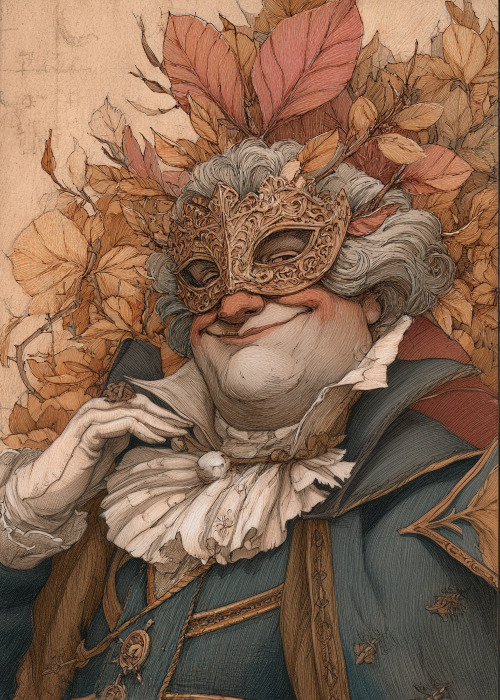
Prince Prospero of Oernonia is a man of profound intellect and monstrous vanity, a master of both mortal magic and moral decay. Lauded as one of the greatest minds of the Oleander Throne, Prospero’s brilliance curdled into arrogance, and his rule into self-worship. He drapes himself in the regalia of nobility he was never granted—robes embroidered with sunbursts of gold thread and rings heavy with arcane sigils of protection. To his people, he was a Governor appointed by imperial decree; to himself, he is Prince Prospero, sovereign of Oernonia and the keeper of life against the creeping hand of death. His vanity knows no bounds, for he sees in his reflection the embodiment of civilization—refined, unyielding, and superior to the natural decay that claims the unworthy.
When the plague came to Oernonia, Prospero’s devotion to self-preservation eclipsed all other duties. The sick cried out in the streets as the fields blackened and the harvest rotted, but their governor retreated into his manor, sealing its gates and leaving the province to fester. Within the candlelit halls of his great estate, Prospero turned to his arcane experiments, seeking to master disease rather than cure it. He delved into forbidden texts and summoned Tallowmirth, the Earl of the Afterfeast. From the ArchFey scavenger lord, Prospero learned how to transmute death into utility—how the discarded could serve the living. He managed to trade for stolen bark from the Eldest Oak, splinters of wood steeped in the essence of decay itself.
With these grim gifts, Prospero forged his masterpiece: the Great Clock, a titanic mechanism whose ceaseless ticking wove wards around his estate, sealing it from pestilence and from the touch of the Court of Blight and Court of Carrion and Decomposition. Its gears were made from cold-wrought iron, and its rhythmic motion were fueled by the magic and power of Tallowmirth who was vivisected and undying body used to operate the clock. Yet the Clock’s protection came at a cost. Outside the manor, the plague worsened and within the manor, it was further fueled by striking those who heard its monstrous chimes with a disease of a grotesque dance—a sickness that drove its victims to convulsive revelry until they perished mid-step. The suffering of his people fed the Clock’s unholy rhythm, and Prospero, safe within his walls, called it balance.
Believing himself victorious over death, Prospero transformed his sanctuary into a carnival of denial—a Masquerade of Unending Splendor, where time itself was an eternal celebration. His courtiers, scholars, and sycophants donned masks of gold and ivory, feasting and dancing beneath chandeliers of bone. Every hour marked by the Clock was greeted with laughter and music, drowning out the distant wails beyond the walls. The air was thick with perfume and rot, for even as decay was kept at bay, it could not be forgotten—it was the price of their eternal revel. In this grotesque parody of life, Prospero mocked mortality itself, declaring that so long as the Clock ticked, death would never claim him.
Though the manor warded the entrance of members of the Court of Blight and the Court of Carrion and Decomposition, the court conspired to draw other courts and their champions to Prospero's unending revelry. It was there that the party encountered Prospero. Though his magic as an archmage protected him from their direct assault, they managed to stop the Great Clock, lowering the wards and Gossamer of the Court of Blight entered with the pestilence that overran the land outside and Prospero was consumed by it and perished.
Current Location
Species
Ethnicity
Circumstances of Death
Plague
Children
Pronouns
He/Him
Gender
Male
Presentation
Masculine
Eyes
Blue
Hair
Gray
Skin Tone/Pigmentation
White, ruddy
Belief/Deity
All-Father